You're probably seeing a version of this already. Rankings for your core terms haven't moved much. Technical SEO is under control. Branded traffic looks stable enough. But non-brand clicks soften, fewer visits turn into qualified sessions, and your team can't explain why without guessing.
That's the gap most old SEO reporting misses.
Search behavior now runs through traditional results, AI summaries, chat interfaces, social discovery, retail search, and platform-native recommendation systems. If your dashboard only reports positions and clicks, it's measuring a shrinking slice of how people discover brands. That's why the useful question isn't just what is search intelligence. It's why your current reporting model can't see enough of the search surface anymore.
Your SEO Reports Are Lying to You
A lot of teams still trust rank tracking because it used to be a decent proxy for visibility. If you ranked well, you were likely to earn attention. That logic breaks when the search experience starts answering the question before the click, summarizing multiple sources, or routing discovery through interfaces your SEO stack never monitored.
That's already happening. AI summaries appear in 50% of Google searches today, yet only 16% of brands systematically track AI search performance, according to McKinsey's analysis of AI search behavior. So a lot of marketing teams are still reporting “good SEO health” while missing where visibility is being won or lost.
The result is a reporting illusion. Your rankings might hold. Your visibility might not.
What the dashboard misses
Traditional SEO reports usually center on a familiar set of metrics:
- Keyword positions: Useful for classic SERPs, but weak when users get their answer from an AI layer.
- Organic clicks: Helpful after demand is captured, but blind to answer-level exposure without a click.
- Landing page traffic: Good for site performance, not for how your brand is described elsewhere.
- Technical health: Necessary, but not enough when brand interpretation becomes part of discovery.
Practical rule: If a report can't tell you whether your brand is present, cited, and accurately represented in AI-generated answers, it's incomplete.
That's where search intelligence becomes operational, not theoretical. It's the discipline of systematically collecting, analyzing, and interpreting search behavior across engines, social platforms, and retail environments so teams can manage visibility, reputation, and growth in a multi-surface search environment.
Old SEO playbooks also break down when different teams define success differently. Content looks at rankings. Brand looks at sentiment. Product watches in-app discovery. Leadership wants one story. If that sounds familiar, this guide on implementing trusted metrics governance is worth reading because the problem isn't only missing data. It's inconsistent definitions.
For teams trying to reconcile stable rankings with weaker business outcomes, a more modern reporting model starts with branded SEO reporting that separates classic search performance from AI-driven brand visibility. Until you make that distinction, your reports will keep telling a partial truth.
Search Intelligence vs SEO and Analytics
Think of SEO as a road map. It shows where you want to go and which routes matter. Search intelligence is closer to a live control center. It layers in traffic, weather, detours, crowd behavior, and route changes as they happen, then helps you decide what to do next.
That difference matters because a lot of teams use the term loosely. Search intelligence isn't just a nicer label for keyword tracking, and it isn't the same as web analytics with a search tab added.
According to Cision's definition of search intelligence, search intelligence evolved from standard search data analytics by moving beyond keyword matching and using AI and machine learning to infer user goals, while creating a unified index that ranks results regardless of source. That shift marks the line in the sand.
The simplest way to define it
SEO asks, “How do we improve visibility in search results?”
Search analytics asks, “What happened in search performance?”
Intent data asks, “What signals suggest a buyer may be in market?”
Search intelligence asks, “How is our brand being discovered, interpreted, cited, and compared across the full search ecosystem, and what action should we take?”
That last part changes the scope. It includes classic rankings, but it also includes AI assistants, answer engines, social search, and machine-readable brand representation.
Search Intelligence vs Related Concepts
| Discipline | Primary Goal | Key Metrics | Scope |
|---|---|---|---|
| Search Intelligence | Understand and improve visibility, interpretation, and authority across search environments | Multi-platform visibility, citation presence, answer attribution, brand representation, trend and gap analysis | Traditional search, AI assistants, social discovery, retail and data platforms |
| SEO | Improve discoverability and traffic from search engines | Rankings, clicks, impressions, indexation, backlinks, technical health | Primarily search engine results pages and on-site performance |
| Search Analytics | Measure and explain search performance | Queries, click-through patterns, landing page behavior, demand shifts | Historical performance reporting within search channels |
| Intent Data | Detect likely commercial interest | Topic engagement, research signals, account-level interest patterns | Buyer research and sales prioritization, often beyond public search surfaces |
A lot of confusion comes from tool overlap. One platform may track rankings, another may pull query data, and a third may monitor mentions in AI interfaces. That doesn't mean they all deliver search intelligence. The differentiator is whether the system produces a unified view of visibility and interpretation across surfaces.
Where older SEO workflows fall short
Traditional SEO workflows still matter. Crawlability, content quality, internal links, and authority signals aren't going away. But on their own, they're not enough because they don't answer newer questions:
- Answer inclusion: Is your brand present in the response, not just the results page?
- Source dependency: Which domains or references are shaping the answer?
- Meaning alignment: Is the system describing your company the way you intend?
- Cross-platform drift: Are social, search, and AI interfaces telling the same story?
SEO tells you whether you showed up. Search intelligence tells you what the system thinks you are.
If you want a broader look at how this sits inside modern growth operations, this overview of search marketing intelligence is a useful companion because it connects search data to business decisions instead of treating reporting as an end state.
The Four Pillars of Search Intelligence
Modern search intelligence works because it combines retrieval, interpretation, and monitoring. It doesn't stop at matching a keyword to a page. It tries to understand how platforms connect entities, context, and user intent.
Moveworks' explanation of intelligent search captures the underlying shift well. Modern systems use NLP to handle colloquialisms, machine learning to improve from interactions, and semantic analysis to understand concept relationships even without exact term matches.
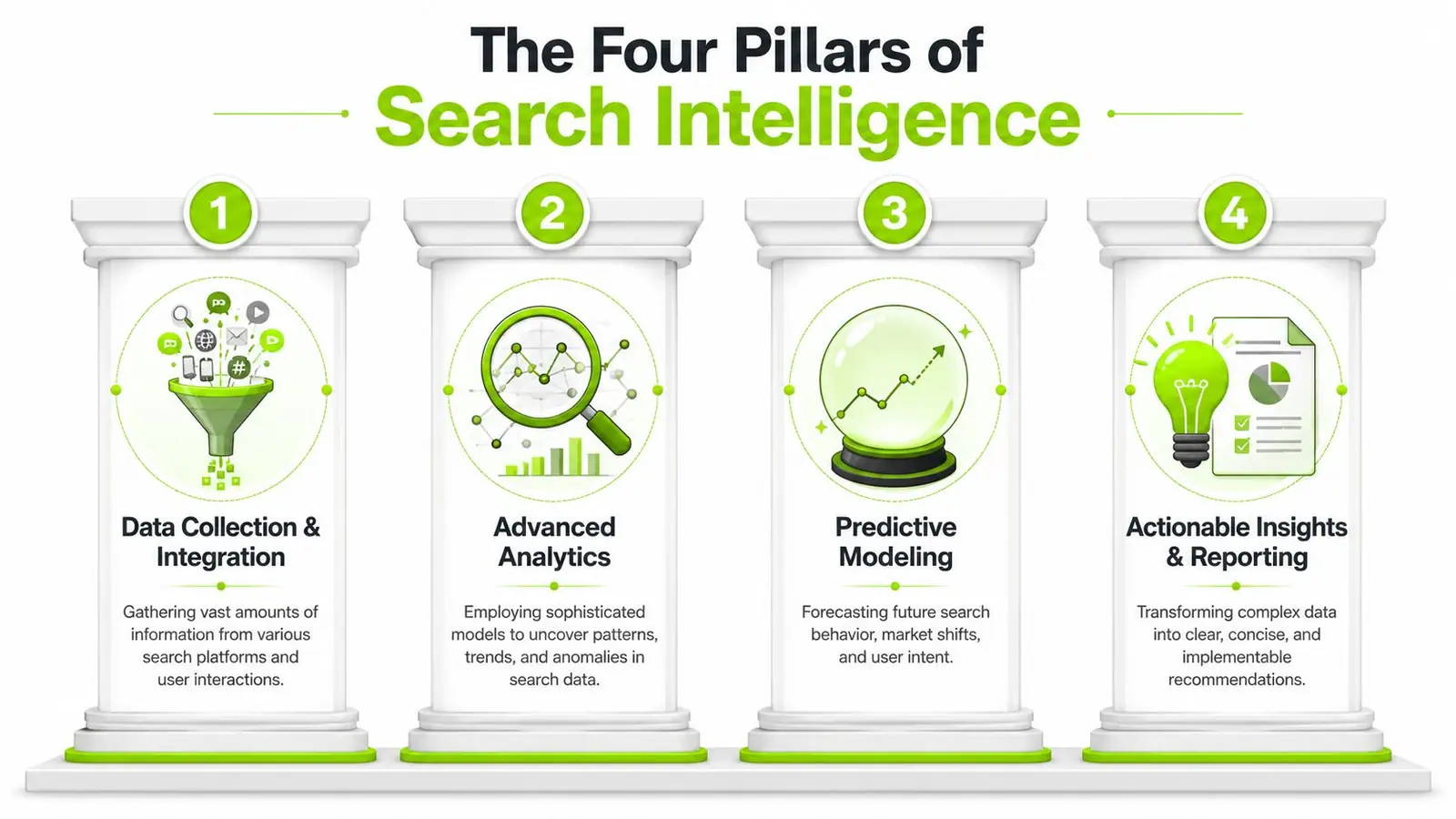
That foundation shows up in four practical pillars.
AI visibility and benchmarking
The first job is straightforward. You need to know whether your brand appears in AI-driven search experiences at all.
That includes AI Overviews, chatbot answers, assistant responses, and other generative discovery layers. The practical challenge isn't just “are we visible.” It's “for which prompts, in what contexts, next to which competitors, and with what framing.”
A good benchmark should compare:
- Brand presence: Whether the brand appears at all in answer sets
- Competitive overlap: Which rivals appear more consistently in the same prompts
- Context quality: Whether visibility happens in favorable, neutral, or distorted contexts
Many teams still operate blind. They may know they rank for a query, but they don't know whether the AI answer names them, cites them, or skips them entirely.
Unified rank tracking
Rank tracking still has a place. It just needs a wider definition.
The old version measures a keyword and a position in a classic SERP. The newer version needs to combine classic rankings with AI-layer presence so teams can see where stable SEO masks lost answer-level visibility. A unified model also helps explain channel confusion internally. Sometimes content is still performing, but the user never reaches it because the discovery layer resolves the query before the click.
This is where cross-surface comparison matters most. When one dashboard reports “position held” and another team says “traffic fell,” the issue often isn't contradictory data. It's fragmented reporting.
For teams that want to operationalize that view, a competitor benchmarking tool becomes useful when it measures presence across both classic and AI-led search experiences instead of comparing only old-style rankings.
Citation and source analysis
AI-generated answers don't appear from nowhere. They are shaped by source material, entity associations, platform context, and retrieval choices.
That creates a new layer of diagnosis. If your brand is absent, weakly represented, or mischaracterized, the fix isn't always “publish more content.” Sometimes the issue is that your authority signals are scattered, outdated, or less accessible than competitor references.
A practical citation review asks:
- Which sources are repeatedly used
- Whether your owned properties appear among them
- Where third-party descriptions of your brand conflict with your intended positioning
- Which gaps can be corrected through content, PR, structured information, or platform cleanup
If you don't know what an AI system is drawing from, you're guessing at the remedy.
LLM performance monitoring
Different models don't interpret brands the same way. They draw from different mixtures of training priors, retrieval systems, web access patterns, and platform-specific behaviors.
That means one model may describe your company accurately while another compresses it into an outdated category or attributes your strengths to a competitor. Monitoring LLM performance helps teams catch that drift early.
This matters for more than brand marketing. Product teams building assistants, support search, recommendation systems, or internal retrieval tools also need to know how machine-readable brand meaning is being resolved. Search intelligence becomes part of quality control.
Search Intelligence in Action for Agencies and Product Teams
The easiest way to understand search intelligence is to watch what happens when teams don't have it.
An agency gets pulled into a tense monthly review. The client sees weaker search traffic and asks a fair question: if rankings are steady, why are leads softer? The agency can show positions, impressions, and site health, but none of that explains whether the client disappeared from AI-generated answers that now sit between the query and the click.
This is the point where standard reporting stops being persuasive.
Agency workflow under the new reality
The agency's first job isn't to defend SEO. It's to diagnose the visibility gap.
That usually means checking whether the client appears inside AI answers for high-intent prompts, comparing competitor inclusion, and reviewing which sources seem to shape those responses. If the client ranks but isn't cited, the agency has a different problem than a standard ranking drop. The strategy shifts from “improve positions” to “improve answer eligibility and source authority.”
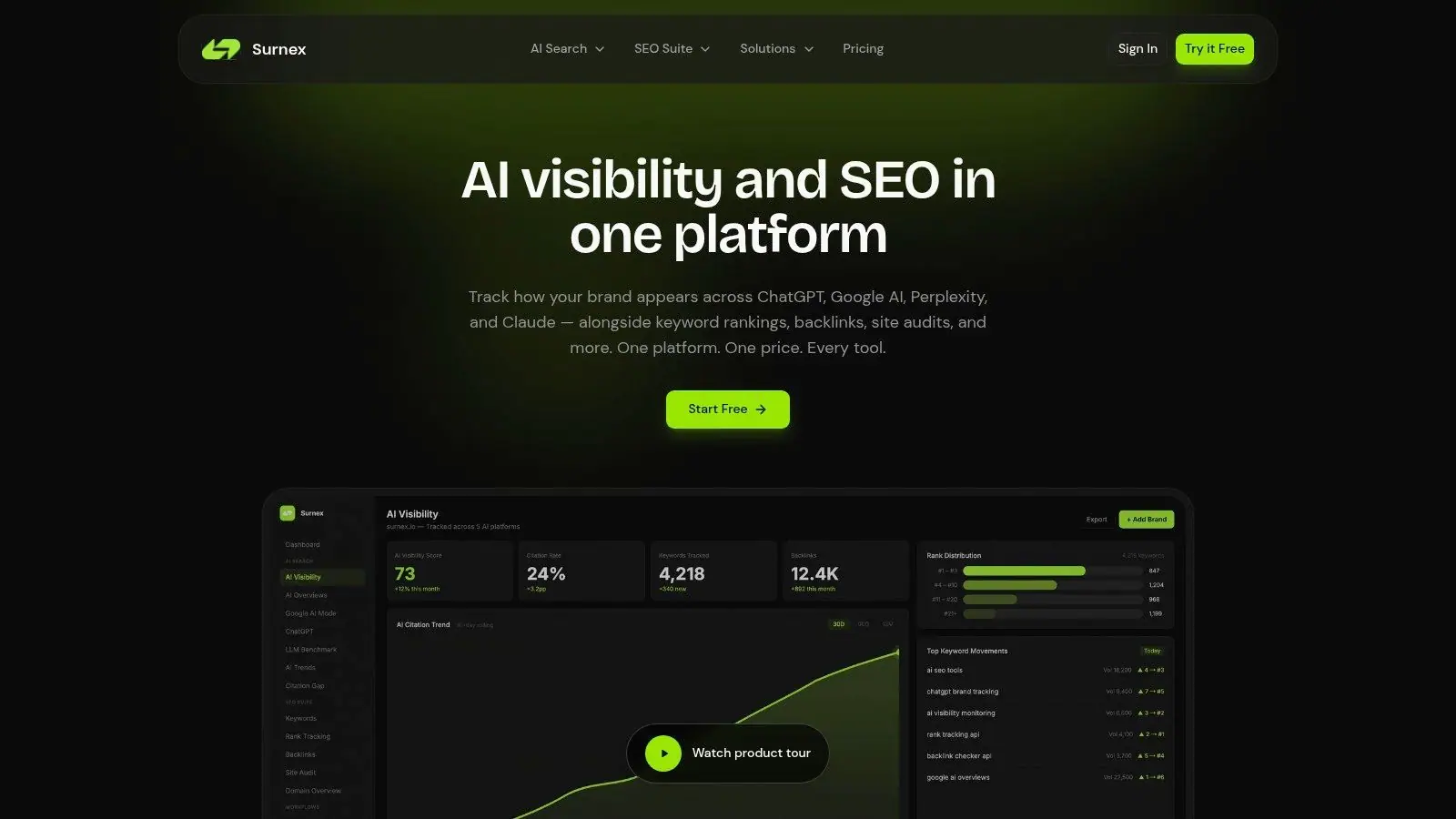
In practice, teams need a system that can pull classic SEO metrics together with AI visibility signals. Surnex is one example of a platform built for that type of workflow. It combines AI visibility tracking with rankings, backlinks, audits, and related reporting so agencies can investigate why search performance changed without hopping between disconnected tools.
A smarter client conversation sounds different:
- Old explanation: Rankings are stable, so the issue may be seasonality or conversion rate.
- Better explanation: Rankings are stable, but competitor citations increased in AI-led discovery and your brand appears less often in answer surfaces for commercial prompts.
That second version gives the client something useful to act on.
The strongest agencies now report on lost visibility before the client notices lost clicks.
Product teams have a different version of the same problem
An in-house product team building an AI assistant faces a related challenge. Their concern isn't just outbound search performance. It's whether their own assistant, internal search layer, or customer-facing AI feature understands brands accurately and consistently.
If the assistant summarizes vendors, surfaces products, or answers category questions, the product team needs to benchmark output quality. Does the system represent the company correctly? Does it over-index on outdated public descriptions? Does it omit differentiators because source material is weak or fragmented?
Those aren't brand vanity issues. They're product quality issues.
A solid review process usually includes prompt sets, response comparison across models, and source tracing where possible. Product, SEO, content, and brand teams often need to work together here because the fix may involve knowledge design as much as content strategy.
A short demo helps make that operational shift easier to see:
What works and what doesn't
What works is surprisingly consistent:
- Cross-functional review: Product, SEO, and brand teams look at the same outputs.
- Prompt-based benchmarking: Teams test real discovery questions, not abstract keyword lists.
- Source gap analysis: They identify missing, weak, or conflicting authority signals.
What doesn't work is trying to force AI-era visibility questions into an SEO report built for a ten-blue-links world.
Implementing a Search Intelligence Strategy
Many teams don't need another dashboard. They need a different operating model.
The old model treats search as a channel measured by rankings and traffic. The newer model treats search as a distributed discovery system where visibility, citation, and interpretation matter together. That requires different metrics, different owners, and tighter reporting discipline.
Younis Group's search intelligence methodology describes the value well. Search intelligence provides quantitative multi-platform visibility metrics across search, AI assistants, and social media, and it helps teams identify trends and citation gaps that older methods often miss.
Start with the right metrics
If your KPI set is still dominated by rank, sessions, and click-through rate, you're under-measuring the current search environment.
A practical scorecard should add metrics like these:
- AI share of presence: How often your brand appears in relevant AI-generated answers
- Citation accuracy: Whether the supporting references reflect current, correct brand information
- Answer sentiment and framing: Whether your brand is presented favorably, neutrally, or with distortions
- Cross-platform consistency: Whether search engines, chat interfaces, and community platforms tell the same brand story
- Competitive answer overlap: Which competitors are repeatedly included where you are not
None of these replaces SEO KPIs. They sit alongside them and explain changes that traffic data alone can't.
A phased rollout works better than a platform swap
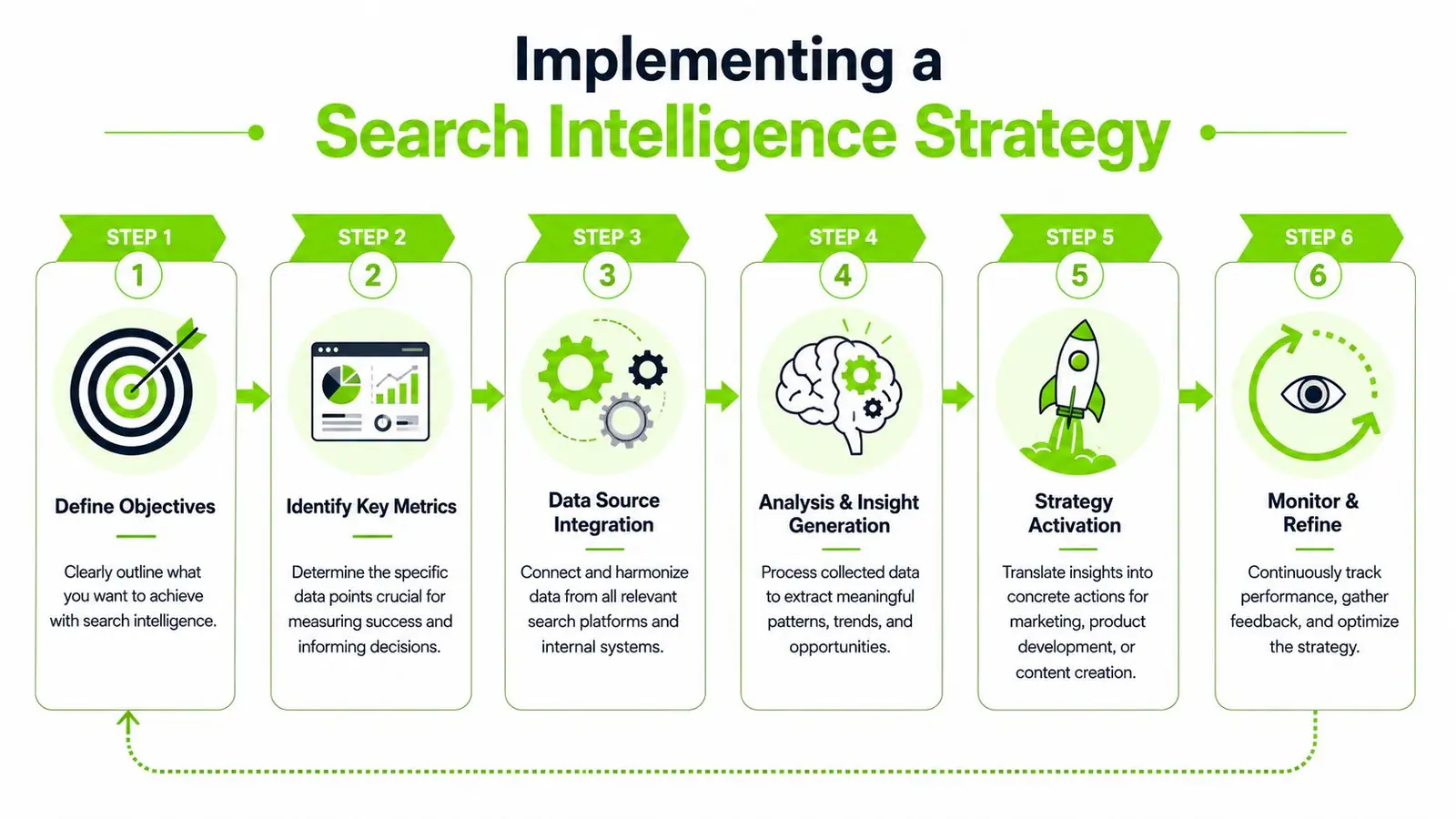
Teams often make the process harder than it needs to be. You don't have to rebuild the entire reporting stack at once. A phased rollout usually works better.
-
Audit the visibility gap Review your highest-value prompts and categories. Compare where your site ranks versus where your brand is mentioned, cited, or summarized across AI-led surfaces.
-
Choose unified measurement Look for a setup that can connect classic search metrics with newer AI visibility signals. Fragmented point tools create more interpretation work than is typically anticipated.
-
Set benchmarks by entity, not just keyword
Track your brand, products, people, and core claims. AI systems often resolve entities and relationships before they resolve pages. -
Change reporting language
Replace “we rank” with “we're visible and correctly represented” where appropriate. Executives understand that distinction faster than practitioners sometimes expect.
Build a workflow people will actually use
This only sticks if reporting becomes easier to act on.
A workable operating rhythm usually looks like this:
- Weekly checks: Review major visibility shifts, citation changes, and answer anomalies
- Monthly analysis: Compare competitor patterns and identify repeat source dependencies
- Quarterly updates: Revisit benchmark prompts, brand entities, and reporting definitions
Teams also need a clean way to separate noise from signal. Trend analysis helps, but only if everyone agrees on what counts as movement worth reacting to. This article on Bulby's approach to data trends is useful for that reason. It's a practical reminder that tracking trends is less about collecting more charts and more about interpreting patterns consistently.
Don't launch a search intelligence program by monitoring everything. Start with the prompts and entities that influence revenue, brand trust, or product adoption.
The companies that do this well don't abandon SEO. They stop treating SEO as the full map.
The Next Frontier of Search and Discovery
A lot of search strategy still assumes Google is the center and everything else is peripheral. That assumption is getting weaker.
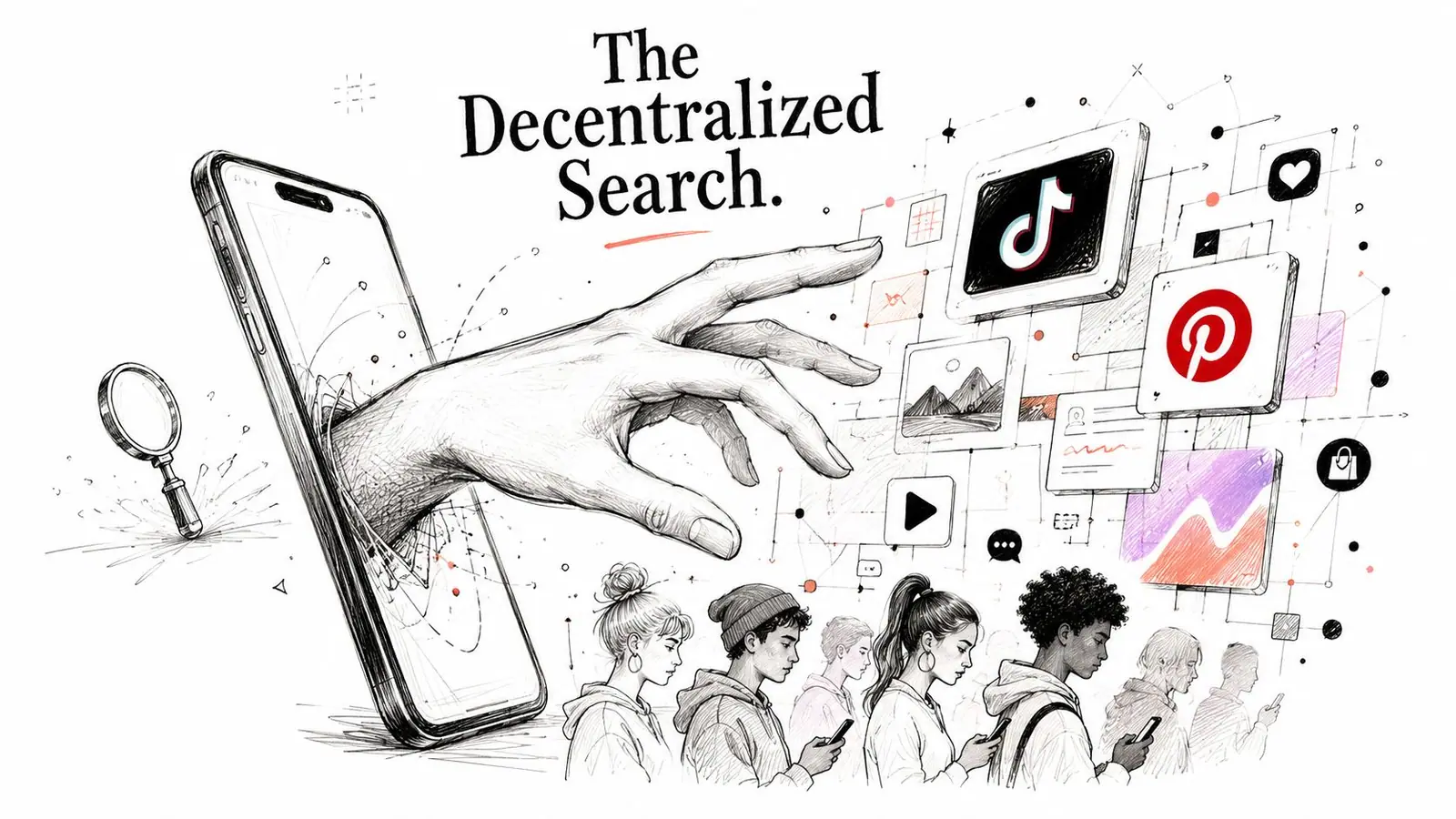
According to DMEXCO's review of emerging search behavior, 40% of Gen Z start information searches on TikTok, and Reddit Answers provides AI summaries from more than 100,000 communities. That's not a side trend. It's a different discovery model.
Search is becoming distributed
Users now bounce between search engines, chatbots, forums, social feeds, and community answer layers depending on the task. Product discovery, software evaluation, local recommendations, and troubleshooting each happen in different interfaces.
That means brand visibility is becoming less centralized and more contextual. A brand may be strong in classic search but weak in Reddit discussions. It may appear in TikTok-driven discovery but be poorly represented in chatbot summaries. It may own category language on-site while losing narrative control in third-party communities.
The discipline has to evolve with that reality.
What this changes for marketers and product teams
Search intelligence becomes more valuable as search fragments. Teams need to monitor not only whether they appear, but how they appear across environments that are conversational, social, and community-shaped.
That's especially important for product leaders working on AI interfaces, recommendation systems, and search-driven user experiences. For teams in that position, this practical guide for AI product leaders is useful because it helps frame AI work as an operational discipline, not just a feature trend.
There's also a direct connection to generative search itself. If you're still treating AI answers as a minor extension of SEO, it's worth reviewing how search generative experience changes visibility.
Brands won't win the next phase of search by ranking well in one place. They'll win by being understood correctly across many places.
The teams that adapt early will build stronger systems for measurement, clearer brand representation, and better collaboration between SEO, content, product, and analytics. Everyone else will keep wondering why rankings look fine while discovery gets harder.
If your team needs a clearer view of how brand visibility is shifting across AI search and traditional SEO, Surnex is built for that job. It helps agencies, in-house teams, and developers monitor AI-driven discovery alongside core SEO metrics so reporting reflects how search works now.