84% of Google search queries are affected by Google’s generative search experience, according to Uncommon Logic’s SGE statistics roundup. That single number changes the conversation. “What is search generative experience” isn’t a curiosity anymore. It’s a reporting problem, a visibility problem, and for many teams, a budgeting problem.
The old search model was simple to explain. Rank well, earn the click, measure traffic, repeat. Google’s Search Generative Experience, now surfaced as AI Overviews, interrupts that loop. The search results page is no longer just a menu of links. It’s becoming an answer layer that summarizes, cites, and sometimes satisfies the query before a user ever reaches your site.
That doesn’t mean SEO is dead. It means the target moved. You’re no longer optimizing only for rank position. You’re optimizing for inclusion, extraction, citation, and trust inside an AI-generated response. If your reporting still stops at “we moved from position 5 to position 3,” you’re missing the part executives will ask about next.
The New Face of Google Search
Google search doesn’t look the same because the user’s job has changed. Instead of comparing links and stitching together an answer, the user increasingly gets a synthesized summary first. That shift matters because it changes what counts as visibility.
When people ask what is search generative experience, the simplest answer is this: it’s Google using large language models to generate an overview at the top of search results, often with cited sources and follow-up prompts. The practical answer is more useful. SGE moved search from retrieval toward interpretation.
Search has become an answer engine
Traditional search asked users to evaluate options. AI Overviews reduce that work. Google surfaces a summary, suggests follow-up questions, and keeps the session inside the result page longer.
For marketers, that creates a new reality:
- Visibility starts above the classic organic listings: If the overview appears, it often becomes the first thing users read.
- Traffic patterns get less linear: A page can rank well and still lose attention if it isn’t represented in the AI response.
- Stakeholder expectations change: Leadership won’t be satisfied with rank reports alone once they see competitors named in AI summaries.
A useful way to frame it for teams is this: classic SEO fought for shelf space. AI search fights for inclusion in the recommendation.
Why this matters right now
Google first tested SGE in Search Labs and later expanded the experience into AI Overviews. That progression turned an experiment into operating reality for search teams. If you need a current view of where Google is heading, Surnex tracks related changes around Google AI Mode visibility.
Practical rule: If your team only measures blue-link rankings, you’re reporting on yesterday’s interface.
The biggest strategic mistake is treating AI Overviews as a cosmetic SERP feature. They change discovery, attribution, and the path to the click. Once that clicks internally, the next question becomes more important than the definition: how does the system decide what to cite?
How Search Generative Experience Actually Works
Think of SGE like a very fast research assistant. You give it a question. It searches for relevant material, pulls the most useful passages, and drafts a combined answer. Then it shows some of the sources it relied on.
That’s close to how the system works, but the technical term matters because it has direct SEO implications.
RAG is the core idea
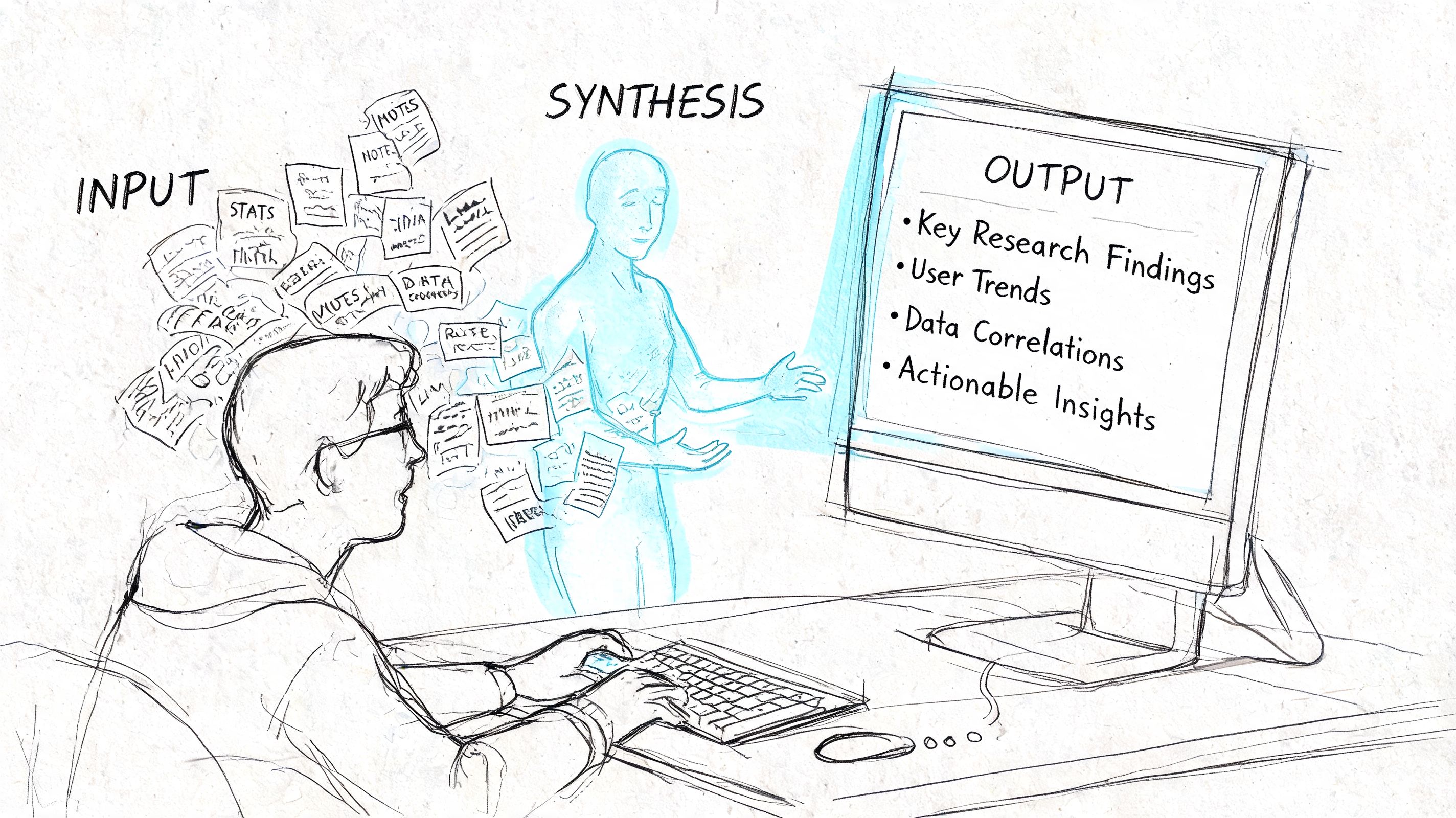
Search Generative Experience uses Retrieval-Augmented Generation, or RAG. Search Engine Land explains that SGE uses a RAG architecture combining language models like PaLM 2 with Google Search as the retriever. The system identifies full documents, extracts relevant passages, and uses those passages during prediction to generate a response.
That detail matters because Google isn’t just “reading your page.” It is selecting pieces of information it can confidently use.
What the machine is really looking for
A page doesn’t become useful to AI Overviews just because it ranks. It becomes useful when Google can easily extract a clear answer from it. In practice, that usually means:
- The page answers a specific question clearly
- The answer sits under a descriptive heading
- Supporting detail is nearby, not buried
- The page is crawlable and indexable
- The wording is precise enough to quote or paraphrase
That’s why messy pages often underperform in AI search. A human can tolerate a wandering article. A retrieval system prefers obvious structure.
Why format and semantics matter
Content teams often overfocus on word count and underfocus on extractability. A stronger mental model is to ask, “If Google needed one short passage from this page, which passage would it trust?”
Useful patterns include:
- Question-led subheads: These map closely to natural-language queries.
- Tight definition blocks: Good for direct answer extraction.
- Short comparison tables: Helpful when users search for differences.
- Clean entity references: Brand names, products, and concepts should be unambiguous.
Teams building AI products internally can learn a lot from work on powering LLMs with web context, because it highlights the same core truth: language models are much more useful when retrieval is grounded in relevant source material.
The best AI-visible page often isn’t the longest page. It’s the page that makes the answer easy to lift without losing meaning.
If you’re benchmarking how your brand appears across different models, a tool like LLM benchmark tracking becomes useful. The technical behavior behind retrieval creates very different visibility outcomes from one AI surface to another.
SGE vs Traditional Search A Clear Comparison
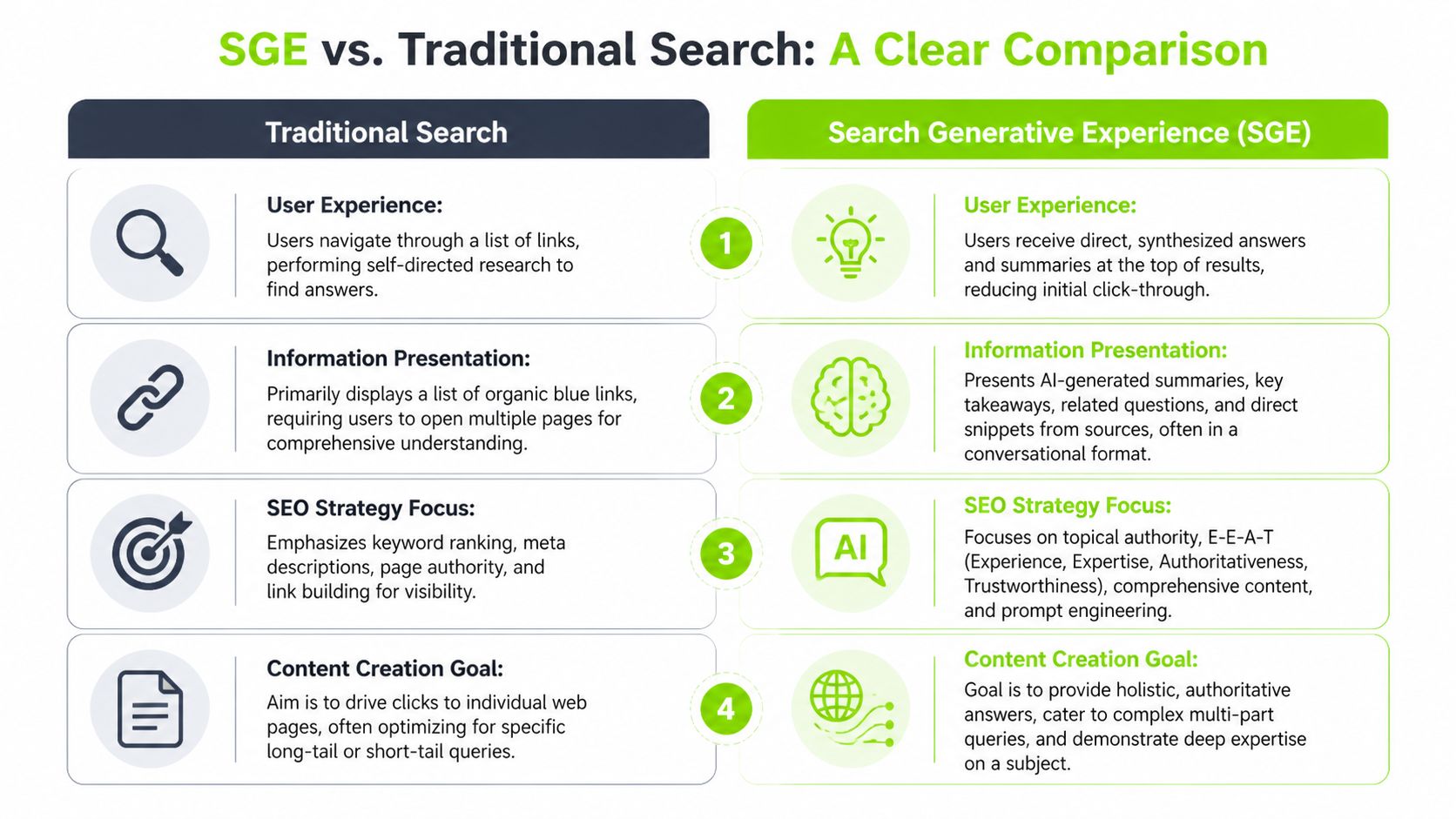
The easiest way to explain the shift internally is side by side. Traditional search presents options. SGE presents a synthesized answer first, then offers sources and follow-up exploration.
AI Overviews vs Traditional SERPs
| Attribute | Traditional Search (SERP) | Search Generative Experience (AI Overview) |
|---|---|---|
| Primary user action | Compare links and choose a result | Read a synthesized answer first |
| Source presentation | Individual listings | Summary with citations |
| SEO win condition | Rank higher than competitors | Get cited inside the answer |
| Measurement focus | Rankings, CTR, sessions | Citation presence, assisted clicks, answer visibility |
| Content preference | Relevance to a keyword | Relevance plus extractable, quotable passages |
| User journey | Click first, evaluate later | Evaluate first, click if needed |
Why the click model changed
A May 2024 Semrush study, cited by Brindle Digital, found a 34.5% drop in average clicks for queries that trigger AI Overviews, while sources cited in those Overviews received 12 to 15% more clicks than non-cited positions. That is the clearest short version of the new search economy. Fewer generic clicks. Better odds for the pages that make it into the answer.
This is why “zero-click search” needs a more careful explanation now. Yes, some users get what they need without visiting any site. But for the sources that earn citation, the click can be more intentional because the user has already seen your page framed as relevant.
What to tell clients and stakeholders
Most clients still understand rankings faster than citations. The reporting bridge is simple:
- Ranking is still an input: It helps Google find and evaluate your content.
- Citation is the new visibility layer: It determines whether your brand appears inside the answer itself.
- Clicks become less evenly distributed: AI Overviews concentrate attention on fewer cited sources.
Client-ready summary: We’re no longer competing only to be chosen from a list. We’re competing to be included in the answer users see before they choose.
That distinction helps marketing teams stop asking the wrong question. The question isn’t “Did we rank?” The better question is “Did Google use us?”
The Real SEO Impacts of AI Overviews
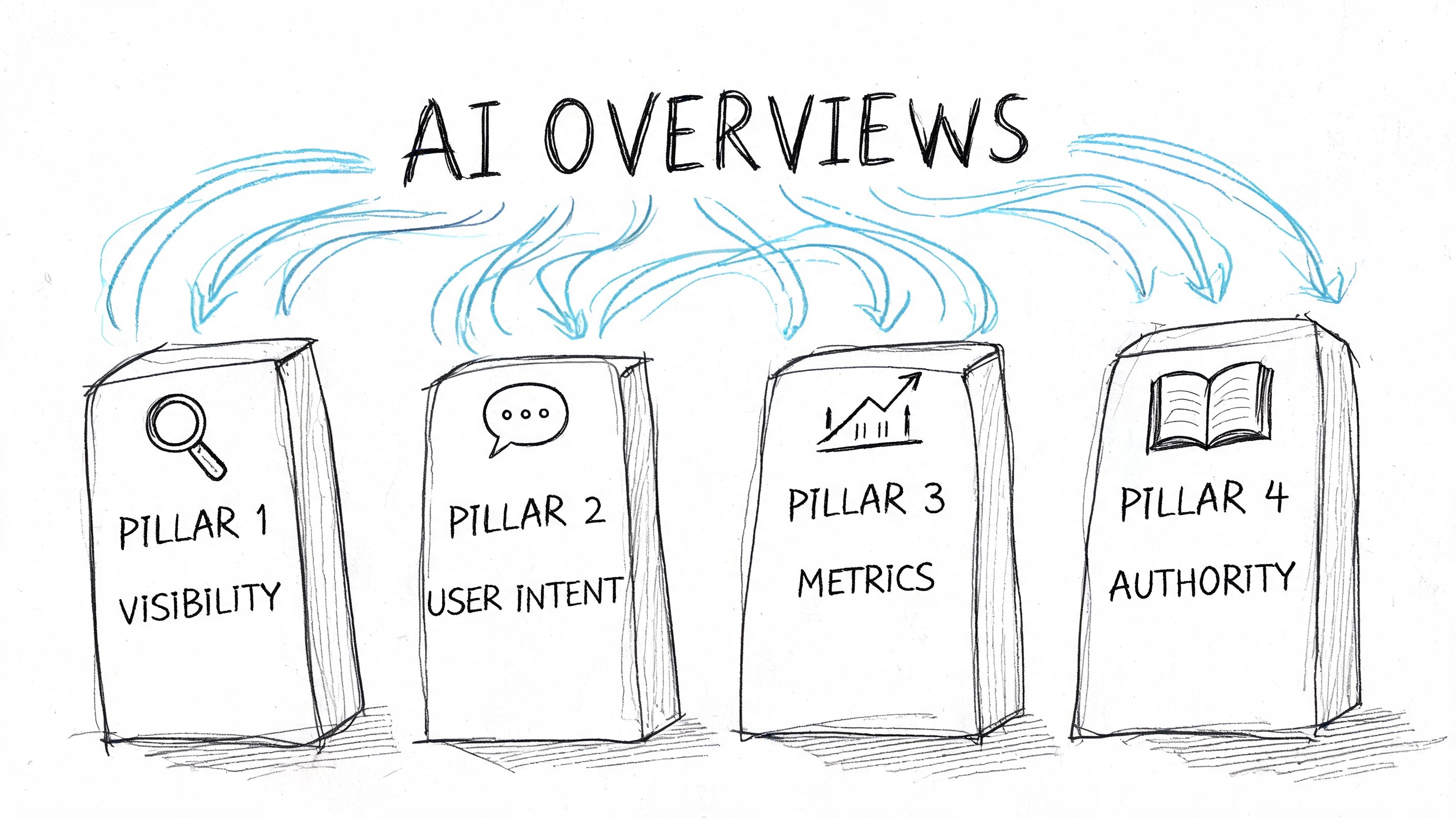
The biggest SEO change isn’t that Google added AI. It’s that the most valuable real estate on the page can now be a generated summary that sits above the old organic hierarchy. That creates four practical impacts for teams responsible for visibility.
Rank alone doesn’t guarantee presence
A page can still hold a strong organic position and fail to appear in the overview. That’s the first uncomfortable change many teams run into. Traditional rank tracking may say you’re winning while the visible interface says otherwise.
This situation makes reporting messy. Your page may technically perform, but if a competitor is cited in the AI box and you aren’t, the user’s perception of authority shifts before the organic listings even begin.
The hidden page zero is now strategic territory
For years, SEOs talked about position zero as featured snippets. AI Overviews are broader and more disruptive because they synthesize from multiple sources. They also reduce the need for the user to inspect several pages.
That creates a new top-of-page battleground:
- Brand recall starts earlier: Users see cited names inside the overview.
- Authority gets inferred instantly: Inclusion feels like endorsement.
- Organic listings do less explanatory work: They often serve as validation or deeper reading, not the first answer.
If your team wants to diagnose where competitors are appearing and you’re missing, a citation gap workflow is more useful than rank deltas alone.
Product search is now a data problem too
For ecommerce teams, AI visibility is not just a content problem. It’s also a feed quality and freshness problem. WordStream notes that Google’s Shopping Graph in SGE contains 35+ billion product listings with 1.8 billion hourly refreshes. That means stale price, inventory, or product attributes can hurt visibility quickly.
Here’s the operational takeaway:
- Structured data has to be accurate
- Merchant feeds need tight synchronization
- Review and product metadata matter more when Google composes its own product snapshot
That’s a shift from link-based competition toward entity and data consistency.
Quotable content beats vague content
One pattern shows up repeatedly in AI-visible pages. They contain passages that can stand on their own. The writing is specific, well-labeled, and easy to lift into a summary.
A good page often includes:
- a direct answer near the top
- a short explanation under a useful subheading
- supporting detail in bullets, tables, or examples
- consistent terms for the same concept
This explainer gives a useful visual overview of that shift:
If a paragraph needs heavy interpretation before it becomes useful, AI systems are less likely to choose it.
The old SEO reflex was to ask, “How do we rank this page?” The newer question is, “Which passage on this page deserves to be quoted by a machine?”
How to Adapt Your SEO Strategy for SGE
Many teams don’t need a total reset. They need a sharper operating model. SGE rewards many of the same fundamentals as strong SEO, but it changes the priority order. Clarity, structure, authority, and entity consistency move up the list fast.
Start with query shapes, not just keywords
Keyword lists still matter, but they aren’t enough. AI Overviews are especially responsive to natural-language and multi-part queries. Your research process should look for the questions users ask before they know exactly what they want.
That changes content planning. Instead of building isolated pages around slight keyword variants, build assets that can answer a cluster of closely related questions in a coherent way. If you’re mapping those opportunities, a dedicated keyword research workflow helps surface longer, more conversational query patterns that fit AI search better.
Rework pages for extraction
This is usually the fastest win because you don’t need to publish everything from scratch. Many existing articles already have good information. They’re just hard for retrieval systems to use.
A practical rewrite pass usually includes:
- Stronger subheads: Make each one descriptive enough to signal the question being answered.
- Answer-first openings: Give the direct response before the nuance.
- Shorter blocks of text: Dense walls of prose are harder to extract cleanly.
- Lists and tables where appropriate: These reduce ambiguity.
Don’t confuse “AI-friendly” with robotic writing. The goal isn’t to write for a machine. The goal is to remove friction so both people and systems can identify the answer quickly.
Build topical authority by coverage, not volume
Thin publishing calendars break down in AI search. Five scattered posts on adjacent topics usually won’t signal as much authority as one tightly organized content hub supported by credible detail.
What works better:
-
Define a topic boundary clearly Pick the area where your brand can be the clearest, most reliable source.
-
Create a primary page that frames the topic This acts as the anchor asset.
-
Support it with specialized pages Comparisons, process guides, definitions, and use-case content all help.
-
Keep terminology consistent If your site uses three names for the same thing, retrieval gets harder.
Working rule: AI visibility often improves when your site sounds like one expert voice, not five disconnected articles.
Treat AI search as an ecosystem
One mistake I keep seeing is treating Google as the whole game. It isn’t. Buyers also discover brands through ChatGPT, Perplexity, and other assistant-style interfaces. A page that’s visible in one environment may disappear in another because retrieval methods and citation patterns differ.
That means your strategy should include:
- Platform-specific testing: Search your brand and category prompts in multiple AI tools.
- Entity consistency: Brand descriptions, product names, and core claims should align across the web.
- Source readiness: Public pages should be easy to cite and understand without surrounding context.
The teams that adapt fastest usually stop asking for a universal AI tactic. They ask a better question: where are we visible, where are we absent, and which content assets are creating that gap?
Measuring and Reporting in the SGE Era
Most SEO dashboards weren’t built for this shift. They measure rank, traffic, and backlinks well enough, but they don’t explain whether your brand appeared in AI-generated answers. That gap is why many teams feel performance became harder to defend even when core SEO work remained solid.
New KPIs worth tracking
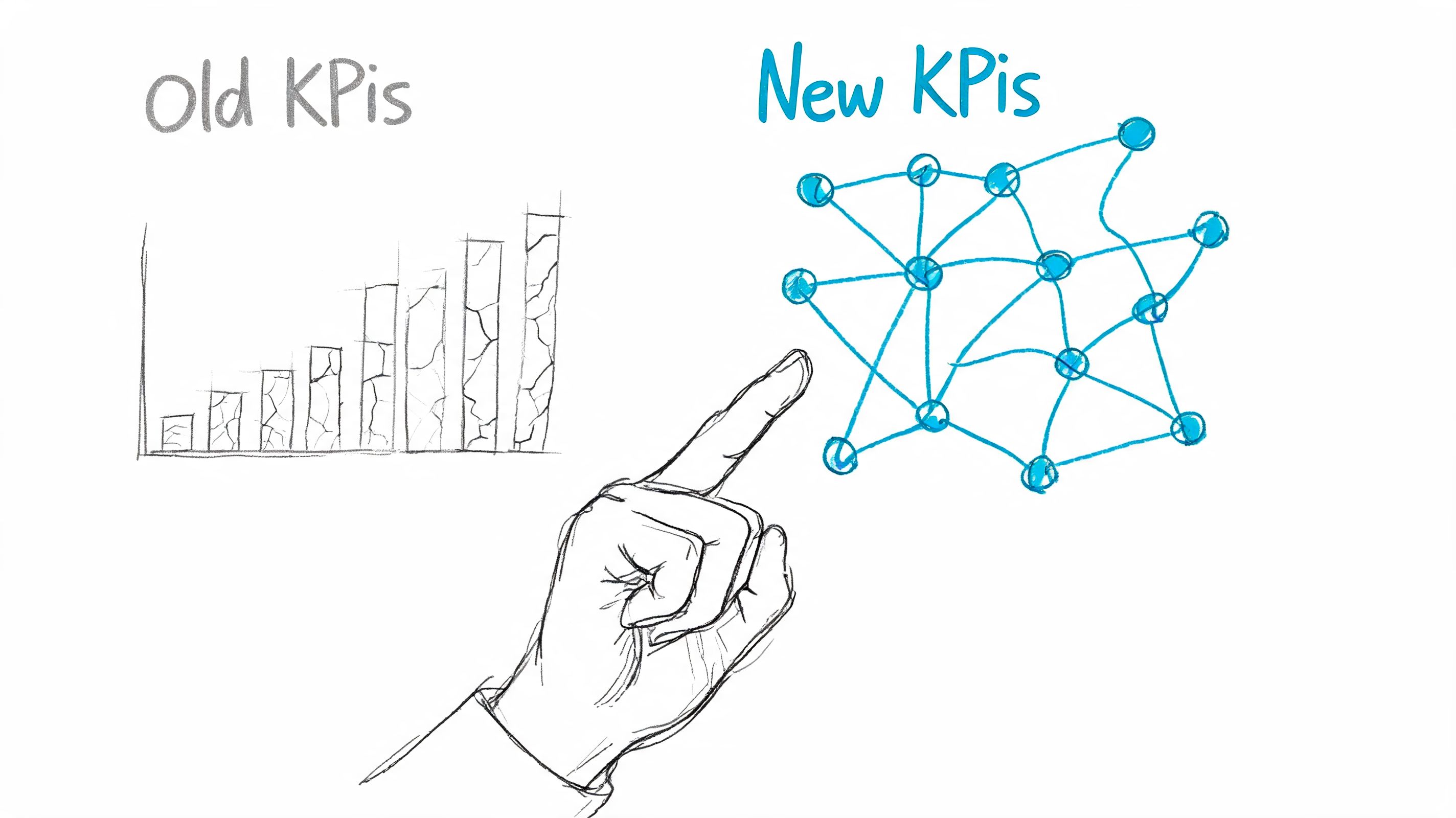
Your reporting needs a layer above traditional SEO metrics. Useful categories include:
- AI visibility rate: How often your brand appears in AI-generated search results for target queries.
- Citation share of voice: How often you are cited compared with direct competitors.
- Citation gap: Which competitor domains appear in AI answers where your brand does not.
- AI-assisted click quality: The downstream behavior of users who arrive from AI-influenced queries.
- Cross-platform presence: Whether your brand shows up across more than one AI discovery surface.
Here’s the kind of interface teams now need to make that visible:
Citation silos are real
Coveo cites a 2025 analysis showing only 15% brand overlap in citations between Google AI Overviews and ChatGPT responses. That’s the cleanest evidence for what many practitioners already suspected: visibility does not transfer cleanly from one AI surface to another.
So reporting has to answer more than “How are we ranking on Google?” It has to answer:
- Where does the brand appear in Google AI Overviews?
- Where does it disappear in conversational AI?
- Which competitors are consistently cited instead?
- Which content assets are producing reusable citations?
If your team is evaluating platforms and workflows around this shift, AI Tools for Local SEO's guide is a helpful starting point for understanding the broader tool ecosystem.
One practical option in this category is Surnex, which combines AI visibility tracking with standard SEO reporting so teams can monitor AI appearances, citation gaps, rankings, and related trends in one place. That matters most for agencies and in-house teams trying to explain a mixed picture: traditional rankings may hold steady while AI citation share changes quickly.
The report your client wants now is not just “we improved rankings.” It’s “here’s where your brand is being named, cited, and ignored across the new search layer.”
Search is no longer just a list of links to rank in. It’s a set of AI-mediated discovery surfaces you need to measure directly. If you need a clearer view of how your brand appears across Google AI experiences and traditional search, Surnex gives teams one place to track visibility, citation gaps, and core SEO signals without splitting reporting across multiple tools.