You're probably looking at a keyword set that clearly scales and wondering whether your team should build pages one by one or turn the whole thing into a system.
That's the right question.
A lot of teams first reach for programmatic SEO when they realize manual production won't keep up with the market. A SaaS company wants pages for every integration pair. A marketplace wants pages for every category in every city. A services brand wants pages for every location and service combination. The pattern is obvious, but the execution can go very wrong if the pages exist only to capture search impressions.
The useful version of programmatic SEO isn't just “publish more pages.” It's building pages that deserve to exist even if search disappeared tomorrow. That standard matters more now because AI search systems don't just rank pages. They also summarize, merge, and compress them.
What Is Programmatic SEO and Why It Matters Now
A team spots thousands of low-volume queries that map cleanly to the business. Service plus city. Template plus use case. Integration plus platform. Writing those pages by hand does not scale, so the temptation is to automate everything and publish fast.
Programmatic SEO is the practice of generating many search pages from a shared template, a structured dataset, and clear page logic. The goal is not volume by itself. The goal is to create repeatable pages that answer repeatable search intents with enough original value to deserve indexing.
That distinction matters more than it used to.
AI search products now summarize results, combine near-duplicate pages, and answer simple query variants without sending the click. Pages that differ only by a swapped keyword are exposed quickly. I see this problem more often on pSEO projects built around production efficiency instead of user-first validation.
User-first validation means checking, before scale, whether each page type solves a real job for the visitor. Can the user complete a comparison, make a decision, find a provider, estimate cost, or take the next step from the page itself? If the answer is no, the template is not ready. If the answer is yes, programmatic SEO becomes a durable acquisition channel instead of a short-lived indexing experiment.
A bookkeeping company targeting multiple cities is a simple example. A weak system creates one page per city with the same copy and a place name swapped in. A better system adds local proof, service availability, pricing context, review signals, nearby office details, and city-specific FAQs. Both approaches create pages at scale. Only one creates pages with a reason to exist.
Teams usually adopt pSEO when they see a repeatable query pattern and already have structured information they can publish usefully. Common cases include:
- Location combinations: one service across many cities, regions, or neighborhoods
- Catalog pages: products, listings, tools, courses, templates, or databases with consistent attributes
- Comparison intent: one option versus another, often with structured differences users want quickly
- Integration ecosystems: software categories where each pairing needs setup details, use cases, and limitations
The operational side has also improved. Internal datasets are easier to clean, modern CMS setups can publish from structured fields, and teams can enrich pages with APIs instead of hand-writing every block. For workflows like that, an SEO data pipeline built on an SEO tool API can help teams validate opportunities before they commit engineering time.
The strategic risk has changed, though. Scale used to be the hard part. Now the harder problem is avoiding AI-native cannibalization, where dozens or hundreds of your own pages compete for the same summarized answer and none becomes the clear source. If templates produce pages that are interchangeable, search engines and AI systems have no strong reason to keep surfacing each one separately.
Strong programmatic SEO gives every page a distinct claim on relevance. It uses structured data, yes, but it also uses differentiated page inputs, intent-specific modules, and quality thresholds that prevent weak combinations from going live. That is why programmatic SEO matters now. It is no longer just a publishing method. It is a test of whether your content system can produce pages that remain useful even as AI compresses the search journey.
The Core Components of a Programmatic SEO Engine
A working programmatic SEO engine has one job: publish pages at scale without letting quality collapse. That requires four parts that reinforce each other. If one part is weak, the whole system starts producing URLs instead of useful pages.
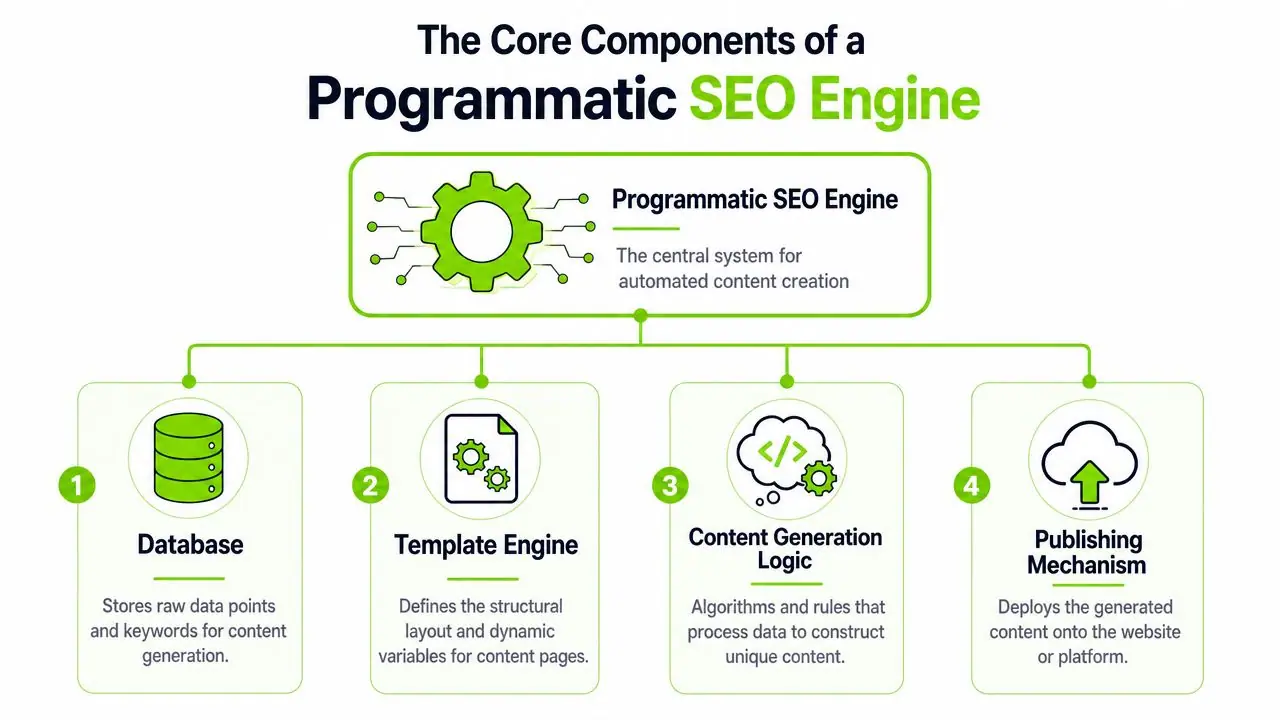
The stack is simple on paper. The hard part is setting quality thresholds before scale hides the problems. I treat pSEO as an editorial system with software around it, not a page factory.
The database
The database is the input layer. It can live in a spreadsheet, Airtable, a product catalog, a CMS collection, or an API feed. Format matters less than coverage, consistency, and whether each record contains enough detail to earn its own page.
This marks the start of user-first validation. A row should map to a real query and a real page promise. If the only unique fields are a keyword, a location name, and one sentence of copy, the page usually has no defensible reason to exist. That also marks the beginning of AI-native cannibalization. If fifty pages resolve to the same answer, AI systems and search engines can compress them into one summary and skip your site entirely.
Good datasets contain page-level differentiators. For a travel site, that might include seasonality, price range, neighborhood context, transport details, and notable trade-offs. For a SaaS site, it might include setup steps, supported triggers, limits, pricing implications, and use-case fit.
The template engine
The template controls structure, metadata, schema, internal linking, and the modules that appear on each page. A strong template keeps production efficient without forcing every URL into identical copy patterns.
Rigid templates create a common failure mode. Pages look distinct because the variables change, but they read like duplicates because the page logic never changes. Search engines have gotten better at spotting that pattern. Users notice it faster.
Good templates support conditional sections. A city page with strong first-party coverage might show local tips, entity highlights, and related neighborhoods. A thin record should show less, or stay unpublished until the underlying data improves.
The content generation logic
Generation logic decides what gets written, what gets skipped, and what gets blocked. This is the rules layer that separates a maintainable pSEO system from a thin-content machine.
I usually define this layer around validation gates:
| Component | What it does | What breaks when it's weak |
|---|---|---|
| Database | Supplies facts and differentiators | Pages feel generic or interchangeable |
| Template | Creates the reusable structure | Pages repeat the same framing and miss intent shifts |
| Logic | Applies quality, relevance, and publishing rules | Weak records go live and compete with stronger pages |
| Publishing | Pushes pages live and updates them | Errors, stale pages, and indexation problems pile up |
The key trade-off is coverage versus distinctiveness. Publishing every possible page combination increases surface area, but it also increases the chance that multiple pages target the same intent with only cosmetic differences. Strong logic prevents that. It can require a minimum number of unique fields, swap modules based on intent, merge overlapping combinations, or hold borderline pages in draft.
The publishing mechanism and monitoring layer
Publishing is the operational layer. WordPress with custom fields, Webflow CMS, a headless CMS, or a custom stack can all work if they support clean URL rules, field-based rendering, updates, and rollback. The stack matters less than whether the team can ship and maintain pages without breaking templates or orphaning content.
Monitoring closes the loop. Track what was generated, what was indexed, which templates drive engagement, and where cannibalization starts to show up. For many teams, a workflow built on an SEO tool API helps connect page creation, indexation checks, internal link audits, and refresh decisions.
One rule holds up in every pSEO project I have seen. If the system can publish faster than the team can validate usefulness, the engine is not finished.
Real-World Examples and Lucrative Use Cases
A team launches 50,000 pages because the template works, the database is clean, and the keyword set looks huge. Six months later, only a small slice of those pages drives qualified traffic. Another slice never gets indexed. The rest competes with each other, or gets summarized away by AI search because the pages do not add enough original value.
That is the true test for programmatic SEO. Scale only matters if each page earns its place.
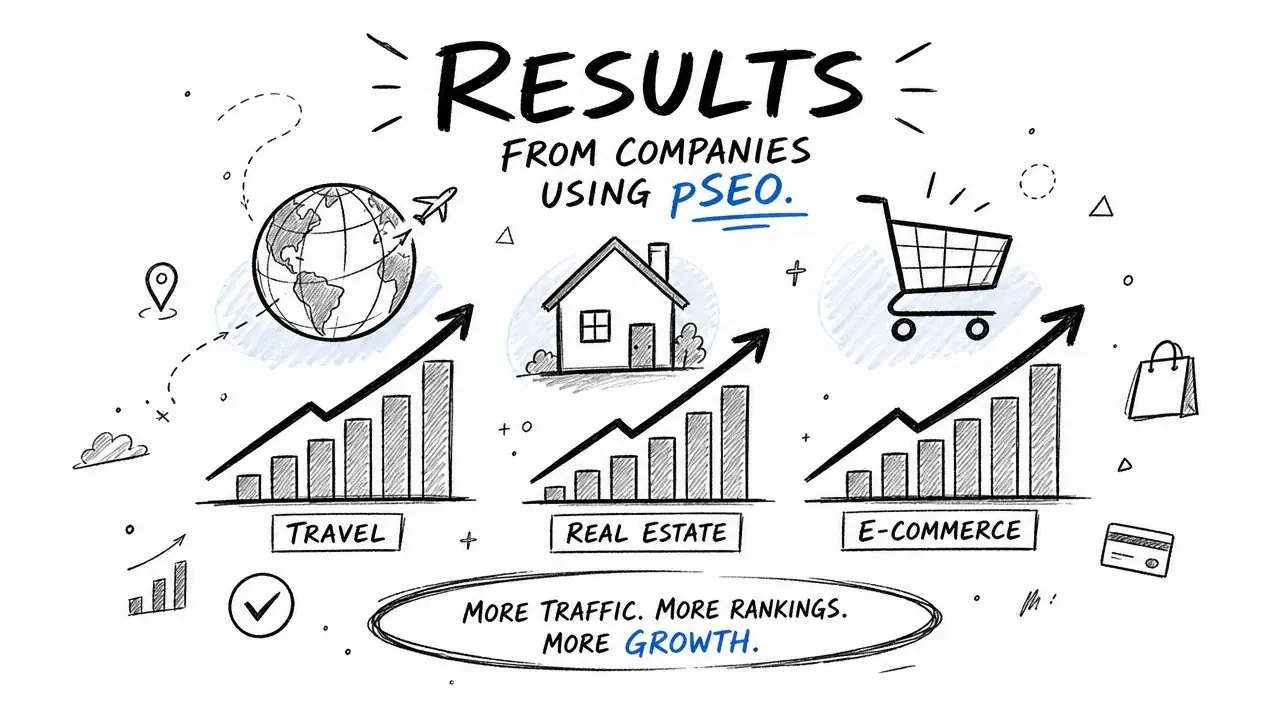
Zillow is the clearest inventory and location example. Users search for homes in a specific area, then narrow by price, property type, school district, or neighborhood. The page pattern repeats, but the user need is specific and the underlying inventory changes enough to justify distinct URLs. That is user-first validation in practice. The page exists because a buyer has a real decision to make.
Zapier fits a different model. Integration pages work because each app pair represents a concrete job, such as sending leads from a form tool into a CRM or pushing webinar signups into an email platform. The template can scale, but the useful pages are the ones tied to real workflows, not every possible app combination.
Tripadvisor shows the directory and local discovery model. People search for restaurants, hotels, and things to do in a city because they need options, filters, reviews, and local context. Structured listings make pSEO possible. User demand makes it defensible.
The profitable patterns are usually the ones where the query modifier changes the decision, not just the wording. If the modifier changes inventory, availability, compatibility, local relevance, or product fit, programmatic SEO can work well. If it only swaps a token in the headline, the page is weak from day one.
Use cases that hold up in practice
Several page types tend to perform well when the underlying data is strong and the page solves a real task:
- Location pages: Good for multi-location services, marketplaces, and local category searches where each market has distinct supply, proof, or constraints.
- Product and variant pages: Strong when each version has meaningful differences in specs, pricing, stock, compatibility, or use case.
- Integration pages: Useful for SaaS companies that can explain what the connection does, who it helps, and what setup looks like.
- Directory pages: Effective when listings include filters, reviews, attributes, and enough detail to support choice.
- Comparison pages: Good when the page can show real differences in features, pricing, workflow fit, or trade-offs.
The planning work starts earlier than many teams expect. A disciplined keyword list built around real query patterns helps separate scalable opportunities from combinations that only exist in a spreadsheet.
What separates strong examples from weak ones
Page utility is the dividing line.
A strong location page gives a visitor local proof, market-specific detail, and a clear next action. A strong integration page explains why the connection matters, what data moves between systems, and where the setup can fail. A strong comparison page helps someone make a decision faster.
Weak pages blur together. That is a ranking problem, but it is also becoming an AI visibility problem. AI-native cannibalization happens when a site publishes many near-duplicate pages that answer the same question with lightly altered copy. Search systems can collapse those pages into one cluster, ignore most of them, or pull a generic summary that leaves the site with little traffic and no differentiation.
I use a simple test. Remove the modifier from the page. If the copy still reads almost the same, the page probably should not exist as its own URL.
The best pSEO examples are not the biggest libraries. They are the libraries with clear page-level purpose, distinct supporting data, and enough original value to survive both traditional rankings and AI summarization.
A Step-by-Step Guide to Planning Your pSEO Project
Most pSEO problems start before launch. The project gets approved because the page count looks attractive, but nobody pressure-tests whether the page set deserves to exist.
That's why planning matters more than generation.
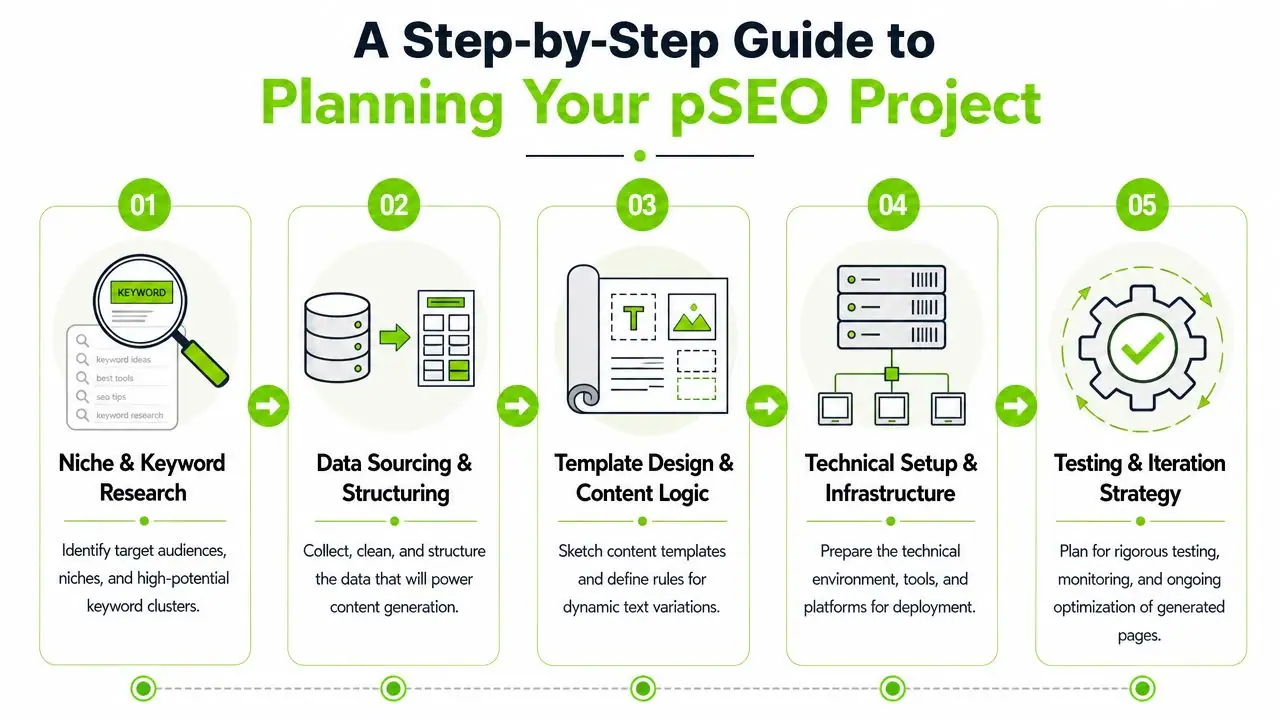
Start with the query pattern
Don't begin with templates. Begin with search behavior.
Look for a head term plus modifier pattern that repeats cleanly across many combinations. That could be service plus city, tool plus use case, software plus integration, or category plus location. The pattern should map to a real need, not just a keyword spreadsheet artifact.
A lot of teams rush this step and create pages for combinations that exist syntactically but don't represent meaningful demand. That's how you end up with bloat.
If your keyword research process needs structure, this guide to building a keyword list is a useful operational starting point.
Build and clean the dataset
Once the pattern is clear, pressure-test the data.
Ask basic but important questions. Is every row complete enough to produce a useful page? Are the source fields verified? Are there obvious duplicates, naming inconsistencies, or gaps? If the answer is no, fix the data before designing the page.
A good dataset makes the later stages easier. A messy one forces your template to hide quality problems.
Here's a simple planning checklist:
- Define the page family: What exact query pattern are you targeting?
- Audit the data fields: What information makes each page meaningfully different?
- Set publishing rules: Which records go live, and which stay unpublished until complete?
- Map internal links: How will related pages connect?
- Choose review checkpoints: Who signs off on quality before scaling?
A quick walkthrough can help your team visualize the process before development begins:
Design the page for users first
Teams often reveal what they're optimizing for.
The key question from the emerging User-First Validation Gap is simple: “Would I keep this page for users if it had no search traffic?” Low-quality, long-tail programmatic pages can dilute internal equity and slow core content performance, as noted in Ross Hudgens' discussion of user-first validation.
That question should decide whether a page family gets built at all.
Use a practical validation filter
Before launching a page set, run each template through this filter:
- Utility check: Does the page answer a specific user need on-page?
- Differentiation check: Does the dataset make this page materially different from sibling pages?
- Navigation check: Can users move from this page to the next relevant page naturally?
- Retention check: Would the business still want the page live without search traffic?
Reality check: A page that exists only because a keyword exists is usually a bad pSEO candidate.
Plan internal linking before launch
Internal linking isn't cleanup work. It's part of the design.
A location page should connect to nearby categories, relevant service hubs, and parent directories. An integration page should connect to related tools and adjacent workflows. If pages launch in isolation, they tend to stay isolated, and both users and crawlers get less value from the system.
Treat internal links as product logic, not editorial garnish.
Common Pitfalls and How to Measure Success
A team ships 20,000 programmatic pages, sees a brief spike in impressions, then spends the next quarter figuring out why half the set is excluded, why engagement is weak, and why core pages started losing internal support. That pattern is common because pSEO usually breaks after launch, not during template design.
The failure points are predictable. So are the fixes.
Thin and near-duplicate page sets
The biggest risk is publishing page families that look different in the URL but feel interchangeable to users and search systems. That problem is getting sharper as AI search products summarize similar pages into one answer surface. If ten pages restate the same idea with swapped entities, you do not have ten assets. You have one weak asset copied ten times.
That is where user-first validation becomes operational, not philosophical. Every page family needs a clear reason to exist beyond keyword coverage. The useful test is simple. Can a real user complete a specific task on this page better than they could on a broader hub, a filtered category page, or an AI summary?
If the answer is no, do not scale it.
I also watch for AI-native cannibalization here, even before the dedicated AI section. In practice, that means sibling pages are so semantically close that search engines may index them separately while AI systems treat them as one interchangeable source. The short-term symptom is weak CTR and uneven indexing. The longer-term problem is that your library trains search systems to ignore your distinctions.
Weak monitoring after launch
Generated pages need product-style monitoring. Indexation, crawl activity, engagement, conversion quality, and template-level defects all need review at the page-family level, not only at the site level.
If you are managing generated clusters over time, an automated SEO monitoring workflow helps catch drops in index coverage, template rendering issues, and sudden engagement changes before they spread across thousands of URLs.
This also matters for AI visibility. Traditional rank tracking will not show you when several pages are being compressed into the same AI answer pattern. Teams that care about search resilience are starting to pair SEO measurement with answer-surface reviews and entity-level differentiation checks, which aligns well with Stimulead's AEO playbook.
What to measure
Raw traffic is not enough. A pSEO system can grow sessions while still producing weak pages, poor conversions, and heavy maintenance overhead.
Use a scorecard that answers four questions. Are pages getting indexed. Are they earning clicks. Are users finding what they came for. Are the pages contributing to the business without hurting the rest of the site.
| Metric | Why it matters | What a problem looks like |
|---|---|---|
| Index coverage | Shows whether search engines accept the page set | Large sections stay excluded or oscillate in and out of the index |
| Impressions and CTR | Shows whether pages surface for the right queries and earn the click | Impressions rise while CTR stays weak across an entire template |
| Average position by page family | Helps isolate clusters that are structurally weak | Similar templates stall in the same low-visibility range |
| Engagement and task completion | Shows whether users actually get value from the page | Fast exits, low interaction, or no next-step clicks |
| Conversion quality | Separates useful traffic from cheap traffic | Pages drive visits but no qualified signups, leads, or revenue |
| Index-to-traffic ratio over time | Reveals overproduction | More pages get indexed without proportional gains in clicks or conversions |
One metric I like in audits is page-family yield. That is the share of indexed pages in a template group that produce meaningful traffic, conversions, or assisted conversions. If only a small slice of a large cluster carries the whole set, the template usually needs pruning or stronger differentiation.
Common failure modes
- Publishing too broadly: Expanding every possible combination before a small page set proves user value, indexability, and business impact.
- Treating weak data as a copy problem: No template can rescue incomplete, stale, or undifferentiated records.
- Letting templates drift: Fields change, entity coverage breaks, and output quality slips unless someone owns template QA.
- Ignoring page-family economics: Some clusters cost far more to maintain than they return.
- Missing AI-native cannibalization: Separate URLs exist, but the content patterns are too similar to earn distinct visibility in AI-driven results.
- Measuring only aggregate traffic: Sitewide growth can hide the fact that one page family is dragging quality signals down.
A healthy pSEO program acts like a maintained product surface. Some page sets grow. Some get merged. Some should be removed. That discipline is what makes programmatic SEO sustainable instead of bloated.
Programmatic SEO in the Age of AI Search
Traditional search let many similar pages coexist as long as each one could rank for its own keyword variant. AI search changes that. Large language models and AI Overviews can collapse multiple pages into one synthesized answer.
That creates a newer problem: your pages may compete not only in rankings, but also inside AI-generated summaries that decide which distinctions matter and which ones get erased.
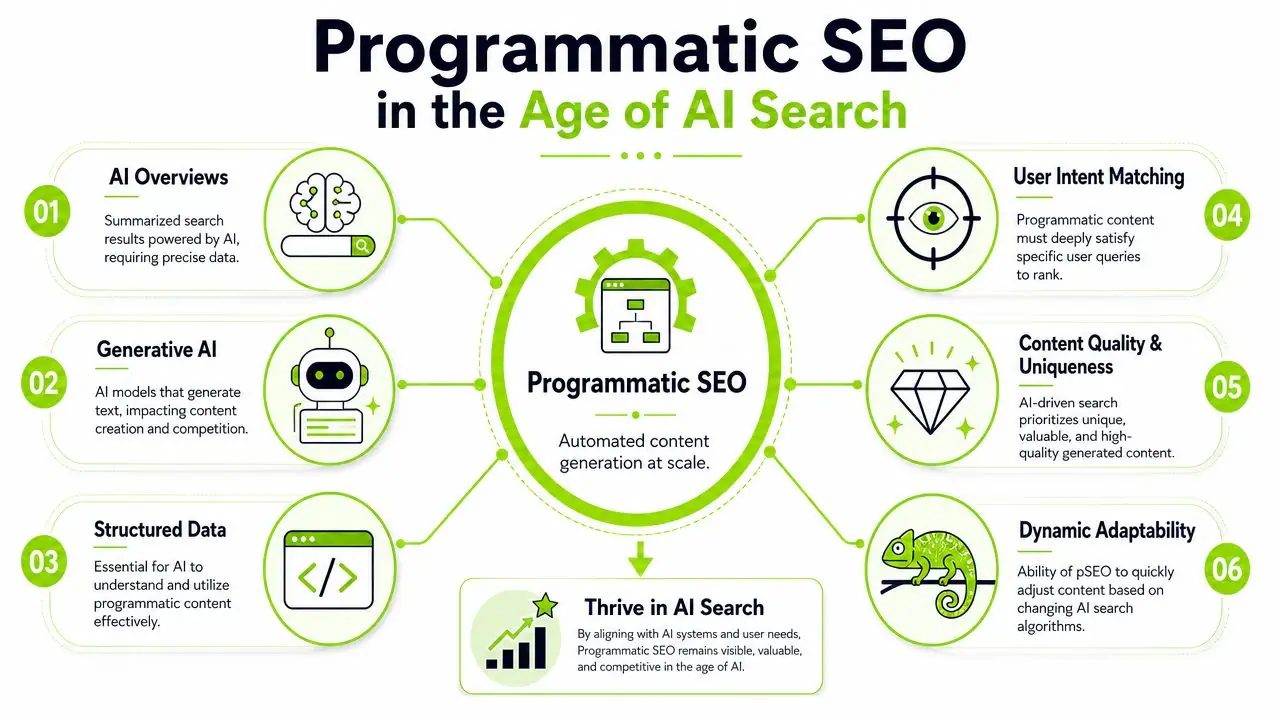
A 2025 study found that 68% of programmatic pages with similar structures are merged by AI into single summaries, reducing visibility for individual pages. This “AI-Native Cannibalization” is described in SEO USA's writeup on the issue.
What AI-native cannibalization looks like
This doesn't always show up as a classic SEO cannibalization problem. You might still have separate URLs indexed. You might even have some rankings. But AI systems can decide that several of your pages say the same thing and compress them into one answer surface.
That's bad for page-level visibility, but it also tells you something useful. The system didn't see enough semantic distinction between the pages.
How to reduce the risk
You can't fully control how AI systems summarize the web, but you can give them stronger signals.
Use these principles:
- Differentiate the structure: Not every page in a family should have identical section flow if the intent differs.
- Differentiate the entity layer: Make sure the page is anchored in specific entities, attributes, and relationships.
- Cluster more carefully: Don't split one intent into too many pages that only vary superficially.
- Add on-page value: Include context, decision support, and supporting details that make each page stand on its own.
Teams adapting to AI search should also study frameworks built specifically for answer-engine visibility. Stimulead's AEO playbook is a useful reference for understanding how search behavior changes when answers, not just links, become the main interface.
Why visibility tracking has changed
Classic rank tracking still matters, but it's no longer enough on its own. You also need to understand whether your brand, pages, or entities appear in AI-generated search experiences and how often those appearances collapse multiple assets into one cited answer.
That's why AI-focused workflows are becoming part of modern SEO operations. A practical starting point is understanding SEO for AI search, especially if your team manages large page sets that could be summarized or recombined by AI systems.
The next version of programmatic SEO won't be judged only by how many pages you can publish. It'll be judged by how clearly each page earns its own existence in both search results and AI answers.
If your team needs one place to monitor traditional rankings, AI Overview presence, citation gaps, and overall search visibility across large page sets, Surnex is built for that job. It gives agencies, in-house teams, and developers a clearer way to track how brands surface across modern search, without stitching together separate tools for SEO and AI visibility.