The most popular advice about keyword research is also the reason many keyword lists fail. Teams still build lists as if search is only a spreadsheet game of volume, difficulty, and a few competitor exports. That was never complete, and now it’s plainly insufficient.
A keyword can have demand and still be a weak target. It might be impossible for your site to rank for. It might attract the wrong intent. It might trigger an AI answer that absorbs attention before a user ever clicks. If your process ignores those realities, you don’t have a strategy. You have a backlog.
The practical version of how to build a keyword list today is less about collecting phrases and more about building a decision system. You need inputs from your site, your customers, your competitors, and the search results themselves. Then you need to sort those inputs by intent, page fit, and visibility across both classic search and AI-driven discovery.
That’s the shift many teams are still catching up to.
Why Most Keyword Lists Are Already Outdated
A lot of keyword lists are outdated before the first page gets written. The reason is simple. They were built for an older search model where ranking in ten blue links was the main goal.
That model is breaking down. Existing guidance still leans heavily on traditional metrics, while AI Overviews now influence 20-30% of Google queries in major markets, and long-tail questions dominate 60% of AI responses according to Seoprofy’s analysis of low-competition keyword strategy. If your list doesn’t account for that, you’ll struggle to explain why impressions rise while clicks flatten, or why a competitor keeps appearing in AI-generated summaries while your brand doesn’t.
The old workflow also overvalues volume. High-volume terms look impressive in a report, but they often hide two problems. First, they usually carry broad intent. Second, they don't tell you whether your brand has any realistic path to visibility in either standard results or AI surfaces.
What the old method gets wrong
Most outdated lists share the same flaws:
- They treat all demand as equal. A query with broad curiosity and a query with buying intent do not deserve the same priority.
- They ignore result format. Some keywords send traffic to websites. Others trigger answer layers, summaries, videos, or mixed results.
- They stop at keyword difficulty. Difficulty matters, but it doesn’t tell you whether an AI system cites brands in that topic space.
- They produce bloated exports. Huge lists feel productive, but without page mapping they create cannibalization and editorial drift.
A keyword list built only from volume and keyword difficulty is a legacy artifact, not a modern search plan.
A better workflow starts by accepting that search behavior changed. Traditional SEO signals still matter. They just aren't enough on their own. Teams need keyword lists that can support rankings, conversions, and visibility in AI-led discovery at the same time. That’s why keeping an eye on AI search trends isn't optional anymore. It shapes what should even make your list in the first place.
Gathering Your Foundational Seed Keywords
The strongest keyword lists start small. Not small in ambition, but small in the sense that the first layer should come from reality, not from a random export.
When teams skip that step, they usually end up with a familiar mess. Lots of phrases. Very little relevance. Almost no confidence that the list reflects how customers search.
Building authoritative keyword lists requires synthesizing seed keywords from at least five distinct sources: manual site audits, Google Search Console with a minimum of 50 impressions, competitor benchmarking, Google Autocomplete analysis, and AI-assisted brainstorming. This approach captures 40-60% more viable keyword opportunities than relying on a single source according to Tower Marketing’s keyword research checklist.

Start with your own site before tools
The first pass should come from pages you already have. Review your homepage, service pages, product pages, category pages, help docs, pricing pages, and case study titles. Pull out the plain-language phrases that describe what you sell, who it’s for, and what problems it solves.
This usually gives you three useful buckets:
- Core offering terms such as product or service names
- Problem-aware phrases that describe the pain point
- Modifier phrases tied to audience, industry, use case, or geography
If you can’t describe a page in a few natural search phrases, the page probably isn’t positioned clearly enough yet.
Pull query data from Search Console
Search Console is where your assumptions meet actual behavior. Export queries that already generate meaningful impressions. The minimum threshold matters because tiny impression counts often create noise.
Look for patterns like:
- recurring verbs such as compare, buy, fix, improve, migrate
- audience qualifiers such as for agencies, for dentists, for ecommerce
- repeated question formats
- near-miss terms where you appear but don’t rank strongly
These aren’t just keyword ideas. They’re evidence of how Google already associates your site with certain topics.
Benchmark competitors without copying them
Competitor research is useful, but only if you use it to find gaps instead of cloning another site’s editorial map. Pull competing domains that serve the same audience, then compare their topic coverage against yours.
A simple review should answer:
- What themes do they rank for that you don’t address at all?
- Where are they weak even though they publish heavily?
- Which pages appear to combine commercial and informational intent well?
This is also where niche platforms matter. If video search plays a role in your space, a focused resource on YouTube keyword search can help you collect phrase patterns that won’t show up cleanly in a traditional SEO export.
Use Autocomplete and AI carefully
Google Autocomplete is still one of the quickest ways to spot real phrasing. Search your core term, then test variations with modifiers like best, vs, near me, software, tool, for, alternative, pricing, and how to.
AI brainstorming helps too, but only as an expansion aid. It should never be your only source. Ask for semantic variants, audience-specific phrasings, and problem-led questions. Then validate everything against real search data and your market knowledge.
Practical rule: If a seed keyword only makes sense inside your company, it’s not a seed keyword. It’s internal jargon.
Keep all of this in one working document. A keyword workspace in Sheets is fine. A dedicated platform is better if you need to assess fit and expand terms at scale. Teams often use keyword research workflows to move from raw seed terms into a cleaner review process without losing context from source to source.
Expanding Your List to Uncover Hidden Opportunities
A seed list is a starting point, not a strategy. The next job is expansion. This expansion transforms a few dozen grounded ideas into a usable search map.
I think of this part like growing a forest from a handful of healthy seeds. If the seeds are real, expansion works. If the seeds are weak, the forest fills with junk.
The main mistake here is chasing scale too early. Teams dump thousands of suggestions into a sheet, then spend hours deleting nonsense. A better approach is to expand in layers and keep each layer attached to a clear topic.
Start with long-tail paths, not broad vanity terms
Many keyword strategies gain practicality from the following statistics. Long-tail keywords of 3 or more words account for 70-80% of all search queries and drive over 90% of organic traffic conversions. Head terms often sit above 70/100 in keyword difficulty, while long-tail terms average 20-40/100 and can convert at 2-5x the rate according to Semrush’s keyword targeting guidance.
That difference changes how I expand lists. I still collect broad head terms, but I rarely treat them as the center of the plan for a mid-sized site. The center is usually made of more specific phrases with clearer intent.
For a seed term like “project management software,” expansion might include:
- Comparison variants like best project management software for agencies
- Pain-point variants like project management software for missed deadlines
- Role-based terms like project management software for operations teams
- Alternative framing like tools to manage client projects
- Question formats like what project management software works for distributed teams
These phrases give you much better clues about page type, content angle, and conversion potential.
Use SERP cues to multiply ideas
Some of the best expansions come straight from the search results. Search a seed term and collect ideas from People Also Ask, Related Searches, autosuggest variations, and the language used in page titles ranking on page one.
Those patterns reveal how users refine the topic.
Here are expansion paths that work consistently:
| Expansion path | Example modifier | Why it matters |
|---|---|---|
| Comparison | vs, alternative, compare | Signals commercial investigation |
| Action | buy, hire, book, get | Signals stronger transaction intent |
| Audience | for startups, for lawyers | Tightens relevance |
| Problem | fix, reduce, improve | Connects to pain points |
| Local | in London, near me | Useful for service businesses |
If your team tends to get stuck at this stage, a quick reset with effective brainstorming techniques can help generate better modifier paths and audience-specific angles without defaulting to generic ideas.
Expand by topic family, not random suggestion
One of the cleanest ways to build a keyword list is to expand every seed into a topic family. That means you keep all related variants together while you're still discovering them.
For example, a seed like “CRM migration” might grow into:
- migration planning queries
- platform comparison queries
- pricing and service queries
- troubleshooting and risk queries
- industry-specific migration queries
That structure makes later filtering easier because you already know the context around each term.
Broad terms make a list look ambitious. Specific terms make a list usable.
The practical test is simple. If a keyword idea can’t be tied to a likely page type or user need, leave it out of the working set for now. Expansion should increase coverage, not confusion.
How to Filter Your List with Modern Metrics
Expansion creates possibility. Filtering creates strategy.
Most bad keyword lists don’t fail because the team found too few ideas. They fail because nobody decided what deserved attention. Everything stayed in the same sheet with the same priority, even though the terms had wildly different value.
The first pass of filtering still uses traditional SEO signals. You should review search demand, competition, likely intent, and commercial value. But that’s no longer enough if you want the list to reflect how people discover brands now.
Here’s the kind of view that makes this analysis easier when AI visibility is part of the workflow.
Start with the classic filters
Traditional metrics still matter because they help you remove obvious dead ends.
A practical filtering pass usually asks:
- Is there enough demand to justify creating or revising a page?
- Can this site realistically compete for the term?
- Does the query show useful intent, or is it too broad?
- Does CPC suggest the term has business value?
I don’t treat any one metric as decisive. Search volume without fit is noise. Low difficulty without business relevance is a distraction. CPC without editorial alignment can push you into content that doesn’t belong on your site.
This is also where people misuse “high volume.” They assume more demand means more value. It often means more competition and fuzzier intent.
A high-volume keyword you can't rank for or that never appears in AI is worthless.
Add AI visibility to the filtering layer
This is the missing piece in many keyword workflows. Some queries still behave like classic SEO opportunities. Others are increasingly mediated by AI summaries, answer layers, and conversational discovery.
That means every serious keyword review should ask a second set of questions:
- does this query commonly trigger AI-generated summaries
- are competitors cited in those results
- does the query format favor concise factual answers or deeper evaluation
- is the topic one where brand mentions matter more than a click
- can your site supply the kind of content that AI systems are likely to surface
You don’t need to turn every keyword into an AI project. You do need to stop pretending AI visibility is separate from keyword research. It now affects prioritization.
A workflow such as citation gap analysis helps teams identify terms where competitors show up in AI surfaces while their own brand is absent. That’s often more useful than seeing who ranks in classic results.
Build a scorecard that reflects trade-offs
Filtering works better when the trade-offs are explicit. I like a simple qualitative scorecard that weighs the following:
| Factor | What to look for |
|---|---|
| Relevance | Direct tie to product, service, or audience problem |
| Winnability | Achievable relative to current site strength |
| Intent quality | Clear informational, commercial, or transactional value |
| Page fit | Obvious destination page or content asset |
| AI visibility potential | Topic likely to matter in AI summaries or conversational discovery |
This keeps the conversation honest. A flashy term might look attractive until it scores poorly on page fit and winnability. A quieter long-tail term often wins because it maps cleanly to a page and aligns with real buying behavior.
The video below is a useful companion if you want to see this kind of research process in motion rather than only in a spreadsheet.
What usually gets cut
By the end of filtering, many keywords should be removed or parked.
Common reasons to exclude a term:
- Wrong audience: the query belongs to adjacent traffic, not your buyers
- No page match: you’d have to force the term into an unsuitable page
- Weak intent: curiosity traffic with no strategic value
- Low realism: the SERP is too entrenched for your current authority
- Topic drift: the term takes the site away from its core topical strengths
That’s a healthy outcome. Keyword research isn’t about keeping everything. It’s about choosing what the business should pursue on purpose.
Organizing Keywords with Clustering and Intent Mapping
A filtered list still isn’t actionable until each keyword has a home. Here, keyword research shifts from collection to architecture.
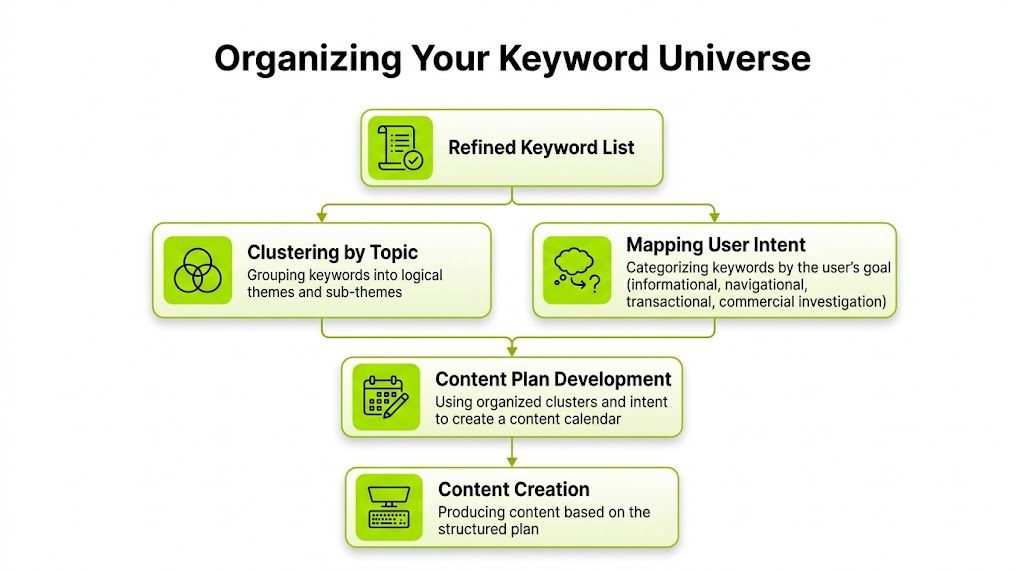
The rule is stricter than many teams realize. Keyword clusters should group queries that share the same search intent and map to one specific page. That structure prevents cannibalization and matters even more when comparing visibility across AI Overviews and traditional search, because different formats can surface different intent types according to Netpeak’s guide to building a keyword list.
If you skip this step, content teams end up writing overlapping pages that compete with each other, while SEO teams keep wondering why rankings shuffle every few weeks.
Group by topic first, then verify intent
Clustering starts with semantic similarity, but it cannot end there. Similar wording does not always mean the same page should target the query.
Take these examples:
- best crm for small business
- crm software pricing
- what is a crm
- crm implementation checklist
They all belong to the same broad topic family. They do not belong on the same page.
A practical clustering pass looks like this:
- group close variants around a topic
- inspect the search results for each term
- confirm whether the same page types rank
- split terms when the intent differs
- assign one primary keyword and supporting variants to a single page
If the SERP behavior changes, the cluster should usually change too.
Use intent labels that help content teams act
Intent labels shouldn’t be theoretical. They should help someone decide what to build.
A simple model works well:
- Informational for learning and explanation
- Navigational for brand or destination seeking
- Commercial for evaluation and comparison
- Transactional for action and conversion
Here’s how those labels usually translate into pages:
| Intent | Typical page type | Example use |
|---|---|---|
| Informational | Guide, glossary, tutorial | Define a concept or solve a problem |
| Navigational | Brand or product page | Help users reach a known destination |
| Commercial | Comparison, alternatives, review page | Support evaluation |
| Transactional | Service, demo, pricing, category page | Capture action-ready demand |
Many organizations improve by stopping a common mistake. They use blog posts to target transactional terms because content is easier to produce than product or service pages. That often leads to weak conversion paths and muddled intent alignment.
One page should serve one dominant intent. If you're trying to rank one page for learning, comparing, and buying at the same time, the page usually does none of them well.
Build the map, not just the cluster
Once clusters are stable, map them to actual URLs or planned URLs. This is the part people skip because it feels operational. It’s also the part that turns research into execution.
Your working sheet should include:
- Primary keyword for the cluster
- Secondary keywords that belong on the same page
- Intent label
- Assigned URL or planned page
- Page type
- Content status
- Notes on SERP format or AI visibility behavior
That map becomes the backbone for content briefs, internal linking, and performance review.
Keep AI behavior in the mapping conversation
Some keyword clusters behave differently across search experiences. An informational query may trigger an AI summary, while a commercial query in the same topic family may still drive traditional clicks to comparison pages.
That matters when assigning content formats. For AI-sensitive informational clusters, concise definitions, clear subheadings, and direct answer sections often help. For commercial clusters, side-by-side evaluation content and stronger evidence tend to matter more.
The point isn’t to create separate websites for AI and SEO. The point is to map each cluster to the format most likely to satisfy both the user and the search experience they encounter.
Prioritizing, Automating, and Maintaining Your Keyword Strategy
A keyword list is not finished when the research is done. It’s finished when the team can decide what gets built first, what gets monitored, and what gets revised later.
That’s why static keyword spreadsheets age so fast. The list may be correct when exported, but the business changes, the search results shift, and new opportunities appear. If nobody maintains the system, the list turns into archive material.
For agencies and larger in-house teams, scale becomes the key pressure point. API-driven list generation and shared dashboards can cut management time by up to 50%, while tool fragmentation is a reported pain point for 25% of agencies. Modern workflows also prioritize AI citation gaps, where ROI can be 2-3x higher according to We Are Bottle’s keyword mapping perspective.
Prioritize with a simple impact and effort view
You don’t need a complex scoring model to decide what goes first. You need consistency.
I usually sort keyword clusters into four practical groups:
-
High impact, low effort Existing pages that need tighter optimization, stronger internal linking, or better intent alignment.
-
High impact, high effort New pillar pages, category pages, or large comparison assets that deserve planning and design support.
-
Moderate impact, low effort Useful long-tail support content that strengthens topical coverage.
-
Low impact, high effort Terms that may be attractive in theory but aren’t worth current resources.
This approach keeps teams from spending months chasing a prestige keyword while easier, more relevant gains sit untouched.
Automate the boring parts
Manual research is still important. Manual repetition is not.
The work that should be automated includes:
- recurring exports from client logs or internal query sources
- bulk enrichment with search and visibility data
- rank and appearance tracking across selected terms
- alerting when important pages lose visibility
- syncing keyword maps into reporting dashboards
For teams running multiple brands or clients, process quality quickly improves. Shared workflows reduce duplicate work and make it easier to compare opportunities across accounts without flattening them into the same strategy.
Ongoing monitoring matters too. A workflow for rank monitoring and changes helps teams catch shifts before they turn into reporting surprises.
Maintain the list like a living asset
A healthy keyword strategy changes over time. Some terms earn stronger pages and stay in active focus. Others get retired because they never matched business goals in the first place.
A practical maintenance rhythm usually includes:
- reviewing newly discovered queries from site data
- pruning terms with poor relevance or no page fit
- updating clusters when intent in the SERP changes
- revisiting page assignments after launches or site restructuring
- flagging keywords tied to new products, services, or market shifts
The best keyword list isn't the biggest one. It's the one your team can actually maintain, explain, and publish against.
That’s also where one modern platform can help if you need both classic SEO signals and AI visibility in the same workflow. Surnex is one example. It combines keyword research, rankings, and AI visibility tracking in a single environment, which is useful for agencies and in-house teams trying to reduce tool sprawl without separating AI discovery from core SEO work.
Frequently Asked Questions About Building Keyword Lists
Should I include zero-volume keywords
Yes, sometimes.
Keyword tools don’t capture every valuable query cleanly, especially newer phrases, niche B2B language, or very specific problem-led searches. If a term comes directly from sales calls, customer interviews, support tickets, or repeated on-site search behavior, it may deserve a place even when volume looks weak or absent.
Use judgment here. A zero-volume keyword is worth keeping when it has clear buyer intent, strong relevance, and an obvious page fit. It isn’t worth keeping just because it sounds clever.
How is a keyword list for SEO different from PPC
The overlap is real, but the priorities are different.
SEO lists usually support content architecture, internal linking, and long-term topical coverage. PPC lists need tighter control over query matching, bidding logic, and negative keywords. SEO can justify broader supporting content. PPC usually can’t afford that kind of exploratory sprawl.
The practical difference is this:
- SEO lists can include educational and mid-funnel terms that build authority
- PPC lists should be stricter about commercial intent and exclusions
- Shared terms often work best when one team handles landing page intent and the other handles broader content support
A mature team keeps the master keyword universe shared, then creates separate filtered views for SEO and paid media.
How do I build a keyword list for a brand new website
Start with market reality, not your lack of data.
A new site won’t have much Search Console history, so lean harder on manual page definitions, competitor benchmarking, Autocomplete patterns, and direct customer language. Focus your first list on tightly relevant topics where your site can create a clear, differentiated page.
For a new domain, I’d usually avoid building the plan around broad vanity terms. Go narrower. Prioritize terms with specific audience, industry, or problem modifiers so the site can establish topical clarity before expanding.
How many keywords should go on one page
Don’t think in terms of stuffing a number onto a page. Think in terms of one cluster per page.
A page should target one primary keyword and a set of supporting phrases that share the same intent. If the terms imply different content needs, they probably belong on separate pages.
This is one of the easiest checks for cannibalization. If your writer needs to explain two different user goals to “fit all the keywords in,” the cluster is probably too broad.
Do I still need head terms in my list
Yes, but they should not dominate the plan unless your authority and resources justify it.
Head terms are useful for topic definition, pillar planning, and long-range visibility goals. They become a problem when teams mistake them for near-term targets. Most of the practical value in a keyword strategy comes from terms with clearer intent and more realistic competition.
Keep head terms in the map as directional anchors. Let more specific queries do more of the actual work.
How often should I update a keyword list
Regularly enough that the list reflects the business you have now, not the one you had when the sheet was created.
Good reasons to update the list include:
- a new product or service launch
- a shift in customer language
- major changes in search result layouts
- content cannibalization showing up in performance data
- competitor moves into your core topic areas
If the list supports active publishing, it should be reviewed often. If it sits untouched for long stretches, it stops being strategy and becomes documentation.
A modern keyword list has to do more than chase rankings. It has to connect intent, page structure, realistic competition, and AI-era visibility into one working system. If you want that workflow in one place, Surnex gives agencies, in-house teams, and developers a way to research terms, track rankings, monitor AI visibility, and spot citation gaps without splitting the work across disconnected tools.