If you're still measuring SEO success by how many clicks the top organic result gets, AI search has already changed the game. Position #1 organic results see a 34.5% lower click-through rate when Google's AI Overviews appear, and AI Overviews doubled from 6.49% to 13.14% of queries between January and March 2025 (Digitaloft).
That doesn't mean SEO is dying. It means the job has changed.
SEO for AI search is no longer just about winning a ranking and waiting for a click. It's about becoming a source that AI systems can parse, trust, and cite across Google, ChatGPT, Perplexity, and whatever interface a user chooses next. The brands that adapt well aren't publishing more content for the sake of volume. They're building content and measurement systems that make their expertise easy for machines to retrieve and easy for teams to monitor.
Most advice stops at basic on-page tweaks for Google AI Overviews. That helps, but it doesn't solve the operational problem. Teams now need a way to understand visibility across several AI environments, compare performance, and act without drowning in tool sprawl.
The New Search Environment AI Is Building
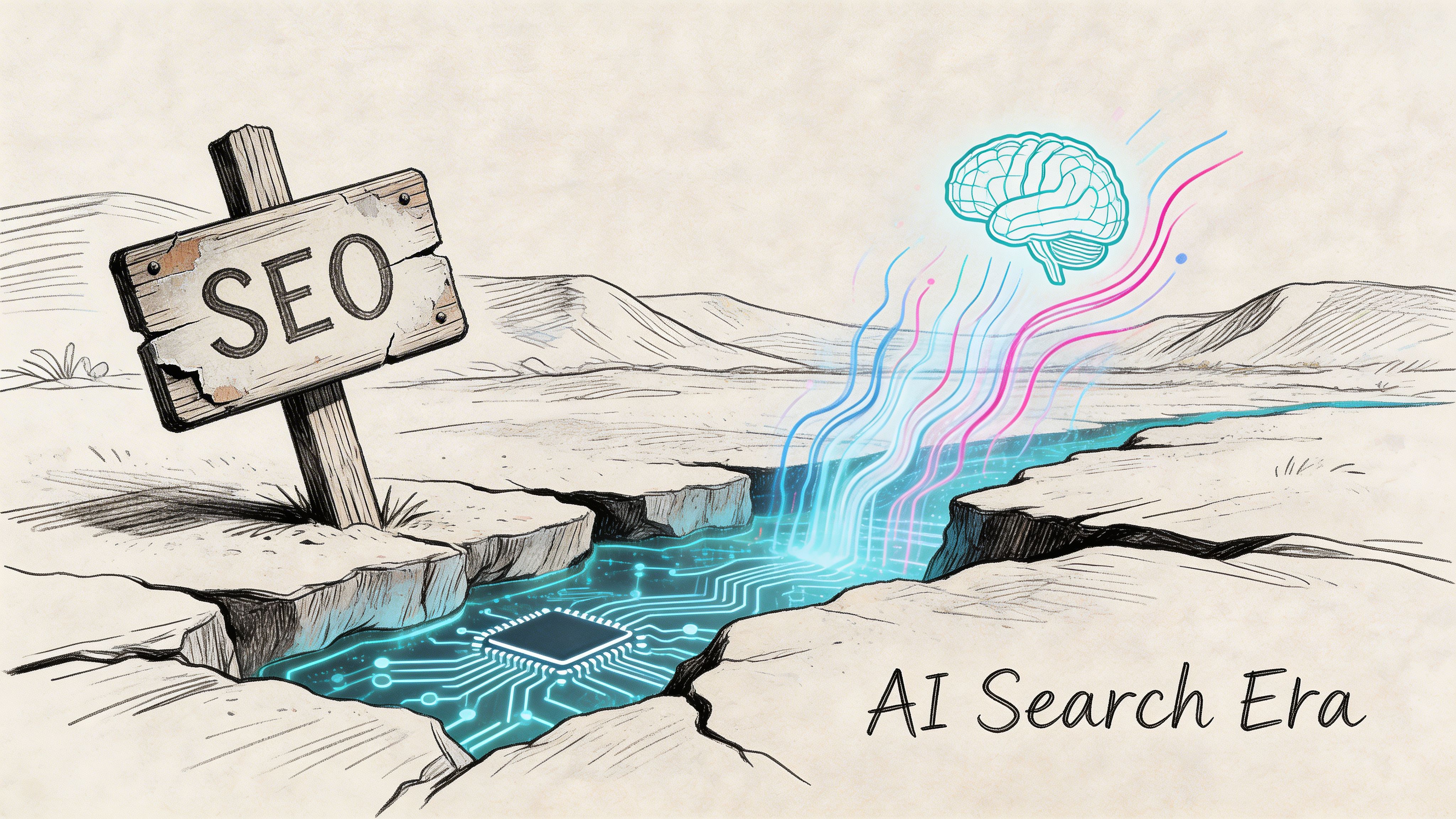
The biggest mistake I see is treating AI search like a small SERP feature update. It isn't. It's a new layer between users and websites.
Google is answering more questions directly inside the results page. Other AI systems are doing the same inside chat interfaces. In both cases, users often get enough information before they ever reach your site. That changes what visibility means.
Ranking still matters, but citation matters more
Traditional SEO focused on a simple chain. Rank well, earn the click, convert the visit.
AI search breaks that chain into more steps. Your page still needs to be discoverable, relevant, and technically sound. But after that, the system may summarize your page instead of sending the user to it. In practice, that means your content has to work in two modes:
- Human mode for readers who land on the page
- Machine mode for systems that extract, compress, and synthesize your information
That's why seo for ai search requires a mindset shift. You're not only optimizing a page. You're optimizing reusable knowledge blocks.
Practical rule: If an AI system can't quickly identify your answer, context, and credibility, it usually won't surface you, even if you rank.
This is also why the debate around whether search engines and AI assistants will merge misses the point. A useful perspective comes from Will Generative AI Replace Search Engines and SEO?, which explores how these systems overlap rather than fully replace one another.
Click loss is real, but so is the opportunity
Many teams see lower clicks and assume the channel is weakening. That's too narrow a read.
What is happening is a redistribution of value. Some informational visits disappear because the AI answer satisfies the query. At the same time, being cited inside AI-generated responses can still influence brand preference, shortlist inclusion, and later conversions. That influence won't show up cleanly if you're only staring at sessions.
The practical response isn't panic. It's instrumentation.
You need to know where your brand appears, which prompts trigger mentions, which competitors are cited instead, and how these patterns move over time. A good starting point is watching how AI-driven search behavior evolves across interfaces and SERPs, which is easier when you're tracking these changes in one place such as https://surnex.io/ai-search/ai-trends.
The old playbook isn't enough on its own
Classic SEO fundamentals still matter. Crawlability, links, internal architecture, and useful content haven't stopped working.
What has stopped working is assuming those basics alone will protect your traffic. In AI search, visibility increasingly goes to sources that are:
- Direct in how they answer
- Structured in how they present information
- Credible in how they demonstrate expertise
- Monitorable across more than one search environment
That's the working definition of modern SEO now. Not just rankability. Citatability.
Rebuilding Your Content for AI Consumption
Most content that ranks reasonably well is still written as a long narrative for human readers. That format can work, but AI systems prefer content they can break into clean, self-contained units.
This is the first major rewrite many teams need to make.
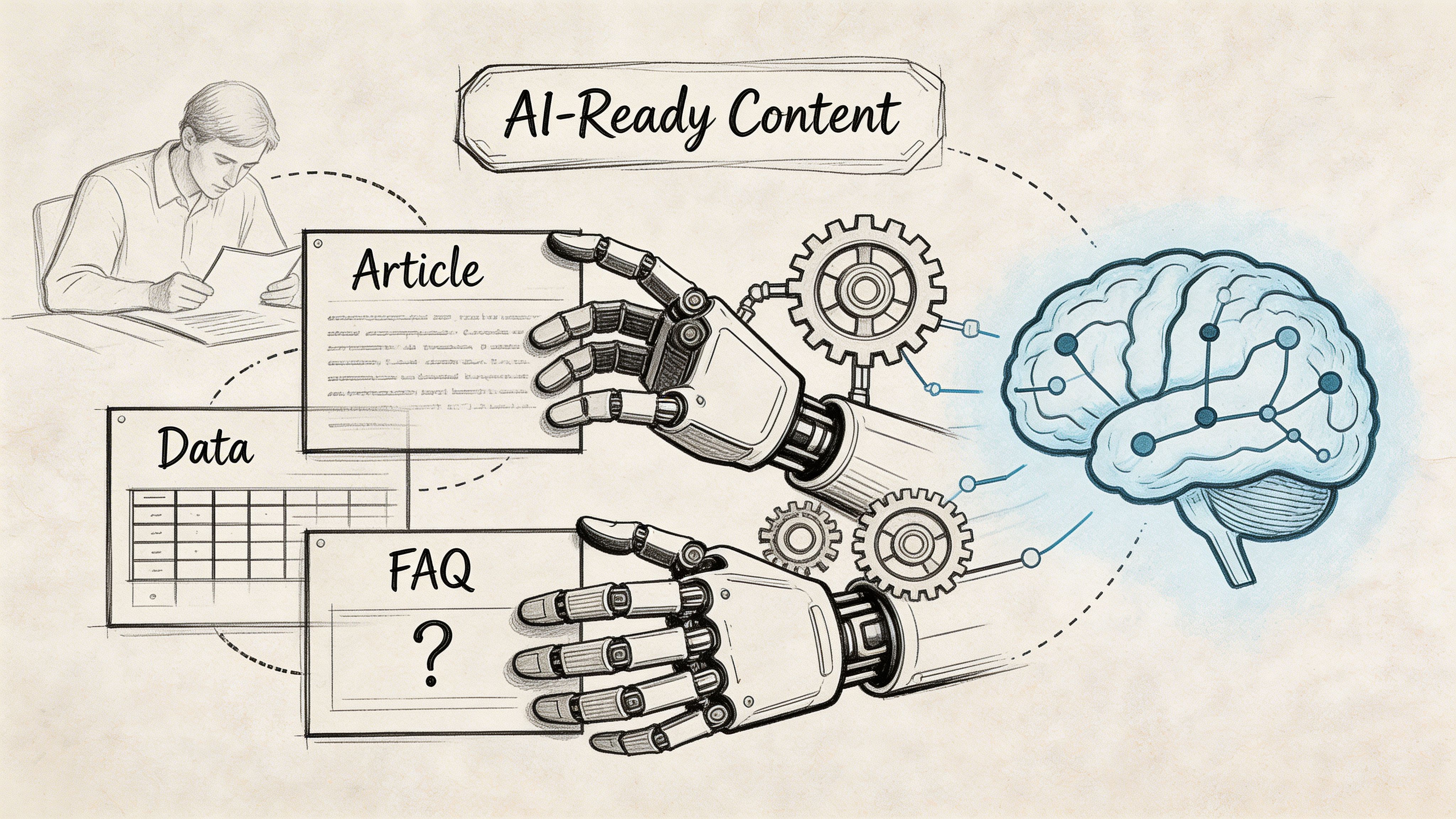
A practical methodology for AI Engine Optimization recommends opening with the exact query in an H2, adding a 2 to 3 sentence answer snippet, using subheadings every 150 to 200 words, and including data tables and expert quotes to improve machine readability and citation potential (Nav43).
Start with answer-first formatting
The opening block under a heading matters more than many teams realize. If your first paragraph wanders through background, definitions, and scene-setting, you've made extraction harder.
Use a pattern like this:
What is seo for ai search SEO for AI search is the practice of making content easy for AI systems to discover, understand, and cite in generated answers. It combines traditional SEO with structured formatting, strong technical signals, and visibility tracking across AI platforms.
That short block does three jobs at once. It answers the question. It defines the topic cleanly. It gives AI systems a reusable snippet.
Build pages in extractable sections
AI systems don't need your prose to be clever. They need it to be legible.
That changes how I structure articles, service pages, comparison pages, and knowledge base content. The best performing layouts tend to share a few traits:
- Exact-match subheadings: Write H2s and H3s that reflect the actual question or topic, not vague labels.
- Short answer blocks: Put a direct response immediately below the heading.
- Predictable hierarchy: Keep the page structure logical so each section stands on its own.
- List-friendly formatting: Use bullets and numbered steps when the information is procedural or comparative.
- Context inside the sentence: Avoid sentences that only make sense when read with the paragraph above them.
Here's the test. If you copy one paragraph out of the page and drop it into a chat result, does it still make sense? If not, rewrite it.
Write for retrieval, not just readability
Readable content is necessary. Retrievable content is what gets cited.
That means avoiding a few patterns that still show up everywhere:
- Long, blended intros: They delay the answer and reduce extraction clarity.
- Soft claims without support: If you make an assertion, anchor it in specifics or explain the basis clearly.
- Over-compressed sections: Dense blocks with several ideas mixed together are harder to parse.
- Generic subheads: "Why it matters" is weaker than "Why AI systems cite structured answers more often."
Content that wins in AI search usually looks more obvious on the page. That's not a downgrade. It's better information design.
A lot of teams resist this because they think direct formatting makes content feel less premium. In practice, the opposite is true. Clear structure makes expertise easier to trust.
Use tables, steps, and quotable passages
Different query types call for different content units. Informational queries often reward concise definitions, comparison blocks, and steps. Commercial queries respond well to decision criteria, limitations, and use-case framing.
A simple content assembly pattern looks like this:
| Content element | Best use |
|---|---|
| Definition snippet | Answering the main question quickly |
| Numbered steps | Process-driven queries |
| Comparison table | Tool, vendor, or feature evaluation |
| Short expert commentary | Adding interpretation and authority |
| Summary bullets | Reinforcing key points for extraction |
If you need additional perspective on how practitioners are adapting page structure and content design, generative engine optimization strategies for 2026 is a useful companion read.
Teams also need better topic research before they draft. Standard keyword research still helps, but it doesn't capture the conversational variants and comparison phrases that show up in AI prompts. That's where broader query mapping matters, especially if you're expanding intent patterns with a workflow like https://surnex.io/seo-suite/keyword-research.
Keep the article human after making it machine-friendly
Many AI content playbooks go wrong at this point. They produce rigid, sterile pages that are technically tidy but forget persuasion.
Good AI-facing content still needs:
- a clear point of view
- examples that help readers judge fit
- honest trade-offs
- plain language
- editorial judgment about what matters most
The goal isn't to flatten the writing. The goal is to expose the useful parts more clearly.
A short walkthrough can help teams visualize the shift from traditional article writing to machine-readable content design:
Mastering Technical SEO for AI Visibility
Content structure gets the attention. Technical scaffolding decides whether that structure is discoverable, interpretable, and worth trusting.
I've seen strong pages miss AI visibility because the technical layer was messy. Not broken enough to disappear from search, but messy enough to make extraction less reliable.
Schema is context, not decoration
Most sites treat schema markup as a checklist item. Add a plugin, validate it, move on.
That leaves value on the table. In seo for ai search, structured data helps machines identify what a page is, what entities it mentions, and how information is organized. It reduces ambiguity. That is a significant payoff.
Useful implementations often include:
- Article markup for primary editorial content
- FAQ markup where the page contains distinct question-answer pairs
- HowTo markup for procedural content
- Product markup on commercial pages that need clearer entity signals
Don't add every schema type you can find. Match schema to the actual page content. Misaligned markup creates noise.
Semantic HTML still matters
A page can look polished in the browser and still be hard to parse under the hood.
Use heading levels in proper order. Keep key information in HTML, not buried inside images. Make sure important copy isn't hidden in interface elements that crawlers may treat inconsistently. Give comparison tables real table markup. Mark lists as lists.
That sounds basic because it is basic. But it's exactly the kind of basic work teams skip when they assume design fidelity equals technical clarity.
Clean semantic structure makes your page easier to interpret before any AI system decides whether your content deserves inclusion.
Internal links should prove topical authority
Topic clusters aren't new, but AI search gives them a more practical role. Internal links show the relationship between concepts, subtopics, and commercial pages.
A useful pattern looks like this:
- Create a strong pillar page around a topic your brand should own.
- Support it with narrower pages that answer distinct sub-questions.
- Link both directions so the crawler can see hierarchy and relevance.
- Use descriptive anchor text that names the concept clearly.
This also helps when you want to monitor whether your authority on a topic is showing up in AI experiences. Teams doing that work typically need a dedicated view into appearance, citation patterns, and competitor gaps such as https://surnex.io/ai-search/ai-visibility.
Long-tail branded queries deserve their own system
A lot of AI-driven discovery doesn't start with broad category keywords. It starts with brand-inflected questions.
That includes searches like your brand versus a competitor, your product with a specific integration, your pricing for a niche use case, or your service for a particular market. Almcorp argues that the primary battleground for organic visibility in 2026 is long-tail branded queries, and that conversational AI amplifies them 3x (Almcorp).
Most SEO programs barely monitor these variations. That's a mistake.
Here is where technical and content work meet. Build pages and supporting sections that address branded comparisons, implementation details, support scenarios, and adjacent use cases in clear language. Then make sure your site architecture helps crawlers connect those answers back to your core brand and product entities.
What usually fails
Teams often overinvest in headline technical tasks and underinvest in consistency. The failures tend to be repetitive:
- Schema with no matching page structure
- Fast pages with weak information architecture
- Great content buried in thin category trees
- Branded query opportunities with no dedicated page or section
- JavaScript-heavy experiences that hide useful text
If your technical SEO is solid for normal search, you're not starting over. But you do need to tighten the relationship between your markup, page semantics, internal links, and branded query coverage. That's the layer AI systems depend on when they decide what to cite.
Measuring What Matters in AI Search
AI search creates a reporting problem that old dashboards don't solve well. You can gain visibility and lose clicks at the same time. You can influence demand before a session exists. You can appear in answers without owning the visit.
That's why traffic-only reporting breaks down.
The useful question has changed
The old question was, "Did this page get the click?"
The better question now is, "Did this brand influence the answer?"
That doesn't mean clicks stop mattering. It means they're no longer the only defensible sign of SEO impact. Search Engine Land notes that being cited in an AI Overview can lift effective CTR from 0.6% to 1.08%, and that AI-derived traffic converts at 6.24% versus 3.29% for traditional organic traffic (Search Engine Land).
That combination is why teams need two views at once. Influence first. Visits second.
Evolving SEO KPIs Traditional vs. AI Search
| Metric Focus | Traditional SEO KPI | AI Search KPI |
|---|---|---|
| Visibility | Rank position | AI visibility share across answer surfaces |
| SERP presence | Impressions | Citation frequency in AI responses |
| Traffic | Organic clicks | Assisted visits after AI exposure |
| Brand impact | Branded search lift | Brand mentions in AI answers |
| Engagement | Bounce rate, pages per session | Downstream actions from AI-assisted sessions |
| Content performance | Page-level ranking movement | Which content blocks get cited and for what prompts |
This table matters because it helps explain performance changes to clients and executives without forcing every result into a sessions chart.
Build reporting around influence and evidence
A useful AI search dashboard usually includes:
- Citation tracking: Which pages and domains are cited for target prompts
- Share of presence: How often your brand appears versus competitors
- Prompt grouping: Informational, commercial, branded, and comparison prompts
- Content source mapping: Which URLs fuel mentions most often
- Business correlation: Leads, assisted conversions, demo requests, or revenue tied to AI-influenced journeys
Notice what isn't on that list. Average position as the main story.
Average position still helps diagnose issues. It just doesn't tell the whole story anymore.
If a stakeholder only sees falling clicks, they may think SEO is slipping. If they also see that the brand is showing up more often in AI answers for high-intent prompts, the conversation changes.
Track by journey stage, not only by page
Better reporting starts to feel strategic instead of reactive at this stage.
Map prompts and citations to journey stages. Educational questions signal awareness. Comparison prompts signal evaluation. Brand-plus-use-case prompts often signal decision. Once you view AI visibility this way, you stop treating all mentions as equal.
You also get a much clearer audit process. The right workflow is to review prompt sets regularly, identify citation gaps, compare competitors, and feed those findings back into content and technical priorities. A dedicated process like https://surnex.io/workflows/ai-visibility-audit fits this model because it turns scattered checks into a repeatable operating rhythm.
The companies handling AI search well aren't pretending old SEO metrics are useless. They're no longer letting those metrics define reality by themselves.
Unifying Your AI and SEO Workflows
The tactical advice around AI search is manageable. The operational reality is not.
One team member checks Google AI Overviews manually. Another tests prompts in ChatGPT. Someone else reviews rankings in a separate SEO tool. Backlink data sits elsewhere. Technical audits live in another tab. Reporting becomes a patchwork of screenshots, exports, and explanations that are hard to defend.
That is the primary bottleneck.
Tool sprawl creates blind spots
A June 2025 analysis highlighted a problem many agencies and in-house teams already feel. There is a lack of unified tools for benchmarking visibility across multiple LLMs, and traditional SEO tools can show up to a 40% variance in brand visibility across different AI models (Shoreline Digital).
That variance matters. If your brand is visible in one AI environment and nearly absent in another, you don't have a single search story. You have several partial stories.
Manual checks won't scale across clients, markets, product lines, and prompt types. They also won't hold up in reporting cycles. Too much depends on whoever ran the prompt, when they ran it, and how they documented it.
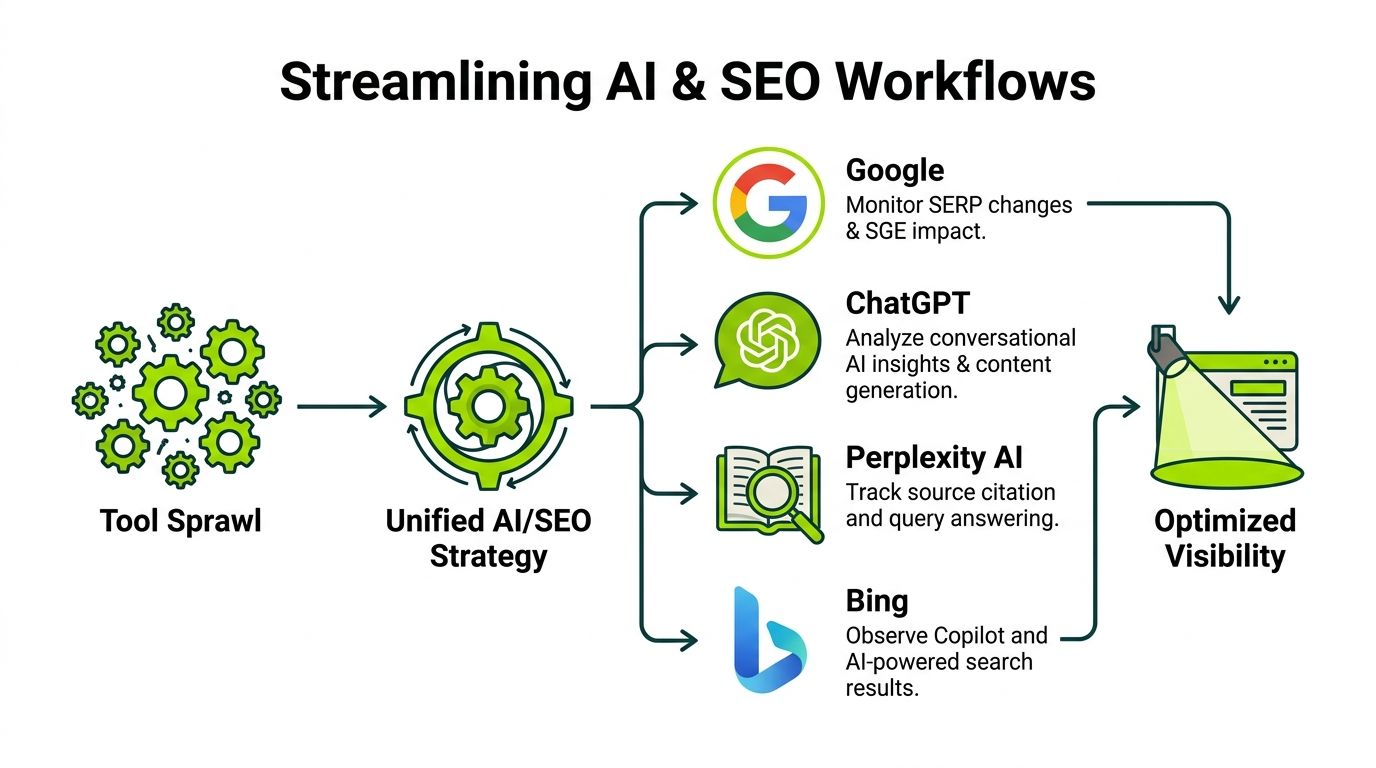
What a unified workflow should include
A credible operating setup needs to bring four functions together:
| Function | Why it matters |
|---|---|
| AI visibility monitoring | Shows where your brand appears across AI answer surfaces |
| SEO performance context | Connects AI visibility with rankings, backlinks, and technical health |
| Competitive benchmarking | Reveals who is getting cited when you are not |
| Automation and reporting | Makes recurring audits and stakeholder updates repeatable |
Without that consolidation, teams spend too much time reconciling systems instead of improving visibility.
The practical case for one dashboard
The strongest argument for unification isn't convenience. It's decision quality.
When AI visibility, organic rankings, backlinks, and technical issues sit together, you can answer questions that siloed tools can't handle well:
- Did a content refresh increase citations but not clicks?
- Are competitors outranking us, or just getting cited more often?
- Which pages support branded AI discovery versus broad informational coverage?
- Are technical issues affecting crawlability and AI appearance at the same time?
Those are the questions clients and leadership teams ask now. They want interpretation, not just exported metrics.
One option in this category is Surnex, which combines AI visibility tracking with core SEO signals such as rankings, backlinks, audits, and content opportunities in one dashboard and API. For agencies and in-house teams, that kind of setup is useful because it reduces the need to stitch together separate point tools just to explain what's happening.
The workflow that wins isn't the one with the most data sources. It's the one that turns cross-platform visibility into clear next actions.
Manual workflows still have a place
Not everything needs to be automated.
For small prompt sets, sensitive branded queries, or executive review, manual testing still adds value. It helps practitioners see phrasing nuances, answer composition, and citation patterns firsthand. But manual review should be a layer on top of a system, not the system itself.
The mature model is simple. Use platform-level tracking for ongoing measurement. Use manual review for interpretation. Feed both into one reporting loop.
That's how teams stop chasing AI search as a collection of scattered experiments and start managing it like a serious channel.
Building a Resilient Search Strategy for 2026 and Beyond
The firms that do well in AI search won't be the ones that react fastest to every new interface. They'll be the ones that build durable habits.
That means accepting a few permanent shifts. Clicks aren't the only prize anymore. Citations, mentions, and answer inclusion now matter. Keywords still matter, but structure and entity clarity matter more than before. Rankings still matter, but they no longer explain the full picture.
A resilient strategy has three layers.
First, publish content that answers real questions in formats machines can extract and humans can trust. Direct definitions, tight hierarchies, tables, comparisons, and honest trade-offs beat vague thought leadership every time.
Second, maintain technical discipline. Clear schema, semantic HTML, strong internal links, and branded long-tail coverage give AI systems a cleaner map of what your site knows.
Third, run search as one intelligence system instead of a pile of disconnected reports. If your team can't compare Google, ChatGPT, Perplexity, and traditional SEO signals in one working view, you'll spend too much time explaining shifts and not enough time acting on them.
That's the practical heart of seo for ai search. Build a site that machines can understand, build content worth citing, and measure influence where users discover brands now.
Common Questions on AI Search Optimization
Should you block AI crawlers
Usually, no.
If your goal is visibility in AI-generated answers, blocking access works against that goal. There may be legal or content licensing reasons to limit access in some cases, but most marketing teams want controlled participation, not blanket exclusion. Decide by content type and business model, not by fear.
Does E-E-A-T matter more in AI search
Yes, but not as a slogan.
AI systems need signals that your content is credible, specific, and tied to a real entity. In practice, that means clear authorship, defensible claims, strong topic coverage, helpful examples, and site-level consistency. Adding an author box won't fix weak content.
Can smaller brands still compete
Yes, especially on focused topics and branded edge cases.
Smaller brands often lose when they chase broad head terms with generic content. They do better when they publish specific comparisons, implementation guidance, niche use cases, and direct answers tied to real expertise. AI systems often need the clearest answer, not just the biggest site.
Should you use AI to create content
Yes, with editorial control.
This isn't controversial anymore. Eighty-six percent of SEO professionals have integrated AI into their workflows, with 65% reporting better results and 67% noting improved content quality (SEOSherpa). The right use is acceleration, not abdication.
Good teams use AI to help with:
- Research expansion: surfacing prompt variations and supporting angles
- Content briefs: organizing topics, objections, and structure
- Draft support: speeding up first versions for human revision
- Content maintenance: updating formatting and identifying gaps
Bad teams use AI to mass-produce interchangeable pages with no original judgment.
What content types work best for AI visibility
The most reliable winners are usually pages that are easy to extract from and easy to trust.
That often includes:
- Glossary and definition pages with direct answer blocks
- Comparison pages that explain trade-offs clearly
- How-to content with ordered steps
- FAQ sections that map to real user questions
- Product and service pages that explain fit, limits, and use cases
The common thread isn't the format. It's whether the content gives a clean, self-contained answer with enough context to be reusable.
How often should teams review AI visibility
More often than quarterly.
AI answer surfaces shift quickly. A prompt that cites your brand today may cite a competitor after a content update, SERP change, or model adjustment. Weekly or ongoing monitoring is usually more practical than occasional spot checks, especially for agencies and large in-house teams managing multiple categories.
What's the biggest mistake teams make
They treat AI search like an overlay on top of the old SEO program instead of a change in how discovery works.
That leads to shallow fixes. A schema update here. A rewritten intro there. But no new measurement model, no prompt tracking, and no cross-platform workflow. The teams getting traction are the ones building for retrieval, citation, and operational clarity at the same time.
If your team needs a clearer way to monitor brand presence across AI search and traditional SEO without juggling a stack of disconnected tools, Surnex is built for that workflow. It gives agencies, in-house teams, and developers a single place to track AI visibility, citations, rankings, backlinks, audits, and content opportunities so reporting and decision-making stay tied together.