Google AI Overviews now reach 2 billion monthly users globally, and when those summaries appear, only 8% of users click the regular search results below them, compared with 15% without summaries, according to Semrush's AI SEO statistics. That changes the job.
A monthly rank report used to be enough for many teams. It isn't anymore. If your monitoring still starts and ends with blue-link positions, you're tracking a shrinking slice of search behavior while missing where brand visibility is being won or lost.
Automated SEO monitoring now has to do three things at once. It has to watch technical health continuously. It has to track traditional organic visibility at the page, query, and SERP feature level. And it has to capture AI-era presence, where the user may never click but still forms an opinion, picks a vendor, or ignores your brand entirely.
The teams that adapt aren't just buying more alerts. They're building systems that collect signals, score impact, route issues to the right owner, and create response workflows through APIs. That's the part most setups still miss.
Why Your Old SEO Playbook Is Now Obsolete
The old playbook assumed search visibility meant ranking in a list and earning a click. That model has broken.
When AI-generated answers sit above the traditional results, user behavior shifts fast. Search teams feel this first in branded traffic patterns, in lower CTR on queries that still hold position, and in client conversations that start with, “We still rank. Why are clicks softer?” The answer is often simple. The SERP is no longer a list-first experience.
Manual checks can't keep up with that change. A consultant reviewing a few keywords on Monday morning won't catch what happened across devices, locations, SERP features, and AI surfaces by Wednesday afternoon. By then, a competitor may already be the brand cited in the answer layer while you're still celebrating a stable position-two ranking.
This is why automated SEO monitoring has moved from convenience to operating requirement. It's not just for enterprise teams with large stacks. Any agency or in-house team that reports on organic growth needs a way to detect changes before the monthly report explains them too late.
Traditional rank tracking still matters. It just no longer describes the whole search experience.
The practical shift is from periodic review to continuous observation. That means monitoring indexation, page health, SERP feature ownership, and AI visibility in one workflow. It also means changing how you explain performance to clients and stakeholders. “We rank well” is now weaker than “we appear consistently where users make decisions.”
If you need a deeper view of how search behavior is changing, this guide to SEO for AI search is a useful companion to the monitoring side of the work.
What Automated SEO Monitoring Really Means
The phrase is often used loosely. It refers to scheduled rank checks, a crawl every so often, and maybe a few Search Console alerts. That's partial automation, not a monitoring system.
A working definition is simpler than it sounds. Automated SEO monitoring is an always-on operational layer that watches the signals most likely to affect search visibility, traffic quality, and revenue, then routes those signals into action. Think of it as a digital nervous system for your website. It senses problems, detects movement, and tells the right part of the organization to respond.
Monitoring is not the same as reporting
Reporting explains what happened. Monitoring catches what's changing while you still have time to intervene.
That distinction matters because the market is investing heavily in automation. The global SEO software market was valued at USD 85.97 billion in 2025 and is projected to reach USD 271.9 billion by 2034, with a 13.65% CAGR, according to Fortune Business Insights. Teams aren't spending that kind of money to get prettier monthly PDFs. They're buying speed, coverage, and fewer blind spots.
What a real monitoring system includes
A practical setup usually covers several layers of observation:
- Technical health: Crawlability, indexability, canonicals, redirects, status codes, structured data validity, and performance regressions.
- Search performance: Query groups, landing page shifts, CTR changes, impressions, and SERP feature ownership.
- Competitive movement: Which competitors gain answer-surface visibility, featured placements, or local prominence for your target topics.
- AI-era visibility: Whether your brand appears in AI-generated answers, how often it's cited, and in what context.
A lot of teams stop at alerts. That's where bad automation starts. Alerts without triage create noise. Noise gets muted. Once the channel is muted, you're back to manual discovery, only now with a false sense of coverage.
Operational rule: If an alert doesn't map to an owner, a severity level, and a next action, it's not monitoring. It's inbox clutter.
What works and what doesn't
A simple comparison makes the difference clear:
| Approach | What it catches | What it misses |
|---|---|---|
| Manual spot checks | Obvious ranking drops, visible page issues | Fast-moving SERP changes, AI answer visibility, issue timing |
| Basic automated alerts | Single-metric anomalies | Context, prioritization, remediation path |
| Full automated SEO monitoring | Technical issues, visibility shifts, AI citations, routed actions | Very little, if configured well |
The strongest systems are boring in the best way. They run on schedule, compare states, classify impact, and push the result into Slack, Jira, email, dashboards, or your internal data layer. Teams don't need more dashboards they have to remember to open. They need monitored conditions tied to decisions.
Key Signals to Monitor in the AI Search Era
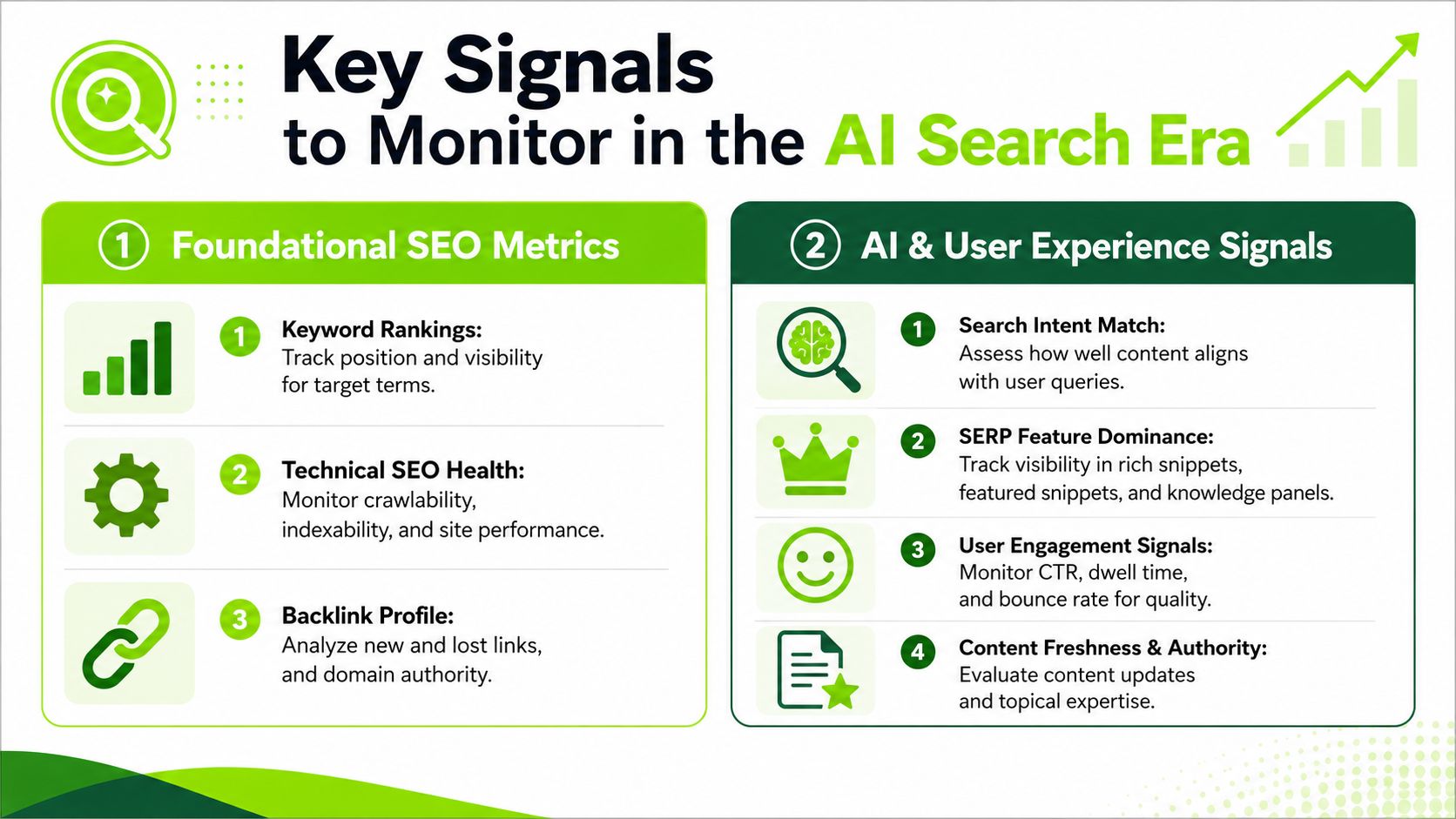
The monitoring list is bigger now, but it doesn't need to be messy. I'd split it into two groups. Foundational SEO signals protect your ability to be found. AI visibility signals measure whether searchers encounter your brand in the new answer-driven layer.
State-of-the-art monitoring systems now track keyword rankings and SERP feature visibility, including AI Overviews, on a daily basis. That creates a 25% increase in opportunity identification speed compared with manual audits by spotting meaningful movement within 24 hours, according to Sedestral's overview of automated SEO monitoring.
Foundational signals that still carry the stack
These are still the first things I'd monitor because they tell you whether your site can compete at all.
- Index coverage health: Watch for excluded pages, unexpected noindex patterns, canonical drift, and sitemap mismatch.
- Crawl integrity: Track broken internal links, redirect chains, orphaned pages, and crawl depth shifts on key templates.
- Core experience issues: Monitor page speed and rendering problems where they affect key landing pages and templates.
- Backlink change patterns: Not just total links. Watch valuable referring domain gains and losses around revenue-driving pages.
- CTR and landing page anomalies: Stable rankings can still hide demand leakage if snippets, intent match, or answer-surface competition changes.
The mistake I see most often is teams monitoring these in separate tools without a common issue model. The crawl tool says one thing, Search Console says another, and no one joins the dots. You need a signal layer that can correlate technical cause with search outcome.
New AI visibility signals most teams still ignore
Old monitoring setups fail here.
Traditional rankings don't tell you whether an AI answer mentioned your brand, cited a competitor, pulled your content without attribution, or summarized the topic in a way that shuts down clicks entirely. In the AI search era, you need new KPIs.
A practical shortlist:
- AI recommendation frequency: How often your brand is mentioned for target prompts or local-intent queries.
- Citation presence: Whether AI surfaces cite your domain, a third-party review site, a marketplace listing, or a competitor instead.
- Citation context: Are you being framed as a leader, an alternative, a budget option, or not included at all.
- Answer-surface share: Whether your content appears in AI Overviews and other answer experiences for high-value themes.
- Prompt cluster coverage: Which query clusters reliably trigger your brand across AI systems and which clusters leave a gap.
That requires a different monitoring mindset. Position tracking is ordinal. AI visibility is probabilistic and contextual.
For teams building competitive monitoring into this layer, this practical guide to SEO competition is useful because it pushes beyond rank tables and into structured market observation. For AI-specific tracking, an AI Overview tracker is the kind of capability you now need in the stack, not as a novelty feature but as a standard monitoring surface.
A simple way to prioritize the signal set
I'd classify monitored signals by operational value:
| Signal group | Best use | Owner |
|---|---|---|
| Technical integrity | Prevent invisibility and crawl waste | SEO lead, developer |
| Performance movement | Detect traffic and CTR shifts | SEO strategist, analyst |
| SERP feature visibility | Find opportunity gaps fast | Content lead, SEO manager |
| AI citation and recommendation signals | Measure brand presence in answer engines | SEO lead, brand, content |
If a signal can't change what someone does this week, don't monitor it at high frequency.
That rule cuts dashboard bloat fast.
How to Architect Your Monitoring System
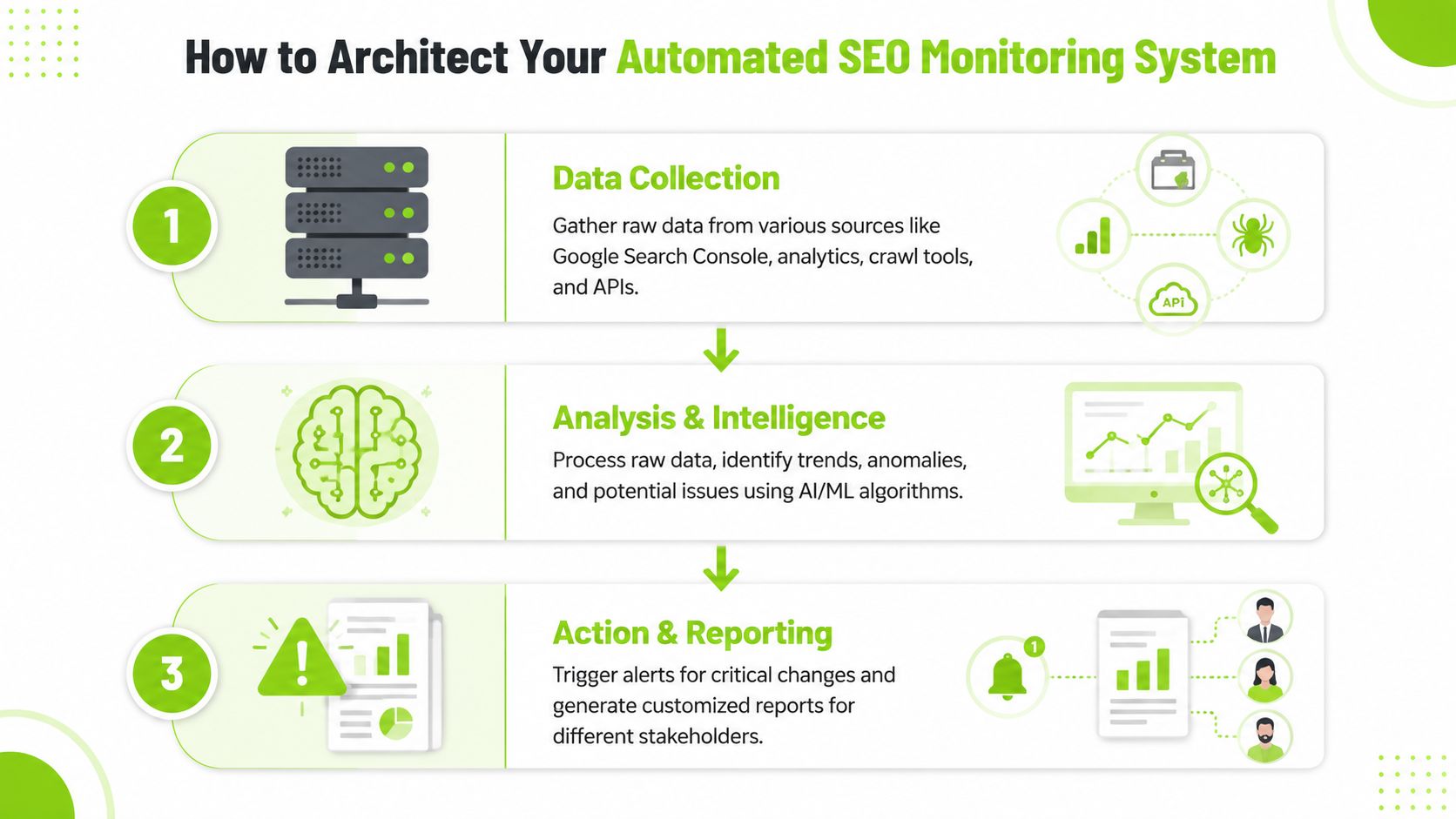
A monitoring system that scales has one job at each layer. Collect evidence. Evaluate change. Route the result to the system or team that can act on it.
For SEO teams dealing with AI search, that architecture has to cover more than crawl errors and rank drops. It also needs to ingest volatile surfaces such as AI Overviews, citation changes, SERP feature shifts, and page-level behavior signals, then normalize them into events your stack can process. If those signals stay trapped in separate dashboards, monitoring stays passive.
Layer one gathers raw evidence
Start with collection. In practice, that means scheduled crawls, Search Console exports, analytics data, rank tracking, log files if you have them, and AI visibility data if your team is monitoring answer engines.
Cadence matters, but consistency matters more. A daily crawl with stable extraction rules is more useful than an ad hoc crawl with changing fields. Good systems compare states over time, so every source needs clear schemas, timestamps, and page identifiers. Without that, you cannot tell whether a drop in indexed URLs, AI citations, or CTR reflects a real issue or a collection mismatch.
I usually separate collection into two buckets: site-state data and search-state data. Site-state tells you what changed on your properties. Search-state tells you what changed in Google, Bing, or AI answer surfaces. You need both to isolate cause.
Layer two applies logic and routing
The second layer turns raw inputs into events with context. n8n, Make, Zapier, serverless functions, or internal jobs can all handle this if the rules are defined well.
A useful flow looks like this:
- A crawl, API pull, or SERP collection job completes.
- Rules check for material changes, such as indexable URL loss, canonical drift, schema failure, AI Overview appearance loss, or unusual title rewrites.
- The event is enriched with business context such as template type, traffic value, owning team, and recent deployment history.
- Severity is assigned based on impact and confidence.
- The event is pushed to the right destination, such as Slack, Jira, email, or an internal dashboard.
The trade-off here is simple. Low thresholds create noise. High thresholds miss early warnings. Agency teams usually need different thresholds by client maturity, site size, and revenue sensitivity. An ecommerce faceted navigation issue deserves a different rule set than a publisher seeing a temporary fluctuation in AI citation share.
Teams that already run observability programs in other channels will recognize the pattern. Guidance on best practices for observable email workflows maps well to SEO monitoring because the same operational rules apply: structured events, clear ownership, retry logic, and alert fatigue controls.
Layer three converts signals into decisions
The third layer should reduce review time, not pretend to replace it.
LLMs are useful for summarizing diffs, classifying likely root causes, clustering related issues, and drafting remediation notes for analysts or developers. They are less useful when asked to decide whether a production change should ship automatically. For technical SEO, false confidence is expensive. A bad classification can send the wrong ticket to engineering or bury a revenue-impacting issue under low-priority noise.
That is why I prefer a constrained output format. Feed the model structured inputs, limit the prompt to specific tasks, and require fields such as issue type, confidence, affected templates, likely cause, and recommended owner. Free-form summaries look polished but are harder to validate and harder to plug into workflows.
Here's the architecture in a compact view:
| Layer | Typical tools | Main output |
|---|---|---|
| Data collection | Screaming Frog, GSC, analytics APIs, rank trackers, AI visibility trackers | Structured raw events |
| Automation and rules | n8n, Make, Zapier, webhooks, internal scripts | Diffs, enrichment, severity, routing |
| Decision support and delivery | LLMs, Slack, Jira, email, dashboards | Summaries, tickets, review-ready recommendations |
Where APIs matter most
APIs make the system operational. They let you pull crawl and SERP data on a schedule, merge it with page and query metrics, push normalized issues into project management systems, and trigger downstream actions without manual copying between tools. For a practical breakdown of how this works, see our guide to using a seo tool api.
This matters even more in the AI search era because the signal set is fragmented. Traditional rank data, AI Overview presence, citation frequency, backlink shifts, crawl anomalies, and content changes often live in different products. If those systems cannot exchange data cleanly, your team ends up reviewing screenshots instead of managing events.
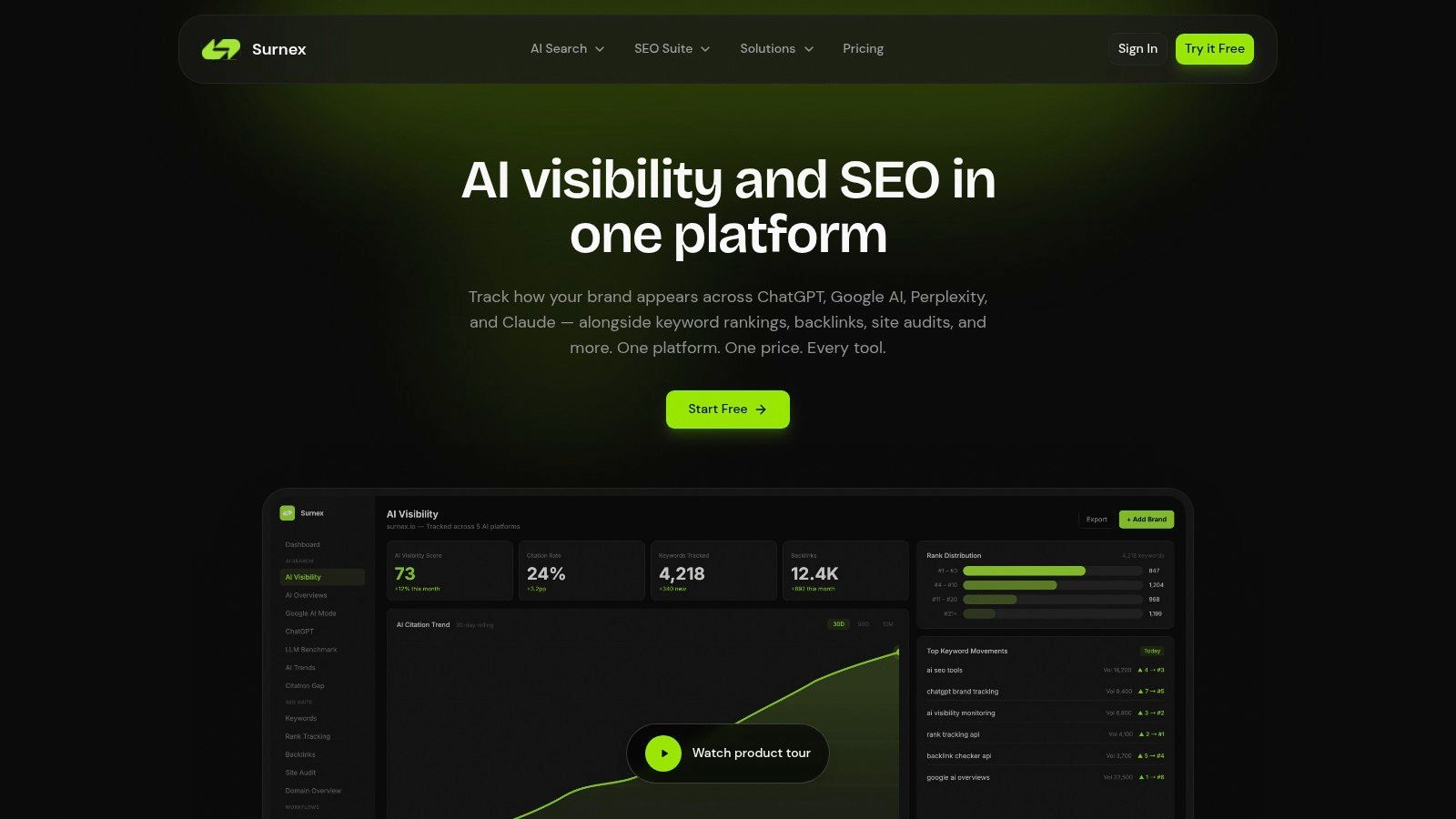
Surnex is one option if you need a single layer for AI visibility tracking, rankings, backlinks, audits, and API access. A custom stack can work just as well if the event model stays stable. Keep the architecture modular, store historical states, and avoid tying business logic to one vendor interface. That gives you room to swap tools without rewriting the monitoring program.
From Alerts to Action With Automated Workflows
Most monitoring systems fail after detection. They create alerts, then stop. The alert lands in Slack or email, someone glances at it, and no one is sure whether it needs content, development, analytics, or client communication.
That's why response playbooks matter more than another dashboard widget.
There's a useful framing from technical SEO automation work: 30% of SEO tasks are automatable, but the value shows up when monitoring is paired with response playbooks for the 70% of work that still needs human review. That combination can save 15 to 20 hours per week on workflows like broken link monitoring and schema handling, according to Dropforce Digital.
Scenario one when indexation drops on a money template
The wrong setup sends a generic message: “Index coverage changed.”
The right setup does more. It checks whether affected URLs belong to a revenue-driving template, compares the current canonical and robots state against the previous crawl, enriches the issue with impression loss from Search Console, and then creates a ticket with a severity tag. The workflow posts the summary to the developer channel, alerts the SEO lead, and opens a client-facing note only if the impact threshold is met.
That's what “automated” should mean. Not just detection. Detection plus context plus routing.
A fast alert is only useful if it arrives with enough evidence for someone to act without starting from zero.
Scenario two when a competitor starts owning the answer layer
This one matters more in the AI search era.
Suppose your monitoring picks up that a competitor is now appearing in AI-generated answers across a topic cluster tied to commercial intent. A raw alert won't help much. A useful workflow groups the affected prompts, checks which of your pages are nearest in topic, summarizes content gaps, and sends the brief to the strategist or editor responsible for that content area.
After the initial issue story, this walkthrough shows the orchestration pattern well:
Build response rules before you add more alerts
I'd define playbooks around a few issue classes first:
- Technical breakages: Indexation loss, canonical errors, broken internal pathways, invalid structured data.
- Visibility losses: Query clusters with CTR drops, SERP feature loss, declining AI citations.
- Competitive movement: New competitor ownership across answer surfaces or feature-rich SERPs.
- Content decay signals: Pages losing freshness, internal support, or intent alignment.
Each playbook should answer four things:
- Who owns the first review
- What evidence must be included
- Which tool receives the task
- When escalation happens
Without that, automated SEO monitoring creates more notifications than outcomes.
Reporting Templates for Agencies and Developers
The strongest monitoring programs report from one data layer but speak in different languages. Clients want to know what changed, what it means, and what happens next. Developers want the exact condition, scope, and urgency. If you give both audiences the same dashboard, one side gets bored and the other gets lost.
Client-facing template for agencies
Agency reporting should translate monitored signals into business-facing narratives. That doesn't mean dumbing the data down. It means organizing it around visibility, risk, and opportunity.
A useful client dashboard usually includes:
- AI visibility summary: Where the brand appears in AI answer surfaces and where it doesn't.
- Organic visibility movement: Important query groups, page groups, and SERP feature changes.
- Priority issues: Only the technical findings that materially affect discovery or lead capture.
- Opportunity queue: Topic clusters, page updates, and competitive gaps worth acting on next.
- Action log: What your team changed since the last reporting period.
If you want a good reference point for how SEO tools package performance data for non-technical users, this article on understanding SEO performance tools is worth a look.
Developer-facing template for internal teams
The internal engineering view should do the opposite. Strip out the storytelling and increase operational detail.
Here's a side-by-side model:
| Reporting audience | Primary questions | Best view |
|---|---|---|
| Agency clients | Are we more visible, where are risks, what should we fund next | Executive summary with trend snapshots |
| Developers | What broke, where, how severe, what changed since last good state | Issue queue with technical evidence |
For developers, I'd include:
- Indexation exceptions by template
- Crawl errors grouped by root cause
- Schema validation failures
- Page groups with performance regressions
- Webhook or API sync failures if the monitoring stack depends on them
One dataset, two narratives
Many agencies lose efficiency. They build one report for the client and another for the delivery team, but the two reports are manually assembled from different sources. That creates drift.
A better approach is to build one normalized event model, then display it differently depending on the viewer. The same issue can appear as “product pages dropped from search visibility” for the client and “canonical mismatch across product template after release” for the developer.
For search performance reporting specifically, a dedicated keyword rankings and visibility report structure helps because it bridges the gap between classic positions and broader visibility patterns. That's the language clients increasingly need.
Good reporting doesn't add more charts. It reduces interpretation time.
The Future of SEO Is Autonomous
The future of SEO isn't a fully hands-off machine that replaces strategists. It's a monitored, API-connected system that handles repeatable detection, organizes evidence, and gives human teams better decisions.
That aligns with where the work already is. 70% of SEO still requires human expertise, especially strategy, content quality, and PR, while 30% of tasks like rank tracking and technical audits are the right candidates for automation, as outlined by NextGrowth. That balance matters even more in AI search, where visibility depends on context and citation, not just rank.
The practical takeaway is simple. Don't try to automate everything. Automate the checks you already know you should never miss. Then connect those checks to owners, tools, and response rules.
Start with one critical workflow. Index coverage on revenue pages is a strong first choice. If you can detect it, classify it, and route it cleanly, you've already moved from reactive SEO to operational SEO.
Surnex gives agencies, in-house teams, and developers a practical way to monitor traditional SEO signals alongside AI visibility in one place. If you're building a modern search monitoring stack and want a platform with unified dashboards and agent-ready APIs, take a look at Surnex.