So, what exactly is an AI overview tracker? Think of it less like a traditional rank tracker and more like your personal intelligence agent for the new world of search. It’s a tool built specifically to tell you when, where, and how your brand gets featured inside those AI-generated summaries at the top of Google.
Instead of just tracking a blue link on a list, it shows you if you’re actually part of the answer.
Why AI Overview Tracking Is Now Essential
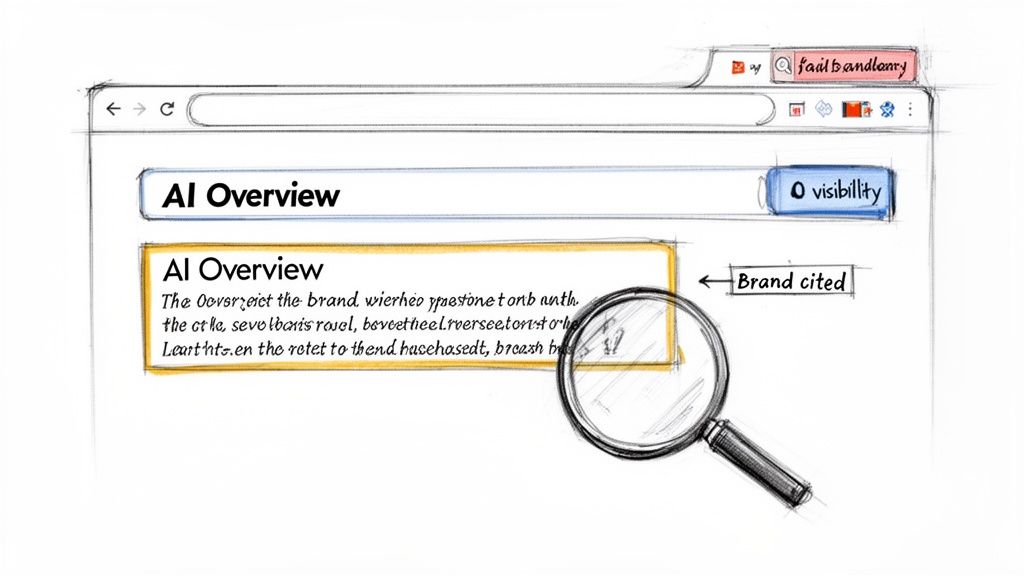
For decades, the goal was simple: get to the top of the search results page. But that page, with its familiar list of ten blue links, isn't the main event anymore. Today, users get instant, summarized answers from AI, completely changing how they find information.
An AI overview tracker is your only real window into this new reality. While older tools might tell you you’re ranking number one, this tool answers the questions that actually matter now: Are you being seen at all? Are you cited as a source?
The Shift from Clicks to Citations
The game has fundamentally changed. The goal is no longer just to win a click, but to become a trusted source that the AI models themselves rely on and cite. By 2026, the impact is impossible to ignore.
We’ve seen Google’s AI Overviews appear in nearly 55% of all global searches. This has pushed zero-click searches to an all-time high of 58%, causing organic click-through rates on those queries to plummet by as much as 61%.
This is a massive change. Even if your site holds the top organic spot, you could be completely invisible to the majority of users who get their answer from the AI Overview and never scroll down. Many publishers have already reported traffic drops of 20-40% since AI Overviews rolled out, which shows just how urgent it is to adapt.
This shift in user behavior means our metrics have to shift, too. Old-school rank tracking is becoming a vanity metric in a world where visibility happens inside the AI's answer.
Here’s a quick look at how the focus has evolved:
Traditional SEO vs AI-Driven Search Intelligence
| Metric Focus | Traditional SEO (Pre-AI) | Modern Search Intelligence (With AI Overviews) |
|---|---|---|
| Primary Goal | Top 10 organic rankings | Being cited as a source within the AI Overview |
| Key Metric | Keyword ranking position | Citation frequency and share of voice |
| Success Indicator | High click-through rate (CTR) | Appearance in AI answers for key user prompts |
| Reporting Focus | Traffic from organic search | Brand mentions and source links inside the AI model |
As you can see, the new KPIs are all about influence and authority, not just position. An AI overview tracker is built to measure this new reality.
It helps you focus on what moves the needle today:
- Citation Frequency: How often does the AI mention your brand or cite your content?
- Share of Voice: In your niche, what percentage of AI answers feature you versus your competitors?
- Prompt Coverage: Which specific questions and user prompts trigger the AI to use your content as a source?
Tracking these new signals allows you to prove your value far beyond organic clicks, which are quickly becoming a less reliable measure of success. It's how you build a content strategy that will keep you relevant for years to come. For a deeper look, check out our guide on what Google AI Overviews are and how they're put together.
Understanding the New Search Landscape
For years, we all played the same game: get to the top of Google's ten blue links. That game is over. The search results page we knew is changing faster than ever, and it's because user expectations have fundamentally shifted. People don't just want a list of websites anymore; they want answers, right now.
This has split the world of search into two new, AI-powered arenas.
First, you have Google's AI Overviews. You've seen them—they're the detailed summaries that pop up at the top of the results, pulling bits and pieces from different sites to create one cohesive answer. It’s still Google, but the way users interact with it has been completely upended.
Then you have conversational AI platforms like ChatGPT. More and more, people are skipping search engines altogether and using these tools for discovery and recommendations. It's like having a conversation with a research assistant, and it represents a massive new channel that exists entirely outside of traditional search.
A Bigger Pie, Not a Stolen Slice
It’s tempting to look at AI Overviews and think they're just cannibalizing clicks from the organic results below. But when you step back and look at the whole picture, that’s not what’s happening. This evolution is actually making the entire search "pie" bigger.
The numbers tell a fascinating story. Recent data shows that the combined activity across traditional search and LLMs is up by 26% globally. While it's true that AI Overviews can crater clicks to websites—sometimes by as much as 58%—you have to look at the other side of the coin. Platforms like ChatGPT now draw 800 million weekly users and account for a staggering 20% of all search-related activity. For more on this, the team at position.digital has compiled some compelling AI SEO statistics.
So, people are searching more, not less. The opportunities haven't vanished; they've just scattered. The key isn't just to rank anymore. It's to become the trusted source the AI itself relies on.
The New User Journey
You have to get your head around this new user path. For a huge number of queries—especially questions starting with "what," "how," or "best"—the first thing a user sees is an AI Overview. In this new reality, the biggest win is getting cited.
When your site is featured as a citation in an AI Overview, it does three powerful things at once:
- Builds Authority: You’re instantly positioned as a credible expert, endorsed by the AI in front of the user.
- Drives Qualified Traffic: Anyone who does click a citation link is already highly engaged. They’ve seen your name, they trust the context, and they want to learn more.
- Establishes Brand Recall: Even without a click, your brand name gets seen. That exposure builds familiarity and trust over time.
This is a complete reversal of the old SEO model. We're no longer just jostling for a click in a list of ten. The new goal is to be woven directly into the fabric of the answer. If you want a deeper dive, our guide on how Google's AI mode operates breaks it all down.
An AI overview tracker is the essential tool that gives you the visibility to compete and win in this new environment.
What an AI Tracker Should Actually Measure
If you're still obsessing over traditional rankings, you're looking in the rearview mirror. The move to AI-driven search means we need a whole new dashboard of metrics. A good AI overview tracker does more than just tally up mentions—it paints a detailed picture of your visibility and authority inside the AI’s answers.
To really get a handle on your performance, you have to look past simple presence and start measuring the quality and impact of every appearance.
This shift in focus can feel big, so let’s break it down. Think of the search world now as having three main lanes: traditional blue links, AI Overviews, and direct conversations with Large Language Models (LLMs).
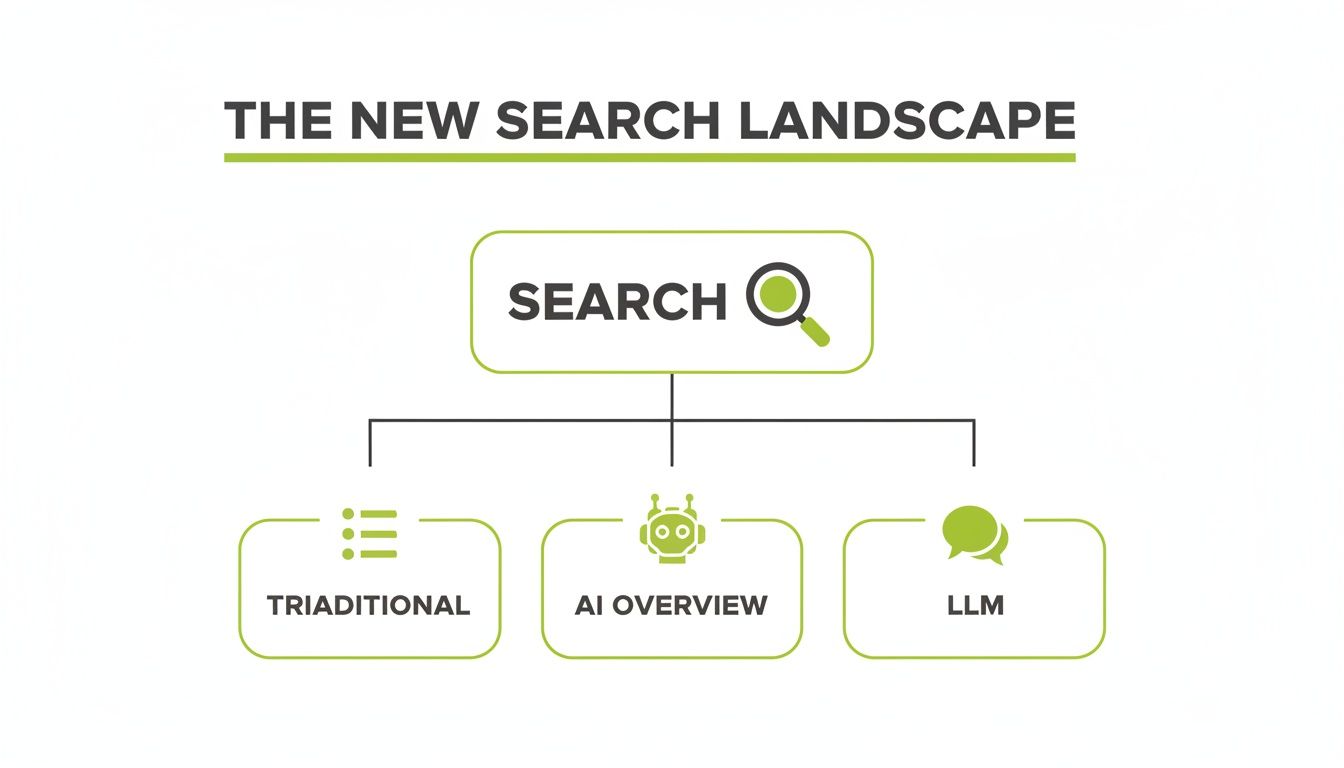
As you can see, the user's journey is no longer a straight line. That's why your tracking has to evolve beyond that classic list of links.
Appearance Frequency and Share of Voice
First up is the most basic metric: Appearance Frequency. Simply put, this is how often your brand shows up in an AI Overview for your target keywords.
But that number is meaningless on its own. You need context, which is where Share of Voice (SoV) comes in. SoV compares your appearance frequency to your competitors, answering the most important question: For this topic, who does the AI trust most?
Let's say you appear in 30% of AI Overviews for "best project management software," but a key competitor shows up in 70%. That’s not just a number; it’s a clear signal that the AI views them as the greater authority. Since AI models are notoriously inconsistent, you have to run these checks across hundreds of prompts to get a reliable read. A high share of voice is the new sign of strong topical authority.
Measuring your brand’s presence in AI answers with precision is a fool’s errand. You can, with enough prompts run enough times, get a dartboard-pattern-like answer comparing you with others. Visibility percentage across hundreds of prompts run multiple times is a reasonable metric.
Citation Analysis and Content Gaps
Getting mentioned in an AI answer is good. Getting cited as a source is gold.
Citation Analysis is all about tracking which of your specific URLs get linked inside an AI Overview. This data is your roadmap. It shows you exactly which pieces of content the AI has stamped as authoritative.
By digging into the pages that earn citations, you can:
- Pinpoint the exact content formats and structures the AI prefers.
- Double down on topics where the AI already sees you as a go-to source.
- Spot competitor citations, which instantly flags your most urgent content gaps.
If a rival's blog post on "agile methodology steps" keeps getting cited and yours is ignored, you know exactly what piece of content you need to improve to win that spot. Our complete guide on boosting your AI visibility digs much deeper into these tactics.
Prompt Coverage and Model Type
Finally, you need to know which questions you're answering. Prompt Coverage analysis maps out the full range of prompts and queries that trigger an appearance for your brand. This is a fantastic way to uncover new long-tail opportunities and get a much richer understanding of user intent.
And don't forget the models themselves. A truly robust AI overview tracker should tell you which AI—whether it’s Gemini, ChatGPT, or something else—generated the result. Each model has its own biases and knowledge base. Knowing where you’re strong and weak across different AI platforms is essential for a complete search intelligence strategy in 2026.
Integrating AI Tracking Into Your SEO Workflow
Having the data is one thing; knowing what to do with it is what really moves the needle. While the idea of an AI overview tracker can sound a bit intimidating, weaving its insights into your day-to-day SEO work is surprisingly straightforward. This isn't about starting from scratch. It's about adding a powerful new perspective to the analysis you’re already doing.
The whole point is to build a simple, repeatable process that turns AI visibility data into better content and a real competitive edge. You can get going with just a few focused steps, creating a workflow that’s both easy to manage and effective from day one.
Begin with Strategic Keyword Selection
Don’t try to boil the ocean by tracking every keyword under the sun. That's a recipe for getting overwhelmed. Instead, start small by zeroing in on the most valuable questions your audience is asking. Focus on high-intent, informational queries where AI Overviews are most likely to show up.
- Identify Core Topics: First, map out the top 5-10 themes that are central to your business.
- Brainstorm Question-Based Prompts: Put yourself in your customer’s shoes. What would they ask an AI assistant about your topics? Think "how to choose...," "what is the best...," or "compare X and Y."
- Analyze Competitor Citations: Use your tracker to see which prompts your competitors are already being cited in. These are your low-hanging fruit—your immediate opportunities.
This targeted approach means you're putting your energy where it counts instead of getting lost in a sea of data.
Configure and Schedule Your Tracking
Once you have your starting list of prompts, the next step is setting up your tool to collect data accurately. When it comes to AI tracking, accuracy isn't about finding one fixed answer. It’s about understanding patterns and trends over time.
AI models are designed to be inconsistent; asking the same question 100 times can yield 100 different results. The key is to run enough prompts, often enough, to establish a reliable "visibility percentage" that shows how you stack up against competitors over time.
Set your AI overview tracker to run on a regular schedule—weekly or bi-weekly works well for most. This rhythm allows you to spot changes as they happen, catch new trends, and actually measure whether your content updates are working. Consistency here is everything.
Incorporate Insights Into Reporting
Finally, it’s time to pull this new data into your regular SEO reports. Don’t treat AI visibility as some separate, exotic metric. Instead, weave it into the bigger picture of your search performance.
For instance, when you report on a key piece of content, you can now show the full story:
- Traditional Metrics: Organic traffic, keyword rankings, and backlinks.
- AI Visibility Metrics: Appearance frequency in AI Overviews, citation wins, and share of voice for that topic.
This integrated approach proves you have a complete grasp of modern search. For a more structured process, you can learn more about conducting a comprehensive AI visibility audit that brings all these elements together. Presenting this unified view shows clients and stakeholders that you're ahead of the curve, managing performance across the entire search experience and proving value that goes far beyond just clicks.
Real-World Use Cases for Agencies and Brands
So, the theory behind an AI overview tracker is one thing, but how does it actually help you in the real world? For marketing agencies and in-house teams, this isn't just another dashboard. It's a tool that fundamentally changes how you measure success and prove your value.
It moves the conversation from abstract goals to concrete wins. You get a clear roadmap for your strategy and the hard data to back it up.
Agency Reporting That Proves Value
For agencies, this is a game-changer for client reporting. Instead of just showing off keyword ranks and traffic charts, you’re now showing your client how you're winning them a spot in the new AI-driven search results. It’s the difference between reporting on the past and demonstrating you're building for the future.
Imagine walking into a client meeting and pointing to the exact moment your content was featured in a crucial AI Overview. You can directly connect that victory to the content work you just completed.
This opens up a whole new way to tell your story in client reports:
- Showcase new visibility: You can literally show clients, "You are now the cited source for this high-value question. Before we started, you were nowhere."
- Pinpoint competitor gaps: Find the topics where your competitors are dropping the ball and failing to get cited. These aren't just ideas; they're clear, data-backed opportunities for your client to move in and take over.
- Prove you're ahead of the curve: You're no longer just reacting to the latest Google update. You’re showing them you're actively securing their brand's authority in the next generation of search.
Reporting like this changes the entire dynamic. You stop being just a vendor who executes tasks and become a genuine strategic partner guiding them through what’s next.
We’re already seeing AI Overviews cause organic click-through rates to plummet by as much as 65%. Agencies have to find new KPIs, like share of voice, to prove their worth. And since 88% of these AI results are triggered by informational searches, having a tool to track it all is becoming non-negotiable. It’s why platforms that unify AI and SEO tracking are quickly becoming the new standard for confident, forward-thinking agencies.
In-House Teams Driving Content Strategy
If you're an in-house marketer, think of an AI overview tracker as the ultimate feedback loop for your content strategy. You’re getting direct input from the AI models themselves on what they like and what they ignore.
This data gives your content team a crystal-clear path forward.
Case Study: How One Brand Used AI Feedback to Dominate Its Niche
A mid-sized e-commerce brand selling sustainable home goods was frustrated. Their blog traffic had hit a plateau, even though they held top organic rankings for some of their best keywords.
They started using an AI overview tracker and the problem became obvious. While they ranked well in the traditional blue links, their competitors were the ones getting cited in AI Overviews for all the important "how-to" and "best of" questions.
The tracker data showed them that the AI models clearly preferred content with numbered steps and simple comparison tables. Their own blog posts were more narrative and story-driven, which the AI was passing over.
Armed with this insight, they launched a project to refresh their top 20 articles. They restructured them to answer questions directly, adding scannable lists and data-focused comparisons.
The result? Within three months, their Share of Voice in AI Overviews for their main topics shot up from just 15% to over 60%. They effectively became the AI's favorite source, which not only drove highly qualified traffic but also cemented their brand as the authority in their space.
A Few Questions We Hear All the Time
Even as we get more comfortable with AI's role in search, it's natural to have questions when you first start digging into the data. Let’s walk through some of the things marketers and SEO pros often ask when they begin tracking AI Overviews.
How Is This Different From a Regular Rank Tracker?
Think of a standard rank tracker as a finish-line camera for a race. It tells you exactly where your URL placed in that long, numbered list of blue links. It’s essential information, but all it really confirms is that you showed up on the page.
An AI overview tracker plays a totally different game. It doesn't care about your position on a list; it cares if you are featured in the AI's answer. Are you mentioned by name? Is your content cited as a source in that generated summary? That's the real win, especially since many people now get their answer from the overview and never bother scrolling down.
Can’t I Just Check for AI Mentions Myself?
You could, but it would be like trying to take a census by knocking on a few random doors. Manually searching a handful of keywords might give you a snapshot, but it’s far too unreliable to build a strategy on.
The thing is, AI Overviews are designed to be fluid. The answer you see can change based on:
- The user's location and past searches
- Slight changes in how the prompt is phrased
- The AI models themselves, which are constantly being tweaked
It's a known feature that these AI tools are inconsistent. If you ask the same question 100 times, you could get 100 slightly different answers, with the order of recommendations shuffled each time.
A real AI overview tracker automates this by running thousands of prompts over and over again. It’s the only way to get a statistically sound picture of your visibility, see how you stack up against competitors, and track your progress over time.
So, How Do I Use This Data to Actually Improve My SEO?
This data becomes your new playbook for content. The insights from an AI overview tracker give you a surprisingly clear path to becoming the AI's favorite source.
Start by looking for the prompts where your competitors show up all the time, but you’re nowhere to be seen. These are your most glaring content gaps—and your biggest opportunities.
Next, dig into the specific pages the AI is citing, both yours and your rivals'. You're essentially reverse-engineering what works. You’ll see the exact structure, depth, and tone the AI seems to prefer for that topic. Use those clues to overhaul your existing articles or create new, hyper-relevant content that speaks the AI's language.
Which Platforms Should My Tracker Cover?
At the very least, you absolutely have to be monitoring Google's AI Overviews. This is where most people will first interact with AI-driven search results.
But for a solid strategy in 2026, you need to look beyond just Google. People are increasingly asking for recommendations and information directly from conversational platforms like ChatGPT and Perplexity. A complete AI overview tracker should be watching your brand's presence in all these places. It brings everything together, giving you one clear view of how you're performing wherever your audience is looking for answers.
Ready to stop guessing and start measuring what really matters in the new era of search? Surnex combines AI overview tracking with all your other core SEO metrics in a single platform. Get a clear view of your performance today.