A client asks why their brand isn't showing up in Google's AI Overviews. Another wants to know why ChatGPT keeps naming two competitors first. Your team has rankings, traffic, and backlink reports ready. None of them answers the question.
That's a significant problem with AI search. Traditional SEO reporting tells you what happened in classic search. It doesn't tell you whether an AI system recommended your brand, cited your content, framed you correctly, or left you out of the answer entirely.
For agencies and in-house teams, this creates an awkward gap. Leaders expect a clear read on visibility in ChatGPT, Perplexity, Gemini, Copilot, and Google's AI experiences. Teams often still rely on screenshots, one-off prompt tests, and gut feel. That isn't a measurement system. It's a collection of anecdotes.
If you want to know how to track brand mentions in AI search, you need a repeatable process. That means prompt design, multi-engine testing, citation logging, scoring, and a way to connect all of it back to business impact. Simple mention counting won't get you there.
The Uncomfortable Question about AI Search
The uncomfortable question isn't “Are we doing AI SEO?”
It's “Can we prove whether AI systems include our brand when buyers ask high-intent questions?”
A lot of teams can't answer that yet. They can pull keyword positions, page-level traffic, and conversion paths. But when someone asks why a competitor appears in an AI-generated recommendation and their brand doesn't, they're left guessing. That's where old reporting breaks down.
Why old SEO dashboards stop short
Classic SEO tools measure pages, rankings, and clicks. AI search changes the interface before the click ever happens. The user asks a question. The engine synthesizes sources. The shortlist forms inside the answer.
That means your brand can lose the consideration phase without losing a ranking.
AI visibility is closer to recommendation tracking than rank tracking.
This is why teams need a separate measurement layer. Not because traditional SEO stopped mattering, but because it no longer explains the whole discovery journey. A brand can rank well and still be absent from AI-generated answers. A weaker site can appear often if the engines trust the sources that mention it.
What teams need instead
A workable system has to answer five practical questions:
- Presence: Is the brand mentioned at all?
- Positioning: Is it framed as a primary recommendation or a side note?
- Citations: Which URLs does the engine treat as supporting evidence?
- Competition: Which rivals appear when the brand does not?
- Impact: Do visibility changes align with business signals your team already tracks?
That's the difference between a demo-friendly screenshot and operational reporting.
When teams learn how to track brand mentions in AI search properly, they stop arguing over isolated examples. They start building a baseline, spotting gaps, and deciding what to fix next.
Decoding the New Mention Landscape
Before you measure anything, you need to define what counts as a brand mention. That sounds obvious, but it's where most tracking setups fail. Teams look for their company name and miss the rest of the picture.
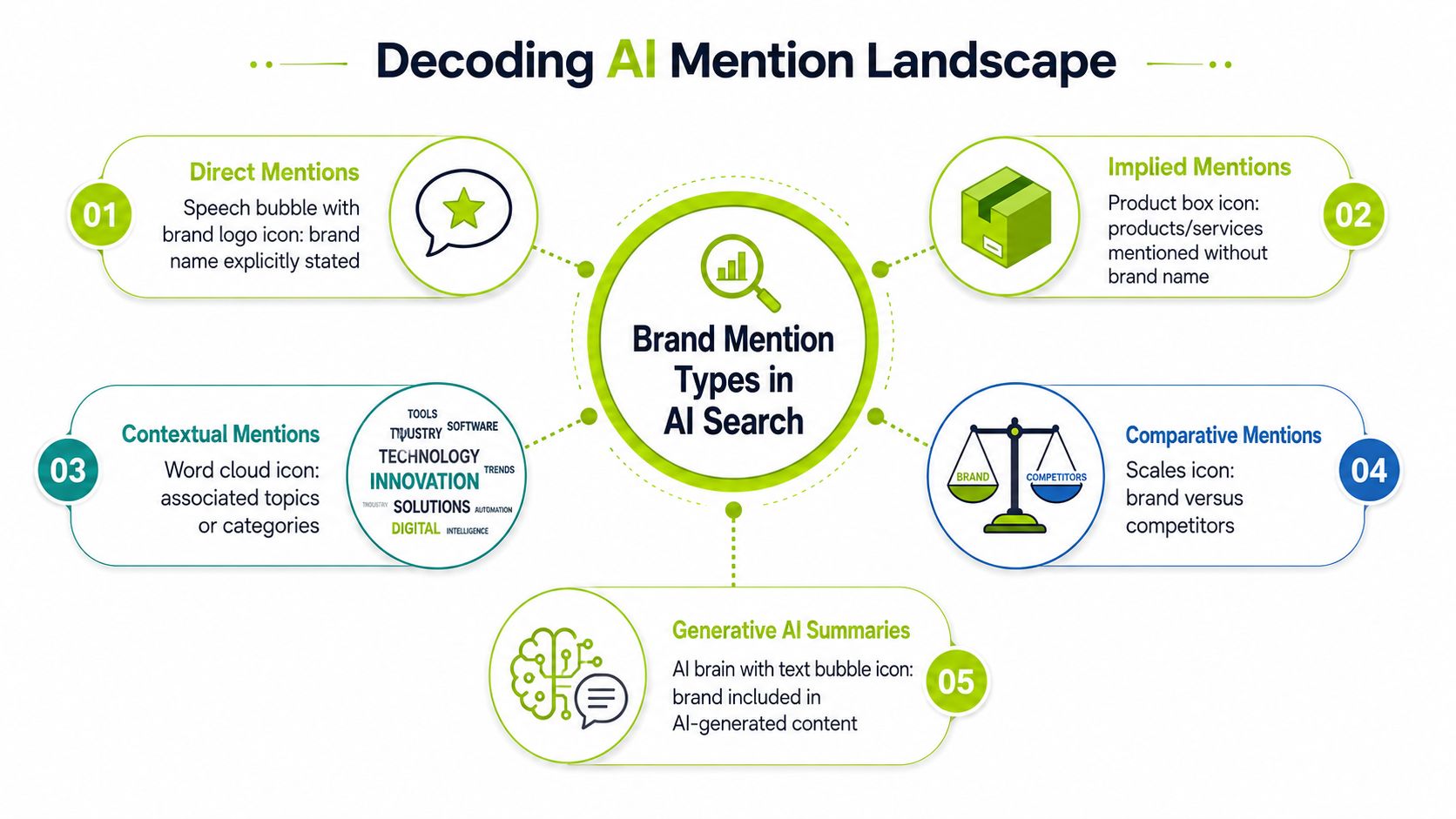
AI systems can surface a brand in several ways. Some are obvious. Others are subtle but still influential.
What a mention actually looks like
A direct mention is the easy one. The AI names your company in the answer. But that's only one layer.
You also need to watch for product references without the parent brand, category associations that describe you without naming you, and comparison responses where your competitors are repeatedly grouped together while you're excluded. In AI search, absence in comparison is often more revealing than presence in general informational prompts.
For teams still getting used to generative search behavior, this overview of Search Generative Experience is a useful reference point because it shows why these answer formats behave differently from classic SERPs.
Types of AI brand mentions
| Mention Type | Description | Example |
|---|---|---|
| Direct mention | The brand name appears explicitly in the answer | The AI lists your company as a recommended vendor |
| Implied mention | The product, platform, or service is referenced without the parent brand name | The answer names your tool module but not the company |
| Contextual mention | The brand is associated with a category, use case, or topic | The AI links your brand with enterprise SEO workflows |
| Comparative mention | The brand appears alongside competitors in a decision-stage answer | The AI compares your platform with two rivals |
| Generative summary mention | The brand is woven into a synthesized paragraph rather than a list | The AI summarizes the market and includes your brand in the narrative |
Mentions and citations are not the same thing
A brand mention tells you that the engine surfaced your name. A citation tells you where the engine likely got supporting information.
That distinction matters because a cited mention is usually more durable than an uncited one. A critical step is logging the specific URLs the AI cites as “sources of truth” and treating these citations as distinct data points from mere mentions, because audit data shows citation rates can vary by up to 3x across different engines for the same prompt set.
Practical rule: Track the answer and the evidence separately. If you combine them, your reporting will hide the real gap.
The anatomy of a useful review
When analysts review an AI response, they should log more than “yes” or “no.” A stronger review captures:
- Brand inclusion: Did the brand appear?
- Answer role: Was it the main recommendation, one option among many, or a passing reference?
- Source support: Which URLs were cited, if any?
- Competitor context: Who else appeared in the same answer?
- Narrative quality: Was the framing accurate, positive, neutral, or off-position?
That's the minimum needed to understand how your brand shows up in AI search. Without it, mention tracking stays shallow and hard to act on.
Building Your Core Tracking Framework
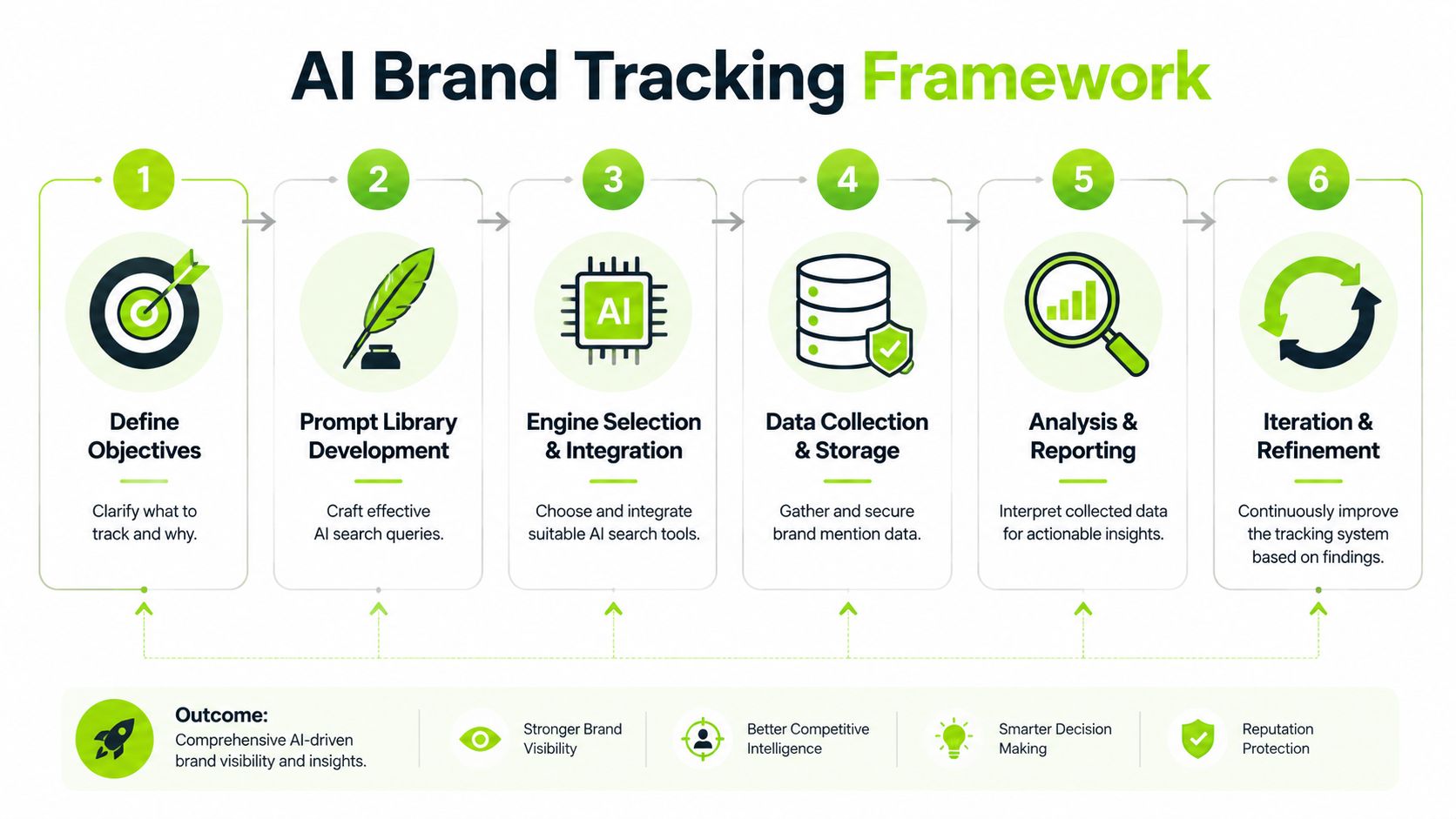
If you want reliable data, the first job is building a stable testing system. Random prompts and occasional checks won't hold up. You need a prompt library, engine coverage, and a repeatable collection rhythm.
Start with a prompt library that mirrors buyer intent
A solid baseline starts with a prompt set that reflects how buyers search. According to Vismore's guidance on tracking brand mentions in AI search, brands should build a 50–150 prompt library based on real buyer-intent questions, run those prompts across at least five AI engines weekly, and use progress from a baseline citation rate such as 25% toward 50% within six months as a working success metric.
That benchmark matters because it forces discipline. Teams stop testing vanity prompts and start covering the questions tied to category discovery, evaluation, and comparison.
Build prompt clusters, not a flat list
A strong library usually includes different prompt types because AI systems behave differently across intents.
Use clusters such as:
- Category prompts: Questions like “best tools for” or “top platforms for” that trigger recommendation behavior.
- Problem-aware prompts: Queries from buyers who know the issue but not the vendor.
- Comparison prompts: Brand-versus-brand or alternatives-style prompts.
- Reputation prompts: Questions about trust, fit, or who a solution is for.
- Use-case prompts: Vertical or workflow-specific requests that expose positioning gaps.
Don't write them once and forget them. Prompt libraries need maintenance because buyer language shifts and product positioning changes.
Test across engines, every week
Cross-engine tracking isn't optional. A brand can show up in one model and disappear in another because retrieval, citation habits, and answer formatting differ. That's why a dedicated system such as an AI Overview tracker is useful for operational monitoring. It gives teams a place to compare visibility patterns instead of checking each surface manually.
The other trap is single-run testing. AI responses vary. If your team captures one answer and treats it as the truth, reporting will swing based on noise.
One useful methodology recommends a fixed panel of 20–30 buyer-centric questions, multiple runs per prompt, and scoring outcomes as mentioned, recommended, or cited as source because the same prompt can return different results across runs and engines, as discussed in this Reddit discussion on measuring AI search visibility.
Run the same tests the same way, or your week-over-week trendline won't mean much.
What to log on every run
Each response should feed a structured log. Keep it simple enough for analysts to use, but detailed enough for later analysis.
-
Prompt and category Store the exact prompt text and its intent cluster.
-
Engine and date Track where and when the response was generated.
-
Mention outcome Note whether the brand was absent, mentioned, recommended, or cited.
-
Competitor inclusion Record which competing brands appeared in the same response.
-
Cited URLs Save the sources exactly as shown by the engine.
Baseline first, optimization second
Teams often want to jump straight to fixes. Don't. Build the baseline first.
That means collecting enough responses to understand where the brand appears consistently, where it vanishes, and which sources drive each pattern. Once that baseline is stable, optimization gets much easier because you're no longer reacting to isolated examples. You're responding to repeated gaps.
Scoring Visibility and Competitive Share
Raw counts don't help much once the prompt library grows. If a brand appears in an answer, you still need to know whether that appearance mattered. Was it first? Was it framed well? Was a competitor treated as the stronger option?
That's where scoring comes in.
Move from mention counts to weighted scoring
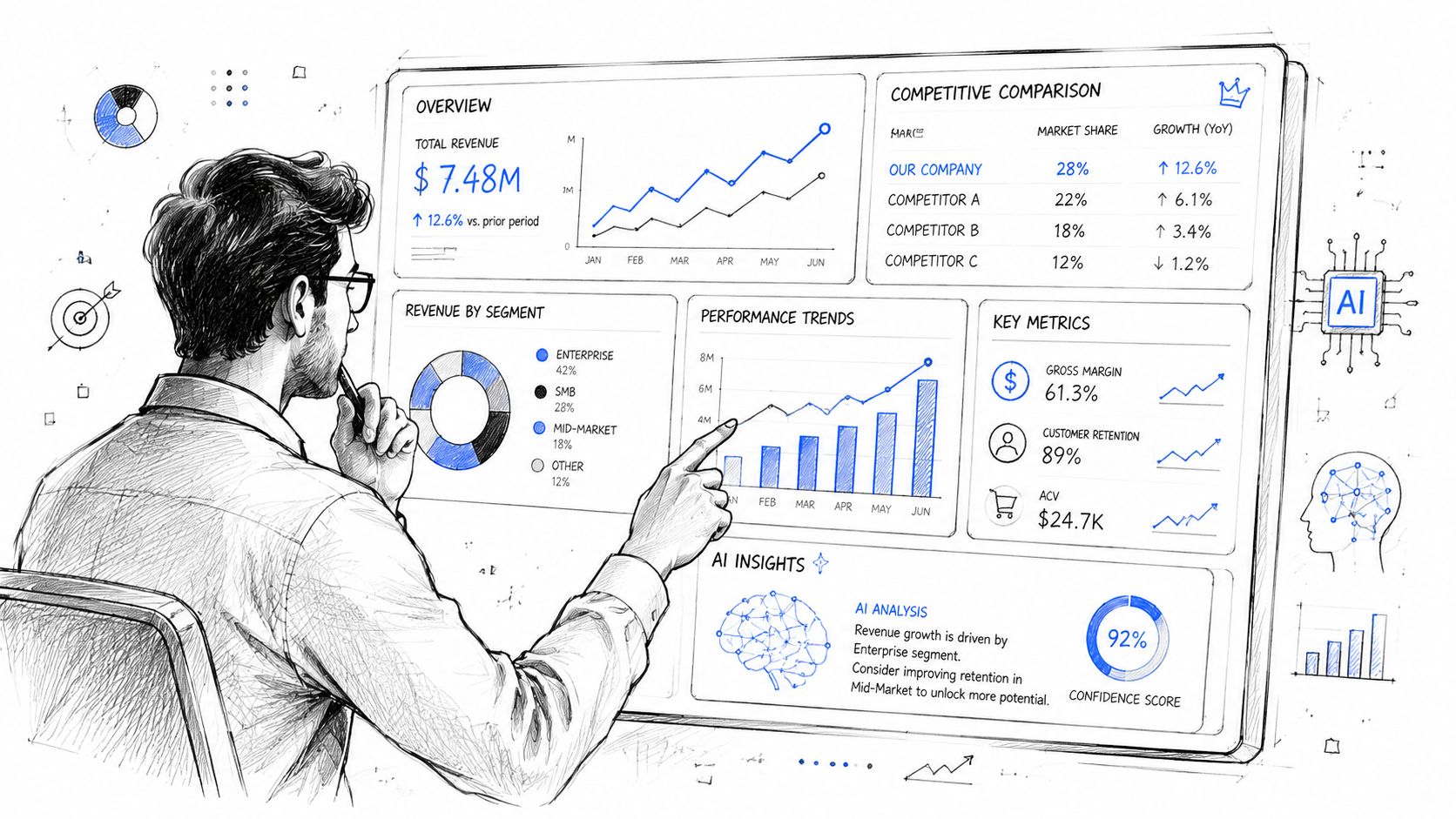
A practical reporting setup usually includes two layers. The first is an AI Visibility Score that summarizes how strongly your brand appears. The second is Share of Model, which compares how often your brand appears against named competitors across the same prompt set.
The scoring model doesn't need to be complicated to be useful. One methodology uses a 100-point AI Visibility Score that combines presence, position, sentiment, and share. The value isn't in the number alone. It's in the consistency of how you calculate it.
A simple weighted logic often works well:
| Scoring Dimension | What to evaluate | Why it matters |
|---|---|---|
| Presence | Whether the brand appears at all | Baseline visibility |
| Position | Whether the brand is primary or secondary | Recommendation strength |
| Framing | Whether the description is accurate and favorable | Brand control |
| Citation support | Whether cited sources reinforce the answer | Durability |
| Competitive context | Whether rivals appear more prominently | Relative performance |
Use audits that are large enough to trust
If the sample is too small, your score will look precise but won't be dependable. Benchmark guidance indicates that 750-response AI audits are needed for professional-standard tracking, and those audits show brands often miss visibility in 30–40% of high-intent prompts due to citation gaps. They also highlight the need to track whether the brand appears as a primary mention versus a secondary example.
That's why scoring can't be just “mentioned or not mentioned.” A weak mention in a crowded answer doesn't carry the same commercial value as being the first recommendation with strong source support.
For teams already reporting classic demand signals, a companion metric like share of search can help leadership connect AI visibility trends with broader brand demand patterns without treating the two as the same thing.
Run citation gap analysis
Competitive scoring gets useful when you pair it with source analysis. If two rivals keep appearing on prompts where your brand is absent, look at the domains the engines cite. That often reveals the gap faster than page-level SEO review.
Ask questions like these:
- Which third-party domains appear repeatedly for competitors?
- Are those domains absent from our citation footprint?
- Do those sources frame the category in a way that excludes us?
- Is the issue lack of coverage, weak positioning, or outdated information?
The fastest diagnosis usually comes from the cited domains, not from the answer text alone.
A walkthrough like the one below is useful for teams building stakeholder understanding around AI reporting:
What good reporting looks like
An executive-ready scorecard should stay compact. Report the trend, not every raw response.
Include:
- Visibility score trend: Is the brand becoming more prominent across tracked prompts?
- Share of Model: Are you gaining or losing ground against direct competitors?
- Primary mention rate: How often are you the lead recommendation?
- Top citation sources: Which domains most often shape your AI visibility?
- Gap prompts: Which important prompts still exclude the brand?
That gives teams something actionable. It also makes AI visibility easier to explain to clients who don't want another noisy dashboard.
Automating Tracking for Scalable Insights
Manual tracking works for a pilot. It fails once you manage multiple clients, business units, regions, or product lines. The workload expands fast. More prompts, more engines, more responses, more citations, more competitor combinations. Someone ends up babysitting spreadsheets instead of finding patterns.
That's why automation becomes part of the strategy, not just a convenience.
What to automate first
Start with the repetitive tasks that create inconsistency when people do them by hand:
- Prompt execution: Run the same prompt sets on a fixed schedule.
- Response capture: Store raw outputs for later review.
- Entity extraction: Detect brand names, competitor names, and cited domains.
- Classification: Label outcomes such as mentioned, recommended, or cited.
- Alerting: Flag sharp changes on priority prompts.
This is where teams often use APIs and workflow tooling. An SEO tool API can help move prompt execution and result collection into a more controlled system so analysts spend less time gathering data and more time reviewing signal quality.
The operating model matters as much as the tooling
Automation fails when the workflow is unclear. If nobody owns prompt updates, quality control, alert routing, or competitive review, the system creates more noise than insight.
A useful planning reference is this guide to marketing process mapping. It's relevant here because AI visibility tracking touches SEO, content, analytics, and often engineering. Mapping the handoffs keeps the monitoring loop from turning into another disconnected report.
A practical workflow usually looks like this:
- Schedule prompt runs across priority engines.
- Parse the outputs into mentions, citations, and competitor co-mentions.
- Store normalized records in a central table or dashboard.
- Score the results against your visibility model.
- Trigger alerts when important changes happen.
- Assign follow-up work to SEO, content, digital PR, or product marketing.
Alerts should focus on decision points
Good alerting is selective. If every fluctuation triggers a notification, nobody trusts the system.
Useful alerts usually focus on events such as:
- A high-value prompt drops out of brand inclusion.
- A new competitor appears repeatedly in a tracked cluster.
- Sentiment shifts from neutral to negative.
- A new cited domain enters the recommendation pattern.
- A critical prompt gains visibility after a content or PR change.
Automation should reduce interpretation time, not create more dashboards to watch.
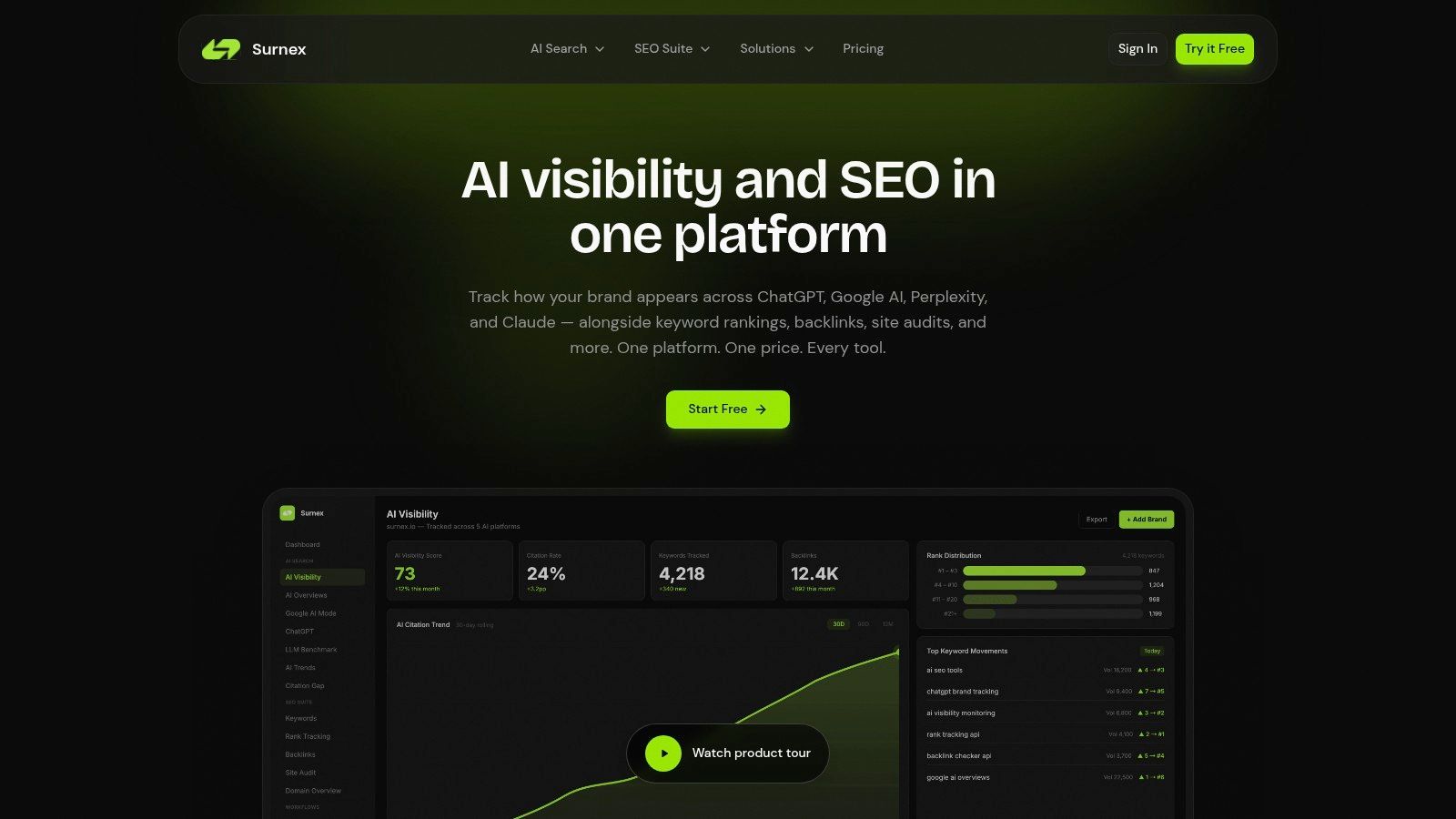
One option in this category is Surnex, which tracks brand presence across AI search surfaces and traditional SEO metrics in one place, including visibility across tools such as ChatGPT and Google AI experiences. That kind of setup is useful when teams want AI visibility data alongside rankings, backlinks, and audits instead of in a separate reporting stack.
Why scale changes the kind of insight you get
The main advantage of automation isn't speed alone. It's consistency.
When prompt execution, logging, and scoring follow the same rules every week, you can finally compare brands, engines, and time periods with confidence. That's what turns AI mention tracking into something operational. Without automation, many organizations stay trapped in reactive checking. With automation, they can spot trend changes early and act before a visibility problem becomes a pipeline problem.
Connecting AI Mentions to Business ROI
A clean visibility report still won't satisfy leadership unless it connects to business outcomes. “We appeared more often in AI answers” is interesting. “That visibility lined up with stronger branded demand and more direct visits” gets attention.
In this context, teams need a more mature attribution mindset.
Treat AI mentions as assistive signals
AI search often shapes the decision before the first measurable visit. A user gets a recommendation in ChatGPT or Google AI Overviews, leaves, comes back later through direct traffic, then converts after a branded search or a return session. Standard last-click reporting won't capture that path cleanly.
That's why AI mentions work better as assistive attribution signals. According to Limy's guide on tracking brand mentions in AI search, teams need to monitor direct traffic lifts and branded search growth alongside AI visibility trends to prove revenue impact, because most existing frameworks still don't connect AI visibility to ROI clearly.
What to compare in practice
You don't need a perfect attribution model on day one. You need a disciplined comparison loop.
Review AI visibility against:
- Direct traffic trends: Helpful when users return after an AI recommendation without a referral trail.
- Branded search growth: Useful when AI exposure increases brand recall and follow-up searching.
- Landing-page concentration: A clue that certain pages are benefiting from AI-shaped discovery.
- Sales feedback: Valuable when prospects start naming AI tools or summaries in calls.
- Prompt-level changes: Important when a visibility gain lines up with a content or citation improvement.
Close the loop with execution
Tracking matters because it tells you what to fix next. The strongest teams use a closed-loop AEO process.
That usually looks like this:
- Measure the baseline across your fixed prompt set.
- Find missing prompts where competitors appear and your brand does not.
- Review cited domains to identify the source gap.
- Publish or update targeted content on the sources that influence AI answers.
- Re-run the same tracking set and compare visibility changes over time.
This is also where many teams improve outcomes by working on sources AI engines cite often, such as Reddit, Wikipedia, G2, YouTube, or industry review and comparison pages. The point isn't to publish everywhere. It's to publish where the engines already look for category truth.
If you can't connect measurement to action, your AI visibility program will stall after the first dashboard.
Leadership doesn't need a theory of AI search. They need evidence that the team can measure inclusion, explain gaps, and tie improvements to meaningful business signals. Once you can do that, AI mention tracking stops feeling experimental. It becomes part of search operations.
If your team needs a practical way to monitor AI visibility alongside rankings, backlinks, audits, and reporting, Surnex is built for that workflow. It gives agencies, in-house teams, and developers a way to track how brands surface across AI search experiences and traditional search from one platform, so the process is easier to operationalize and easier to explain to stakeholders.