Google AI Overviews changed the economics of ranking. When AI Overviews are present, position 1 organic CTR drops 34.5% based on Ahrefs analysis cited by seoClarity, and AI Overviews appeared for 30% of U.S. desktop keywords as of September 2025 (seoClarity research on AI Overviews impact).
That's the headline often felt by reporting teams. The mistake is what they do next.
A lot of agencies reacted by looking for “AI SEO” tricks, new files, prompt hacks, and platform-specific gimmicks. That's the wrong frame. The search result changed. The core path to earning trust from Google did not. If you're working on Google AI Overviews SEO today, the job is not to abandon SEO fundamentals. The job is to apply them more precisely, then measure visibility in a different way.
The New Reality of Search Visibility
The hard part about AI Overviews is that two things are true at once.
First, they are a major shift in how users interact with the SERP. Second, Google's position is still that normal SEO drives inclusion. Google says there are “no additional technical requirements” beyond standard search eligibility, and data cited by Evergreen Media shows 99.5% of AI Overview sources originate from the top 10 organic rankings (Evergreen Media's guide to Google AI Overviews).
That should reset how teams talk about this internally. You do not need a parallel “AI algorithm” playbook. You need stronger indexing, stronger topical authority, stronger E-E-A-T, cleaner information architecture, and content that answers the query clearly enough to be cited.
What this changes for strategy
The old mindset was simple. Rank higher, get more clicks.
That model is weaker now because Google can answer the query before the click happens. But the response shouldn't be panic or tool sprawl. It should be tighter execution around authority, answer quality, and SERP feature tracking.
Practical rule: Stop asking “What AI hack are we missing?” Start asking “Why would Google trust this page enough to cite it?”
The strongest teams I've seen aren't rewriting their whole SEO program. They're refining it. They're cleaning up weak pages, clarifying authorship, improving topical coverage, and making key pages easier for Google to extract and cite.
A useful companion perspective is Busylike's guide on how to Win visibility in AI search. It's helpful because it reinforces the same operational point many teams need to hear twice. Visibility in AI-driven SERPs comes from authority and clarity, not from mythical shortcuts.
What still works and what does not
A few realities are already clear:
- What works: Strong organic rankings, crawlable pages, expert-led content, clear entity signals, and direct answers.
- What doesn't: Treating AI Overviews like a separate search engine, chasing unsupported tactics, or assuming a top ranking automatically guarantees a citation.
- What matters more now: Being the source Google can summarize with confidence.
That's the new reality of search visibility. The game didn't reset. The margin for weak SEO just got smaller.
What Exactly Are Google AI Overviews
Google AI Overviews are AI-generated summaries that appear on the search results page and answer the query directly. Google launched them in May 2024, and they sit above or around traditional results depending on the query and layout (background on Search Generative Experience and AI search behavior).
The easiest way to explain them to clients is this:
A Featured Snippet is like quoting one book. An AI Overview is like a librarian reading several books, combining the main points, and giving you a synthesized summary.
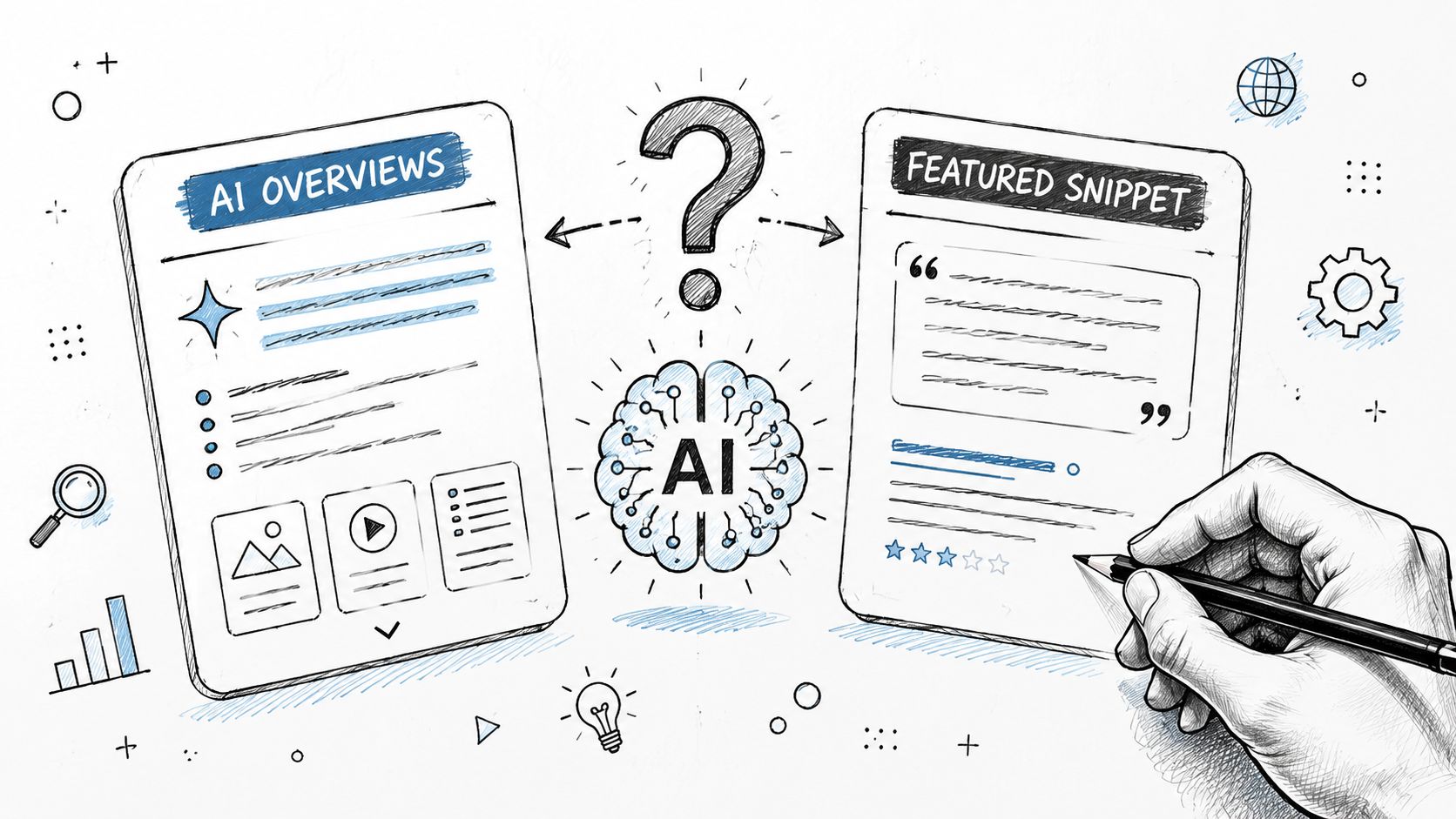
Extraction versus synthesis
That distinction matters because old snippet optimization was often about producing a neatly formatted block that Google could lift directly.
AI Overviews don't work that way. Google can synthesize across multiple sources, combine claims, and cite supporting pages around the summary. Your page may influence the answer even if the wording in the overview doesn't match your page exactly.
Here's the practical difference:
| Search feature | How it uses content | What SEO teams optimize for |
|---|---|---|
| Featured Snippet | Extracts a direct passage from one source | A concise snippet-ready answer |
| AI Overview | Synthesizes information from multiple sources | Clear claims, trusted authorship, semantic clarity, citation-worthiness |
Why this matters for content structure
If Google is acting more like a synthesizer than an extractor, pages need to be easier to interpret at the claim level.
That means:
- Lead with the answer: Put the direct response near the top, not buried after a long intro.
- Separate ideas cleanly: One section should answer one intent cluster clearly.
- Reduce ambiguity: If a page mixes definitions, opinions, and sales copy without structure, it becomes harder to cite.
An AI Overview doesn't need your exact paragraph. It needs your page to supply a trustworthy piece of the answer.
This is why Google AI Overviews SEO often feels frustrating at first. Teams produce good long-form content, but the page still isn't citation-friendly. It may rank well, yet fail to present information in a way that an AI system can confidently summarize.
What users actually see
Users usually see three things in an AI Overview experience:
- The summary itself
- Cited source links or cards
- Traditional organic listings below
So your page now has more than one visibility path. You can still rank in the classic results. You can also become part of the answer layer. Those are related goals, but they are not the same thing.
The Real Impact on Traffic and Discovery
By September 2025, AI Overviews appeared for 30% of U.S. desktop keywords, according to the seoClarity analysis cited earlier. The same research, drawing on Ahrefs data, reported a 34.5% drop in position 1 CTR when AI Overviews are present, and some sites saw organic traffic declines as high as 45%.
That is the business case.
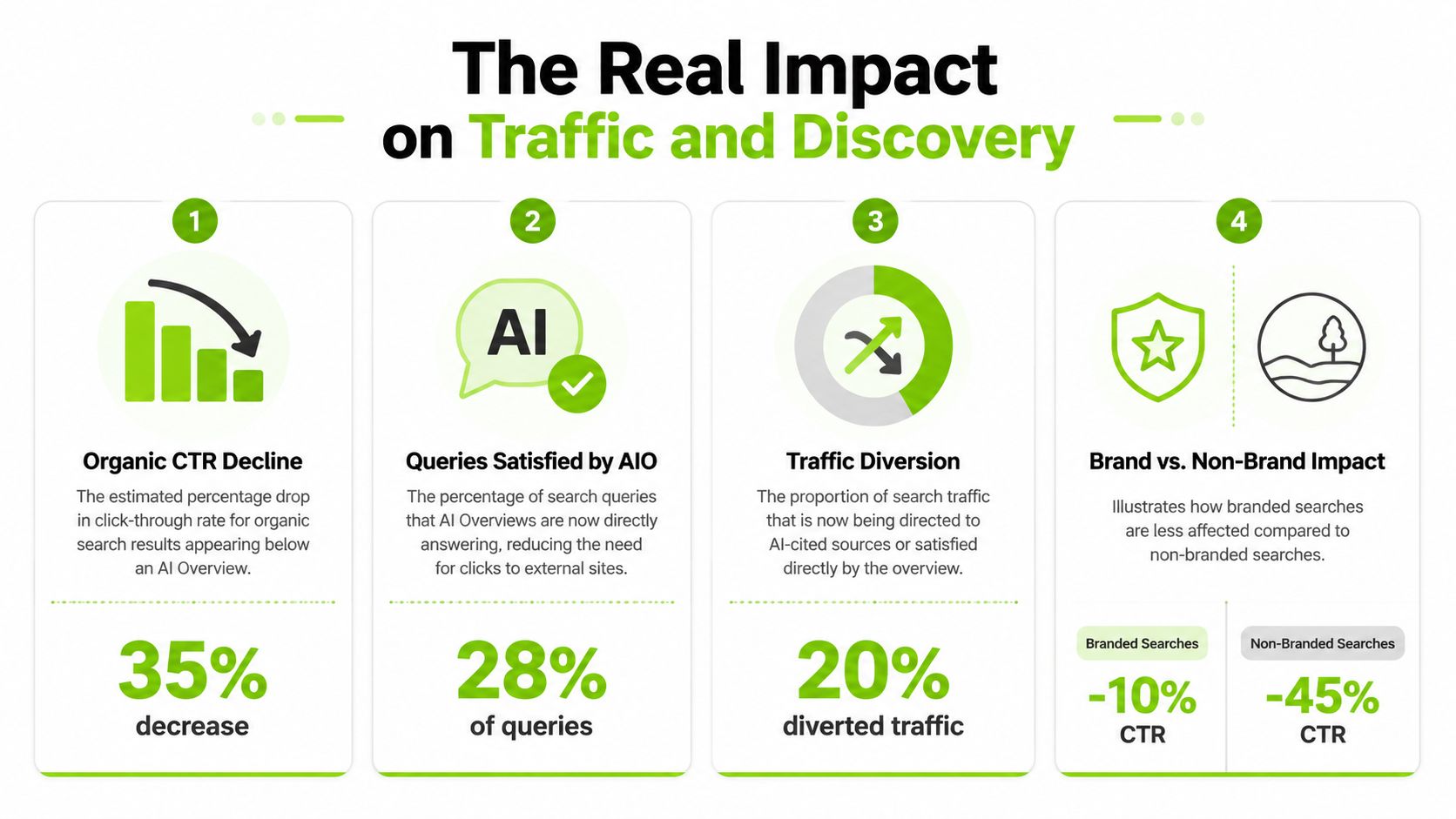
Informational discovery is under the most pressure
The biggest losses usually show up on non-branded informational queries. Webfor cites a 34.5% to 61% reduction in organic CTR for those searches when AI Overviews appear. In the same analysis, a September 2025 study found a 61% year-over-year CTR drop for informational queries with AIOs, while non-branded keywords saw a 19.98% decline (Webfor on how Google AI Overviews are changing SEO).
Agency teams can see the pattern without waiting for another industry study. A guide can hold its rankings, keep its impressions, and still lose visits because Google answered enough of the query before the click. That changes discovery economics for top-of-funnel content.
This is also why chasing mythical AI SEO tricks is a waste of time. The opportunity is not to outsmart the interface. It is to publish pages strong enough to be cited, trusted enough to influence the answer, and structured clearly enough to survive reduced click demand.
Brand and intent change the outcome
Traffic loss is not uniform across query types.
Webfor also reports that branded keywords can see an 18.68% CTR increase when they trigger an AI Overview. That makes sense in practice. If a user already knows the brand, the overview can reinforce trust instead of replacing the visit.
For strategy, that means intent segmentation matters more than ever. Informational content still matters, but its job has changed. Some pages will drive fewer sessions and still be worth keeping because they support entity visibility, assisted conversions, and citation presence. Teams that still evaluate every page by last-click traffic will misread what is happening.
Discovery now happens in more than one layer
Organic discovery used to be easier to explain. Rank well, win the click, measure the session.
Now there are at least three outcomes to track for the same query set. Your page might lose clicks. It might gain visibility through a citation. It might strengthen branded demand later because the user saw your name in the answer layer first.
That is a harder model to report, but it is closer to how search now works. It also matches what we see in content audits. Pages with strong definitions, original framing, or clean evidence blocks often contribute to visibility even when traffic does not return to prior levels.
Document format can affect this more than teams expect. Content that is difficult for systems to parse, extract, or quote cleanly is less likely to become part of the answer layer. Markdown Converters on AI document issues gives a useful explanation of how formatting choices can lead to weaker AI outputs.
What reporting has to change
Rank tracking alone is no longer enough. A page can move up and still produce less traffic. Another page can stay flat in classic organic results and become more important because it earns visibility inside AI summaries.
A better reporting model focuses on four questions:
- Where is click loss concentrated? Segment informational, non-branded queries that trigger AI Overviews.
- Which pages still influence discovery? Check whether cited pages support assisted conversions, branded search lift, or downstream engagement.
- Which query sets justify citation-focused work? Some topics will not recover historical CTR, but they still shape category authority.
- Which tools show answer-layer visibility? Standard rank trackers miss part of the picture. Teams comparing LLM optimization options for AI visibility tools should look for citation tracking, SERP feature monitoring, and query-level segmentation by intent.
The trade-off is straightforward. AI Overviews reduce available clicks on many informational searches. They also create a new visibility layer that still rewards authority, clarity, and strong source pages. SEO teams that accept that shift can make better decisions about what to protect, what to rebuild, and what to measure.
How to Earn Citations in AI Overviews
Most citation wins come from disciplined SEO, not novelty. The pages that show up tend to do three things well. They answer fast, prove authority, and remove ambiguity for search systems.
Digital Marketing Institute cites technical guidance that prioritizes “direct, citable answers” within the first 100 words and strong entity authority signals. The same source cites Authoritas data claiming 93.8% of AIO citations originate from sources outside the top 10 organic results (Digital Marketing Institute on Google AI Overviews and citable content).
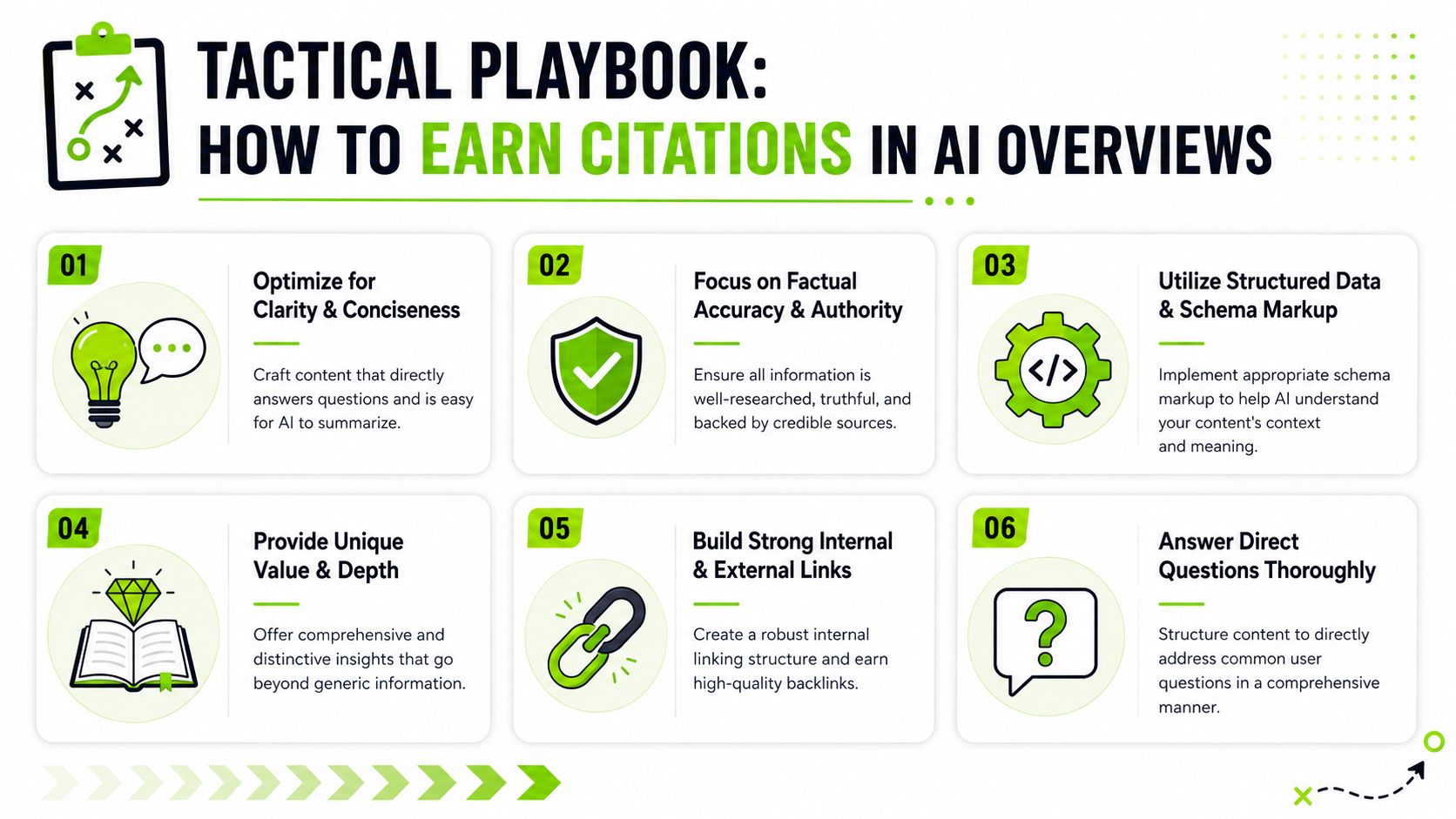
That contradiction with other published data is exactly why teams need to avoid rigid assumptions. Don't assume only top rankings get cited. Don't assume lower-ranked pages can't contribute. Build pages that are citation-ready either way.
Pillar one is citable content
The first test is simple. Can Google pull a clear answer from the page without interpreting a messy introduction?
Bad example:
- A long brand-first intro
- Several paragraphs of context
- The actual answer buried halfway down
- Generic wording that never commits to a clear claim
Better example:
- A one-paragraph direct answer near the top
- Supporting detail underneath
- Short sections built around real sub-questions
- Plain language and stable terminology
A practical pattern that works well:
- Open with the answer in one short paragraph.
- Define the key term if the query is conceptual.
- Break the page into sub-questions that match search intent.
- Add evidence, examples, or process detail after the direct answer.
If your page takes too long to get to the point, it may still rank, but it becomes harder to cite.
Pillar two is entity and E-E-A-T signals
A lot of content is technically fine but weak on trust.
Google doesn't just need information. It needs confidence about who is providing it. For YMYL topics in particular, the threshold is higher. That means your page should make authorship, expertise, and organizational identity obvious.
Use this checklist:
- Author clarity: Add real author names with relevant bios.
- Organization consistency: Keep your company name, descriptions, and profiles consistent across the site.
- Editorial trust: Show publish dates, update dates, and sensible review processes when relevant.
- Topical fit: Publish within subject areas your site has earned the right to cover.
Field note: A polished article with vague authorship often loses to a simpler page written by a clearly qualified expert.
This is also where many “AI content” workflows break down. Teams scale content output but strip away the signals that help Google trust the page. If the byline is generic, the source material is thin, and every page sounds interchangeable, the content becomes harder to cite.
For teams cleaning up AI-assisted drafts, this piece on Markdown Converters on AI document issues is worth reading because it highlights a practical problem many SEO teams ignore. AI-generated material often arrives with formatting and structure issues that make documents harder to parse, edit, and publish cleanly.
Pillar three is schema and machine-readable context
Schema markup doesn't turn weak content into cited content. It helps strong content become easier to interpret.
Use structured data where it matches the page:
- Article schema for editorial pages
- Organization schema for business identity
- Person schema for authors
- FAQ or HowTo schema where the page fits that format
The key is alignment. Your markup should describe what is on the page. Don't add schema just because a plugin offers it.
For teams comparing workflows and tools around AI visibility, Surnex has a useful overview of LLM optimization options for AI visibility tools. The practical takeaway is that optimization needs to stay grounded in clear content, entity signals, and measurable visibility, not speculative add-ons.
Here's a simple do-this-not-that table:
| Do this | Not that |
|---|---|
| Put the answer near the top | Hide the answer behind brand storytelling |
| Use expert bylines and organization signals | Publish anonymous, generic content |
| Add schema that matches page content | Stuff pages with irrelevant markup |
| Cover subtopics in distinct sections | Blend multiple intents into one dense page |
A short walkthrough can help teams visualize the shift in practice:
The best mindset is simple. Don't optimize for the AI label. Optimize for citability.
Tracking and Measuring AIO Performance
Traditional rank tracking is still useful. It just isn't enough on its own.
If your report says a page ranks in the top results, that's only part of the picture. The harder question now is whether Google surfaces your brand inside the AI answer layer. That's why citation tracking has moved from a nice-to-have to a core measurement need.
What to track instead of rank alone
A modern reporting stack for Google AI Overviews SEO should answer five questions:
- AIO presence: Which of your target keywords now trigger AI Overviews?
- Citation frequency: How often does your site appear as a cited source?
- Citation gaps: Which competitors are showing up where you are not?
- Query pattern: Which intents tend to surface your brand versus suppress clicks?
- Page contribution: Which URLs repeatedly support visibility across related topics?
Those questions change the agency conversation. “We rank third” is weaker than “we are cited across this topic cluster and absent from these competitor-owned themes.”
Why manual checks break quickly
A lot of teams start by searching target queries manually.
That works for a small keyword set, but it falls apart as soon as you manage multiple clients, locations, device types, or frequent SERP changes. AI Overviews aren't static. The appearance, citation set, and summary wording can shift. Manual spot checks miss trend lines and make reporting subjective.
Rankings tell you where your page sits. Citation tracking tells you whether Google trusts your page enough to use it.
That is a very different level of signal.
What a useful platform should show
The most practical workflow is to combine classic SEO metrics with AI visibility signals in one place. That lets teams compare rankings, citations, technical health, and topic opportunities without building a separate process for every SERP change.
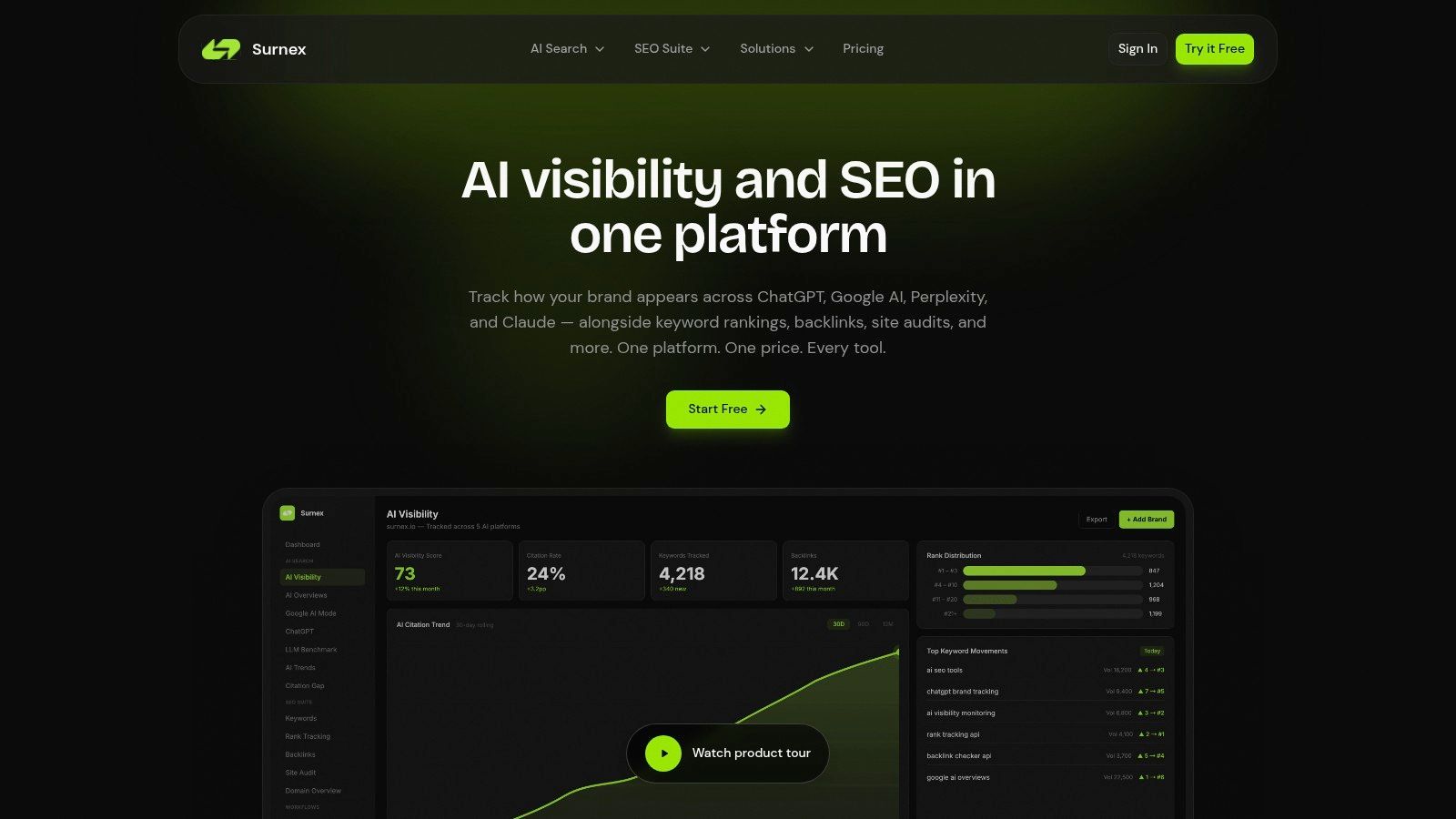
One option for that is Surnex, which tracks AI Overview presence, citations, rankings, backlinks, and related SEO performance in a single dashboard. If you want to see the measurement side of this shift more directly, their article on an AI Overview tracker is a useful reference point.
The core value is not just seeing whether an AIO exists. It's seeing patterns:
| Metric | Why it matters |
|---|---|
| Keyword triggers AIO | Confirms whether the SERP changed for that topic |
| Your domain cited | Measures actual participation in the answer layer |
| Competitor cited | Identifies authority gaps |
| Citation trend over time | Shows whether optimization work is gaining traction |
The reporting shift clients need
Clients still care about traffic. They should.
But your reporting needs to explain why visibility can improve even when clicks don't follow in the old pattern. The goal is to move the conversation from “did rankings go up?” to “did our authority increase where Google now resolves the query?”
That's the reporting model that fits the AIO era. It's more honest, more actionable, and far more useful for prioritization.
A Practical Workflow for AIO Optimization
The teams that adapt fastest usually don't create a separate AI department. They update the SEO workflow they already have.
A workable process starts with query selection, then moves to content diagnosis, then to page rebuilding, and finally to citation-aware reporting. If you want a broader view of how AI fits into normal SEO operations, this guide on using AI in SEO is a solid operational reference.
A weekly operating rhythm
Use a simple sequence.
First, identify target keywords where AI Overviews are present and where the topic matters to revenue, brand authority, or sales enablement. Then audit the ranking pages attached to those queries. You're looking for pages that rank but don't cite well, pages that are structurally messy, and topics where competitors have stronger entity signals.
Next, rewrite or expand pages with a citation lens:
- Tighten the opening: Add a direct answer near the top.
- Clarify expertise: Improve author bios, review information, and company identity signals.
- Restructure sections: Split mixed-intent pages into cleaner subtopics or supporting assets.
- Add schema carefully: Use only the markup that matches the page.
How agencies can operationalize this
For client work, I'd keep the workflow compact enough that account teams can repeat it monthly without friction.
- Choose the keyword set Focus on high-value informational, branded, and high-intent terms.
- Map SERP type Mark which keywords trigger AI Overviews and which still behave like classic organic opportunities.
- Score citability Review the page intro, answer quality, authorship, structure, and schema alignment.
- Ship updates Prioritize pages with authority potential, not just pages with traffic history.
- Report citations and gaps Show where the client appears, where competitors appear, and what changed after optimization.
That last step matters because it keeps expectations realistic. Some queries will remain lower-click environments even after strong optimization. The win may be stronger brand presence, better source inclusion, or better performance on branded follow-up searches.
Where outside resources help
For ecommerce and product-led teams, it also helps to study adjacent AI search workflows outside classic publishing SEO. Shoptank's perspective on Shoptank for AI search visibility is useful because it shows how AI search optimization intersects with merchandising, product data, and discoverability beyond standard blog content.
The bigger point is simple. Don't replace your SEO process. Evolve it.
If your team needs a clearer way to track Google AI Overviews, citations, rankings, and competitor visibility in one workflow, Surnex is built for that shift. It gives agencies, in-house teams, and developers a single place to monitor AI search presence alongside core SEO metrics so reporting and prioritization stay grounded in what the SERP looks like now.