TL;DR: Generative Engine Optimization (GEO) is the practice of creating and structuring content so it's selected, understood, and cited as a source in the answers generated by AI engines like ChatGPT and Google's AI Overviews. The shift is large enough that the global GEO market is projected to reach USD 1,089.3 million in 2026 and USD 17,148.6 million by 2034, with a 40.6% CAGR, and that matters because success in AI search is measured less by rankings and more by citation frequency, share of voice, and appearance inside generated answers.
Generative Engine Optimization (GEO) is the practice of creating and structuring content so it's selected, understood, and cited as a source in the answers generated by AI engines like ChatGPT and Google's AI Overviews.
The New Frontier of Search Visibility
The GEO category is no longer niche. The global Generative Engine Optimization market is projected to reach USD 1,089.3 million in 2026 and expand to USD 17,148.6 million by 2034, representing a 40.6% compound annual growth rate, according to Dimension Market Research's GEO market report. That kind of projected growth tells you something simple. Search behavior has changed, and budgets are following it.
For agencies, this changes the client conversation. A few years ago, visibility meant showing up in search results and winning the click. Now visibility also means appearing inside the answer itself. If an AI engine summarizes the category, recommends vendors, compares options, or answers a buying question, your brand needs to be one of the sources it chooses.
That is what makes generative engine optimization worth understanding beyond the definition level. It's not just another acronym added to SEO. It's a different visibility layer with different reporting requirements, and that matters most for teams managing many brands, many markets, and many stakeholders.
Why old reporting no longer tells the full story
Traditional dashboards still matter, but they're incomplete. A client can hold rankings, publish content regularly, and still lose discoverability if AI systems summarize the topic without citing them. In that scenario, your organic chart may look stable while real consideration shifts elsewhere.
The practical response is to start tracking AI appearance as a first-class search metric. Teams that want a clean view of that shift usually need a dedicated way to monitor AI visibility across modern search experiences, not just rankings and sessions.
Practical rule: If your content isn't getting selected for AI answers, it isn't visible in a growing part of search, even if it still ranks well in the old model.
GEO is the operational answer to that shift. It asks a harder question than classic SEO did. Not "How do we rank?" but "Why would an AI system trust, retrieve, and cite this page when composing an answer?"
Generative Engine Optimization vs Traditional SEO
SEO and GEO overlap, but they aren't the same job.
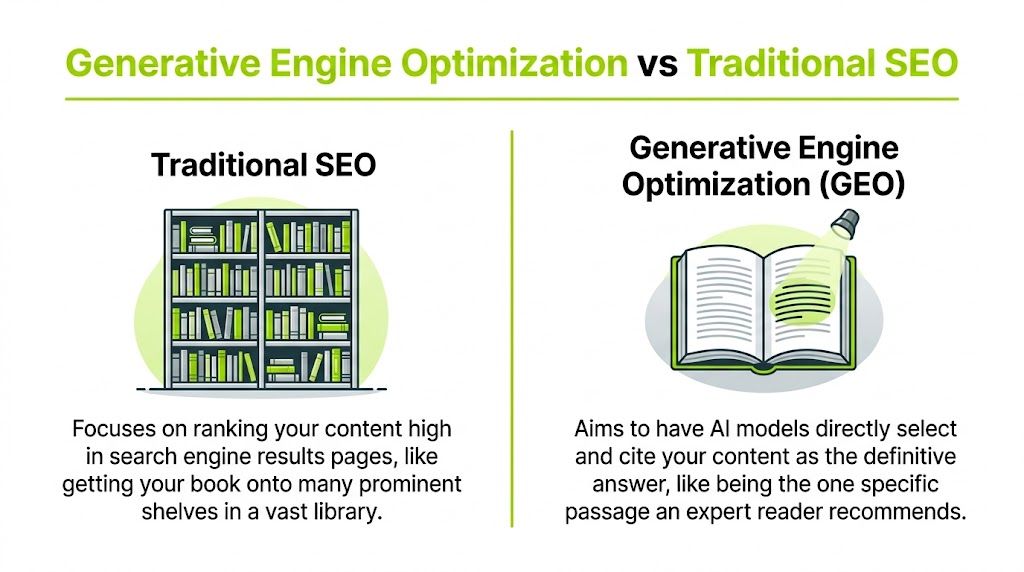
The easiest way to explain the difference to clients is this. Traditional SEO is like getting your book onto the right shelf in a library. GEO is like getting a passage from your book quoted in an expert's research paper. One is about placement in a results list. The other is about being selected as evidence inside a synthesized answer.
When AI-generated answers appear, the old click model weakens fast. Wellows reports that traditional click-through rates for informational queries drop from 1.41% to 0.64% when AI-generated answers are displayed, and nearly 60% of Google searches in the US and EU are zero-click as of 2024. That doesn't mean SEO is dead. It means visibility now splits across two surfaces: links and answers.
The core difference
SEO optimizes for a search engine result page. GEO optimizes for an AI response.
That sounds small, but it changes almost everything about how you judge success. In SEO, a page can win because it earns clicks from a strong position. In GEO, a page wins when an AI engine decides the content is useful enough, trustworthy enough, and clear enough to include in its answer generation process.
GEO vs. Traditional SEO At a Glance
| Aspect | Traditional SEO (Search Engine Optimization) | GEO (Generative Engine Optimization) |
|---|---|---|
| Primary goal | Earn rankings and clicks from search results | Earn citations, mentions, and inclusion in AI answers |
| Main output | Blue links, snippets, SERP features | Synthesized responses, summaries, cited recommendations |
| Success metric | Rankings, traffic, click-through rate | Citation rate, AI share of voice, brand sentiment in AI responses |
| Optimization focus | Keywords, crawlability, backlinks, intent alignment | Semantic clarity, authority signals, extractable structure, citation-worthiness |
| User behavior | Searcher scans options and chooses a link | User asks a question and receives a composed answer |
| Content requirement | Rank-worthy page | Citation-worthy page |
| Reporting challenge | Established and standardized | Newer, fragmented across platforms |
What still overlaps
The overlap matters because clients often assume GEO replaces SEO. It doesn't.
A solid technical site, clear topical coverage, expert-led content, and content freshness still help. If you're already doing serious SEO work, you're not starting from zero. But the emphasis shifts. Exact-match keyword placement matters less than whether your page clearly answers a question, supports claims, and presents information in a format an AI engine can extract cleanly.
A keyword research workflow is still useful because it reveals topic demand and intent patterns. It just needs to connect to broader concept clusters and real questions, which is why teams still benefit from a toolset for keyword research and topical planning.
If SEO helps users find your page, GEO helps AI systems trust it enough to use it.
What doesn't transfer cleanly
Some habits from old-school SEO don't carry over well.
Pages padded for length, vague thought leadership with no supporting detail, thin comparison content, and JavaScript-heavy experiences often struggle in AI search workflows. So do pages built around phrase repetition instead of explanation. AI engines don't reward content for sounding optimized. They reward content that is easy to retrieve, easy to interpret, and easy to cite.
That is why what is generative engine optimization isn't just a definition question. It's a workflow question. Agencies need new deliverables, new scorecards, and a new explanation of what visibility means.
How Generative AI Engines Find and Surface Answers
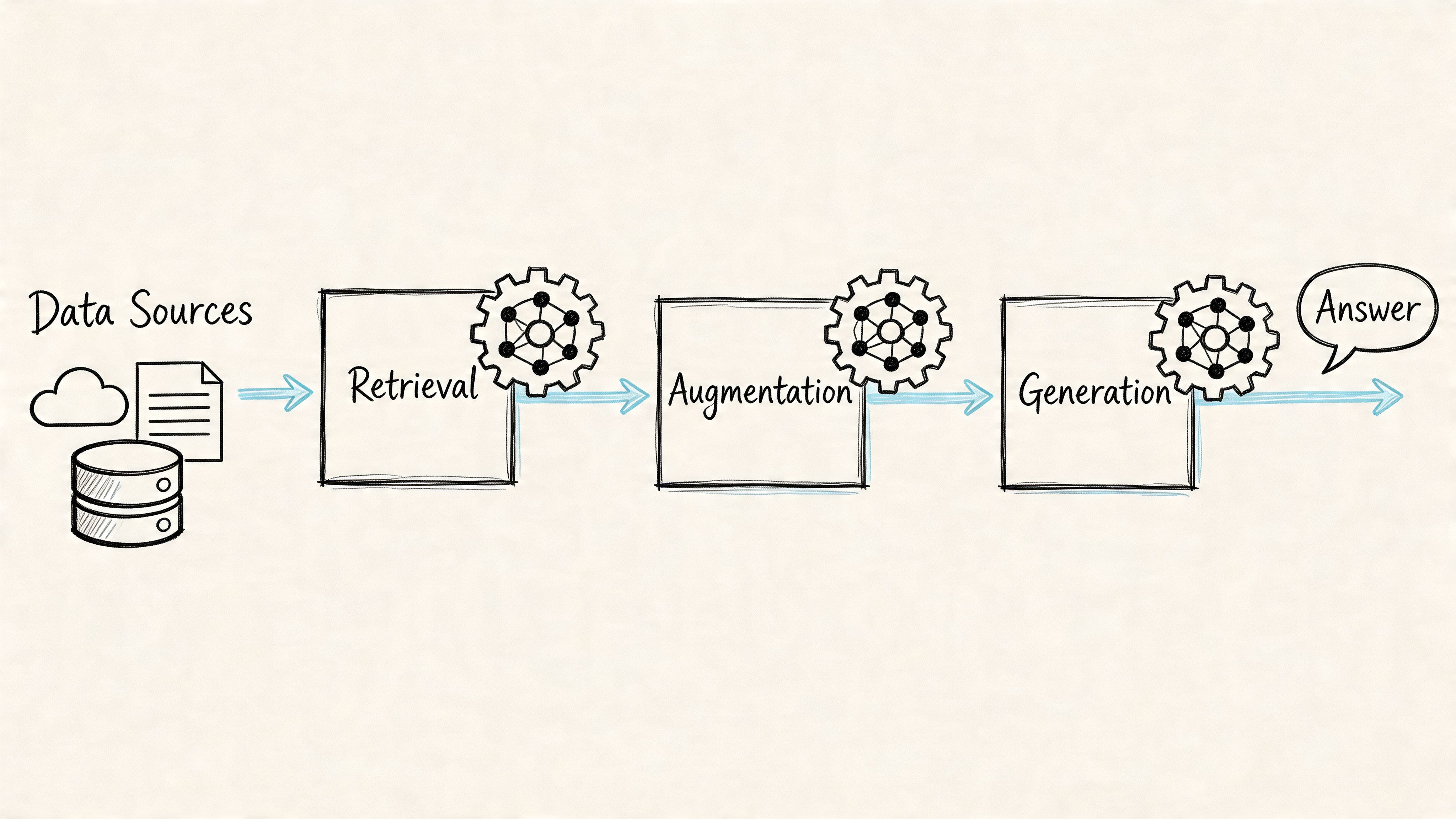
Most AI search products don't "think" through the open web the way people imagine. They use retrieval systems that decide what information to pull in before generating an answer. That process is usually explained through Retrieval-Augmented Generation, or RAG.
A useful analogy is a research assistant. You ask a question. The assistant rewrites it into something workable, searches a set of sources, picks the best material, and then writes a concise answer based on what they found. They are not copying one page word for word. They are synthesizing several sources into a response.
The four stages that matter
Frase explains RAG as a four-step process: semantic query processing, retrieval via concept matching, ranking based on relevance, authority, and recency, and answer synthesis. GEO tactics have the most influence in the ranking stage, because that's where the system decides which sources are strong enough to use.
Here is the practical translation:
-
The engine interprets the question It doesn't just look for exact words. It tries to understand what the user means.
-
It retrieves documents by concept This is why pages can surface for related phrasing even when they don't mirror the prompt exactly.
-
It ranks possible sources Relevance matters, but so do authority, freshness, and structure.
-
It generates the answer It combines material from the selected sources into a new response.
Why semantic matching changes content strategy
Many teams encounter difficulties at this juncture. They still write for exact match instead of topic coverage.
If a page explains AI search optimization clearly, an engine may retrieve it for a prompt about generative engine optimization even if the page doesn't repeat the phrase constantly. That's the practical difference covered well in this guide on semantic search vs keyword search. The machine is matching concepts, not just strings.
A good GEO page doesn't just contain the term. It contains the surrounding ideas an AI engine expects to see when that term is discussed well.
What agencies should monitor
Because different AI systems use different retrieval layers and ranking logic, one brand may appear frequently in one platform and barely register in another. That is why single-platform checks are misleading. You need platform-level benchmarking and prompt-level testing.
For teams doing this at scale, the operational requirement is simple: compare how the same topic performs across engines, prompts, and competitors using an LLM benchmark workflow. Without that, you can't tell whether the issue is content quality, platform variance, or a weak citation footprint.
The ranking threshold is the real battle
Many pages are relevant. Far fewer are selected.
That selection threshold is where GEO lives. If your page has thin explanations, no evidence, weak structure, or stale framing, it may be retrievable but still not rank high enough in the RAG pipeline to make the final answer. In practice, that means good content is not enough. You need content that is easy for machines to trust and use.
Actionable GEO Tactics to Earn AI Citations
The pages that earn citations usually don't look clever. They look clear.
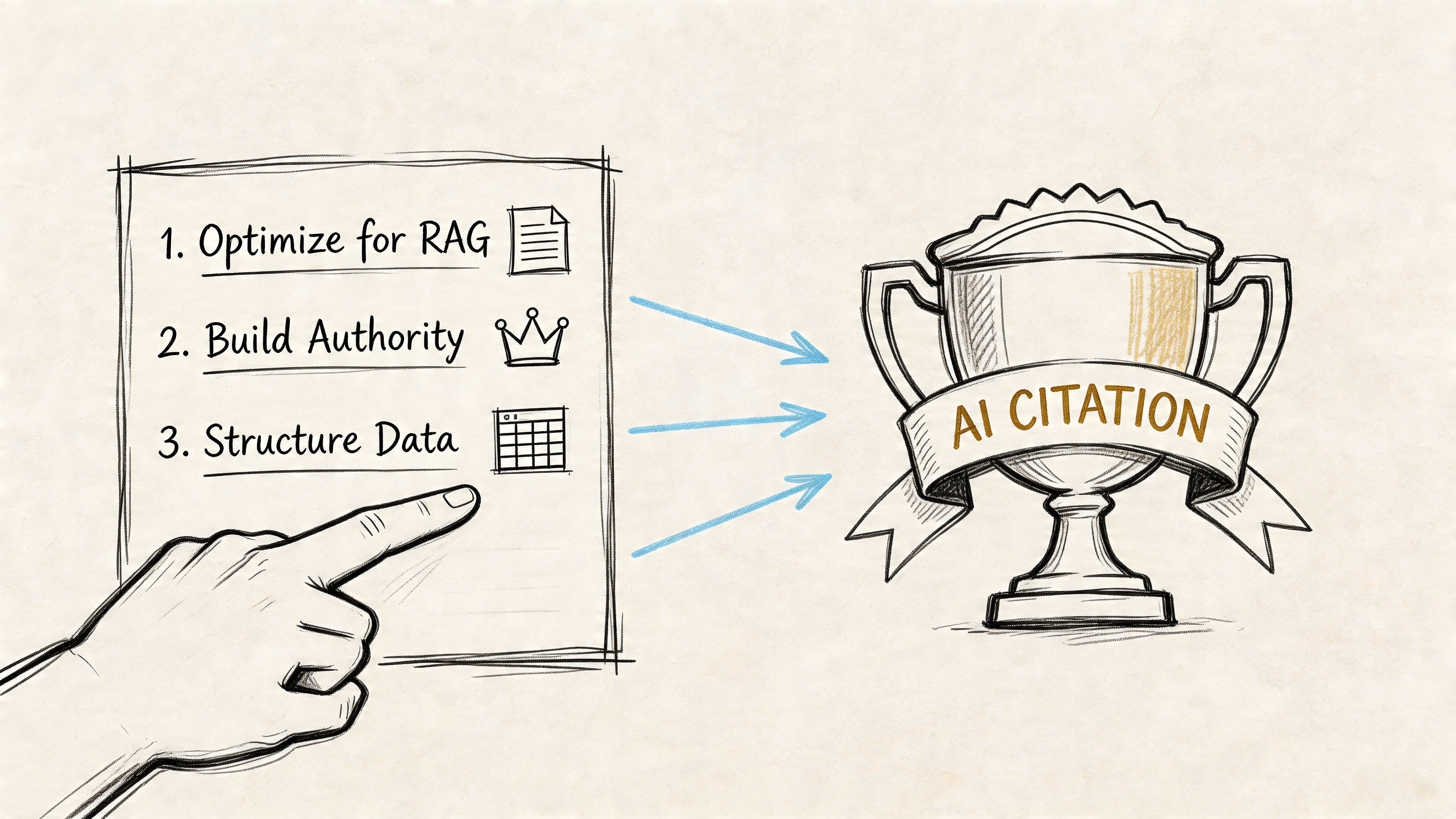
That is a useful shift for content teams because it changes the target. You're not trying to impress an algorithm with tricks. You're trying to make your content easy to extract, easy to verify, and easy to summarize. HubSpot's overview of GEO highlights the technical side directly: semantic schema markup, clear heading hierarchies, and scannable formatting like bullet points help AI engines extract, contextualize, and rank content for citation.
Write pages that answer one job well
A lot of weak GEO content fails because it tries to cover too much.
A page built to answer a specific decision, comparison, workflow, or implementation question is usually easier for an AI engine to understand than a broad article trying to rank for every variation. Agencies should map content by decision point, not just keyword family.
Good examples include:
- Comparison pages that explain differences clearly
- Implementation guides that break down steps in order
- FAQ sections that answer one question at a time
- Definition pages that establish terms and context cleanly
- Use-case pages that connect a problem to an outcome
This doesn't mean every page should be short. It means every page should be focused.
Content tactics that improve citation-worthiness
Three habits improve GEO performance consistently.
-
Use direct claims with support If you make an assertion, support it with a source, a method, or a clear explanation. Unsupported generalities are hard to trust and hard to cite.
-
Write in a question-and-answer rhythm AI systems frequently surface content that mirrors how users ask. That doesn't mean robotic FAQ spam. It means headings and paragraph openings should resolve real questions quickly.
-
Add useful specifics Define terms. Name tools. Explain trade-offs. Show the difference between two options. Vague content gets ignored because it doesn't help a generator build a strong answer.
Field note: Pages that open with the answer and then unpack the nuance tend to be easier for both readers and AI systems to use.
Structural tactics that make extraction easier
Here, technical SEO and content design meet.
-
Use clean heading hierarchy H1, H2, and H3 tags should reflect how the topic actually breaks down. If the outline is messy, the page is harder to parse.
-
Format for scanning Bullet lists, numbered steps, short tables, and concise paragraphs help retrieval systems isolate useful units of meaning.
-
Deploy schema where it fits Article, FAQPage, HowTo, and Organization schema help provide machine-readable context.
-
Keep publication and update signals clear Freshness affects whether some AI systems trust a page enough to use it for current-answer generation.
-
Reduce rendering friction If critical content is hidden behind client-side rendering, some AI crawlers may not see it cleanly.
Here is a simple before-and-after view:
| Page trait | Weak for GEO | Strong for GEO |
|---|---|---|
| Intro | Long scene-setting before the answer | Direct answer in the first lines |
| Headings | Clever but vague | Specific and question-aligned |
| Formatting | Dense paragraphs | Lists, steps, tables, short sections |
| Evidence | Assertions without support | Claims backed by cited material or clear reasoning |
| Technical setup | Heavy client-side rendering | Accessible content with schema and clean hierarchy |
A useful way to operationalize this is to run a citation gap analysis workflow on priority pages. The point isn't just to optimize your page in isolation. It's to compare what cited pages are doing structurally that yours is not.
What usually doesn't work
Some GEO advice online encourages content teams to "sound like AI" or force citation bait into every paragraph. That usually produces stiff content and weak pages.
Avoid these patterns:
-
Keyword stuffing with AI terms Repeating "LLM," "AI search," and "GEO" won't make a page more useful.
-
Fake authority formatting Adding quotes, stats, or expert-sounding language without substance creates pages that read polished but say very little.
-
One-template publishing Not every page should use the same structure. A how-to guide, pricing explainer, glossary page, and comparison page need different formats.
This short walkthrough is worth reviewing before your team starts updating templates:
The agency version of a good GEO brief
A strong brief for an AI-visible page should include:
- The prompt class the page is meant to serve
- The core entities and concepts that must appear naturally
- The evidence requirements for claims and recommendations
- The structural model the page should follow
- The comparison set of currently cited competitors or reference pages
If that isn't in the brief, writers will default to classic SEO habits. GEO needs a more explicit editorial standard.
Measuring and Reporting on GEO Performance with Surnex
The biggest reporting mistake agencies make is using old SEO metrics as the main proof of GEO performance.
That won't hold for long because GEO success isn't primarily about where a page ranks in a list. The measurement problem is different. A Wikipedia summary of generative engine optimization captures the core issue: there is a lack of standardized measurement, and success depends more on citation frequency and share of voice in AI responses than on traditional rankings.
The KPIs that actually matter
If you manage AI search visibility, report on outputs the client can understand and act on.
Citation rate This is how often a brand or page is cited across tracked prompts. It answers a simple question: when the AI responds on our core topics, are we one of the chosen sources?
AI share of voice This tracks how often the brand appears relative to competitors across prompt sets and platforms. It is the clearest executive metric because it frames visibility as market presence, not just page performance.
Brand sentiment in AI responses Appearing isn't enough. You also need to know how the brand is described. Are you framed as a leader, a niche option, an affordable choice, or not recommended at all?
Prompt coverage This measures whether your brand appears across informational, commercial, comparison, and post-purchase prompts. A brand that only appears for branded queries is still weak in broader discovery.
Why rankings can mislead
A client page can hold a strong organic position and still disappear from AI-generated answers. The reverse can also happen. A page with modest traditional visibility can be highly citable if it is well structured, specific, and trusted.
That is why GEO reporting should separate three layers:
| Reporting layer | What it tells you | Why it matters |
|---|---|---|
| Search performance | Rankings, traffic, CTR | Shows classic organic health |
| AI appearance | Mentions, citations, prompt coverage | Shows whether AI engines surface the brand |
| AI perception | Share of voice, framing, sentiment | Shows how the brand is positioned in generated answers |
The client question isn't "Did we publish content?" It's "Did AI systems use it, and did that improve our visibility against competitors?"
What to include in a monthly GEO report
A useful GEO report should include:
- A tracked prompt set tied to business priorities, not random experiments
- Platform splits across Google AI Overviews, ChatGPT, Perplexity, and any other relevant engine
- Citation winners and losers so the client sees which pages are being used
- Competitor deltas that explain who is gaining ground
- Action items tied to specific pages, entities, or missing content angles
For agencies, this is where a unified system matters. If your team tracks organic search in one place, AI mentions in spreadsheets, and prompt testing manually, reporting becomes fragile fast. A platform like Surnex is useful because it gives agencies one place to monitor cross-engine visibility, spot citation gaps, and present GEO outcomes in language clients already understand.
How to frame ROI without overclaiming
Don't promise traffic spikes from every AI mention. That is not how this works.
Instead, tie GEO reporting to three business outcomes:
- Visibility in zero-click environments
- Presence in high-intent comparison and recommendation prompts
- Improved brand inclusion across AI-assisted research journeys
That is a more honest model, and it matches how AI search influences discovery.
A Rollout Checklist for Agencies and In-House Teams
Most GEO programs fail because teams treat them like a content side project. They work better when rolled out like a search capability with owners, workflows, and reporting.
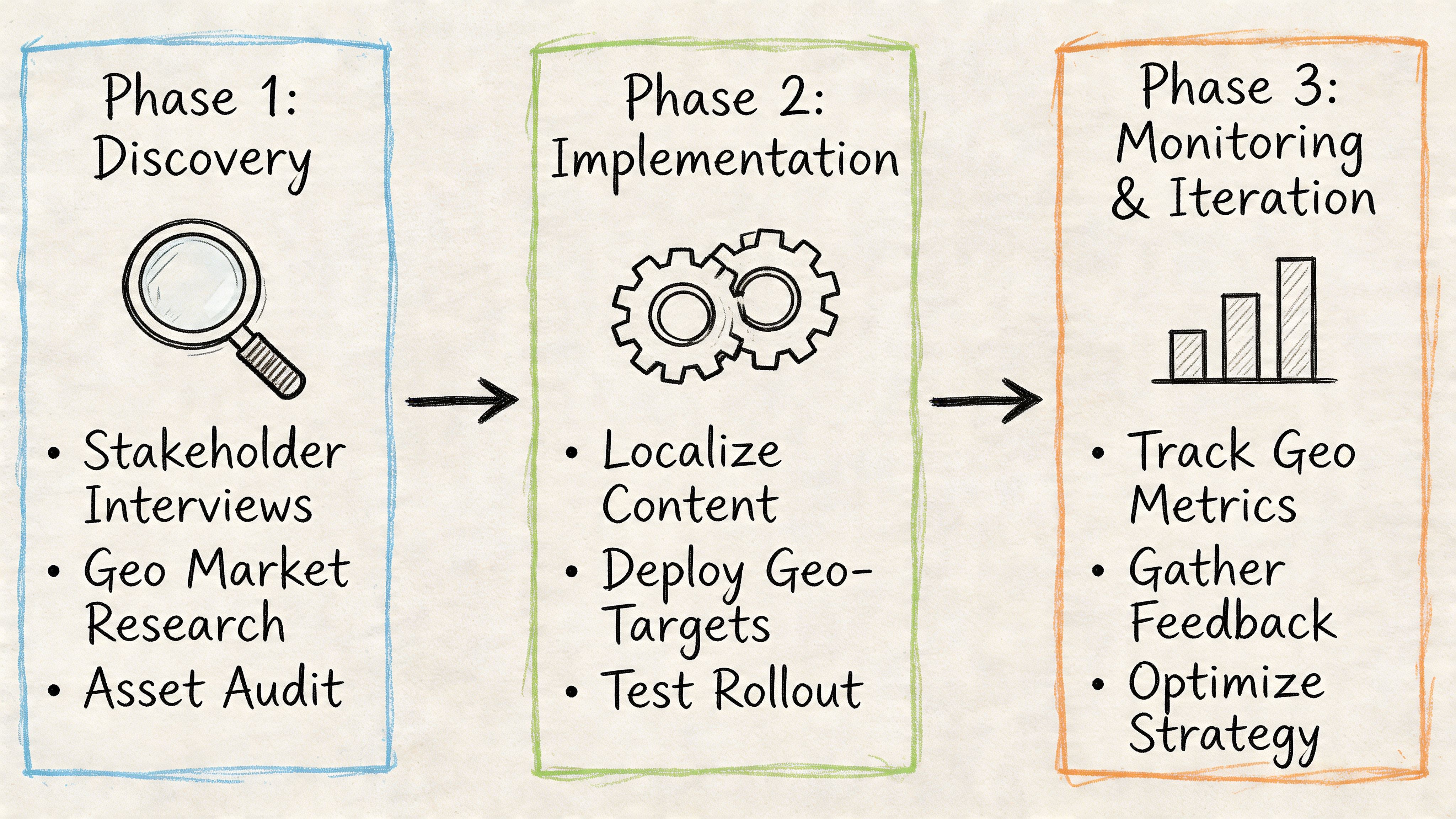
Phase one audit and strategy
Start with what the brand needs to be cited for.
- Define prompt groups around category terms, comparison terms, use cases, and buying questions.
- Audit current visibility by checking whether the brand appears, how often it appears, and how it is described.
- Identify citation-worthy assets already on the site, including glossaries, product explainers, comparison pages, and help content.
- Map competitive gaps by topic. If a competitor is repeatedly cited, review what their page does better structurally and editorially.
Phase two content optimization
Once you know the priority prompt sets, update the pages most likely to support them.
- Tighten intros so each page answers the main question quickly.
- Rewrite headings to reflect real user questions and subtopics.
- Add support where claims are weak, including sourced facts, definitions, and clarifying examples.
- Split broad pages when one article is trying to answer too many different intents.
Good GEO content usually becomes better human content too. Clarity is not a trade-off.
Phase three technical implementation
Content quality alone won't carry a weak technical foundation.
- Deploy relevant schema such as Article, FAQPage, HowTo, or Organization where it fits.
- Improve rendering accessibility so core content is visible without relying heavily on client-side delivery.
- Standardize information hierarchy across templates using clean H-tag structure and scannable layouts.
- Surface freshness signals with clear publication and update dates where appropriate.
Phase four monitoring and reporting
Here, GEO becomes a repeatable service, not a one-off cleanup.
- Track citation rate and share of voice on a fixed prompt set.
- Review platform differences because one engine's visibility does not guarantee another's.
- Log content changes against visibility shifts so your team can learn what moved the needle.
- Report outcomes in plain language tied to category presence, competitive movement, and business relevance.
If you're asking what is generative engine optimization from an operational standpoint, this is the answer. It is not a trick or a plugin. It's an ongoing process of aligning content, structure, and reporting with how AI systems choose sources.
Frequently Asked Questions About GEO
Does GEO replace SEO
No. GEO complements SEO.
Traditional SEO still matters because search engines still drive discovery, crawling, and traffic. GEO adds another layer by helping your content appear inside AI-generated answers. Most brands need both because users move between classic search and AI-assisted research without thinking about the distinction.
Is GEO only for large enterprises
No. Smaller brands can benefit because AI engines often look for the clearest and most useful source, not just the biggest website.
A focused company with strong comparison pages, a clean glossary, clear product documentation, and consistent brand messaging can become citable in narrow but valuable topic areas. In practice, many smaller teams move faster because they can update templates and approve content changes without heavy internal process.
How long does GEO take to show results
There isn't a universal timeline.
It depends on the platform, the crawl and retrieval behavior involved, how much authority the brand already has, and whether your current content is close to citation-ready. In agency work, the better question is not "How fast?" but "What changed in citation coverage after we improved page quality, structure, and topical fit?"
What kind of content tends to perform best
Content that answers real questions directly tends to do best.
That includes explainers, FAQs, implementation guides, product comparisons, glossaries, and pages built around clear use cases. Pages that are vague, overloaded with marketing language, or structurally messy are harder for AI systems to use.
Should teams optimize every page for GEO
No. Prioritize pages with the highest chance of being used in AI answers.
That usually means pages tied to category definitions, commercial research, comparisons, buyer objections, technical explanations, and recurring support questions. Not every blog post needs the same treatment.
What should agencies show clients first
Start with visibility, not theory.
Show whether the client appears in relevant AI responses today, where competitors appear instead, and which existing pages are most likely to improve with focused updates. That makes GEO concrete. Once clients see that search visibility now includes AI-generated answers, the reporting conversation becomes much easier.
If your team needs a practical way to monitor AI visibility, benchmark prompts across engines, and report citation-driven performance alongside core SEO metrics, Surnex gives agencies and in-house teams one platform for modern search intelligence.