Most advice about keywords in content is still stuck in a checklist mindset. Put the phrase in the title. Add it to the H1. Repeat it in the intro. Sprinkle it through the copy. That advice isn't fully wrong, but it's incomplete enough to push teams toward robotic pages that rank poorly, convert weakly, and age fast.
The better question isn't “how many times should this keyword appear?” It's “does this page solve the intent behind the search better than the alternatives?” That shift matters more now because search no longer works like a simple exact-match retrieval system. Google interprets meaning. AI search experiences summarize answers, compare sources, and reward pages that show clear expertise, not just repeated phrasing.
Rethinking Keywords in Content for the AI Era
A lot of teams still treat keywords in content as a placement exercise. They ask where the phrase should go, how often it should appear, and whether a synonym counts. Those questions miss the bigger issue. If the content angle is weak, placement won't save it.
Existing guidance often says keywords should be used naturally, but rarely answers the practical question of how much presence is enough. The more useful takeaway is simpler. The strongest page is not the one with the highest keyword density. It's the one with the clearest intent fit and the sharpest angle, as noted in this discussion of keyword use and content angle.
Why the old checklist breaks down
A page can include the target phrase in every traditional location and still fail for three common reasons:
- The intent is mismatched: The query suggests comparison, but the page reads like a definition.
- The angle is generic: The article repeats what every competing page already says.
- The topical signals are thin: The copy mentions the keyword, but doesn't cover the surrounding concepts users expect.
Practical rule: If removing the exact keyword barely changes the page's usefulness, that's often a good sign. It means the value comes from the answer, not repetition.
This is also why AI-assisted workflows need tighter editorial judgment, not looser standards. Teams using automation should focus less on insertion rules and more on whether the draft reflects real search intent, product knowledge, and topical breadth. That's the difference between scalable output and scalable noise. If your team is operationalizing that shift, this guide on using AI in SEO is a useful companion.
What actually wins now
Modern search rewards content that is easy to interpret and easy to trust. That usually means:
- One clear primary topic: Don't blur several intents into one page.
- A distinct angle: Add a perspective competitors missed.
- Language that matches how users ask: Not just what tools suggest.
- Evidence of depth: Related concepts, examples, constraints, and trade-offs.
Keywords still matter. They just work best as directional signals, not as a writing formula.
The True Foundation of Content Success Is User Intent
Search engines work more like a skilled store clerk than a filing cabinet. A filing cabinet matches labels. A good clerk listens for what the customer is trying to do. Search works the same way. The words matter, but the goal behind them matters more.
If someone searches “best payroll software for small business,” they're not asking for a definition of payroll software. They're evaluating options. If they search “payroll software pricing,” they may be closer to a purchase. If they search “ADP login,” they want to get somewhere specific. Small wording changes often reveal a completely different job to be done.
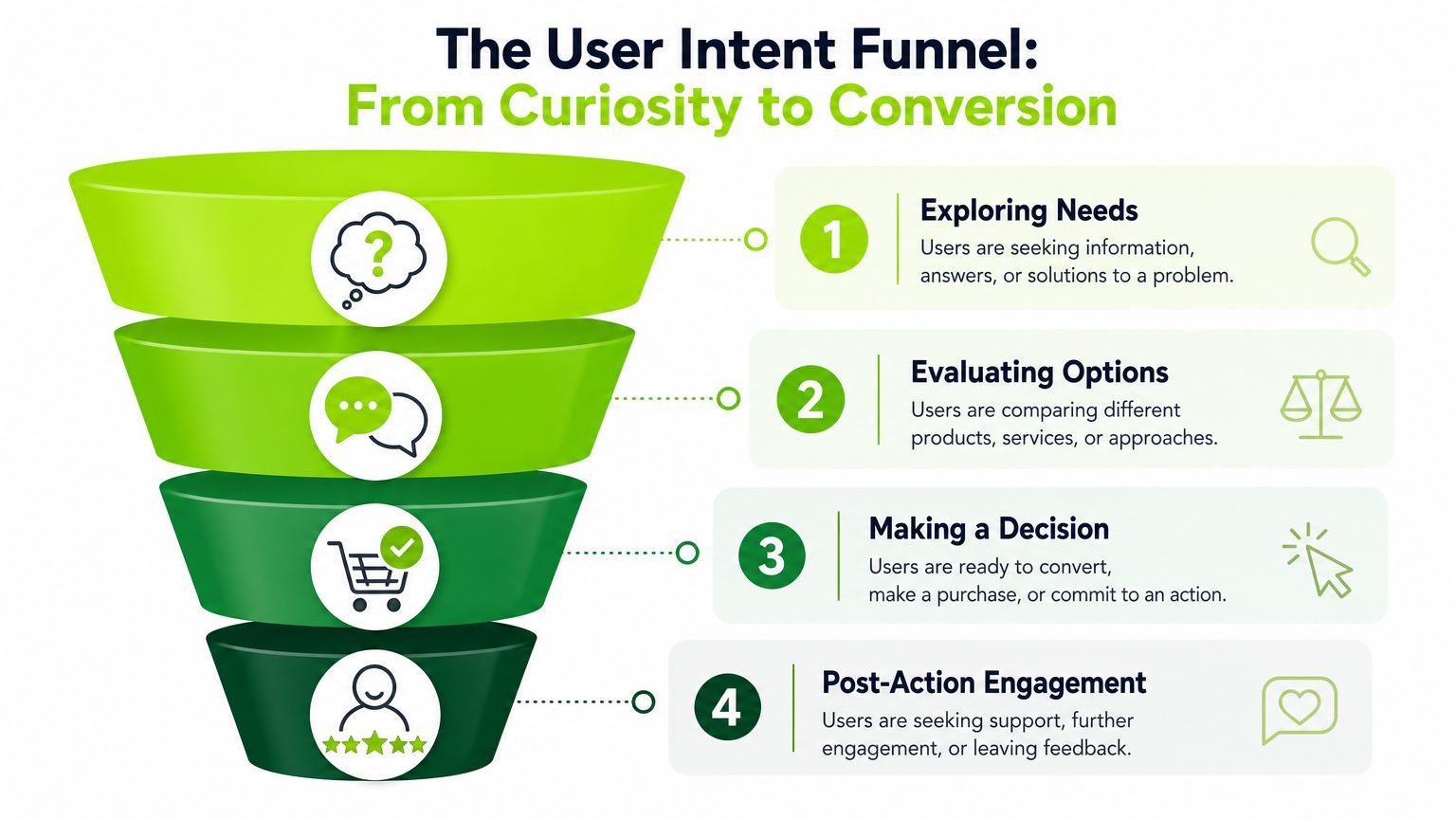
The four intent types that shape content
| Intent type | What the user wants | Query example | Best content format |
|---|---|---|---|
| Informational | To learn or understand | “how does technical SEO work” | Guide, explainer, tutorial |
| Navigational | To reach a specific destination | “hubspot keyword tool” | Product page, login page, brand page |
| Commercial investigation | To compare solutions | “best CRM for agencies” | Comparison, shortlist, review page |
| Transactional | To act now | “buy rank tracker software” | Landing page, pricing page, demo page |
This framework clears up most keyword debates. If the page type doesn't match the query type, rankings often stall even when on-page basics are correct.
How to read intent from language
Certain modifiers give the game away:
- Words like “how,” “what,” and “why” usually signal learning intent.
- Words like “best,” “vs,” and “review” often point to comparison intent.
- Words like “pricing,” “demo,” “buy,” and “near me” usually show stronger commercial intent.
- Brand names often indicate navigational intent, unless paired with comparison or pricing terms.
One of the clearest examples of high-intent search comes from local behavior. 88% of consumers who conduct a local search on their smartphone visit or call a store within 24 hours, according to this keyword research statistics roundup. That's why local modifiers and action-oriented queries deserve their own content treatment.
When a keyword carries strong intent, the page shouldn't just mention the topic. It should remove friction and help the visitor complete the next step.
Intent work also improves more than rankings. Teams that listen to customer language tend to produce better pages, better onboarding, and better product messaging. If you want a practical way to connect search behavior with real customer needs, this guide to improving customer experience adds a useful voice-of-customer layer.
Building a Resilient Strategy with Diverse Keyword Types
A keyword strategy built only around head terms is fragile. It looks impressive in a spreadsheet and disappointing in the SERP. Broad phrases are competitive, vague, and often mixed-intent. They rarely give a single page a clean path to visibility.
The stronger approach is to build coverage across keyword types. That means balancing broad topic pages with narrower supporting pages that answer specific questions, comparisons, use cases, and objections.
Why the long tail carries the real opportunity
Ahrefs reports that 94.74% of keywords get 10 monthly searches or fewer in its SEO statistics research. That matters because most demand is fragmented. Teams that focus on a handful of trophy keywords ignore the queries where real coverage depth is built.
In practice, the long tail is where content becomes useful. These queries tend to be more specific, less ambiguous, and easier to map to a clear page purpose.
A balanced keyword mix
Think in terms of a portfolio, not a list.
- Head terms: Broad topics like “content marketing” or “project management software.” Good for category pages and pillar content, but often too wide for a single blog post to satisfy well.
- Body keywords: More focused phrases like “content marketing strategy” or “project management software for teams.” These usually have clearer intent and better editorial boundaries.
- Long-tail keywords: Specific searches like “how to build a content marketing strategy for B2B SaaS” or “best project management software for remote design teams.” These often convert better because the user knows what they need.
A practical way to sharpen your mix is to review examples of marketing keyword strategies and compare them against your own page inventory. Many teams discover they have too many broad blog topics and not enough intent-specific content.
What agencies should do differently
Agency teams usually need a system that scales across clients and categories. A useful working model looks like this:
- Use broad terms for architecture: Category pages, service pages, and pillar assets.
- Use mid-specific terms for core educational content: Pages that explain, compare, and frame the buying problem.
- Use long-tail terms for capture: FAQs, use-case pages, problem-solution posts, and niche comparisons.
For a practical workflow, build the list first, then judge whether each term deserves a new page, a section on an existing page, or no action at all. This resource on how to build a keyword list is a good model for that process.
From Keywords to Concepts with Semantic Search
Exact-match optimization still has a role, but it's no longer the center of the job. Search engines interpret topics through relationships between terms, entities, and context. That means a page about coffee doesn't need to repeat “coffee” in every paragraph to prove relevance. It needs to cover the surrounding concepts a useful answer naturally includes.
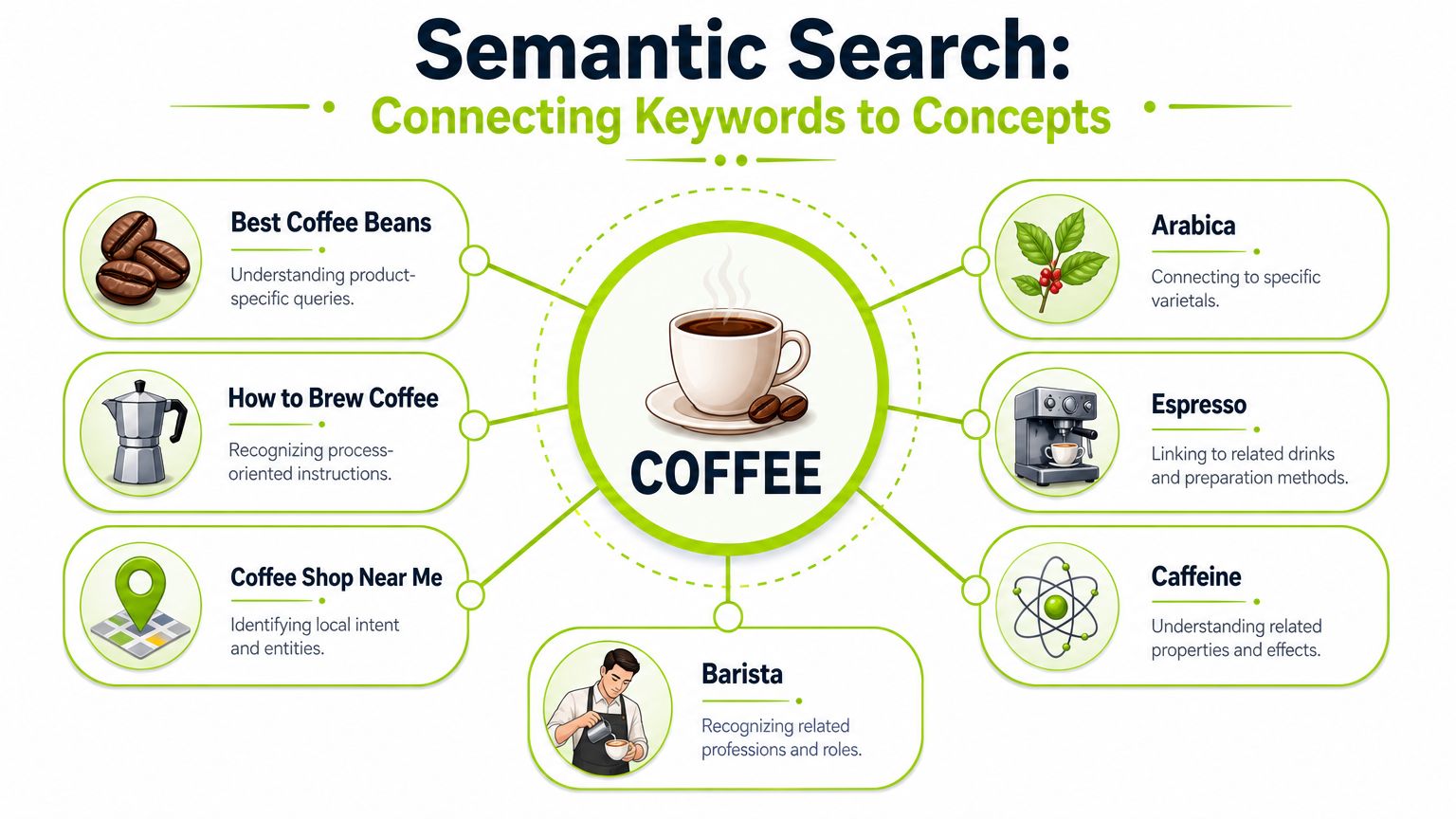
Search engines parse meaning, not just strings
Take the query “jaguar.” The same word can refer to an animal, a car brand, or a sports team. Search engines use surrounding words, prior behavior, page context, and entity relationships to decide what the user likely means. Content that makes its subject unmistakable tends to perform better because it removes ambiguity.
That changes how you should approach keywords in content. Instead of trying to repeat one phrase, build pages around a concept set:
- Primary entity: The main topic of the page
- Supporting entities: Related products, problems, audiences, locations, or processes
- Intent signals: Words that show whether the user wants to learn, compare, or act
- Contextual vocabulary: Terms a credible page would naturally include
Many content teams get stuck because they publish isolated articles instead of connected topic clusters.
Topical authority comes from connected coverage
A page can rank for a narrow query without much authority. Sustained visibility across a topic usually requires a stronger cluster. That means one page covers the core concept, while supporting pages address subtopics, adjacent questions, and commercially relevant variations.
Here's a simple comparison:
| Approach | What it looks like | Likely outcome |
|---|---|---|
| Single keyword page | One article aimed at one phrase | Limited reach, weak durability |
| Topic cluster | Pillar page plus supporting pages | Broader relevance, stronger internal context |
| Entity-rich content | Covers concepts, terms, examples, constraints | Better alignment with semantic search |
The same principle appears outside SEO. Data teams use semantic models to connect messy information into something usable for decision-making. If you work with product, analytics, or RevOps teams, this explanation of getting clear business insights is a good analogy for how semantic structure improves interpretation.
A related SEO concept is latent semantic indexing, though modern practice is less about the old acronym and more about related language and concept coverage. This overview of latent semantic indexing SEO is helpful if your team still uses that term loosely.
How to find better angles in a fragmented search environment
The old process was simple. Pull keywords from a tool, sort by volume, and write. That process misses emerging intent shifts, especially when users move between Google, video, forums, and AI assistants.
Underserved content angles are increasingly found by combining search behavior with external demand data, not by keyword tools alone, as explained in this content angle guide. That matters because the best opportunities often come from real-world changes in buyer questions, product constraints, sourcing issues, or policy changes before standard keyword tools fully reflect them.
A strong content brief should include more than target phrases. It should include:
- What the user is trying to decide
- Which competing angles already dominate the SERP
- What real-world context has changed
- What expertise or evidence your brand can add
This short video is a useful primer on how search has moved toward semantic understanding.
Good keyword targeting narrows the topic. Semantic coverage proves you deserve to rank for the broader concept.
Strategic On-Page Placement Without Sounding Robotic
Placement still matters. It just needs to serve clarity, not superstition. If a page's title, heading structure, and opening copy make the topic obvious, you've already handled most of the on-page signal without forcing repetition.
The cleanest rule is to assign one primary keyword to the page's main purpose, then support it with natural variations that reflect subtopics and user language.
Where the primary keyword belongs
Use the primary phrase in the places that define page meaning:
- Title tag: Make the topic obvious and compelling.
- H1: Usually close to the title, but written for humans first.
- URL slug: Keep it short and descriptive.
- Opening paragraph: Confirm relevance early without sounding scripted.
That doesn't mean every location needs the exact same wording. Minor variation is often better if it improves readability.
Where variation does the real work
For documentation-heavy content, best practices recommend reinforcing the primary keyword in title tags and H1s where it fits naturally, while using semantic variants and related terms in lower-level headings to preserve intent alignment and avoid overstuffing, according to this guide for technical keyword research.
That guidance is useful well beyond documentation. Subheadings should expand the topic, not echo the same phrase repeatedly.
Here's a practical example:
| Weak heading set | Better heading set |
|---|---|
| “Email Deliverability Guide” | “What Email Deliverability Actually Means” |
| “Email Deliverability Tips” | “Common Causes of Spam Placement” |
| “Email Deliverability Best Practices” | “How to Diagnose Inboxing Issues” |
The second version still supports the page's core topic, but it adds information scent and covers related intent.
Editorial test: Read the page aloud. If the keyword calls attention to itself, rewrite the sentence.
What doesn't work anymore
Three habits still hurt pages:
- Keyword stuffing: Repeating the same phrase in every heading and paragraph.
- Template intros: Opening with an exact-match sentence that sounds machine-written.
- Forced synonym swaps: Replacing normal language with awkward variants just to “hit” more terms.
Good on-page SEO should be almost invisible to the reader. The user should feel guided, not optimized against.
Measuring Performance in Search and AI Experiences
Rank tracking still has value, but it's no longer enough on its own. If your reporting only shows where a few keywords rank, you're missing how visibility works now. Users discover brands through classic organic results, AI Overviews, conversational assistants, citation patterns, and blended SERP features.
A page can lose a position and still gain influence if it appears more often in AI-generated summaries or supports pages that capture broader topical demand. The reverse is also true. A page can hold a rank and become less valuable if AI interfaces satisfy the query before the click.
What to measure instead of just rank
A modern reporting stack should include several layers:
- Visibility across query sets: Not only a few trophy terms, but clusters tied to a topic or funnel stage.
- Organic traffic trends: To see whether keyword coverage is translating into discovery.
- Conversion signals: Form fills, demos, purchases, or qualified visits.
- AI search presence: Mentions, citations, summary inclusion, and recurring absence.
That broader model gives teams something far more useful than isolated position changes. It shows whether the brand is becoming easier to find and easier to trust.
Why agencies need a unified view
Client reporting gets messy fast when search data lives in one tool, content auditing in another, and AI visibility nowhere at all. Teams end up with fragmented narratives and weak recommendations.
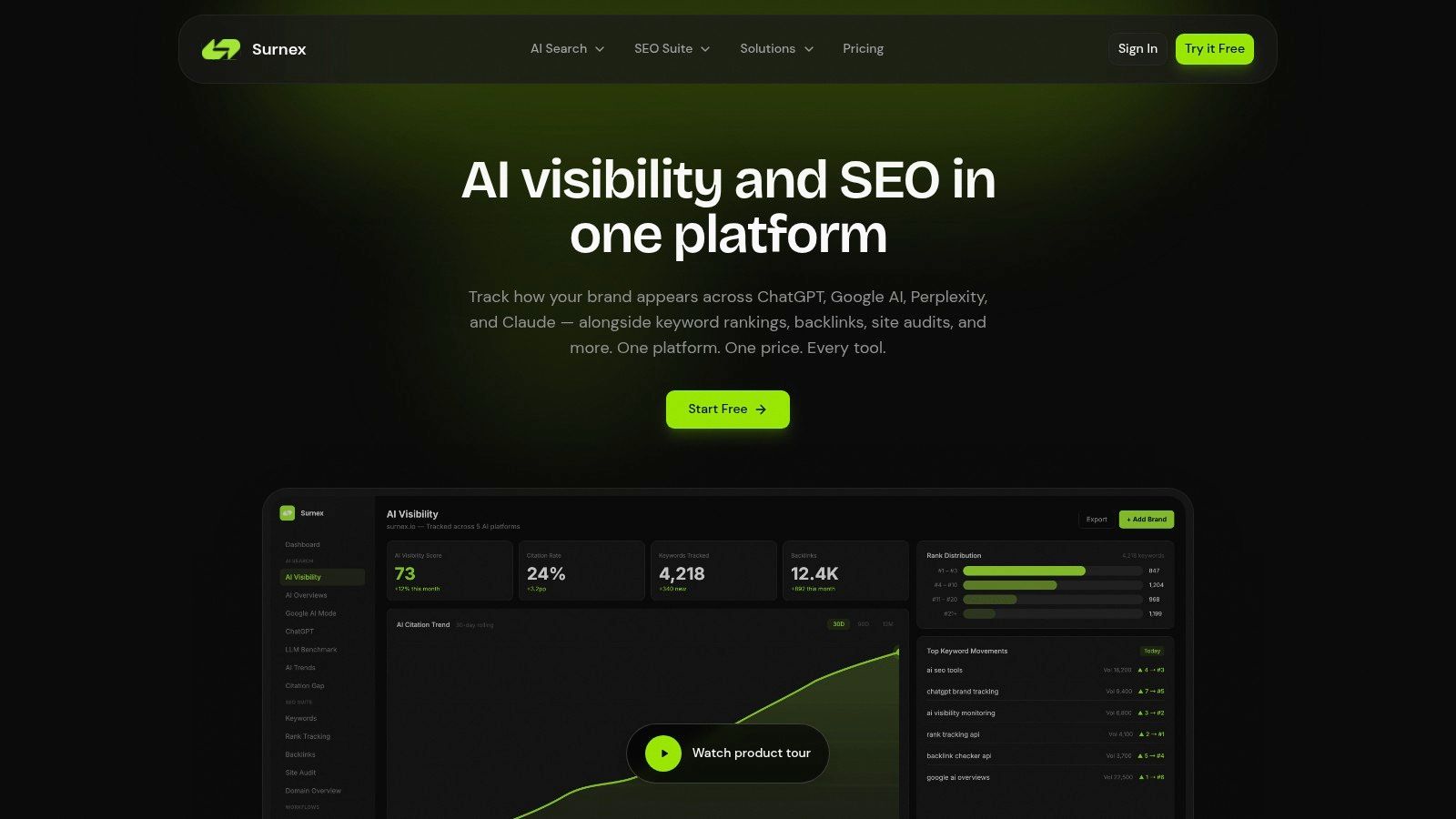
One practical option is to use a platform that combines traditional SEO signals with AI visibility monitoring. Surnex, for example, tracks rankings, audits, backlinks, and visibility across AI search experiences in one environment. That kind of setup is useful when agencies need to explain not just rankings, but how a client appears across emerging discovery surfaces. This guide to a keyword rankings and visibility report shows the reporting logic well.
The reporting questions that matter now
Instead of asking only “Did we move from position five to three?”, ask:
- Did coverage expand across the topic?
- Are more pages contributing to discovery?
- Are AI systems citing or surfacing our content?
- Which intent groups improved, and which stalled?
- Did visibility lead to business outcomes?
If reporting doesn't connect keyword work to actual discovery and action, the team will optimize what's easy to track instead of what matters.
That's the trap many SEO programs fall into. They report precision and miss relevance.
A Tactical Checklist for Using Keywords in Content
Execution breaks down when teams skip the map. Writers get a phrase, open a doc, and start drafting. Editors fix wording later. Strategists review after publication. That sequence creates thin pages, overlapping topics, and preventable rework.
A better process is boring in the best way. Decide the page purpose first, map the keyword, confirm the angle, then write to the intent.
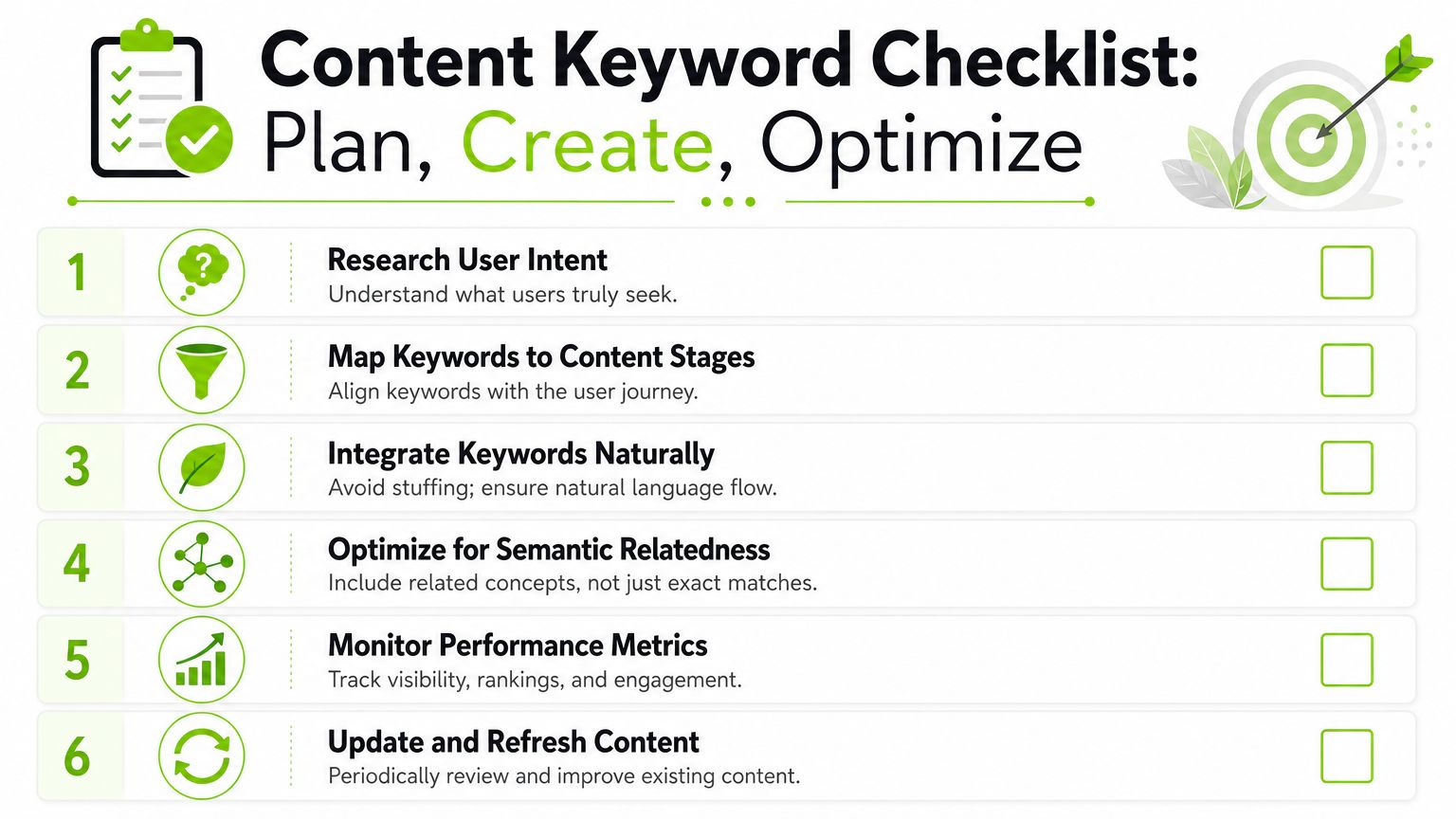
The working checklist
A practical technical standard is to map one primary keyword per page and document supporting metrics in a content-to-keyword map, which helps identify coverage gaps and weak links before publishing, as explained in Moz's keyword mapping guidance.
Use this checklist before a page goes live:
- Confirm page intent: Decide whether the page is meant to teach, compare, convert, or support navigation.
- Assign one primary keyword: Give the page a single main target. Don't force several unrelated intents onto one URL.
- Choose supporting terms carefully: Add secondary phrases, related concepts, and likely questions that naturally belong on the page.
- Review the SERP manually: Check what formats rank. Guides, category pages, comparison posts, and forums signal different expectations.
- Write the title and H1 for clarity: Include the main topic where it fits, but keep both readable.
- Place the keyword early: Use it in the intro if it sounds natural and helps confirm relevance.
- Build useful subheadings: Expand the topic with related concepts instead of repeating the main phrase.
- Check internal overlap: Make sure another page on the site isn't already targeting the same job to be done.
- Edit for human flow: Remove forced repeats, awkward synonyms, and boilerplate intros.
- Measure after publishing: Look at visibility, traffic quality, and conversions, not just isolated rankings.
The audit question most teams forget
Ask one blunt question before approving the draft.
Does this page deserve to rank if the exact keyword appears only a few times?
If the answer is no, the problem usually isn't placement. It's weak intent alignment, shallow coverage, or no clear angle.
If your team needs a clearer way to track how content performs across both traditional SEO and AI-driven discovery, Surnex gives agencies and in-house teams one place to monitor rankings, visibility, citations, audits, and content opportunities without splitting the work across disconnected tools.