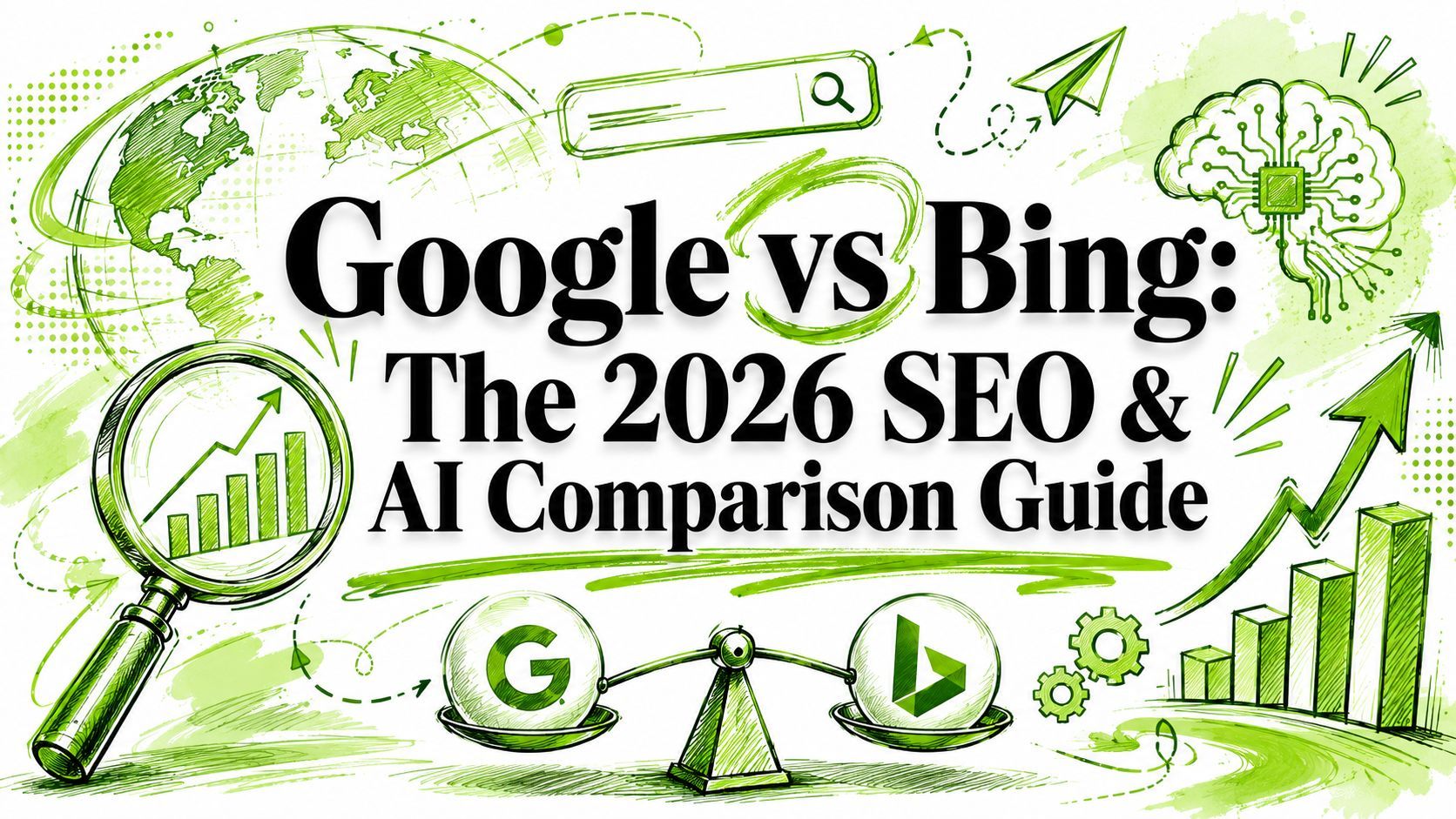
Most advice on Google vs Bing is too shallow to help an agency make budget decisions. It usually ends at market share, then jumps to a lazy conclusion: Google is bigger, so Bing barely matters.
That conclusion is directionally true and strategically incomplete.
A smart search team doesn't ask only which engine is larger. It asks where intent differs, where competition differs, and where AI changes visibility rules enough to justify separate workstreams. In 2026, that matters more than it did a few years ago because search isn't just blue links anymore. It's summaries, citations, sidebars, follow-up prompts, and ad placements shaped by the operating system and browser sitting between the user and your client.
Google vs Bing An Introduction Beyond Market Share
Google still owns the broad consumer search market. StatCounter search engine market share data shows Google at 90.39% and Bing at 5.03% worldwide in May 2026. The same source notes that Bing is stronger in the U.S., reaching about 10.48% in one independent 2026 market-share analysis.
That should end one argument quickly. If an agency has to choose one engine to cover first, it chooses Google.
But that isn't the actual decision most agencies face. The actual decision is whether Bing deserves dedicated effort after Google's baseline is covered. For many accounts, the answer is yes.
Where the market share argument breaks down
Market share tells you scale. It doesn't tell you channel quality.
Bing can matter disproportionately when a client sells into desktop-heavy audiences, Windows-based work environments, or enterprise contexts where Microsoft products shape default behavior. That's why the useful question isn't “Is Bing bigger than Google?” It obviously isn't. The useful question is whether Bing behaves like a different acquisition environment.
Here is the practical comparison agencies should use early in planning:
| Factor | Bing | |
|---|---|---|
| Global reach | Dominant worldwide | Much smaller worldwide |
| U.S. strategic relevance | Strong across nearly every vertical | More relevant than its global average |
| Organic ranking style | Broader semantic interpretation | Tighter response to explicit signals |
| AI search experience | AI Overviews inside core search | Copilot woven through Microsoft's ecosystem |
| Paid media environment | Broad scale and heavier competition | Smaller scale with different audience pockets |
What agencies miss
The biggest mistake isn't ignoring Bing entirely. It's treating Bing as a copy of Google with less volume.
That leads teams to port over the same content, the same ad assumptions, and the same reporting logic. Then they judge Bing unfairly when it doesn't mirror Google's outcomes.
Practical rule: Google is the default engine for scale. Bing is the testable engine for audience asymmetry.
If your client sells software to operations teams, financial services to office-based buyers, or B2B services where work devices shape search habits, Bing can punch above its headline share. If your client depends on broad mobile discovery and mass-market informational demand, Google usually stays the center of gravity.
The AI era makes that split sharper, not smaller. Google and Microsoft aren't just serving search results through different brands. They're shaping different user journeys around answer generation, citations, and follow-up behavior.
Comparing AI Overviews and Bing Copilot Integration
The old Google vs Bing comparison focused on rankings and ads. The current one starts with interfaces.
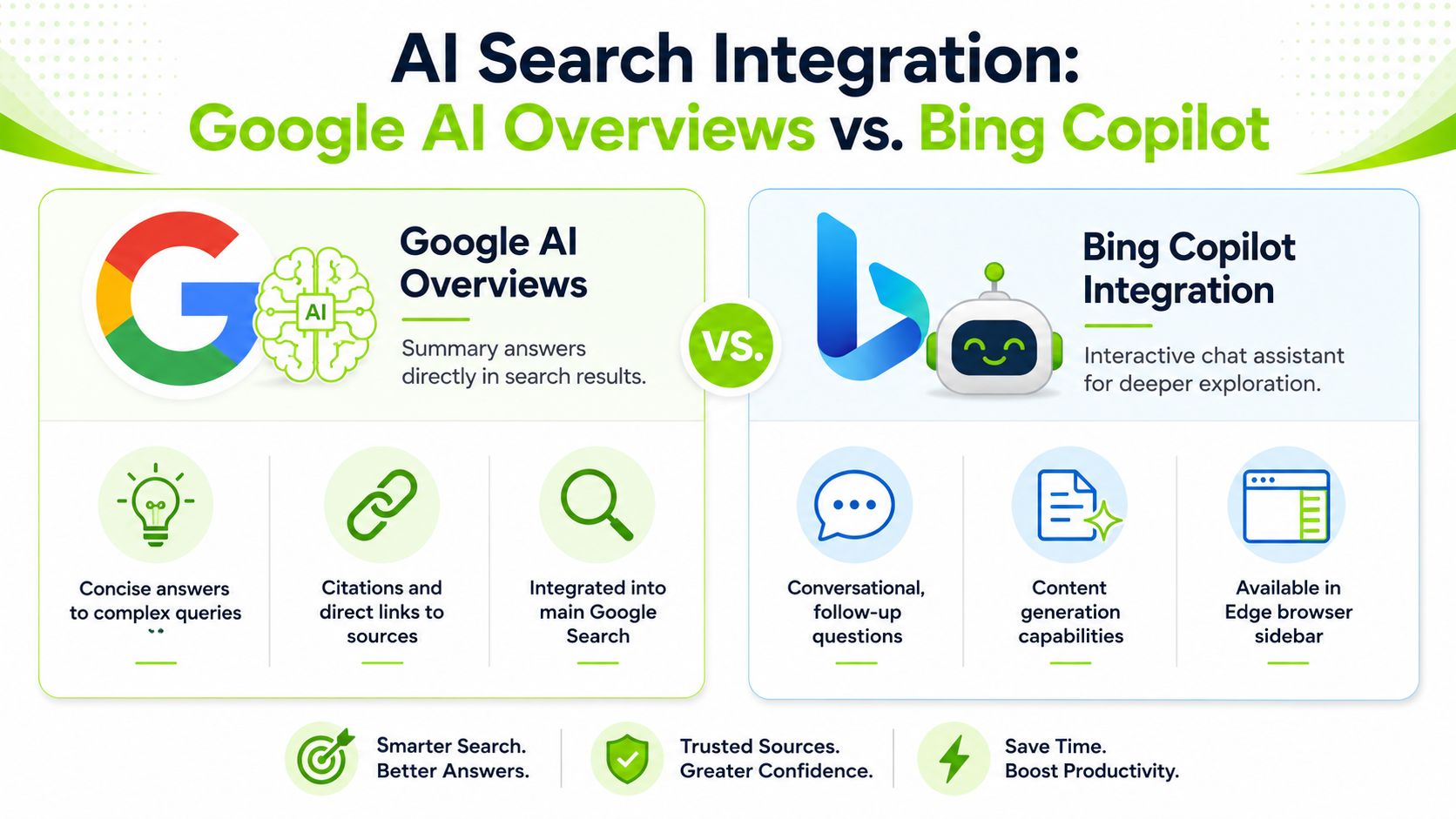
Google's AI layer appears inside the main search experience. Bing's AI layer is tied more tightly to Microsoft's broader environment. That difference matters because users don't just see an answer. They see an answer in a specific context, with different habits around clicking, refining, and continuing the session.
The core strategic difference
A useful framing comes from Upgrow's Bing vs Google analysis: the missed question isn't only market share, but whether Bing can be a materially different acquisition channel for certain audiences. That becomes more important in the AI era because Microsoft's ecosystem can surface Bing's AI experiences differently across Edge, Windows, and Microsoft accounts.
Google's AI Overviews sit inside the world's default search habit. Bing Copilot often feels more like an interactive assistant layered into Microsoft's product surface.
That changes the optimization mindset:
- For Google AI Overviews, your content has to earn inclusion in a high-volume environment where Google compresses information into a quick answer format.
- For Bing Copilot, your content may benefit from being useful in a more conversational workflow where the user continues asking questions.
- For both, brand visibility is no longer only “Did we rank?” but also “Were we cited, paraphrased, or bypassed?”
A good primer on that shift is Surnex's explanation of search generative experience, especially if your team still reports only on classic rankings.
Click risk and citation opportunity
Agencies should hold two ideas at once.
AI answers can reduce clicks for simple questions. They can also expand visibility for brands that become trusted citation sources. The trade-off isn't theoretical. It's operational. You need content formats that can survive summary-style extraction without becoming invisible afterward.
If a page only works when a user reads every paragraph in order, it's fragile in AI search.
That means teams should prioritize content that does four things well:
- Answers the question early
- Uses clear sectioning that machines can parse
- Supports claims with verifiable details
- Creates a reason to click beyond the summary
A later-stage buyer may still click for product detail, pricing logic, comparison nuance, implementation steps, or proof. A top-of-funnel user may not.
This product walkthrough is useful context for how search is becoming more answer-led and workflow-led:
What to do differently
For Google, build pages that can supply clean, extractable answers without flattening the entire experience into one paragraph. For Bing, think beyond the SERP and consider how Copilot-style interactions may reward content that handles follow-up questions well.
Use these editorial patterns more often:
- Short answer blocks near the top of key pages
- Explicit comparisons rather than implied distinctions
- Entity clarity around products, features, people, and organizations
- Modular formatting so citations can pull from well-scoped sections
The winning move isn't “optimize for AI” in the abstract. It's to make pages useful both as destinations and as citation sources.
Understanding Core Ranking Factors and Indexing
Most agencies say they optimize for “search engines” as if Google and Bing read pages the same way. They don't.
Bing ranking behavior described by Impression Digital is often more sensitive to exact-match on-page signals, title tags, URLs, freshness, and click or user-engagement signals, while Google is more associated with semantic understanding, relevance, and domain authority.
How that changes on-page SEO
Google is generally better at connecting related concepts even when the wording isn't identical. Bing is often more literal. If a page targets a term, Bing may respond more directly when that term is reflected clearly in the title, headings, and URL structure.
That doesn't mean stuffing exact matches everywhere. It means being less casual with keyword alignment when Bing matters.
A practical split looks like this:
- Google-first pages can tolerate broader phrasing if intent coverage is strong and the page earns authority.
- Bing-sensitive pages often benefit from cleaner keyword-target mapping, tighter titles, and less ambiguity in metadata.
- Shared best practice still applies to both. Strong information architecture helps each engine understand page purpose.
Why authority still isn't optional
Some teams overcorrect when they hear that Bing is more responsive to traditional signals. They start acting as if links and brand authority only matter for Google. That's the wrong lesson.
Authority still matters. It just doesn't remove the need for explicit page-level optimization. If your team needs a refresher on why authority signals remain central to search visibility, Surnex's overview of PageRank and link authority is a useful baseline.
Working advice: If Google rewards nuance and Bing rewards clarity, most pages should aim for both.
Where agencies lose performance
The hidden failure mode is not technical. It's editorial.
Writers produce broad, polished content that reads well but obscures keyword intent. Titles get clever instead of clear. URLs become branded rather than descriptive. Internal links reference vague concepts rather than the terms users search.
Bing tends to expose those weaknesses faster.
Use a simple QA pass before publishing:
| Check | Why it matters more on Bing |
|---|---|
| Exact topic match in title | Reinforces direct query alignment |
| Descriptive URL slug | Gives an additional relevance cue |
| Fresh updates on time-sensitive pages | Supports recency-sensitive interpretation |
| Strong CTR-facing title writing | Aligns with engagement-sensitive behavior |
Google usually gives you more room to win through breadth, authority, and contextual depth. Bing often asks whether you clearly stated what the page is about. Agencies that separate those two questions usually build better pages for both engines.
Analyzing SERP Features and Structured Data Support
Winning search visibility now means occupying more than one result type. Organic listings, rich results, local surfaces, image visibility, and branded knowledge treatments all shape click share before a user ever reaches the “best blue link.”
That makes structured data less of a technical afterthought and more of a packaging layer for search visibility.
Schema implementation should follow business value
Don't start with every schema type available. Start with the schema types that correspond to pages that already matter to the business.
Here is a simple working model:
| Schema Type | Google Support & Impact | Bing Support & Impact |
|---|---|---|
| Product | Strong for product-focused experiences when page details are explicit | Useful where product attributes are clearly structured |
| Review | Helpful when reviews are tightly connected to the reviewed entity | Can support result clarity when markup is consistent |
| FAQ | Useful when questions match real search behavior | Helpful for explicit question-answer formatting |
| Organization | Supports brand understanding and entity consistency | Supports clearer business identity interpretation |
| LocalBusiness | Important for local discovery and business detail accuracy | Important where Bing local surfaces matter |
| Article | Helps search engines classify editorial content | Helps reinforce page type and content context |
What to prioritize first
Agencies usually get better results from implementation discipline than from markup volume.
Focus on:
- Core commercial pages first because product, service, and category visibility tends to influence revenue most directly
- Local entities second if the client depends on maps, local discovery, or service-area intent
- Editorial content third when the site uses publishing to capture research and comparison queries
If your team actively tracks local result movement, tools built specifically for Bing can add useful context. This guide to Bing SERP tools for local SEO is a practical reference for agencies that want visibility beyond Google-only local reporting.
Rich results need operational consistency
Markup doesn't rescue weak pages. It amplifies pages that are already coherent.
That means:
- Match visible content to markup
- Keep entity naming consistent
- Avoid templated clutter that muddies the main topic
- Treat schema as maintenance work, not one-time setup
For teams that need a quick refresher on how enhanced results work in practice, Surnex has a concise explanation of rich snippets and search result enhancements.
Structured data is most valuable when it reduces ambiguity. Search engines don't need more markup. They need cleaner meaning.
The agency trap is chasing every SERP feature equally. That's rarely necessary. A better approach is to map each important page type to the result enhancements most likely to affect that client's funnel, then validate whether those enhancements appear consistently in both ecosystems.
Google Ads vs Microsoft Ads for Audience Targeting
Paid search decisions are easier than SEO decisions in one sense. You can control spend directly. They're harder in another sense because platform scale can hide inefficient targeting.
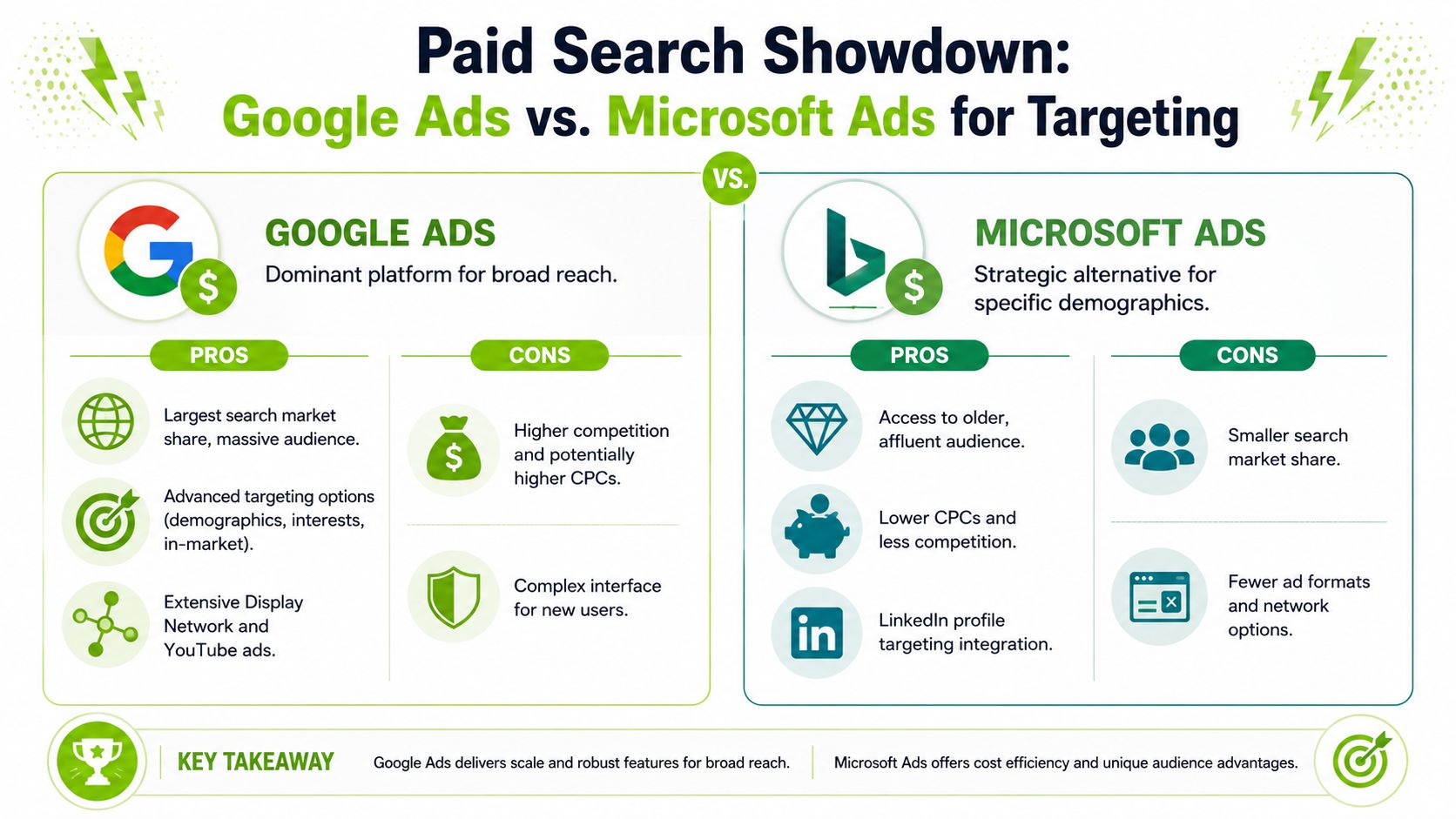
Google wins on reach. That part isn't controversial. Konvart's industry summary on Bing vs Google usage and revenue says Google handled over 14 billion searches per day and generated over $252 billion in search ad revenue in 2025, while Bing generated a little over $14 billion in ad revenue that year. The same source notes that this scale difference often translates to lower CPCs and less competition on Microsoft Ads.
When Google Ads should dominate the plan
If a client needs broad intent capture, national reach, and mature campaign depth, Google Ads usually takes the larger share of spend.
Google is often the default choice for:
- High-volume consumer demand
- Aggressive ecommerce acquisition
- YouTube and broader media support
- Rapid testing across larger query sets
The advantage is obvious. More demand lets teams learn faster. The trade-off is also obvious. More advertisers usually means more competition.
When Microsoft Ads deserves serious budget
Microsoft Ads is strongest when audience quality matters more than raw scale.
This often shows up in accounts where:
- Desktop usage is meaningful
- Office and enterprise environments influence search behavior
- B2B buyers have longer evaluation cycles
- Google CPC pressure makes marginal queries too expensive
That doesn't mean Microsoft Ads is a fallback. In some accounts, it becomes the more efficient second engine precisely because the auction is less crowded.
Agency rule of thumb: Use Google to find scale. Use Microsoft Ads to improve efficiency on audiences that don't need mass reach.
How to split testing effort
Don't duplicate the entire Google account into Microsoft Ads and call that strategy. Start with intent clusters where buyer value is highest and query language is stable.
A better rollout looks like this:
- Port the proven non-brand campaigns first
- Tighten match logic and ad copy around explicit intent
- Review search terms with a separate lens instead of assuming Google behavior will repeat
- Judge Microsoft Ads on marginal profitability, not on whether it matches Google volume
The biggest reporting mistake is comparing platforms only on absolute conversions. A smaller engine can still improve account economics if it reaches a neglected buyer segment at lower cost.
Building a Hybrid Search Strategy and Reporting Framework
A useful 2026 search strategy doesn't choose between Google and Bing. It assigns each one a job.
Google usually carries scale, category discovery, and broader demand capture. Bing often carries selective value in desktop-heavy, enterprise-shaped, and Microsoft-adjacent environments. AI adds another layer because visibility now includes answer inclusion and citations, not just ranking positions.
HawkSEM's industry summary of Google and Bing search volume cites Google at about 8.5 billion searches per day versus Bing at 900 million. That's still a huge gap. But the combined sphere is large enough that fragmented reporting becomes its own operational problem.
Build the plan by client type
Agencies should stop using one search playbook for every account. Use a planning model tied to business model and audience context.
For B2B and enterprise-oriented clients:
- Put more weight on Bing SEO hygiene. Clear titles, descriptive URLs, and exact topic alignment matter.
- Test Microsoft Ads earlier, especially on high-intent service and solution queries.
- Track AI visibility where Microsoft surfaces can influence early research behavior.
For D2C and broad consumer brands:
- Keep Google as the primary SEO and paid engine.
- Use Bing selectively for profitable query clusters rather than full expansion.
- Prioritize content formats that can still earn clicks when AI summaries answer simple questions.
For local and multi-location businesses:
- Validate local presence on both ecosystems instead of assuming Google Maps tells the whole story.
- Use structured data and business detail consistency as a shared foundation.
- Monitor local SERP movement separately where Bing local visibility matters.
Reporting has to change before strategy can mature
Most agency dashboards still report an outdated version of search performance. They show classic rankings, maybe some ad metrics, and a thin layer of local pack data. That misses how clients now appear inside AI-generated experiences and blended result formats.
A useful reporting stack should answer five questions:
- Where do we rank in classic search?
- Where are we cited or summarized in AI-led experiences?
- Which engine is driving qualified traffic or conversions by audience segment?
- Which pages are packaged well enough to win enhanced result visibility?
- Where are we missing coverage despite strong content?
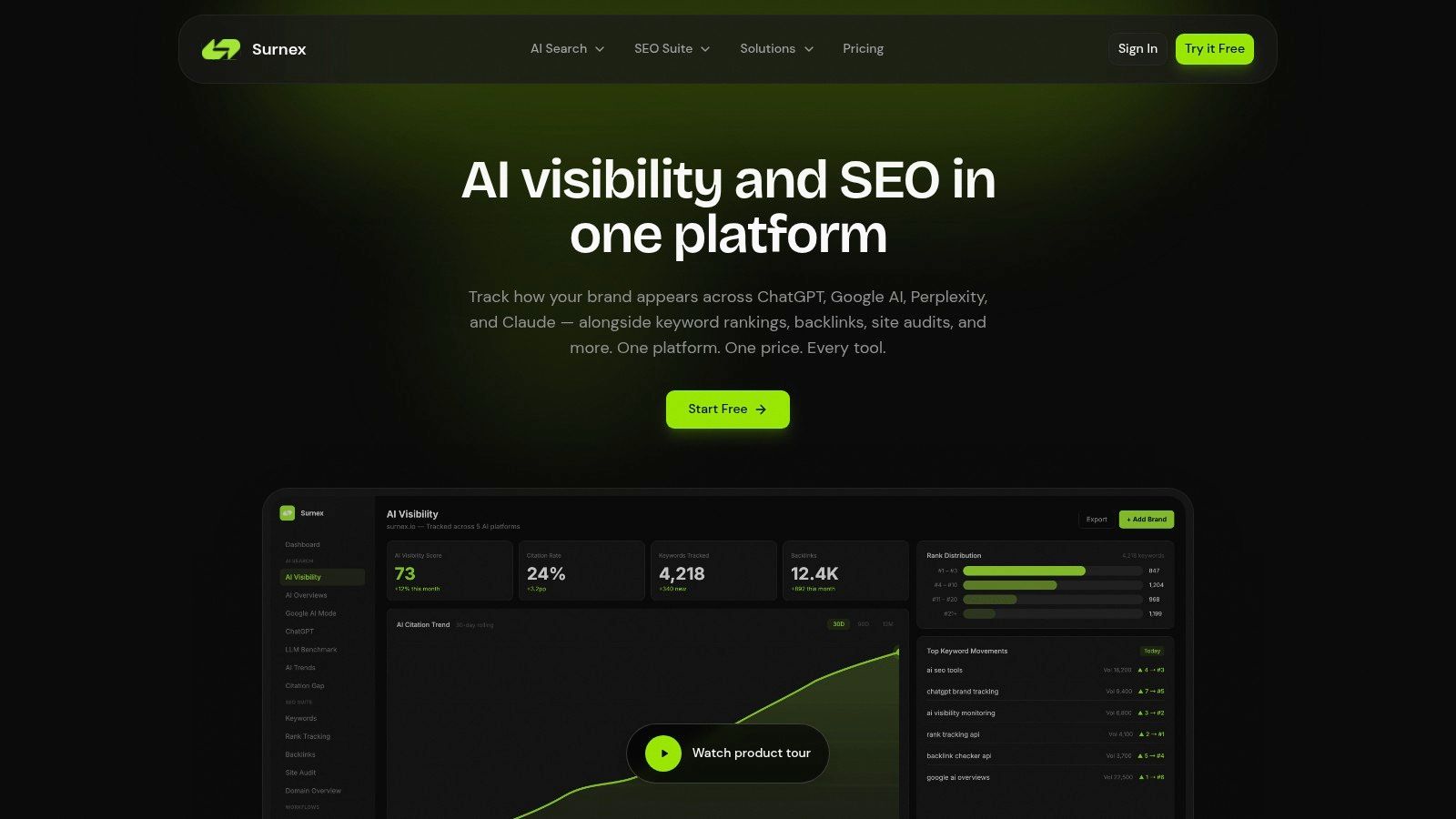
This is where platform consolidation matters. Instead of stitching together separate rank trackers, AI visibility monitors, audit tools, and ad notes, agencies need one operating view. Surnex is one option built for that workflow. It combines AI visibility tracking with rankings, backlinks, audits, and content opportunity analysis in one system.
If you need a practical template for presenting this to clients, a clear starting point is Surnex's guide to a keyword rankings and visibility report.
A budget framework agencies can actually use
You don't need a perfect split. You need a defensible one.
Start with this decision logic:
| Situation | Budget and effort bias |
|---|---|
| Broad consumer category, heavy mobile demand | Strong Google bias |
| B2B, enterprise, desktop-heavy audience | Google first, larger Bing allocation than average |
| High Google CPC pressure | Test Microsoft Ads for efficiency gains |
| AI citation visibility is part of the KPI | Track both engines as separate surfaces |
| Local presence matters across business tools | Maintain dual-engine local monitoring |
For agencies refining broader media planning, this piece on strategic ad spend choices is useful context because it frames search budget as an allocation problem, not a channel loyalty problem.
The strongest conclusion isn't that Google matters less than people think. It still matters more than any other engine by a wide margin. The stronger conclusion is that Bing matters differently than people think. That difference becomes valuable when an agency understands audience context, interface behavior, and reporting gaps well enough to act on it.
If your team needs a clearer view of how clients appear across traditional search and emerging AI experiences, Surnex gives you one place to track visibility, rankings, backlinks, audits, and content opportunities without juggling separate tools.