A client asks whether their site has “good PageRank,” and the question sounds dated until you realize the confusion is still common. The public score is gone, the old browser toolbar is gone, and yet the idea behind PageRank still shapes how SEOs think about authority, internal links, backlinks, and now even AI citations.
If you work in an agency or manage SEO across multiple sites, understanding what is pagerank matters for a practical reason. It gives you a clean mental model for why some pages earn visibility more easily than others, why not all links are equal, and why site structure still affects performance long after the original Google era that made PageRank famous.
What Is PageRank and Why Was It Created
Before Google became the default way people searched the web, search engines had a hard problem. They could match keywords on a page, but that didn't always tell them whether the page was useful, trustworthy, or important.
That gap is where PageRank changed search. It was created in 1998 by Google co-founders Larry Page and Sergey Brin at Stanford, and the core idea was simple: a page's importance can be estimated from both the number and the quality of pages linking to it. A link acts like a vote, but votes from important pages count more, which pushed search beyond basic keyword matching and toward authority-based ranking, as described in Wikipedia's overview of PageRank.

The easiest way to think about it
The best analogy is academic citations.
If a research paper is cited by many respected papers, people assume it matters. If it's cited only by obscure or low-quality work, that signal is weaker. The same logic applied to web pages. Google treated links as signals of endorsement.
That doesn't mean PageRank measured truth. It measured importance inside a network.
A link from a strong page was never just another link. It carried some of that page's authority with it.
Why this was such a big deal
The web was growing fast, and keyword matching alone didn't scale well. Anyone could repeat a phrase on a page. It was harder to fake broad recognition from other sites, at least in the early days.
That's why PageRank became one of the core ideas behind Google's early search quality. It gave search engines a way to estimate authority from the web's link graph itself, not just from page text.
For agencies, this is still useful thinking. When clients ask why one competitor outranks another with similar content, the answer often starts with authority signals, not wording alone. That's also why many teams still build service architectures, editorial hubs, and backlink plans around the same principle that old-school SEO consultants use when evaluating authority flow.
What PageRank was not
It wasn't a simple popularity contest.
A page could have many weak links and still lose to a page with fewer, stronger links. That “quality over quantity” idea is the part of PageRank that still survives in modern SEO thinking.
How the PageRank Algorithm Actually Works
Hearing “algorithm” often brings to mind a wall of math. You don't need the formula to understand the mechanism.
Start with a mental picture: a person lands on a page, clicks a link, lands on another page, clicks again, and keeps moving. PageRank models that behavior as a random surfer moving through the web.
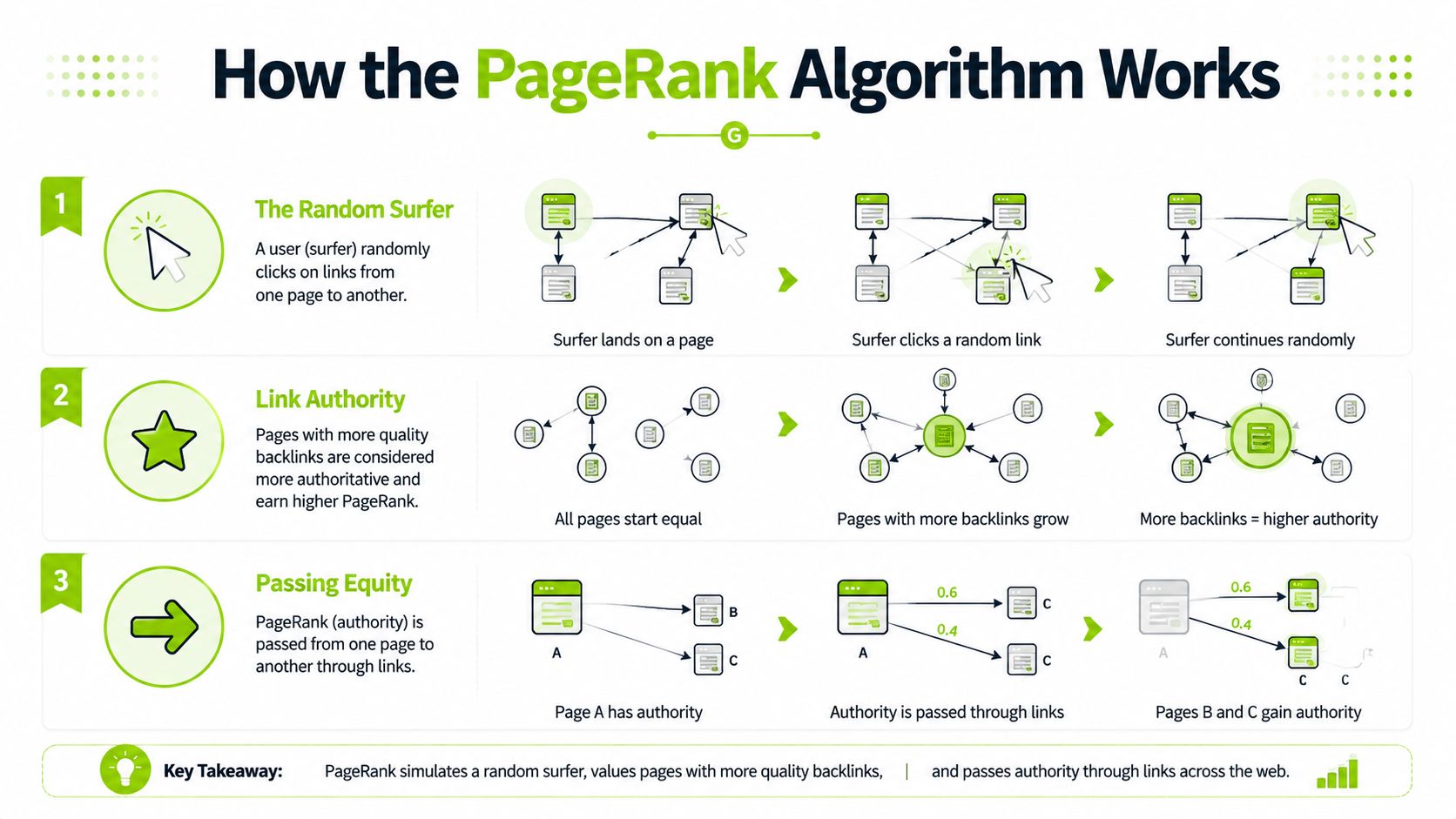
The random surfer model
In technical terms, PageRank assigns each page a probability-like score that represents the steady-state chance of landing on that page. The score is recursive: a page receives rank from pages linking to it, and each source page divides that rank across its outbound links. The algorithm is then computed iteratively until the scores converge, as explained in GeeksforGeeks' PageRank implementation overview.
That sounds abstract, so make it concrete.
Suppose Page A links to Page B and Page C. If A has authority, it passes some of that authority out through its links. But it doesn't pass the full amount to both. It splits what it can pass.
Why outbound links matter
Many new SEOs often get tripped up here.
A strong page doesn't give the same amount of value to every destination no matter how many links it has. If it links out to many pages, the authority passed through any one link is diluted because the source page spreads its available value across all those outlinks.
A simple way to consider it:
- One strong page linking to a few important pages can send a concentrated signal.
- One strong page linking to many pages still passes value, but each destination gets a thinner slice.
- Several weak pages linking to one target may add less than one authoritative page.
Practical rule: PageRank flows. It doesn't teleport. You have to look at where authority starts, where it moves, and where it gets diluted.
Why Google needed a damping factor
There's one more piece that helps the model behave sensibly: the damping factor.
Without it, the random surfer could get stuck in loops or “rank sinks,” where authority circulates endlessly inside a closed cluster of pages. The damping factor adds the idea that sometimes the surfer stops following links and jumps somewhere else. That keeps the system from collapsing into strange pockets of the graph.
Here's the practical version. If a group of pages only points to each other, they shouldn't trap all possible authority forever. The damping concept prevents that.
A quick visual can help if you want to see the mechanism explained another way:
What this means for everyday SEO work
PageRank isn't only about backlinks from other sites. It also gives you a framework for internal linking.
When you link from a strong page on your site to an important commercial or editorial page, you help route authority there. When your best pages are buried, orphaned, or surrounded by messy navigation, authority often spreads poorly.
That's why SEO engineers care about:
- Which pages attract links from outside domains
- How internal links distribute value from those pages
- How many unnecessary links appear on key templates
- Whether important pages are easy to reach within the site structure
A lot of technical SEO gets easier once you stop seeing links as decoration and start seeing them as part of a graph.
The Rise and Fall of Toolbar PageRank
If you were around in earlier SEO circles, PageRank wasn't just a concept. It was visible.
Google used to show a public-facing version of PageRank in its browser toolbar. People saw a green bar, treated it like a status symbol, and quickly turned it into one of the most overused SEO reference points of its era.
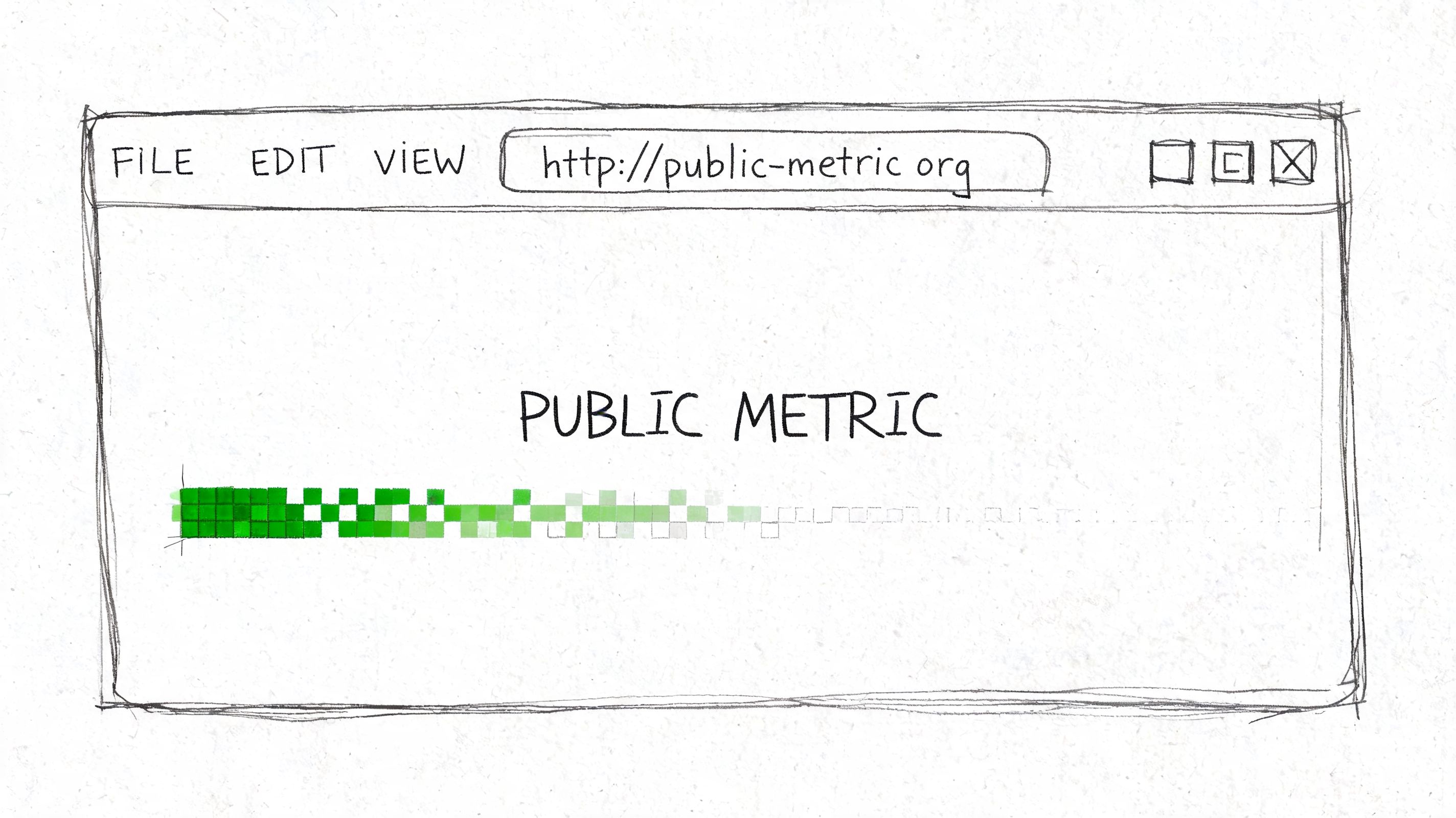
Why the toolbar became a big deal
The public score gave SEOs something simple to point at. That was the appeal.
Clients could ask, “What's our PageRank?” Agencies could compare sites fast. Link sellers could use it to price placements. The problem was that a simple public score invited simple, often bad, behavior.
Soon the market started chasing the visible number instead of the underlying quality. People bought links for score. They swapped links for score. They tried to sculpt internal links around score.
What the public metric encouraged
The toolbar wasn't useless. It helped many people learn that links mattered.
But it also trained the industry to obsess over one signal in isolation. That's rarely how search works.
Some common behaviors from that era included:
- Treating the score like a goal itself instead of asking whether links were relevant or editorial
- Overvaluing homepage authority while ignoring weak deeper pages
- Reducing complex SEO conversations to one visible bar in the browser
- Using public score as shorthand for link pricing in questionable marketplaces
The moment a ranking signal becomes a public scoreboard, people start optimizing for the scoreboard.
Why Google moved away from it
The toolbar score disappeared because a public metric can become a target. Once enough people use it to manipulate link behavior, the metric stops being a healthy teaching aid and starts becoming a distortion field.
That shift matters because some clients still speak in old toolbar language. They may ask for “higher PageRank” when what they really want is better visibility, stronger link equity, or improved ranking ability. In modern reporting, agencies are better off translating that request into things they can monitor directly, such as rankings, backlink quality, and page-level performance through tools like search rank tracking dashboards.
The toolbar is gone. The lesson remains. Public scores are easy to sell, easy to misunderstand, and easy to game.
Common PageRank Myths and Misconceptions
The easiest way to get PageRank wrong is to treat it as either magic or obsolete. Most confusion comes from reducing it too far in one direction.
So a high PageRank guarantees a top ranking
No.
Even in the era when PageRank was discussed constantly, it was never the only thing affecting rankings. A page can have strong authority and still fail because the content doesn't match intent, the page isn't the best result, or another page is more relevant.
A better way to say it is this: PageRank can improve a page's ability to compete, but it doesn't guarantee a win.
If PageRank matters, then more links always means better results
Not necessarily.
The original logic behind PageRank favored link quality, not raw count. A handful of respected, relevant links can be more meaningful than a pile of weak ones. That's why seasoned SEOs spend time judging where a link comes from, how naturally it appears, and whether the linking page itself seems authoritative.
PageRank is dead because the toolbar disappeared
This is probably the most persistent myth.
The public display disappeared. The underlying idea did not. Search engines still need ways to evaluate authority and relationships between pages. Modern systems are more complex than early Google, but link-based authority never stopped being useful.
Don't confuse “not publicly visible” with “not used in principle.”
PageRank only matters for backlinks from other websites
That misses half the operational value.
PageRank thinking also applies to internal linking. If your site has a few strong pages and you never route their authority toward priority URLs, you leave value sitting in the wrong places. Agencies see this all the time on large content sites where blog posts attract links but money pages stay isolated.
A homepage with lots of authority automatically fixes the whole site
It doesn't.
Authority still has to move through the internal link structure. If navigation is weak, if key pages are buried, or if important pages get very few contextual links, the site can have plenty of overall strength and still underperform where it matters.
You can reduce SEO to one authority number
That's a reporting shortcut, not a search reality.
Third-party tools create useful authority metrics, but they aren't Google's internal score. They're estimates. Helpful ones, often. But still estimates. If you build your whole strategy around a single metric, you risk repeating the same mistake the industry made with the old toolbar.
PageRanks Legacy in Modern Search and AI
The public PageRank score is history. The idea behind it is not.
What survived is the principle that authority moves through a network, and that a node becomes more influential when other influential nodes point to it. In PageRank terms, rank is redistributed through links, pages with many outlinks leak rank faster, and pages linked by authoritative sources gain more. That same mechanic is now used in graph databases and AI to identify central or influential nodes, which also makes it useful for internal linking strategy and source citation in LLM contexts, as described in Positional's PageRank explanation.
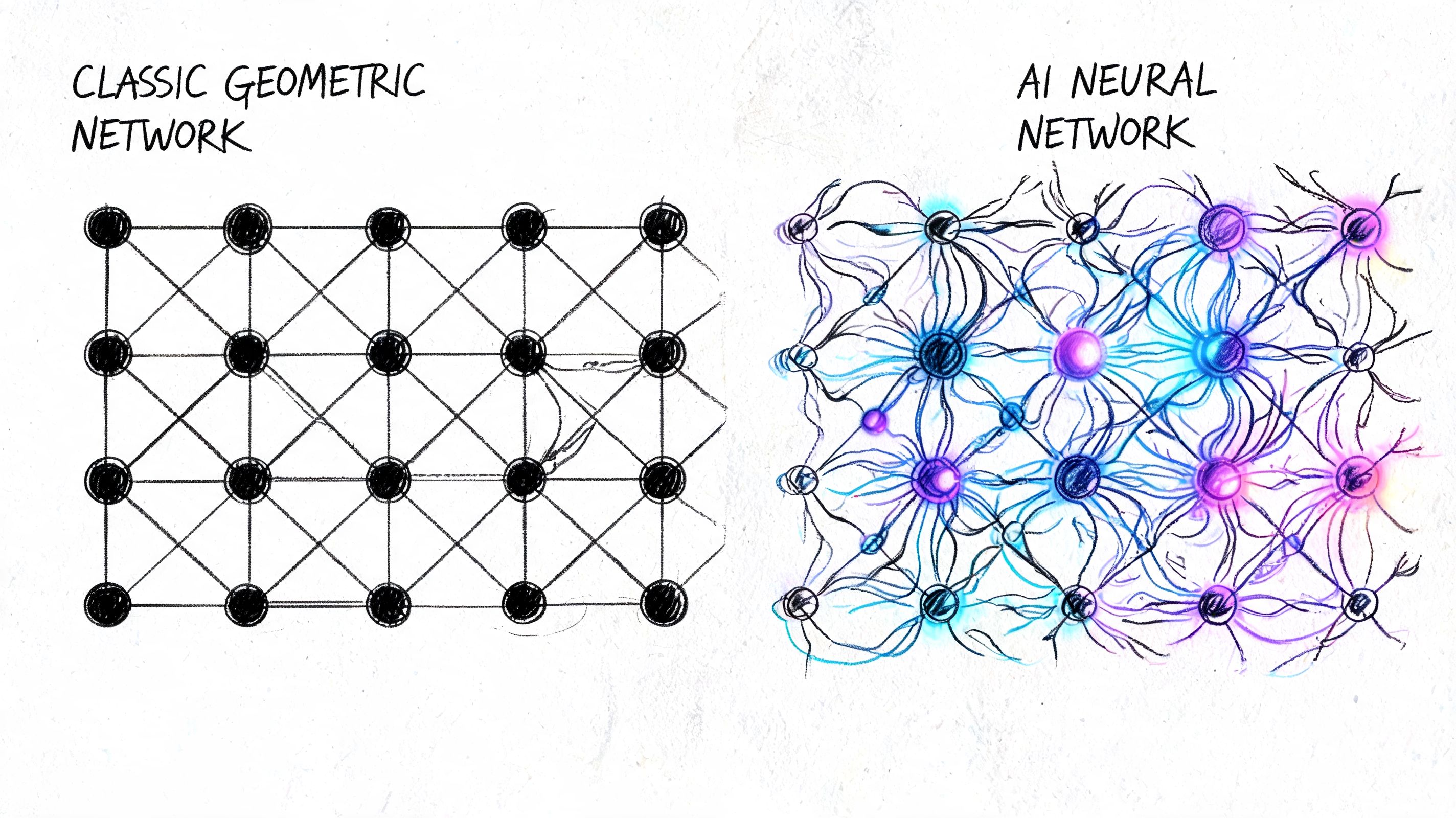
Why the core idea still matters
Modern search engines use far more than classic PageRank. They evaluate language, intent, freshness, spam signals, entities, and many other layers.
But link authority still gives a clean answer to a basic question: why should this page be trusted or surfaced at all? A page that sits inside a strong web of references has a different profile from a page that stands alone.
That's also why internal links still deserve engineering attention. The old theory maps neatly to modern site architecture work:
- Hub pages matter because they collect and route authority
- Contextual links matter because they connect related documents in meaningful ways
- Bloated templates matter because too many links can spread attention thinly
- Isolated pages struggle because they don't receive much authority flow
How this connects to AI-driven search
AI search experiences don't work exactly like ten blue links, but they still need ways to decide which sources look central, credible, and worth citing.
That's where the PageRank legacy becomes useful again. In retrieval systems, knowledge graphs, and source selection layers, network authority still helps determine what stands out. If a page is consistently well connected, referenced, and structurally important, it's easier for systems to treat it as worth pulling into summaries, answers, and citation sets.
For teams thinking about optimizing search performance with AI prompts, this matters because visibility in AI systems isn't only about writing answer-shaped content. It's also about becoming a source those systems can justify using.
Strong AI visibility often starts before generation. It starts with source selection.
What agencies should take from this
When you explain authority to clients today, don't frame it as nostalgia for an old Google score. Frame it as a live principle.
A brand earns stronger visibility when its pages sit inside a better authority network, both externally and internally. That applies to traditional search and to emerging AI surfaces where source selection, citation behavior, and entity confidence increasingly matter. Teams that want to understand where they're being cited less often than competitors usually need visibility into that exact problem, which is why workflows around AI citation gap analysis are becoming part of modern search operations.
Practical Ways to Estimate Link Authority Today
You can't open a toolbar and check Google's PageRank anymore. So what do SEOs use instead?
Proxy metrics from third-party tools are often used. These aren't replacements for Google's internal systems, and they shouldn't be treated as direct equivalents. But they're useful for prioritization, prospecting, and quick comparisons.
The common metrics you'll run into
The names differ, but the purpose is familiar. Each tool tries to estimate how authoritative a site or page appears based on its link profile and related signals.
Here's a simple comparison.
| Metric | Provider | Scale | Primary Focus |
|---|---|---|---|
| DR | Ahrefs | Proprietary score | Relative strength of a site's backlink profile |
| DA | Moz | Proprietary score | Predicted ability of a domain to perform in search |
| AS | Semrush | Proprietary score | Overall authority estimate using link-related signals and broader quality inputs |
What these scores are good for
These metrics are handy when you need to sort a long prospect list. They help you avoid obviously weak targets and identify sites that may deserve a closer look.
They're also useful in client conversations because they create a shared vocabulary. If one site is materially stronger than another by multiple third-party metrics, that usually tells you something worth investigating.
Still, none of them should be treated as truth. They are models.
What to check beyond the score
A strong link opportunity usually reveals itself through context, not just through a number in Ahrefs, Moz, or Semrush.
When I review a backlink prospect, I usually ask:
- Is the site topically relevant to the client's market, service, or audience?
- Does the linking page look editorial or does it feel manufactured for SEO?
- Would a real person click this link and find it useful?
- Is the site publishing coherent content or does it look like a patchwork of unrelated topics?
- Can the link point to the right page instead of always forcing everything to the homepage?
A mediocre-looking metric on a very relevant site can beat a flashy metric on an irrelevant one.
A practical review workflow
For agencies, this tends to work well:
- Start with the proxy metric to narrow the field quickly.
- Open the site manually and review quality with your own eyes.
- Check topical fit against the client's category, geography, and intent.
- Review the likely placement to see whether the link will sit naturally in useful content.
- Decide at page level, not just domain level.
That last point matters a lot. A good domain can still offer a poor page. A modest domain can still host the exact page your client needs.
If you're managing many accounts, it also helps to centralize backlink review so your team isn't bouncing between spreadsheets, browser tabs, and disconnected tools. That's why many agency workflows now combine authority proxies with backlink analysis inside a dedicated backlinks workspace.
The healthiest mindset
Think like the original idea, not like the old toolbar.
Ask whether a link improves your position in a meaningful authority network. If the answer is yes, the link may be worth pursuing even if the proxy score isn't perfect. If the answer is no, a shiny metric won't rescue it.
An Agency Workflow for Managing Client Visibility
When clients ask about PageRank today, they're usually asking a broader question: “Why aren't we more visible than this competitor?” Agencies do better when they answer the modern version of that question instead of correcting the vocabulary and moving on.
Start with translation, not jargon
Don't tell clients PageRank is dead and leave it there.
Tell them the public score is gone, but the idea of link authority still matters. Then connect that idea to outcomes they care about: stronger rankings, better landing page performance, more referral value from the right placements, and stronger eligibility to be surfaced as a cited source.
That keeps the conversation strategic instead of historical.
Build authority with a portfolio mindset
Agencies often waste time chasing “high authority” links that look impressive in a deck but don't help the client much in practice.
A better workflow balances several link types:
- Relevant editorial links from sites focused on the topic
- Commercially aligned mentions that support core service or product pages
- Digital PR opportunities that strengthen brand recognition
- Internal link improvements that route existing authority toward pages that matter
The best programs don't ask, “Can we get any strong link?” They ask, “Which links improve this client's visibility for the pages tied to revenue and demand?”
Report what clients can act on
Don't reduce reporting to authority metrics. Include them, but don't stop there.
Show the relationship between link work and actual visibility changes. That can include movement on target queries, improved support for priority page groups, stronger referral relevance, and broader presence across search experiences.
A simple internal operating rhythm works well:
- Audit authority sources across backlinks and internal links
- Map authority to priority pages rather than treating the whole site equally
- Close structural gaps where important pages receive too little support
- Pursue relevant new mentions that fit the client's market and narrative
- Review visibility regularly across both classic search and AI-driven discovery surfaces
The agency advantage
Clients don't need another recycled explanation of the green toolbar era. They need a team that can turn authority theory into action.
That means explaining why one page deserves more internal links, why one outreach target is better than another, and why visibility in AI search depends on source credibility as much as content formatting. Agencies that can make that connection clearly are easier to trust because they're managing the system, not just the metric.
If your team needs a clearer way to track rankings, backlinks, AI visibility, and citation opportunities in one place, Surnex gives agencies and in-house teams a practical view of modern search performance without the usual tool sprawl.