You've seen it in search results even if you've never named it.
You search for a product, a recipe, or a local event. One result looks plain. Another shows stars, price, availability, cooking time, or a thumbnail image right on the results page. The page titles might be equally relevant, but one listing earns the click first because it answers part of the question before the visit.
That difference is usually a rich snippet, or in Google's broader language, a rich result. If you're asking what are rich snippets, the short answer is simple: they are enhanced organic search results that display extra information pulled from structured data on the page.
For SEO teams, this isn't decoration. It changes how a page competes in the SERP. For agencies, it also changes client conversations, because the result can become more informative without needing a ranking jump first. And in practice, the teams that handle this well usually aren't doing anything magical. They're making their content easier for machines to understand, then testing it with discipline.
Why Some Search Results Look Better Than Others
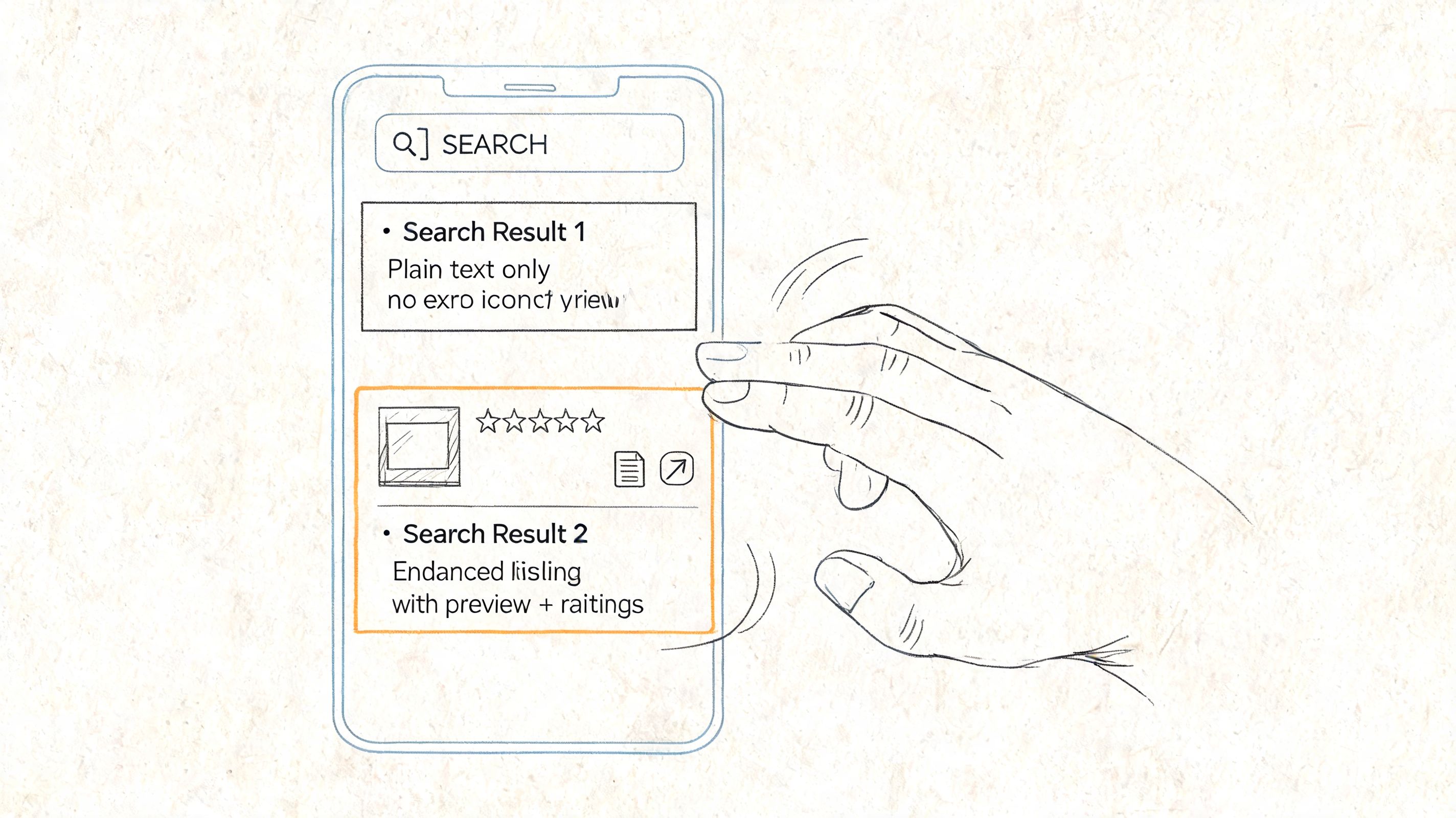
Search for a recipe and you'll often see the pattern immediately. One page appears as a normal blue link with a short description. Another includes a photo, star rating, prep time, and other details directly in the result. Both are organic listings, but one feels finished and one feels incomplete.
That upgraded version is what is typically meant when people say rich snippet. It's still your normal organic result, but with extra context layered in. Instead of showing only a title, URL, and meta description, search engines can display additional details pulled from structured data in the page's HTML.
What the user notices first
Users don't think in schema types. They notice whether a result looks useful.
A rich snippet can show things like:
- Ratings and reviews that signal trust at a glance
- Product information such as price or availability
- Recipe details like preparation time or images
- Event details that help someone decide without opening five tabs
- Video enhancements that make media content easier to identify
Search is competitive at the moment of choice. Even if your page already ranks, a weaker-looking listing compared to others can result in the click going elsewhere.
Why Google started formalizing this
Google formalized the concept of visually enhanced search results on May 17, 2016, when it introduced rich cards, moving beyond the traditional blue link and meta description format, as covered by Search Engine Land's overview of rich results.
That shift was bigger than a visual redesign. It signaled that search engines wanted machine-readable page details so they could present better search experiences.
Practical rule: Rich snippets don't exist to make SEOs happy. They exist because search engines want clearer, more structured answers.
For site owners, the takeaway is straightforward. If your content has details that help a searcher decide, and you mark them up correctly, your result has a better chance of standing out.
Clearing Up SERP Feature Confusion
A lot of teams mix up rich snippets, featured snippets, knowledge panels, and rich results. The terms sound similar, but they are not the same thing. If you don't separate them clearly, implementation decisions get messy fast.
Think about the SERP as real estate
Use this mental model:
- A rich snippet is your normal listing with upgrades attached
- A featured snippet is a promoted answer box near the top of the page
- A knowledge panel is a separate information area for an entity like a brand, person, or place
- Rich results is the broader Google term for enhanced listings generated from structured data
A rich snippet does not replace your result. It enhances it.
A featured snippet often pulls part of your page into a special answer area. That's a different behavior and a different optimization path. You don't earn it by adding product price or review markup.
A knowledge panel isn't your standard webpage result either. It's more like an entity card that Google assembles from multiple signals.
The easiest way to explain it to a client
When I explain this to new team members or clients, I keep it simple:
| SERP feature | What it is | Where it appears | What usually drives it |
|---|---|---|---|
| Rich snippet | Enhanced organic listing | Inside your normal search result | Structured data plus eligible content |
| Featured snippet | Direct extracted answer | Prominent top answer area | Concise content matching query intent |
| Knowledge panel | Entity information card | Separate side or top panel | Entity recognition and trusted sources |
| Rich result | Google's umbrella term | Various enhanced result formats | Structured data and eligibility |
That distinction matters because people often say, “We added schema, why don't we own position zero?” They're chasing two different outcomes with one tactic.
Why the terminology still matters
Google now uses rich results more often than rich snippets, but in SEO practice, both terms still show up in conversations. Teams, clients, and audits still use “rich snippets” as shorthand. That's fine, as long as everyone understands the mechanics.
Rich snippets are enhancements to an existing organic result. They are not a guarantee of a top-of-page answer box, and they are not the same as a brand knowledge panel.
If you keep that boundary clear, the rest of the work gets easier. You'll know when to focus on structured data, when to improve content formatting for extractable answers, and when a page is the wrong candidate entirely.
Common Types of Rich Snippets You Can Earn
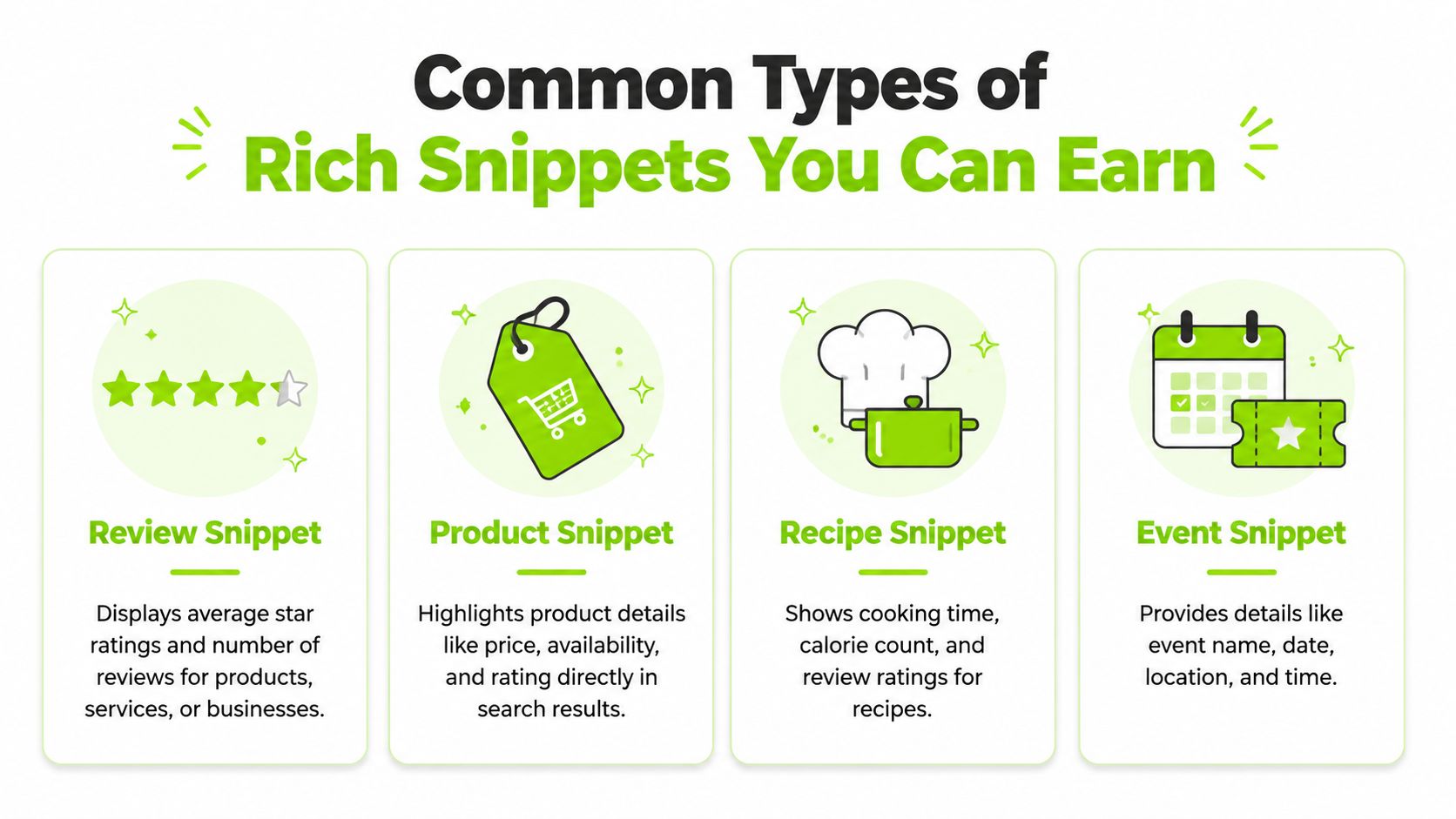
The easiest way to understand rich snippets is to look at the formats teams try to win most often. Different page types support different enhancements, and the best opportunities usually line up with clear user intent.
Product snippets
A product page is the classic example. When Google can understand the item name, offer details, and price, the result may show commercial details directly in the SERP.
That helps users answer the first buying question fast: “Is this what I want, and is the offer relevant enough to click?”
For ecommerce teams, product snippets usually work best when the page is tightly aligned with one product, one price context, and current availability data. They work badly on mixed listing pages, category pages with inconsistent markup, or pages where the visible content and schema don't match.
Review snippets
Review snippets are the stars people notice immediately. They can show rating information and review context when the page is marked up appropriately and meets quality expectations.
The business value is obvious. Users scan trust signals before they commit attention. Review markup can help a result look credible, but it also attracts abuse, which is why search engines apply stricter filters here.
Google's review snippet documentation is one reason I tell junior SEOs not to treat stars as a cosmetic shortcut. They're one of the fastest ways to learn that “valid code” and “eligible display” are not the same thing.
Recipe snippets
Recipe results are one of the cleanest examples of rich snippet value. A user wants to know whether the result fits their need before clicking. Cooking time, image, and ratings help answer that instantly.
That's why recipe sites often look stronger in search than general content sites. Their content structure is naturally compatible with structured data.
Event and video snippets
Event snippets help users compare date, location, and timing from the results page. They're useful for organizers, venues, and publishers with dedicated event pages.
Video snippets solve a different problem. They help a searcher confirm that the result is a video-based answer, not a text article. For tutorials, product demos, and explainers, that distinction matters.
How teams should choose
Don't start with “What schema can we add?” Start with “What page types already contain stable, specific facts?”
Use this quick filter:
- Product pages if the page has a clear offer and visible price
- Review pages if reviews are first-party, visible, and attributable
- Recipe pages if the content is structured and complete
- Event pages if the details are date-based and maintained
- Video pages if the media is central to the page, not incidental
Common Rich Snippet Types and Their Uses
| Snippet Type | Required Schema | Primary Benefit |
|---|---|---|
| Product | Product | Shows offer details such as price and availability |
| Review | Review or AggregateRating | Adds visible trust signals like star ratings |
| Recipe | Recipe | Surfaces practical details before the click |
| Event | Event | Highlights timing and location information |
| Video | Video-related markup | Signals that the page offers a watchable answer |
The strongest implementations usually feel boring internally. Clean page templates. Consistent fields. No guessing. That's what tends to work.
How Search Engines Generate Rich Snippets
Search engines don't infer rich snippets from vibes. They parse structured data, validate it, compare it with visible page content, and then decide whether the page is eligible for enhanced display.
Structured data is the translator
A page already contains information for humans. Structured data turns that information into a machine-readable format.
Think of it this way:
- Schema.org is the shared vocabulary
- JSON-LD is the format many teams use to express that vocabulary
- The markup itself tells Google what specific elements mean
Without that layer, a crawler may see “$99” on a page. With structured data, it can understand that the value is a product price attached to an offer for a specific product.
Technically, Google generates rich results by parsing markup such as JSON-LD. For a Product result, required properties include name and offers with a price, while aggregateRating is needed for star displays. Google's support has expanded from a small starting set in 2009 to over 30 types today, as described in Google's announcement on introducing rich snippets.
A simple product example
Here's the kind of structure teams often use on a product page:
{
  "@context": "https://schema.org",
  "@type": "Product",
  "name": "Example Product",
  "offers": {
    "@type": "Offer",
    "price": "99",
    "priceCurrency": "USD",
    "availability": "https://schema.org/InStock"
  },
  "aggregateRating": {
    "@type": "AggregateRating",
    "ratingValue": "4.5",
    "reviewCount": "24"
  }
}
The point isn't the syntax alone. The point is alignment. If the page says one thing and the schema says another, Google has a reason to ignore it.
What works and what fails
Good markup usually has three traits:
- It matches the visible content
- It uses the right schema type for the page
- It stays current when the page changes
Bad implementations usually fail in more ordinary ways. Teams mark up category pages like product pages. Developers hard-code old prices into templates. Plugins output duplicate schema blocks with conflicting values.
If your team is also thinking about AI search, this discipline matters beyond the standard SERP. Clean, machine-readable content is part of the foundation for AI visibility across emerging search experiences, even though the exact rules for AI-generated discovery are still evolving.
Structured data is not a trick for search engines. It's a data quality layer for your website.
A Simple Workflow for Implementation and Testing
The teams that succeed with rich snippets usually follow a repeatable process. The teams that struggle often jump straight to adding markup sitewide and assume valid code means finished work.
It doesn't.
Start with page selection, not code
Pick page types that naturally support a rich result. A product detail page is a candidate. A loose editorial landing page usually isn't. A recipe page can work well. A broad “resources” archive probably won't.
Agencies save time or waste it in this context. If the content model is weak, schema won't rescue it.
A simple starting workflow looks like this:
-
Choose the right page template Match the schema type to the actual page purpose.
-
Map visible elements to schema fields If the page shows price, availability, author, reviews, or event timing, identify exactly where each field lives.
-
Generate or write the JSON-LD You can use Google's helpers, plugins, or custom template logic. For large sites, template-based generation is usually safer than manual entry.
-
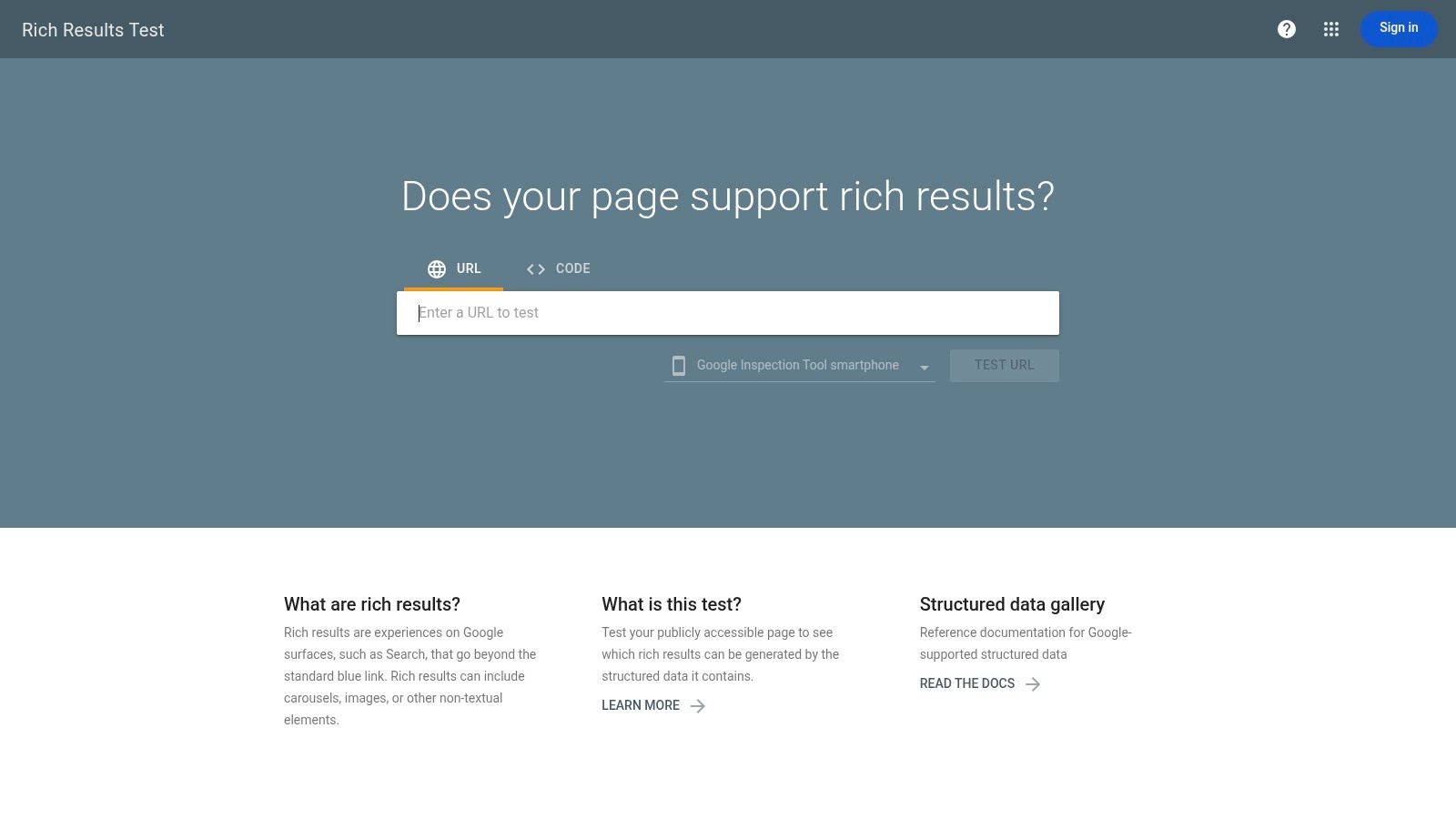
Validate before launch Use Google's Rich Results Test and inspect both errors and warnings.
-
Monitor after deployment Check whether pages remain eligible as templates, stock values, and content fields change.
Validation is where most avoidable issues show up
A lot of implementation mistakes are boring, but expensive:
- Mismatched content where the schema claims something the page doesn't visibly show
- Missing required properties for the target result type
- Duplicate markup created by SEO plugins and custom templates together
- Stale values for price, stock, or review data
- Conflicting entities on one page that blur what the page is about
If you've inherited messy templates, resources like Titan Blue Australia's guide on how Titan Blue fixes schema are useful because they focus on correction patterns, not just basic definitions.
For technical teams managing many client sites, I'd pair validation with a recurring technical site audit workflow so schema issues get checked alongside crawlability, indexability, and template regressions.
Use the tools in the right order
First validate the code. Then validate the rendered page. Then monitor the live result.
This short walkthrough is helpful if your team wants a visual reference for the testing flow:
Don't treat “valid” as “done.” Treat it as “eligible for further review.”
That mindset prevents a common mistake: shipping schema, seeing no rich result, and assuming Google is broken. Usually the issue is one of eligibility, quality, page fit, or inconsistent implementation.
Measuring the True Impact of Rich Snippets
SEO professionals typically measure rich snippets at the click level first. That makes sense. Search Console is the fastest place to see whether enhanced results are appearing and whether those pages are attracting traffic.
The catch is that click-through rate is only the beginning.
What you can measure cleanly
You can use Google Search Console to compare impressions and clicks for pages that earn rich results versus similar pages that don't. That's operationally useful. It helps confirm whether markup changes are surfacing in search appearance and whether they are changing user behavior at the SERP layer.
Some sources report that rich snippets can raise CTR by 20 to 30 percent, but they also highlight a major gap: agencies often can't tie that improvement to conversion rate or vertical-specific ROI, as discussed in Nightwatch's review of the rich snippets reporting gap.
The real questions clients ask
Clients don't stop at “Did it get more clicks?” They ask questions like:
- Did product snippet traffic convert better than standard organic traffic?
- Did review-enhanced pages attract better-qualified visitors?
- Did users bounce less because they had clearer expectations before clicking?
- Which snippet types deserve more implementation effort next quarter?
Those are the right questions. They're just harder to answer.
Build a practical reporting layer
For agency work, I'd treat rich snippets like a performance channel with incomplete attribution. That means you should report in layers:
| Measurement layer | What to review | Why it matters |
|---|---|---|
| Search appearance | Impressions and clicks | Confirms visibility and engagement |
| Landing page behavior | Sessions, engagement, conversion paths | Shows whether the traffic is useful |
| Page-type comparison | Product vs review vs recipe pages | Helps prioritize implementation |
| Trend monitoring | Before and after rollout patterns | Helps catch gains or regressions |
If you're already tracking search movement with a platform that includes rank tracking for SEO visibility, pair ranking and snippet analysis rather than treating them as separate reports. That gives you a clearer view of whether better performance came from position gains, richer presentation, or both.
A rich snippet can improve the quality of the click, not just the quantity. But you have to measure beyond the SERP to prove it.
That's the part many teams skip. They celebrate the visual win and stop before the business case is finished.
Preparing for the Future of Search with Structured Data
Rich snippets started as a way to improve visibility in standard search results. That's still true. But the bigger reason to care now is that structured data teaches your site how to speak clearly to machines.
That matters in a search environment that is no longer limited to ten blue links.
Why this matters beyond Google's classic SERP
As of 2026, most guidance still focuses on traditional SERPs, which leaves a blind spot around how structured data performs in AI Overviews and LLM-driven discovery. Optimizing only for pre-AI rich snippets may not be enough for citation and visibility in AI-generated search experiences.
No one should pretend the exact playbook is settled. It isn't. There's still limited established guidance on how schema translates into AI-generated summaries, retrieval systems, or brand mentions across assistant-driven interfaces.
But one principle already holds up. If your content is well-structured, clearly labeled, and internally consistent, machines have a better chance of understanding what your page is about.
What smart teams are doing now
They're not waiting for a perfect AI-search rulebook. They're tightening the basics:
- Cleaning entity signals across templates and core pages
- Reducing schema noise caused by duplicate plugins and conflicting outputs
- Making page purpose obvious so one URL represents one primary thing
- Keeping visible content and markup aligned so trust isn't broken at parse time
If local or location-based pages are part of your footprint, a resource like Altitude Design's practical schema guide for local success is a good complement to broader rich snippet work because local entities often expose markup quality problems quickly.
Teams that want to stay ahead should also watch how search behavior is shifting across AI interfaces, answer layers, and citation patterns. Following AI search trend changes helps frame structured data as part of a broader visibility strategy, not just a classic SEO enhancement.
Rich snippets are still worth pursuing for today's SERPs. But the deeper value is this: structured data makes your site easier to interpret in whatever interface comes next.
Surnex helps teams track that shift in one place. If you need a clearer view of how your brand appears across traditional search, AI Overviews, and LLM-driven discovery, explore Surnex.