Google's AI Overviews now reach 2 billion monthly users, are available in more than 200 countries, and AI content appears in 17.31% of top search results, according to Semrush. That changes the job of SEO. Ranking still matters, but ranking alone no longer describes whether your brand is visible where people get answers.
Most guides on using AI in SEO stop at content generation. That's the easiest part to demo and often the least important part to operationalize. The harder work is building a system: strategy, content workflows, technical readiness, and measurement that shows whether your brand appears inside AI-driven search experiences, not just below them.
That's the shift modern teams need to make. Use AI to speed up execution, but build your program around visibility, citations, and coverage across the search surfaces that now shape discovery.
The New Search Landscape Is Here
A growing share of search queries now ends on the results page. That changes what SEO teams need to optimize for.
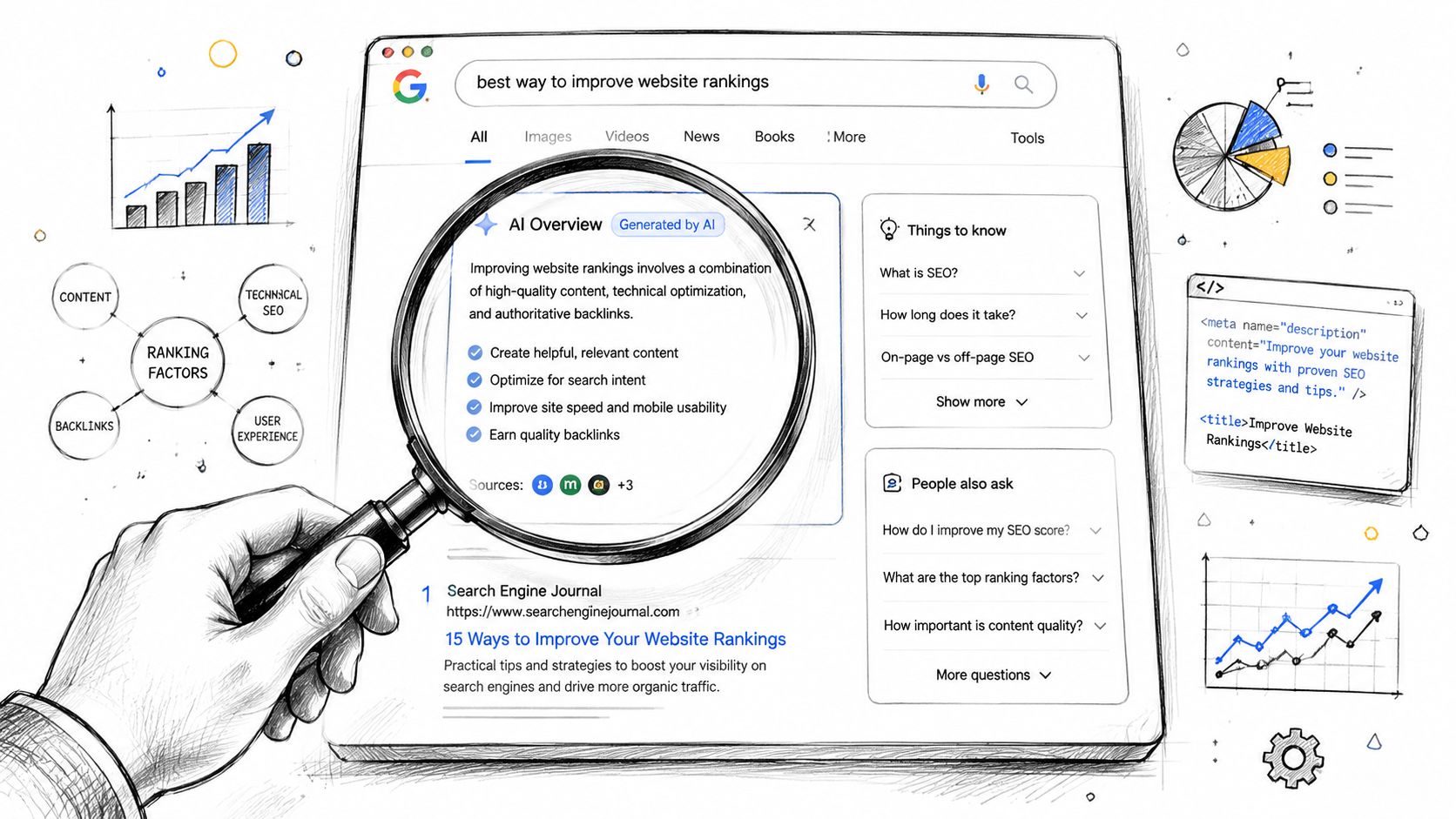
Google search no longer works like a ranked list with a few enhanced features around it. AI-generated summaries sit inside the results, shape the first impression, and often satisfy the query before a click happens. If you need a quick primer on how Google AI Overviews work in practice, that resource is useful for understanding the format brands are competing inside.
Visibility now means more than rank
For SEO teams, the practical shift is straightforward. High rankings still help, but rank is no longer a complete visibility metric when users can get an answer, brand comparison, or recommendation without visiting your site.
I see this in reporting all the time. A page holds position two or three, traffic stays flat or drops, and the missing explanation is the answer layer above the organic results. The brand may still be indexed, still relevant, and still technically ranking well. It just is not being surfaced where the user is making a decision.
That changes what success looks like:
- Old success metric: A keyword moved from position eight to position three.
- New success metric: The brand appears in the AI summary, earns citations, and shows up across the supporting sources users inspect next.
- Reporting implication: SEO dashboards need to track presence in AI-generated search features alongside traditional rankings and clicks.
Practical rule: If reporting stops at rank, it misses part of the search experience users now see first.
The SERP is becoming an answer interface
This is why familiar SEO work feels less linear than it used to. Publishing more pages, adding more keyword variations, and refining title tags can still improve performance. Those actions do not reliably produce inclusion in AI summaries, because search systems now retrieve information, compare sources, and compress answers before the click opportunity appears.
The trade-off is important. AI-driven search can reward strong source coverage, clear entities, and well-structured answers. It can also reduce direct traffic, even when your content informs the response. Teams that only measure sessions will miss the difference between being absent and being cited.
That is also why older SEO ideas are getting renewed attention. Entity clarity, source consistency, off-site mentions, and answer formatting now affect whether a brand is easy for search systems to interpret and reuse. The older search generative experience overview is useful background if you want context on how search interfaces started shifting in this direction.
Traditional SEO still matters. It now sits inside a broader visibility system that includes ranking, citation, summarization, and brand presence inside AI-driven search results.
Building Your AI-Powered SEO Strategy
McKinsey reports that half of consumers are using AI-powered search today and estimates it could affect $750 billion in revenue by 2028 in its analysis of the new front door to the internet. The same analysis says only 16% of brands systematically track AI search performance. That gap explains why many SEO programs are busy but under-instrumented.
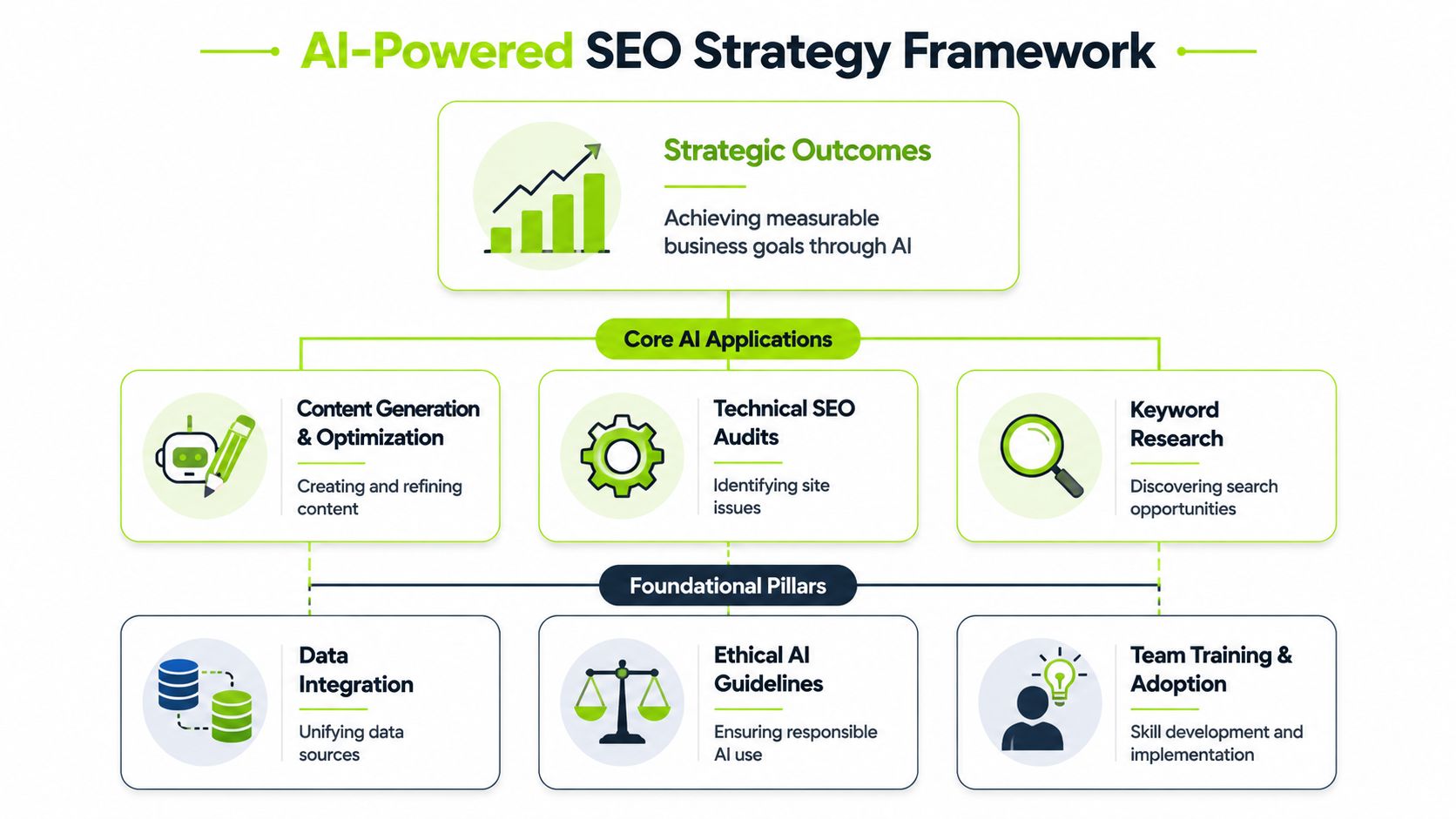
An AI SEO strategy should answer three questions before a team generates a single draft. What business outcome matters. Which workflows deserve automation. How will the team measure visibility beyond rankings and clicks. If those decisions come later, output scales faster than quality control, and reporting breaks first.
Start with business outcomes
Tie the program to decisions leadership already makes. In practice, that usually means four priorities:
-
Protect branded discovery Track what AI answers say about your brand, products, and competitive alternatives. If those responses are wrong, outdated, or missing, the problem shows up before a prospect reaches your site.
-
Grow non-brand visibility Use AI to speed up research, clustering, and brief development for category and problem-aware queries. The goal is broader qualified discovery, not more pages for their own sake.
-
Improve operating efficiency AI can shorten cycle time for briefs, schema drafts, internal linking suggestions, QA checks, and reporting summaries. That matters if the team is constrained by production capacity rather than ideas.
-
Report on AI search impact SEO teams now need to show whether their work improves citation, summarization, and brand presence inside AI-driven results. Standard rank tracking does not cover that.
Teams that need a shared baseline can start with this guide to generative engine optimization. It gives stakeholders a common definition before workflow changes, tool purchases, and reporting requirements start to sprawl.
Set rules before you scale output
AI works best as part of an operating model. Teams that skip governance usually get the same pattern. Draft volume rises, editing time rises with it, and no one can explain whether the extra content improved visibility.
Use a lightweight governance model:
| Area | What to define |
|---|---|
| Approved use cases | Brief creation, clustering, rewrite assistance, schema drafting, internal link suggestions, reporting summaries |
| Restricted use cases | Final fact claims, original expert opinion, legal or regulated copy, attribution-heavy sections |
| Human checkpoints | Subject-matter review, factual verification, link validation, tone review, technical QA |
| Success criteria | Better answer coverage, clearer structure, stronger citation likelihood, faster production without quality loss |
This is how scalable programs stay usable. The guardrails prevent unsupported claims, repetitive drafts, conflicting recommendations, and low-value pages that create more maintenance than revenue.
Build around source ecosystems, not just owned pages
AI search visibility is not limited to what you publish on your own site. McKinsey notes that a brand's own sites often account for only 5% to 10% of the sources AI search references. The rest often comes from publishers, review platforms, affiliates, forums, and other third-party sources.
That changes strategy. A strong program covers three environments at the same time:
- Owned assets such as product pages, blog content, documentation, comparison pages, and FAQs
- Earned visibility through press coverage, expert commentary, partner mentions, reviews, and community discussions
- Structured brand understanding through clear entities, consistent brand language, markup, and site architecture
This is the part many AI-in-SEO guides miss. They focus on content generation because it is easy to demo. The harder and more useful work is building a system that improves discoverability, supports reuse by AI systems, and measures whether your brand is showing up.
For tactical ideas that support that broader model, these SearchMention AI visibility tips are a helpful supplemental read.
A good strategy makes AI operational. It does not hand strategy over to AI.
Core AI Workflows for Content Creation
Most AI content workflows fail for one of two reasons. They either produce generic drafts too early, or they skip the research step that tells you what's worth publishing.
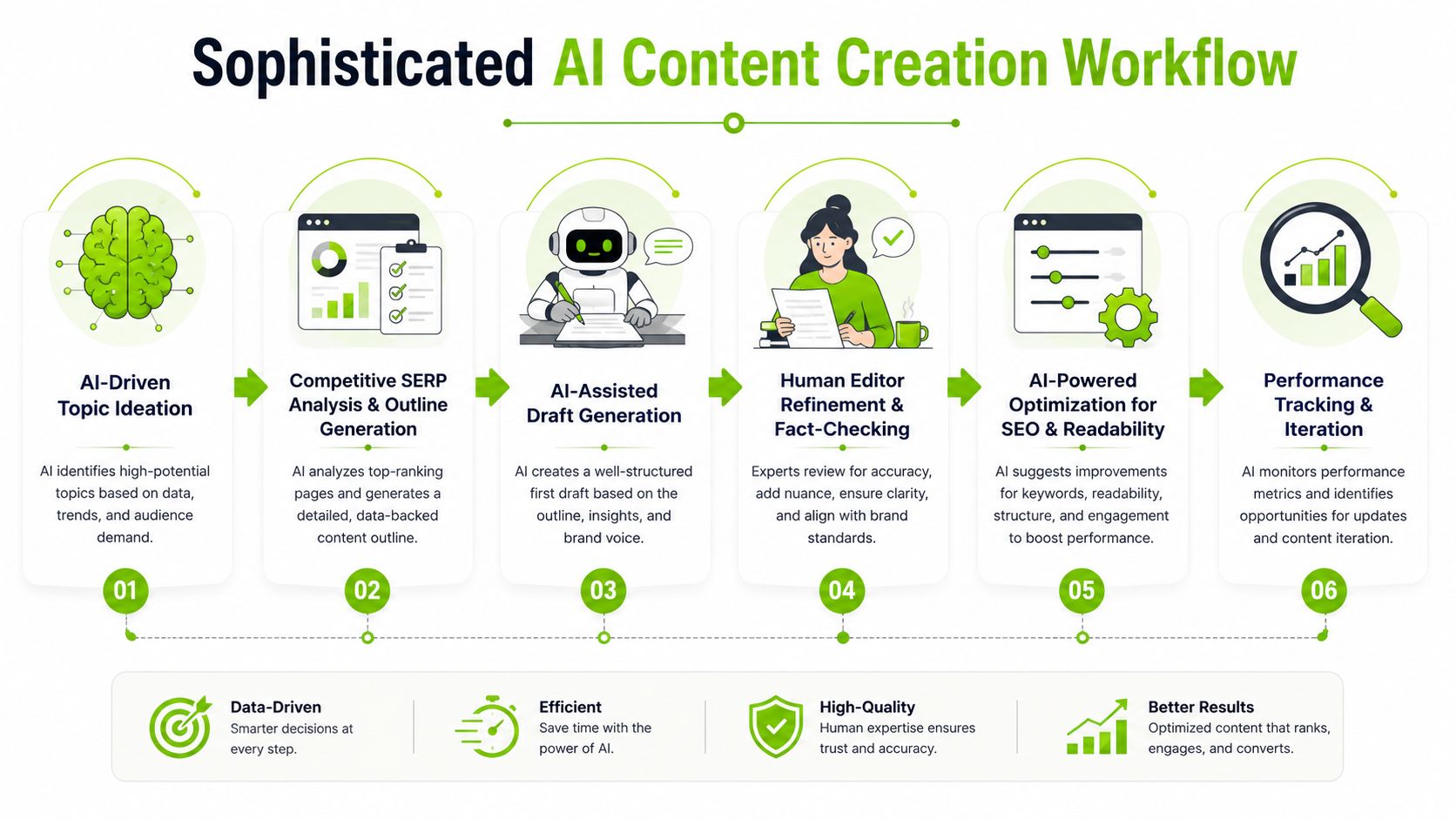
The better model is to use AI as a research and production assistant inside a human-led editorial system. That means AI helps you find patterns, shape briefs, and speed up routine tasks. Your team still owns the point of view, evidence, and final answer quality.
Use AI before the draft, not just during it
The most useful place to start is topic modeling and gap analysis. Give AI a constrained task: compare ranking pages, extract recurring entities, identify repeated subtopics, surface missing questions, and summarize where consensus is thin. That's far more valuable than asking for “a 2,000-word blog post.”
A practical workflow looks like this:
- Cluster the query space around one topic. Group informational, comparative, and transactional intents separately.
- Review the current SERP manually so you understand format expectations, not just keywords.
- Prompt AI to extract patterns from the ranking set. Ask what every page says, what only some pages say, and what nobody answers clearly.
- Turn that into a brief with required sections, evidence needs, internal linking targets, and expert input requests.
- Draft only after the brief is solid.
Information gain is the real filter
Animalz argues that AI has made information gain mandatory and recommends original research, customer-data-driven insights, and content that fills gaps left by top-ranking pages in its piece on information gain. That matches what strong practitioners are seeing. Generic synthesis is easy for AI systems to collapse. Original insight is harder to replace.
A simple editorial test helps here:
| If the draft does this | It probably won't stand out |
|---|---|
| Repeats common definitions | Low differentiation |
| Summarizes consensus with no new angle | Weak citation value |
| Copies SERP structure too closely | Easy to commoditize |
| If the draft does this | It has a better chance |
|---|---|
| Adds first-hand experience | Stronger trust signal |
| Uses internal customer or product insight | More original value |
| Answers the next logical question | Better usefulness in summaries |
Editorial filter: If five competing pages could say the same thing, the page probably won't earn durable AI visibility.
Structure content for retrieval and understanding
Once the brief is strong, AI can help create section drafts, alternative explanations, FAQs, examples, and supporting copy. But every draft should be shaped around retrieval, not just readability.
That means:
- Write answer-first sections so key ideas appear early.
- Use descriptive headings that map to clear subtopics and questions.
- Separate concepts cleanly instead of blending definitions, examples, and opinions into one block.
- Preserve entity clarity by naming products, services, categories, and relationships consistently.
For teams evaluating software that supports this work, it helps to compare LLM optimization options for AI visibility tools before committing to one workflow or vendor.
Keep humans on the hard parts
AI is useful for scale. It's weak at judgment. The parts your team still needs to own are the parts that create differentiation:
-
Choosing the angle This comes from market knowledge, not prompt engineering.
-
Adding evidence AI can organize material, but your team has to decide what is credible, current, and worth saying.
-
Refining claims Weak drafts transform into usable pages. Tighten language, remove filler, and cut anything that sounds plausible but isn't grounded.
-
Publishing with intent Every page should have a role. Some pages target citations. Some defend branded queries. Some support internal linking and entity depth.
The content teams getting value from AI aren't handing over authorship. They're building repeatable editorial operations that move faster without lowering the bar.
Technical Optimization for AI Search Visibility
A lot of AI SEO advice skips the basics and jumps straight to prompts, citations, and speculative tactics. That's backward. If search systems can't reliably crawl, render, index, and understand your pages, the rest doesn't matter.
Lumar's AI-search technical SEO webinar states that a page must be indexed by Google to appear in AI Mode and cites research suggesting the nosnippet tag may block content from AI Mode in its session on technical SEO in the age of AI search. That makes technical hygiene a prerequisite, not a cleanup task.
Check access before optimization
Start with the pages you want surfaced in AI-driven results. Then work through access and eligibility in order.
-
Indexation status Confirm the target page is indexed. Don't assume publication equals visibility.
-
Robots and snippet controls Audit directives that may limit retrieval or snippet use. If a page is blocked from key forms of extraction, no amount of content tuning will fix it.
-
Rendered content checks Compare raw HTML with the rendered DOM. If critical copy, links, or schema only appear inconsistently after rendering, retrieval can break.
-
Internal discovery paths Pages buried behind weak navigation or isolated from relevant hubs are harder for crawlers and systems to contextualize.
Many AI visibility problems still start as ordinary technical SEO problems.
Use entities and structure to remove ambiguity
Technical optimization for AI search also needs a machine-readable model of your site. iPullRank recommends an approach built around entity and structure optimization in its guide to technical SEO for AI search. The core idea is simple: make relationships explicit.
That means mapping each priority topic to a clear page hierarchy, linking related pages with descriptive anchor text, and publishing JSON-LD with consistent @id values inside an @graph so systems can resolve relationships such as Organization to WebSite to WebPage to Product, Service, or FAQ.
A practical checklist looks like this:
- Define page roles clearly so category pages, service pages, knowledge pages, and support pages don't overlap without purpose.
- Standardize entity naming across headings, copy, navigation, and structured data.
- Use JSON-LD consistently rather than mixing fragmented markup patterns across templates.
- Validate markup twice with Schema.org and Google Rich Results Test.
- Review crawlability, renderability, and indexability together because partial visibility often comes from the interaction between them.
What doesn't work well
Some teams try to paper over weak technical foundations by mass-generating schema, adding FAQ blocks everywhere, or rewriting copy in a more “AI-friendly” tone. Those changes can help when the page is already accessible and clearly structured. They won't rescue a page that isn't being reliably processed.
The durable approach is boring in the best way. Clean architecture, strong internal linking, consistent entities, validated markup, and accessible content still do most of the heavy lifting.
Measuring What Matters and Reporting on AI Impact
The hardest part of using AI in SEO isn't generation. It's proving impact. Most reporting stacks still center on rankings, sessions, and conversions, which means teams can describe old search performance while missing newer forms of visibility.
One analysis argues that the central question is not whether AI can do SEO, but whether SEO produces AI search visibility, and that AI search measurement is structurally different from traditional ranking signals in its write-up on the AI visibility measurement gap.
Traditional SEO metrics are no longer enough
Rankings still belong in the report. They just can't carry the whole narrative anymore.
If a query triggers an AI summary, you need to know more than where your URL sits in standard results. You need to know whether your brand is present in the answer, whether your pages are cited, whether the answer is accurate, and whether competitors appear more often across the same topic cluster.
That changes reporting from a rank-only model into a visibility model.
A stronger KPI set includes:
- AI Overview presence for priority keyword groups
- Citation frequency by page, topic, and brand
- Citation accuracy so teams catch weak or misleading brand descriptions
- Share of answer visibility across competitors in the same query set
- Brand presence across AI discovery surfaces beyond standard SERPs
- Traditional SEO support metrics such as rankings, indexation health, backlinks, and page-level technical issues
Reporting should connect cause to visibility
A useful monthly report answers four questions.
| Question | What the report should show |
|---|---|
| Where are we visible? | Topics, queries, and surfaces where the brand appears |
| Why are we visible? | Pages, entities, citations, and technical conditions supporting that visibility |
| Where are we missing? | Competitor wins, uncovered topics, absent citations, unsupported entities |
| What changed this month? | Content updates, technical fixes, new pages, and resulting visibility movement |
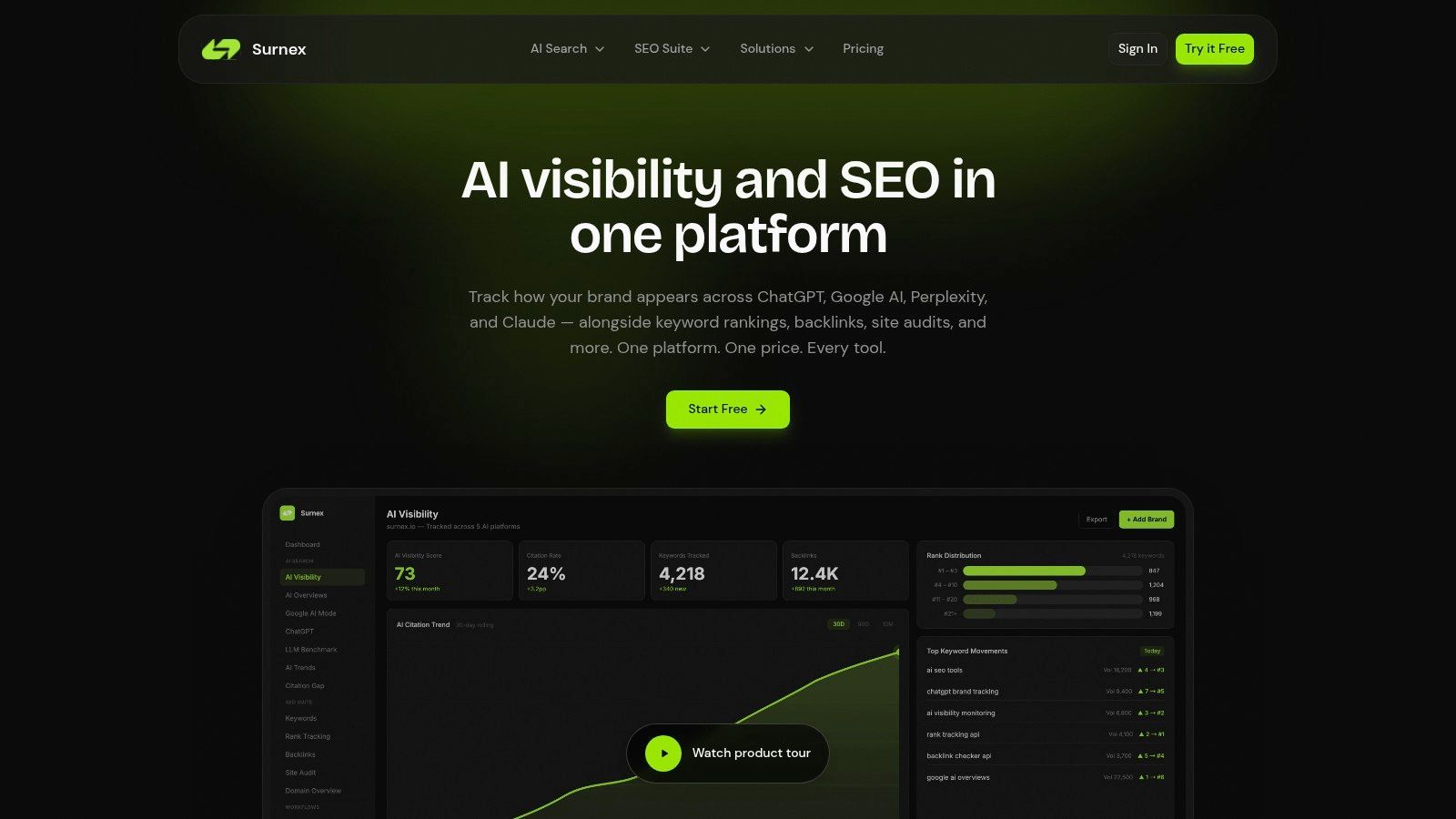
Unified tooling is important. Teams can stitch together Search Console, manual query reviews, crawler output, and spreadsheets, but that gets fragile fast. One option is a platform like Surnex AI Overview tracker, which tracks AI visibility alongside core SEO signals so agencies and in-house teams can monitor citations, rankings, and broader search performance in one workflow.
If you can't tie content updates and technical fixes to AI visibility outcomes, your reporting is descriptive, not operational.
Build a reporting cadence your team can maintain
A lot of AI search measurement fails because teams overcomplicate it at the start. They try to track everything, on every prompt, across every model. That usually collapses under its own weight.
A better cadence is:
-
Pick a priority query set Focus on brand terms, core commercial terms, and high-intent informational queries.
-
Capture a baseline Record current AI presence, cited URLs, competitor appearances, and technical status.
-
Map interventions Note which content, internal linking, entity, or markup changes were made.
-
Review monthly Look for directional movement, recurring citation gaps, and topic clusters where the brand remains absent.
Later, once the system is stable, you can expand to more surfaces and more nuanced segmentation.
For teams that want a visual sense of how this kind of reporting is evolving, this overview is worth a few minutes:
The key is to avoid vanity dashboards. A strong report helps a strategist decide what to fix next.
Putting Your AI SEO Framework into Action
Organizations often don't need a full rebuild. They need a tighter operating model.
In the first month, focus on a narrow rollout that gives you a baseline and a repeatable workflow.
A practical first 30 days
-
Audit current visibility Review your priority branded and non-branded queries. Note where AI summaries appear, whether your brand shows up, and which pages get cited.
-
Define an AI usage policy Decide where AI is allowed in the workflow and where human review is mandatory. Keep this simple and enforceable.
-
Pilot one content workflow Pick one topic cluster. Use AI for SERP analysis, outline development, gap finding, and draft support. Keep final claims, examples, and positioning under human control.
-
Run a technical readiness pass Check indexation, rendering, snippet directives, internal linking, and structured data on the pages you want surfaced.
-
Change reporting before scaling production Add AI visibility, citations, and answer-surface tracking to your normal SEO reporting so you can evaluate whether the work is actually changing search presence.
What a mature program looks like
A strong AI SEO program doesn't publish more for the sake of it. It builds content with information gain, gives machines cleaner structure, protects technical accessibility, and measures whether that work changes visibility in modern search experiences.
That's the difference between using AI as a shortcut and using AI as infrastructure.
Surnex helps agencies, in-house teams, and developers track how brands appear across AI-driven search experiences and traditional SEO from one platform. If you're trying to measure citations, AI Overview visibility, rankings, and technical opportunities without stitching together disconnected tools, take a look at Surnex.