The worst advice about finding a niche is still the most common: follow your passion and the market will sort itself out.
That works for hobbies. It fails for client work, product strategy, and search-driven growth. Teams don't need a niche that feels inspiring in a brainstorm. They need a niche that maps to a real problem, shows signs of buying intent, and can win attention in both classic search and AI-driven discovery.
A niche isn't a personal identity. It's a focused commercial bet. The practical question isn't "What do we love?" It's "Which specific problem can we solve for a specific group, and what evidence says they'll care enough to act?"
Moving Beyond Follow Your Passion
Passion helps you stay with the work. It doesn't validate demand.
In practice, the strongest niches come from specific pain, not broad enthusiasm. One of the clearest frameworks I've seen for this comes from an entrepreneur discussion that argues successful niche selection starts by solving a single painful problem in a large, evergreen market, while broad categories usually fail because they're too crowded and too vague. The same source also points to a simple benchmark: if paid ads appear in Google for that niche, businesses are already making money there, which is a strong signal of commercial viability (Reddit discussion on profitable niche selection).
What usually goes wrong
Junior teams often start with category labels:
- "Fitness" instead of a narrowly defined body-composition problem
- "B2B SaaS marketing" instead of a buyer-stage or workflow problem
- "Pet care" instead of a concern tied to a pet type, condition, or buying moment
Those aren't niches. They're containers.
The market doesn't reward generic coverage. It rewards clarity. When a team narrows too slowly, they usually end up with content that ranks nowhere, product pages that convert poorly, and outreach that sounds interchangeable with every other vendor in the category.
Practical rule: If the niche can describe thousands of unrelated search intents, it isn't narrow enough.
A better way to define the target
Use a simple filter:
| Filter | Weak niche | Strong niche |
|---|---|---|
| Audience | Small businesses | Multi-location dental practices |
| Problem | Get more traffic | Recover lost local visibility after listing inconsistency |
| Outcome | Grow online | Generate qualified appointment demand |
| Environment | Search engines | Search engines plus AI assistants |
That last line matters more than is commonly understood. Traditional keyword tools still matter, but they no longer describe the whole opportunity. If buyers now discover brands through AI Overviews and assistant-style answers, your niche process has to account for whether a brand can boost visibility using AI search as part of the go-to-market motion.
What to optimize for instead
Don't ask whether the team is excited. Ask these:
- Is the problem painful enough to trigger action?
- Can we describe the buyer in one sentence without using broad labels?
- Can we see commercial signals in search results and community discussions?
- Can this topic earn trust in AI-mediated discovery, not just blue-link rankings?
A good niche feels a little uncomfortable because it's so narrow. That's usually a good sign. Broad ideas are easy to pitch internally and hard to win externally. Narrow ideas are harder to explain at first, but they create better positioning, cleaner content strategy, and stronger product fit.
How to Uncover and Quickly Vet Niche Ideas
Teams waste months on niche selection because they treat it like branding work. It is closer to market forensics. The job is to find a tight group of buyers with a costly problem, clear buying language, and enough visibility in search and AI-generated answers to support acquisition.
Start with friction, not inspiration.
The fastest ideas usually come from places where buyers complain in their own words, compare options, or explain why the current tool, agency, or workflow fails them. Review sites, support forums, internal sales notes, product communities, and search suggestions all matter because they expose the language real buyers use before they ever fill out a demo form. For SEO teams, this step now has a second layer. Check whether the problem already appears in AI Overviews, forum summaries, and LLM-style recommendation patterns. If AI systems are collapsing broad informational queries into a few cited brands, niche selection has to favor topics where a specialist can still earn mentions, citations, or inclusion.
Where strong niche ideas surface first
A useful pattern shows up across four source types:
- Product reviews and comparison sites: G2, Capterra, app marketplaces, and ecommerce reviews reveal missing features, failed expectations, and switching triggers.
- Customer-facing internal data: Sales call notes, onboarding transcripts, support tickets, and live chat logs often surface sharper niche angles than keyword tools.
- Search behavior sources: Google autocomplete, People Also Ask, related searches, and question tools expose demand phrased in buyer language.
- Communities with repeated problem threads: Slack groups, private communities, industry forums, LinkedIn comments, and niche subforums show where the pain is active enough to create discussion.
The goal is not to collect a giant idea list. It is to narrow fast.
A broad label rarely survives first contact with the SERP. "Project management for agencies" is still a category. "Reporting software for SEO agencies managing local rankings and AI Overview visibility across 50 client locations" is closer to a workable niche because the pain, workflow, and buyer are specific.
Use the paid ads test early
Before anyone builds a content plan, check the commercial intent in Google. Search the core problem and the obvious solution terms. If the results page has active advertisers, product pages, comparison pages, and strong commercial copy, the niche likely has revenue behind it. Google explains how the ad auction works in its overview of Google Ads and Ad Rank, and that matters here for a simple reason: advertisers do not keep paying for clicks in a niche that never converts.
Treat paid ads as a screening tool, not proof.
Some ad-heavy spaces are too expensive to enter. Others look quiet because the buyer pool is small but high value. I usually pair the ad check with a manual SERP review. Look for who is buying traffic, what promises they make, whether the offers are generic, and whether the content layer is weak enough for a specialist brand to compete. Then check whether AI Overviews summarize the topic with generic advice or cite actual vendors and experts. That tells you whether SEO alone is enough, or whether brand authority and entity visibility will matter from day one.
Use a quick screen like this:
| Check | What to look for | Why it matters |
|---|---|---|
| Paid ads | Search results with active advertisers and offer pages | Suggests buyers have commercial value |
| Specific pain | Repeated problem wording, not broad goals | Makes messaging, pages, and targeting sharper |
| Visible gaps | Thin pages, generic claims, old comparisons, weak expert content | Creates room to win with specificity |
| Audience concentration | Active newsletters, communities, events, podcasts, or forums | Makes distribution and research easier |
| AI search visibility | AI Overviews, citations, forum summaries, vendor mentions | Shows whether the niche can earn discovery beyond blue links |
If nobody is trying to sell into the problem, treat it carefully. You may be looking at interest, not demand.
Build a shortlist you can kill fast
Use a simple pass or fail sheet for each idea. Write one sentence for the buyer, one for the painful trigger, one for the offer, and one for the proof channel. Proof channel means the place you expect demand to show up first, such as search, communities, outbound response, partner referrals, or AI-generated recommendations. If any line stays vague, the niche is still too loose to prioritize.
For teams that want examples of how broad categories get narrowed into monetizable segments, Refgrow's profitable niche guide is a useful reference. After that, pressure-test the keyword layer. A niche can sound sharp in a strategy doc and still be impossible to enter if every commercial query is dominated by incumbents. This guide to low-competitive keywords for narrower niche entry points is useful for checking whether the phrase set leaves room for a newer site or specialist offer.
Quantifying Opportunity with SEO and Market Data
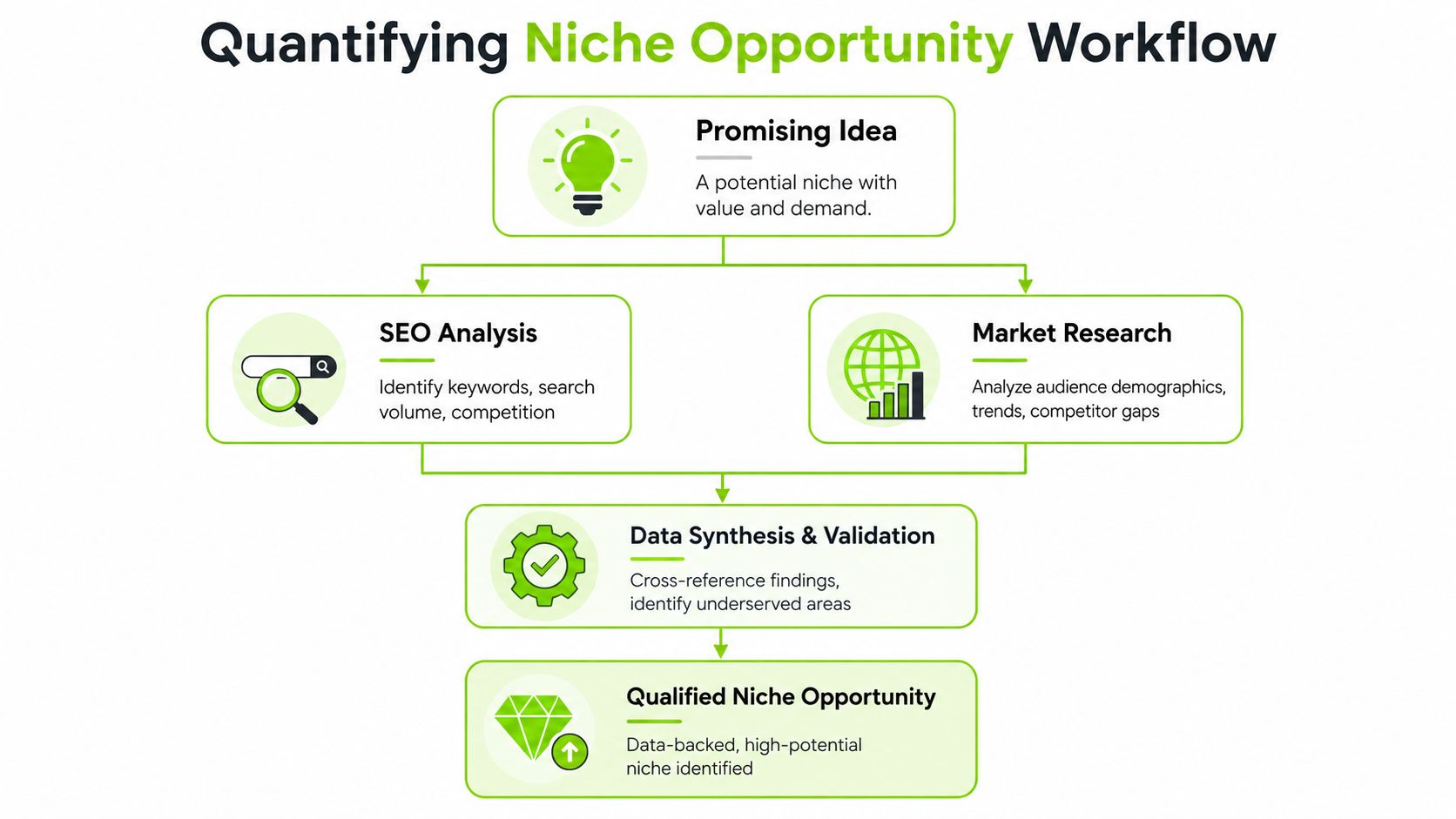
A niche idea becomes real when the numbers support it.
That means more than checking a few keywords. A rigorous niche process includes a four-week research and analysis phase to identify viable opportunities, validate market size, and calculate total addressable market, making sure the opportunity justifies the investment (four-week niche research process from The Strategy Institute).
Week one and two focus
Start with search demand, but don't stop there. Pull keyword sets from Semrush, Ahrefs, Google Search Console if you already have a site, and autocomplete sources. Group terms by intent:
- Problem-aware queries that reveal pain
- Solution-aware queries that suggest comparison shopping
- Transaction-adjacent queries that imply a next step
- Authority queries where users want expert guidance
Then open the SERPs. Don't just record volume. Look at who owns the results, what content formats dominate, whether forums are surfacing, and whether AI Overviews summarize the topic in a way that leaves room for a specialist brand to earn visibility.
Week three focus
Now move into market math.
Build a TAM estimate using the narrow audience definition, not the broad category. Then pressure-test a realistic share based on competition, channel access, and the sales model. A niche can be too small, but more often teams choose one that's too wide to enter efficiently.
A market opportunity review should combine keyword demand, audience concentration, and monetization logic. This walkthrough on market opportunity analysis is the kind of framework I'd want a junior strategist to use before recommending a niche to a client.
Working rule: If keyword demand looks decent but the audience is impossible to reach or the offer can't capture value, the niche is weaker than it looks.
What to document before approval
Use a decision table, not a gut-feel slide.
| Signal | Questions to answer |
|---|---|
| Search demand | Are there enough queries across the topic cluster, not just one head term? |
| SERP quality | Are the current winners strong because they're better, or just because nobody focused deeply yet? |
| Audience access | Can you reach buyers through search, communities, ads, partnerships, or owned lists? |
| Revenue logic | Is there a credible path from traffic or visibility to service, product, subscription, or lead value? |
This is also where content quality enters the equation. Search opportunity isn't just about finding a gap. The team still needs pages worth ranking. If you need a practical benchmark for page-level improvement, this guide on how to improve content for higher rankings is useful because it keeps the focus on content quality rather than checklist SEO.
What weak analysis looks like
Weak niche analysis usually sounds confident and proves nothing:
- "There are a lot of searches."
- "The industry is growing."
- "The client already likes this space."
None of that is enough.
Strong analysis ties together audience definition, SERP structure, TAM logic, and the likelihood of earning trust. That's the difference between a niche idea and a niche business case.
How to Validate Niche Demand Before You Build
Teams often waste time after the research phase by building too much, too early.
A niche isn't validated when people say it's interesting. It's validated when they take an action that suggests buying intent. The useful signals are add-to-cart actions, email registrations, and direct messages, which are better indicators of real interest than page views. That same insight also points to a practical method that too few teams use: testing demand privately with a landing page and Meta ads before revealing too much publicly (validation signals and confidential demand testing).
A simple visual helps keep that process disciplined.
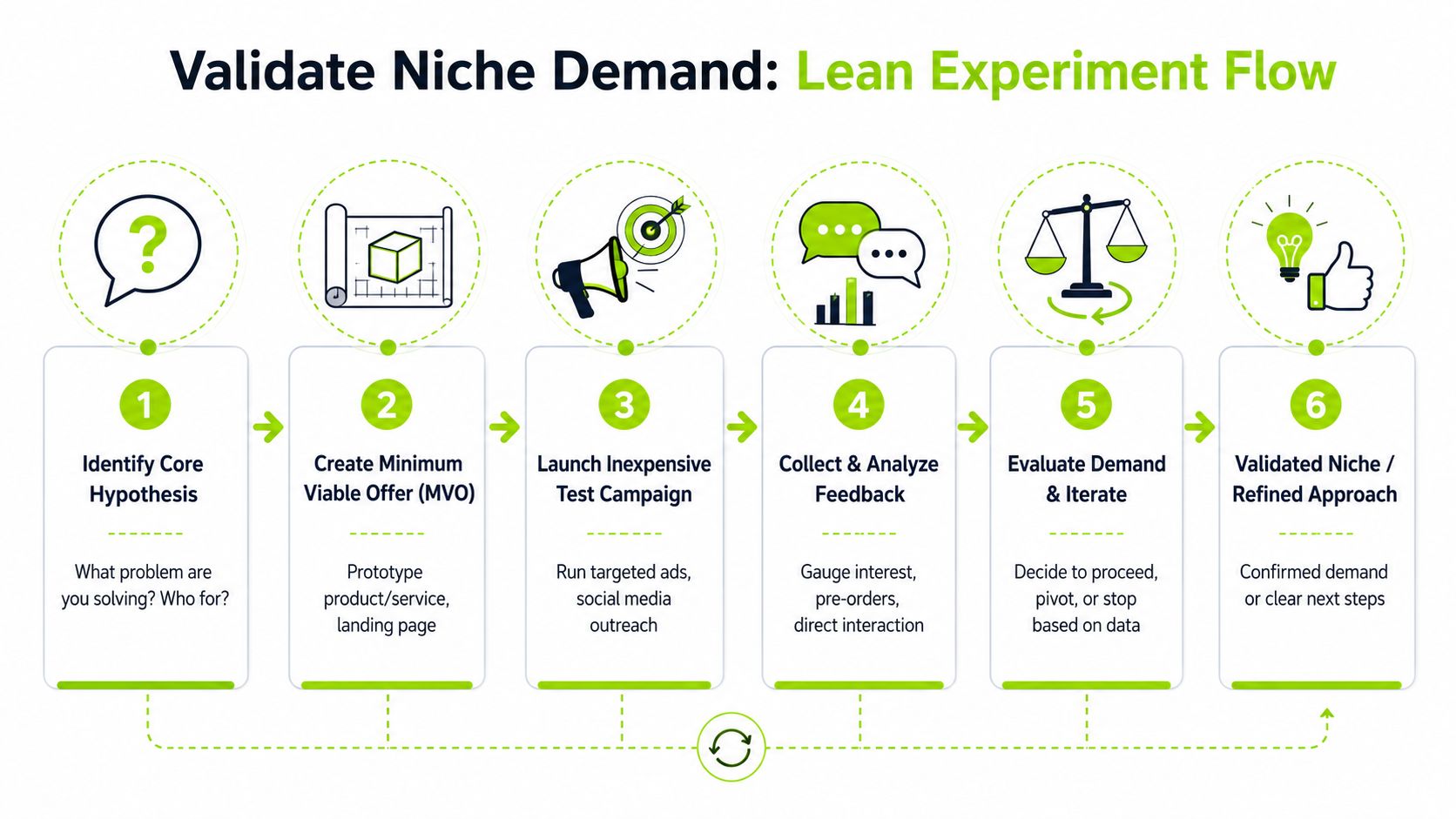
Build a smoke test, not a full product
The cleanest validation setup is small and controlled:
-
Write one sharp hypothesis Define the audience, the problem, and the promise in one sentence.
-
Create a one-page offer Use a lightweight landing page. The page should explain the problem, the offer angle, and one clear action.
-
Drive qualified traffic Run a small Meta campaign, targeted social distribution, or direct outreach to the exact audience segment.
-
Track intent signals Measure actions that imply commitment, not curiosity.
Here are the signals worth watching first:
- Email registrations: People want the launch notice, demo invite, or waitlist update.
- Add-to-cart clicks: Strong for product-style offers, even if checkout isn't live yet.
- Direct messages or reply emails: Often the strongest sign because people are spending effort to ask follow-up questions.
Keep the test narrow and quiet
If the niche is promising but crowded, secrecy matters. That's where paid social or limited-distribution testing helps. You can test positioning without publishing a full content hub or announcing the concept widely.
This is also why keyword planning matters before launch. You don't need a giant SEO buildout for a smoke test, but you do need message discipline. A structured process for building a keyword list helps teams keep the landing page language aligned with the actual problem language buyers use.
The right early metric isn't traffic. It's evidence that someone wants the thing enough to raise a hand.
What to include on the page
A good validation page usually contains:
| Element | Why it matters |
|---|---|
| Specific headline | Confirms this is for the intended audience |
| Pain-focused copy | Shows you understand the actual problem |
| Offer framing | Gives visitors a reason to act now |
| Single CTA | Makes the test readable |
Add basic tracking. Keep the page fast. Don't load it with navigation, brand story, or broad educational copy.
Later in the process, a practical walkthrough can help teams see this kind of lean validation in action.
How to read the result
Three outcomes matter:
- Clear intent: The audience understands the offer and takes action. Move forward.
- Interest without action: The problem is real, but the positioning or offer likely needs work.
- No meaningful response: Either the audience isn't right, the pain isn't urgent, or the niche isn't viable enough to pursue now.
That last one is useful. Good validation doesn't just confirm winners. It protects the team from expensive false positives.
Aligning Your Niche with Content and Monetization
A validated niche only matters if the business model fits it.
Many SEO-led projects often drift. Teams prove a topic has demand, then publish generic content and hope monetization appears later. That approach weakens quickly because the type of niche you choose should shape both the content architecture and the revenue path from day one.
Research on niche markets supports this narrower approach. Targeting specialized segments can lead to higher profit margins compared to broad markets, and one example from the UK higher education sector showed niche market sales rising 95% from £166.2 million in 2010 to £324.2 million in 2015 (Taylor & Francis research on niche market growth).
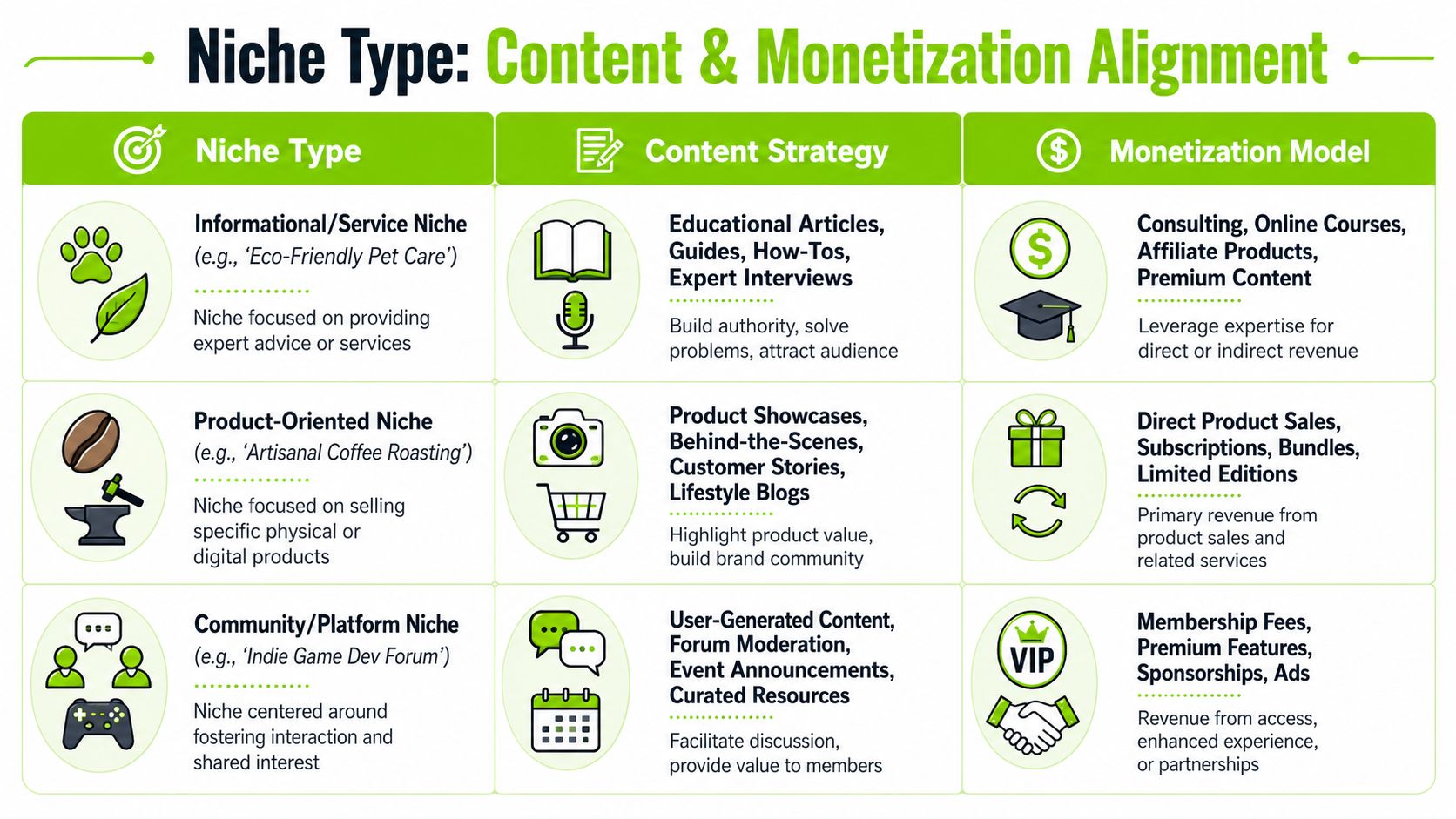
Match the content model to the buyer journey
Different niche types need different content systems.
| Niche type | Best content pattern | Most natural monetization path |
|---|---|---|
| Informational service niche | Guides, comparison pages, expert explainers | Consulting, retainers, courses, affiliate recommendations |
| Product-oriented niche | Collection pages, use-case content, product education | Direct sales, bundles, subscriptions |
| Community niche | Member resources, curated threads, recurring updates | Sponsorships, memberships, premium access |
An informational niche usually wins by building trust and then converting that trust into service or advisory revenue. A product niche needs stronger commercial pages earlier. A community niche depends on recurring participation, so content should support interaction, not just ranking.
What works and what doesn't
What works:
- Content built around the exact problem that validated demand
- Monetization tied closely to the user intent behind that content
- A publishing model that reflects how buyers evaluate options
What doesn't:
- Publishing top-of-funnel articles with no clear commercial bridge
- Mixing multiple monetization models before one proves itself
- Choosing a niche because it has traffic while ignoring revenue fit
A niche with modest search demand and clear buyer intent is often better than a larger topic full of vague interest.
A practical alignment check
Before scaling content, ask the team to answer these in writing:
- What kind of niche is this? Service, product, or community.
- What does the first conversion look like? Call, signup, trial, purchase, inquiry.
- Which content asset supports that action best? Guide, landing page, comparison page, case-led explainer, or product page.
- What content should not be created yet? This matters just as much.
Senior strategy helps. A junior team often wants to publish widely to "cover the topic." The better move is to build depth around the validated problem cluster, then add adjacent content only when it supports distribution, trust, or conversion.
A niche strategy earns better margins when the audience feels specifically understood. Content creates that feeling. Monetization captures its value.
Future-Proofing Your Niche with AI Search Insights
Most niche research still assumes the battle is fought in ten blue links.
That's outdated. Buyers now ask Google for summaries, scan AI Overviews, and use assistants to compare options before they ever click a website. If your niche process ignores that, you're assessing only part of the visibility scope.
One verified shift makes this impossible to dismiss. 68% of consumers now use AI assistants for initial product research, which means niche validation now requires benchmarking visibility across LLMs and identifying citation gaps that traditional SEO-only workflows miss (AI assistant usage and LLM visibility gap).
What modern niche validation needs
A niche can look attractive in standard keyword tools and still be weak in AI search environments.
Check for:
- AI Overview representation: Which sources get surfaced when the core problem is queried?
- Entity clarity: Does the topic map cleanly to a recognizable problem, category, and solution set?
- Citation gaps: Are weak, generic, or outdated sources getting referenced where a specialist page could do better?
- Assistant discoverability: When someone asks for recommendations conversationally, does the niche favor broad brands or focused experts?
This changes how you judge competition. In some niches, classic SERPs are crowded, but AI-generated answers still pull from thin or mediocre source sets. That's an opening. In others, AI systems compress the category into a few dominant names, which makes a "good enough" niche far less attractive than it first appears.
Why this matters for agencies and in-house teams
Traditional SEO research tells you where search volume exists. AI search analysis tells you whether the brand can become part of the answer layer.
That distinction matters for reporting, content prioritization, and pitch quality. Agencies need to explain why a niche that looks broad and tempting in a keyword spreadsheet may be structurally harder to own if assistants keep citing the same incumbent brands. In-house teams need to know whether a narrower niche offers a better path to authority because AI systems still need clearer, more specialized sources.
For teams adapting their workflows, this guide to SEO for AI search is a useful starting point because it frames optimization around how brands surface in newer search experiences, not just where pages rank.
Low competition isn't enough anymore. You want a niche where your brand can become a cited authority.
The practical takeaway is simple. When you're finding a niche today, validate two layers at once: demand and discoverability. The niche has to be worth serving, and it has to be possible to earn visibility in the systems buyers now trust first.
If you're evaluating niches across both traditional SEO and AI-driven discovery, Surnex helps you see where brands surface in Google AI Overviews, ChatGPT-style discovery, and core search results in one place. For agencies and in-house teams, that makes it easier to compare niche opportunities, spot citation gaps, and choose markets you can win.