You're probably dealing with one of two situations right now.
Either the team has too many ideas and no shared way to decide which market, segment, or channel deserves investment. Or you already picked a direction, and now you need the analysis to prove the opportunity is real before budget, headcount, or roadmap time gets locked in.
That's where a good market opportunity analysis earns its keep. Done well, it stops teams from treating “interesting” as “worth pursuing.” It gives you a structured way to measure demand, pressure-test assumptions, compare channels, and decide whether the reachable upside is big enough to matter.
In practice, that process has changed. Traditional market sizing still matters, but it no longer captures the full picture on its own. Search behavior is fragmenting. Buyers discover vendors through classic search results, AI Overviews, assistant-style answers, review ecosystems, and category content that gets cited in generative experiences. If your analysis ignores those visibility shifts, you can size the market correctly and still enter it with the wrong go-to-market plan.
The Foundations of a Strong Analysis
A market opportunity analysis is a decision tool. It isn't a brainstorm, and it isn't a polished slide that says a category is “growing.”
The baseline is more concrete than that. The U.S. Small Business Administration frames market research and competitive analysis around measuring demand, market size, market share, and barriers to entry, while also looking at competitor importance and the window of opportunity for entry, as outlined in the SBA's market research guidance.
Four things every analysis needs
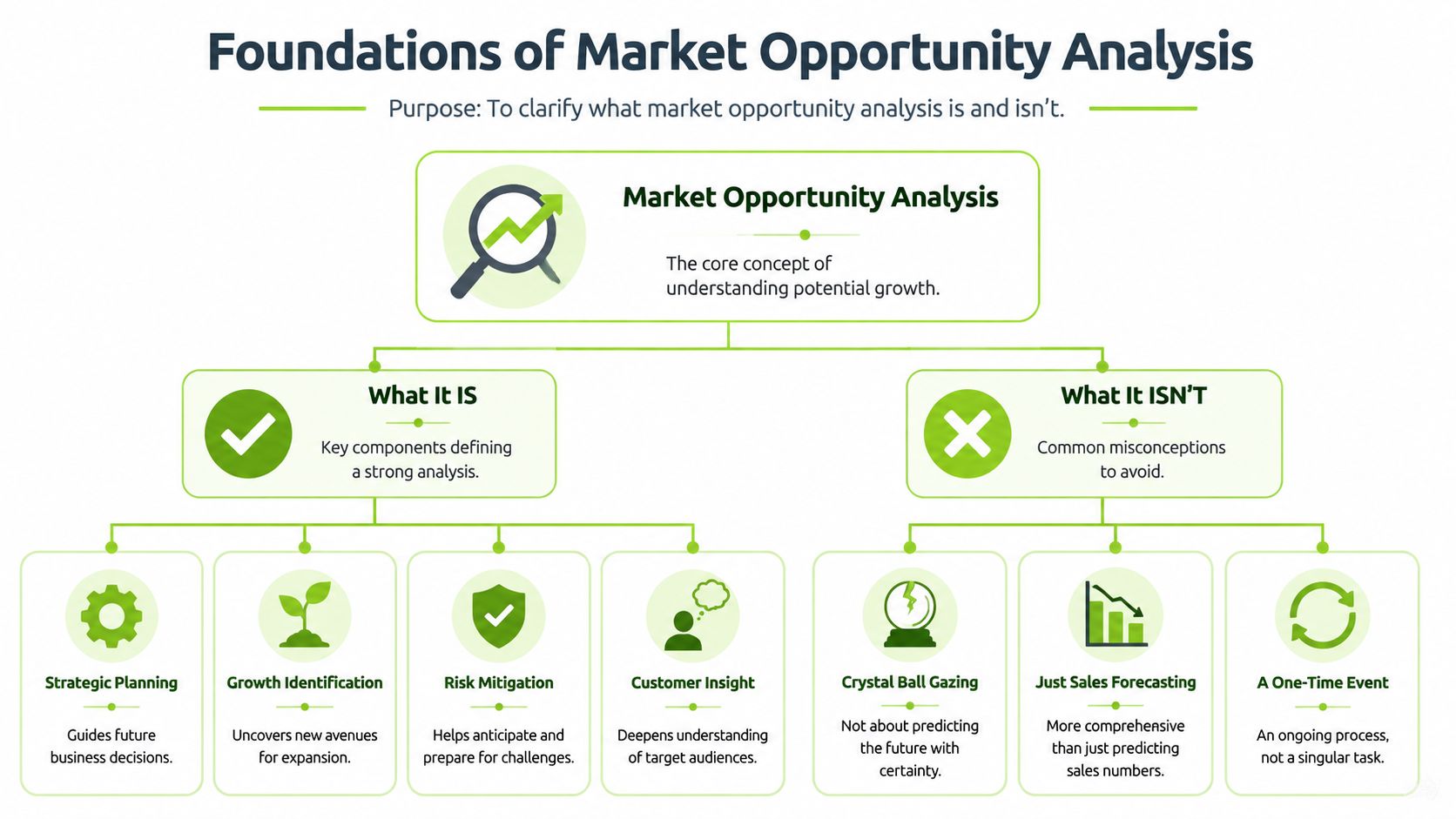
If those inputs aren't in the work, the analysis usually collapses into opinion. A solid version answers four basic questions:
- How much demand exists. Not “Would people like this?” but “How many buyers are actively trying to solve this problem?”
- How large the market is. You need a view of the category, the reachable segment, and how concentrated demand is.
- What share you can realistically win. At this stage, most overconfidence becomes apparent.
- What blocks entry. Entrenched competitors, channel dependence, buyer trust, compliance, sales friction, and implementation complexity all matter.
The point isn't to produce perfect certainty. The point is to stop making investment decisions from intuition alone.
Practical rule: If the team can't explain the expected path from market demand to sales forecast, the opportunity isn't ready for budget.
What this is not
Teams often confuse market opportunity analysis with adjacent planning work. That creates sloppy decisions.
It isn't just forecasting. A forecast without market logic is only arithmetic. It also isn't a competitor list, a TAM slide, or a customer persona workshop done in isolation.
What works better is a sequence: demand first, constraints second, revenue case third. That's why early validation matters. If you're working on a software product or feature set, this guide on how to validate your SaaS idea is useful because it forces the conversation back to real market evidence before you build too much around assumptions.
Where digital reality changes the foundation
For search-led businesses, one extra layer belongs in the foundation now. You need to know not just whether demand exists, but where discoverability sits today.
That means checking which brands are visible in traditional search, which ones dominate category language, and which publishers, tools, or competitors show up in AI-assisted discovery. Competitive visibility data helps here because it reveals who already owns the conversation before you spend to enter it. A practical starting point is this look at competitive intelligence for SEO, especially if your market depends on search visibility as a demand capture layer.
A strong analysis turns broad ambition into a credible sales view. Weak analysis says, “This market feels hot.” Strong analysis says, “Here's the demand, here's the reachable share, here's the resistance, and here's what has to be true for this to become revenue.”
A Three-Stage Framework for Actionable Insights
Most weak opportunity work fails for a simple reason. Teams start with solution enthusiasm instead of problem evidence.
A more reliable approach follows three stages. Seer Interactive's framework lays it out clearly: define the problem and validate demand with primary research, run a gap analysis on how the market and competitors solve it today, then size the opportunity by estimating target market size, current share, competitor share, and future growth potential, as described in Seer's opportunity analysis guide.
Stage one means proving the problem is worth solving
Start with buyer pain, not product language.
If you ask vague questions, you'll get polite answers. If you ask buyers how they currently solve the problem, what slows them down, and what triggers a switch, you get decision-grade information. Primary research should include interviews, direct feedback, and lightweight behavioral validation wherever possible.
A practical checklist for launch teams is to align this work with the rest of your rollout planning. Resources like this product launch checklist help because they force product, marketing, and operations to tie validation to execution instead of treating them as separate tracks.
Use simple prompts that expose reality:
- Current behavior. What are buyers doing today instead of using your offer?
- Failure cost. What happens when the problem stays unsolved?
- Buying trigger. What event moves this issue from “annoying” to “budgeted”?
If you can't describe the existing workaround, you probably don't understand the market yet.
Stage two is a gap analysis, not a feature comparison
Teams often get lazy. They compare feature lists, pricing pages, and messaging headlines, then call it competitive analysis.
That misses the key question. You're trying to find where the market is underserved, overserved, or poorly explained. Sometimes the gap is product depth. Sometimes it's onboarding speed, trust signals, education, or channel presence.
The useful gap isn't always in the product. Often it's in how buyers discover, evaluate, or trust the options in front of them.
For digital categories, this stage should include search and content behavior. Look at how competitors frame the problem, where they rank, what content formats they use, and which journeys they dominate. If your team is already using machine assistance in workflow analysis, this perspective on using AI in SEO is helpful because it shows where automation supports research without replacing judgment.
Stage three turns evidence into a business case
Only after demand and market gaps are clear should you size the opportunity.
At this point, you're no longer asking, “Is this an interesting market?” You're asking tougher questions:
- Can we reach enough of the right buyers?
- Can we win against the current alternatives?
- Will the expected return justify the work?
At this stage, many projects get rejected, and that's healthy. A market can be real and still be a bad bet for your company right now. Maybe the category is crowded. Maybe your distribution is weak. Maybe buyers need implementation support your team can't deliver yet.
That tension is exactly why this three-stage structure works. It protects you from scaling excitement faster than evidence.
How to Size Your Market with TAM SAM SOM
Market sizing gets dismissed as finance theater when teams use it badly. It becomes useful when it forces discipline.
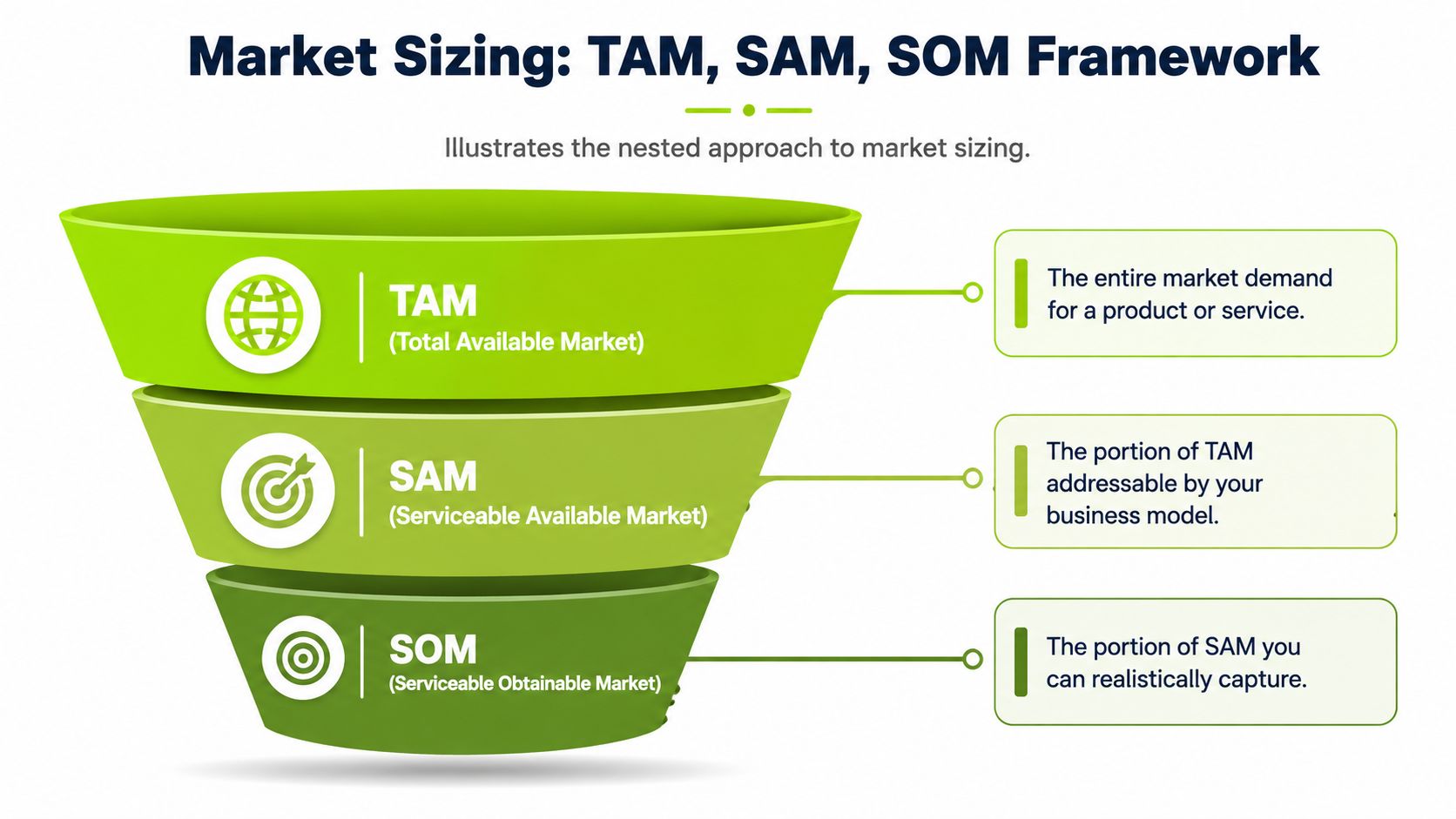
The TAM, SAM, SOM model gives you that discipline by splitting one big market story into three separate questions. Activated Scale describes this framework as standard in startup and growth planning because it turns broad opportunity into a measurable revenue case that accounts for factors like competitor intensity, CAC, and ACV, as explained in their market opportunity analysis breakdown.
Think of it like nested circles
TAM is the total available market. It represents all demand for the category if every relevant buyer could purchase a fitting solution.
SAM is the serviceable available market. This is the portion your business model can serve based on geography, channel, product scope, and operating constraints.
SOM is the serviceable obtainable market. This is the share you can realistically capture, given competition, sales capacity, budget, conversion assumptions, and timing.
A simple way to think about it:
- TAM asks whether the category is meaningful.
- SAM asks whether your company can serve a real subset of it.
- SOM asks whether winning enough of that subset is plausible.
The last number is the one that matters most.
Why this model keeps teams honest
TAM is where teams exaggerate. They start with the largest possible category, then imply that category size validates the plan.
It doesn't. A huge market can still be operationally irrelevant if your product only fits a narrow segment, your sales motion is expensive, or buyers are already locked into incumbent tools. SAM fixes some of that by narrowing the reachable market. SOM forces the hardest conversation of all: what can this team win?
That's also where search visibility enters the sizing discussion. In many categories, discoverability acts as a practical limiter on obtainable share. If buyers search before they buy, your presence across category queries becomes part of market access. That's why share of search is a useful signal alongside classic market sizing. It doesn't replace TAM, SAM, and SOM, but it helps estimate whether your current visibility supports your growth assumptions. This is a good primer on share of search if your market relies heavily on digital discovery.
Build the model from assumptions you can defend
Don't treat the framework like a template you fill in once. Treat it like a pressure test.
Useful inputs include:
- Segment fit. Which buyer groups clearly match your offer?
- Go-to-market reach. Which channels can you operate well?
- Conversion logic. What has to happen from attention to closed revenue?
- Competitive pressure. Where are incumbents strongest, and where are they weak?
Later in the process, it helps to show the team a shared visual explanation before debating assumptions. This short video is useful for grounding the conversation:
A credible SOM is rarely exciting on first read. That's often a sign the model is finally getting realistic.
Strong market opportunity analysis doesn't use TAM, SAM, and SOM to impress stakeholders. It uses them to expose whether the path to revenue survives contact with channel limits, competitive intensity, and the cost of acquiring customers.
Analyzing Channels and Competitors in the AI Era
A market can look attractive on paper and still be harder to enter than expected because the discovery layer has changed.
That's the issue many teams miss today. Channel analysis used to focus on search rankings, paid media, partner reach, and maybe social distribution. Those still matter. But buyers now encounter brands inside AI-generated summaries, assistant-style answers, synthesized recommendations, and citation patterns that don't map neatly to the old SERP-only view.
Recent industry reporting highlighted in Ask Attest notes that Google's AI Overviews are already common, that Google said AI Overviews reached over 1.5 billion monthly users in more than 100 countries, and that Adobe reported traffic from generative AI sources to U.S. retail sites surged more than 1,200% year over year during the 2024 holiday season, according to their discussion of market opportunity analysis and AI-driven discovery.
Traditional competitor reviews now miss live demand capture
If your analysis only asks who ranks in blue links, you're undercounting who shapes buyer choice.
You need to examine at least three layers:
- Category ownership. Which brands and publishers appear when buyers ask broad problem-oriented questions?
- Citation presence. Which sources get referenced in AI-generated answers and assistant outputs?
- Conversion path visibility. Which brands show up when the query moves from education to vendor evaluation?
A competitor may have mediocre organic rankings and still control a large share of AI-mediated attention because their content gets cited, summarized, or reused as a trusted reference point.
What to actually review
This work is more practical than it sounds. Pick a market segment, then review the discovery path from first question to shortlisting.
Look for patterns such as:
- Problem framing gaps. Are competitors defining the problem more clearly than you are?
- Authority concentration. Do a small number of domains keep appearing across search and AI surfaces?
- Brand mention frequency. Which companies get named as examples, comparisons, or recommended tools?
- Citation asymmetry. Are publishers or communities getting surfaced more often than vendor websites?
If you're still getting up to speed on this shift, Algomizer's LLM search guide is a helpful reference because it translates emerging discovery behavior into concrete optimization questions.
Use tooling where visibility is fragmented
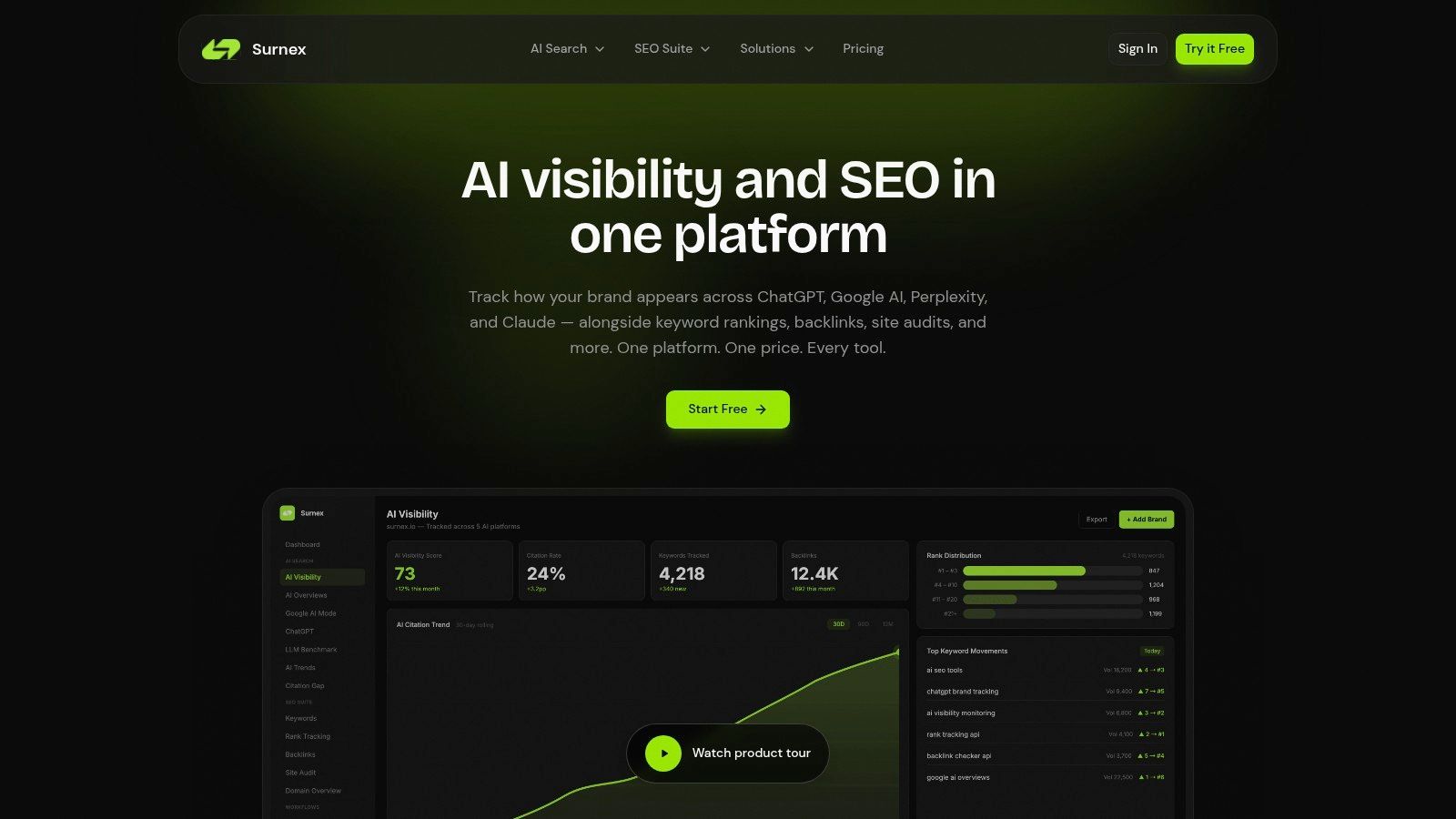
This is one place where a platform can save time, especially when you're comparing multiple brands or client accounts. Tools that unify classic SEO data with AI visibility signals make the work less manual. For example, Surnex tracks brand appearance across AI and traditional search surfaces, along with core SEO signals, which is useful when you need one view of rankings, citations, and competitor visibility rather than separate exports from different systems.
A practical starting point is to identify the domains and brands that consistently appear in the same conversations as you. This guide on how to find competitors of a website is useful because it pushes competitor discovery beyond the obvious named rivals.
The market opportunity isn't only where demand exists. It's where buyers can still find and trust you during the moments that shape selection.
That's the core update for the AI era. Channel analysis no longer means listing acquisition sources. It means tracing how buyers move through modern discovery environments and measuring who controls those touchpoints before you invest in entry.
A Simple Model for Scoring and Prioritizing Opportunities
After the research, teams often end up with a different problem. They don't lack options. They have too many.
Strategy often breaks down because people defend the market they understand best, the channel they already own, or the idea with the loudest internal champion. A scoring model won't remove judgment, but it does force judgment into the open.
Score opportunities against business reality
The simplest version works well. Pick a small set of criteria, assign a weight to each one, then score each opportunity on the same scale.
Use criteria that reflect actual execution, not wishful thinking:
- Market size
- Strategic fit
- Competitive position
- Channel accessibility
- Resource load
- Revenue quality
If a criterion doesn't influence budget, hiring, or speed to market, it probably doesn't belong in the model.
Here's a clean format for discussion:
| Criteria | Weight | Opportunity A Score | Opportunity A Weighted | Opportunity B Score | Opportunity B Weighted |
|---|---|---|---|---|---|
| Market size | |||||
| Strategic fit | |||||
| Competitive position | |||||
| Channel accessibility | |||||
| Resource requirements | |||||
| Revenue quality |
Don't pretend all criteria are equal
They aren't. A large market with poor fit often loses to a smaller market your team can reach, serve, and sell into efficiently.
That's why weighting matters. If you're an agency with strong search capability but weak field sales capacity, channel accessibility and serviceability may deserve more weight than broad category size. If you're an enterprise team with strong distribution but limited engineering bandwidth, implementation complexity may need to count more heavily.
Good scoring discussions sound a little uncomfortable
That's a feature, not a flaw.
A useful scoring session usually exposes conflicting assumptions. One person believes the category is easy to enter because search demand looks healthy. Another points out that buyers require long trust-building cycles. A third notes that your current product only solves part of the use case.
Put those differences into the model instead of debating in circles.
Decision lens: Prioritize the opportunity with the strongest combination of reachable demand, realistic advantage, and manageable execution cost.
You'll also get better outcomes if you score opportunities in two passes. First, let stakeholders score independently. Then review the spread together. Large gaps usually reveal the assumptions that deserve more research.
The biggest advantage of a scoring model isn't mathematical precision. It's that it turns strategy from a personality contest into a documented decision process. When you revisit the market later, you can see which assumptions held and which ones didn't.
That's how market opportunity analysis becomes operational. Not by producing a perfect answer, but by giving the team a repeatable way to choose where to focus next.
Common Pitfalls and How to Build a Defensible Case
Most market opportunity analysis doesn't fail because the framework is wrong. It fails because the evidence is weak, biased, stale, or incomplete.
That usually shows up in familiar ways. Teams interview friendly customers instead of hard-to-reach buyers. They size the market from one angle and stop there. They use old assumptions in fast-moving categories. Then they present the result as if the confidence level were higher than it is.
Industry guidance summarized by Entrepreneur points to several common failure modes: bias, poor audience access, low engagement, and stale data. The same guidance recommends validating opportunities using demand-side and supply-side sizing plus top-down triangulation, and notes that stronger analyses track market share changes over time and buyer touchpoints to find conversion friction, as discussed in their review of market research pitfalls.
The most common mistakes
A few patterns show up repeatedly in real projects:
- Confirmation bias first, research second. The team wants a market to be attractive, so they collect evidence that supports the conclusion they already prefer.
- Narrow sample quality. Interviews come from current customers, existing followers, or the easiest respondents to recruit.
- Single-method sizing. One spreadsheet becomes the market truth, even though it only reflects one angle.
- Outdated channel assumptions. The analysis reflects how buyers used to discover vendors, not how they do it now.
Any one of these can distort the final recommendation.
What makes the case defensible
You don't need perfect data. You need evidence from different directions that points to the same conclusion.
That means combining:
- Demand-side signals such as buyer needs, interviews, and behavior
- Supply-side signals such as competitor presence and market coverage
- Top-down checks that keep your assumptions from drifting into fantasy
A defensible case also separates facts from assumptions. If something is estimated, label it as estimated. If confidence is low, say so. Senior stakeholders usually accept uncertainty. What they don't accept is hidden uncertainty presented as certainty.
Behavioral evidence beats tidy narratives
This is the part many teams skip because it's messy. They have the spreadsheet, the category map, and the competitive deck. They don't have enough proof that buyers will change behavior.
That proof often comes from direct feedback, observed journeys, and repeated patterns in how buyers evaluate options. If buyers say one thing in interviews but behave differently when they search, compare vendors, or request demos, behavior should carry more weight.
The strongest market opportunity analysis is less polished than most decks. It includes caveats, competing explanations, and notes on where the evidence is still thin.
When you work this way, the final recommendation becomes much easier to defend. You're not asking the business to believe a neat story. You're showing that multiple inputs support the same conclusion, that the assumptions are visible, and that the team knows exactly what still needs validation after launch.
If your team needs a clearer view of market demand across both traditional search and AI-driven discovery, Surnex helps you track visibility, competitor presence, and emerging search patterns in one place so your opportunity analysis reflects how buyers find brands now.