If you think SEO competitor analysis is just about pulling a list of keywords your rivals rank for, you’re already behind. That's simply tracking, not intelligence.
Real competitive intelligence in SEO is about digging deep to understand the why behind your competitors' success. It's about reverse-engineering their strategy to find gaps you can exploit. This isn't just a nice-to-have; it's the foundation of any serious growth strategy, especially now that AI is changing the search game entirely.
The New Rules of Search Intelligence
Just knowing what keywords a competitor ranks for is table stakes in 2026. True intelligence means uncovering the strategic moves that fuel their visibility. You need to understand not just what they're doing, but how they're doing it—and more importantly, where they're likely to go next. We've moved from passively watching the competition to proactively outmaneuvering them.
The pressure is immense. With Google owning nearly 91% of the global search market, the fight for visibility is a high-stakes game. Think about it: the page ranking at #1 gets a 27% click-through rate (CTR), and a whopping 68% of all clicks are funneled to the top three results. If you want to see how top companies use this kind of data, you can explore detailed competitive intelligence statistics that break it down.
Adapting to AI-Driven Search
The arrival of features like Google's AI Overviews has thrown another wrench in the works. It's no longer enough to rank in the top ten blue links. Now, the goal is to become a citable, authoritative source that gets featured directly inside AI-generated answers. This requires a whole new level of strategic intelligence.
To really get a handle on this, you have to understand how AI affects SEO in 2026, as it's reshaping everything from how people find information to how search engines function. The best SEOs are already shifting their focus and tracking a new set of metrics, including:
- AI Answer Footprint: Pinpointing which competitors are cited most often in AI Overviews and for what specific questions.
- Backlink Velocity: Not just how many links a competitor has, but the speed and quality of the new links they’re building. This is a huge tell for their off-page momentum.
- Content Pivots: Catching when a rival suddenly changes its content focus, which often signals a shift in their target market or a new product launch.
Before we go further, it's helpful to see these key metrics laid out. Here's a quick breakdown of what you absolutely must be tracking to get a leg up in both traditional and AI-powered search.
Essential Competitive Intelligence SEO Metrics to Track
| Metric | What It Reveals | Why It Matters for SEO |
|---|---|---|
| SERP Visibility | Your overall share of voice for a target keyword set across the top 20 or 50 results. | It's your market share in organic search. A low number means your competitors own the conversation. |
| AI Answer Footprint | Which competitors are being cited as sources within AI-generated answers and for what queries. | This is the new #0 position. Being cited drives authority and can bypass traditional organic results entirely. |
| Backlink Velocity | The rate and quality of new backlinks a competitor is acquiring over time. | A sudden spike in high-quality links often precedes a rankings surge. It shows active and effective PR or link-building campaigns. |
| Content Gap & Format | The topics and content types (e.g., video, tools, studies) your competitors have that you don't. | This uncovers proven opportunities you're missing, allowing you to fill the gaps and capture new audiences. |
| Top Ranking Pages | The specific URLs that drive the most organic traffic for your competitors. | By analyzing their top pages, you can deconstruct their most successful content formulas and on-page strategies. |
This table is just a starting point. The real magic happens when you bring all this information together to see the complete picture of what your competitors are doing and why it’s working.
The real power of competitive intelligence isn't just finding out what your competitors did. It's about using that data to build a clear roadmap for what you should do next. You stop reacting to ranking drops and start anticipating market shifts.
Unifying Your SEO Intelligence
Having separate tools for rank tracking, backlink analysis, and AI monitoring creates blind spots. You see pieces of the puzzle, but you can't put them together. How can you connect a competitor's recent surge in backlinks to their sudden appearance in AI Overviews if the data lives in different places?
The modern solution is a unified platform that merges traditional SEO metrics with AI search insights. This gives your team a single source of truth, making it possible to draw direct lines between different strategic actions and their outcomes. For a closer look at this concept, you can see how we approach monitoring AI search performance. For agencies and in-house teams, consolidating this data is the key to working faster and building strategies you can stand behind with confidence.
Building Your Competitive Intelligence Framework
Diving headfirst into competitor data without a clear plan is a recipe for disaster. I've seen countless teams get lost in endless spreadsheets, chasing metrics that don't matter. A strong competitive intelligence SEO framework isn't about hoarding data; it’s about knowing exactly what you’re trying to accomplish first.
Before you pull a single keyword ranking or backlink report, you need a goal. Are you trying to steal a competitor’s top-ranking keywords? Or maybe your focus is on getting your brand featured in AI Overviews. Each goal demands a completely different approach and a unique set of data.
This whole process is about moving from basic tracking to deep analysis, especially with the rise of AI in search.
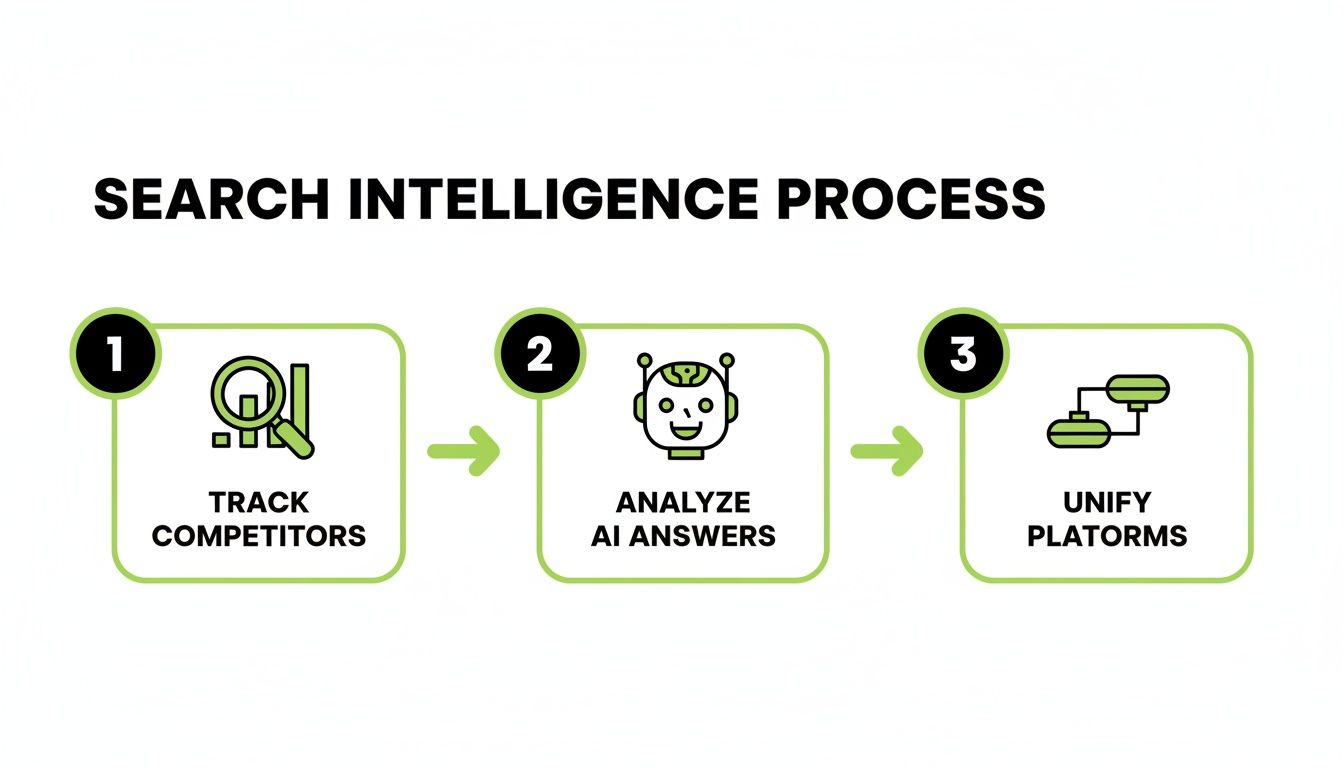
As you can see, a modern framework has to account for everything from the classic SERPs to the new AI-powered answer boxes.
Defining Your Real Objectives
Your goals are the foundation of your entire strategy. Let’s walk through a couple of real-world examples to see how this plays out.
Scenario 1: An Agency's Local SEO Push
Imagine an agency has a new client: a dental practice with several locations. They want more appointment bookings, specifically from three cities. The goal here isn't broad national traffic—it's all about hyper-local dominance.
- The Mission: Get more local organic traffic and own the Map Pack for searches like "dentist near me" or "emergency dentist in Boston."
- The Data That Matters: You’d look at competitor Google Business Profiles, how many local citations they have, their review count and velocity, and the performance of their local landing pages.
- The Focus: Forget about national health blogs. The real targets are the 3-5 dental offices that pop up in the local pack every single time for those money keywords. For a business like this, a targeted citation gap analysis is a goldmine. It quickly shows you all the local directories your competitors are on, but your client is missing from.
Scenario 2: A SaaS Company's Market Share Battle
Now picture an in-house SEO team at a project management SaaS company. They're the underdog, trying to steal market share from two industry giants. Their goal is to get in front of people who are actively comparing different tools.
- The Mission: Show up when potential customers are searching for things like "best project management software," "Asana alternative," or other feature-based comparisons.
- The Data That Matters: Here, you're digging into competitor backlink profiles, what their top-of-funnel content looks like (guides, case studies), and which sites get cited in AI Overviews for comparison queries.
- The Focus: The team would tear apart the competitors' most successful comparison pages. They'd analyze everything—content structure, linking strategies, and every on-page element—to figure out how to build something better.
I’ve seen this mistake made time and again: teams confuse their biggest business rival with their actual SERP competitor. The company you see as your main threat might be terrible at SEO, while some small, niche blog is eating your lunch in the search results.
Identifying Your True SERP Competitors
Once you know what you're trying to achieve, you can find out who you’re really up against. This isn't just about who sells a similar product. It's about who owns the digital shelf space you want.
Your competitor list will look different depending on your goal.
- For Keyword-Level Competition: Who consistently shows up on page one for your most valuable keywords? These are your immediate rivals.
- For Content and Link Building: Which sites are getting links from the high-authority publications you want to be in? They are your PR and link competitors.
- For AI Visibility: Which domains get cited most often in AI Overviews when people ask questions related to your product or service? These are your new competitors for 2026 and beyond.
By setting clear objectives and identifying your true SERP competitors from the get-go, you build a focused, actionable plan. This turns your competitive intelligence SEO efforts into a precision tool for growth, not just another pile of data.
Gathering Actionable Data From Search and AI
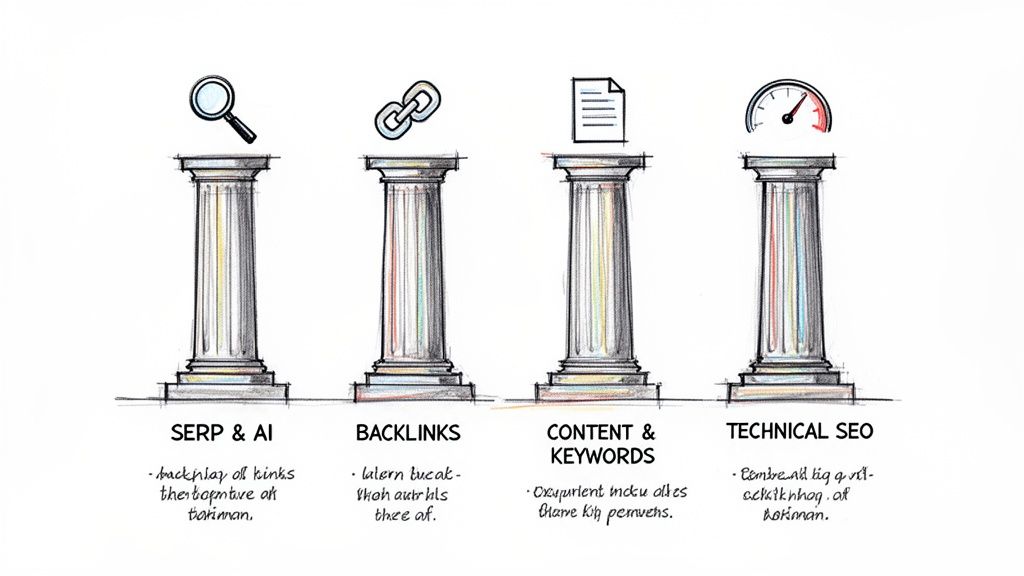
Once you’ve defined your goals and picked your competitors, it’s time to get your hands dirty. Your entire competitive intelligence SEO effort hinges on the quality of the data you gather. This isn’t just about scraping numbers; it’s about building a repeatable system to collect insights across four critical areas.
The real goal here is to get a complete picture of the competitive landscape. We need to look far beyond just a few keyword rankings to truly understand what your competitors are doing right.
SERP and AI Visibility Data
First up, you need to figure out who actually owns the conversation in search—both on the classic results pages and inside the new AI-powered answers. Knowing who ranks #1 is old news; today, it’s about total visibility.
I always start by tracking ranking distribution, but I look at the top 50 results, not just the top 10. This shows you who truly dominates a topic and, more importantly, who’s bubbling up on page two and could become a major threat tomorrow.
Then, you have to turn your attention to AI. With AI Overviews and other generative experiences reshaping search, knowing who’s getting cited is non-negotiable. The data from 2026 is staggering: AI search traffic soared by 527% in the last year alone. Google's AI Overviews are now in front of 2 billion monthly users, and since 75% of the links in those answers come from the top 12 organic results, cracking that first page is more critical than ever.
Pro Tip: You can use advanced search operators to find clues about AI citations. A quick search like
"competitor brand name" inurl:google.com/search?q=your+keywordcan sometimes reveal how a rival is being featured within Google's AI, giving you intel that most tools will miss.
Backlink Profile and Velocity
A competitor’s backlink profile is a direct measure of their authority and a roadmap of their marketing efforts. It tells you who endorses them and how aggressive their off-page strategy really is.
A backlink gap analysis is the perfect place to start. A tool like Ahrefs or Semrush can instantly show you which high-quality sites link to your competitors but not to you. That’s your low-hanging fruit for link building right there.
But don’t stop at a static count. You have to track backlink velocity—the speed at which competitors are earning new links. If you see a sudden spike in new referring domains, that’s a signal. It could be a killer PR campaign, a new piece of viral content, or a major push that you need to be aware of.
Dig into their most-linked pages, too. Find out if they're earning links with data studies, free tools, or comprehensive guides. This is a goldmine for informing your own content strategy.
Content and Keyword Gaps
The third piece of the puzzle is a deep dive into your competitors' content to find proven topics you're missing out on. A proper content gap analysis is more than just finding keywords you don't rank for.
Begin with keyword gaps, but focus on the "striking distance" opportunities. These are the keywords where your competitors are on page one, and you're stuck on page two or three. They are often your quickest path to more traffic.
From there, look for bigger-picture gaps in topics and formats.
- Topic Gaps: What subjects are competitors covering that you haven't touched? Are they addressing a pain point or stage of the buyer's journey you've completely ignored?
- Format Gaps: Are they crushing it with video while you’re only writing blog posts? Have they built a free calculator or template that’s a magnet for leads and links?
Uncovering these gaps reveals the strategic holes in your own plan. For a real-world example of how different formats appear in search, you can explore our guide on tracking ChatGPT visibility to see how competitors show up. The idea isn't to copy them, but to find what works for your audience and then create a better version.
Technical SEO Benchmarks
Finally, none of the above matters if your site’s technical foundation is cracked. You could have the best content in the world, but if your site is slow and a mess for search engines to crawl, you’ll lose.
Benchmark your site's technical health against your top three competitors. I focus on comparing these key metrics:
- Core Web Vitals (CWV): How does your LCP, INP, and CLS measure up? A faster site is a better experience, and it's a confirmed ranking signal.
- Crawlability and Indexability: Check out their
robots.txtfiles and XML sitemaps. Are they giving search bots a clear path to their most valuable content? - Structured Data: Are they using Schema markup (like FAQ, Product, or HowTo) to earn those eye-catching Rich Snippets?
This kind of technical audit helps you spot any disadvantages holding you back. By gathering data across these four pillars, you're not just collecting numbers—you're building a powerful dataset to make smarter strategic decisions.
Analyzing Competitor Strategies to Find Your Edge
All that raw data you've gathered is just noise until you give it meaning. This is where the real work—and the real fun—begins. We're about to turn that mountain of numbers on visibility, backlinks, and content into a genuine competitive advantage.
Think of it this way: the data is a treasure map, but it won't lead you anywhere unless you know how to read it. Our goal isn't just to spy on what competitors are doing. It’s to figure out why their strategies work, where they’re dropping the ball, and what big opportunities they've completely overlooked.
This is the stage where your entire competitive intelligence seo effort pays off, transforming simple observation into a concrete action plan.
Deconstructing Competitor Backlink Strategies
A competitor's backlink profile is like reading their diary. It tells you exactly who they're talking to and what they're talking about. By digging into it, you can basically reverse-engineer their off-page SEO playbook and find some incredible link opportunities for yourself.
Don't just get hung up on the total number of referring domains. The first thing I always do is start sorting their links into categories. Are they getting big-name media placements from a savvy digital PR team? Or are they earning links from niche industry blogs by publishing original research? This tells you where they’re spending their time and money.
The real gold in backlink analysis isn't just a list of websites to hit up for links. It’s understanding the type of content that naturally earns authority in your space, so you can build assets that attract links on their own.
Once you have that context, building a priority outreach list becomes much easier. I always look for a few key patterns:
- Recurring Link Sources: Do you see the same sites linking to a competitor over and over? That signals a strong relationship—one you could probably build, too.
- High-Authority Gaps: Find the powerful sites that link to two or three of your competitors but not to you. These are your warmest prospects, hands down.
- Content-Driven Links: Pinpoint their most-linked-to pages. Is it a free tool? A "state of the industry" report? An ultimate guide? That’s your blueprint for creating your own "link magnet."
This level of detail gives you a repeatable strategy, not just a one-off list. For a deeper dive into these tactics, our guide on analyzing backlink profiles for SEO walks you through the entire process.
Finding Gaps Beyond Keywords
A standard content gap analysis—the kind that just spits out a list of keywords you’re missing—is a decent starting point. But the real opportunities are found in the strategic gaps: the gaps in topic depth, content format, and user intent.
Let’s say you sell high-end coffee gear. A competitor might rank #1 for "best espresso machine," but their page is just a wall of text. That's your opening.
You have a clear shot to create something 10x better. Imagine a resource that includes:
- Crisp video demos of each machine in action.
- An interactive comparison table where users can filter by specs, price, and features.
- Direct quotes or testimonials from professional baristas.
You’re not just filling a keyword gap here; you’re filling a massive value gap. You've moved beyond simply writing another article and have created the definitive resource that actually helps someone make a decision.
Benchmarking Your AI Search Visibility
With AI-powered search becoming a bigger piece of the puzzle every day, you absolutely have to include it in your competitive intelligence seo work. You need to know when and where your competitors are showing up in AI Overviews and other generated answers.
The stakes are unbelievably high. We all know that less than 1% of searchers ever bother clicking to the second page of Google. Now consider this: Google's AI Overviews source roughly 75% of their links from the top 12 organic results. If you’re not there, you’re invisible. Tracking how your rivals are performing in this new arena is no longer optional. It's a critical part of understanding how SEO is such a high-ROI channel.
Start tracking the key informational questions in your niche. When someone asks a question, whose content does the AI cite? Is there a consistent winner? Look closely at the pages getting featured and break down why they’re seen as the best answer. It’s usually because the content is well-structured, fact-heavy, and answers the question directly and without fluff.
To get a true edge, you need a holistic approach, which is why mastering competitor analysis for SEO and PPC is so crucial. Once you see which questions your competitors are owning, you can focus on the ones they're missing. These "citation gaps" are your golden ticket to creating content built specifically to be the go-to source for an AI-generated answer.
Turning Insights Into Actionable SEO Playbooks
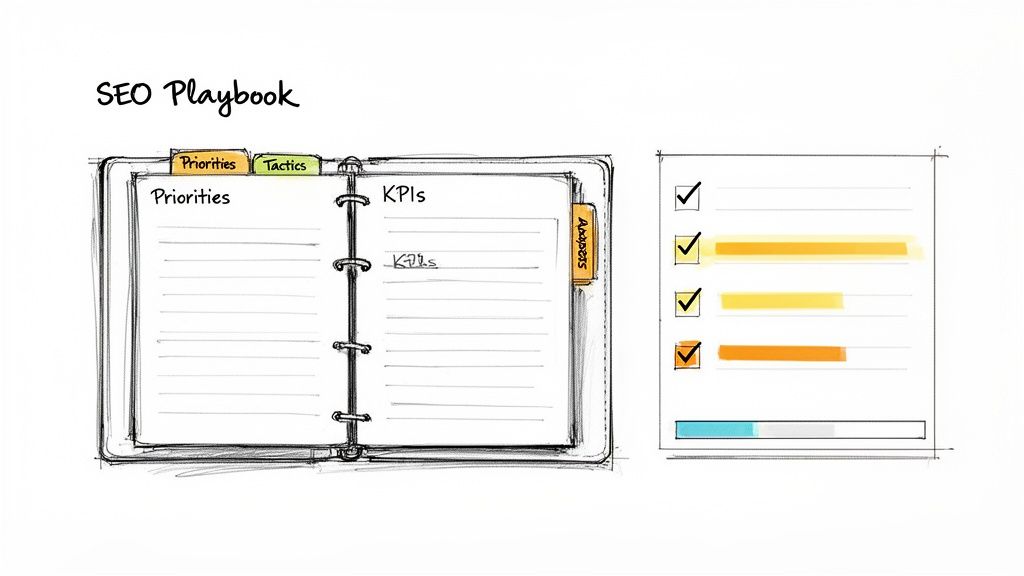
Here’s a hard truth I’ve learned over the years: the single biggest failure point in competitive intelligence SEO is a lack of action. All that brilliant analysis means absolutely nothing if it just gathers dust in a spreadsheet. This is where we bridge the gap between data and doing. We need to turn those hard-won insights into clear, actionable SEO playbooks that actually drive results.
Think of a playbook as more than a to-do list. It’s your strategic game plan. It outlines a specific goal, the exact steps to get there, and the metrics that will prove you've succeeded. For an agency, it proves your value. For an in-house team, it's how you win budget and get things done.
Ultimately, you’re creating a living document that anyone—from a junior analyst to a CMO—can pick up and instantly understand the what, why, and how.
For Agencies: Building Reports that Make You a Partner
When you're an agency, your competitive report is a story, not just a data dump. Your client doesn't care about the 5,000 backlinks you sifted through; they care about what those links mean for their bottom line.
Your job is to build a clear, concise narrative. I always start with a punchy executive summary that answers three questions: Who’s winning? How are they doing it? And where are our biggest shots on goal?
From there, I like to frame the findings around a few core pillars:
- The Threat Assessment: Pinpoint the top 1-3 competitors who are a genuine threat. Get specific about the exact strategies they're using to eat your client's lunch.
- The Opportunity Matrix: This is the fun part. Lay out a prioritized list of clear wins—content gaps they've missed, link sources they’re tapping into that you aren't, or easy technical fixes.
- The Action Plan: This is the heart of the playbook. For every opportunity, detail the exact steps, the resources needed, and the expected outcome. No fluff.
The reports that get clients excited are the ones that translate SEO-speak into business impact. Instead of just presenting data, tell them the story: "Competitor X is getting 30% more traffic from these keywords because their content answers three key questions we've completely ignored. Here’s our plan to close that gap by the end of Q3."
This simple shift in framing changes your relationship. You're no longer just a vendor executing tasks; you’re a strategic partner mapping the path to growth.
For In-House Teams: Presenting Findings to Get Buy-In
If you're in-house, your challenge is different. You’re not just reporting on the competition; you're competing for internal resources against other departments. Your audience is a leadership team that needs to see a clear connection to business goals.
That means you have to speak their language: revenue, leads, and market share. Drop the jargon. "We need to improve our Core Web Vitals" gets you a blank stare. "Improving our site speed could boost conversions by 2%, which translates to an extra $200,000 in revenue next quarter" gets you a budget.
When I’m building a deck for leadership, I make sure it hits these key points:
First, I show a simple visual of the current landscape—where we stand versus our key competitors in search. Then, I quantify the cost of doing nothing. For example, "Competitor Y is generating an estimated $50,000 in monthly traffic value from keywords where we don't even rank." This creates urgency.
Next, I present 2-3 clear playbooks with specific asks, whether it’s a content budget or developer time. Finally, I wrap it up with the projected ROI, linking every proposed action back to a measurable business outcome. You’re not asking for a handout; you’re presenting a strategic investment.
Practical Playbook Examples
Let's make this real. Here are a couple of common scenarios and what a playbook might look like.
Playbook 1: Closing a High-Value Content Gap
- Goal: Capture a top-3 ranking for the keyword "best project management software for startups."
- Opportunity: The current top-ranking article is from 2024 and is just a wall of text. We can do much better.
- Action Plan:
- Create a "living" resource page with video demos and an interactive tool to compare features.
- Secure quotes from three startup founders to add unique E-E-A-T signals.
- Launch a targeted outreach campaign to 10 SaaS review blogs that linked to the competitor's outdated piece.
- KPIs: Rank position for the target keyword, organic traffic to the new page, and free trial sign-ups.
Playbook 2: Replicating Competitor Authority Links
- Goal: Boost domain authority by earning links from top-tier publications that have previously linked to our competitors.
- Opportunity: Two main competitors were featured in a recent TechCrunch article by providing original data from a survey.
- Action Plan:
- Commission a new survey on "The State of AI in Small Business for 2026."
- Package the findings into a compelling report with shareable infographics.
- Identify and pitch 20 journalists who cover data-driven stories in our niche.
- KPIs: Number of new referring domains with a Domain Rating of 70+, and brand mentions in our top-5 target publications.
By building these kinds of specific, goal-oriented playbooks, your competitive intelligence SEO stops being a one-off research project and becomes a repeatable engine for growth.
Common Questions About SEO Competitive Intelligence
Even with a solid framework in place, getting your hands dirty with competitive intelligence can bring up some tricky questions. It's one thing to have a plan, but another to put it into action.
Let's walk through a few of the most common hurdles I see teams face.
How Many Competitors Should I Actually Track?
This one comes up all the time. The short answer? It completely depends on what you're trying to achieve. The biggest mistake you can make is tracking too many competitors—it’s a fast track to data overload and getting nothing done.
I always recommend starting smaller and being incredibly specific with your goals.
- For big-picture market share analysis: Keep your eye on 5-10 of your primary business and SERP competitors. This gives you a solid high-level view without getting lost in the weeds.
- For a specific keyword cluster: Get surgical. Zero in on the top 3-5 domains that are consistently outranking you for those terms. These are your direct rivals for that slice of the search results.
- For a backlink campaign: Your list might actually be much bigger here. You'll want to include any site that's earned links from your dream publications, even if they don't sell a competing product.
The trick is to have different competitor lists for different plays. Don't fall into the trap of using one massive, generic list for everything.
How Do I Prove This is Worth the Effort?
You absolutely have to connect this work to business results, especially if you want to keep your budget. "We know more about the competition" isn't a compelling argument for your boss.
The only way to truly measure the ROI is to tie every single action you take back to a core KPI. Your analysis is only as valuable as the results it drives.
Before you roll out any changes based on your findings, take a snapshot of your baseline metrics. That way, you can clearly show the "before and after."
Here’s what that looks like in the real world:
- Higher Traffic Value: Did that new article you wrote to fill a content gap start ranking for valuable keywords? Use a tool to put a dollar figure on that new organic traffic.
- More Leads or Sales: You noticed a competitor’s landing page had a killer design, so you updated yours. Did it lead to a 15% lift in conversions? That's a direct financial win.
- Better Ranking Velocity: Are you closing the gap on your main rival for your most important "money" keywords? Showing you're gaining ground faster than before is a powerful indicator of future revenue.
Is This a One-Off Report or an Ongoing Thing?
This is maybe the most critical question of all. A one-time competitive analysis is just a snapshot. It's useful for a moment, but its value starts to decay almost immediately. The SERPs are constantly in flux—competitors launch new features, Google tweaks its algorithms, and new players show up out of nowhere.
Think of competitive intelligence as a continuous cycle, not a one-and-done report.
The best SEO teams build this into their regular workflow. It's a simple, repeatable loop:
- Monitor: Keep a constant pulse on your core competitors’ vitals.
- Analyze: Every month or quarter, look for fresh threats and new opportunities.
- Act: Launch targeted campaigns based on what you found.
- Measure: See how your actions impacted your KPIs.
- Repeat: Feed those results right back into the process.
This is how you turn a static report into a living, breathing strategy that fuels real, sustainable growth.
At Surnex, we designed our platform specifically to make this whole process feel effortless. Instead of juggling a half-dozen tools for rankings, backlinks, and AI visibility, you can track everything in one spot. This means you can spot competitor moves as they happen and build smarter playbooks that actually move the needle. See how Surnex can unify your search intelligence at https://surnex.io.