So, you want to find your website's competitors. The obvious first step is a quick manual Google search for your main keywords, maybe running a keyword overlap report in an SEO tool, or even using an audience overlap feature to see where else your customers are hanging out online. These tactics are great for a quick snapshot of who you're up against in the search results.
But that’s just scratching the surface.
Why Finding Your True Competitors Is Essential for Growth
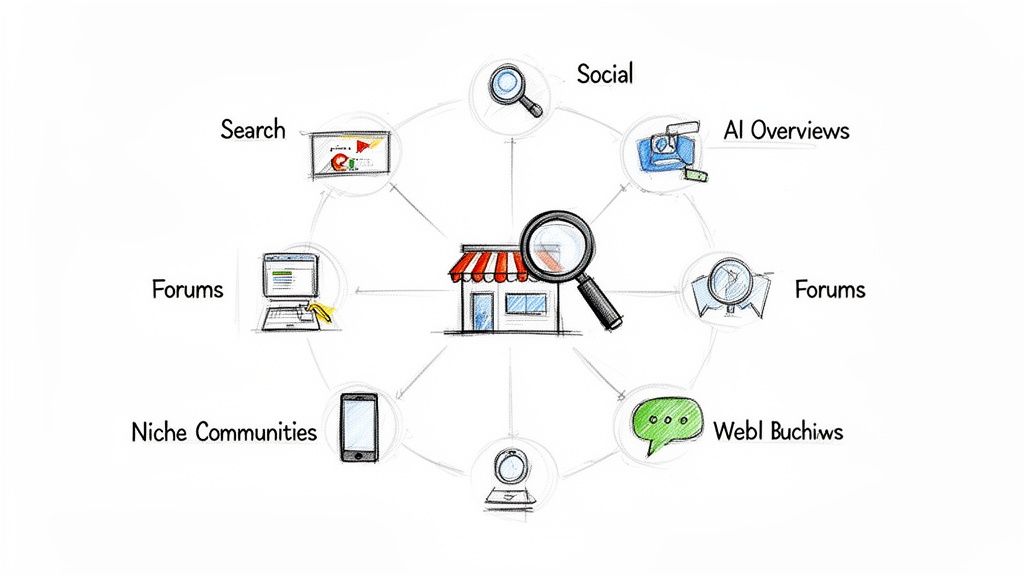
Before we get into the step-by-step methods, we need to talk about why this is so important. If you think your competition is just the top ten results on Google, you’re looking at the market through a very old lens. Your audience's world is much, much bigger now. They find solutions everywhere—from AI Overviews and TikTok feeds to private Slack groups and niche Reddit communities.
When you only focus on the handful of rivals you already know, you're flying blind. You’re leaving your flank exposed to competitors you don't even see coming and missing out on golden opportunities. This guide is all about looking beyond the usual suspects to uncover your direct, indirect, and even the new wave of AI-driven competitors.
A Modern View of the Competitive Field
You have to accept that the customer journey is no longer a straight line. Someone might start with a search, see a brand pop up in an AI Overview, ask for opinions on Reddit, and then get hit with a targeted ad on Instagram. Each of those moments is a battleground with a different set of competitors fighting for that person's attention.
Getting a handle on this entire field doesn't just inform your SEO—it sharpens your whole business strategy. It tells you:
- Content Gaps: What valuable topics are others covering that you’ve completely missed?
- Product Opportunities: Is there an indirect competitor solving a problem in a clever way you haven’t thought of?
- Marketing Channels: Where are new players building loyal communities that you could engage with?
- Strategic Weaknesses: What are customers constantly complaining about with your competitors? That's your opening.
By looking at competition through this wider lens, you stop reacting to market shifts and start anticipating them. This proactive stance is what builds a resilient strategy that doesn't just work today but is prepared for 2026 and beyond.
I’ve seen this firsthand. A SaaS company might think its biggest threat is another software platform, only to discover it’s actually a popular Notion template creator on Gumroad who is solving the same problem for a fraction of the cost. That kind of insight changes everything, from pricing to content. That’s the level of clarity we're aiming for.
Find Your True Rivals Through Keyword Overlap
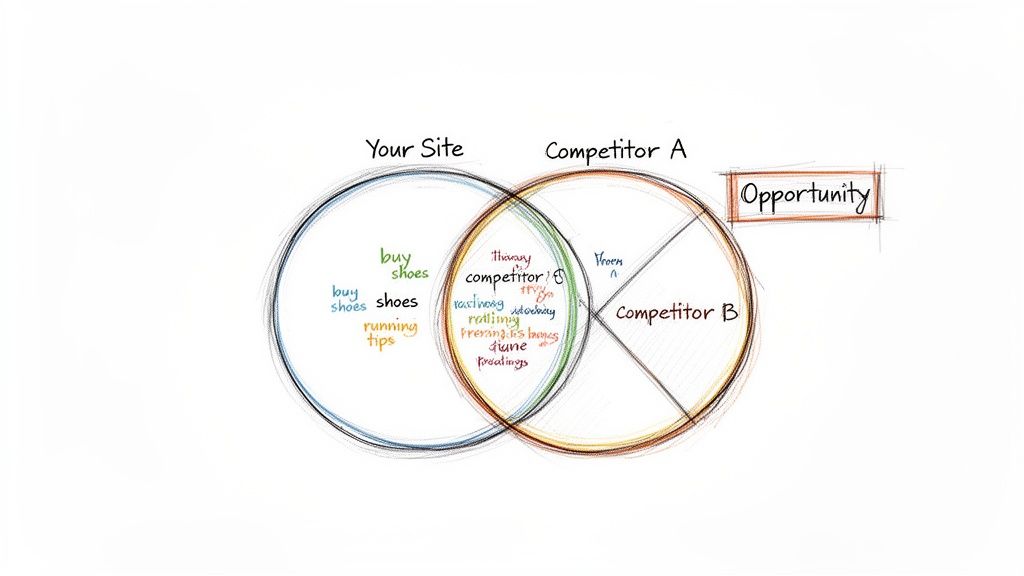
If you want the most direct, no-nonsense way to find out who you’re up against online, just look at who you’re fighting for search rankings. Think of every keyword as a small piece of real estate. Finding out which other domains are squatting on your turf is the most reliable way to build a list of your true digital competitors.
This whole process is called a keyword gap analysis. It’s a foundational SEO tactic for good reason: it pulls you out of the guesswork and gives you a data-backed list of rivals based on the exact search terms your customers are typing into Google. It’s not about who you think your competitors are; it’s about who the search results prove they are.
Go Deeper Than the Obvious Keywords
It’s tempting to just search for your main product and call it a day. For instance, if you sell "custom mechanical keyboards," you'll quickly spot the usual suspects. But that’s only scratching the surface. What about the hundreds of other phrases your audience uses before they even know they want your product?
They’re probably looking for things like:
- "best switches for tactile feedback"
- "how to build a 60% keyboard"
- "qmk vs via explained"
The websites ranking for these informational searches are your competitors, too. They’re getting in front of your audience early, building trust, and positioning themselves as the go-to experts. If you ignore them, you’re only showing up at the very end of the customer's journey—and by then, you’ve likely already lost.
How to Run a Keyword Gap Analysis
Your goal here is twofold: find sites that rank for many of the same keywords you do, and—more importantly—uncover the valuable keywords they rank for that you've completely missed. This is where you'll need an SEO tool like Surnex, Ahrefs, or Semrush.
Just plug your domain into a competitive analysis tool to get started. Most platforms will immediately suggest a list of organic competitors based on your shared keyword footprint. This is a decent starting point, but the real insights come from digging into the "content gap" or "keyword gap" feature. This is where you can plug in your domain and a few of your known competitors to see exactly what they're ranking for that you aren't.
I once saw this completely change a client's strategy. They were a niche B2B software company and assumed their rivals were other software tools. But our analysis showed their biggest "competitor" was actually a popular industry blog. The blog was ranking for every single problem their software was built to solve, intercepting potential customers with "how-to" articles before they even started looking for a paid solution.
This kind of analysis has been a game-changer since tools like Ahrefs' Site Explorer first hit the scene back in 2010. Today's tools can reveal up to 70% more rival keywords than you'd ever find by hand. A top e-commerce site might rank for over 1.2 million keywords, but you may only overlap on 15-20% of them. That means your competitors could be dominating the other 80%, and you wouldn't even know it.
Making Sense of Your Keyword-Defined Competitors
Running a keyword gap report will spit out a huge list of domains. Don't get overwhelmed; you just need a system to sort through them. Looking at your competitors' high-level metrics in Surnex's Domain Overview tool is a great way to get the context you need to start prioritizing.
A simple table can help you turn that raw data into an actual action plan. It breaks down what each type of keyword means and tells you what to do next.
Keyword Gap Analysis Output Explained
This table breaks down the types of keyword data you'll get from a gap analysis and explains what each category means for your strategy.
| Keyword Category | What It Means | Strategic Action |
|---|---|---|
| Shared Keywords | These are the terms where you and your competitors are in a direct dogfight. This is your primary SEO battleground. | Analyze the top-ranking pages. Figure out why they're winning (e.g., better content, more backlinks, slicker UX) and create a plan to one-up them. |
| Competitor-Only Keywords | Your competitor ranks for these, but you don't. This is a clear content gap and a massive opportunity for you. | Prioritize these keywords by search volume and relevance. Create new, genuinely helpful content to target these terms and capture traffic you're completely missing. |
| Your Unique Keywords | You rank for these, and your competitors don't. This is your current competitive edge. | Defend these rankings fiercely. Keep this content updated and improved to protect your turf and make it harder for competitors to move in. |
With this structured approach, you can stop guessing and start acting. You’ll know who your most dangerous competitors are, where your biggest content opportunities lie, and which of your current rankings are most important to protect.
Find Competitors by Following Your Audience
Keywords give you a peek into what people are searching for, but they don't tell the whole story. To truly understand your competitive landscape, you need to follow the digital footprints of your audience—where do they go when they aren't on your site?
This approach digs deeper than a simple search engine results page. The logic is straightforward: if a good chunk of your visitors also spends time on another website, that site is a competitor. They might be a direct rival selling the same thing, or an indirect one vying for the same customer attention with a different solution.
The Power of Audience Overlap
Let's say you run an online shop for high-end running shoes. Your keyword research will point you to other shoe retailers, no surprise there. But what if you found out that 20% of your visitors also frequent a popular marathon training blog, a site that sells GPS watches, and a subscription service for nutritional supplements?
These sites aren't selling the same shoes you are, so you might not think of them as traditional competitors. But they are absolutely competing for the attention, trust, and budget of your core audience within the larger "running" ecosystem.
Discovering this kind of overlap gives you a huge advantage. It can reveal:
- Potential partnership opportunities with brands that complement yours.
- New content topics your audience is hungry for.
- Indirect threats from businesses solving related problems for your customers.
This is exactly what audience overlap analysis is for. It maps out the shared visitor bases between your site and other domains, giving you a clear picture of your competitive world based on how real people behave online.
Uncovering Competitors With Traffic Analytics
The best way to see this in action is with traffic analytics tools. Platforms like Semrush have made this incredibly accessible with features like their Audience Overlap dashboard. For example, in an analysis of major athletic brands, Nike was found to have a massive 2.8 million overlapping visitors with Adidas. This number confirms what we already suspect about direct rivals, but it’s often the unexpected overlaps that provide the most strategic value.
In fact, some data shows that businesses using this kind of analysis can pinpoint their top competitors 25% faster than by just using manual methods. You can see more on how brands use this data in Semrush's analysis of competitor traffic. It helps you stop making assumptions and start seeing the web through your customers' eyes.
I saw a fantastic real-world example of this when an athletic wear brand discovered a surprising audience overlap with a wellness-focused meal prep service. On the surface, they sell completely different things. But the data showed they were both targeting the same health-conscious, high-income individual who values convenience. This insight led the apparel brand to launch a new content series on nutrition for athletes, directly tapping into an interest they had previously overlooked.
This is the kind of strategic thinking that pushes a business forward. It's about understanding your customer’s entire lifestyle, not just their immediate interest in your product.
Making Sense of the Overlap Data
Once a tool helps you identify sites with significant audience overlap, the real work begins. Don't just glance at the overlap percentage; you need to dig in and investigate these sites to figure out what their relationship is to your audience.
I find it helpful to group them into a few buckets:
- High Overlap, Direct Competitor: These are your head-to-head rivals. Your audience is actively comparing your offerings to theirs (e.g., two different stores selling running shoes).
- High Overlap, Content Competitor: Think blogs, media outlets, or forums in your niche. They’re competing with you for attention and authority, not necessarily sales (e.g., your running shoe store and a popular running magazine's website).
- Moderate Overlap, Indirect Competitor: These sites solve a related, but different, problem for your audience. They compete for their budget and mindshare (e.g., your running shoe store and a brand selling high-tech GPS watches).
Organizing your findings this way paints a much richer and more accurate picture of the competitive field. It can even sharpen your own content strategy. For instance, analyzing your "content competitors" might uncover new keywords to target. If you need help finding those opportunities, Surnex has a powerful keyword research tool designed for exactly this purpose.
Ultimately, following your audience is one of the smartest ways to make sure your marketing resonates and that you're never blindsided by a competitor you didn't even know you had.
Analyze Top Content to Find Who Is Really Winning

A big traffic number is great, but it only tells you a website is popular, not that it’s actually any good. A site can get millions of visitors who show up, get confused, and leave in a huff. That's why the real work begins when you dig into a competitor's top-performing content and the engagement metrics that prove they’ve built a real connection with their audience.
This 'content-first' approach helps you see past vanity metrics. You can start to spot the rivals who have truly figured out what your audience wants to read, watch, or interact with. By finding the specific articles and landing pages that drive both traffic and engagement, you’re essentially uncovering a blueprint for success in your niche.
The Story Behind Engagement Metrics
When you start pulling data on a competitor, it’s easy to get buried in numbers. But a few key metrics can tell you a surprisingly clear story about their content quality and user experience.
Here’s what I always look for first:
- Top Pages: Which URLs are pulling in the most traffic? This is the fastest way to see which topics and content formats are their home runs.
- Average Visit Duration: Are people actually sticking around to read? Or are they clicking away after a few seconds? Longer visit times almost always point to high-quality, engaging content.
- Pages Per Visit: Do visitors explore other pages on the site after landing on one? A high number here shows the content is compelling enough to make people want more, creating a 'sticky' experience.
- Bounce Rate: What percentage of people leave after seeing just one page? A high bounce rate often means there’s a mismatch between what users expected and what the page delivered.
Think of it this way: if a competitor has a blog post with tons of traffic but an 85% bounce rate and a 15-second average visit, they aren't a threat—they're a warning sign of what not to do. A true competitor has content that draws people in and keeps them there.
How to Pinpoint Their Winning Content
To get this kind of data, you’ll need to fire up a competitive intelligence tool. Platforms like Surnex, Semrush, or Similarweb have dashboards that break down a domain's traffic page by page. This lets you zoom in from a 10,000-foot view of a competitor to a granular look at their most successful work.
For instance, you might find that a competing e-commerce site gets 40% of its traffic from a single, in-depth "Beginner's Guide to [Your Product Category]." That’s a massive insight. It tells you that your market is hungry for educational, long-form content to help them make a buying decision.
Looking at top pages and engagement is a statistical goldmine. A tool’s top pages report can easily show you the content driving 60-70% of total visits. When you see pages with metrics like 5+ pages per visit and a bounce rate under 40%, you've found a real winner. This method, which has been refined since real-user data panels first emerged around 2013, has proven its worth. Top retail sites, for example, average a 3.2-minute visit duration, which correlates with a 22% increase in conversions. You can see more data on how metrics predict success in this insightful competitor analysis guide.
Turn Their Success Into Your Strategy
Once you've identified a competitor's best pages, it's time to put on your detective hat and do a manual review. Go to these pages and start deconstructing what makes them work.
Ask yourself a few key questions:
- Content Format: Is it a listicle, a detailed how-to guide, a case study, or maybe a video?
- Depth and Quality: How deep does it go? Does it include original research or a unique perspective I haven't seen before?
- Visuals and UX: Are they using custom graphics, interactive tools, or just a clean layout to make it easy to read?
- Calls-to-Action (CTAs): How are they turning this traffic into leads or sales? Are they pushing a newsletter, a free trial, or a specific product?
This process of "reverse-engineering" a competitor's best work is one of the smartest ways to build your own content strategy. It shows you exactly what resonates with your audience, taking a lot of the guesswork out of your own efforts. By analyzing the assets that are already winning, you can create a smarter content plan, aim to build pages that are "10x better," and start pulling some of that traffic over to your site.
Plus, these top-performing pages are often magnets for high-quality backlinks. You can dive deeper into how to analyze and acquire those in our guide to backlink analysis.
Uncover Hidden Competitors in Social and Niche Communities
If you think your competitor list is complete just by looking at Google, you're missing a huge part of the picture. Some of your most formidable rivals aren't fighting for the top spot in search results. They’re flying completely under the SEO radar, quietly building incredibly loyal followings in places search crawlers don't often go.
These are your "dark horse" competitors. They're winning on social media, dominating discussions in niche forums, and cultivating passionate communities on platforms like Reddit, LinkedIn, or private Slack channels. A competitor might have a weak website, but a massive, engaged audience on TikTok that trusts every word they say. To really understand who you're up against, you have to go where your audience actually talks, shares, and asks for recommendations.
Tune Into Social Media and Hashtag Buzz
One of the best ways to find these hidden players is to simply listen in on the right conversations. Start thinking beyond the obvious hashtags. If you sell project management software, you're looking for more than just #projectmanagement. Your real audience is using tags like #startupgrind, #remotework, and #prodmgmt to talk about their daily challenges.
By keeping an eye on these hashtags across LinkedIn, X (formerly Twitter), or Instagram, you'll start to see which brands pop up over and over. This is how you spot the consultants, small agencies, and up-and-coming tools that are deeply embedded in the conversation, even if they're nowhere to be found on Google's first page.
- Follow the Problem, Not Just the Solution: Track hashtags related to your customers' pain points. You’ll find out who they turn to for help.
- Watch for "Alternatives To" Questions: A simple search for "any good alternatives to [Your Brand]?" is a goldmine. It tells you exactly who your customers see as a direct substitute.
- See Who Influencers Are Talking About: Pay attention to the tools and brands that industry leaders mention. Their recommendations often signal the next big thing.
Don't just look for direct competitors. The goal is to identify any brand that’s successfully capturing your audience's attention and earning their trust.
The real insights are almost always hiding in the comments. When someone asks about a problem your product solves, look at what real people recommend. That’s your unfiltered view of the competitive landscape.
Dive Deep into Niche Forums and Communities
Beyond the wide-open spaces of social media, you'll find tight-knit communities where your most passionate customers are having incredibly detailed discussions. These are the places where trust is everything, and a recommendation from a fellow member is as good as gold.
Think about specific subreddits like r/smallbusiness or r/saas, specialized Facebook Groups, or professional Slack communities. In these forums, people aren't just sharing wins; they're asking for help with real-world problems. Finding out which tools are consistently suggested as the go-to solution is a powerful way to identify competitors who have built true grassroots momentum.
A search for "best CRM for a solo freelancer" on Reddit, for example, won't just bring up the industry giants. It will almost certainly surface newer, niche tools that are a perfect fit for that specific audience. These are the competitors who can chip away at your market share from the ground up, one happy user at a time.
This kind of manual research adds a human layer to the hard data you get from SEO tools. It helps you understand the why behind a customer’s choice, revealing competitors who win on word-of-mouth, not just domain authority. It’s this complete view that ensures you’re never blindsided by a rival you didn’t even know you had.
Build Your Competitor Analysis Workflow
Okay, you've done the digging. You’ve run the reports, scoured social media, and now you’re staring at a massive list of potential competitors. What’s next?
This is where many people get stuck. A long list of domains is just data—it isn't a strategy. The final, and most critical, part of finding your competitors is turning that raw data into an organized plan you can actually act on. Without a system, you're just collecting names.
The most effective way I've found to handle this is to validate and prioritize everyone on your list by sorting them into tiers. This simple exercise brings immediate clarity and helps you decide where to focus your energy.
Tier Your Competitors for Focus
Let's be honest: not every competitor deserves the same level of attention. Some are a direct threat, while others are just noise. A tiered list helps you see the difference.
- Tier 1: Direct Competitors. These are your head-to-head rivals. They target the same audience with an almost identical product or service. You're fighting for the exact same customers.
- Tier 2: Indirect Competitors. These businesses solve the same problem as you, but with a different solution. Think of a project management tool competing with a simple spreadsheet template—they both aim to organize work, but in different ways. They’re competing for your audience's budget.
- Tier 3: Emerging Competitors. These are the up-and-comers. They might be new to the scene, often with a buzzing social media presence but not much SEO authority yet. Keep a close eye on them; they could become Tier 1 threats down the road.
Once your list is tiered, you can finally shift from gathering data to making strategic moves. A simple spreadsheet is all you need to get started tracking the key metrics for your Tier 1 and most important Tier 2 competitors.
The goal isn’t just to collect data; it's to transform that data into intelligence. Your competitor analysis should directly fuel your marketing decisions—from content ideas and keyword targeting to identifying new link-building opportunities.
Think about how you find competitors on social media. It’s a constant loop of listening for brand mentions, searching relevant hashtags, and discovering new brands that pop up in the conversation.
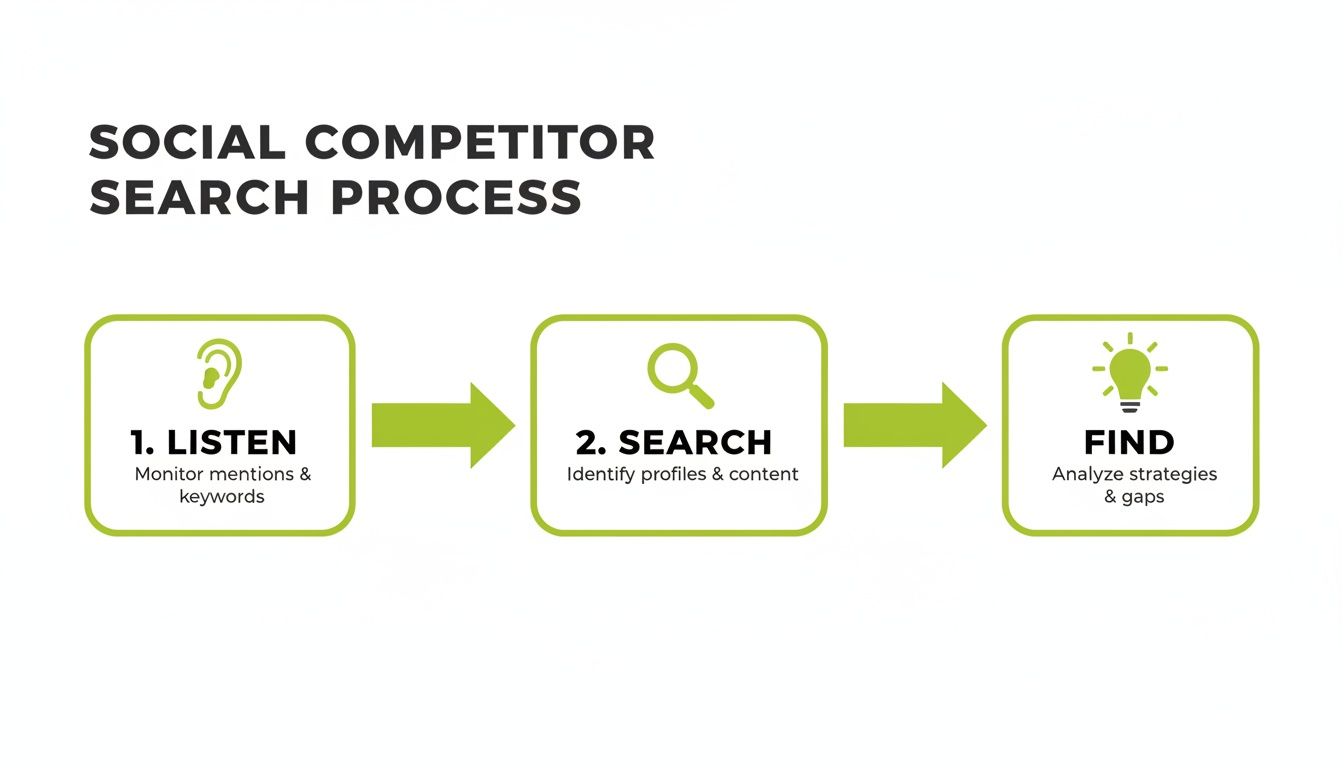
This process isn't a one-and-done task. It's about combining active searching with passive listening. The insights you gather feed right back into your ongoing competitor audits, helping you spot gaps and opportunities.
For example, you can use this intel to find weaknesses in their backlink profiles. To learn more about that, check out our guide on backlink review and opportunities. This continuous cycle is what keeps your strategy sharp and ensures you're never caught off guard.
Your Competitor Analysis Questions, Answered
Let's tackle a few of the most common questions we get asked about competitor research. Here are some quick, practical answers to help you get started.
How Often Should I Actually Research My Competitors?
This is a great question, and the honest answer is: it depends on your industry.
For most businesses, a big, deep-dive analysis every quarter is a good cadence. Then, supplement that with a lighter check-in once a month to keep an eye on things like ranking shifts or new content that’s taking off.
However, if you're in a fast-paced space like e-commerce or SaaS, you really need to be doing those deep dives monthly. Things just change too quickly. The most important thing is to be consistent. Using a tool that automatically tracks keyword movements or new backlinks can give you a heads-up without you having to do all the heavy lifting yourself.
What's the Real Difference Between a Direct and Indirect Competitor?
Getting this right is fundamental to building a full picture of your market. It all boils down to how they solve your customer's problem.
- Direct Competitors: These are the obvious ones. They offer a very similar product or service to the same people you do. Think Coca-Cola and Pepsi. If a customer is choosing between you and them, they're a direct competitor.
- Indirect Competitors: This is where it gets interesting. They solve the same core problem, but with a totally different product. A classic example is a movie theater versus Netflix—both are solutions for "what should I do for entertainment tonight?"
Don't sleep on your indirect competitors. They are often the ones who disrupt an entire market because they find a completely new way to meet a customer need you thought you had locked down.
How Do I Find Competitors for a Brand-New Website With No History?
When you're just starting out, you don't have any traffic or audience data to analyze. So, you have to get a little more creative.
Your best bet is to start with a keyword-first strategy. Think about the main search terms you want to own. Go search for them and see who’s already sitting at the top of the results—those are your first competitors.
You can also look at the sites you aspire to be like. Check out their backlink profile to see who is linking to them. Those linking sites are relevant to your audience and will almost certainly point you toward other key players in your niche. Finally, don't underestimate good old-fashioned manual searching on social media and in forums to see which brands are leading the conversation.
Ready to move from guessing to knowing exactly where you stand? Surnex unifies your view of the competitive landscape, tracking your visibility across both traditional search and new AI experiences. Get the clarity you need to build a winning strategy.
Find out how Surnex can help at https://surnex.io.