
Most advice about share of voice seo is stuck in an older version of search. It assumes that if you rank well, you own visibility. That was never fully true, and it’s much less true now.
Clients still get monthly SOV charts built from keyword positions alone. Those charts can look healthy while the brand is absent from AI Overviews, missing from answer boxes, and rarely surfaced in conversational research workflows. A report can say “visibility is up” while actual discovery is moving somewhere else.
That’s the core problem. Traditional SOV reporting measures a shrinking slice of how people find brands. Senior SEO teams need to keep the classic view because rankings still matter, but they also need a second layer that reflects how search behavior has changed. Good reporting now blends standard SERP visibility with answer-layer visibility, feature ownership, and citation presence across AI-driven experiences.
Why Your Old Share of Voice Is Obsolete
Legacy SOV models assume the search journey starts with blue links and ends with a click. That assumption breaks fast once Google answers the query directly or an LLM summarizes the category before a user ever reaches a website.
BrightEdge’s 2026 analysis argues that true SOV now needs a connected view of organic and AI visibility, and it also notes that AI modes like Google’s AI Overviews are capturing 20-30% of queries in major markets. The same analysis points out that teams still lack clear methods for tracking AI citation gaps, which creates obvious blind spots in reporting (BrightEdge on what share of voice means for search in 2026).
That creates a reporting problem agencies know well. A client asks why branded demand feels flat or why pipeline quality changed. The dashboard shows rank stability. The old model says nothing is wrong.
Rankings still matter, but they no longer tell the whole story
Traditional SOV remains useful for a few things:
- Competitive benchmarking: It still shows whether your site is gaining or losing share across a tracked keyword set.
- Category coverage: It helps you spot topics where competitors dominate standard organic results.
- Forecasting: It gives a practical model for estimating click opportunity from rankings.
But it misses where decisions increasingly happen:
- AI-generated summaries: A brand can rank but still be excluded from the synthesized answer.
- SERP features: Featured snippets, local packs, image blocks, and other modules can absorb attention before organic listings matter.
- Conversational discovery: Users now research products inside tools that don’t behave like a ten-blue-links results page.
Traditional share of voice can overstate market presence because it counts rank opportunity, not whether your brand is present in the answer layer.
The main blind spot in client reporting
The biggest issue isn’t that old SOV is wrong. It’s that teams often treat it as complete.
A modern report should separate at least three views: classic organic SOV, SERP feature visibility, and AI answer visibility. If you collapse those into one line chart without explanation, clients get a neat graph and a bad diagnosis.
That’s why older share of voice seo advice now feels incomplete. It measures shelf space in one aisle while buyers are shopping the whole store.
Defining SEO Share of Voice for Today
SEO Share of Voice is the percentage of your market’s total estimated search traffic that goes to your site compared with competitors. One simple framing comes from Keyword.com: if a site’s keyword set has a combined organic search volume of 200 million and the site generates 2 million organic visitors from those keywords, its SOV is 1% (Keyword.com’s explanation of SEO Share of Voice).
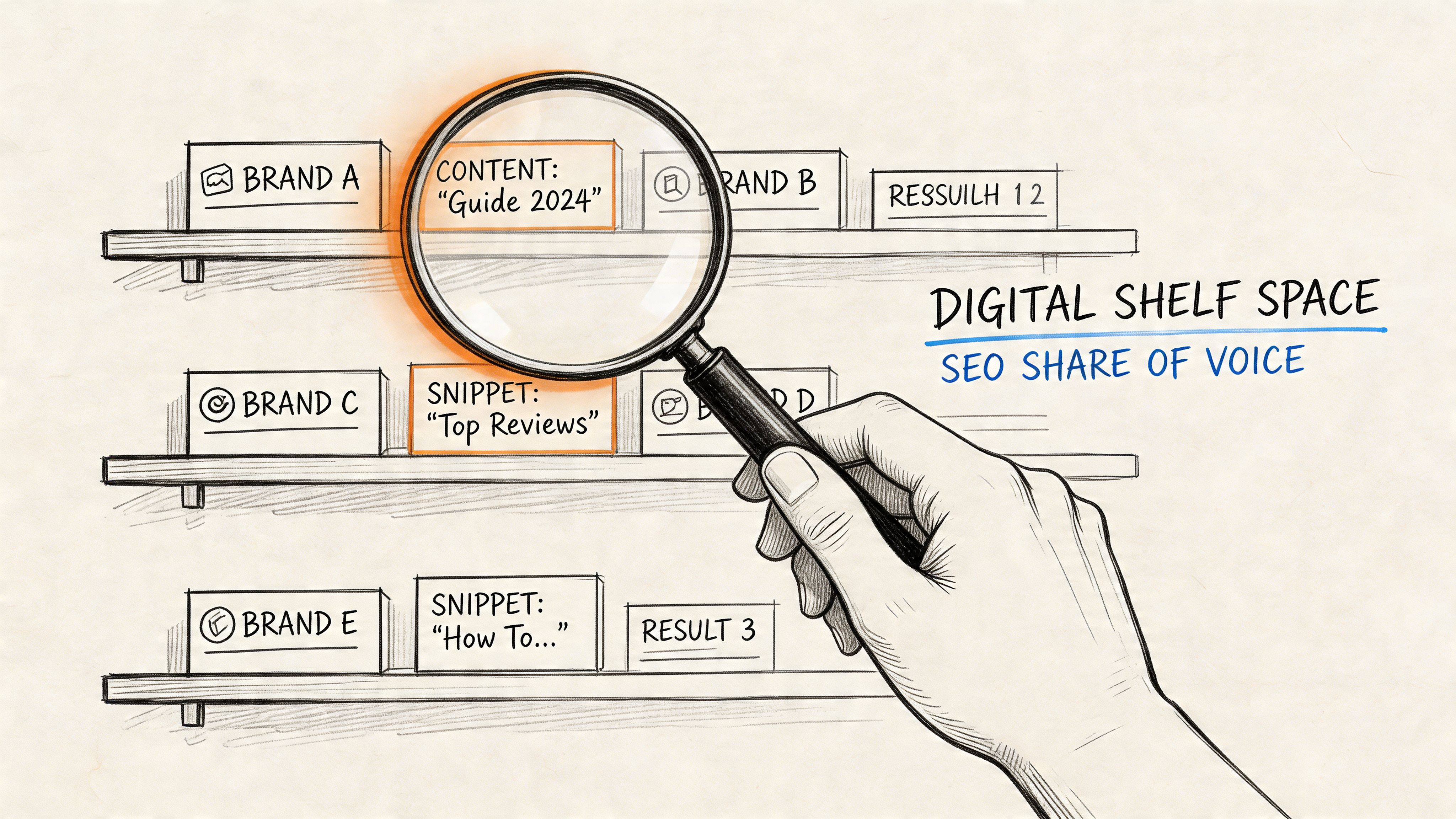
That definition is still useful. The mistake is treating it as a pure rank metric instead of a market visibility metric.
A practical way to explain SOV to clients is digital shelf space. Your brand isn’t competing for one keyword at a time. It’s competing for presence across a category, a product set, or a buying journey. The question isn’t “Do we rank for this term?” It’s “How much of the searchable demand in this market do we own?”
Think in market segments, not keyword lists
Weak reporting commonly commences with this. Teams export a ranking set, calculate a percentage, and call it SOV. That’s a partial measurement.
Useful SOV definitions tie the metric to a real business slice:
- Product-line SOV: One category, feature set, or service line
- Intent-based SOV: Informational, commercial, or branded demand
- Geographic SOV: Region, country, or local market
- Journey-stage SOV: Awareness, comparison, and conversion terms
That framing changes how clients interpret the number. A low broad-market SOV may be acceptable if the business dominates the part of the category that drives revenue.
What SOV is not
SOV often gets confused with other visibility metrics. Keep the distinctions clean.
| Metric | What it tells you | What it misses |
|---|---|---|
| Rankings | Position for individual keywords | Category-wide presence |
| Impressions | How often pages appeared | Competitive context |
| Clicks | Direct traffic outcome | Whether competitors owned more visibility |
| Share of Voice | Your relative visibility across a market set | Full answer-layer visibility unless you extend the model |
That last point matters. Modern share of voice seo should still start with search demand, but it shouldn’t stop there.
A short walkthrough can help if you need to align teams around the concept before building dashboards:
The modern definition clients actually understand
Use this in reporting language:
Practical rule: SEO Share of Voice is your share of discoverable demand across the search experiences that influence a buyer, not just your average rank in a keyword tracker.
That wording gives you room to modernize the metric without abandoning the old one. It also makes the next step easier, which is calculating SOV in a way that’s consistent, explainable, and worth acting on.
How to Calculate Share of Voice The Right Way
The cleanest way to calculate classic SEO SOV is to use a traffic-forecast model. SE Ranking defines it as [your site’s Traffic Forecast for keywords in top N / total Traffic Forecast for all sites in top N] × 100%, where Traffic Forecast comes from search volume multiplied by position-based CTR curves such as position 1 at about 30% CTR and position 2 at about 15% CTR (SE Ranking’s Share of Voice formula).
That approach is more useful than raw rank averages because it reflects two realities. First, not all keywords carry the same demand. Second, moving from position eight to position three matters more than moving from position eighteen to position thirteen.
Start with one decision before you calculate anything
Choose the scope of the measurement first. Most bad SOV reports fail here.
Define:
- The keyword set you want to measure
- The competitor set that matters in that segment
- The SERP depth you’re counting
- The update cadence for reporting
If you skip that step, the formula may be correct but the result won’t be useful.
The four practical calculation options
Different teams need different methods. Some need a fast executive metric. Others need a model they can segment by market, intent, or feature set.
| Metric Type | Formula | Data Sources | Best For |
|---|---|---|---|
| Traffic-forecast SOV | Your Traffic Forecast ÷ Total competitor Traffic Forecast × 100 | Rank tracker, keyword volume, CTR model | Standard SEO reporting with competitor comparison |
| Estimated traffic share | Your estimated traffic from keyword set ÷ Total search volume or total estimated market traffic × 100 | SEO platform traffic estimates | Quick category-level visibility checks |
| Keyword share SOV | Keywords where your site ranks within target range ÷ Total tracked keywords × 100 | Rank tracking exports | Content coverage and topical gap reviews |
| Search volume share by segment | Search demand tied to a segment where you appear ÷ Total demand in that segment × 100 | Keyword research and rank data | Product, region, or intent-based benchmarking |
A simple workflow agencies can repeat
Here’s the version that scales across accounts:
- Build the keyword universe: Group terms by service line, product category, funnel stage, or geography.
- Pull rankings for you and your competitors: Semrush, Ahrefs, SE Ranking, and similar platforms all work if your tracking is disciplined.
- Apply a CTR model: This is what turns rank data into expected click opportunity.
- Sum your forecasted traffic: Then sum the total forecasted traffic for all tracked competitors in the same set.
- Divide and convert to a percentage: That gives you classic SOV for that segment.
If a client mixes branded and non-branded queries in one report, separate them. Otherwise branded strength can hide category weakness.
What works and what doesn’t
What works:
- Segmented SOV views by intent, location, or product line
- Consistent competitor sets over time
- Trend reporting with commentary on what changed and why
What doesn’t:
- One giant keyword bucket covering everything the business has ever targeted
- Switching competitor sets every month
- Using average position as a stand-in for SOV
A useful companion concept here is Share of Voice vs Share of Market, especially when a client confuses search visibility with actual market performance. The distinction matters because SOV is a visibility indicator, not a revenue statement.
Tooling and operational setup
For agency workflows, the ideal setup is a rank tracker that exports clean competitor data and supports segmentation. If your team is rebuilding this manually in spreadsheets every month, the process will break as client count grows. A purpose-built rank tracking workflow makes the reporting side easier because you can structure segments and competitor groups before the dashboard stage, not after.
Don’t optimize the formula before you fix the keyword set. In practice, SOV quality depends more on scope discipline than on mathematical complexity.
Beyond Rankings The New Frontiers of SOV Measurement
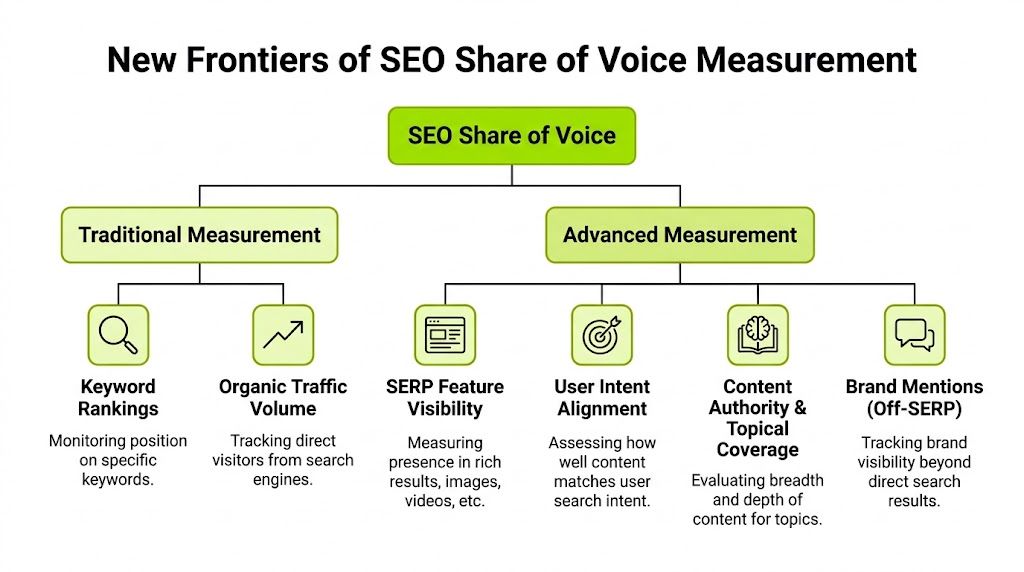
Classic SOV shows who owns likely clicks. Modern SOV also needs to show who owns the answer.
That distinction matters because Ahrefs notes that zero-click features such as AI Overviews or featured snippets can erode traditional SOV by 20-30% by reducing position 1 CTR, which means a rank-based model alone can overstate real visibility (Ahrefs on Share of Voice and click-based modeling).
Share of answer is the missing layer
A client can hold strong organic rankings and still lose presence if Google resolves the query inside the SERP or if an LLM cites a competitor more often during product research.
That’s why I treat modern SOV as a stack:
| Layer | What you track | Why it matters |
|---|---|---|
| Organic click share | Rankings and estimated clicks | Baseline category visibility |
| SERP feature ownership | Snippets, PAA, image/video blocks, local features | Attention shifts before organic clicks |
| AI answer presence | Inclusion in AI summaries and recommendations | Discovery now happens inside generated answers |
| Citation visibility | Whether your brand or content is referenced | Authority and retrievability in answer systems |
Practical ways to measure the new layer
There isn’t one universal formula yet for AI-era SOV, so teams need a reporting framework rather than false precision.
Use a scorecard with these fields:
- Prompt or query cluster: Group by commercial research themes, not random prompts
- Presence status: Did the brand appear or not appear
- Position in answer: Early mention, later mention, or omitted
- Citation status: Linked, referenced, paraphrased, or absent
- Competitor comparison: Which brands are repeatedly present
- Volatility notes: Did answers change materially across checks
This is less elegant than classic CTR-based SOV, but it’s honest. It gives clients a reliable operating view instead of pretending AI answer visibility is already standardized.
Where teams usually fail
Often, teams make one of two mistakes.
First, they ignore AI visibility because measurement is messy. Second, they over-engineer a fake precision model that nobody trusts. The better approach is to build an observable framework and refine it over time.
A lot of agencies already understand this pattern from data warehousing and dashboard design. If you’ve worked with broader business intelligence strategies, the logic is familiar. You create a stable taxonomy, define the source-of-truth fields, and report confidence levels instead of overselling certainty.
A practical tool stack for unified visibility
The stack usually looks like this:
- Traditional rank tracker: For keyword positions and competitor comparisons
- SERP capture workflow: For screenshots or logs of feature ownership
- Prompt testing process: For repeatable AI and LLM checks
- Unified reporting layer: For combining organic, feature, and answer visibility
That last step is where many teams need platform support. A workflow such as an AI visibility audit helps operationalize repeated checks across AI-driven discovery experiences and standard search reporting without turning the process into a manual research project.
If your report only answers “Do we rank?” it’s outdated. Clients also need “Are we cited?”, “Are we summarized?”, and “Who owns the answer instead of us?”
Benchmarking and Improving Your Share of Voice
The worst way to improve share of voice seo is to chase isolated keywords because a competitor jumped ahead on one report. That creates motion, not progress.
The better approach is to build topic ownership. Clients don’t need a scattered win list. They need sustained visibility across the themes that shape demand and buying decisions.
Quattr points out why broad benchmarks often mislead. A niche B2B company can hold 40-60% SOV in a specific subcategory while sitting at under 5% in the broader market, which is why segment-specific benchmarks matter far more than universal targets (Quattr on what a good share of voice percentage looks like).
Benchmark the market you actually serve
A useful benchmark answers a business question, not an SEO vanity question.
Good benchmark groups include:
- Direct revenue competitors: Brands the client loses deals to
- SERP competitors: Publishers, affiliates, marketplaces, and review sites that absorb visibility
- AI recommendation competitors: Brands repeatedly surfaced in answer-driven research
- Subcategory rivals: Companies competing in the exact niche that matters most
This is why one blended SOV benchmark often causes confusion. A client may be weak in broad informational visibility but strong where purchase intent sits. That should change the roadmap, not trigger panic.
A practical framework for improving SOV
Use this operating sequence:
-
Find the visibility gaps
Compare your presence against competitors by topic cluster, intent class, and search feature. Don’t start with content production. Start with the missing market segments.
-
Fix weak middle coverage
Many sites have strong top pages and weak supporting pages. That creates thin topical depth. Build supporting content, entity clarity, and internal linking around the clusters that already matter.
-
Target feature ownership
Standard rankings matter, but answer-focused formatting matters too. Tight definitions, comparison tables, FAQs, concise summaries, and well-structured supporting pages often improve feature-level visibility.
-
Improve retrievability for AI systems
Clear claims, strong source pages, entity consistency, and topic coverage help answer systems understand when to cite you. Sloppy architecture and duplicated content make that harder.
What agencies should prioritize first
If you manage multiple accounts, prioritize the work that changes market coverage fastest:
- Competitor content gap analysis
- Intent clustering
- Page consolidation where overlap is diluting authority
- Structured refreshes for pages already near visibility thresholds
- Segmented keyword discovery using a reliable keyword research workflow
A practical benchmark isn’t “Are we number one everywhere?” It’s “Are we increasing our share in the segments that matter most, and are we expanding into adjacent demand logically?”
What usually doesn’t move SOV much
These activities often consume time without shifting real share:
- Publishing disconnected articles with no cluster strategy
- Tracking too many vanity terms that don’t map to business value
- Reporting broad average improvements that hide segment losses
- Treating AI visibility as separate from SEO, rather than an extension of discoverability
The teams that improve SOV consistently aren’t doing mysterious work. They’re choosing the right segment, tightening coverage, and measuring visibility in the places where buyers compare options.
Reporting SOV to Clients and Stakeholders
The reporting challenge isn’t building a chart. It’s making a skeptical stakeholder care about what the chart means.
A client usually asks some version of the same question: “If rankings are stable, why are you telling me visibility changed?” That’s where weak reporting falls apart. It leads with metrics instead of market position.
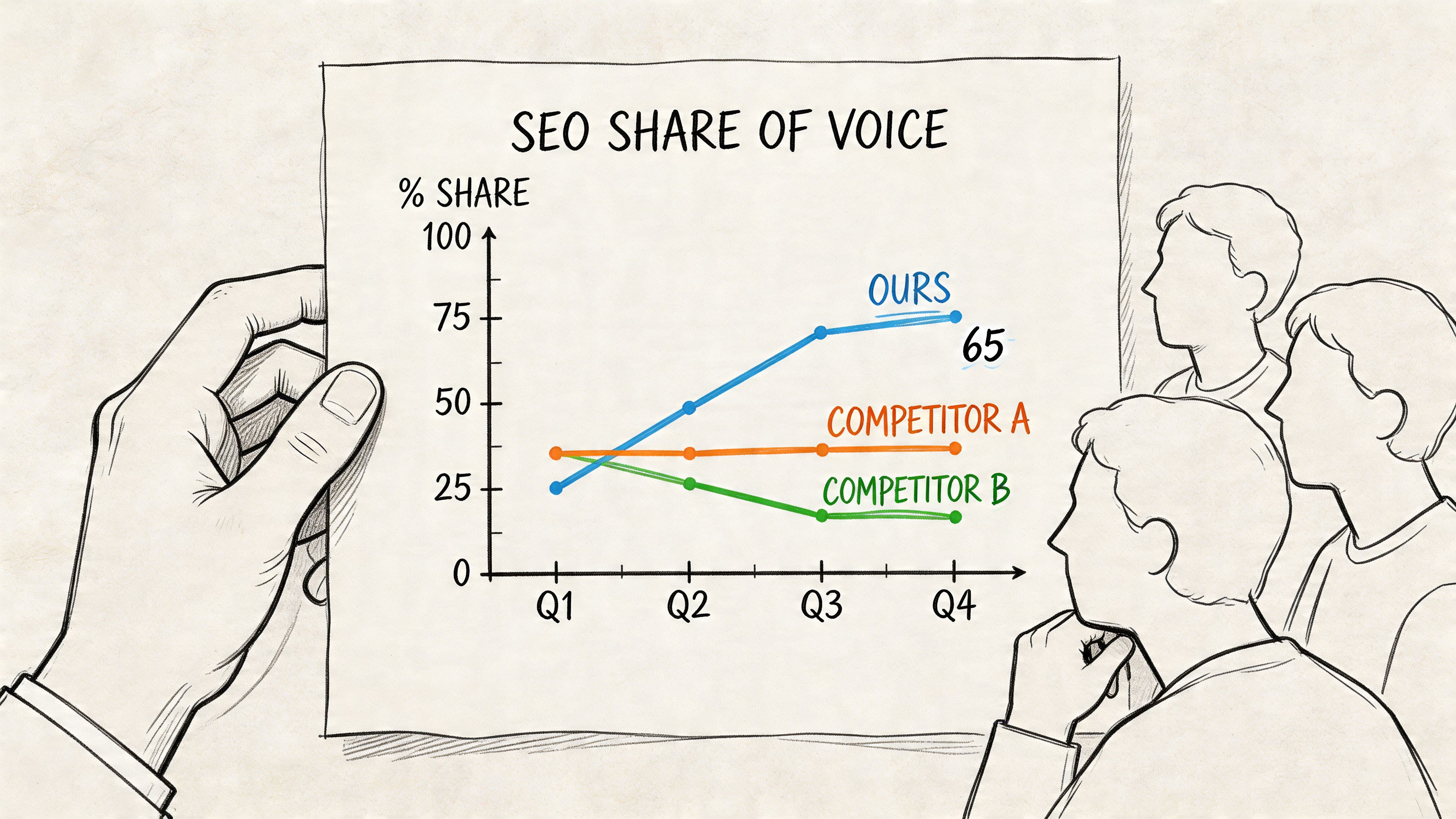
Use a simple narrative structure
A client-ready SOV report works better when it tells a story in this order:
| Report element | What to show | Why it matters |
|---|---|---|
| Market view | Your SOV against named competitors | Establishes position quickly |
| Trend view | Movement over time by segment | Shows whether direction is improving |
| Topic view | Clusters won, lost, or stagnant | Turns the metric into action |
| Answer-layer view | AI and SERP feature presence | Explains why rank alone isn’t enough |
| Action plan | Specific next moves | Connects reporting to execution |
That sequence works because it mirrors how executives think. They want to know where they stand, what changed, why it changed, and what happens next.
An example of the conversation
Here’s the practical version.
You show a client that standard organic SOV held steady in core commercial terms. Good news. But competitor visibility increased in answer-oriented queries because their content is being surfaced more often in summary-style results and support pages are covering comparison language better.
That changes the conversation from “SEO is flat” to “Our classic visibility is stable, but we’re underrepresented in answer-led discovery.” That is a much more useful diagnosis.
“Your rankings report says you’re visible. Your SOV report should say where visibility is strong, where it’s leaking, and whether competitors are winning the recommendation layer.”
What to include every month
A monthly or quarterly stakeholder report should include:
- Overall SOV by segment: Branded, non-branded, product line, region, or funnel stage
- Competitor movement: Which rivals gained or lost presence
- SERP feature notes: Where snippets or other features changed the opportunity
- AI visibility notes: Where the brand appeared, disappeared, or was replaced
- Recommended actions: Content, technical, or authority work tied to the findings
Keep commentary short and concrete. Most clients don’t need a theory lecture. They need a clear explanation that links the metric to decisions.
How to scale reporting without drowning the team
The process breaks when analysts assemble every view manually. Agencies need repeatable templates, standard segment naming, and source fields that can feed dashboards consistently.
That’s where automation matters. A client-ready reporting workflow helps teams package traditional SEO reporting and emerging AI visibility into one deliverable, which is far easier to defend in client calls than a stack of disconnected exports.
A good SOV report doesn’t try to sound advanced. It removes ambiguity. Stakeholders should leave knowing where the brand stands, where competitors are gaining, and what work has priority next.
Frequently Asked Questions about Share of Voice
Is share of voice a Google ranking factor
No. Share of voice isn’t a direct ranking factor.
It’s a measurement framework. It helps you understand how much search visibility you own relative to competitors across a defined market or topic set. Improving the things that affect SOV, such as content coverage, relevance, technical quality, and authority, can improve rankings. But SOV itself isn’t something Google reads as a ranking input.
How often should teams measure share of voice seo
Measure it as often as your market changes and as often as your team can respond.
For most agency and in-house workflows, weekly checks are useful for operational monitoring and monthly reporting is easier for stakeholder communication. If you’re in a volatile category or actively shipping content, product, or technical changes, tighter monitoring helps. If the business moves slowly, monthly may be enough.
The bigger issue is consistency. A monthly report built from a different keyword set each time is less useful than a simpler report run on a stable framework.
What counts as a good SOV
There isn’t a single universal benchmark that applies across every category.
A good SOV depends on your segment, business model, and competitive set. In a focused niche, a company can dominate a narrow subcategory while remaining small in the broader market. That’s why segment-specific benchmarking is more useful than asking for one target number across the whole business.
Use “good” in context:
- Good for a niche category: Strong ownership in the subtopic that drives pipeline
- Good for a product line: Consistent share growth against direct revenue competitors
- Good for broad market reporting: A stable or rising position in non-branded demand without losing key answer-layer presence
Should branded and non-branded SOV be reported together
Usually no.
Branded and non-branded queries behave differently, and blending them often obscures the true situation. Strong branded demand can make overall SOV look healthy even when category discovery is weak. Split them so the report shows both demand capture and market expansion.
How do you handle local SEO share of voice
Treat local SOV as its own reporting layer.
Use a local keyword set, local competitors, and location-specific result tracking. Include local pack presence, review-driven visibility, and city or region-level segmentation. A national SOV model won’t explain what’s happening in local search, especially for multi-location brands.
Can you calculate SOV with Google Search Console alone
You can build a partial version, but not a complete competitive one.
Search Console gives you strong first-party data on your own impressions, clicks, and queries. It does not give you the same view for competitors. That means it’s useful for trend analysis and internal segmentation, but not enough by itself for true market-relative SOV reporting.
A practical setup is to combine Search Console with rank tracking and competitor benchmarking data. That gives you first-party performance plus the market context clients care about.
How should teams report AI visibility when no standard formula exists
Don’t force fake precision.
Use a structured observational framework. Group prompts by topic, track whether your brand appears, note citation presence, compare against named competitors, and report trends over time. Clients will trust a clear methodology more than a neat percentage that nobody can explain.
Is SOV more useful for agencies or in-house teams
Both, but they use it differently.
Agencies use SOV to prove competitive movement, justify strategic recommendations, and show where a client is gaining or losing visibility. In-house teams use it to prioritize categories, align stakeholders, and connect search work to broader market presence.
What is the most common mistake in SOV reporting
Using a broad, messy keyword set and calling the result strategy.
If the set mixes brand terms, irrelevant informational queries, local modifiers, old services, and random edge cases, the output won’t guide action. Clean segmentation matters more than a fancy dashboard.
If your team needs a clearer way to measure visibility across both traditional SEO and AI-driven discovery, Surnex is built for that shift. It gives agencies, in-house teams, and developers a unified way to monitor rankings, competitor visibility, and emerging AI search presence without stitching together disconnected tools by hand.