You know the meeting. The team walks in with a polished competitor deck, keyword wins highlighted, rank movements color coded, backlinks neatly summarized. Then someone asks the question that breaks the whole presentation.
Where are we showing up in AI Overviews, and where are competitors getting cited instead of us?
That's the moment many benchmarking workflows fall apart. The old report isn't wrong. It's just incomplete. Search behavior has shifted, and benchmarking efforts are still measuring the visible leftovers of an older model instead of the discovery layer users increasingly interact with first.
A modern competitor benchmarking tool has to answer a broader question than “Who ranks above us?” It needs to help teams understand where competitors win attention across classic organic search, social proof, review sentiment, and AI-generated answers. If it can't do that, it's giving you a historical summary, not strategic intelligence.
Your Competitor Reports Are Already Obsolete
A lot of teams still run competitor analysis like it's a quarterly SEO hygiene task. They export keyword rankings from Semrush or Ahrefs, compare backlink trends, add a few screenshots of competitor landing pages, and call it a benchmark. That used to be enough to support a decent search strategy.
It isn't enough now.
The weakness shows up when a brand has solid rankings but weak presence in AI-generated discovery. A page can still rank. A brand can still lose the mention, the citation, or the recommendation layer that increasingly shapes what the searcher sees first. If your report doesn't capture that, leadership gets an optimistic view of performance while visibility shifts elsewhere unnoticed.
Many marketers are already dealing with this. Their SEO dashboard says one thing. Actual brand discovery says another. Users don't always click through the same path they did before, especially in workflows influenced by AI summaries and answer engines. If you need a clearer picture of how this shift started, this breakdown of Search Generative Experience is a useful place to reset the mental model.
Your competitor report becomes obsolete the moment it tracks rankings but ignores where users now get answers.
The bigger problem is workflow design. Legacy reports are built around static snapshots. AI-era benchmarking needs continuous monitoring, because brand presence in generated answers can change with content updates, citation patterns, and shifting source preference. That means the tool itself matters less than the system behind it.
Teams that keep benchmarking stuck in “SEO only” mode usually miss three things:
- Citation gaps: Competitors appear in AI summaries, but your brand doesn't.
- Narrative control: A competitor's framing gets repeated in answer engines.
- Cross-channel influence: Reviews, product pages, and public authority signals affect discovery beyond rankings alone.
The issue isn't that traditional SEO metrics stopped mattering. It's that they're now only part of the board.
What Is a Competitor Benchmarking Tool Really
A competitor benchmarking tool is often described as software for comparing your metrics against competitor metrics. That definition is correct, but it's too shallow to be useful.
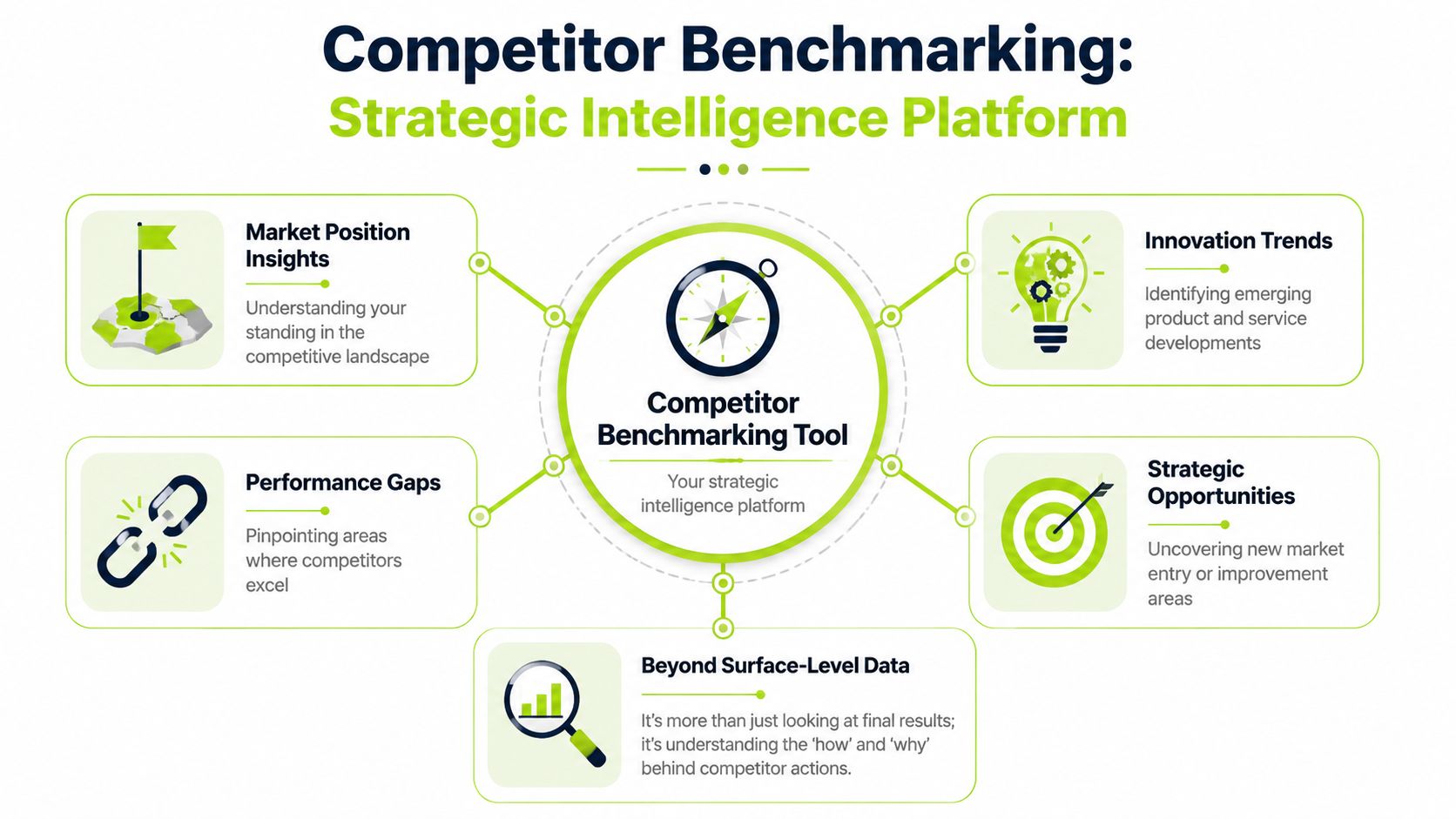
At its best, a competitor benchmarking tool acts more like a strategic intelligence platform than a reporting dashboard. It should tell you where you stand, where competitors are pulling ahead, and what actions explain the gap.
According to Supermetrics on competitor benchmarking, competitor benchmarking is the systematic process of comparing a business's most important metrics and KPIs, such as organic traffic value and keyword rankings, directly against a competitor's performance. The same source notes that businesses can automate data collection from sources like Google Trends and Semrush to establish specific competitive benchmarks.
That matters because manual benchmarking breaks fast. It creates lag. By the time someone assembles the spreadsheet, the insight is already aging.
Static scorecards miss the game behind the score
Think of the difference between reading the final score after a match and watching the live broadcast with commentary. The box score tells you what happened. The live feed tells you how the game changed, where momentum shifted, and what pattern kept repeating.
That's the difference between a basic report and a modern benchmarking system.
A useful platform should help your team answer questions like these:
- Which competitor pages keep gaining visibility? That points to content models worth dissecting.
- Where are they stronger than us by channel? Organic, social, reviews, and AI visibility rarely move in sync.
- What changed recently? New product pages, pricing edits, content refreshes, and messaging shifts matter more than vanity comparisons.
- Which gaps are actionable? Some differences are structural. Others can be fixed by better content, stronger topic coverage, or clearer authority signals.
The real job is decision support
Teams don't need more dashboards. They need faster decisions.
A benchmarking platform earns its place when it reduces interpretation work. It should pull public data, normalize it, and make patterns obvious enough that a strategist, SEO lead, or account manager can decide what to do next without stitching five exports together. That's also why many teams pair their workflow with a wider view of competitive web analytics, not just keyword movement.
Practical rule: If a tool only tells you that a competitor is ahead, but not where the lead comes from or how to respond, it's a monitoring tool, not a benchmarking system.
The best setups don't replace strategic thinking. They remove the busywork that blocks it.
The Core Metrics to Benchmark in 2026
A strong benchmark isn't a pile of KPIs. It's a scorecard built around how buyers discover, compare, and trust brands now.
Teams still over-index on keyword rankings because rankings are easy to export and easy to present. The problem is that they don't describe the full visibility picture anymore. A useful benchmark needs traditional SEO, competitive market signals, audience response, and a separate layer for AI-era discovery.
Start with business position, not just search position
Benchmarking should begin with the metrics that tie visibility back to business performance. One of the clearest examples is market share. SurveyMonkey's guide to competitive benchmarking notes that market share reflects a company's sales percentage within its industry. The same source highlights social media metrics like likes, shares, comments, and follower count as indicators of effective messaging and brand awareness.
That's important because a search team can win rankings while the business still loses attention elsewhere. A competitor with stronger market traction or stronger social resonance often creates momentum that later shows up in search, branded demand, and AI citations.
Then benchmark the channels that shape discovery
Traditional SEO metrics still belong in the model. You still need keyword rankings, organic traffic value, and page-level visibility trends. But they should sit alongside wider signals so you can see whether search strength is translating into broader presence.
Here's a practical scorecard structure.
| Category | Metric Example | Why It Matters |
|---|---|---|
| Business position | Market share | Shows relative standing in the category and whether visibility supports commercial presence |
| Organic search | Positioning for priority keywords | Reveals where competitors outperform you in classic search results |
| Content strength | Topic coverage and content gaps | Helps identify where competitors answer demand more completely |
| Social presence | Likes, shares, comments, follower growth | Highlights brands with stronger messaging and audience pull |
| Review intelligence | Repeated negative review themes | Surfaces unmet demand and whitespace opportunities |
| AI visibility | Appearance in AI Overviews and LLM answers | Shows whether your brand is cited or recommended in generated discovery |
| Citation quality | Source overlap and citation gaps | Identifies which competitor sources are trusted by answer engines and which of yours are missing |
If you already use a reporting framework built around a visibility score for SEO, then many teams need to expand the definition. Visibility is no longer just rank-based. It's environment-based.
AI visibility is now a separate benchmark category
This is the shift most outdated guides miss.
Legacy competitor tools still focus heavily on rankings and backlinks, even though AI-generated discovery has become a major layer of search behavior. Verified industry framing in the brief shows that Google's AI Overviews are projected to drive 30%+ of search queries in 2025, while fewer than 15% of existing tools benchmark AI appearance across LLMs. That gap is exactly why many teams can't explain where search visibility is moving.
The right way to benchmark AI visibility is not to pretend it works exactly like SEO. It doesn't. Instead, track patterns such as:
- Brand mentions in AI answers
- Competitor citations across recurring prompts
- Topic clusters where your brand is absent
- Overlap between high-performing content and AI-cited source pages
- Prompt-level comparison of which competitor gets referenced first
A page can rank well and still lose the recommendation layer. That's why AI visibility needs its own benchmark row, not a footnote under SEO.
Don't confuse volume with usefulness
Not every available metric belongs in your benchmark. Good scorecards are selective.
If a metric doesn't help someone change budget, content, messaging, or prioritization, it probably shouldn't be on the executive version of the report. The benchmark should create action. Otherwise, it becomes a museum of nice-looking numbers.
Practical Benchmarking Workflows for Your Team
The best competitor benchmarking tool won't fix a weak process. Teams get value when the workflow is clear, the comparison set is controlled, and someone owns the follow-through.
Three patterns work well in practice because they map to how agencies, in-house teams, and growth teams operate.
Quarterly review workflow for agencies
Agencies usually have the hardest reporting challenge. They need to show progress, explain losses, and create a credible next-step plan without drowning clients in raw exports.
A solid quarterly review starts before the reporting deck. The account lead aligns on client goals, confirms the specific competitor set, and narrows benchmarking to the channels the client focuses on. For one client that may be non-brand organic visibility. For another it may be product page comparison, review sentiment, and AI mentions around high-intent prompts.
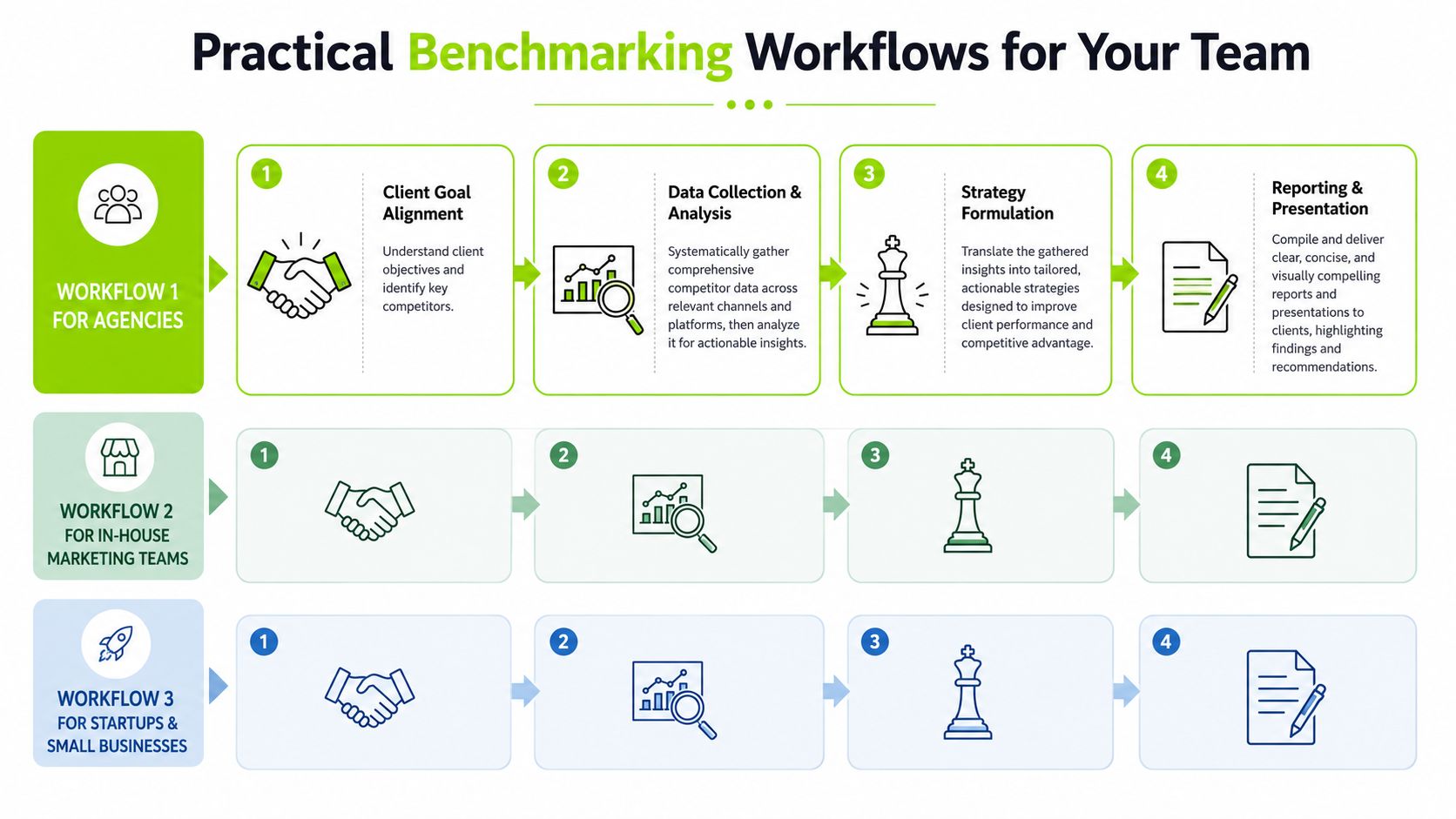
Then the team gathers the benchmark inputs and organizes them into a story:
- Baseline position: Where the client stands versus the selected competitors.
- Movement since last review: Which competitors gained ground, and in which areas.
- Gap diagnosis: Whether the issue is content depth, authority, messaging, product clarity, or AI citation absence.
- Action plan: What gets changed next quarter.
The agencies that do this well don't try to impress with volume. They translate comparison into decision-making. Clients want to know what changed and what to do now.
Content gap takedown for in-house teams
In-house SEO and content teams often need a repeatable process, not a big quarterly presentation. One practical workflow is a content gap takedown.
Start with one topic cluster that matters to pipeline or product discovery. Pull the top competitor pages, compare them against your own cluster, and look for missing angles rather than just missing keywords. In many markets, the winning difference isn't that a competitor targeted a different phrase. It's that they answered adjacent intent more clearly.
Useful inputs in this workflow include:
- Topic completeness: Do competitor pages answer setup questions, comparison questions, and objection questions?
- Format choices: Are they using templates, examples, use cases, FAQs, or review-style sections more effectively?
- Internal support: Do their supporting pages reinforce the main asset better than yours?
- Authority cues: Are they cited, referenced, or socially reinforced in ways your content isn't?
The team then rebuilds one cluster decisively instead of making shallow edits across twenty URLs.
Field note: Benchmarking becomes productive when you compare competing systems of content, not isolated pages.
AI search opportunity audit for growth teams
This is the workflow still not widely adopted, even though it's needed.
The core problem is simple. Verified briefing data notes that fewer than 15% of existing tools benchmark AI appearance across LLMs, which leaves teams unable to quantify AI share of search or track citation gaps. That's why many growth teams can see declining click patterns or confusing discovery behavior but can't explain the source.
An AI search opportunity audit starts with a prompt set, not a keyword set. Build a list of prompts that reflect how buyers ask questions in natural language. Then compare which brands appear in AI Overviews or LLM responses, which sources get cited, and which topics repeatedly exclude your brand.
A practical audit usually follows this sequence:
- Prompt selection: Choose prompts across awareness, comparison, and decision stages.
- Response capture: Record how different AI environments answer the same intent.
- Competitor mapping: Note who gets cited, mentioned, or recommended.
- Source analysis: Review the pages and domains that appear to support those answers.
- Gap prioritization: Classify the missing presence as a content issue, credibility issue, formatting issue, or source-distribution issue.
This workflow changes content strategy fast because it shows where the old SEO lens is too narrow. A competitor might not outrank you everywhere, but they may still own the answer layer for the exact questions your buyers ask.
How to Choose and Implement the Right Tool
Tool selection gets messy when teams shop by feature list instead of operating model. A platform can look impressive in a demo and still fail once your team tries to run real reporting across clients, departments, or workflows.
The better approach is to evaluate a competitor benchmarking tool around fit, accuracy, and implementation friction.
What to look for first
The first requirement is reliable data collection. If the tool can't consistently gather competitor signals across the channels you care about, everything else becomes presentation polish on weak foundations.
Modern benchmarking platforms also matter at the systems level. GroupBWT's overview of competitive analysis and benchmarking describes modern platforms as using automated data collection and integrating with BI, ERP, or CRM systems. The same source states that this setup can help teams adapt strategies 2–3 times faster than competitors by identifying gaps in operational efficiency, customer retention, and digital presence.
That's the key buying lens. You're not just buying dashboards. You're buying speed of interpretation and speed of response.
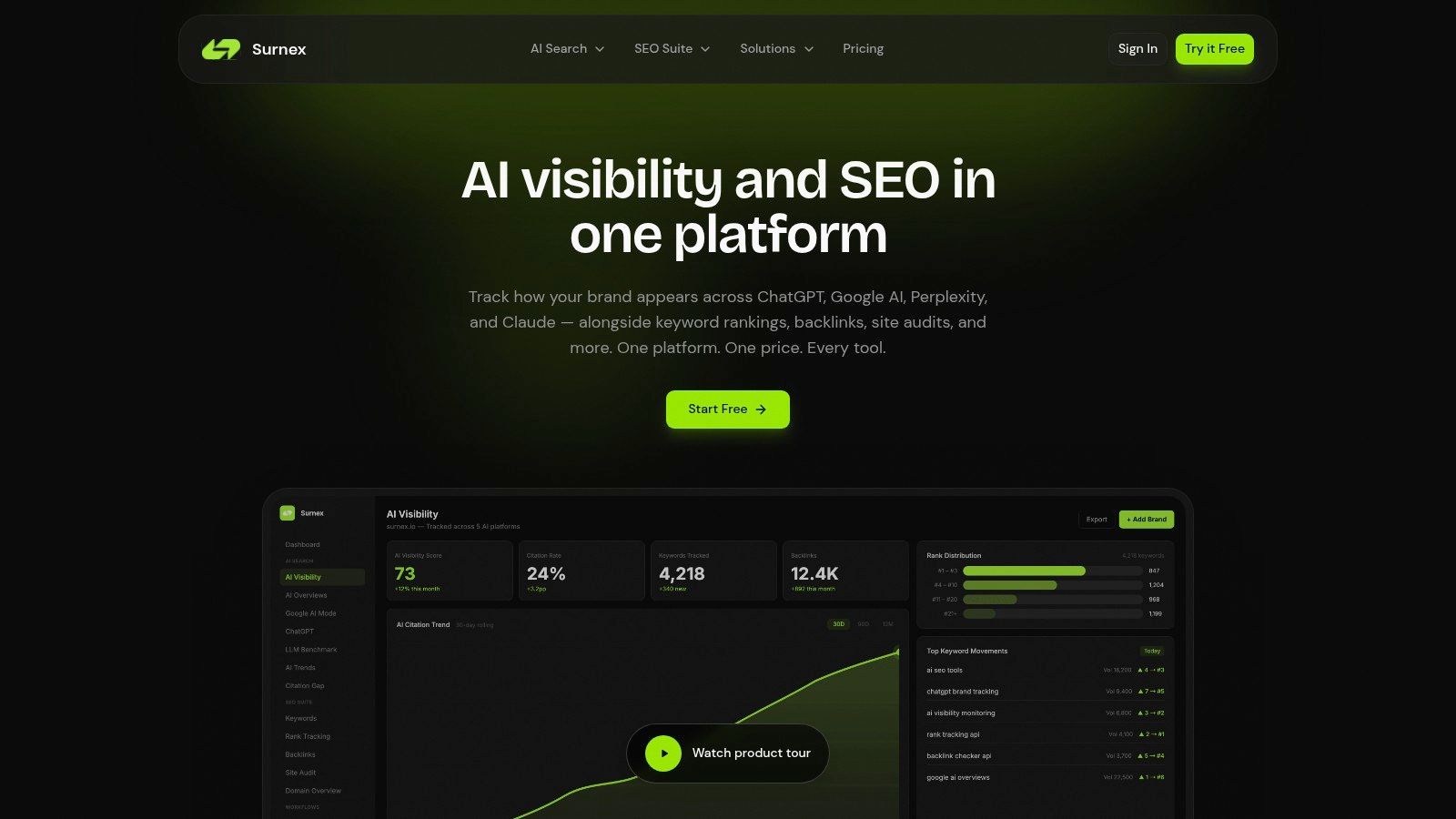
A strong shortlist should satisfy these criteria:
- Unified visibility: The platform should cover classic SEO benchmarks and emerging AI search presence in one place.
- Workflow readiness: Teams should be able to export, report, and compare without rebuilding reports manually every cycle.
- Integration support: It should connect cleanly into the systems where your team already works.
- Usable reporting: Dashboards should help account managers, SEO leads, and executives read the same performance story.
- Automation potential: APIs matter if your team wants to operationalize benchmarking, not just view it.
The trade-offs that actually matter
Most tools are good at one layer. Semrush and Ahrefs are useful for organic search benchmarking. Social platforms help with engagement comparisons. Review tools surface sentiment themes. The pain starts when the team has to combine them all manually.
That's where implementation usually fails. Not because the tools are bad, but because the workflow becomes brittle. One specialist knows how to pull the right exports. One strategist knows how to interpret them. Reporting turns into a craft project.
This is also why it helps to look at adjacent evaluations of software stacks, especially if your team is trying to avoid overlapping subscriptions and reporting sprawl. A practical example is this breakdown of Writestack and Stackbuddy reviewed, which is useful less for the specific category and more for how it frames feature overlap and workflow fit.
Questions to ask before implementation
Before signing anything, ask direct questions:
- Can this tool benchmark AI visibility, not just rankings?
- Can we compare competitors at the topic, page, and brand level?
- Can account teams and executives understand the output without a specialist translator?
- Does the API support the automation we'll want later?
- Will this replace fragmented reporting, or just add another tab?
If AI visibility matters to your reporting model, your evaluation should include a review of AI search visibility tools, because that category is where legacy benchmarking platforms most often fall short.
Buy for the reporting environment you need next year, not the dashboard you can tolerate this quarter.
Implementation should stay narrow at first. Pick a controlled competitor set, define the few metrics that drive decisions, build one recurring reporting template, and only then expand. Teams that start with everything usually end up trusting nothing.
The Future of Benchmarking Is Unified Intelligence
Benchmarking used to be a comparison exercise. Pull rankings, compare traffic proxies, skim social metrics, and identify the obvious gaps. That approach still has value, but it no longer reflects how visibility works.
Discovery is now fragmented across classic search results, AI Overviews, LLM responses, social validation, and public review ecosystems. If your team tracks each signal in a separate tool without a shared interpretation layer, you don't have competitive intelligence. You have fragments.
Unified intelligence changes how teams operate
A modern benchmark has to connect signals that used to sit in separate reports. Organic strength without AI citation presence is an incomplete win. Strong review sentiment without discoverability is hard to scale. Social engagement without search conversion rarely tells the full story.
Unified intelligence solves that by giving teams one operating view of competitive visibility. That doesn't mean every metric belongs on one crowded screen. It means the reporting model is coherent. The SEO lead, growth lead, strategist, and executive should all be able to answer the same question: where are competitors winning attention, and what do we do next?
A similar shift is happening in adjacent channels as teams try to automate social media with AI. The pattern is the same. The point isn't automation for its own sake. The point is reducing disconnected work so strategy can move faster.
Old benchmarking looked backward
The old model rewarded teams for collecting more data than they could use. The new model rewards teams for turning the right signals into faster action.
That means the future competitor benchmarking tool won't just monitor rankings or compile social comparisons. It will connect traditional SEO, AI visibility, citation gaps, and workflow automation into one decision system. Teams that get there first won't just report better. They'll prioritize better.
The future isn't more benchmark rows. It's one clear view of how your brand appears wherever buyers ask questions.
If your current reports still treat AI visibility as a side note, they're already behind the market.
Surnex gives agencies, in-house teams, and developers a unified way to track traditional SEO and emerging AI search visibility in one place. If you need clearer competitor benchmarks, cleaner reporting, and a better view of how brands appear across AI Overviews and LLM-driven discovery, explore Surnex.