Your client asks why traffic is slipping when rankings still look stable. The usual SEO dashboard cannot answer that cleanly anymore, because discovery is now split across classic search results, AI Overviews, and answer engines that cite sources without sending the same volume of clicks.
That reporting gap is the actual problem.
Teams need more than another list of AI search visibility tools. They need a way to answer specific questions fast. Which prompts mention us? Where are competitors getting cited instead? Which pages deserve an update because they support AI answers but no longer earn visits? Good tooling should make those decisions easier, not add another dashboard to babysit.
The shift matters most when buyers do research before they ever reach your site. In B2B and software, that often means product comparisons, implementation questions, and category education are happening inside ChatGPT, Perplexity, Gemini, and Google’s AI experiences. If reporting still stops at rank tracking, the team is measuring only part of the journey.
That is why I evaluate these platforms by workflow first, not feature count.
Some tools are better at spotting citation gaps. Some are stronger for enterprise reporting, large keyword sets, or cross-market tracking. Some are good enough for a lean in-house team that just needs visibility data without enterprise overhead. Others make sense only if you already have mature SEO operations and need AI visibility folded into them.
If you want a practical reference point before choosing a platform, Surnex’s AI visibility tracking for modern search teams shows the kind of workflow this category should support: monitoring where brands appear across AI-driven discovery and tying that back to actionable SEO work.
For software-focused teams, this is also where broader strategy matters. AI Visibility for Software Development Companies is a useful companion read if your buyers are technical and your discovery path runs through product-led research.
The tools below are organized to help you choose the right setup for your team, budget, and reporting needs.
1. Surnex
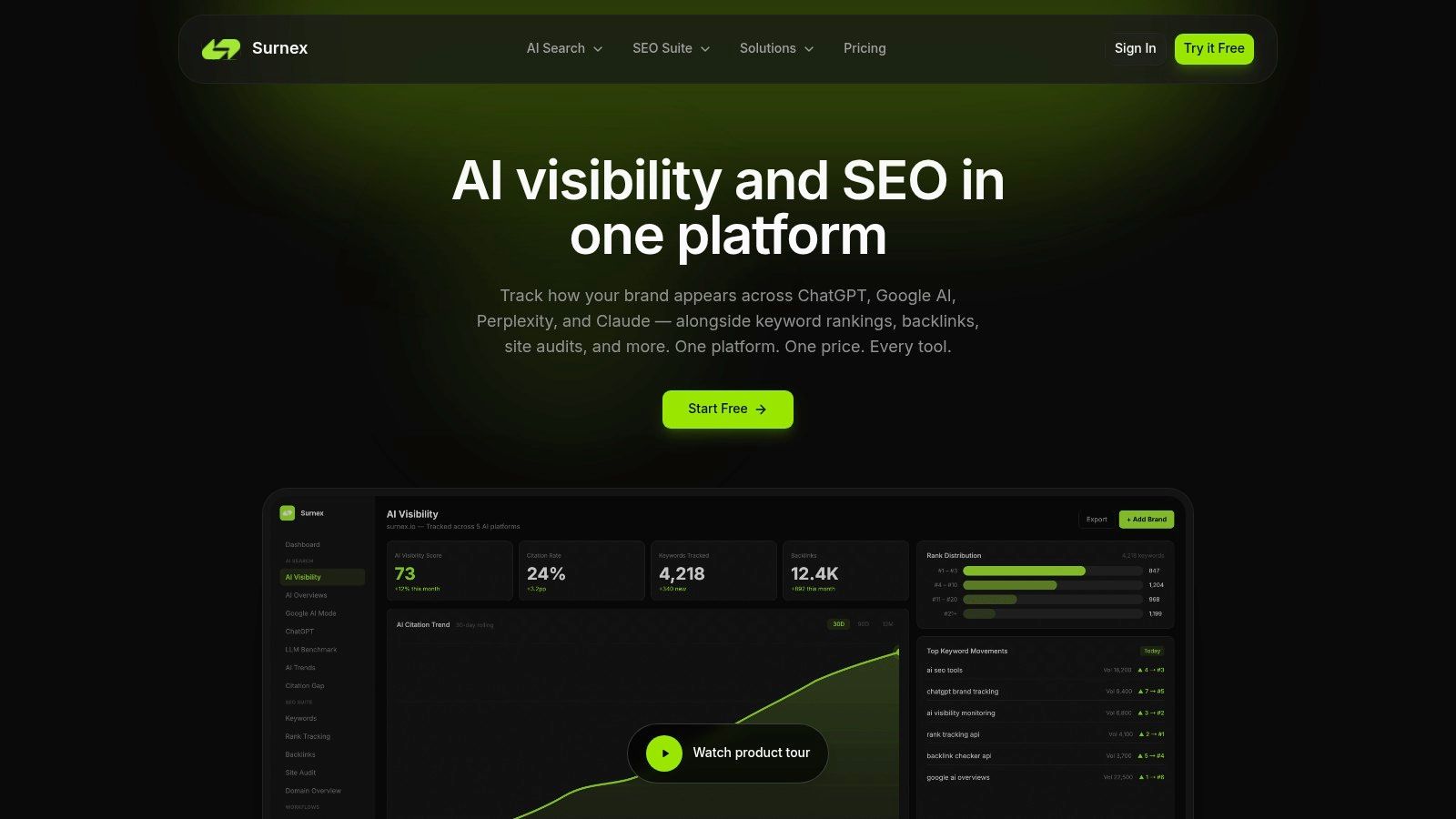
Surnex is the tool I’d put in front of teams that are tired of stitching together five dashboards just to explain one traffic trend. It combines AI visibility tracking with core SEO workflows, so you can check rankings, backlinks, audits, and AI citations without jumping between disconnected products.
That matters because AI search reporting breaks down fast when the data lives in separate systems. You might know a page lost clicks in Google Search Console and separately see that competitors are showing up in AI answers, but you still can’t connect the story cleanly. Surnex is built around that exact reporting problem.
Best fit and why it stands out
Surnex tracks visibility across Google AI Overviews and AI Mode, ChatGPT, Perplexity, and Claude, then layers that on top of familiar SEO work. For agencies, that means fewer awkward client calls where you explain AI search in theory but can’t show where a brand disappeared in practice. For in-house teams, it means the AI view and the SEO view finally sit in the same workflow.
The feature that makes it more practical than many newer entrants is the way it surfaces citation gaps. You’re not just told that visibility is weak. You can see which domains are being cited, where competitors are winning, and which topics deserve new or refreshed content. If you want the dedicated product page, the clearest overview is Surnex AI visibility tracking.
Practical rule: If your team has to merge exports before it can answer a simple client question, your stack is too fragmented.
The other strong differentiator is the API-first design. Every team says they want automation. Few teams achieve it because their tools were designed for manual use first. Surnex makes more sense for developers and product teams because the same capabilities available in the dashboard are exposed through a REST API, which is useful if you’re embedding search intelligence into internal systems, AI agents, or client reporting pipelines.
What works and what doesn’t
What works:
- Unified reporting: AI visibility, rank tracking, backlink analysis, site audits, Core Web Vitals, and domain-level research live together.
- Useful AI workflows: LLM benchmarking, AI Trends, and Citation Gap analysis are built for action, not just screenshot reporting.
- Agency practicality: White-label reporting and repeatable workflows reduce delivery overhead.
What doesn’t:
- Pricing detail isn’t fully public: You may need to sign up or talk to sales to see plan limits in detail.
- Legacy specialists may still go deeper in narrow areas: Teams with highly specialized backlink or historical data needs may still keep one best-of-breed tool alongside it.
Surnex also offers a 14-day free trial without requiring a credit card, which lowers the friction for testing it against your current process. That’s important because the fastest way to evaluate ai search visibility tools is to run a live brand, not a demo account.
Website: Surnex
2. Semrush
A common scenario: the team already runs reporting, keyword research, and competitor checks in Semrush, then AI Overviews starts affecting click patterns and nobody wants to add another platform just to answer a new reporting question. In that setup, Semrush earns its place because it lets you investigate AI visibility inside a tool your SEO team already uses every week.
That matters if your first question is operational, not theoretical. Are AI Overviews showing up for the queries you track? Which pages are losing attention even when rankings have not moved much? Semrush is useful when you want those answers next to position data, domain research, and broader organic reporting instead of in a separate AI-only dashboard.
Where Semrush fits best
Semrush makes the most sense for SEO teams that want blended monitoring. It is less about building an AI search program from scratch and more about extending an existing search workflow without creating extra process overhead.
The trade-off is focus. If the job is "show me AI visibility in the same place I already track rankings and competitors," Semrush is a practical choice. If the job is "find citation gaps, benchmark LLM answers across engines, and build AI-specific reporting workflows," specialist tools usually feel more direct.
For teams working through that second problem, a structured AI visibility audit workflow helps clarify whether Semrush is enough on its own or whether it should sit alongside a more AI-specific tool.
Trade-offs to watch
Semrush works well for:
- Existing Semrush customers: Adoption is faster because the team already knows the interface and reporting model.
- SEO-led organizations: AI monitoring fits into familiar keyword, page, and competitor workflows.
- Teams trying to control tool sprawl: One platform is easier to budget for and govern than several disconnected subscriptions.
It is less effective for:
- AI-first investigation: The workflow can feel broad when the team needs a tight answer to a narrow question, such as which competitor citations appear in generated answers and where your brand is missing.
- Cost-sensitive buyers: Packaging can become expensive once you move beyond core SEO use cases or need higher-tier access.
- Cross-functional product or research teams: Semrush still feels like an SEO platform first, which may matter if content, PR, product, and analytics teams all need different AI-search views.
My rule of thumb is simple. Choose Semrush when your main goal is to add AI visibility checks to an SEO program that already runs in Semrush. Choose a specialist when AI search itself is the workflow, not just another report in the stack.
Website: Semrush
3. Conductor
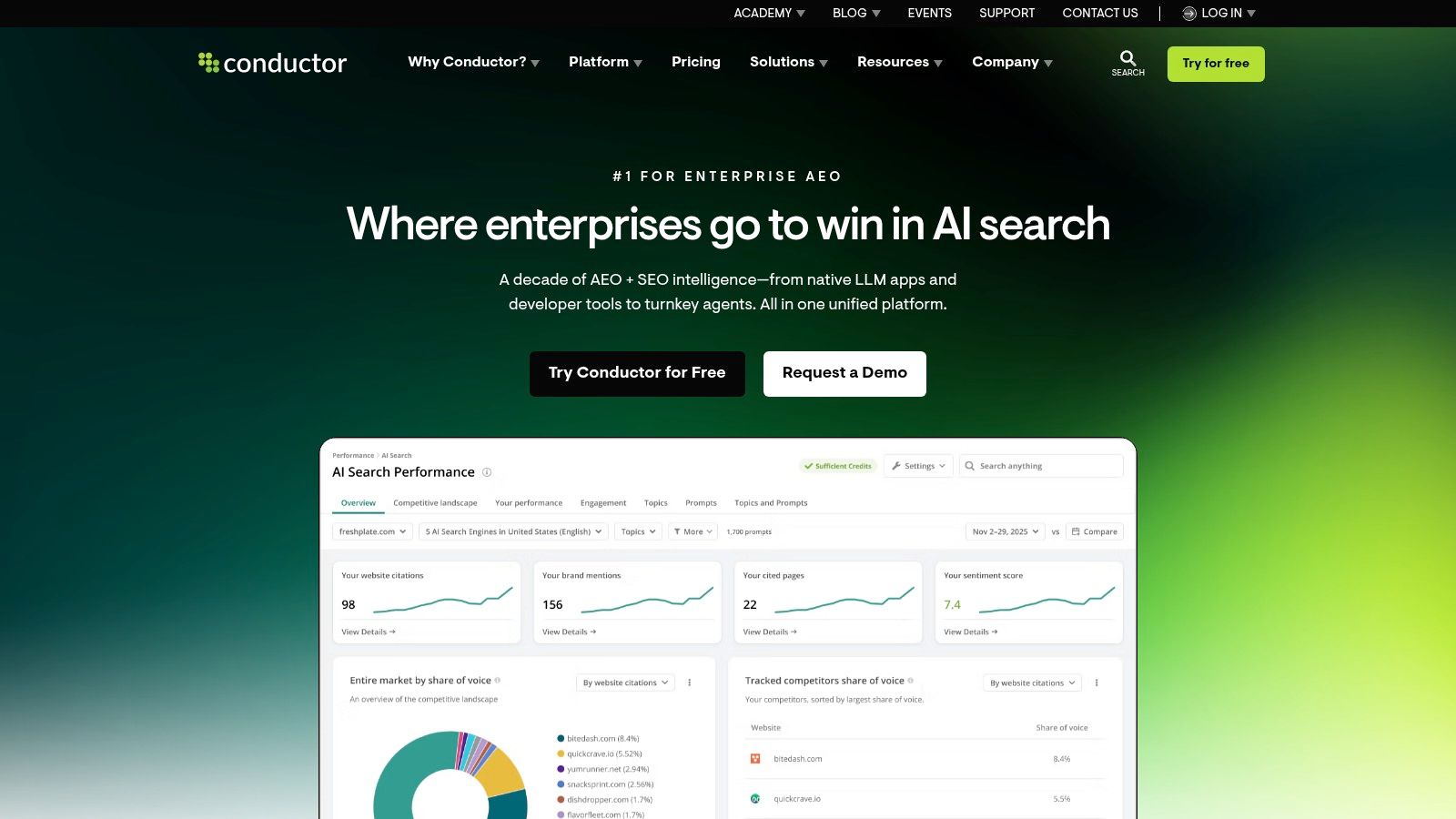
A common enterprise problem looks like this. The SEO team can see AI search volatility, the content team owns the pages, and leadership wants reporting by topic, business unit, and market. Conductor fits that operating model better than point tools because it ties AI search performance back to the content system the team already manages.
That distinction matters. Teams rarely need another visibility chart on its own. They need to answer specific workflow questions: Which page clusters are getting cited? Which topic areas are slipping? Which updates belong in the next editorial sprint?
Best for content teams that need structure
Conductor is a strong choice when AI search work has to pass through planning, production, reporting, and governance. If the SEO lead, content strategist, and executive team all need different views of the same underlying data, Conductor usually handles that handoff well.
I would put it in the "managed program" category, not the "fast investigation" category.
That makes it useful for large content operations, but it also creates trade-offs. Setup is heavier than in lighter monitoring tools, and the value shows up only if the team is prepared to act on page-level findings. A formal AI visibility audit workflow helps here because it forces the team to move from reporting to prioritization.
Where Conductor earns its cost
Conductor is a good fit when you need:
- Page and topic visibility tied to content operations: Better for editorial planning than a broad brand score alone.
- Governed reporting: Useful when SEO, content, and leadership need different cuts of the same data.
- A repeatable operating model: Stronger for teams that review performance in cycles and assign work back to page owners.
It is a weaker fit when you need:
- Quick citation-gap research: Specialist tools are often faster for narrow questions about who is cited and where your brand is absent.
- Lightweight adoption: Smaller teams may not get enough value from the implementation effort.
- A low-cost monitor: Conductor makes more sense when AI search is one part of a larger enterprise content program.
My rule of thumb is simple. Choose Conductor when the primary job is turning AI visibility data into governed content decisions across a large organization. If the job is narrower, such as spot-checking prompts or finding missing citations fast, a more focused tool will usually get you to the answer sooner.
Website: Conductor
4. seoClarity
A common enterprise scenario looks like this. Traffic slips on a set of high-value pages, rankings have not collapsed, and leadership wants an answer by the end of the week. seoClarity is one of the better options for that job because it helps teams trace AI Overview exposure back to specific keyword groups and mapped URLs.
That framing matters. Some platforms answer a brand-monitoring question across AI systems. seoClarity is more useful for a search operations question: which query clusters changed, which pages are exposed, and where should the team investigate first.
Where seoClarity fits best
seoClarity makes sense when the workflow starts with a large keyword set and ends with action inside an enterprise SEO program. Teams can segment terms, map them to landing pages, and review AI Overview impact in a structure that feels familiar to established search teams. That reduces adoption friction for organizations already built around rank tracking, page groups, and recurring reporting.
I usually place seoClarity in the "diagnose and prioritize" bucket.
It is a strong choice if your first question is operational. Which URLs are tied to queries that now trigger AI Overviews, and which business segments are most exposed? That is different from asking who cites your brand in ChatGPT or where you have mention gaps across multiple LLMs. If citation-gap research is the main workflow, a specialist tool will usually get you there faster.
seoClarity is especially useful for:
- Large keyword portfolios: Good fit for enterprises tracking thousands of terms across markets, product lines, or site sections.
- URL-level investigation: Helpful when teams need to connect SERP changes to specific landing pages and templates.
- Existing SEO reporting processes: Easier to adopt if the organization already works from dashboards, keyword groups, and page-level ownership.
The trade-off is scope. seoClarity is strongest in a Google-centric workflow and less compelling if your team mainly needs broad monitoring across multiple AI assistants. Cost and setup also make more sense for mature SEO programs than for lean teams looking for a lightweight AI search monitor.
My rule of thumb is simple. Choose seoClarity when the primary job is isolating AI Overview impact across a large keyword universe and turning that into a prioritized page list. If the job is broader brand visibility across LLMs, use a tool built for that question instead.
Website: seoClarity
5. BrightEdge
A common enterprise problem looks like this. Leadership sees AI Overviews changing category traffic, regional teams want answers, and the SEO team needs one system that can frame the shift in a way executives, content leads, and product marketers can all use. BrightEdge fits that job well.
Its value is less about prompt-by-prompt investigation and more about market-level interpretation. The platform is built for teams asking bigger planning questions: which categories are seeing the heaviest AI Overview presence, what kinds of pages are getting displaced, and where content strategy needs to change before performance reporting turns ugly.
Best for strategic search oversight
BrightEdge is strongest when AI search visibility is part of a broader governance and reporting workflow. The Generative Parser and related research features help teams group patterns, compare themes, and explain search changes in business terms instead of isolated ranking anecdotes.
That matters in large organizations. A VP usually does not need a spreadsheet of prompts. They need a defensible view of where exposure is rising, which business units are affected, and what actions deserve budget.
I usually recommend BrightEdge when portfolio management is the workflow. If your question is, "How do we monitor category-level AI Overview shifts and turn that into quarterly content priorities?" BrightEdge is a serious option. If your question is, "Where are we missing citations across ChatGPT, Perplexity, and other assistants this week?" a more specialized tool will get to the answer faster.
Where BrightEdge fits
BrightEdge makes the most sense for:
- Enterprise SEO and content teams: Useful for large sites with multiple stakeholders and reporting layers.
- Organizations that need governance: Helpful when central teams need a shared view across regions, business units, or product lines.
- Strategy-led programs: Strong when trend analysis and category movement matter as much as page-level diagnosis.
The trade-off is straightforward. BrightEdge can be more platform than a lean team needs, and the cost only makes sense if someone will convert those research outputs into editorial, technical, or category-level decisions.
Website: BrightEdge
6. Similarweb Rank Tracker (Rank Ranger)
Similarweb’s Rank Tracker, including Rank Ranger workflows, is best when your team already uses Similarweb for broader market intelligence and wants AI Overview presence layered into rank reporting. It’s a practical product, not a flashy one. That’s part of the appeal.
The main benefit is overlaying AI Overview presence directly on tracked SERPs with location and device segmentation. For campaign teams, that’s often enough to identify whether a ranking drop problem is really a ranking problem, or a search feature problem.
Best for campaign overlays
This tool is useful when your reporting starts with daily ranking movements and segment analysis. You can flag where AI Overviews show up and compare patterns across campaigns, markets, and devices without rebuilding your entire reporting process.
That can be enough for many teams because Gartner projects a 25% drop in traditional search engine volume by 2026 as users shift toward AI chatbots, according to Semrush’s AI SEO statistics roundup. If your organization is still heavily tied to traditional rank reporting, adding AI presence overlays is a practical first adaptation.
Useful, but not the deepest AI answer engine view
Similarweb Rank Tracker works best for:
- Search teams already in Similarweb: Little friction to adoption.
- Campaign segmentation: Good for location and device views.
- SERP feature context: Helpful in explaining performance changes.
It’s less ideal for:
- Citation-level analysis: It focuses more on AIO presence than detailed answer-engine mentions.
- Cross-LLM strategy: If ChatGPT, Perplexity, and broader prompt tracking are central, specialist tools go further.
Website: Similarweb Rank Tracker
7. AccuRanker
A common agency scenario: the client asks why rankings held steady but clicks dropped. AccuRanker helps answer that fast because it adds AI Overview context to the rank reports clients already expect. You can see which tracked keywords trigger AI Overviews, review the overview text, and inspect cited sources without rebuilding your reporting workflow from scratch.
That makes AccuRanker a good fit for teams with a clear job to do. Explain changes in Google visibility, keep reporting fast, and give account managers something concrete to discuss on calls.
Best for agencies that need fast answers in familiar reports
AccuRanker earns its place when the workflow starts with tracked keywords, refresh speed, tags, and exports. If your team already lives inside ranking reports, adding AI Overview visibility here is a practical step. It keeps the operating model simple while giving you enough context to explain why a keyword is still ranking but delivering different traffic patterns.
This is also where the trade-off becomes clear. AccuRanker is strong for reporting-layer decisions. It is less useful for broader AI discovery work, like comparing how your brand appears across ChatGPT, Perplexity, and other answer engines, or identifying citation gaps across non-Google systems.
Teams weighing tool depth against reporting efficiency should compare AccuRanker with a broader rank tracking platform with AI overlays if they expect those needs to expand.
Where it fits, and where it doesn’t
AccuRanker works well for:
- Agency reporting: Clear outputs for clients and account teams.
- Fast refresh cycles: Useful when daily movement matters.
- Google AI Overview monitoring inside rank tracking: Good for teams extending an existing SEO reporting process.
- Exports and API workflows: Useful for agencies pushing data into custom dashboards.
It falls short for:
- Citation-gap research: Better tools exist if the main question is which sources AI systems cite instead of you.
- Cross-LLM visibility: Its value is concentrated in Google-centric workflows.
- Strategy-led AI search analysis: It supports execution better than research.
Website: AccuRanker
8. Advanced Web Ranking (AWR)
AWR fits teams that already know what they want to measure and need a tool that can be shaped around that process. If the primary question is, "How do we track Google rankings, AI Overviews, and local variations, then push that data into our own dashboards?", AWR deserves a serious look.
That is the key distinction.
Some platforms try to answer the strategy question for you. AWR gives you the raw material and configuration options to build your own reporting model. For technical SEO teams, in-house analysts, and agencies with established reporting workflows, that can be a strength rather than a burden.
Best for custom tracking workflows
AWR stands out for localized tracking, flexible segmentation, scheduled reporting, and API access. It is a strong fit for agencies managing multiple regions, or enterprise teams that need ranking and AI Overview data at a market level instead of a single national view.
It also works well when the workflow matters as much as the interface. Teams that route SEO data into BI tools, client portals, or internal scorecards usually care less about polished defaults and more about export control, naming conventions, and repeatable automation. AWR handles that job well.
The trade-off is clear. You need someone who can set it up properly and maintain the logic behind the reports.
Where it fits, and where it doesn’t
AWR works well for:
- Custom reporting pipelines: Good for teams pushing ranking and AIO data into external dashboards.
- Localized monitoring: Useful when city, region, or market-level tracking changes the decision.
- Agency operations: Helpful for teams managing many client reporting setups with different requirements.
- Technical SEO environments: A solid option when API access and workflow control matter more than out-of-the-box guidance.
It is less suited to:
- Non-technical teams that want instant answers: Setup takes more thought than lighter tools.
- Cross-LLM visibility research: Its value is strongest in Google-centric monitoring.
- Citation-gap analysis: Better options exist if your main goal is finding which sources AI systems cite and your brand does not.
Website: Advanced Web Ranking
9. Nightwatch
A common buying mistake happens right here. A team realizes AI Overviews are affecting clicks, starts comparing platforms, and ends up stuck between cheap rank trackers that miss the new SERP features and enterprise suites built for larger reporting operations. Nightwatch fits the gap between those two options.
It works best for teams asking a practical question: do we need enough AI visibility to spot changes and report on them, or do we need a full search intelligence system with custom workflows across many departments? If the answer is the first one, Nightwatch deserves a serious look.
The appeal is straightforward. You can track traditional rankings, monitor AI-related visibility, and report on share of voice without turning the tool into its own implementation project. For small in-house teams and agencies, that matters more than feature volume.
Best for teams that need usable reporting fast
Nightwatch makes sense when the workflow is simple: monitor a defined keyword set, check whether AI features are changing exposure, and show clients or leadership where visibility is improving or slipping. That is a real use case, especially for lean teams that need weekly answers instead of a quarter-long rollout.
I would put it in the shortlist for agencies with SMB and mid-market clients, or in-house teams that want clearer reporting before they commit to a broader platform stack. It covers the core monitoring job well enough to support decisions, without asking for enterprise-level budget or setup time.
That trade-off cuts both ways.
If your next question is, "Which sources keep getting cited in AI answers, and where is our brand missing from those mentions?" Nightwatch is less compelling than tools built around citation analysis and answer-engine research. If your question is, "Are AI features changing our visibility on priority terms, and can we show that clearly?" it is a much better fit.
Where it fits, and where it doesn’t
Nightwatch works well for:
- SMBs and agencies watching budget closely: Lower operational commitment than larger enterprise platforms.
- Hybrid search reporting: Useful when one team wants classic rank tracking and AI visibility in the same interface.
- Client reporting and competitive snapshots: Share of voice views help frame performance discussions without a custom BI layer.
- Teams early in AI search measurement: A practical starting point when the goal is monitoring, not full-scale research.
It is less suited to:
- Deep citation-gap workflows: Better choices exist if you need to know which publishers and domains AI systems cite most often.
- Cross-LLM research programs: Teams comparing visibility across multiple answer engines may want broader coverage.
- Complex enterprise operations: Larger organizations usually outgrow it once they need custom data pipelines, governance, and multi-team workflows.
Website: Nightwatch
10. SE Ranking
A common scenario: an agency or lean in-house team wants to track AI Overviews, monitor rankings, and keep client reporting in one platform, but the budget will not support an enterprise contract. SE Ranking fits that gap better than many tools in this category.
The appeal is straightforward. You get a broad SEO suite, AI Overview tracking, citation visibility, and competitor research in a system that is easier to adopt than heavier enterprise platforms. For teams already using SE Ranking for rank tracking or site audits, adding AI search monitoring usually feels like an extension of current work, not a separate research program.
That also defines the trade-off.
SE Ranking is a practical choice when the workflow is, "How do we monitor AI visibility across accounts and spot changes quickly?" It is less convincing when the workflow is, "Which sources are cited most often across answer engines, where are our citation gaps, and how do we prioritize outreach or content updates from that data?" Tools built specifically around citation-gap analysis and LLM research go further there.
Where SE Ranking makes sense
SE Ranking works well for:
- Agencies managing several clients: The price-to-capability balance is strong, especially if one team needs rankings, audits, and AI visibility in the same place.
- In-house teams starting AI search measurement: The learning curve is manageable, and setup is lighter than enterprise platforms.
- Teams consolidating tools: It can reduce the need for a separate point solution if the goal is monitoring and reporting, not deep AI research.
- Competitive tracking: Useful for seeing which brands and domains appear across AI surfaces without building a custom workflow.
It is less suited to:
- Detailed citation-gap work: Source-level analysis is not its strongest use case.
- Cross-LLM research programs: Teams comparing behavior across multiple answer engines may want broader or more specialized coverage.
- Large enterprise operations: Organizations with complex governance, custom reporting layers, or advanced data pipeline needs may outgrow it.
Website: SE Ranking
Top 10 AI Search Visibility Tools Comparison
| Product | Core features & AI coverage ✨ | UX & Quality ★ | Pricing / Value 💰 | Target audience & USP 👥 |
|---|---|---|---|---|
| Surnex 🏆 | ✨ Unified AI visibility + full SEO suite; LLM benchmarking; Citation Gap; API‑first | ★★★★★ Intuitive dashboard, client‑ready workflows | 💰 Plans $49–$399/mo; free trial (no CC); replaces multiple subscriptions | 👥 Agencies, in‑house teams, developers; ✨ API‑first + LLM benchmarking |
| Semrush | ✨ Broad SEO stack with AI/LLM detection (Position Tracking, Organic/Domain) | ★★★★ Mature datasets, integrated workflows | 💰 Complex tiers; AI features often in higher plans | 👥 SMB → Enterprise; ✨ Deep competitive datasets |
| Conductor | ✨ AI Search Performance: page‑level citations, prompts, trend reporting | ★★★★ Enterprise workflows, robust reporting | 💰 Enterprise / sales‑led pricing | 👥 Enterprise content ops; ✨ Page‑level AI citation insights |
| seoClarity | ✨ Dedicated AIO module, keyword/URL impact, trended CTR modeling | ★★★★ Scales to very large keyword sets | 💰 Enterprise positioning; sales quotes | 👥 Large enterprises; ✨ URL‑level impact and CTR modeling |
| BrightEdge | ✨ Generative Parser + AIO research, industry/category trend tracking | ★★★★ Strong governance and strategic insights | 💰 Enterprise focus; pricing not public | 👥 SEO leaders/enterprises; ✨ Industry AIO trend analysis |
| Similarweb Rank Tracker (Rank Ranger) | ✨ AIO overlay in daily rank tracking; location & device segmentation | ★★★☆☆ Straightforward rank + AIO overlay | 💰 Bundle‑dependent; may require higher tiers | 👥 Teams using Similarweb stack; ✨ Multi‑campaign/device support |
| AccuRanker | ✨ High‑speed rank checks, AIO previews, tagging & exports | ★★★★ Very fast, API & client‑friendly reports | 💰 Agency‑friendly pricing; usage tiers | 👥 Agencies/clients needing speed; ✨ High refresh + exports |
| Advanced Web Ranking (AWR) | ✨ 'Google Search + AIO' engine, ChatGPT tracking, high‑volume APIs | ★★★★ Flexible and technical, public docs | 💰 Mid→Enterprise; setup/config effort | 👥 Technical agencies; ✨ Customizable pipelines & automation |
| Nightwatch | ✨ AI share of voice, prompt‑level LLM tracking, AIO detection | ★★★★ Modern UI, balanced features | 💰 Competitive vs large enterprise suites | 👥 SMBs & agencies; ✨ Cost‑effective AI + rank tracking |
| SE Ranking | ✨ AIO detection, cross‑LLM mentions, competitor research | ★★★☆☆ Practical UI, solid basics | 💰 Value‑priced; strong price‑to‑capability | 👥 Agencies with many clients; ✨ Budget‑friendly AI+SEO |
Building Your Modern Search Intelligence Stack
A common scenario looks like this. Rankings hold steady, clicks soften, branded search gets noisy, and the monthly report still says performance is stable. That gap is why teams are reworking their search stack. AI answers changed what users see first, but many reporting setups still measure only blue-link performance.
The teams that handle this well start with workflow failures, not feature checklists. Ask a narrower question first. Are you trying to find where competitors get cited in ChatGPT or Perplexity? Do you need AI Overview tracking inside an existing rank reporting process? Is the blocker executive reporting, governance, or budget? Tool choice gets easier once the job is clear.
Pick the tool by the job
Map the platform to the task in front of you.
- Find citation gaps across AI platforms: Surnex, Conductor, and SE Ranking are better fits when the goal is understanding brand mentions, missing citations, and competitor presence across answer engines.
- Add AI Overviews to rank tracking you already run: Semrush, AccuRanker, Similarweb, and AWR make sense if your team already works from keyword sets, daily positions, and segmented ranking reports.
- Support enterprise reporting and page-level governance: Conductor, BrightEdge, and seoClarity fit larger teams that need approvals, cross-team workflows, and tighter control over how page changes are tracked and reported.
- Keep costs in check while adding AI monitoring: Nightwatch and SE Ranking are practical starting points for smaller in-house teams and agencies that need coverage without enterprise pricing.
Those are different products for a reason. Some are rank trackers with AI visibility layers added on top. Some start from citation and answer-engine monitoring. Others are full SEO platforms that now include AI reporting. The mistake is expecting one category to behave like another.
Build around decisions, not dashboards
A useful stack answers specific operating questions:
- Why did clicks drop if positions barely moved?
- Which commercial prompts mention competitors but not us?
- Which pages get cited, and which never appear in AI answers?
- Can account managers or internal stakeholders explain this in one monthly report?
That last point matters more than vendors admit. Attribution is still messy. Four Dots makes this point well in its guide to AI visibility optimization. Teams can often show visibility shifts or citation gains, but tying that cleanly to pipeline, conversions, or direct revenue inside one native workflow is still hard.
Treat AI visibility scores as directional inputs. Use them to spot gaps, validate content updates, and prioritize technical or editorial work. Then connect those findings to Search Console, analytics, CRM data, and conversion reporting. The teams that win usually have a better operating model, not just better charts.
A practical way to choose
Run one live test before you commit. Use your real brand terms, product queries, and competitor prompts. Give the tool a week or two and judge it on three things: how quickly it surfaces useful findings, how cleanly it exports or reports them, and whether your team will use it after the trial ends.
For agencies, the best fit is often the product that makes client reporting easier, even if another tool has a deeper feature set. For in-house teams, the better choice may be the one that fits the current stack and avoids another dashboard nobody checks. For enterprise programs, governance and integrations often matter more than flashy AI views.
Surnex is worth testing if you want AI visibility and core SEO data in one place without stitching together several tools. Keep that mention in context. It is one option, not the answer for every team.
Modern search intelligence now includes classic rankings, AI Overviews, answer-engine citations, and the reporting layer that connects them. Build for the workflow that is breaking first. Then expand the stack once the team can act on what it sees.
If you’re also rebuilding your workflow around content production and reporting, SEO Content Automation Tools is a useful next read.
If you want one platform that tracks AI visibility and core SEO without forcing your team into a patchwork stack, Surnex is a practical place to start. It is built for agencies, in-house teams, and developers who need visibility into AI Overviews, ChatGPT, Perplexity, Claude, rankings, backlinks, and audits in one workflow. Start with the free account, test it on real prompts and competitors, and see whether your reporting finally matches how search works now.