A familiar reporting problem keeps showing up in SEO meetings. Traffic is softer than expected. Clicks are harder to explain. Yet the ranking report looks mostly stable, so no one can point to one obvious failure.
That disconnect usually means the team is watching positions without watching search visibility. A keyword can hold steady while the page loses attention, a competitor takes higher-value terms, or the search results page changes around it. If your reporting still revolves around isolated rankings, you're seeing the scoreboard one query at a time instead of understanding your actual presence across the market.
That matters even more now because search visibility no longer lives only in the classic ten blue links. Brands also need to understand whether they appear in AI-generated experiences, whether they're cited, and whether users still encounter them when search journeys become less click-heavy. Teams working on mastering AI search engine optimization, including GEO & AEO are already adjusting their content and entity strategy around that shift.
For agencies and in-house teams, the practical starting point is still the same. You need a single benchmark that shows whether your presence is expanding or shrinking across a tracked keyword set, then you need a way to connect that benchmark to the new AI layer. A domain overview workflow in Surnex is useful for that kind of broader diagnostic because it puts the visibility question in context instead of treating rankings as the whole story.
Introduction Why Your Rankings Don't Tell the Whole Story
A ranking report can look healthy and still hide a performance problem.
That happens because rankings aren't linear. A move near the top of the page changes outcomes far more than a move at the bottom. A site can "hold rankings" in a technical sense while losing the positions that capture the most attention, or while competitors gain visibility on terms that are important.
Practical rule: If traffic, leads, or share of voice feel off, stop asking only "What rank are we?" Ask "How much of the available attention are we capturing?"
The visibility score seo teams rely on is useful because it answers that second question. It translates a messy set of keyword positions into one comparable percentage. That makes trend analysis easier, client reporting clearer, and competitive benchmarking much more honest.
The metric also helps explain why modern SEO reporting needs an upgrade. Traditional visibility tells you how much of the organic opportunity your site captures across tracked keywords. It doesn't fully explain what happens when searchers get answers inside AI Overviews or discover brands through tools like ChatGPT. That's where many teams are getting caught. Their old dashboards still describe rankings, but their customers are moving through a broader discovery system.
What Is an SEO Visibility Score A Practical Definition
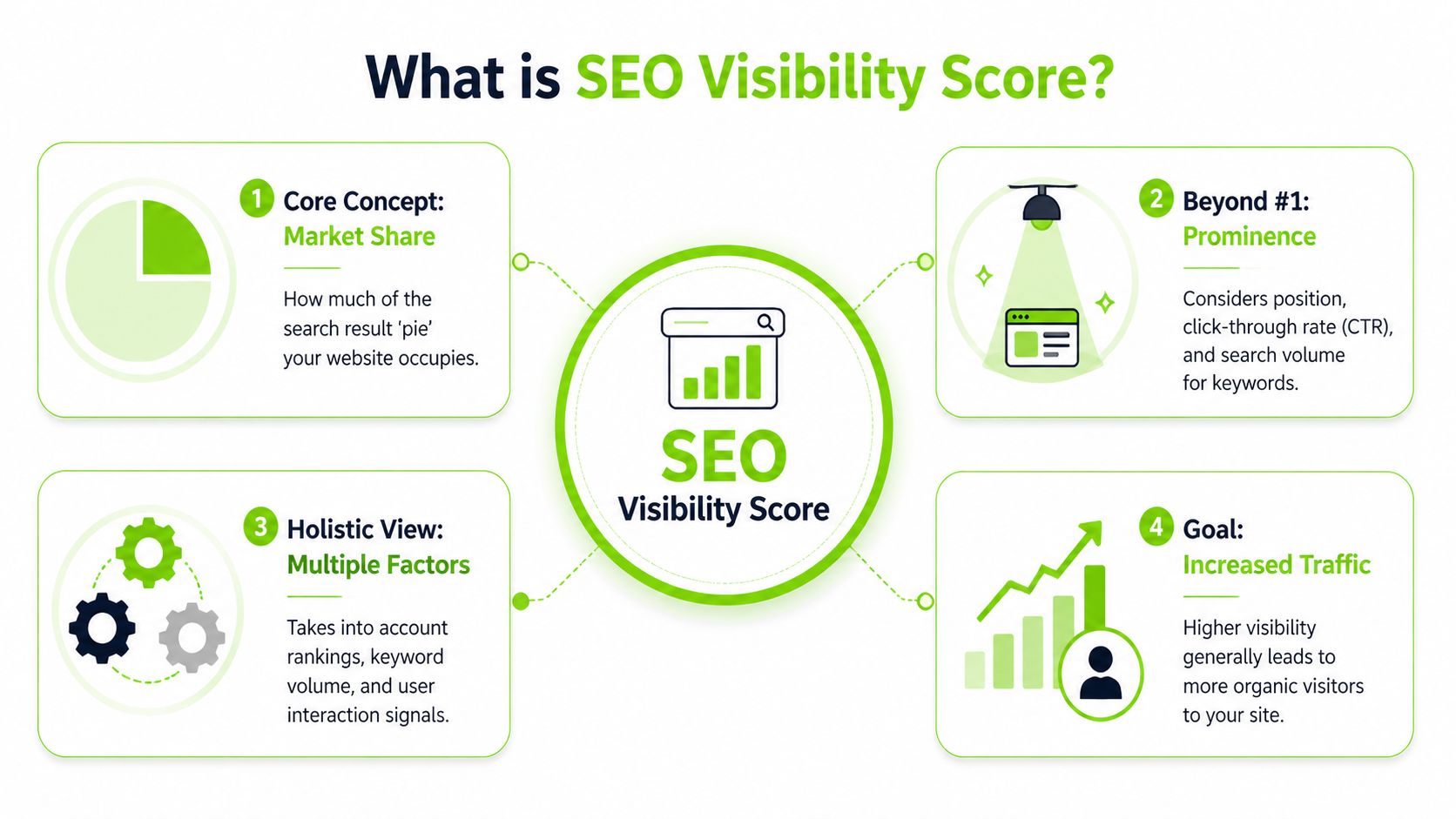
A practical definition starts with what the metric is built to answer. An SEO visibility score estimates how much of the organic click opportunity your site captures across a tracked keyword set.
That makes it more useful than a stack of isolated rankings. A position means very little on its own unless you know the search demand behind it and how much attention that position tends to win.
The working formula is simple. Visibility combines three inputs: the keywords you track, the search volume behind those keywords, and the expected click-through rate for each ranking position. In Semrush's model, 100% means ranking in the top spot for all tracked targets, and Influize's explanation of SEO visibility also notes that top positions capture a disproportionate share of clicks, which is why small ranking gains near the top often matter more than larger gains deeper in the results.
The three inputs that matter
Every visibility model depends on the same core ingredients:
- Tracked keywords: The score only reflects the terms in your monitoring set. If the list misses commercial queries, branded variants, or core category terms, the score gives a distorted view.
- Search volume: High-demand keywords carry more weight because more potential clicks are available.
- Expected CTR by position: Rankings near the top contribute more because users concentrate their attention there.
This is the trade-off teams need to understand. A win on a low-volume keyword can look good in a rank tracker and still have almost no effect on visibility. A small move on a high-intent, high-volume term can change the picture fast. That is why a clean SEO rank tracking workflow matters. The score is only as reliable as the keyword set and position data behind it.
Why the score is more useful than raw rankings
Visibility is closer to business reality because it weights outcomes by opportunity.
For example, a page ranking second for a revenue-driving query may contribute more to your search presence than a page ranking first for a niche informational term. Agencies use that distinction to set priorities. In-house teams use it to defend roadmap decisions. It helps answer a harder question than "where do we rank?" It answers "where are we visible enough to win clicks?"
That same logic matters even more now because traditional organic listings are no longer the only place attention gets captured. A keyword can show strong classic rankings while losing exposure to AI Overviews or answer engines. So the practical definition of visibility has to expand. The old score still matters, but it should sit inside a broader framework that measures total search presence across both standard SERPs and AI-driven discovery.
What this changes in daily SEO work
Once teams understand visibility this way, priorities get sharper:
- Build the keyword set around business value. Track the terms tied to pipeline, product discovery, and qualified traffic.
- Prioritize positions with real upside. Movement near the top usually produces more impact than cleanup work on deep pages.
- Read visibility with context. Pair the score with traffic, conversions, and emerging AI search coverage.
A visibility score is a decision metric. It helps teams judge whether their search presence is strong enough to support traffic and revenue goals.
That is why this metric remains useful. It compresses a noisy search program into one number, but it still reflects demand and likely click potential. Used well, it becomes a planning tool, not just a reporting line.
How Different SEO Tools Calculate Visibility
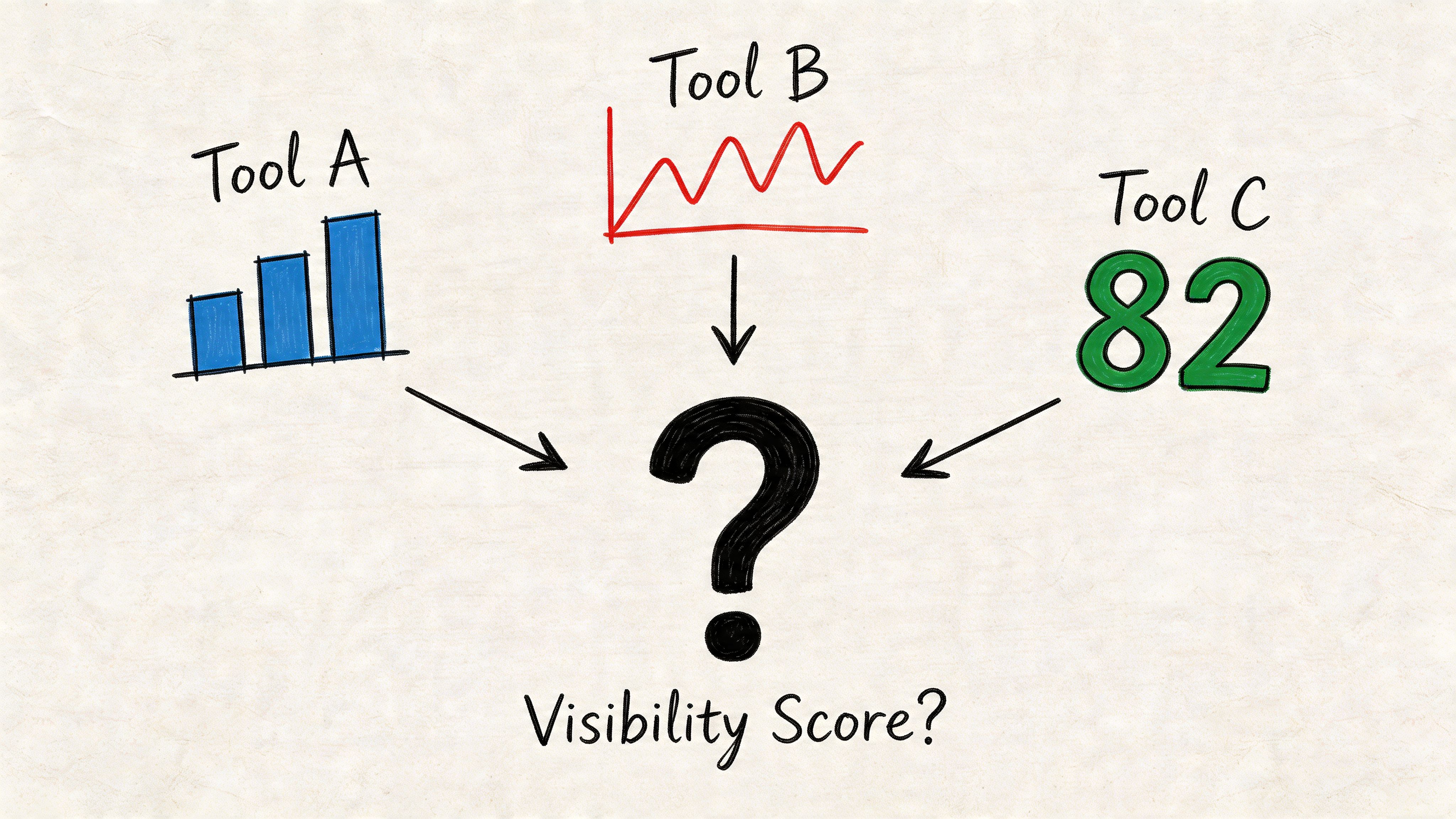
A visibility score only works if the team agrees on what the score is measuring. That is where tool differences matter.
The same site can look stronger in one platform and weaker in another because each vendor builds its own model. The score is usually based on the same ingredients, rankings, search demand, and estimated click share by position, but the weighting changes. Semrush outlines that approach in its SEO visibility methodology guide, where visibility is expressed as a percentage based on expected click potential across tracked keywords.
What changes from tool to tool is the setup behind that percentage.
- Keyword database: Each platform tracks a different set of terms, locations, devices, and SERP layouts.
- CTR assumptions: One tool may give much more value to a top-three ranking than another.
- Update cadence: Daily refreshes, weekly refreshes, and slower regional rollouts can produce different scores for the same domain.
- SERP treatment: Some platforms account for richer result pages differently, including features that reduce clicks on standard organic listings.
That last point matters more than it used to. A classic visibility score was built for ten blue links and standard SERP competition. Search now includes AI Overviews, answer engines, and zero-click behavior. If a tool only measures traditional rankings, it can still be directionally useful, but it no longer captures total search exposure on its own.
This is why reporting arguments about whether one platform shows 18% and another shows 21% usually waste time. The key decision is which model your team will trust consistently.
For agencies, that means using one tool across clients when possible so month-over-month reporting stays clean. For in-house teams, it means locking the keyword set, location targets, and device mix before executives start using the score in forecasts. A stable rank tracking workflow helps keep that benchmark consistent and makes score changes easier to explain.
Use one source of truth for classic visibility. Then pair it with a separate view of AI search presence.
That combined approach is the practical fix. It respects how traditional SEO tools calculate visibility, while acknowledging that modern search visibility now includes places those legacy scores do not fully measure.
Interpreting Your Score What a Good Visibility Score Looks Like
A VP of marketing sees visibility at 11% and asks the wrong question first: “Is that good?” The useful question is, “Good relative to which market, which keyword set, and which growth target?”
A visibility score is a benchmark, not a grade. It helps teams judge how much search demand they currently control inside a defined keyword universe. That makes it useful for planning, but only if the score is read in context.
A practical benchmark model, drawing on ranges and supporting observations summarized in WhatArmy's SEO visibility benchmark guide, looks like this:
| Score Range | Classification | What It Usually Means | What To Do Next |
|---|---|---|---|
| 1-5% | Low | Limited page-one presence, weak targeting, or technical friction holding pages back | Fix indexation, clean up keyword mapping, and improve pages that should already be competitive |
| 6-15% | Moderate | Some meaningful rankings, but not enough high-position coverage to drive consistent share | Improve internal linking, consolidate overlapping content, and push priority terms into stronger positions |
| 16-30% | Good | Clear competitive traction across the tracked set | Expand winning topic clusters and protect pages already driving visibility |
| 31%+ | Excellent | Strong share of attention for the keyword set being measured | Defend the lead, monitor erosion early, and keep widening coverage where competitors are still weak |
Those ranges are useful because they line up with how traffic concentrates. Top-three rankings capture a large share of clicks, so a score can rise fast once important terms move from the middle of page one into those spots. In competitive sectors, higher visibility can also separate teams that are merely present from teams that consistently capture demand.
Context still decides whether a score is healthy.
A 12% visibility score for a niche B2B category can signal solid market control if the keyword set is tight and the SERPs are dominated by entrenched competitors. The same 12% in a broad ecommerce category may mean the site has partial coverage but is still missing large chunks of commercial demand. Agencies need to calibrate that reality client by client. In-house teams need to calibrate it by business line, region, or product category instead of forcing one blended number to explain the whole program.
I usually pressure-test the score in three ways:
- Against direct competitors: If your score is flat but the gap to the leader is shrinking, the program may be working.
- Against business-critical keyword groups: A stable sitewide score can hide losses on product terms that matter more than blog traffic.
- Against newer search surfaces: Traditional visibility may hold steady while AI-generated answers reduce exposure upstream.
That last check matters now. A “good” classic score can still mask a discovery problem if your brand is absent from AI summaries, answer engines, or cited sources. Teams that want a fuller read should pair standard rank tracking with AI search visibility reporting so they can see whether their search presence holds up outside the classic organic model.
Trend direction often matters more than the absolute number.
- Sudden drops usually point to technical issues, indexation problems, major ranking losses, or SERP changes around your highest-value terms.
- Slow declines often mean competitors are expanding coverage, refreshing content more effectively, or winning stronger links and mentions.
- Flat performance usually signals that the team has captured the easy gains and now needs new topic coverage or stronger page differentiation.
- Steady growth usually means better page-one coverage, stronger rankings for core terms, or both.
One caution. Visibility is easy to overread. If branded queries, low-value informational terms, and revenue-driving keywords all sit in the same tracked set, the score can look healthy while pipeline quality stalls. Segmenting by intent fixes that.
For agencies, that means reporting visibility by service line or campaign theme. For in-house teams, it means separating category terms, bottom-funnel terms, and brand-defense terms so budget decisions are tied to real business outcomes. The same discipline applies to adjacent channels too. Teams investing in community-led discovery often benefit from mastering Reddit SEO as a separate visibility play, because some search demand is now won before a user ever clicks a standard blue link.
Use the score to diagnose position, momentum, and risk. Do not use it as a stand-in for revenue.
The New Frontier Tracking Visibility in AI Search
A familiar reporting problem is showing up in more boardrooms. Organic rankings hold steady, traffic looks acceptable, yet branded discovery softens because users are getting answers from AI layers before they ever reach a results page or click a source.
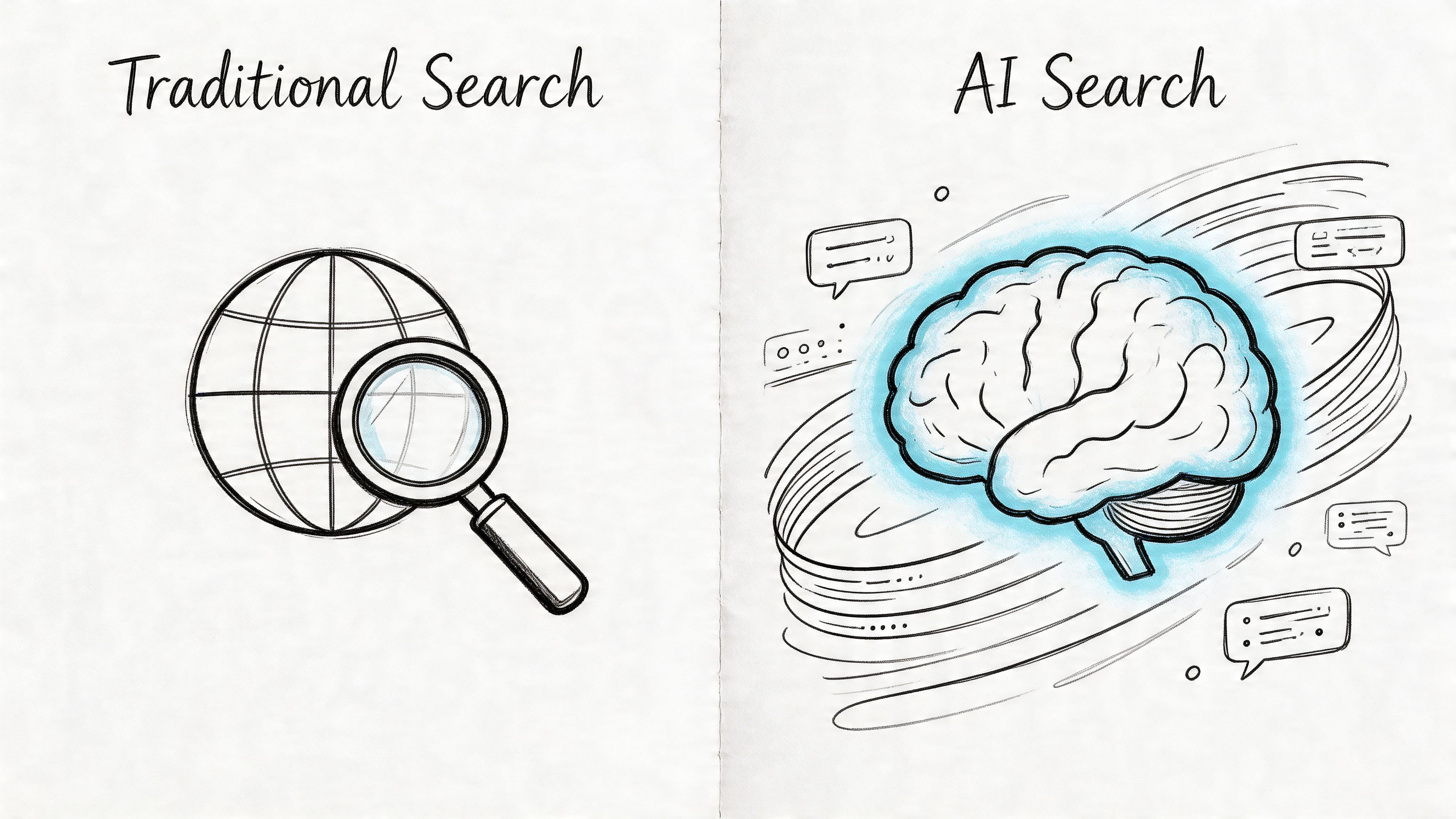
That gap matters because the old visibility score was built for ten blue links. Search teams now have to account for AI Overviews, answer engines, and LLM-driven research tools that summarize, cite, and recommend sources in different ways. The practical question is no longer just, "Where do we rank?" It is also, "Are we still being surfaced when AI intermediates the journey?"
Why classic visibility reporting is incomplete
Traditional visibility tools measure position, estimated click opportunity, and share of presence across a tracked keyword set. They do that well. What they miss is whether your brand gets cited, paraphrased, or skipped in AI-generated answers. As noted in this analysis of the SEO visibility gap, that blind spot is becoming harder to ignore.
For agencies, this creates an attribution problem. A client can keep page-one coverage for commercial terms and still lose consideration if AI summaries quote competitors, marketplaces, publishers, or community sources first. For in-house teams, the trade-off is budget allocation. If reporting only reflects rankings, leadership may underinvest in the content formats and brand signals that influence AI exposure.
What AI visibility actually means
AI visibility tracks whether a brand appears across answer generation, citation patterns, recommendation lists, and assisted discovery paths that may never produce a traditional click. That requires a broader measurement model.
In practice, teams need to watch four things:
-
Brand inclusion in AI answers
- Whether your company, product, or content appears in generated responses
-
Citation and source frequency
- Whether AI systems reference your site directly, rely on third-party sources, or ignore you entirely
-
Entity clarity
- Whether your brand, products, authors, and topic expertise are easy for machines to interpret consistently
-
Off-site visibility
- Whether discussions, reviews, and community mentions strengthen your presence beyond your own domain
That last point gets overlooked. AI systems and searchers both pay attention to signals that live off-site, which is why mastering Reddit SEO can support a broader visibility strategy. The goal is not to chase every platform. The goal is to show up in the sources and conversations that shape recommendations.
A practical setup is to report traditional search visibility and AI visibility side by side. A platform with AI visibility tracking gives teams one place to compare keyword coverage with AI-driven brand presence, instead of forcing separate workflows and disconnected dashboards.
Here's a useful explainer to share with stakeholders when this shift feels abstract.
A unified framework that teams can actually use
The cleanest reporting model has two layers.
Traditional visibility
- Rankings across the tracked keyword set
- Estimated opportunity based on search demand and likely click share
- Competitor movement on priority topics
AI visibility
- Appearance in AI-generated answers and summaries
- Citation frequency by prompt, topic, or query class
- Brand presence across discovery paths that influence research before the click
This combined view fixes a common executive reporting problem. Teams can explain why rankings are stable while top-of-funnel influence drops, or why branded demand improves after stronger citation coverage and off-site mentions. That is the fundamental shift. Search visibility now includes classic rankings and machine-mediated discovery, and teams that measure both are making better content, PR, and channel decisions.
Your Action Plan to Improve Total SEO Visibility
If your visibility score seo is weak, the fix usually isn't one dramatic move. It's a sequence of smart corrections. Teams that improve steadily tend to work in phases, not random bursts.
The goal is to expand your search footprint across both traditional and AI-influenced discovery. That means tightening the basics first, then investing in the pages and topics that can move the score.
Phase one fix the measurement and targeting
Most visibility problems start with poor tracking hygiene. Teams monitor too many irrelevant keywords, ignore intent, or mix brand terms with non-brand terms in ways that hide the complete picture.
Start here:
- Rebuild the tracked keyword set: Group terms by topic, intent, and business relevance. Remove vanity keywords that don't influence buying journeys or strategic awareness.
- Separate branded and non-branded reporting: Branded terms often inflate confidence. Non-branded visibility shows whether you're earning market share.
- Map keywords to pages: One page should have a clear job. If three pages compete for the same query family, the score may stagnate even when content volume increases.
- Audit technical blockers: Crawlability, indexation consistency, internal linking, and page quality all shape whether gains are even possible.
If your reporting still feels messy after this step, the issue usually isn't analysis. It's that the keyword set doesn't reflect the actual business.
Phase two move the pages that are close
The easiest gains usually come from pages already sitting near page one or on the lower half of page one.
This is the work that often changes visibility faster than publishing net-new content for entirely new topics:
-
Tighten search intent alignment If a page ranks but doesn't climb, compare the content format with what already dominates the SERP. Guides lose to product pages when the intent is commercial. Product pages lose when the intent is informational.
-
Improve page architecture Rewrite weak titles and headings. Add missing subtopics. Clarify the answer early. Remove fluff that delays relevance.
-
Strengthen internal links Internal linking is one of the most practical levers for moderate visibility scores because it helps Google understand page importance and topic relationships.
-
Consolidate overlap If several thin pages target near-identical queries, merge them into one stronger asset instead of forcing them to compete.
Teams often publish too much and consolidate too little. Visibility improves faster when authority is concentrated.
Phase three build topic authority
Once the obvious page-level fixes are done, the next gains usually come from breadth and credibility.
That means:
- Expand around proven winners: If one cluster performs, build adjacent pages that support it semantically and commercially.
- Earn relevant backlinks: Strong mentions and links still matter because they reinforce authority and improve the odds of ranking for harder terms.
- Sharpen E-E-A-T signals: Make authorship, expertise, and editorial quality visible. Strong topic coverage with weak trust signals often stalls below the top tier.
- Refresh pages before they decay: Don't wait for a drop. Update winning pages when competitors begin publishing deeper or more current coverage.
What doesn't work is broad content production without a cluster plan. More URLs don't automatically create more visibility. In many accounts, they just create index bloat and cannibalization.
Phase four optimize for AI-mediated discovery
Here, modern search teams need a wider lens.
To improve AI visibility, structure content so machines can interpret it easily and trust it enough to surface it. That doesn't mean writing for robots. It means reducing ambiguity.
Use this checklist:
- Answer clearly and early: Put direct answers near the top of relevant sections.
- Use strong heading structure: Clear hierarchy helps both search engines and AI systems parse the page.
- State entities consistently: Brand names, products, people, and topics should be described in stable, unconfusing language.
- Support claims carefully: Pages that are easy to cite tend to be easier to reuse in AI-generated summaries.
- Publish around real questions: AI answer systems often favor content that resolves specific user questions cleanly.
- Build off-site credibility: Mentions, reviews, discussions, and community references can strengthen brand discoverability beyond your own domain.
For teams trying to operationalize this, an AI visibility audit workflow is a practical way to spot citation gaps and compare where traditional SEO strength isn't yet translating into AI-era presence.
Phase five report the right way
Reporting is where many SEO programs lose stakeholder trust.
A better structure is:
| Reporting Layer | What to Watch | Why It Matters |
|---|---|---|
| Visibility trend | Direction over time | Shows whether overall search presence is expanding or shrinking |
| Topic cluster view | Which categories are gaining or lagging | Helps teams allocate content and technical effort |
| Competitor comparison | Relative movement against a fixed set | Prevents isolated self-assessment |
| AI appearance view | Presence in AI-driven discovery | Catches gaps rankings alone won't explain |
A useful operating model is to review visibility monthly, investigate meaningful changes quickly, and use quarterly planning to reallocate effort toward the clusters that can still gain share.
One platform that fits this modern model is Surnex. It combines AI visibility tracking with rank monitoring, backlinks, audits, and content opportunity workflows, which is useful for agencies and in-house teams trying to reduce tool sprawl while reporting on both traditional and AI search from one place.
Conclusion From Metric to Strategy with Surnex
A visibility score is more than a neat SEO percentage. It's one of the clearest ways to understand whether your brand is occupying meaningful search territory.
That matters because rankings alone don't tell the whole story. They don't capture the weighted importance of search demand. They don't show how much opportunity sits in the positions just above you. And they don't explain the full shift happening as AI systems shape more discovery before a click ever happens.
The strongest teams now treat visibility as a strategy layer, not a reporting widget. They benchmark it against real competitors. They segment it by topic and intent. They use it to find technical issues, content gaps, and authority weaknesses before those problems turn into larger business losses.
They also stop pretending traditional organic visibility is enough on its own. Search has expanded. A complete picture now includes where your brand ranks, where it gets cited, and whether it appears across the answer environments users increasingly trust.
That is the fundamental evolution behind visibility score seo in 2026. The metric still matters. It just needs to sit inside a wider operating model that reflects how people search now.
If your team needs a clearer view of both classic SEO performance and AI-driven discovery, Surnex is worth evaluating. It gives agencies, in-house teams, and developers one place to track search visibility, monitor AI appearance, benchmark competitors, and report on the shift in search with more confidence.