Let's be honest: trying to rank for a massive keyword like "SEO tools" feels like shouting into a hurricane. You're up against industry giants with deep pockets and backlink profiles older than your business. It's a tough, often losing, battle.
This is where the real magic happens. Instead of going head-to-head with the Goliaths, a smarter strategy is to find the keywords they're ignoring. These are the low-competition keywords—specific, often longer search queries that fewer websites are actively trying to rank for.
Focusing on these terms is your secret weapon. It lets you sidestep the main battlefield and carve out a path to organic traffic you can actually win.
Why Low Competition Keywords Are Your SEO Secret Weapon
Think about it this way: would you rather fight for a crumb of a giant pie or get a whole slice of a smaller, tastier one? That's the core of this strategy. These keywords attract visitors who know exactly what they want and are much closer to making a decision.
Someone searching for "best hiking boots" is just window shopping. But someone searching for "lightweight waterproof hiking boots for narrow feet"? That person is ready to pull out their wallet. You're meeting a specific need at the perfect moment.
The Real-World Advantage of Targeting Underserved Searches
The best part is that you don't need a huge budget or a sky-high domain authority to make this work. By zeroing in on these overlooked search terms, you can get some serious traction.
Here’s what that looks like in practice:
- You'll Rank Way Faster: With less competition in the way, your content can shoot to the top of the search results in weeks or months, not years. We've seen it happen time and time again.
- Your Audience is Primed to Convert: Specific searches signal specific problems. The traffic you get is far more likely to become a lead, a customer, or a loyal subscriber because you're solving their exact problem.
- You Build Real Authority: When you consistently rank for related low-competition keywords, Google starts to see you as an expert in that niche. This builds a strong foundation, making it easier to rank for more competitive terms down the road.
This isn't a new-fangled trick. Ever since Google's 2013 Hummingbird update, the search engine has gotten much better at understanding intent, making these longer, more specific queries incredibly powerful. In fact, they now account for over 92% of all searches.
Yet, so many marketers are still stuck in the past, chasing those old-school, high-volume head terms. This creates a massive opportunity for anyone willing to dig a little deeper. If you're curious about the data behind this, it's worth reading these insights about low-competition keywords.
Before we dive into how to find these gems, let's quickly break down the fundamental differences between the keywords everyone fights for and the ones you should be targeting.
Low Competition vs High Competition Keywords at a Glance
This table gives you a quick snapshot of the strategic differences. It helps clarify why shifting your focus can have such a big impact on your results, especially when you're starting out or trying to break into a new niche.
| Metric | Low Competition Keywords | High Competition Keywords |
|---|---|---|
| Search Volume | Typically lower (e.g., 10-1000 searches/month) | Very high (e.g., 10,000+ searches/month) |
| Keyword Length | Usually longer (3+ words), more specific | Typically shorter (1-2 words), very broad |
| Search Intent | High; users are often ready to buy or decide | Low; users are often browsing or researching |
| Competition Level | Low; fewer high-authority sites targeting it | Extremely high; dominated by established brands |
| Time to Rank | Faster (weeks to months) | Slower (months to years) |
| Conversion Rate | Generally higher | Generally lower |
As you can see, the trade-off is simple: you exchange massive volume for higher intent and a much greater chance of success. It's about playing a smarter, more efficient game.
How to Discover Untapped Keyword Opportunities
If you want to find genuinely low-competition keywords, you have to start thinking less like an SEO and more like your actual customer. The real gold isn't hiding in broad "seed keywords" you plug into a tool. It's buried in the specific, problem-focused language people use when they're truly stuck and looking for help.
Before you even touch a keyword metric, your first job is to build a massive, unfiltered list of these potential gems. This means looking in places your competitors probably aren't. While standard tools have their place, the best ideas come from digging into real human conversations.
Mine Online Communities for Raw Insights
Online forums and groups are an absolute goldmine for the exact phrases your audience uses. People don't use "marketing speak" here—they describe their struggles in plain, honest language. This is where you’ll stumble upon keyword ideas that are completely invisible to your competition.
Start by lurking where your target audience hangs out online:
- Reddit: Find a few relevant subreddits (like r/smallbusiness or r/realtors) and just start searching. Look for phrases like "how do I," "any tool for," or "recommendation for." The post titles themselves are often perfect long-tail keywords.
- Quora: The entire site is built on questions. Search for topics in your niche and pay close attention to how people frame their problems. The "Related Questions" sidebar can send you down some very profitable rabbit holes.
- Facebook Groups: Niche groups are fantastic for this. A quick search for "fix lens" inside a "Vintage Camera Collectors" group could uncover dozens of specific, problem-oriented keywords you'd never have thought of.
The key here is to listen, not to sell. Your goal is to collect the verbatim phrases you see. For example, you might not be looking for "CRM software." Instead, you might find a thread titled, "help finding a CRM for a small real estate agency that does email automation." That entire phrase is a potential keyword.
Key Takeaway: The most valuable keywords aren't just strings of words; they represent a specific problem someone needs to solve. When you find the problem, you've found the keyword.
This is the core of the strategy. You're shifting from battling for hyper-competitive terms to uncovering and dominating these smaller, niche opportunities where you can actually win.
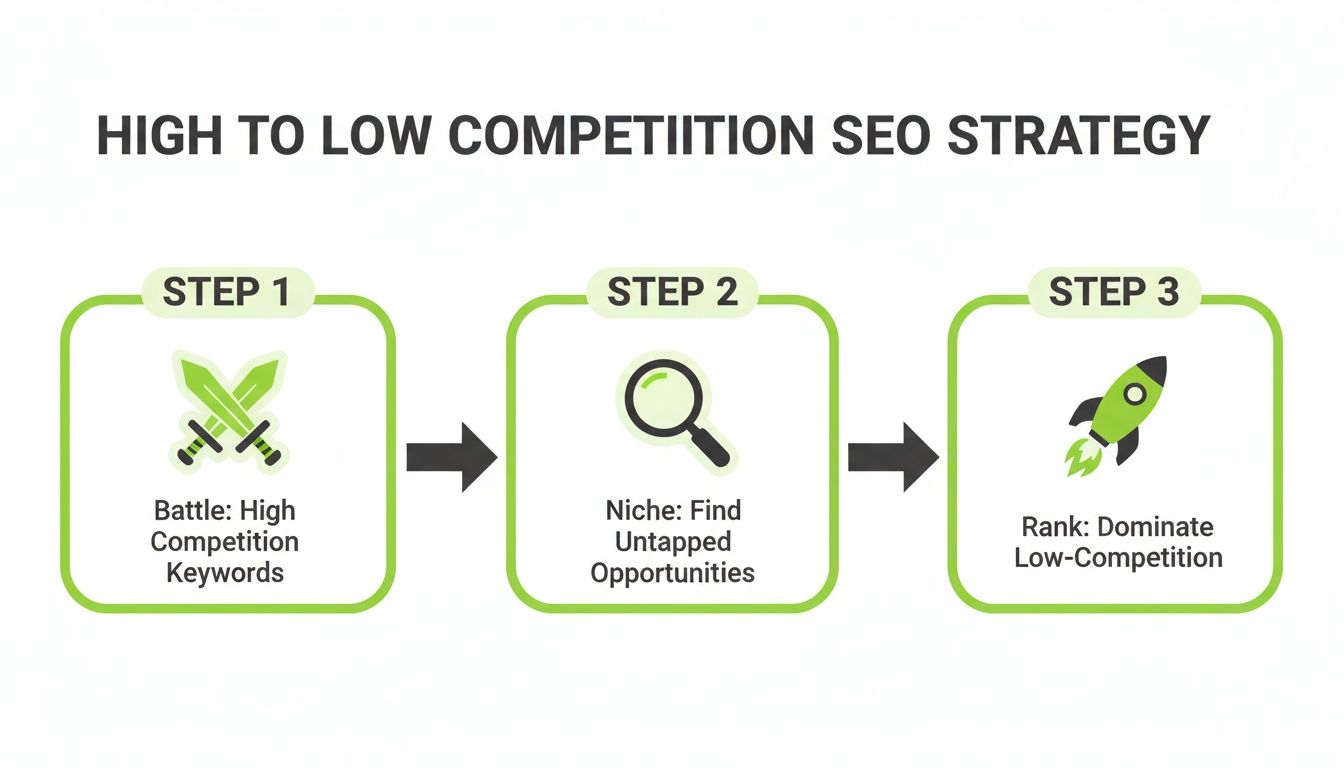
As you can see, the path to ranking isn't always a direct fight. It's often about sidestepping the main battle to find your own territory where you can plant your flag.
Leverage Google’s Own Clues
Don't forget that Google itself leaves a trail of breadcrumbs for you to follow. These features are designed to help users, but for an SEO, they're a direct line into the searcher's brain.
- Google Autocomplete: This is my first stop. Start typing a broad term and see what Google suggests. Then, mix it up by adding prefixes like "how to," "best," "vs," or "for" to uncover new angles.
- People Also Ask (PAA): This little box is a content outline waiting to happen. It shows you the exact follow-up questions people have after their initial search. Every single one is a potential keyword or, at the very least, a subheading for your article.
- Related Searches: Always scroll to the bottom of the SERP. These suggestions often point to related concepts and long-tail variations you might have missed.
By combining insights from online communities with Google's own suggestions, you'll have a powerful raw list of ideas. If you want to get more technical with this process, our guide on using a keyword research tool can show you how to organize and scale this effort.
Now, with this big list in hand, it's time to figure out which of these keywords are actually winnable.
Validating True Keyword Competition on the SERP
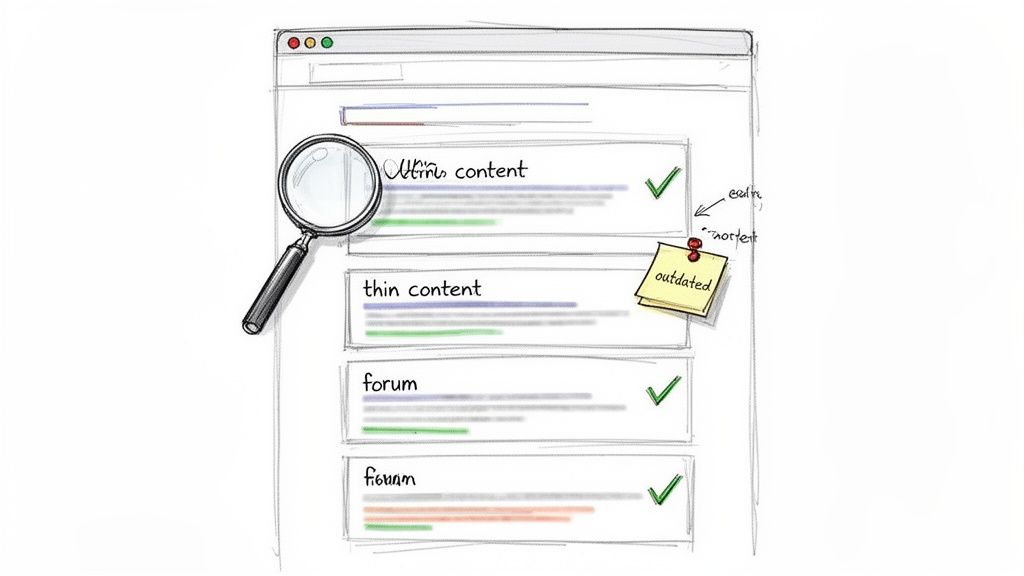
A low "Keyword Difficulty" score from a tool is a great sign, but it’s just that—a sign. These metrics are clever estimates, not a guarantee. To find keywords you can actually rank for, you have to get your hands dirty and manually check the SERP.
This is the step most people skip, and honestly, it’s where you’ll find your biggest advantage.
Think of it this way: a tool might show you a street with low-priced houses. But are they cheap because they're hidden gems or because the plumbing is shot? You’d never know without driving by to see for yourself. The same goes for the search results page.
Putting on Your SERP Detective Hat
Go ahead and search for one of your target keywords. Now, open the top 10 results in new tabs and actually look at them. Your goal is to spot weaknesses and find clues that tell you, "I can do better than this."
Here’s a quick checklist of what I always look for on page one:
- Forums and Community Threads: Seeing a Reddit or Quora post in the top five is a massive green flag. It’s Google’s way of saying it can’t find a truly great article to answer the question.
- Thin or Outdated Content: Are the top pages short, light on details, or written back in 2019? If the information feels stale, that’s your invitation to create something fresh and comprehensive.
- Big Brands with Bad Aim: You'll often see a huge website ranking with a page that only vaguely relates to the search. They’re there because of their overall authority, not because that specific page is any good. You can beat them with a focused, well-crafted article.
Finding just one or two of these weak spots is a great sign. If you see three or more, you've probably hit a goldmine.
My rule of thumb is simple: If looking at the top results makes you think, "I can definitely create something way better," then it's a go. If your gut reaction is, "Wow, that's impressive," it might be better to move on for now.
Gauging Authority and Content Fit
Beyond quality, you need to size up the authority of who you're competing against. Are they small, niche blogs like you, or are you trying to fight industry giants?
An SEO browser extension can give you a quick look at the Domain Authority (DA) or Domain Rating (DR) of the sites on page one. If everyone in the top 10 has a DA over 80, it's going to be a long, tough battle.
But if you see a good mix of sites with a DA below 50, the field is much more level. Research often shows that keywords with low competition have top-ranking pages with fewer than 10 backlinks, which means even sites with a DA under 30 have a fighting chance. You can see more data on this type of keyword analysis and how it works in the real world.
This manual check turns a simple list of keywords into a real strategic plan. You’ll know which terms are worth your time and which ones to shelve for later. Once you start publishing, you'll want to see how your new content climbs the ranks for these hand-picked terms. If you need a solid way to watch your progress, it’s worth setting up a rank tracking system.
Prioritizing Keywords That Drive Business Growth
So, you've done the digging. You’ve sifted through forums, picked apart the SERPs, and now you have a massive list of potential keywords. It's a great spot to be in, but it can also feel a little overwhelming. Where do you even start?
The biggest mistake I see people make is sorting that list by search volume and just diving in. It’s a trap. A keyword’s real power isn’t its search volume; it’s the business it can bring you. I'd take a keyword with 50 monthly searches that brings in ready-to-buy customers over one with 1,000 searches from people who are just browsing any day of the week.
Scoring Keywords for Business Impact
To separate the gold from the gravel, you need a quick way to vet your list. I use a simple scoring system that forces me to think about what actually matters for growth. It’s just a 1-to-5 scale across three factors.
-
Commercial Intent (1-5): How close is the person searching to pulling out their wallet? "Best CRM for startups" is a 5, showing someone is ready to buy. "What is a CRM" is a 1—they're just starting their research.
-
Audience Relevance (1-5): Does this keyword sound like something your ideal customer would type into Google? If it perfectly matches who you're trying to reach, that’s a 5, even if the search volume seems low.
-
Problem-Solving Value (1-5): Is the searcher trying to solve a painful problem that your product fixes? The more urgent the problem, the more valuable your content becomes.
Just add up the scores for each keyword. Anything that hits 13-15 is a top priority. Keywords that score below an 8 probably aren't worth the effort right now. This simple exercise quickly brings the most valuable opportunities straight to the top.
Mapping Keywords to the Customer Journey
Beyond a simple score, think about when someone would search for this. Are they just realizing they have a problem? Are they actively comparing solutions? Or are they about to make a final decision? Each stage of this journey needs a different kind of content.
This is a huge part of modern SEO. For instance, some analysts predict that long-tail keywords will make up 92% of all search queries by 2026. Most of these have very little competition, which is a massive opening if you know how to find them.
Key Insight: The goal isn't to find the easiest keywords. It's to find the keywords that will most efficiently grow your business through actual leads and sales.
When you map your keywords to the customer journey, every piece of content gets a clear job. An "awareness" post might be designed to build your email list. A "decision" post, on the other hand, should push for a demo or a direct sale. This gives your whole content strategy a clear purpose and proves its ROI, turning your blog into a machine that guides visitors from prospect to customer. As your authority grows, so will your ability to earn high-quality links. If you are interested, check out our guide on how backlinks can improve your SEO.
Creating Content That Actually Wins the SERP

Alright, you’ve done the hard work of hunting down a promising, low-competition keyword. But finding the opportunity is just getting you to the starting line. The real work—the part that actually gets you ranking—starts now.
Your mission isn’t just to write another article on the topic. It’s to create something so genuinely helpful and thorough that Google sees it as the absolute best answer for anyone searching that term. You want to be the undisputed champ for that query.
Deconstruct the SERP to Find Your Angle
Before you write a single word, head straight back to Google and search for your keyword. This time, you're not just looking at metrics; you're putting on your detective hat.
Open up the top 3-5 articles and really dig in. You’re looking for what they’re doing right, but more importantly, you’re hunting for what they missed. This is where you’ll find your competitive edge.
Ask yourself these questions as you analyze each page:
- What are the must-have topics? See what common ground all the top pages cover. These are your table stakes—you need to address these points just to be in the game.
- What's missing? This is where the gold is. Maybe they all explain what something is but not how to do it. Or maybe they completely ignore a follow-up question you saw in the "People Also Ask" box.
- What format are they using? If the top results are all simple, text-only articles, that’s your opening. Could you blow them out of the water with a detailed guide that includes custom graphics, a comparison table, or even a short video?
Your goal is to build an outline that includes all the essential topics and then strategically layers in the missing pieces you've uncovered.
My Personal Tip: I keep a simple "Content Gap Checklist" for every article I plan. For every weakness I find—outdated stats, a confusing explanation, a missing example—I add it to my list. The piece I create isn't finished until I've addressed every single item on that checklist.
Structure Your Content for Both Scanners and Deep Divers
Let’s be honest: most people don't read articles online from top to bottom. They scan. Your content's structure needs to cater to both the person looking for a quick answer and the one who wants a deep, detailed explanation.
This means breaking up your writing into small, easy-to-digest chunks.
Use clear H3 subheadings for every major section. Keep your paragraphs short—one or two sentences is often perfect. This creates valuable white space and makes the page feel approachable, not like an intimidating wall of text.
Also, lean on formatting to make your points pop:
- Bulleted lists are great for summarizing features or benefits.
- Numbered lists work perfectly for walking someone through a process.
- Blockquotes are ideal for highlighting key insights or expert advice.
For instance, instead of writing a dense paragraph about the pros and cons of a particular method, pop them into a simple two-column table. It instantly makes the information easier to grasp and adds more value than your competitors.
Thinking about how your content is structured is a core part of on-page SEO. If you want to go deeper on how this fits into the bigger picture, our guide on performing a comprehensive SEO site audit connects these very dots.
Answering Your Questions About Low-Competition Keywords
Once you start exploring a low-competition keyword strategy, a few questions always pop up. Getting these sorted out is key to moving forward with confidence and sidestepping some common mistakes. Let's walk through the questions I hear most often from teams just getting their feet wet with this approach.
What's a Good Search Volume for a Low-Competition Keyword?
Everyone wants a magic number for search volume, but honestly, that’s the wrong way to look at it. The real priorities should be relevance and intent.
Think about it this way: a keyword with just 50 monthly searches from people ready to buy is infinitely more valuable than a term with 1,000 searches from folks who are just window shopping.
For a new website or even an established one tackling a new topic, keywords with as few as 10-100 searches a month can be absolute gold. These are the terms that help you get your first wins, bring in targeted traffic, and start building authority. The goal isn't just volume; it's attracting the right people.
How Long Does It Take to Rank for These Keywords?
This is where you really see the payoff. The speed is one of the biggest upsides. While nothing in SEO is guaranteed, it's not unusual to see high-quality content for a truly low-competition keyword hit the first or second page within a few weeks or a couple of months.
This is especially true if your site already has some authority and your content genuinely answers the searcher's question better than anyone else.
This gives you a massive head start compared to the 6-12+ months you might spend trying to crack the top ten for a super-competitive head term. Those quick wins build serious momentum.
That rapid feedback is crucial. It lets you see what’s working, double down on it, and adjust your strategy without having to wait a year to know if you're on the right track.
Can I Only Target Low-Competition Keywords?
Absolutely not. Think of this strategy as your launchpad, not your final destination. Starting with low-competition keywords is simply the smartest way to build a solid foundation for your site's SEO.
The journey usually looks something like this: You begin by targeting these easier-to-rank terms to get some initial traffic flowing and earn your first organic links. As you consistently publish great content around these topics, Google starts to recognize your site as a credible voice in that niche. This is how you build topical authority.
Once you have that stronger authority profile, you've earned the right to go after the bigger fish. You can start targeting more competitive, higher-volume keywords with a much better shot at ranking. You've already laid all the groundwork.
It's a sustainable way to scale your SEO. You build momentum, proving your expertise to both users and search engines, and then you progressively take on bigger challenges you know you can win.
Ready to stop guessing and start winning in the new era of search? Surnex gives you the unified platform to monitor your brand's visibility across both traditional SEO and emerging AI experiences. Cut through the noise, find your best opportunities, and manage performance from a single dashboard. See where search is going.