The worst advice still circulating around latent semantic indexing seo is also the most familiar: find a list of “LSI keywords,” sprinkle them into the copy, and expect rankings to follow.
That advice belongs to another era. It confuses an old information retrieval concept with the way modern search systems interpret language. Worse, it pushes teams toward shallow optimization habits that sound strategic but usually produce awkward copy, weak briefs, and reporting that misses what search has become.
Agencies feel this first. A client asks why a page isn’t showing in AI answers, someone runs an “LSI keyword” tool, and the team gets a spreadsheet full of related phrases. The page gets updated. The language becomes broader, but not better. The content still doesn’t answer the actual question, doesn’t establish expertise, and doesn’t connect the entities, subtopics, and intent patterns that AI-driven search systems rely on.
The useful part of LSI was never the keyword list. It was the underlying idea that language has structure beyond exact-match terms. That idea still matters. The tactic built around it does not.
The End of an SEO Myth
The phrase “LSI keywords” should have disappeared years ago. It survived because it sounds technical enough to be credible and simple enough to package into templates, audits, and content briefs.
That’s the trap.
Google has explicitly denied using LSI as a direct ranking signal since at least 2009, and the practical takeaway is to stop chasing “LSI keywords” and start auditing topical gaps through co-occurrence and relevance analysis instead, as explained in Oncrawl’s discussion of latent semantic indexing. That same source also notes that over-optimization penalties can drop rankings by 50-90% when teams stuff terms instead of improving coverage and clarity.
What the bad advice gets wrong
Most “LSI keyword” advice treats search like a matching game. If the page about coffee includes enough adjacent words like aroma, roast, beans, and brew, it must be semantically complete.
But related terms are not a strategy by themselves. They are evidence. They can show what a topic usually includes, what users expect, and what high-quality pages tend to explain. They cannot replace editorial judgment.
A senior team should read “LSI keywords” as a warning sign that the conversation is already off track.
| Outdated Myth | Modern Reality (2026) |
|---|---|
| You need LSI keywords to rank | Search systems evaluate broader semantic relevance, not a specific LSI keyword checklist |
| Google uses LSI in ranking | Google has denied using LSI directly |
| More related terms always help | Forced additions can create spam signals and poor readability |
| LSI tools reveal hidden ranking terms | They usually surface related language, which still needs intent and entity review |
| The job is to expand keyword density | The job is to build topic completeness and answer coverage |
What agencies should replace it with
The better workflow is simple:
- Map intent first: Separate informational, commercial, navigational, and task-focused searches before writing.
- Review top-ranking coverage: Look for recurring entities, questions, examples, definitions, and missing context.
- Track AI visibility, not just blue links: Pages now need to surface in synthesized answers too. A toolset built for ChatGPT visibility tracking makes that shift easier to measure.
- Edit for meaning, not term count: If a phrase doesn’t improve comprehension, it probably doesn’t belong.
Practical rule: If a writer can’t explain why a related term helps the reader, it shouldn’t be in the brief.
The Original Idea Behind Latent Semantic Indexing
Before SEO turned LSI into a buzzword, it was a serious attempt to solve a real search problem.
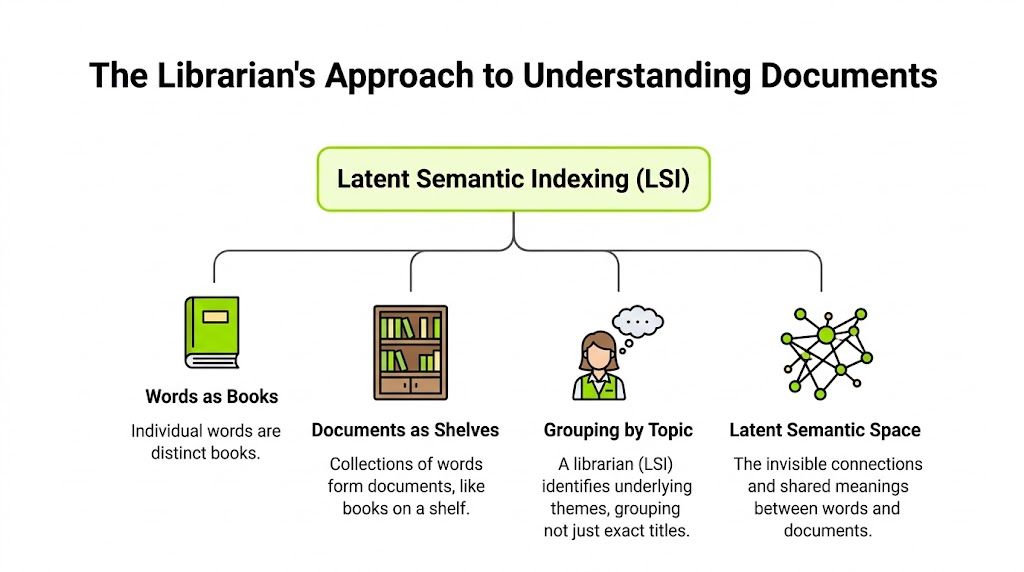
Think of a librarian sorting books. One book says “ancient Rome.” Another says “Roman Empire.” A third says “Caesar and the Senate.” If the librarian organized books only by exact title words, those books might end up far apart. A good librarian groups them by topic. LSI tried to do something similar for documents.
Why LSI mattered in the first place
LSI originated in the late 1980s, and the foundational paper by Deerwester et al. was published in 1990. Early keyword matching systems missed up to 70-80% of relevant documents in testing, and LSI improved recall by 15-30% by reducing dimensionality and surfacing hidden relationships between terms, as summarized in Wordtracker’s history of the LSI myth.
That was a meaningful breakthrough because language is messy.
Two classic problems caused trouble:
- Synonymy: people use different words for the same idea.
- Polysemy: the same word can mean different things in different contexts.
A simple keyword system struggles with both. If someone searches for “car,” a document using “automobile” may not appear. If someone searches for “apple,” the system may not know whether they mean the fruit or the company.
The basic mechanics without the math headache
LSI used Singular Value Decomposition (SVD) on a term-document matrix. In plain English, it looked at which words appeared across which documents and tried to compress those patterns into a smaller set of underlying concepts.
Here’s the practical version of that process:
- Collect documents and terms: Build a matrix of words and the documents they appear in.
- Reduce noise: Remove common stop words and focus on content-bearing terms.
- Find co-occurrence patterns: Identify which words tend to appear in similar contexts.
- Compress the space: Use SVD to reduce the giant matrix into latent factors that represent shared themes.
That’s why LSI could infer that “digital camera” might relate to “photography equipment” even when the exact wording differed.
LSI was useful because it helped machines infer topic similarity from patterns, not because it created a magic list of SEO terms.
Where SEO went wrong
The misunderstanding came later. After Google launched in 2001, many SEOs saw related terms bolded in search results and assumed those were “LSI keywords.” That idea spread for years, even as search technology moved far beyond the underlying method.
The original concept deserves respect. The SEO myth built on top of it does not.
Debunking Common LSI Keyword Misconceptions
The phrase “LSI keyword” usually means one of two things. Sometimes people mean synonyms. Sometimes they mean related phrases pulled from tools. Neither one is the same as actual LSI.
That distinction matters because the wrong label leads to the wrong tactic.
Myth 1: You should sprinkle LSI keywords into every page
This is still common in content operations. A strategist builds a brief, exports related terms, and asks the writer to “work them in naturally.” The result is often a page that checks boxes without deepening the answer.
What works is broader topical coverage. Related language can support that, but only if the page also explains the concepts, relationships, and questions that the topic requires.
A page about espresso machines shouldn’t just add “coffee beans,” “milk frother,” and “home barista.” It should explain the differences between machine types, maintenance demands, pressure systems, price considerations, and user scenarios. Terms follow understanding. They should not lead it.
Myth 2: LSI keyword tools are essential SEO software
Most so-called LSI tools are really term suggestion tools. That’s not useless. It’s just not what they claim to be.
Use them carefully and they can help with:
- Coverage checks: spotting missing subtopics
- Brief improvement: expanding beyond one head term
- SERP language review: seeing how the market describes a topic
Use them poorly and they become stuffing machines.
A senior reviewer should always ask: does this term represent a concept the page needs, or is it just statistically adjacent language?
Myth 3: More related phrases means stronger semantic SEO
That’s only true when those phrases reflect real topic depth.
A page can mention twenty related terms and still be thin. Another page can use fewer variants but do a far better job because it explains definitions, edge cases, comparisons, examples, and decision criteria. Search systems reward the second kind of page more consistently because it helps users complete the task behind the query.
Myth 4: If Google doesn’t use LSI, related terms don’t matter
This is the overcorrection. Teams hear that Google doesn’t use LSI directly and then dismiss semantic work entirely.
That’s a mistake. Related terms still matter because they signal topical completeness, intent matching, and contextual relevance. The problem was never semantic expansion itself. The problem was pretending old-school “LSI keyword” checklists were the mechanism behind modern rankings.
A practical content workflow should separate these questions:
| Question | Better way to think about it |
|---|---|
| Which keyword do we target? | What job is the user trying to complete? |
| Which LSI terms do we insert? | Which entities, subtopics, and questions must this page cover? |
| How many variants do we need? | How much explanation is needed to satisfy intent? |
| Did we optimize the copy? | Did we improve usefulness, clarity, and retrieval signals? |
Myth 5: Semantic SEO is just keyword research with a new label
It isn’t. Keyword research is one input. Semantic SEO adds structure, entity relationships, document architecture, and answer completeness.
That’s why old reports often miss modern performance issues. A page can rank for several phrase variations and still underperform in AI-generated experiences if it lacks source clarity, factual support, or explicit treatment of connected concepts.
When teams move away from “LSI keywords,” they don’t lose a tactic. They gain a better operating model.
How Modern Search Engines Actually Understand Topics
Modern search engines didn’t reject the old ideas behind LSI because meaning stopped mattering. They moved past LSI because language understanding needed more context than co-occurrence models could provide.
That’s the key distinction. The principle survived. The method did not.
From statistical association to contextual understanding
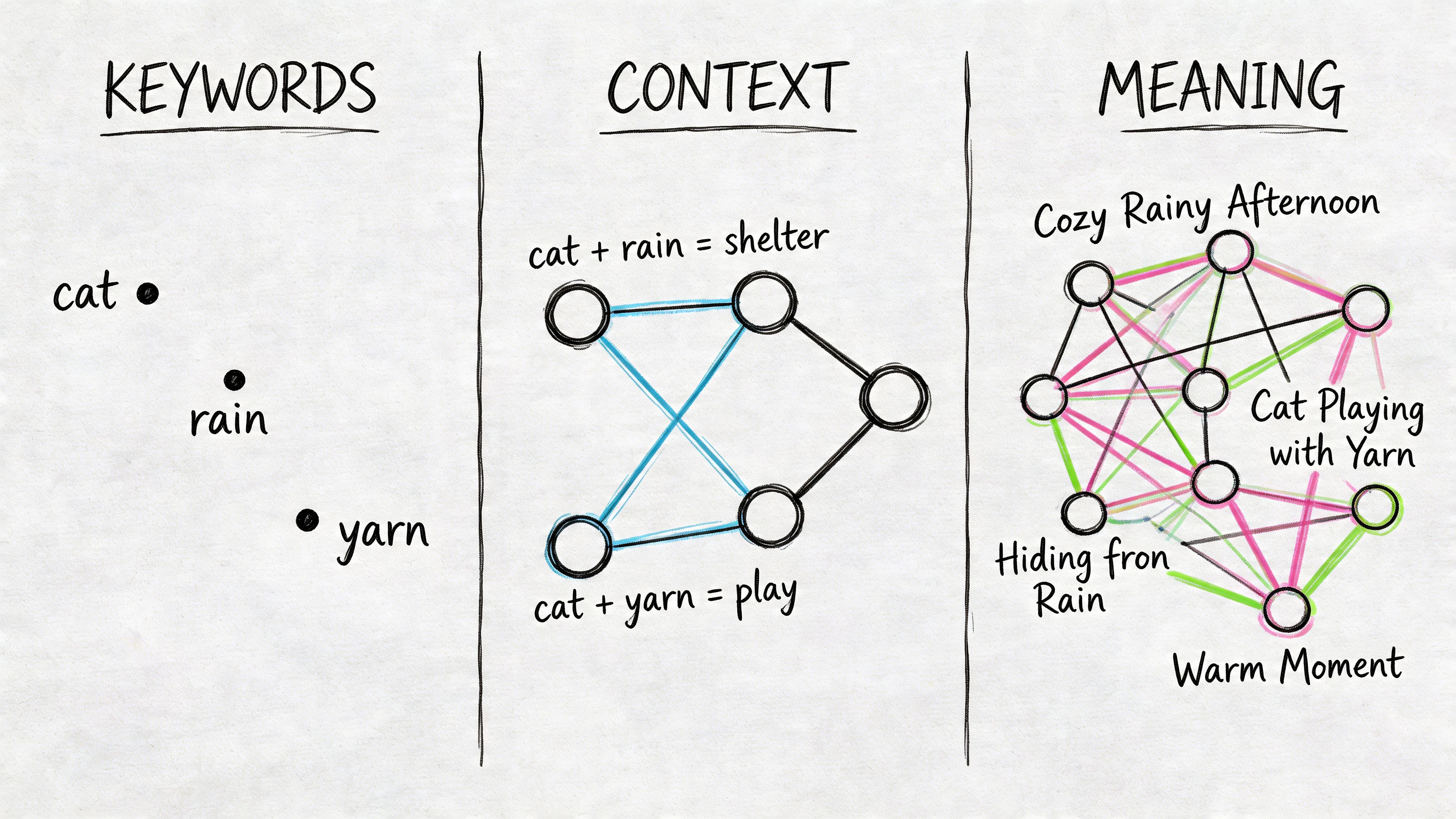
LSI looked for hidden relationships in word usage. That was useful, but limited. It struggled with word order, syntax, and nuanced meaning. Modern neural systems such as BERT and MUM handle those problems far better by analyzing context within the full phrase and across broader representations of meaning.
The practical impact is visible in ambiguous queries. A word like “crane” can refer to a bird or a machine. Old co-occurrence approaches often needed broad surrounding patterns to guess. Modern models do a better job because they read the phrasing, relationships, and contextual hints more like a human reader would.
According to Search Engine Journal’s overview of LSI and modern ranking systems, pages optimized purely around LSI keywords saw 28% lower visibility in AI-generated answers in Q1 2026 compared to content built around entity-focused semantic SEO.
What this means for content teams
Search systems now evaluate more than proximity between terms. They look for signals that a document understands the subject.
That includes:
- Entities: the people, products, places, concepts, or objects involved
- Relationships: how those entities connect
- Intent fit: whether the content satisfies the actual task
- Context: how phrasing changes meaning
- Trust signals: whether the document appears reliable and grounded
This is why semantic relevance now overlaps so closely with quality frameworks. If your team needs a clean reference for how trust and expertise show up in AI search, Raven SEO’s guide to E-E-A-T for AI is worth reviewing.
The strongest pages don’t just mention the topic. They demonstrate that the author understands how the topic works.
Why AI Overviews changed the operational model
Traditional SEO could get away with narrower page optimization because ranking a blue link was the main goal. AI-generated search experiences change that. Systems summarize, compare, and cite. They look for passages that can support an answer, not just pages that target a phrase.
That shifts optimization in two ways.
First, teams need to build content around answerability. Definitions, distinctions, examples, constraints, and direct responses matter more.
Second, teams need to monitor where they appear in AI surfaces, not just classic SERPs. Tracking AI Overviews visibility is now part of serious search reporting because ranking alone no longer captures brand presence.
The right mental model
Don’t think of modern search as “LSI but smarter.”
Think of it as a progression:
| Older approach | Modern approach |
|---|---|
| Find words that tend to occur together | Understand phrases, entities, syntax, and intent together |
| Approximate topic similarity statistically | Interpret context with neural language models |
| Focus on document-term relationships | Focus on meaning, relevance, and answer usefulness |
| Optimize via related phrase inclusion | Optimize via topic depth and explicit clarity |
That change is why latent semantic indexing seo still comes up in strategy discussions, but mostly as a historical reference point. The useful lesson is semantic relevance. The outdated lesson is term sprinkling.
A Practical Framework for Semantic Content Strategy
A workable semantic strategy doesn’t start with a keyword dump. It starts with a content job. What does the page need to help the user understand, compare, choose, or do?
That’s the shift agency teams need to institutionalize in briefs, reviews, and reporting.
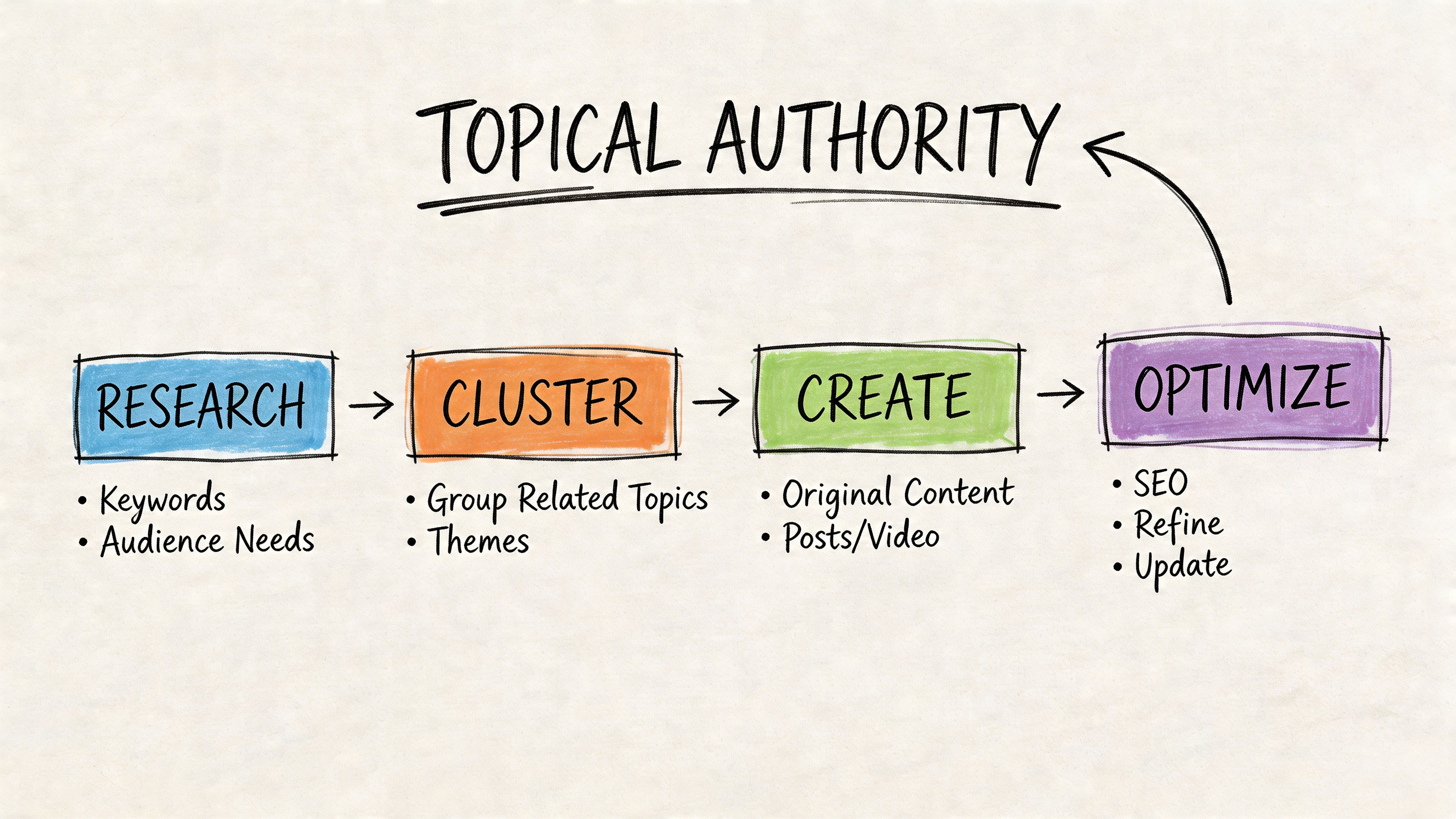
Case studies summarized by Trigger Growth’s article on semantic optimization report 20-40% increases in organic traffic, 15-25% lower bounce rates, 10-20% higher time-on-page, ranking for 2-3x more semantic query variations, and up to 25% higher conversion rates when pages are optimized with related term clusters as part of stronger topical coverage.
Start with the core topic and the user task
Use one primary subject, then define the intent behind it before you write.
Take electric vehicle charging. That topic sounds singular, but users may want very different things:
- a beginner explanation of charging levels
- home installation guidance
- connector compatibility
- public charging network comparisons
- charging speed expectations
- cost and route planning
If a single page tries to satisfy all of those without structure, it usually becomes vague. If the page chooses one core task clearly, it can then support that task with the right surrounding entities and subtopics.
Build the brief around entities and questions
Many teams still fall back into “LSI keyword” behavior. They collect phrase variants but skip the hard editorial work.
Instead, build your brief with these inputs:
-
Primary intent Define whether the page is explaining, comparing, troubleshooting, or helping someone choose.
-
Required entities For EV charging, that might include connector types, charging levels, home chargers, public charging stations, battery range, installation, and charging networks.
-
Decision questions What would a careful buyer or researcher ask before acting?
-
Proof elements Include examples, comparisons, visuals, FAQs, and operational details that make the page more usable.
A lot of teams use keyword tools at this stage. That’s fine. Just treat them as research support. A strong keyword research workflow should feed topic development, not replace it.
Editorial check: If the brief is mostly a phrase list, it isn’t ready for a writer.
Structure pages so context is obvious
Modern search systems reward pages that make relationships explicit.
For the EV charging example, a stronger page structure might include:
- What EV charging levels mean
- How connector types affect compatibility
- What changes with home installation
- How public charging networks differ
- What affects charging speed in practice
- Which mistakes first-time EV owners make
That structure gives both users and retrieval systems a clearer map of the topic.
A useful outside reference for teams building broader programs is this overview of comprehensive SEO services, which reflects how modern SEO work increasingly combines technical, content, and strategic layers rather than isolated keyword execution.
Write naturally, then optimize for completeness
Writers shouldn’t force semantic variants sentence by sentence. They should write the clearest answer possible, then review the draft for missing concepts, missing explanations, and weak transitions.
A quick training resource can help teams align on that process:
Use optimization as a second pass:
- Add missing subtopics when the page skips obvious user concerns
- Clarify entity relationships when terms appear without explanation
- Improve answer blocks when headings promise information but deliver fluff
- Tighten internal language when jargon hides the meaning
The best semantic pages don’t feel optimized. They feel complete.
Measuring Semantic Performance and Scaling for Teams
If your reporting still revolves around a small set of exact-match rankings, you won’t see the full gains from semantic work. You also won’t catch the failures early enough.
A page can hold a decent position for one target term while losing ground across a wider topic cluster, surfacing less often in AI-generated results, and missing citations on adjacent queries. Teams need a broader measurement model.
What to track instead of just rank positions
The more useful question is not “did keyword X move from position seven to four?” It’s “did this page gain visibility across the topic, and does it appear where users now get answers?”
That means tracking:
- Topic cluster visibility: whether the page earns impressions and rankings across semantically related searches
- Coverage gaps: which expected subtopics are missing or underdeveloped
- AI surface presence: whether the brand or page appears in synthesized search experiences
- Engagement quality: whether users stay, scroll, and continue into the next step
- Portfolio patterns: where the same semantic weakness repeats across multiple client sites
Why unified workflows matter
This gets harder fast in an agency setting. One client needs classic SEO reporting. Another wants answers about AI Overviews. A third wants API access for internal dashboards. If each need sends the team into a different tool, semantic strategy turns into operational drag.
Ryte’s coverage of LSI notes the broader workflow challenge for multi-client teams and points to the need for unified platforms post-2025, with benchmarks showing 32% better performance for entity-focused content and growing demand for “agent-ready” APIs for semantic monitoring in modern search operations, as summarized in Ryte’s LSI reference.
A scalable review model for agencies
A practical team process usually looks like this:
| Review layer | What the team checks |
|---|---|
| Page level | Missing concepts, unclear answers, weak entity coverage |
| Cluster level | Cannibalization, overlap, internal linking, content depth |
| SERP level | Competing formats, recurring themes, AI answer patterns |
| Account level | Repeated gaps across categories, products, or markets |
Automation becomes valuable when a repeatable AI visibility audit workflow helps teams benchmark where content appears, where citation gaps persist, and which pages deserve updates first.
Reporting advice: Show clients topic-level movement and AI visibility trends alongside rankings. That tells a much truer performance story than a rank tracker alone.
What a good semantic report should prove
The report should answer four operational questions:
- Did visibility broaden? Are more related queries and answer surfaces picking up the content?
- Did the page become more useful? Do engagement signals and secondary actions improve?
- Did topical authority strengthen? Does the domain own more of the subject, not just one phrase?
- Did the work scale? Can the same process be reused across accounts without adding chaos?
That’s the business case for moving past latent semantic indexing seo as a tactic and treating semantic relevance as a measurable operating system.
Frequently Asked Questions About Semantic SEO
Is latent semantic indexing seo still worth learning?
Yes, as history and context. LSI helps explain why exact-match keyword thinking was always limited. It’s useful for understanding how search moved toward semantic relevance. It is not useful as a modern ranking tactic or as a justification for stuffing related phrases into content.
What should replace LSI keyword research in content briefs?
Replace it with a richer brief built around intent, entities, subtopics, required questions, and expected proof elements. Related phrases can still appear in research notes, but they should support the brief rather than define it.
A good brief tells the writer:
- what the user needs
- what must be explained
- what comparisons matter
- what misunderstandings to prevent
- what evidence or examples increase trust
Are synonyms enough for semantic optimization?
No. Synonyms help with language variation, but they don’t create topic depth by themselves. A page earns stronger semantic relevance when it covers the subject’s surrounding concepts, relationships, and decision points with clear structure and useful detail.
How do I know if a page is over-optimized?
Look for these signs:
- Forced phrase repetition: the copy sounds engineered instead of natural
- Shallow headings: headings promise breadth, but paragraphs add little substance
- Disconnected term inserts: related words appear without explanation or purpose
- Declining readability: the page becomes harder to understand after “optimization”
If edits make the page less helpful, the optimization pass went in the wrong direction.
How should agencies train writers on semantic SEO?
Train them to think like subject explainers, not phrase placers.
Useful habits include:
- reviewing top-ranking pages for missing angles, not just repeated terms
- outlining entity relationships before drafting
- writing direct answers under each heading
- adding examples, comparisons, and constraints where users need them
- using optimization tools only after the main draft is coherent
Does semantic SEO matter for AI search more than traditional search?
It matters for both, but AI search raises the standard. AI-generated answers depend on content that is easy to interpret, easy to cite, and clear about what it covers. Pages with stronger semantic structure tend to be more reusable in those systems because the meaning is explicit.
What’s the fastest win for a team still using LSI-style workflows?
Stop asking writers to “add more related keywords.” Start asking editors to identify what a page still fails to explain.
That one change usually improves briefs, copy quality, and reporting discipline at the same time.
Teams that still optimize around “LSI keywords” are solving the wrong problem. Modern search rewards topic coverage, entity clarity, and visibility across both traditional results and AI experiences. Surnex helps agencies, in-house teams, and developers track that shift in one place, with AI visibility monitoring, core SEO data, and workflows built for how search works now.