Your monthly report says rankings are steady. Organic traffic is soft. Paid search is doing its own thing. Brand demand looks stronger in some places and weaker in others. Then someone asks a simple question: are we losing search visibility, or is visibility moving somewhere the dashboard doesn't track?
That's where a lot of teams are right now.
Classic SEO reporting still tells part of the story. It can show positions, clicks, and landing pages. What it often can't show is how your brand appears in AI Overviews, whether AI assistants mention you at all, or whether third-party sites are capturing the visibility you thought your own site had earned. Search didn't disappear. It fragmented.
Search marketing intelligence is the framework that makes that fragmentation manageable. It gives agencies and in-house teams one way to read demand, competition, visibility, and intent across both traditional search and AI-driven discovery. Without it, teams keep reporting what's easiest to measure instead of what's shaping performance.
Why Your Search Dashboards No Longer Tell the Whole Story
A familiar pattern shows up in client reviews and internal marketing meetings. A category page drops in clicks. Rankings haven't collapsed. Branded search is holding up. Paid campaigns are still converting. But the usual dashboard can't explain the disconnect, so everyone reaches for a different theory.
The problem usually isn't a lack of data. It's that the data lives in separate systems and reflects an older model of search. Google alone processes over 8.5 billion searches every day, and 93% of online interactions begin with a search engine, according to Smart Insights search engine statistics. When search operates at that scale, even small changes in where your brand appears can change outcomes quickly.
Search behavior changed faster than reporting did
A rank tracker built for ten blue links can't fully explain a results page that includes ads, snippets, AI summaries, video results, product modules, and competitor assets. It also can't tell you much about what happens when a buyer starts in ChatGPT, checks Google, then validates the answer on Reddit or YouTube.
That's why many teams feel like their reporting is becoming less useful even when they're collecting more metrics.
Old dashboards answer, “Did we rank?” Modern teams also need to answer, “Did we get surfaced, cited, and trusted?”
A lot of SEO reporting software still assumes that organic clicks are the cleanest signal. They're still important, but they're no longer enough on their own. If you're evaluating what a modern stack should include, this look at SEO dashboard software is useful because it shows how reporting needs to evolve from isolated rank views into broader visibility analysis.
What teams are actually missing
Most dashboards break in three places:
- They isolate channels. SEO, PPC, and AI visibility sit in different reports.
- They overvalue clicks. That misses answer surfaces where discovery happens before a site visit.
- They underweight SERP context. Position alone doesn't explain what users saw before choosing.
Search marketing intelligence closes those gaps. It doesn't replace SEO. It makes SEO readable again inside a much messier search environment.
What Is Search Marketing Intelligence
Think of traditional SEO as a compass. It points you toward a destination. Usually that destination is better rankings for target queries.
Search marketing intelligence is the full navigation system. It includes the compass, but it also includes the map, traffic conditions, weather, alternate routes, and nearby hazards. That's the difference between knowing where you want to go and knowing how to get there under real conditions.
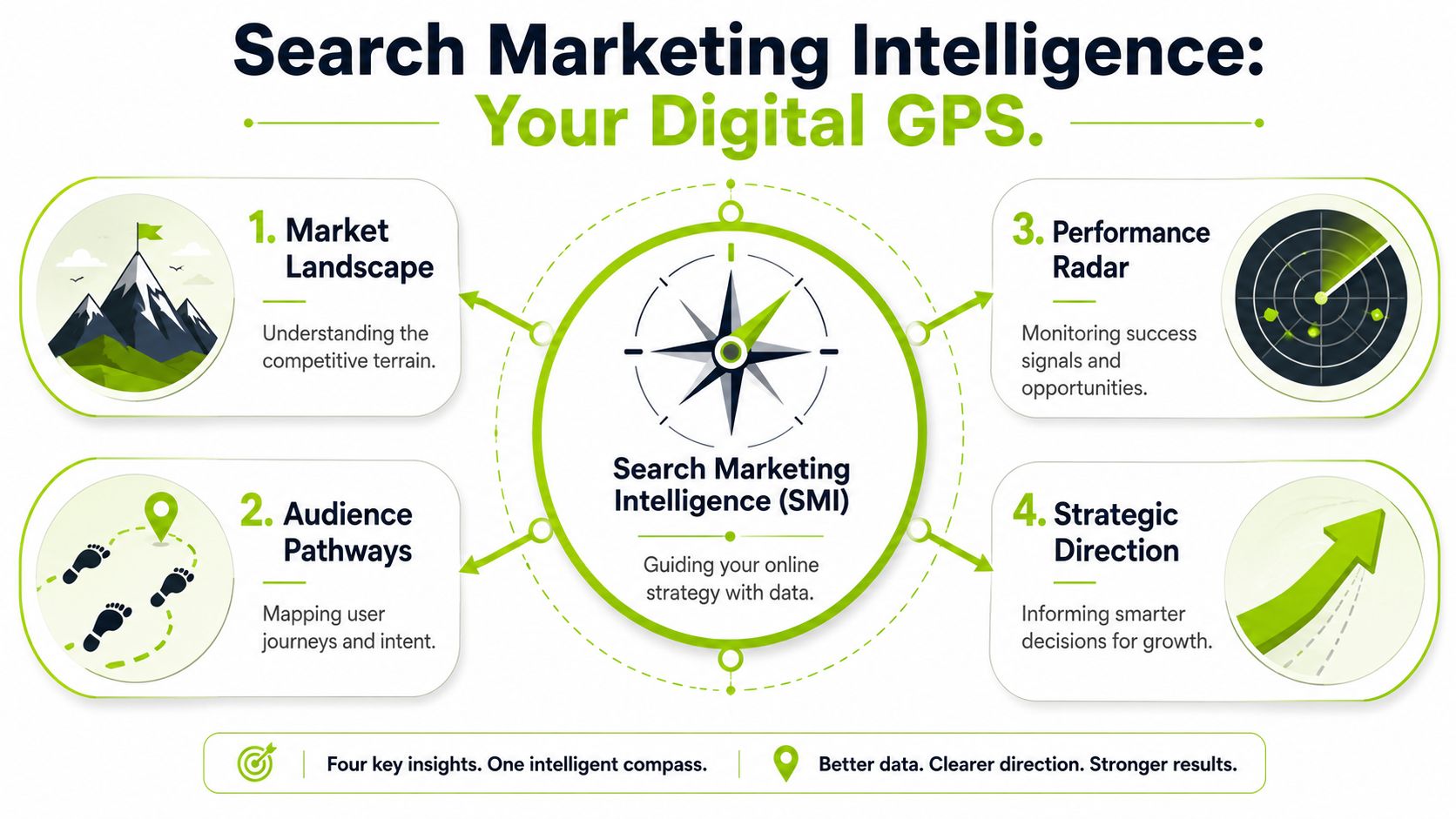
At a practical level, search marketing intelligence means collecting and interpreting signals from the whole search environment. That includes organic listings, paid placements, featured snippets, query patterns, competitor activity, and the newer answer surfaces reshaping discovery. Cordelia Labs describes effective search marketing intelligence as treating SERP data as a structured signal set that combines organic listings, paid ads, featured snippets, and competitor analysis to infer intent shifts and content gaps, which helps teams optimize SEO and PPC from one dataset in its piece on search marketing intelligence.
It's not more reporting. It's better interpretation
Organizations already have data. Search Console, Google Ads, analytics, rank trackers, crawling tools, and content platforms all produce it. The hard part is turning those disconnected outputs into decisions.
That's where search marketing intelligence becomes useful. It helps teams answer questions like:
- Where is demand moving? Query changes often show that before traffic reports do.
- Who owns the SERP? Competitor wins aren't always organic ranking wins. They can come from ads, snippets, video, or AI surfacing.
- Which topics need action? Not every drop is a content problem. Some are a visibility-format problem.
- What deserves budget? Search data can guide both organic priorities and paid support.
The strategic shift
Teams that do this well stop treating SEO, paid search, and content strategy as separate workstreams. They read them as one market signal.
That's especially relevant for editorial and content operations. If your team is trying to connect search data to planning, workflows, and topic prioritization, this guide for content organizations is a useful companion because it frames intelligence as an operating model, not just a reporting layer.
Search marketing intelligence works when it helps a team choose. What to publish, what to defend, what to expand, and what to stop doing.
That's the practical definition. It is search data organized well enough to support real decisions.
The Core Components of Modern Search Intelligence
Many organizations still build search analysis on one pillar. They track rankings, clicks, technical issues, and maybe competitor keywords. That foundation still matters. It just isn't sufficient anymore.
Modern search intelligence needs two pillars. One is familiar. The other is where most blind spots now live.
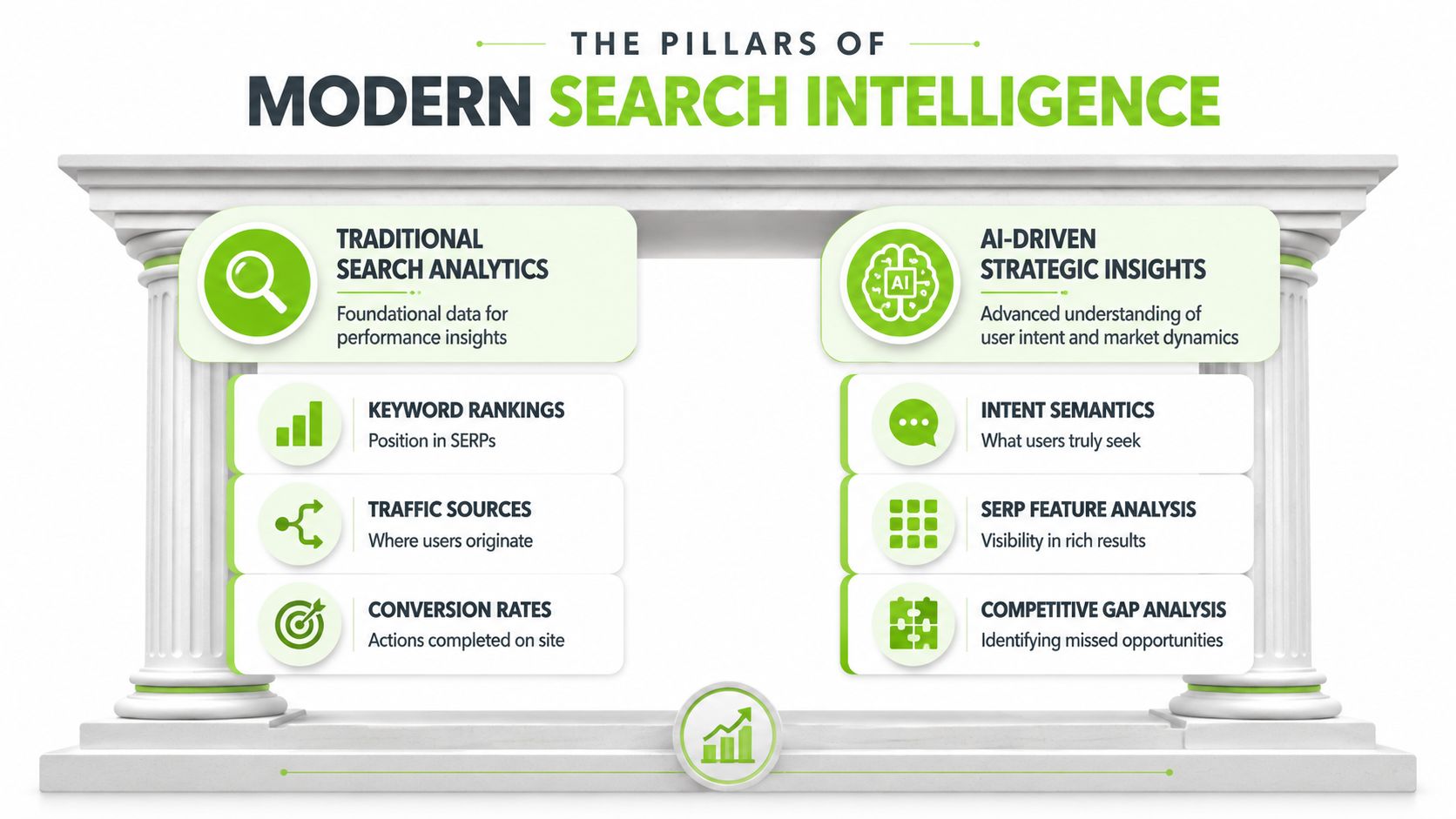
Pillar one is traditional search analytics
This is still the operational core of search work. You need to know how pages rank, which queries trigger impressions, where technical issues block visibility, and how SERP features shape click potential.
That matters because clicks remain highly concentrated near the top of results. Lumar, summarizing research based on analysis of 4 million Google search results, reports that the #1 organic result has a 27.6% click-through rate, compared with 15.8% for position #2. It also notes that position #1 gets 81.5% more clicks than position #2 and roughly 10 times the clicks of position #10. The same summary notes Sistrix found results with sitelinks averaged a 46.9% CTR. Those figures from Lumar's SEO statistics summary explain why rank tracking and SERP feature monitoring still matter.
Traditional analytics usually includes:
- Keyword and page visibility tied to business-relevant query groups
- Technical health signals that affect indexing, rendering, and crawlability
- SERP feature presence such as snippets, sitelinks, image packs, and paid overlap
- Competitor movement across the same topic clusters
This pillar tells you whether your site can compete in search as a web property.
Pillar two is AI visibility and citation tracking
This is the missing layer in many stacks.
Search discovery now happens through AI-generated summaries and assistant-style answers that don't behave like standard result pages. Azarian notes that a major challenge is attributing value across Google AI Overviews and traditional search, and that practitioners report legacy dashboards feel incomplete when they try to explain performance in this environment, as discussed in its article on search marketing intelligence.
That creates a second set of questions:
- Does your brand appear in AI summaries for priority queries?
- Which pages or sources get cited when AI systems answer questions in your category?
- Are third-party sites representing your expertise better than your own domain is?
- Do AI surfaces favor a competitor narrative you haven't addressed?
If you're comparing options for this layer, these AI search visibility tools show the kind of tracking teams now need beyond classic rank monitoring.
Why one pillar without the other fails
A team can have stable rankings and still lose practical visibility if AI summaries answer the query before the click. The reverse is also true. A site can struggle to win top organic positions while still being cited or mentioned in AI-led discovery for high-value topics.
The current mistake isn't abandoning SEO. It's assuming SEO metrics alone still describe search exposure.
A modern search intelligence model combines both pillars because buyers move across both environments. If your reporting only sees one, your strategy will keep correcting the wrong problem.
How to Implement a Search Intelligence Framework
The fastest way to make this too complicated is to begin with tooling. Start with workflow instead. Teams need a system they can run every week, not a slide full of disconnected dashboards.
Funnel describes a mature marketing-intelligence stack as relying on four technical layers: unified data aggregation, metric harmonization, built-in analytical models, and decision-ready dashboards. It also notes that this structure reduces reporting friction and makes trend detection actionable at scale in its overview of marketing intelligence tools. That framework works well for search because it turns a broad idea into an operating model.
Start with aggregation
Pull your core search inputs into one environment. That usually means Search Console, analytics, paid search data, technical SEO data, competitor tracking, and AI visibility data if you have it.
Don't overengineer this stage. The point is to stop answering one performance question with four different exports.
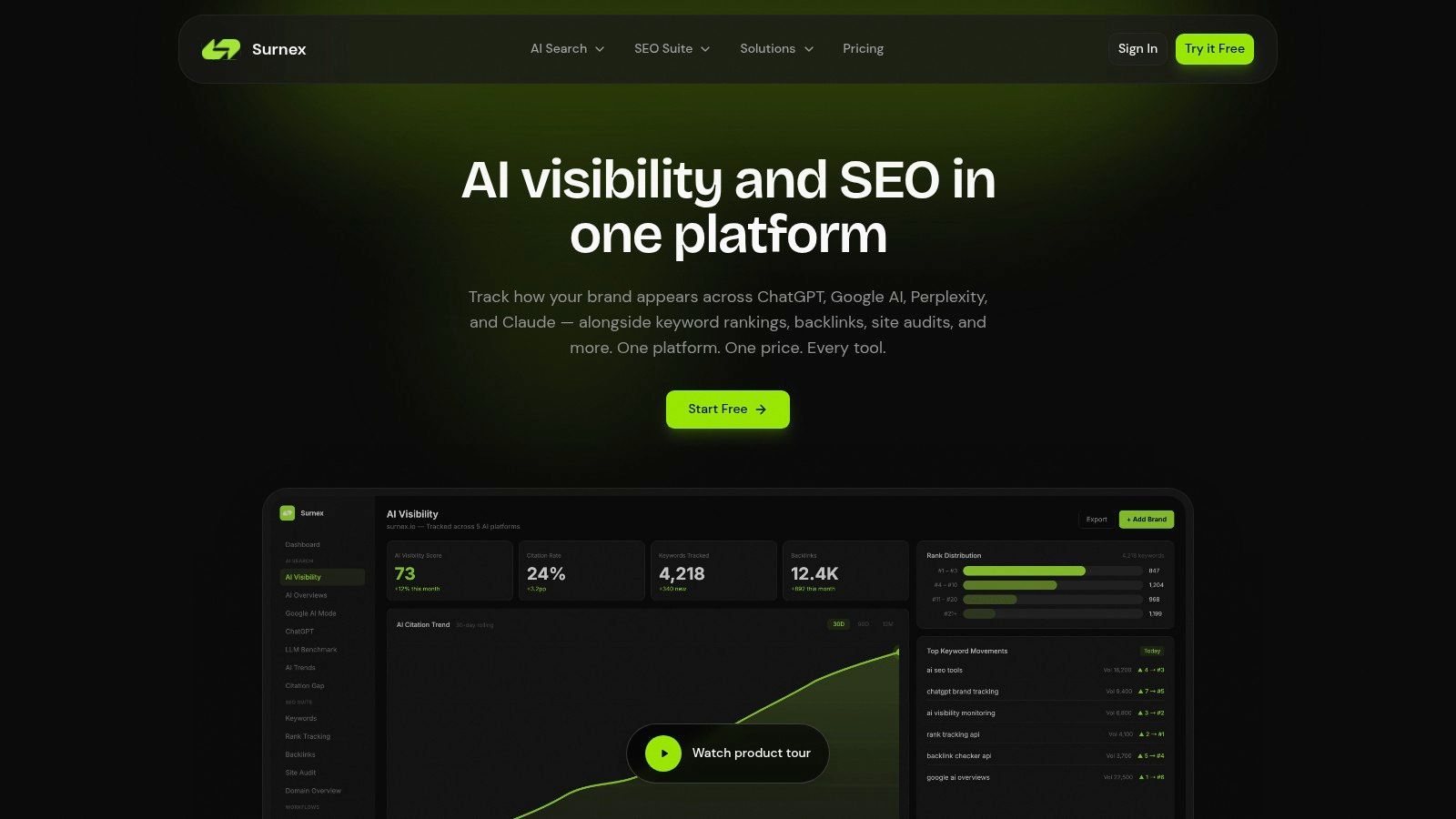
One option in this category is Surnex, which combines AI visibility tracking with core SEO metrics such as rankings, backlinks, audits, and content opportunities in one interface and API. The exact tool matters less than the operating principle. Put traditional and AI-era search signals where one team can read them together.
Harmonize the metrics
Many implementations fail because teams aggregate data but keep incompatible definitions.
A useful framework usually includes a shared query set, shared topic groups, shared competitor set, and a common reporting cadence. That lets everyone compare movement in a way that isn't distorted by channel-specific naming.
A practical metric map often looks like this:
| Reporting layer | Traditional input | AI-era input | Shared question |
|---|---|---|---|
| Visibility | Rankings, impressions, SERP features | AI Overview presence, citations, mentions | Are we showing up where discovery happens? |
| Competition | Organic competitors, ad overlap | Citation competitors, third-party source dominance | Who is capturing the answer? |
| Performance | Clicks, sessions, conversions | Assisted discovery, influenced visits, branded demand shifts | Is search exposure affecting pipeline? |
Build repeatable analysis, not one-off reports
Once the data is aligned, teams need recurring workflows. Good examples include competitor gap reviews, topic cluster reviews, branded versus non-branded visibility checks, and source-gap analysis for AI citations.
If your team is trying to operationalize this with automation, workflows around using AI in SEO can help shape how analysis gets repeated without turning into manual busywork.
Practical rule: If an analyst has to rebuild the same report from scratch each month, you don't have a framework yet.
A simple review rhythm works better than a complex one. Weekly checks for movement. Monthly analysis for themes. Quarterly adjustments for structure and budget.
Here's a useful walkthrough on how teams are thinking about this broader shift in search operations:
Finish with decision-ready dashboards
A dashboard should help an account manager, SEO lead, paid lead, or marketing director answer three things fast:
- What changed
- Why it likely changed
- What we should do next
If the dashboard can't support that, it's only a storage layer. Search intelligence becomes valuable at the point of decision, not at the point of collection.
Key Metrics to Track in the AI Search Era
A lot of search reporting still leans too hard on rankings, sessions, and page-level clicks. Those metrics still belong on the board. They just don't belong there alone.
The shift isn't from old metrics to new metrics. It's from isolated metrics to a more complete set.
What to keep and what to add
The easiest way to modernize reporting is to treat legacy SEO metrics as foundation metrics and AI-era metrics as interpretation metrics.
| Legacy metric | Why it still matters | Modern companion metric | Why it matters now |
|---|---|---|---|
| Keyword rankings | Shows baseline organic competitiveness | Share of voice across search surfaces | Shows whether visibility extends beyond blue links |
| Organic clicks | Captures direct demand capture | AI Overview presence | Shows whether your brand appears before the click |
| Page impressions | Reveals topic exposure | Citation frequency | Shows whether AI systems rely on your sources or brand |
| Branded search trend | Reflects market recognition | Topic authority by prompt set | Shows where AI repeatedly associates you with a subject |
The metrics that deserve executive attention
Typically, four modern measures are enough to start.
- Share of voice across surfaces tracks whether your brand is visible in classic SERPs, rich results, and AI-led answer environments for a fixed query set.
- AI Overview presence tells you whether you are included in Google's summary layer for the topics that matter most.
- Citation velocity shows whether mentions and references are increasing, holding, or slipping over time.
- Topic authority reflects whether systems consistently pull your brand, pages, or viewpoints into answers around a subject.
None of these should live in isolation. Their value comes from comparison. If organic clicks decline while AI presence expands, your interpretation changes. If rankings improve but third-party citations dominate answer layers, your content strategy needs distribution help, not just on-site updates.
What not to obsess over
Some teams respond to AI search by inventing too many experimental KPIs. That usually creates noise.
Avoid metrics that are hard to define consistently, hard to review repeatedly, or impossible to connect to business outcomes. The best reporting layer is still the one stakeholders can understand quickly and trust over time.
If you need a practical way to normalize search exposure into something more comparable across queries, this explanation of an SEO visibility score is useful because it helps frame visibility as a portfolio signal rather than a single keyword outcome.
Track fewer metrics, but make each one answer a real decision.
That's what separates modern measurement from a dashboard full of labels.
Search Intelligence in Action Illustrative Use Cases
The easiest way to understand search marketing intelligence is to look at how it changes decisions.
Agency use case with a nervous client
A client sees a decline in organic clicks on a commercial topic and assumes SEO is underperforming. The old response would be defensive. Show rankings. Explain seasonality. Promise new content.
A stronger response starts by widening the lens. The agency reviews traditional rankings, SERP features, paid overlap, and AI answer presence for the same topic group. That's when the full picture appears. The client's pages aren't disappearing. Search behavior around the topic has changed, and AI answer layers are surfacing the brand more often than the click report suggests.
The conversation changes immediately. Instead of arguing over one declining metric, the agency can show that visibility has shifted format. That protects trust and leads to a better plan: update pages that feed answer extraction, improve source clarity, and adjust reporting so the client sees exposure beyond organic clicks.
A good search report reduces panic because it explains the shift, not just the symptom.
In-house use case with off-site visibility
An in-house team notices that AI systems in its category often pull examples and recommendations from sites the brand doesn't control. Summit Partners notes that AI search engines often cite third-party sources such as Reddit, YouTube, G2, GitHub, and Medium more frequently than brand-owned pages in its piece on how AI is disrupting search marketing.
That insight changes the plan. Instead of putting all effort into another blog refresh, the team builds a distribution strategy. Product experts contribute to community discussions. The company improves profile quality on review platforms. Video explainers are published where buyers already compare options. The team also tracks where competitors are being cited more often and uses that gap to prioritize off-site work.
For marketers thinking through how this affects buying journeys, this report on AI product discovery is worth reading because it helps connect visibility changes to how people now evaluate products.
Both examples show the same principle. Search intelligence is useful when it changes action. Better reporting is nice. Better decisions are the core outcome.
The Future of Search Is Unified Intelligence
Search has split into multiple discovery environments, but the job hasn't changed. Teams still need to understand demand, earn visibility, and prove impact. What changed is the number of places where that work now happens.
That's why unified intelligence is no longer optional. If you only track rankings and organic clicks, you're managing one visible slice of a larger system. You may still catch problems. You won't catch them early, and you won't explain them well.
The teams that adapt fastest are the ones that stop asking only how to rank and start asking how to become the answer. That means understanding not just what your site earns in Google, but also how your expertise travels across AI summaries, assistant responses, and third-party sources. For marketers trying to interpret that shift, this piece on understanding AI Overviews and SEO adds helpful context around why older assumptions about search performance no longer hold.
Search marketing intelligence is the operating model for that reality. It brings SEO, paid search, SERP analysis, AI visibility, and source monitoring into one view that people can effectively use.
The practical takeaway is simple. Keep your traditional SEO discipline. Expand your measurement. Unify your reporting. The teams that do that now will build a more resilient search strategy for the next phase of discovery.
If your team needs a clearer view of how brand visibility is shifting across traditional search and AI discovery, Surnex gives agencies, in-house teams, and developers one place to track rankings, citations, AI presence, and core SEO signals without splitting the story across multiple tools.