Your client asks a fair question: “Are we showing up in AI answers when people search for us?”
If your branded SEO report still starts and ends with Search Console clicks, a few branded rankings, and a traffic chart, you can’t answer that cleanly. You can show whether the homepage ranked. You can’t show whether Google’s AI layer cited the brand, whether ChatGPT surfaced a competitor instead, or whether the language around your brand was favorable, vague, or damaging.
That gap matters because branded search is still a major part of search behavior. Branded searches make up about 44% of all Google queries, and the organic result in position 1 gets a 39.8% click-through rate, according to SE Ranking’s roundup of SEO statistics. Traditional branded reporting still matters. It just no longer covers the full surface area of brand discovery.
The stack many teams built for branded SEO reporting was designed for a simpler SERP. Today, a strong report has to combine classic branded metrics with AI visibility, citation presence, and narrative framing. That’s the shift most old templates are missing.
Why Your Old Branded Reports Are Obsolete
A lot of branded reports still answer the wrong question.
They answer, “Did we rank for our own name?” That’s useful, but it’s too narrow for the search environment most brands now operate in. Buyers don’t only click a homepage result anymore. They read AI Overviews. They compare vendor summaries generated from third-party sources. They ask LLMs for alternatives, reviews, pricing context, and category recommendations before they ever visit a site.
That means branded seo reporting has to track visibility across more than the ten blue links. If you don’t, the report can look healthy while actual brand presence is slipping in the places executives are starting to care about most.
The old report assumes the click is the event
Legacy branded reports usually focus on a small set of familiar outputs:
- Brand keyword rankings for the homepage and a few modifiers
- Branded organic traffic from Google
- CTR and impressions in Search Console
- Maybe conversions from brand terms if analytics is set up well
Those metrics still belong in the report. The problem is that they assume the click tells the whole story. It doesn’t.
A user can now search your brand, read a generated answer, see a competitor mentioned alongside you, and leave with a changed impression without clicking anything. Your old report won’t capture that.
Practical rule: If a stakeholder can ask, “Did AI mention us?” and your report can’t answer, the report is outdated.
Visibility and narrative are now separate problems
Two brands can appear equally often in AI-generated responses and still have very different outcomes. One gets described as trusted, established, or forward-thinking. The other gets framed as basic, expensive, or unclear. Traditional reporting has almost no way to surface that.
That’s why newer reporting models need a narrative layer. Teams tracking AI search shifts are already moving in that direction, especially as AI search trends continue to change how brand discovery happens.
A branded report used to be mostly a measurement artifact. Now it’s also a monitoring system for reputation, discoverability, and citation control.
What the newer model changes
The practical change is simple. Stop treating branded reporting as one tab inside an SEO report. Treat it as a cross-channel intelligence view.
A modern report should connect:
| Reporting area | Old method | Modern requirement |
|---|---|---|
| Search presence | Brand rankings only | Rankings plus AI surface presence |
| Performance | Clicks and sessions | Clicks, sessions, citations, and assisted impact |
| Brand perception | Not tracked | Narrative framing and mention quality |
| Competitive context | Basic rank comparison | Competitor inclusion in AI answers and summaries |
The old model told you whether the brand owned its SERP. The new model tells you whether the brand owns its digital description.
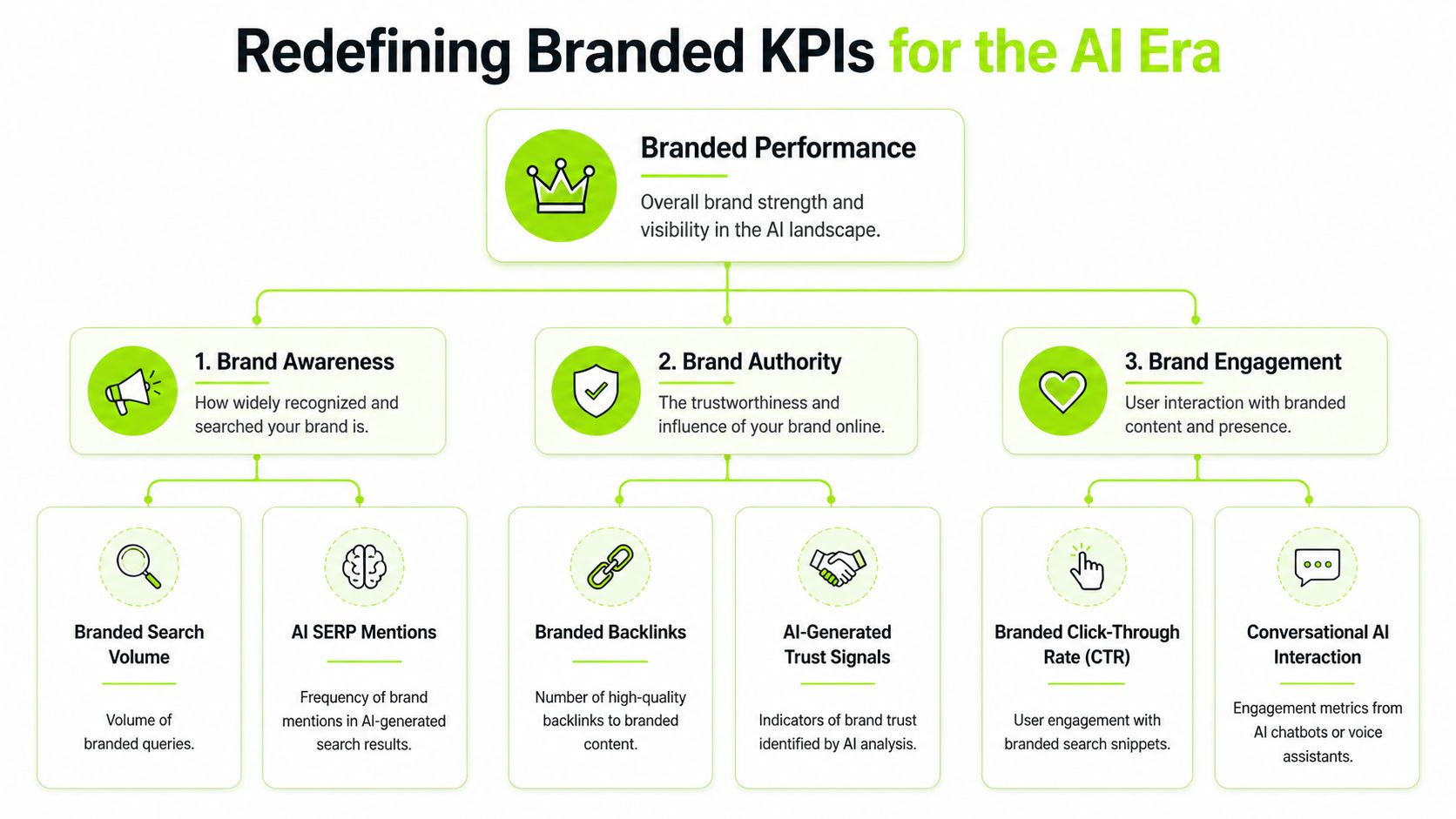
Redefining Branded KPIs for the AI Era
The first fix isn’t a better dashboard. It’s a better metric model.
Many teams don’t have a tooling problem at the start. They have a KPI problem. They’re still reporting branded performance as if branded SEO begins with search demand and ends with a click to the homepage.
That leaves out how brands are surfaced, summarized, and compared in AI results.
Keep the core KPIs, but clean them up
The base layer still matters. I wouldn’t remove any of it. I’d tighten it.
Start with a branded KPI set that’s explicit and segmented:
-
Branded query impressions This shows whether the brand is being searched more often and where demand is forming around modifiers like reviews, pricing, alternatives, locations, or product lines.
-
Branded CTR This catches snippet problems fast. If branded impressions hold steady but CTR slips, title rewrites, weak meta descriptions, or competing SERP features may be pulling attention away.
-
Branded landing pages There's often an over-focus on the homepage. In practice, branded demand often lands on docs, support, pricing, reviews, and comparison pages. If those pages aren’t in the report, you miss real intent.
-
Branded conversions and assisted conversions Branded traffic usually converts differently from non-branded traffic. If you don’t separate them, the report blurs awareness, demand capture, and sales-readiness.
-
Branded vs non-branded segmentation This is still foundational. It stops teams from claiming broad SEO success when most of the gains are coming from people who already know the brand.
For rank tracking, use a dedicated system that can separate exact-match brand terms, modifiers, local variants, and competitor-comparison queries. A toolset like Surnex rank tracking fits here because it lets teams watch those groups in one workflow instead of maintaining a separate spreadsheet for branded terms.
Add the AI layer as a distinct KPI group
Most reporting templates fall short. They either ignore AI visibility entirely, or they drop in a vague mention count and call it covered.
That’s not enough. AI-related branded KPIs need their own group because they answer a different set of questions.
Use metrics such as:
-
AI Overview presence Did the brand appear in AI-generated answers for branded and brand-adjacent queries?
-
Share of LLM mentions Across tracked prompts, how often did the brand appear compared with named competitors?
-
Citation source mix Was the answer informed by your site, by review sites, by publishers, by forums, or by user-generated discussions?
-
Prompt-class coverage Did the brand appear only for navigational prompts, or also for commercial investigation prompts like alternatives, comparisons, implementation, support, and trust questions?
Being present in one branded query cluster doesn’t mean you’re present in the others that influence buying decisions.
A modern branded report should show where the brand appears, where it doesn’t, and who is speaking for it when it’s absent.
Narrative Share of Voice belongs in the report
The most overlooked KPI in branded seo reporting is also one of the most important: Description Share of Voice.
The core idea is straightforward. Two brands can have similar visibility, but the language attached to them can differ sharply. As The Drum’s discussion of the attribution gap notes, the narrative frame matters. A brand described as “forward-thinking” lands differently from one described as “basic,” even if both are mentioned equally often.
That gives you a practical KPI layer to build:
| KPI | What it tells you | Why it matters |
|---|---|---|
| Description Share of Voice | The recurring descriptors attached to your brand | Shows whether AI frames the brand favorably |
| Competitor co-mention rate | How often rivals appear in the same answer | Reveals where your branded SERP is becoming comparative |
| Third-party dependency | Whether AI leans on outside sources over your own pages | Signals where reputation is being outsourced |
| Negative narrative flags | Repeated weak or risky descriptors | Helps catch reputation issues early |
Narrative metrics won’t be as clean as CTR. That’s fine. They’re still operationally useful.
Build KPIs by decision, not by data source
One reason branded reports get bloated is that teams organize metrics around tools. Search Console section. Analytics section. Rank tracker section. AI section.
That’s backwards.
A better dashboard organizes KPIs around decisions:
-
Demand capture Are we capturing brand intent when people search for us?
-
Brand control Are we the primary source behind our own story?
-
Commercial influence Are branded interactions supporting pipeline and conversion paths?
-
Narrative quality Are we being described in the way we want to be known?
If a metric doesn’t help make one of those decisions, it probably belongs in an appendix, not in the executive view.
Building Your Unified Data Collection Stack
Good branded SEO reporting starts with boring plumbing.
Most reporting problems that look strategic are data problems. Queries aren’t tagged cleanly. AI observations sit in a separate sheet. Brand modifiers change by market. Paid traffic bleeds into branded narratives. Then the dashboard gets blamed for confusion that really started upstream.
The fix is a unified stack with clear ownership rules.
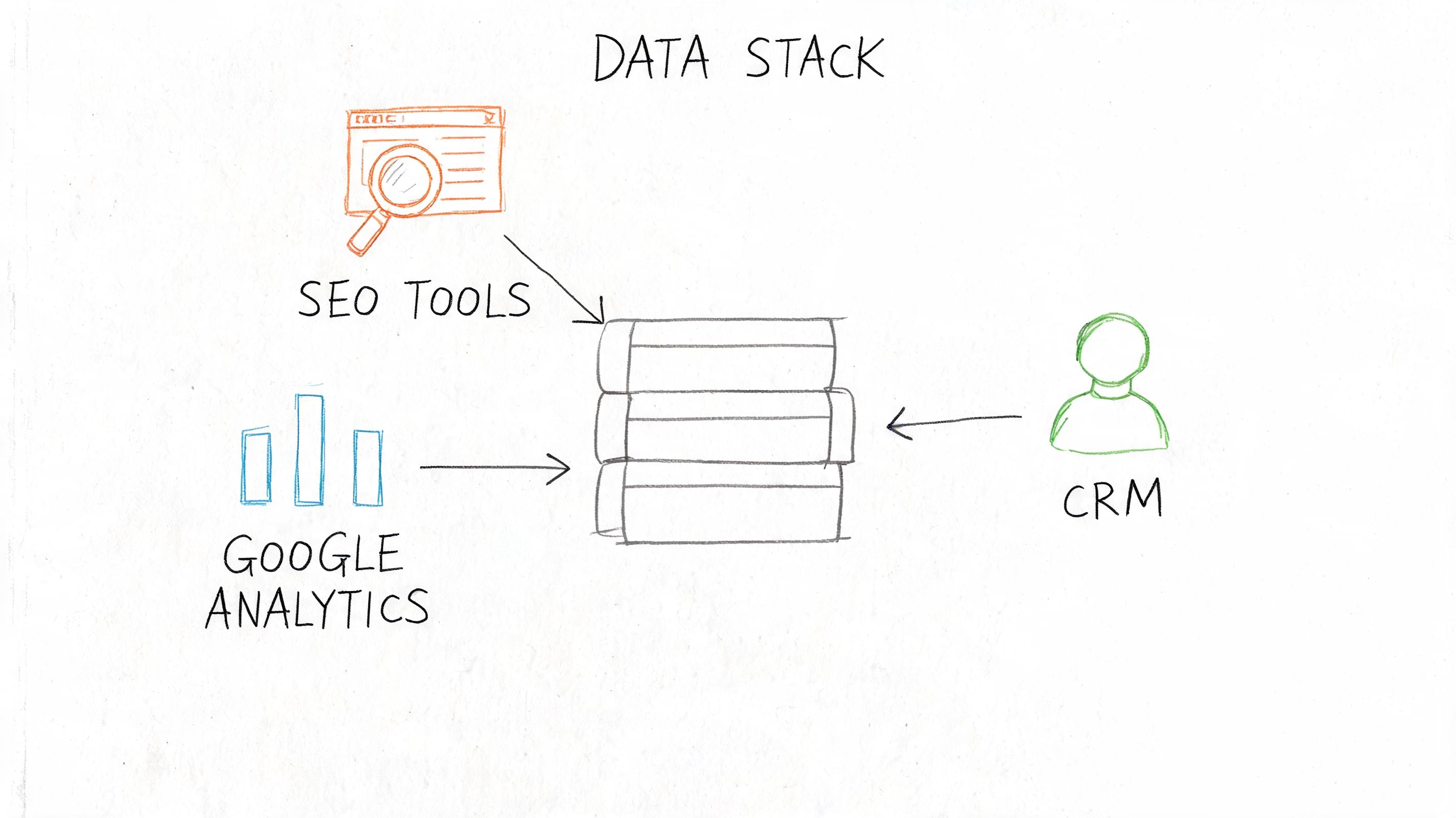
Start with the systems that already hold the truth
For many teams, the core stack looks like this:
- Google Search Console for branded query impressions, clicks, CTR, and landing-page pairing
- GA4 for sessions, conversion paths, and branded landing-page behavior
- A rank tracker for exact brand terms, brand modifiers, review terms, and comparison terms
- Backlink data for brand-anchor trends and third-party validation pages
- A warehouse such as BigQuery for normalization and joining datasets
- CRM data for lead quality, opportunity stages, or downstream sales signals
- AI visibility tracking for AI Overview presence and LLM mention monitoring
The operational win comes from getting all of that into one model, not from having more tools.
Filter branded queries properly
This step is where a lot of teams cut corners. They create one regex for the main brand name and stop there.
That misses branded modifiers, common misspellings, product-line terms, executive-name searches, branded support phrases, and category pairings that still represent branded demand.
Use a branded query dictionary with grouped match logic:
| Query group | Example pattern | Why it matters |
|---|---|---|
| Exact brand | Brand name only | Pure navigational demand |
| Brand plus modifier | Brand + pricing, reviews, login | Commercial and support intent |
| Misspellings | Common brand variants | Captures real search behavior |
| Product-linked brand | Brand + product name | Connects brand to solution demand |
| Comparison terms | Brand vs competitor | Shows consideration-stage pressure |
The technical guidance worth keeping here is simple: filter Search Console for brand matches and export to BigQuery for normalization. That approach is specifically recommended in The Digital Ring’s SEO reporting guide. The same guide also notes that branded traffic converts 4-8x higher than non-branded, but over-reliance can inflate perceived SEO wins by 50% due to paid channel bleed. That’s exactly why clean segmentation has to happen before anyone opens Looker Studio.
Use a warehouse so reporting logic is stable
If you’re still copying CSV exports into slides every month, the reporting process will stay fragile.
BigQuery works well because it gives you one place to:
- standardize branded query classifications
- join Search Console with GA4 landing pages
- map rank-tracked keywords to query groups
- append CRM outcomes
- store AI visibility snapshots over time
A simple starter SQL pattern for branded query filtering looks like this:
SELECT
  date,
  query,
  page,
  clicks,
  impressions,
  ctr,
  position,
  CASE
    WHEN REGEXP_CONTAINS(LOWER(query), r'brandname|brand name|brandname reviews|brandname pricing') THEN 'branded'
    ELSE 'non_branded'
  END AS query_type
FROM `project.dataset.search_console`
WHERE date >= DATE_SUB(CURRENT_DATE(), INTERVAL 12 MONTH)
That isn't complex. It doesn’t need to be at first. The goal is a repeatable classification model your team can improve over time.
Bring AI visibility into the same warehouse
Many stacks often remain disconnected. AI tracking gets treated as an experiment instead of a reporting input.
It should sit beside ranking and traffic data, not outside it.
In practice, teams need to track:
- whether the brand appears in Google AI Overviews
- whether the brand appears in tracked LLM prompts
- which domains get cited when the brand is mentioned
- whether competitors are co-mentioned
- what descriptors show up repeatedly
A platform such as Surnex can be one source for this because it tracks AI visibility alongside core SEO metrics and exposes data through an API. That matters if you want one client-ready model instead of separate AI screenshots pasted into a monthly deck.
A conceptual API pull might look like this:
curl -X GET "https://api.surnex.io/v1/ai-visibility/mentions?entity=brandname&window=30d" \
  -H "Authorization: Bearer YOUR_API_KEY"
And a second endpoint for tracked branded prompts might look like:
curl -X GET "https://api.surnex.io/v1/ai-visibility/prompts?tag=branded" \
  -H "Authorization: Bearer YOUR_API_KEY"
The exact endpoint structure depends on the implementation, but the reporting logic should stay the same. Pull AI mention data into the warehouse, timestamp it, and map it to the same brand taxonomy you use for search queries.
Join datasets around entities, not around channels
The cleanest model I’ve seen uses a shared entity table.
That table contains the canonical brand name, known variants, product names, executive names, and key competitors. Once that exists, every incoming dataset can map to the same entity layer.
A join pattern might look like this:
SELECT
  s.date,
  e.entity_name,
  s.query,
  s.clicks,
  s.impressions,
  g.sessions,
  g.conversions,
  a.llm_mentions,
  a.ai_overview_presence
FROM `project.dataset.search_console_branded` s
LEFT JOIN `project.dataset.entity_map` e
  ON REGEXP_CONTAINS(LOWER(s.query), e.match_pattern)
LEFT JOIN `project.dataset.ga4_landing_pages` g
  ON s.page = g.landing_page AND s.date = g.date
LEFT JOIN `project.dataset.ai_visibility` a
  ON e.entity_name = a.entity_name AND s.date = a.date
That gives you one reportable row set instead of four disconnected views.
If your AI visibility data can’t be joined to your branded query groups, it’s not part of the reporting stack yet. It’s just monitoring.
Don’t forget qualitative capture
Not everything useful belongs in SQL.
For AI narrative tracking, I still recommend a small manual review layer. Keep a structured sheet or table with fields like:
- prompt
- engine
- date captured
- brand mentioned yes or no
- competitor mentioned yes or no
- primary descriptors
- cited domains
- analyst notes
That manual layer is often what catches the issue a quantitative dashboard misses. Especially when the problem isn’t absence, but framing.
Designing a Client-Ready Reporting Dashboard
A strong reporting stack can still fail if the dashboard reads like an analyst’s scratchpad.
Clients and internal stakeholders don’t need to see every table you built. They need a view that helps them answer three questions fast: what changed, why it changed, and what they should do next.
That means the dashboard needs hierarchy, not just data density.
Build one dashboard for different readers
The same dashboard usually serves at least three audiences:
| Audience | What they care about | What they don’t need |
|---|---|---|
| Executive team | Brand visibility, business risk, strategic movement | Query-level noise |
| Marketing lead | Trends, page groups, competitor changes, AI mention shifts | Raw warehouse logic |
| SEO team | Keyword clusters, page performance, source data, diagnostics | Summary-only scorecards |
The mistake is trying to satisfy all three with the same top section.
A better layout starts with a compact executive summary, then moves into analyst-friendly drill-downs below the fold.
The executive layer should be sparse
Keep the top of the dashboard tight. Five to seven cards is usually enough if the underlying model is solid.
Useful top-line modules include:
- Branded demand trend
- Branded CTR trend
- Branded conversions or assisted influence
- AI visibility status
- Narrative watchlist
- Top risk or top opportunity
- Short written summary
This is the part most stakeholders will remember after the meeting. If it’s crowded, they’ll miss the story.
A workflow designed for client-ready reporting usually works best when the dashboard acts like a briefing memo first and a reporting database second.
The best dashboard element is often a sentence, not a chart. “Brand demand held steady, but AI summaries started citing review sites instead of product pages” is more useful than another scorecard.
Use visual formats that match the decision
A common dashboard issue is chart misuse. Teams use the same line chart for everything because it’s convenient, not because it fits the metric.
Match the format to the question:
- Scorecards for current-state KPIs
- Time-series charts for trend movement
- Stacked bars for source mix or citation composition
- Tables for branded query clusters and page-level detail
- Annotated callouts for AI narrative changes
For design decisions inside the dashboard itself, the same discipline used in CRO applies. If you’re reworking layout, labels, or summary modules, it helps to borrow from A/B testing best practices. Not because a dashboard is a landing page, but because clarity improves when teams test assumptions about what readers notice and understand.
A simple page structure works better than a clever one
Most branded reporting dashboards should follow a predictable flow:
Summary view
Short, readable, and built for meetings. Include the current period, the prior comparison period, and one concise interpretation for each top KPI.
Search ownership view
Focus on branded queries, landing pages, CTR, and branded modifier groups. Traditional SEO reporting still does most of its work on these.
AI visibility view
Show appearance across AI Overviews and tracked LLM prompts, plus cited-domain patterns and competitor co-mentions.
Narrative view
List repeated descriptors, favorable language, negative terms, and any shifts in framing that need action.
Recommendations view
Don’t bury this at the end of a slide deck. Add a visible panel with actions tied directly to the findings.
Keep annotations human
Automation helps with refreshes. It usually hurts when it writes summaries badly.
I prefer pre-structured commentary blocks where the strategist fills in a few fields:
- What changed
- Likely cause
- Business impact
- Recommended response
That’s enough structure to keep commentary consistent without flattening judgment.
If you’re using Looker Studio, build those blocks from blended fields and leave space for manual notes. If you’re using an integrated reporting environment, the same principle applies. The dashboard should help the strategist think clearly, not replace that role.
Automating Your Reporting Cadence and Workflow
Manual branded reporting burns time in exactly the place your team should be adding judgment.
If analysts spend the last two days of every month exporting query data, cleaning naming issues, taking screenshots, and fixing broken charts, they’re not doing the work clients pay for. They’re assembling a packet.
That’s why cadence matters as much as automation.
More than 50% of marketing agencies produce monthly SEO reports, which is why monthly reporting remains the standard operating rhythm for client accountability, according to We Are TG’s review of SEO reporting norms. That cadence still makes sense for branded seo reporting because it gives search behavior enough time to settle while keeping stakeholders close to meaningful shifts.
Monthly for visibility, quarterly for interpretation
A monthly cycle works best for the core report.
It’s frequent enough to catch important movement in branded query behavior, AI presence, and competitor encroachment. It’s also slow enough to avoid turning routine SERP fluctuation into false urgency.
Then layer a quarterly review on top for the bigger questions:
- Are branded modifiers changing?
- Is AI citing us more or less often?
- Are third-party sources shaping the narrative?
- Are support, review, and comparison pages doing the work they should?
That quarterly layer is where strategy gets updated. The monthly layer is where accountability stays real.
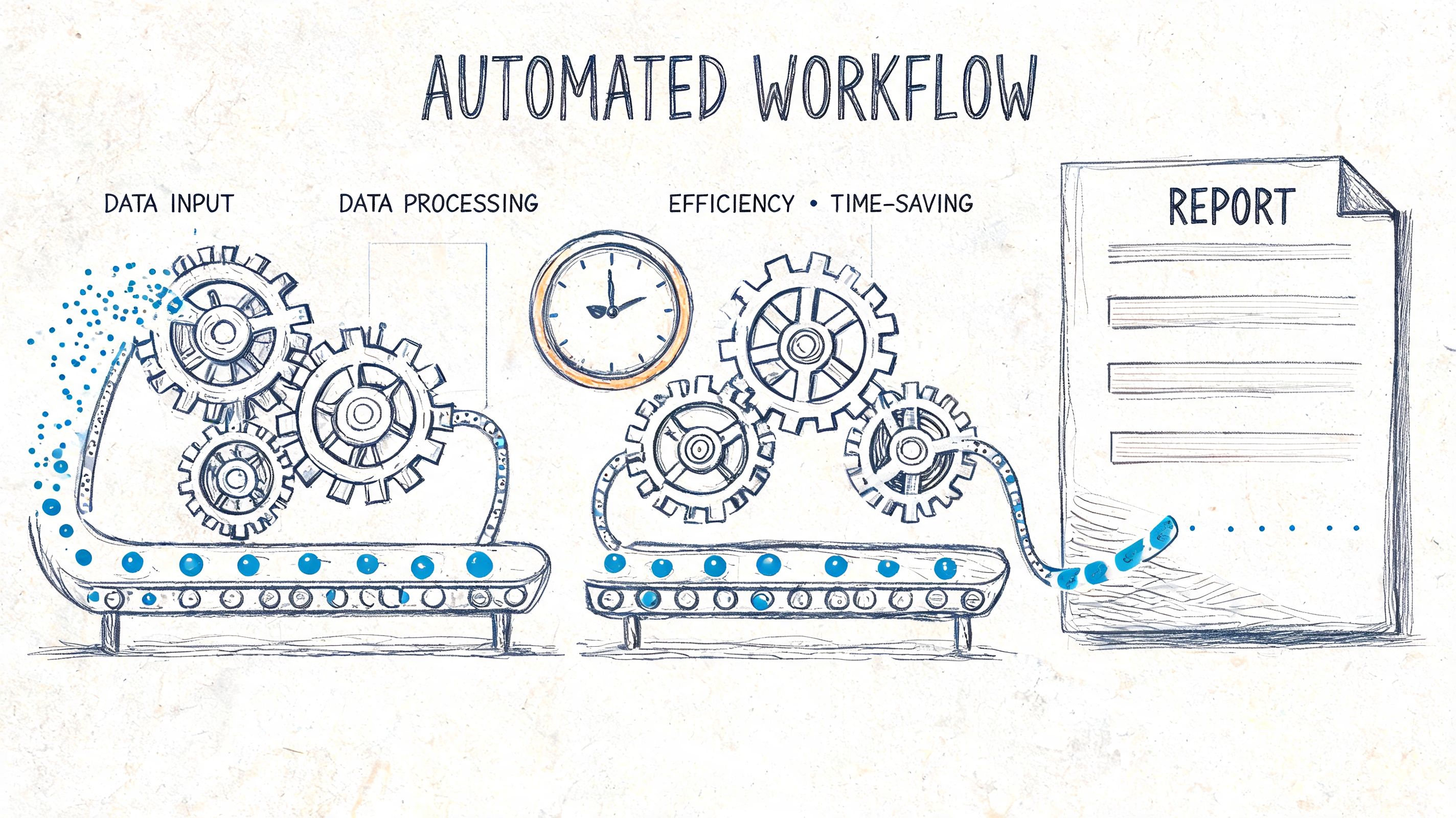
Automate the pipeline, not the thinking
The stack should automate collection, normalization, and refreshes.
That usually means:
- scheduled API pulls into a warehouse
- recurring query classification jobs
- dashboard refresh schedules
- anomaly alerts for major branded changes
- prebuilt commentary fields for human review
A lot of teams over-automate the final output and under-automate the messy middle. Fix the middle first.
For teams refining the operational side of reporting systems, practical frameworks around optimizing business workflows are useful because they push the conversation beyond “Can we automate this?” to “Which tasks should stay manual because they require judgment?”
A useful setup also includes alerting. If branded CTR suddenly drops, if a competitor starts appearing in your tracked branded prompts, or if narrative language shifts in a concerning direction, someone should know before the monthly review.
A short explainer can help teams align on that process:
The workflow that usually holds up
In practice, the cleanest operating model is:
- Daily or scheduled ingestion from search, analytics, rank, and AI systems
- Weekly QA on mappings, anomalies, and prompt coverage
- Monthly reporting for the client or leadership team
- Quarterly strategic review with recommendations and reprioritization
That rhythm frees up time for interpretation. It also prevents the common agency pattern where reporting gets treated like a deadline instead of a management tool.
Turning Branded Data into a Compelling Narrative
The strongest branded SEO reports don’t feel like exports. They read like judgment.
That doesn’t mean adding hype to neutral data. It means connecting visible movement to an explanation stakeholders can use. Most clients don’t struggle to read a chart. They struggle to understand what action the chart should trigger.
The before and after most teams recognize
Here’s the weak version of a branded update:
- branded traffic increased
- homepage rankings held
- brand queries remained strong
- impressions were stable
None of that is wrong. None of it is especially useful either.
Now compare it with a sharper version:
- branded demand stayed healthy
- CTR softened on brand-plus-review queries
- competitor comparison pages started appearing more often
- AI answers mentioned the brand, but cited third-party review sources instead of owned pages
- recommendation: strengthen review, comparison, and proof assets so the brand controls more of the commercial narrative
Same reporting category. Very different level of value.
“Numbers don’t build trust by themselves. Good interpretation does.”
Use a simple interpretation frame
I use a four-part frame because it keeps commentary disciplined:
| Step | Question | Example output |
|---|---|---|
| Observation | What changed? | Brand queries held, but AI citation mix shifted |
| Cause | Why likely changed? | Third-party review content gained visibility |
| Impact | Why does it matter? | Buyers may form opinions before visiting the site |
| Response | What should we do? | Improve review pages, comparison assets, and supporting citations |
That format works well in agency reporting because it stops teams from over-talking metrics and under-explaining consequences.
Don’t hide the uncomfortable parts
A common reporting failure is selective storytelling. The report emphasizes the one clean win and leaves out the messy context.
That’s one reason cherry-picking is so damaging. As SEOSiteCheckup’s guide to reporting missteps notes, one recurring pitfall is reporting 95% branded traffic dominance without acknowledging paid or social influence, which can mislead stakeholders and appears in an estimated 60% of agency reports.
That’s not just a methodological issue. It changes the story you tell.
If paid search, social activity, PR, or product launches are inflating branded demand, say so. If branded performance looks strong because existing customers are doing most of the searching, say that too. A credible report separates signal from comfort.
Explain dips without sounding defensive
When branded visibility slips, weak reporting gets reactive fast. It either blames the algorithm or tries to minimize the change.
The better move is to explain the loss in context:
- Was the dip isolated to one modifier class?
- Did a competitor publish a stronger comparison or review asset?
- Did AI answers pull more heavily from publishers or forums?
- Did a page rewrite reduce clarity for branded commercial intent?
A good narrative doesn’t pretend bad news is good. It shows that the team understands the mechanism behind it.
Tie branded reporting to business outcomes carefully
Not every branded change maps cleanly to revenue. Don’t force certainty where the data doesn’t support it.
But you can usually connect branded signals to business reality by asking better questions:
- Are leads from branded entry pages more sales-ready?
- Are support or pricing searches increasing before close periods?
- Are comparison searches rising when win rates become more contested?
- Are AI-generated summaries aligning with what sales teams hear on calls?
Those are useful links because they connect search behavior with operational signals the business already trusts.
Keep one narrative thread through the whole report
Every monthly report should have a central sentence.
Not a slogan. A sentence.
Examples:
- The brand still owns navigational demand, but commercial branded discovery is becoming more comparative.
- AI mentions are present, but the narrative is increasingly controlled by third-party sources.
- Branded search demand is stable, yet the pages shaping trust are not the pages we own.
That sentence gives the report coherence. Without it, stakeholders remember isolated metrics and miss the strategic picture.
Your Blueprint for Modern Brand Visibility
Branded SEO reporting used to be a narrow exercise. Check branded rankings. Pull traffic. Comment on CTR. Move on.
That model no longer covers how brands are discovered and judged.
A useful modern report combines classic branded search signals with AI visibility, citation patterns, and narrative framing. It separates branded demand from non-branded growth, shows where third parties are shaping perception, and turns raw observations into decisions a team can act on.
If you build the stack well, the reporting process gets simpler, not more chaotic. The warehouse holds the logic. The dashboard tells the story. The strategist handles interpretation. And the business gets a clearer view of AI visibility alongside traditional search performance.
That’s the point of modern branded seo reporting. Not more charts. Better control over how the brand appears, how it’s described, and where the next risk is forming.
If you need one place to track branded rankings, AI Overview presence, LLM mentions, and client-ready reporting without stitching together separate tools, Surnex is built for that workflow. It gives agencies, in-house teams, and developers a unified way to monitor modern search visibility and turn it into reporting that’s easier to explain and act on.