
Your team publishes a strong article on your site. A week later, someone drops a link into Slack. The same article is live on an industry portal, almost word for word. One person likes the extra exposure. Another asks if this will hurt rankings. Someone else wants to know whether this counts as a win, a problem, or both.
That moment is where a lot of content teams first ask what is content syndication.
The confusion makes sense because people use the term in two different ways. Sometimes they mean a publisher or partner site republishing your article with permission. Sometimes they mean a B2B demand gen vendor distributing your whitepaper or guide through a lead capture network. Those are related ideas, but they do different jobs and create different risks.
If you're also trying to understand how this plays out in AI-driven discovery, the confusion gets even worse. A syndicated article can show up in search, in recommendation widgets, in newsletters, in publisher archives, and in systems that summarize the web rather than sending a click. That means reach alone isn't the whole question anymore. Attribution matters more than ever. So does knowing where your brand is being repeated and cited, including in places covered by guides on tracking brand mentions in AI search.
The Article That Showed Up on Someone Else's Site
A content marketer usually notices syndication backwards.
Not during planning. Not during a neat kickoff call. During cleanup.
An article that your team wrote, edited, approved, and promoted suddenly appears on another site. The page might say “Originally published on” with a link back. Or it might just run the piece with a slightly changed title and your byline. If the republishing was intentional, everyone relaxes. If nobody on your team recognizes the partner, things get tense fast.
Why the first reaction is usually mixed
The first reaction is often two emotions at once.
You like the reach. A larger audience may now see the piece. A recognizable industry site may put your brand in front of readers who never visit your blog. But then the SEO alarm goes off. If this is the same article, won't Google think it's duplicate content? Could the partner outrank your original? Could your own work get buried by the copied version?
Those are good questions. They're also where teams often talk past each other because they're mixing two separate models under one label.
The two models people keep blending together
Here's the plain version:
- Publisher syndication means another site republishes content you already made.
- B2B lead-gen syndication means a vendor distributes a gated asset, usually to collect leads.
Both involve sending content beyond your own website. But the mechanics differ. The SEO setup differs. The money flow differs. Even the success metric differs.
The same word gets used for both models, which is why teams often think they're discussing one tactic when they're actually discussing two.
If you only remember one thing from this article, remember that distinction first. It clears up almost every later question about rankings, lead quality, and whether syndication still matters in a search environment shaped by AI summaries and recommendation systems.
What Content Syndication Actually Means
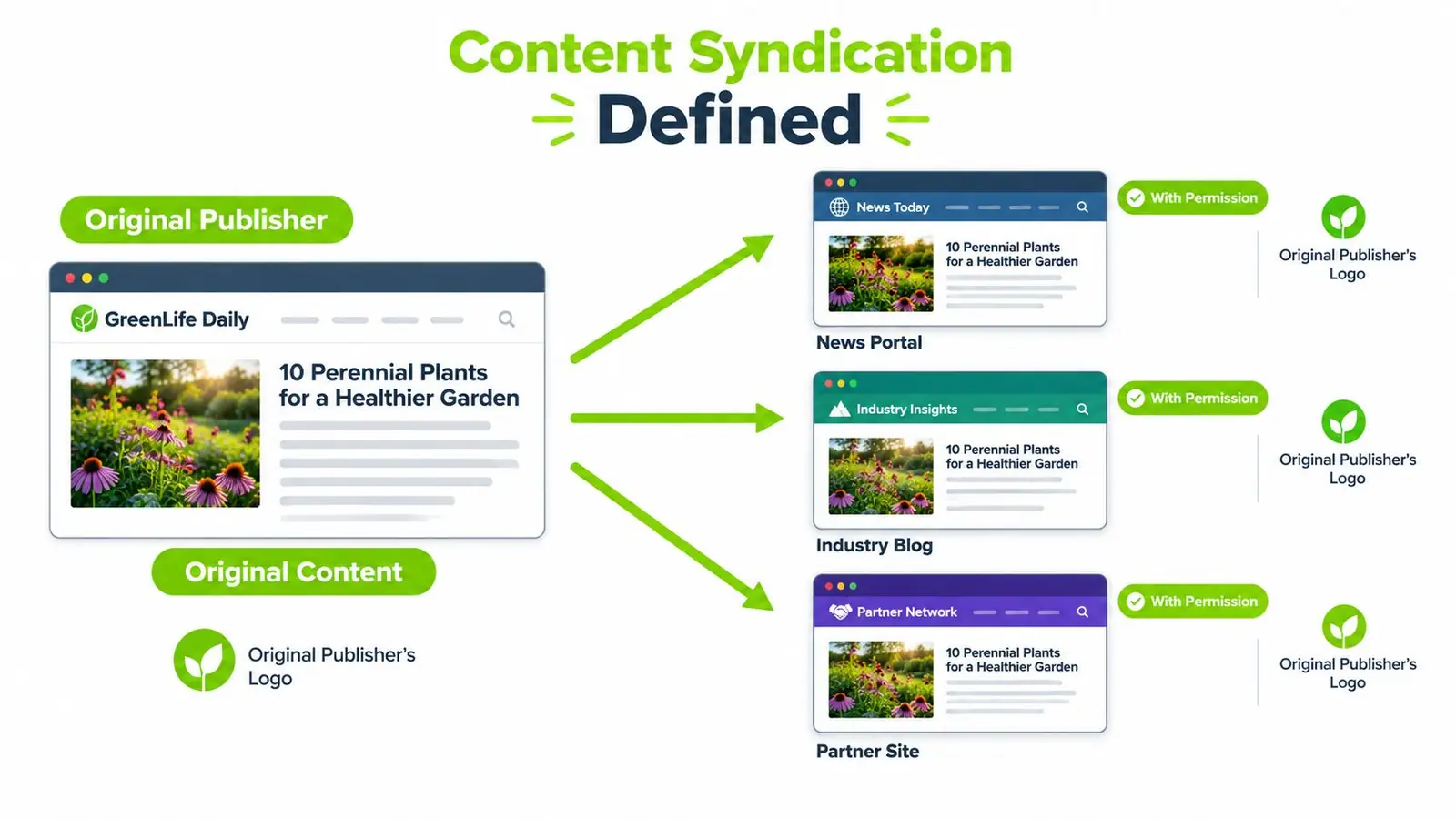
Content syndication means distributing the same content through another platform with permission while the original owner still owns the work.
A library system. You wrote the book. Your site is the original shelf. Other places stock approved copies so more people can read it. The catalog should still point back to where the book came from.
The publishing meaning
In the publishing sense, syndication is simple. A third-party site republishes an article, infographic, video, or other asset from the original publisher. The partner gets material for its audience. The original publisher gets distribution beyond its own site.
This model has deep roots. One market overview notes that content syndication as a distribution model has existed for decades, with an early precedent in the 1920s U.S. motion picture industry, when films were run multiple times after first presentation. The same overview says Jupiter Communications estimated the syndication market would grow from $126 million in 1998 to $1.5 billion by 2004 worldwide. That's a useful reminder that syndication didn't start as a trendy growth hack. It developed into a real distribution channel over time, as described in this content syndication market overview.
The B2B demand gen meaning
In B2B marketing, the phrase often means something else.
A vendor distributes a gated asset, such as an ebook, report, webinar, or buyer's guide, across its network. The audience fills out a form to access the asset. The brand sponsoring the asset receives lead data. In this model, the content isn't just being republished for readership. It's being used as a lead capture device.
That distinction matters because many explainers blur the two. One B2B-focused guide makes the point clearly: the term is used both for republishing content on third-party sites and for distributing gated assets through lead-gen networks, which is why people get confused about SEO, duplicate content, and lead quality in the first place, as explained in this overview of content syndication meanings.
A definition you can actually use
If a client asks for the short version, use this:
Content syndication is the licensed distribution of your content through third-party platforms, either to expand readership or to generate leads, while your brand remains the original source.
That sentence is simple enough to repeat and precise enough to avoid the usual confusion.
How Content Syndication Works in Practice
A syndication deal looks clean from the outside. Inside, it has moving parts.
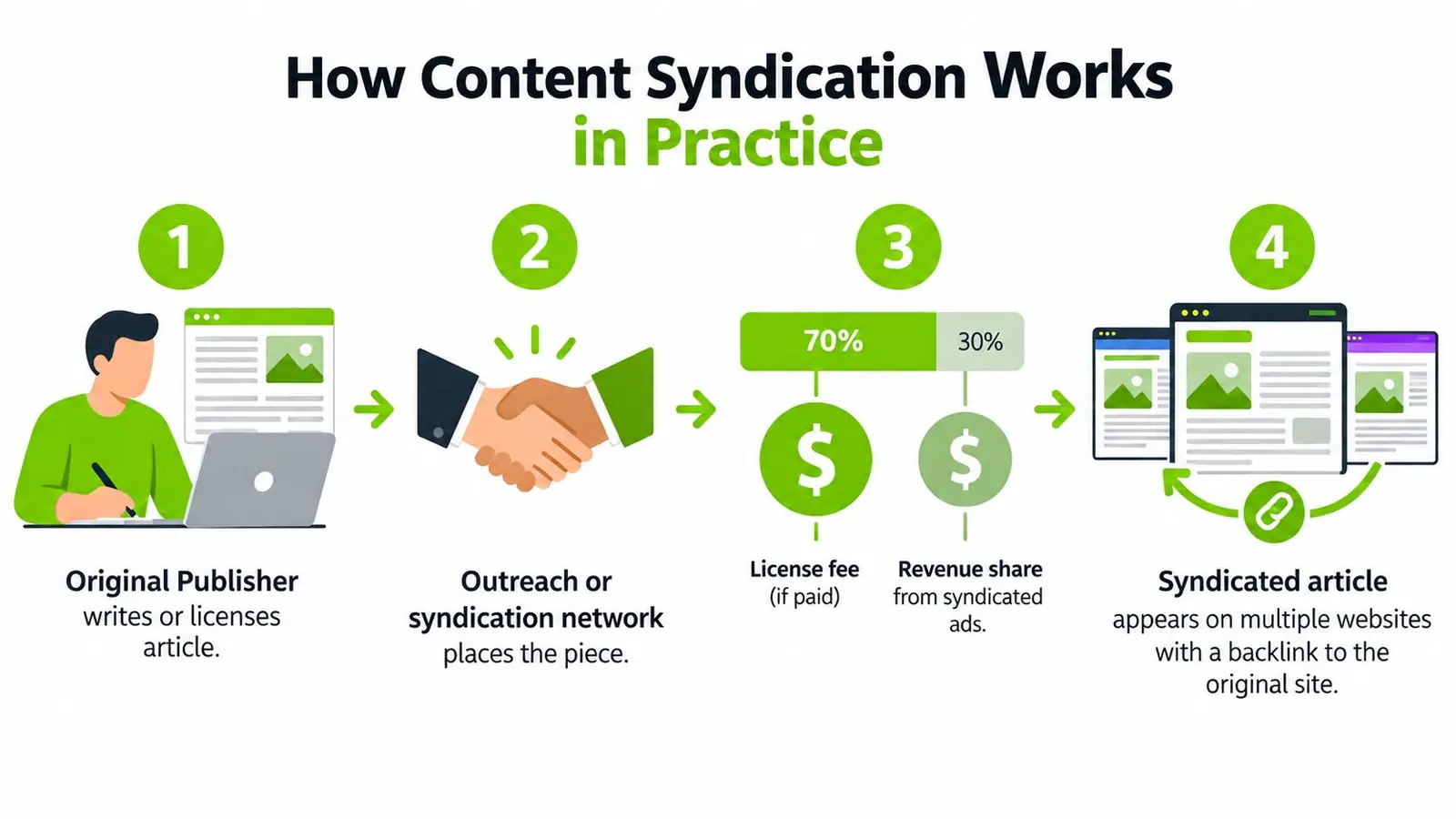
The content has to be chosen. A partner or network has to agree to distribute it. Attribution has to be set up. Someone has to decide whether the content will appear in full, in part, or behind a form. And someone has to pay, or at least benefit enough, to keep the arrangement going.
To make that easier to picture, start with the basic flow.
A simple example
Say your team publishes a guide for IT leaders. You have two options.
In the publishing model, an industry publication agrees to republish the guide as an article on its site, usually with attribution and a link to the original source. Readers consume the content openly.
In the lead-gen model, a syndication vendor promotes that same guide through a network of sites or placements. A reader clicks, lands on a form, submits details, and then gets the asset. The value exchange is different. One model trades content for audience attention. The other trades content for contact data.
Who gets what
The easiest way to understand syndication is to follow the incentives:
- Original publisher or brand: Gains distribution, visibility, and possibly referral traffic or leads.
- Partner site or media outlet: Gains content to publish without creating it from scratch.
- Syndication vendor in lead-gen campaigns: Usually earns revenue from distribution and lead delivery.
- Reader: Either gets free access to the article or exchanges information for a gated asset.
That's why money flow matters. If a site republishes your article with permission, that may function like a content partnership. If a vendor pushes your asset across a network and charges for performance, that's a paid demand gen channel.
Here's a useful visual example of that flow:
The three common delivery formats
Most campaigns use one of these formats:
-
Full republish
Best when your goal is thought leadership, awareness, or broad reach. This is the classic “originally published on” setup. -
Partial repost with a link back
Best when you want the partner to tease the content but send readers to your site for the full piece. This can work well for editorial partnerships. -
Gated PDF or asset download
Best when the goal is lead generation. The content is usually promoted through forms, landing pages, or recommendation placements.
Operational rule: Before launch, agree on the exact format. Most reporting problems start when one side thinks the deal is for visibility and the other side treats it like a lead program.
Why Syndication Became a Mainstream B2B Tactic
B2B teams didn't adopt syndication because it sounded fashionable. They adopted it because owned channels alone often don't reach enough of the right people.
Long sales cycles create a practical problem. You need to educate a narrow audience over time, often before they're ready to talk to sales. Organic search helps, email helps, and paid search helps, but many teams still need another channel that can place useful content in front of in-market professionals who already spend time on niche publications and network sites.
That's why syndication moved from edge tactic to standard line item. One industry review reports that 79% of marketers use at least one vendor for content syndication, 30% of B2B experts say it is the most effective lead-generation tactic, 65% of B2B experts in 2017 prioritized syndication to generate more leads, and 47% wanted to increase their resources for it, according to this industry review of content syndication usage.
Content Syndication in B2B Demand Gen Usage Snapshot
| Metric | Statistic | Source context |
|---|---|---|
| Marketers using at least one syndication vendor | 79% | Industry review of marketer adoption |
| B2B experts naming it the most effective lead-gen tactic | 30% | Industry review of tactic effectiveness |
| B2B experts prioritizing syndication to generate more leads in 2017 | 65% | Industry review of demand gen priorities |
| B2B experts wanting to increase resources for syndication | 47% | Industry review of budget and focus trends |
Why it fits between awareness and sales
Syndication often sits in the middle of the funnel.
Cold outbound starts conversations fast but can feel interruptive. Paid social can build awareness but not always the right kind of intent. Syndication gives teams a way to put educational content in front of relevant audiences who are already consuming industry material. That's why many marketers keep it in the same conversation as other top B2B lead gen tactics. It solves a specific distribution problem: getting strong content in front of the right rented audience when owned reach isn't enough.
What changed structurally
The larger shift is simple. B2B teams stopped assuming their own blog, email list, and social followers were enough.
Syndication became mainstream because modern demand generation depends on meeting buyers where they already are, not waiting for every buyer to arrive through owned traffic alone.
The SEO Side of Syndication
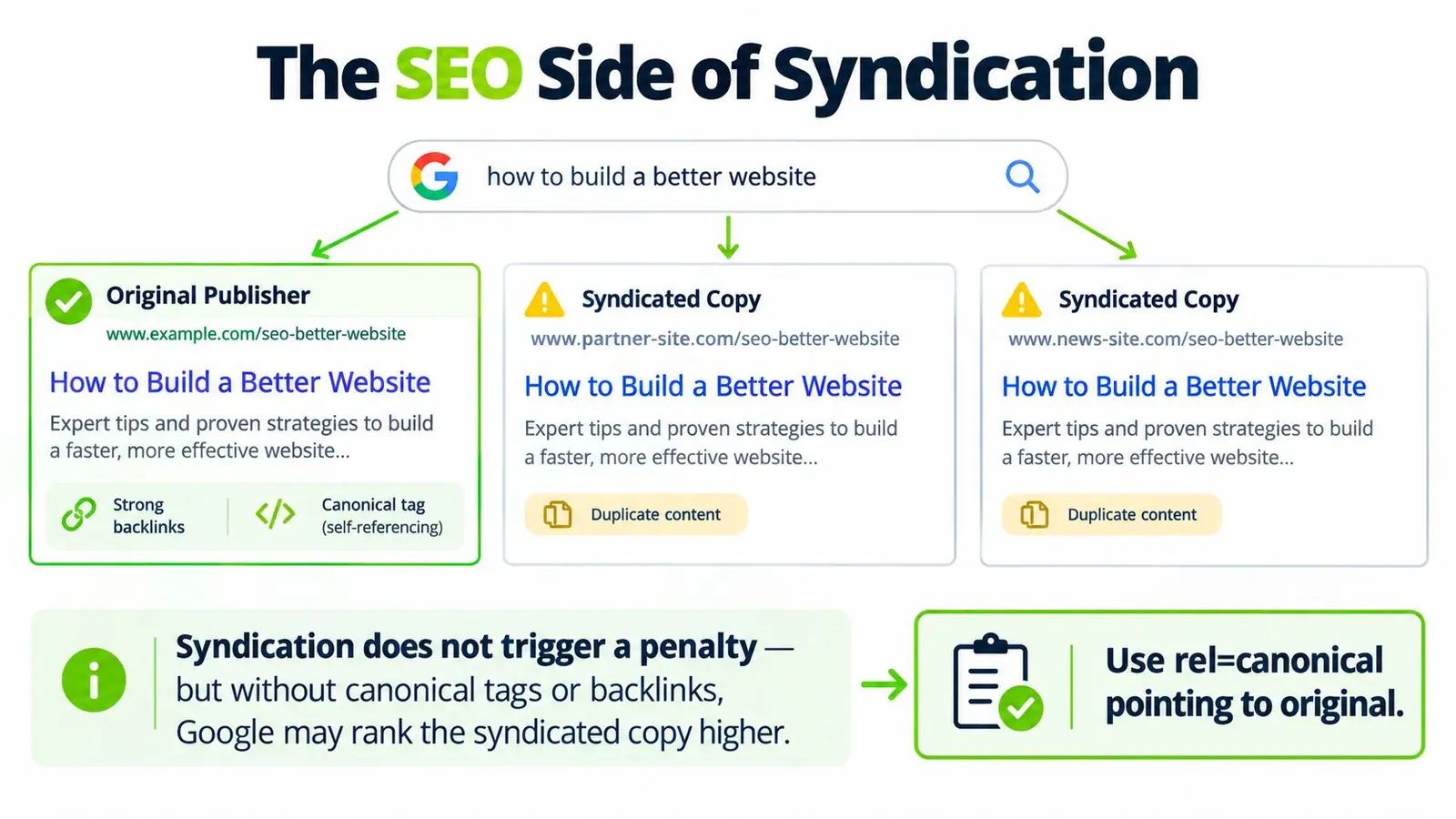
A common scenario causes the confusion. Your team publishes an article on your site. A partner then republishes that same piece on a larger domain, and within days their version starts appearing for the query you wanted to own.
That does not always mean Google "penalized" you. It usually means Google had to choose between near-identical pages and found the partner's version easier to trust, crawl, or rank.
What the real risk is
Search engines treat syndicated content like multiple labels on the same file. They need one clear answer to a simple question: which URL should represent the original work?
If both versions are indexable, the engine compares signals. Domain authority plays a role, but so do crawl timing, canonical tags, internal links, byline consistency, and plain on-page attribution. The core question is whether the search engine can confidently identify the original source.
That matters even more in 2026 because discovery is no longer limited to ten blue links. AI summaries, answer engines, and retrieval systems often pull from whichever version looks most established and best connected. If your source signals are messy, the republished copy can become the version that gets cited, summarized, or quoted back to buyers.
The signals that protect the source
For publisher-style syndication, three mechanics do most of the work:
- Canonical tag back to the source: The syndicated page should reference the original URL as canonical.
- Clear attribution link: Use visible language such as “Originally published on” with a link to the source article.
- Consistent byline: Keep the same author or brand attribution so readers and crawlers can connect the versions.
Off-page authority also shapes that decision. A source page with strong mentions, links, and brand signals is easier for search engines to treat as the primary version, which is why the supporting practices in this off-page SEO guide still matter.
Why B2B lead-gen syndication is a different SEO question
Teams mix up the two meanings of content syndication.
If a publisher republishes your article, SEO is directly involved because multiple public URLs may contain the same or similar text.
If a B2B lead-gen network promotes your ebook, webinar, or report behind a registration form, the SEO issue is usually smaller. In many cases, there is no full public duplicate of your original article at all. The risk shifts from duplicate pages to weaker concerns such as thin landing pages, unhelpful partner copy, or brand mentions that do not send much authority back to your site.
Same label. Different mechanics.
Two operating models that can work
Canonical republishing
The partner runs the article largely as-is and points search preference back to your original page. This model fits teams that want broader reach but want one URL to remain the source of record.
Adapted co-publication
Both brands publish related versions shaped for different audiences. The article may share the same research or argument, but the intro, examples, framing, or commentary are changed enough that each page has a clear reason to exist. In that setup, transparent authorship and cross-linking matter more than pretending the pages are unrelated.
Where execution usually breaks
SEO problems in syndication are usually operational.
- The canonical tag is removed during publishing
- The partner publishes before your original page is crawled and indexed
- The headline is rewritten to target the exact same query as your source page
- The byline or source note disappears
- The page is noindexed without anyone telling your team
- The partner adds enough edits to create partial duplication without clear attribution
A good rule helps here. Publish on your own domain first, get the page indexed, then syndicate. Treat every partner placement like a technical setup, not just a distribution win. That mindset keeps reach and source ownership aligned.
Benefits and Risks in Real Campaigns
A simple way to judge syndication is to ask what problem you are trying to solve.
If the problem is distribution, syndication can help a strong asset travel farther than your own site, email list, or social reach can carry it. If the problem is weak positioning, weak targeting, or weak follow-up, syndication will only spread those problems faster. That is true in both versions of syndication. Publisher republishing widens exposure. B2B lead-gen syndication rents access to someone else's audience and form flow.
Where syndication helps
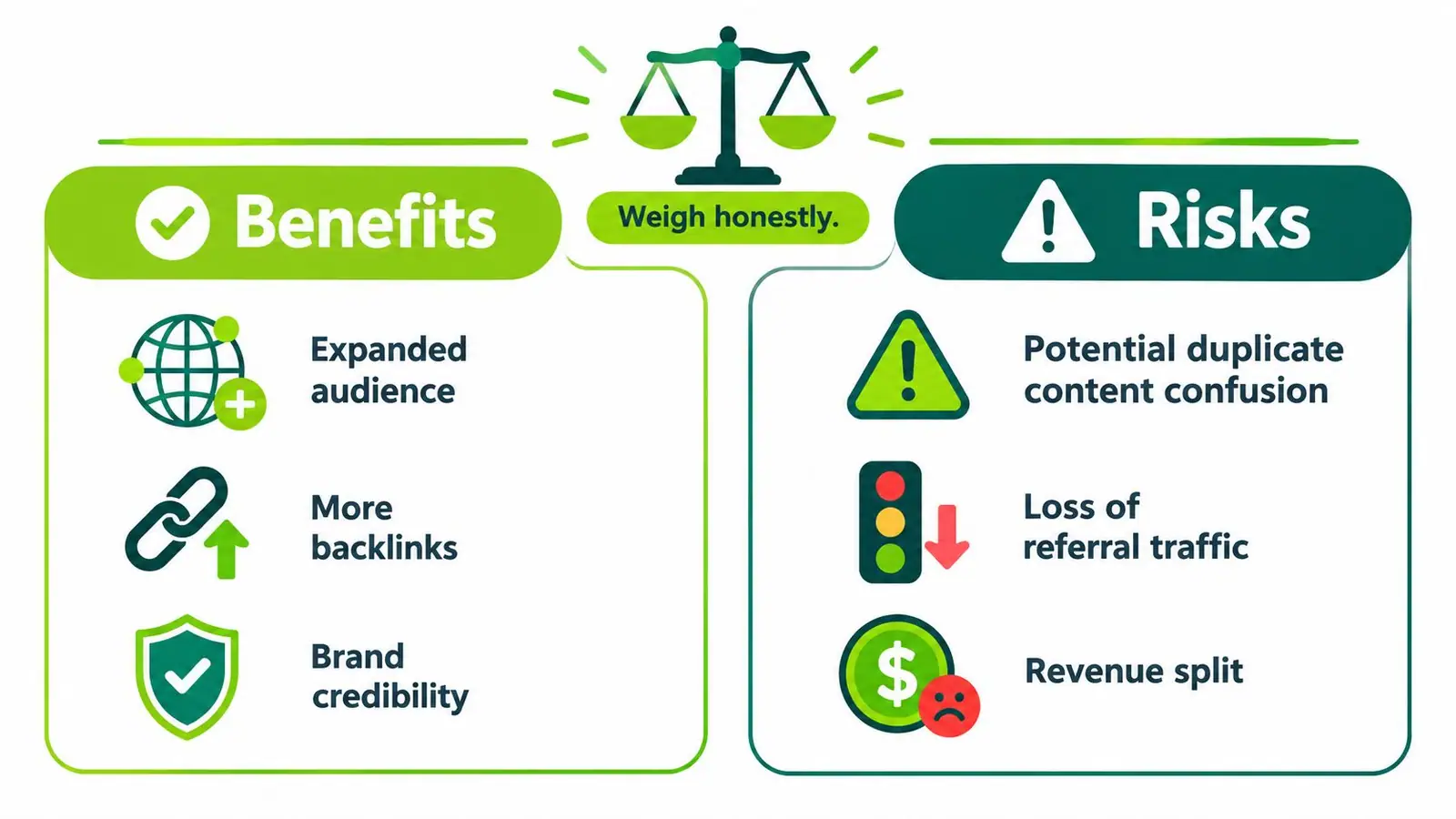
Used well, syndication acts like a second distribution lane for content you already know is useful.
For publisher-style syndication, the gain is reach with context. Your article appears in front of readers who already trust that publication, which can strengthen brand recall and send qualified referral traffic back to your site.
For lead-gen syndication, the gain is volume with planning control. A B2B team can put a webinar, guide, or report into market and get a steadier flow of contacts than waiting for organic discovery alone. That predictability is why demand generation teams keep using it, even as search changes and AI assistants summarize more top-of-funnel content before a click happens.
A smaller in-house team often feels this acutely. You can publish something helpful and still struggle to get enough of the right people to see it.
Where it breaks down
The failure points are rarely mysterious. They show up in campaign review calls.
- Selection risk in search: Search engines and AI discovery systems may choose the partner version to represent the topic if the original is weaker, later, or less clearly established as the source.
- Lead quality variance: Some syndication networks deliver contacts who downloaded an asset but are a poor fit for your offer or too early to buy.
- Follow-up strain: Sales teams can lose time chasing names that meet the form requirement but do not show meaningful intent.
- Brand mismatch: A good asset can end up beside thin editorial, noisy ads, or placements that make your brand look less credible.
- Measurement confusion: Teams may report success from raw lead counts or placement totals without checking influenced pipeline, meeting rates, or assisted conversions.
What the actual risk is
The common search problem is selection: platforms have to decide which version of similar content to surface.
That matters more in 2026 than it did a few years ago. Classic search results still matter, but AI-assisted discovery layers another selection system on top. If your original page is weakly attributed, hard to crawl, or less cited than the syndicated copy, your brand can lose source recognition even when the ideas started with you. In plain terms, another site can become the page that gets remembered.
The lead-gen version has a parallel problem. The network may deliver the contact, but your team still has to earn attention after the download. A list of names is not pipeline. If the asset attracts broad curiosity instead of buying interest, the campaign looks good in a spreadsheet and disappointing in the CRM.
Decision rule: Use syndication when distribution is the bottleneck. Skip it when message fit, audience fit, or sales capacity is the bottleneck.
When it tends to be worth it
Syndication earns its place when three things line up. You know who the asset is for. The asset sits in the middle of the funnel, where the audience is comparing approaches or defining a problem. The partner or network can preserve attribution, audience relevance, and reporting quality.
It is a weaker choice when your site already owns the topic, when your team cannot process follow-up well, or when a placement gives you reach without trust. In those cases, direct partnerships, email promotion, PR, or stronger original distribution often produce a better return.
A Safe Workflow for Agencies and In-House Teams
Most syndication problems don't start with strategy. They start with sloppy operations.
A team agrees to “republish some content,” but nobody defines canonical handling, timing, bylines, UTM rules, or how lead quality will be reviewed after launch. The result is avoidable confusion.
A safer workflow is boring in the best way. It makes every decision explicit before content leaves your domain.
Phase one partner selection
Start by vetting the partner, not the asset.
Look at relevance first. Does the site speak to your audience? Then look at editorial quality. Does the site publish coherent, credible material or look like a content warehouse? If you're using a vendor, ask how placements are sourced and how form fills are validated.
A simple scoring sheet helps. Give each partner a pass, caution, or reject label across relevance, editorial standards, attribution flexibility, reporting quality, and brand safety.
Phase two tagging and source control
Many agencies save a client from a future headache.
Set the canonical requirement in writing. Define the attribution text. Add UTM parameters to any link you want to measure. Keep the original byline if possible. Confirm whether the partner will index the page, noindex it, or use another arrangement.
If your team needs stronger source material before launching, it also helps to review examples of professional content production services so the asset itself is worth syndicating. Weak content distributed widely is still weak content.
Phase three launch hygiene
Don't hit publish everywhere at once.
Let the original page exist clearly on your own site first. Check that it's crawlable. Verify the canonical on the syndicated version after the partner publishes. Use Search Console URL Inspection to review what the search engine sees. If you're auditing older assets before choosing what to syndicate, a structured web content audit process will usually surface which pages are evergreen enough to reuse and which ones should stay put.
Launch checklist
- Original URL first: Publish and confirm the source page on your own domain before syndication goes live.
- Attribution locked: Review the live page for the actual byline and source link, not just the promised version.
- Indexing status checked: Confirm whether the partner page is indexable or intentionally excluded.
- Tracking attached: Make sure links can be separated in analytics later.
Phase four measurement and review
Measure the result by model.
For publisher syndication, review referral traffic, assisted conversions, branded search behavior, and whether the original URL keeps its intended visibility. For lead-gen syndication, review lead quality by partner, not just lead volume. Ask sales whether the names were relevant, reachable, and appropriately timed.
The safest syndication workflow is the one that assumes every technical setting will go wrong unless someone checks the live page.
Agencies that run this process well can hand clients a clear operating manual instead of vague reassurance.
Where Syndication Fits in a 2026 Search Strategy
A buyer asks an AI assistant for the best vendors in your category. The answer mentions a competitor's framework, cites a partner publication, and summarizes a third-party review. Your original article never appears, even though your team published the core idea first.
That is the planning problem in 2026.
Content syndication now sits inside a wider discovery system. People still click search results and visit websites, but they also get answers from AI Overviews, chat tools, recommendation feeds, and summary layers that pull language from many places at once. A good syndication plan helps your material show up in more of those places, with your brand attached to it.
Both meanings of syndication matter here. Publisher syndication puts your article on another site, which can widen reach and create more places where your ideas are cited. B2B lead-gen syndication places an asset inside a distribution network built to collect contacts, which can create pipeline if the targeting and follow-up are sound. Same label, different job. One spreads published ideas across the web. The other rents access to an audience and returns names.
So the question for next quarter is narrower than "should we syndicate more?" A better question is "which form of syndication helps us become easier to find, easier to cite, or easier to buy from?"
Use this filter:
- Choose assets that can travel well: Syndicate pieces that carry a clear point of view, original framing, or useful data. Thin opinion posts rarely help on partner sites or in AI summaries.
- Match the syndication model to the goal: Use publisher syndication if you want broader visibility, citations, and audience reach. Use lead-gen syndication if you want named prospects and you can verify lead quality by source.
- Look for citation value, not just click value: Referral traffic still matters, but so do branded mentions, repeated attribution, and whether your language starts appearing in AI-driven discovery.
- Treat setup as strategy, not admin: Source links, bylines, partner quality, and post-publication checks shape the outcome as much as the asset itself.
- Protect the original: Your site still needs the strongest version of the piece, because that is the page you want buyers, journalists, analysts, and AI systems to trace back to.
Teams adapting to AI discovery should also understand what generative engine optimization is, because syndication now overlaps with how brands become citeable, attributable, and retrievable across AI systems.
The practical role of syndication in 2026 is straightforward. It is one distribution layer inside a broader visibility strategy. Used carefully, it helps your best ideas appear in the places humans read and machines summarize, without confusing search engines about where those ideas came from.
Surnex helps agencies and in-house teams track how brands show up across traditional search and emerging AI discovery, so you can see whether syndicated content is improving visibility, citations, and search performance. If you need one place to monitor rankings, backlinks, audits, and AI presence without bouncing between tools, visit Surnex.