You paste a page into Google's Rich Results Test, wait for the scan to finish, and get a screen full of green checks, warnings, or errors. The page seems technically healthy, but you're still left asking the practical question: will Google show a rich result?
That confusion is understandable. The tool evaluates structured data, not your entire search strategy, and its result is often mistaken for a promise of enhanced visibility. Rich test results matter because search engines increasingly use machine-readable signals to interpret pages, while eligibility rules and supported search features keep changing.
This guide starts with the basic idea of structured data, then explains how to interpret the test, prioritize fixes, and respond to the removal of FAQ rich results in 2026. By the end, you'll have a workflow that treats validation as a quality gate, not a display guarantee.
Introduction to Rich Test Results and Why They Matter
A product page can pass Google's Rich Results Test, yet its search listing may remain a standard blue link. A developer might see valid Product markup alongside a warning about an optional property. A content manager may also discover that an old FAQ template no longer supports the feature it was designed to target. These outcomes describe technical conditions, not guaranteed SERP appearances.
Rich results add information to a standard search listing. Depending on Google's supported types and current policies, a result may show details for a recipe, product, event, review, video, or another page category. Structured data gives Google clearer, machine-readable context about those details. Google's systems still determine whether a presentation is eligible for a query and whether to display it.
This distinction matters more in 2026. FAQ rich results have been removed, and other supported types have narrowed, so tutorials built around older feature lists can send teams toward work that no longer produces the expected result. Treat the Rich Results Test as an eligibility gate. It checks whether Google can parse particular markup and recognize a supported type, much like a ticket check before entry. Passing that check does not reserve a place in the search results.
Structured data has also become part of routine page architecture. The HTTP Archive's 2025 SEO report found usage at 50% on both desktop and mobile in 2025, compared with 48% of desktop home pages and 49% of mobile home pages in 2024. Schema is therefore no longer limited to technically advanced sites.
Ask “What is this page eligible for, and does Google still support that presentation?” rather than only “Did my schema pass?”
A valid result cannot confirm appearance for a particular query, continued feature availability, or improved business performance. For a plain-language explanation of what rich snippets are and how they work, start with the difference between readable markup and search display decisions.
What Rich Results Really Are and How Structured Data Powers Them
A product page may show a name, price, and availability in visible text. A person can connect those details quickly. A search engine must infer their relationships from code, layout, wording, and other signals.
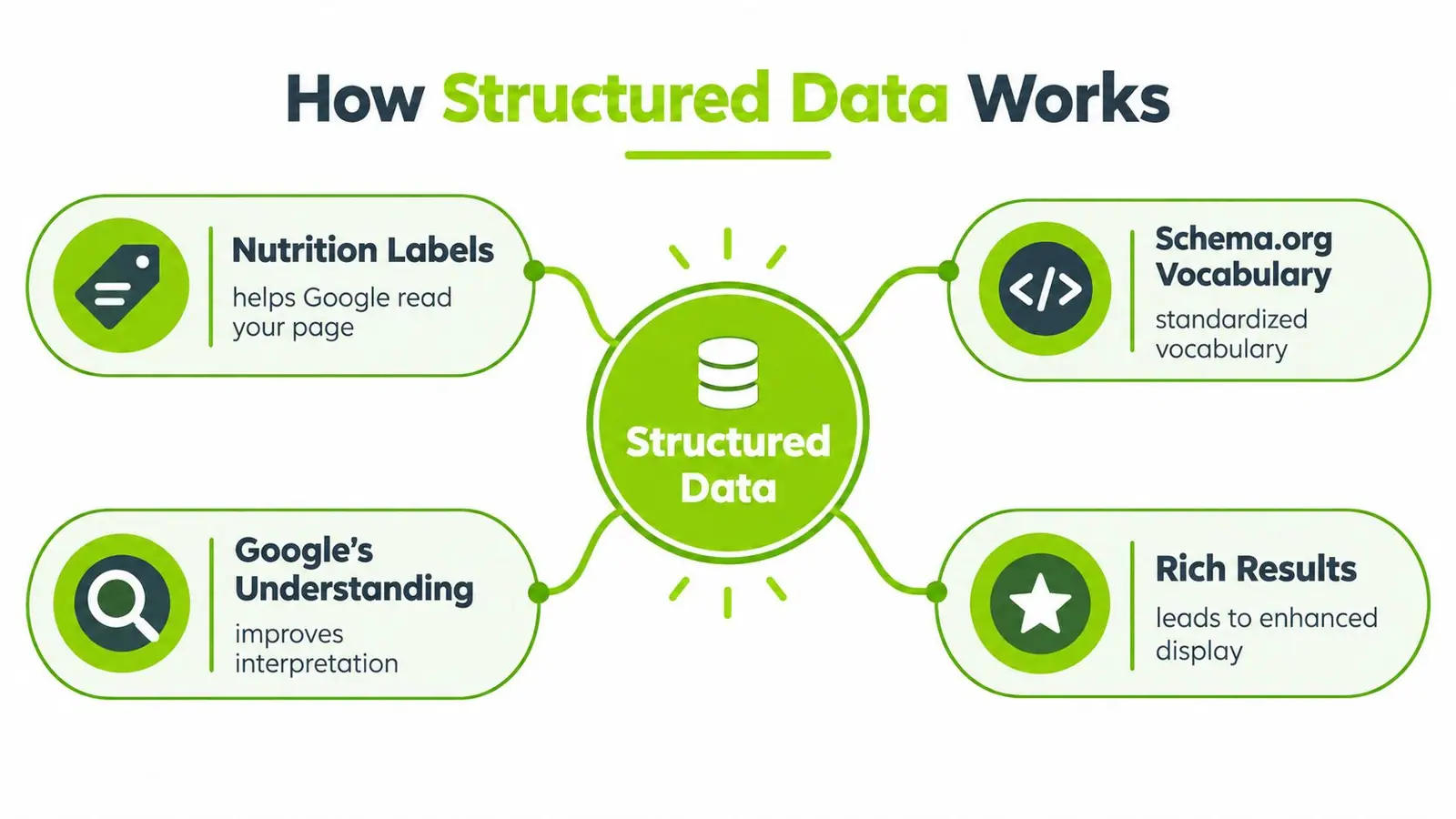
Structured data works like a nutrition label. It gives a consistent description of an item and its properties. For example, markup can identify whether “30 minutes” means preparation time, cooking time, or reading time instead of leaving Google to interpret the phrase alone.
The vocabulary and formats
Schema.org supplies the vocabulary for describing entities and properties. Google evaluates supported structured-data types to determine whether a page may qualify for particular search features.
Developers commonly use one of three formats:
- JSON-LD: A script-based format that keeps structured data separate from visible page markup.
- Microdata: Attributes added directly to HTML elements to identify items and properties.
- RDFa: An HTML-based approach for expressing relationships and metadata.
Google's Rich Results Test can evaluate these formats after rendering the page. That step matters on modern websites because JavaScript may add or modify the markup after the initial server response.
From interpretation to presentation
Structured data informs Google's evaluation rather than producing a rich result automatically. A page may become eligible for an enhanced presentation when its markup describes a supported type, includes the required properties, and follows Google's policies.
That process separates a normal search result from a rich result. A normal result can show a title, URL, and snippet. An enhanced version may expose additional context, depending on the page type and Google's decision.
Eligibility is the useful boundary to understand. A passing test means Google can read the markup and recognize a supported opportunity. It does not guarantee that a feature will appear for every query, or that the feature will remain available as search eligibility changes.
For a practical guide to structured data testing, compare what your page communicates with what Google can interpret before and after deployment. Describe the page accurately, choose a format your site can maintain, and verify the rendered markup rather than relying only on the source code.
How to Read Your Rich Results Test Output Like a Pro
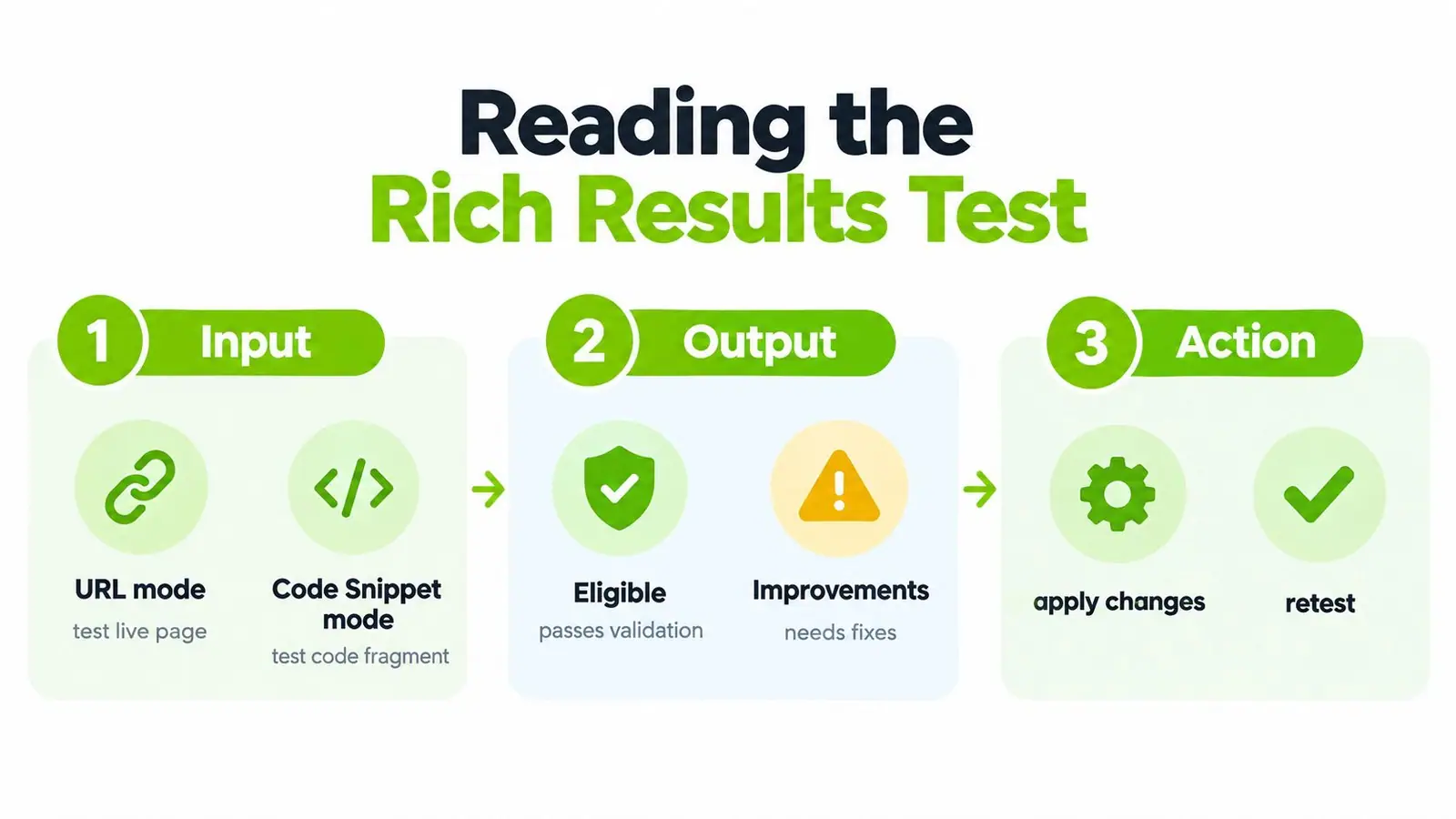
Start at Google's Rich Results Test. You'll normally choose between testing a publicly accessible URL and testing a code snippet. The first option checks the live page as Google can access it. The second is useful when a developer is working on markup that hasn't been deployed yet.
The tool renders the page, parses supported structured data, and reports which rich-result types it detects. Google describes it as a way to check which rich results can be generated from the structured data on a public page, not as a forecast of rankings or final search appearance.
Read the result in layers
Don't treat the first green message as the entire answer. Review the output in this order:
- Detected types: Identify which structured-data items the tool found. A page can contain more than one item, and each item may have different requirements.
- Eligibility status: Check whether the detected type is eligible or whether a required property prevents eligibility.
- Warnings: Separate optional recommendations from blocking problems. Warnings can improve completeness, but they usually don't carry the same consequence as errors.
- Highlighted markup: Use the code or field view to locate the exact property connected to the message.
- Preview information: If a preview is available, treat it as an illustration of possible presentation, not a live SERP promise.
Google's support documentation recommends the Rich Results Test as a first stop for debugging and describes it as useful alongside URL Inspection. The official testing guidance also explains that the tool catches most technical errors, while Search Console helps teams monitor valid and invalid items over time.
Use the tool as a gate
The best mental model is a deployment gate. Before a release goes live, the markup should be parseable, accurately connected to visible content, and free from blocking errors. A successful gate means the implementation is ready for the next evaluation stage. It doesn't mean Google must show the feature.
A code-snippet test helps isolate syntax or property problems. A URL test reveals what exists on the rendered page, including differences caused by templates, JavaScript, caching, or deployment conditions.
For a visual walkthrough of the tool's role, watch this practical demonstration:
Run both modes when a live result doesn't match the developer's intended implementation. If the snippet passes but the URL doesn't, investigate rendering, deployment, or template output rather than rewriting the schema blindly.
Common Errors and Warnings and What They Mean
A page can fail for different reasons, and the message category determines where to begin. Separate blocking validity problems from optional completeness recommendations. Fixing every yellow warning first can delay the red issue that prevents an item from qualifying.
Google's documentation describes the tool as surfacing errors, warnings, and unparseable structured data. The labels may vary by result type, but the diagnostic principle stays consistent: Google must read the markup and connect it to the page's meaning.
A quick diagnostic reference
| Status | Meaning | Action Required |
|---|---|---|
| Error | A required property or rule has failed, so the item may not qualify for the detected rich result. | Fix the issue, then retest the affected item. |
| Warning | An optional or recommended property is missing or incomplete. | Review its value, but prioritize required fields first. |
| Unparseable structured data | The tool can't reliably read the markup because of a syntax or formatting problem. | Correct the syntax and test again before reviewing eligibility. |
| Valid | The detected item meets the technical requirements recognized by the tool. | Treat it as a deployment gate, then monitor actual search performance. |
An error such as a missing required property identifies a specific eligibility problem. Trace the field to the page element or data source that should provide it. Confirm that the value matches visible content, then retest the complete URL. Adding unrelated properties will not resolve the underlying failure.
Warnings require judgment rather than automatic correction. Optional fields may provide useful context, but guessed, outdated, or inconsistent values weaken the markup. A smaller schema object that accurately describes the page is safer than a fuller object built from assumptions.
Fix what blocks eligibility first. Improve optional detail only when the property is accurate, maintainable, and useful.
Unparseable markup points to a reading problem. Check quotation marks, brackets, nesting, data types, and the template that injects the structured data. If the page returns an unexpected technical response during testing, examine its delivery path too. The guide to HTTP response code 304 explains one cache-related response that can help teams interpret retrieval behavior.
A valid result confirms that the tool understood the implementation. It remains an eligibility signal, not a promise that a search feature is active, suitable for the query, or guaranteed to appear. That distinction matters even more as supported result types and display rules change.
Why Valid Markup Does Not Always Show as a Rich Result
A marketer publishes valid schema, tests the URL, and sees a clean result. Later, the page appears in ordinary search listings without the enhancement shown in the preview. Both outcomes can be correct because the test and Google Search answer different questions.
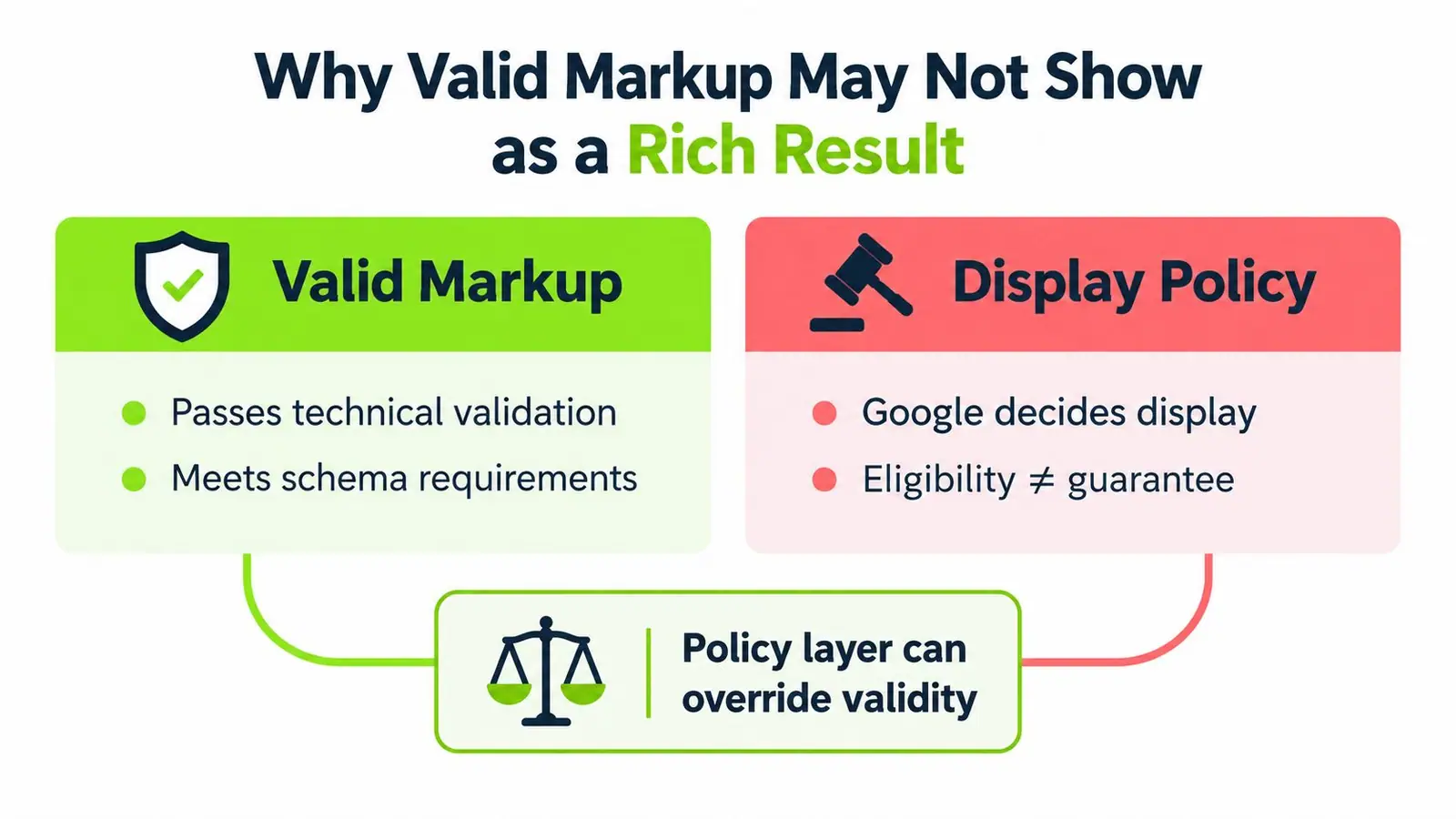
The Rich Results Test is an eligibility gate. It checks whether Google can parse the markup and whether the page meets the technical conditions for a supported result type. Search then applies a separate decision layer. Google may narrow a feature, limit it to certain page classes, retire it, or decide that a query does not warrant the enhancement.
FAQ shows why older tutorials fail
Google's guidance states that FAQ rich results stopped appearing in Google Search on May 7, 2026. Support for FAQ in the Rich Results Test and FAQ reporting in Search Console is also being phased out. The current FAQ change coverage explains why tutorials that present FAQ schema as a dependable SERP tactic are now partly obsolete.
The FAQ content itself can still serve readers. Clear questions and answers may improve page organization, support topical coverage, and help conversational discovery. Keep that content for its usefulness, not because an old checklist promises an FAQ box.
Eligibility and display are separate checkpoints
Other result types can change as well. Google's supported coverage has narrowed, with Practice Problems removed in January 2026 and changes affecting multiple types in September 2025. Industry reports have also described reduced display for types such as FAQ, Review, and How-To. Those observations do not turn a valid test into a display guarantee.
The distinction is straightforward:
- Valid markup: The syntax and required properties pass the test.
- Supported feature: Google currently recognizes the type for a particular presentation.
- Displayed result: Google selects that presentation for a real query and page context.
A green test result confirms that Google understood the implementation. It does not confirm that the feature remains active, fits the query, or will appear. Search Console impressions, appearance reports where available, and broader visibility tracking provide better evidence of actual exposure than a pass screen alone.
Troubleshooting Steps to Get Your Rich Results to Appear
Troubleshooting works best as a controlled QA process rather than a sequence of guesses. Start with the smallest reliable test, make one class of change at a time, and record what changed between test runs.
Use a repeatable workflow
-
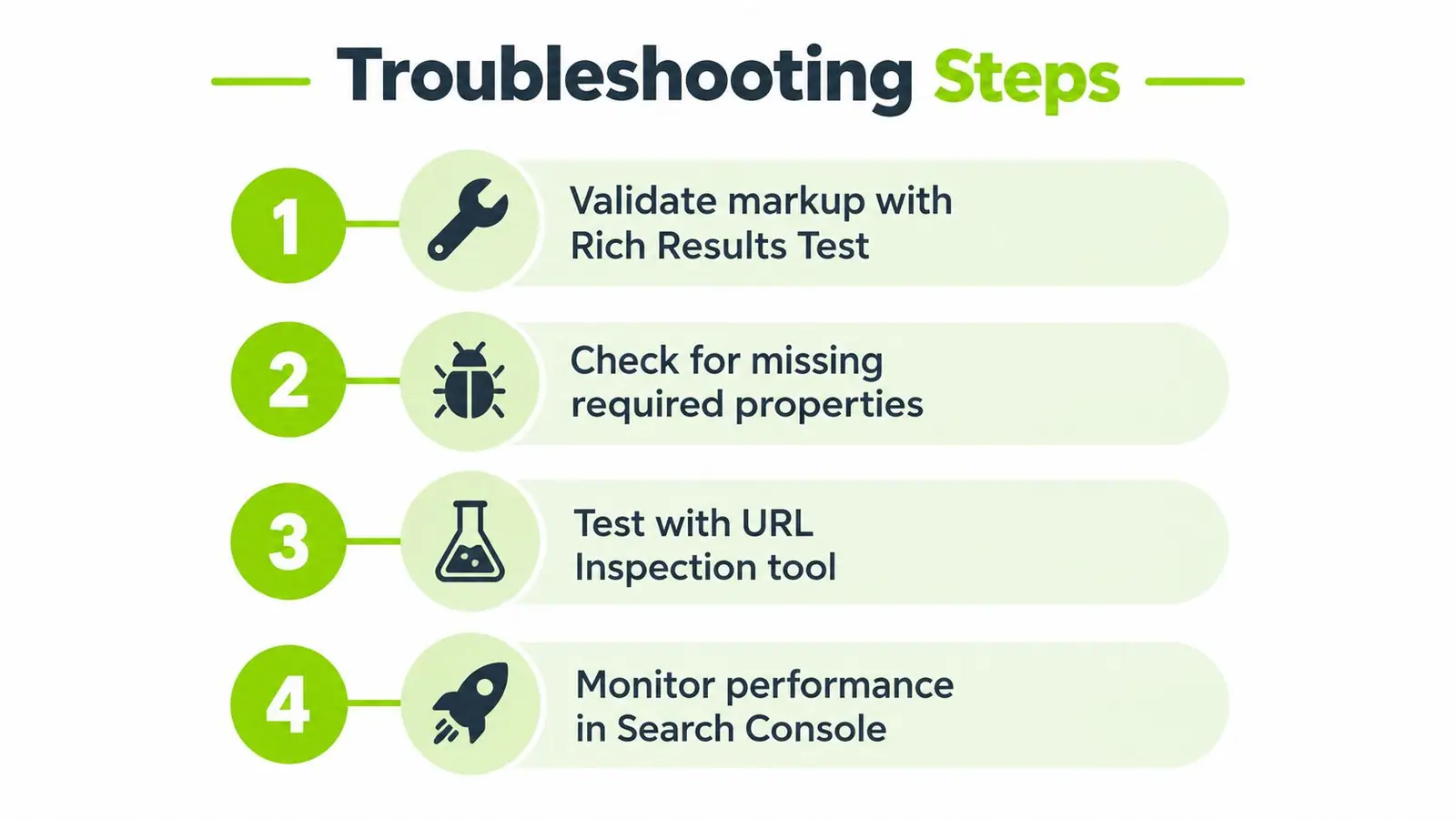
Validate the markup. Run the code snippet through the Rich Results Test when the implementation is still being developed. This isolates syntax and property problems before template changes complicate the result.
-
Resolve blocking fields. Open each error and trace it back to the source data. Confirm that the value exists on the page, describes the visible content, and uses the expected format. Don't fill required properties with placeholders just to obtain a green status.
-
Test the rendered URL. After deployment, run the public URL. This catches problems that a code fragment can't reveal, such as JavaScript-generated markup, template conditions, or a page version that differs from the developer's local code.
-
Inspect and monitor. Use URL Inspection to examine the page in Google's broader workflow, then review Search Console rich-result reports for valid and invalid items over time. Google says those reports can help teams track how changes affect rich results, but the data should be interpreted alongside real impressions and search appearance.
A team can turn this into a release checklist, with an owner for markup changes, a record of affected templates, and a retest after publication. Teams building broader QA systems may also benefit from free test strategy template resources to organize test coverage, expected outcomes, and regression checks.
Handle legacy FAQ content deliberately
Don't delete every FAQ section because its former rich result disappeared. Review the page's purpose first. Keep useful questions in a readable format, improve directness and depth, and connect them to the surrounding topic instead of treating them as isolated schema fields.
For sites with automated dashboards, remove FAQ rich-result status from success targets as Google phases out its support. An empty report may reflect a retired feature, not a sudden implementation failure. If you're investigating crawl or rendering behavior at scale, analyze log files to understand how bots encounter important templates and page variants.
Finally, compare test output with real search data. A valid item that produces no impressions may be correctly implemented but irrelevant to the current display policy or query context.
Building a Future Proof Strategy for Rich Results
A durable rich-result strategy starts with a change in priority. Schema should clarify strong content, not compensate for weak content or chase every available feature. As Google narrows and retires result types, teams gain more from accurate page architecture, direct answers, clear entity relationships, and genuine topical depth than from adding markup to every template.
That doesn't make structured data unimportant. It makes implementation discipline more important. Choose types that accurately describe the page and still have a meaningful role in your search program. Maintain the visible content first, then keep the markup synchronized with it.
Measure more than validation
A mature reporting model separates technical health from search exposure:
- Technical health: Can Google parse the markup, and are required properties present?
- Feature support: Does Google currently support the relevant rich-result type for this page category?
- Search exposure: Do Search Console reports and impressions show the feature in practice?
- AI discoverability: Do important answers appear in AI Overviews or conversational search experiences, and are your pages cited?
FAQ content illustrates why this separation matters. The old feature is no longer a dependable target, but a well-structured answer can still support users and broader discovery when it's written clearly and placed in a strong topical context. Treat conversational extraction as a content-quality objective, not as a promise that one schema type will achieve it.
Build change detection into operations
Agencies and in-house teams should review templates when Google changes documentation, then update validation rules and client reports. Remove deprecated features from automated pass-rate dashboards so stakeholders don't mistake an unsupported test for a regression.
Surnex can fit alongside Google's testing and Search Console workflows by combining traditional SEO metrics with visibility tracking across AI experiences, including citation and presence monitoring. That gives teams another way to investigate whether content is being surfaced beyond a technical schema result.
The strongest long-term workflow is therefore practical and flexible: validate markup, keep page content authoritative, monitor actual visibility, and revise priorities when Google changes its presentation rules. Eligibility is a checkpoint. Search presence is the outcome that still needs measurement.
Use the Surnex platform to connect structured-data QA with traditional SEO metrics and visibility across AI search experiences. Visit Surnex to monitor appearances, citations, and changing search signals instead of relying on Rich Results Test status alone.