You've published the pillar pages, fixed the internal links, cleared the technical backlog, and watched Core Web Vitals turn green. Yet a competitor with thinner content keeps appearing above you, while your brand barely surfaces in AI answers unless someone types its name directly. That gap usually isn't another content brief. It's the external reputation layer your team hasn't measured as a system.
Off page SEO now includes more than acquiring backlinks. Editorial coverage, unlinked mentions, reviews, citations, social discussion, and references in AI and LLM experiences all contribute to how search systems and buyers judge a brand. This guide explains what still moves rankings, which tactics waste budget, and how to track traditional and AI visibility from one operating dashboard.
The Ranking Mystery Most Teams Misdiagnose
The quarterly business review had the familiar shape. An agency lead walked a B2B SaaS client through another content audit, another list of missing subtopics, and another set of recommendations for improving commercial pages. The client was publishing two long-form posts a week, covering the subject thoroughly, and targeting the right intent.
The rankings still looked stubborn. Most commercial terms sat on page two. Competitors had shorter pages, fewer visible product details, and less obvious topical depth, but they continued to win the positions that mattered.
The team checked the basics again. Internal linking was coherent. The pages answered the main questions. Technical performance wasn't blocking access, and Core Web Vitals were green. At that point, continuing to polish the same HTML would have produced activity, not a meaningful diagnosis.
The missing evidence sits outside the site
The competitive gap appeared in the external data. Rival brands had more references from relevant publications, more independent discussion, and stronger evidence that other organizations recognized them as credible players in the category. Their content wasn't necessarily better in isolation. Their external validation pattern was stronger.
That distinction matters because backlinks remain a foundational off-page signal. A widely cited SERP study found that the number one Google result had 3.8 times more backlinks than pages ranked from positions two through ten, as reported in this off-page SEO statistics roundup. The same source notes that pages with more referring domains tend to earn more search traffic, while top-ranking pages often gain followed backlinks at a rate of roughly 5% to 14.5% per month.
Backlinks aren't the whole explanation. A link's value depends on the linking page's authority, topical relevance, anchor text, HTTP status, and placement, as this analysis of how SEO link value works explains. A handful of editorial links from pages that discuss your market can carry more practical weight than a large batch of weak placements.
Diagnostic rule: If on-page quality is competitive but rankings remain stuck, audit third-party recognition before commissioning another rewrite.
The same problem appears in AI Overviews and LLM answers. A page can explain a subject clearly, yet the brand may remain absent because external sources don't consistently connect the brand with that subject. Search engines and AI systems need more than a well-optimized destination. They need evidence that the destination belongs in the conversation.
That's why teams working through SEO tactics for new businesses should build external recognition early, not treat link acquisition as a late-stage growth task. A useful PageRank refresher is also available in what PageRank means for SEO, particularly when your team needs to explain why link context matters more than a raw count.
The practical diagnosis has five parts: editorial links, brand mentions, reviews, local citations, and social engagement. Together, they form a distributed trust system that affects rankings, discovery, and the chance that an AI system cites or recommends your brand.
What Off Page SEO Actually Means in Practice
Off page SEO is the work of building reputation signals outside your website's own HTML. Those signals help search engines, AI systems, prospects, journalists, and partners decide whether your brand deserves attention and citation.
Think of the discipline as reputation engineering. Your website makes claims about expertise. External sources either reinforce those claims or leave them unsupported. Search guidance from Moz's explanation of off-site SEO frames backlinks, brand citations, and social mentions as part of the external signals used to evaluate trust, authority, and discoverability.
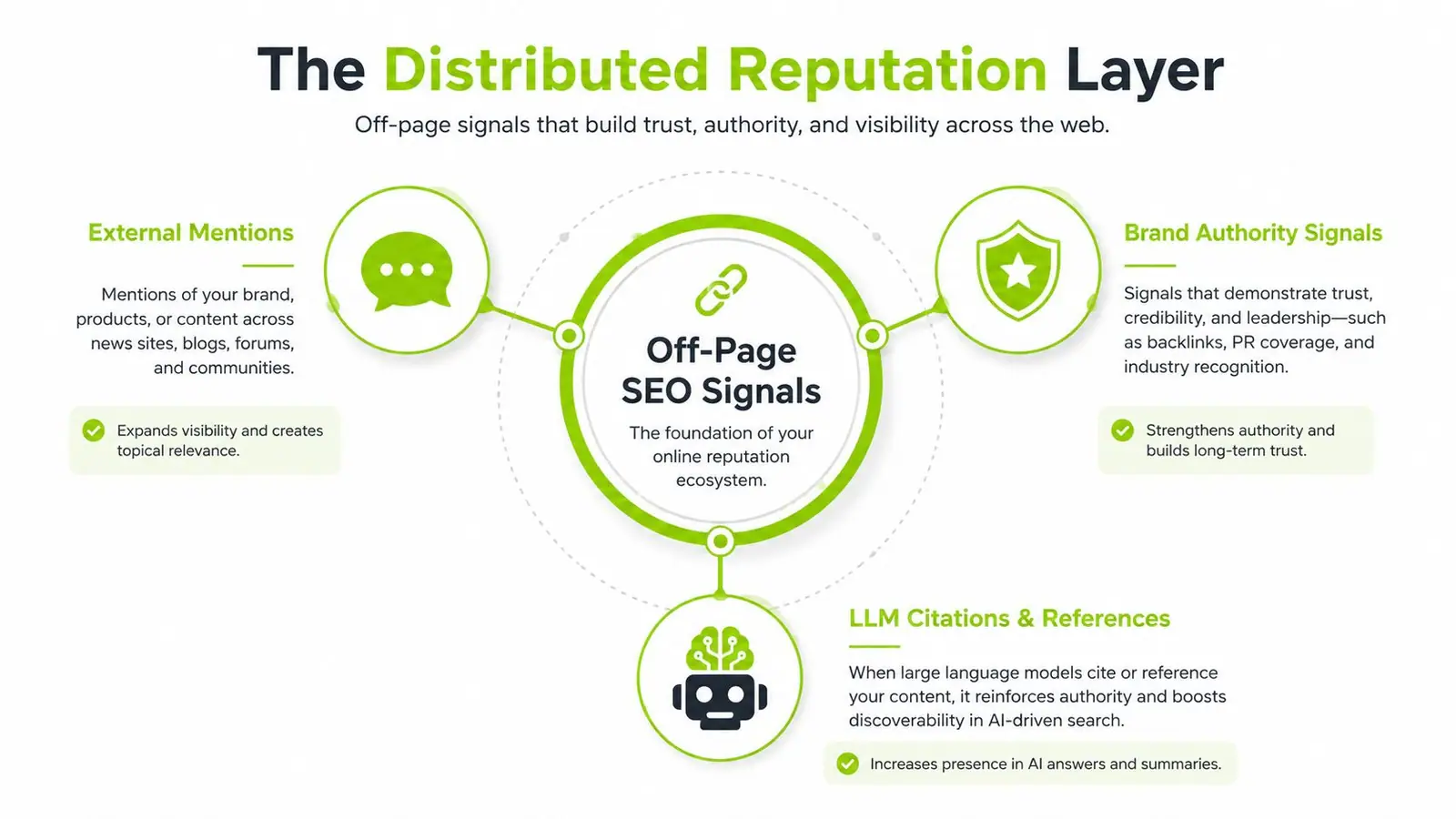
Five connected signal families
Editorial backlinks come from a comparison article in a respected trade publication, a research roundup, or a relevant guide that cites your original contribution. They provide both authority and context, especially when the surrounding text explains why your brand belongs in the topic.
Unlinked brand mentions appear when a journalist quotes your executive, an analyst names your product, or a community discusses your company without adding a hyperlink. These references can still strengthen entity recognition and may create opportunities for later link conversion.
Reviews provide direct customer feedback. A steady flow of verified reviews on platforms such as G2 or Trustpilot gives buyers commercial evidence that your product exists, serves a defined audience, and has an experience worth evaluating.
Local citations connect a business to a place or service area. Consistent name, address, and phone information across directories, aggregators, chambers, and industry listings helps search systems reconcile the business entity.
Social engagement creates public discussion and distribution. A LinkedIn thread that attracts practitioners and gets picked up by analysts may not pass traditional link equity, but it can expose the brand to people who later create stronger references.
These signals reinforce one another. Original research can earn a media link, trigger social discussion, produce unlinked mentions, and give sales teams a credible asset to share. Reviews can strengthen conversion while local citations improve entity clarity. The goal isn't to force every signal into every campaign. It's to create a coherent external pattern.
For a more detailed classification of link types, see this guide to types of backlinks. The important distinction is that links are one output of reputation work, not the complete definition of it.
The Five Signal Families That Build External Authority
Different signals answer different questions. A backlink can show that a publication considers your resource worth citing. A review can show that customers have evaluated the product. A citation can connect a location to a business entity. Treating them as interchangeable leads to poor allocation.
| Signal Family | What It Proves | Strongest Scenario |
|---|---|---|
| Editorial links | A relevant publisher considers the brand or resource citation-worthy | Competing for difficult head terms |
| Brand mentions | Independent sources associate the brand with a topic or category | Increasing LLM citation probability |
| Reviews | Customers have expressed commercial experience and sentiment | Local, product-led, and comparison queries |
| Local citations | The business has a consistent place or category identity | Multi-location visibility |
| Social engagement | A topic or brand is gaining active public discussion | Reaching new audiences and amplifying campaigns |
Editorial links carry context
Editorial links are scarce because publishers decide whether a reference helps their audience. That scarcity is useful. A comparison feature in a software publication can communicate category relevance and credibility more effectively than a generic directory entry.
The trade-off is speed. Editorial campaigns require a strong asset, a credible angle, and patient relationship building. They're most valuable for competitive terms where the results page contains established brands with substantial external recognition.
Mentions help systems connect entities
An unlinked mention may look weaker in a backlink report, but it can still matter for entity understanding. When several independent sources describe a brand using consistent category language, an AI system has more material to associate the company with a particular problem or solution.
That makes mentions especially useful for LLM visibility. A journalist's reference, an analyst's market commentary, and a respected community discussion can collectively improve the likelihood that a model recognizes the brand as relevant, even when no individual page links to it.
Reviews and citations answer local questions
Reviews carry direct commercial intent. Buyers use them to assess reliability, fit, and customer experience, while search platforms can use review volume and sentiment as part of local relevance.
Citations serve a different function. They help search systems match a business to a location, service, and category. Multi-location brands should treat citation consistency as infrastructure, not a one-time directory submission. A listing with the wrong address or inconsistent business name can create ambiguity that no amount of broad content will repair.
Social engagement works as an amplifier. A well-researched post can reach a new audience, attract questions, and give journalists or analysts a reason to investigate the underlying asset. It rarely replaces editorial coverage, but it can increase the number of people who encounter the story.
Tactics That Earn Real Mentions and Links in 2026
The strongest off-page programs start with something other people can use. Generic outreach emails rarely create that condition. A publisher needs a reason to cite you, a partner needs a reason to collaborate, and a community needs a reason to continue the discussion.
Build assets with a clear editorial trigger
Original research is usually the best starting point for a campaign because it gives journalists a claim, a chart, or a new angle. Proprietary data, expert surveys, benchmark reports, and transparent methodology can all support coverage when the subject connects to a live industry question.
Digital PR should lead with the story, not the requested anchor text. Pitch the implication, explain why the audience should care, and make the supporting evidence easy to verify. If the story earns coverage, the link and mention become natural outcomes rather than the entire objective.
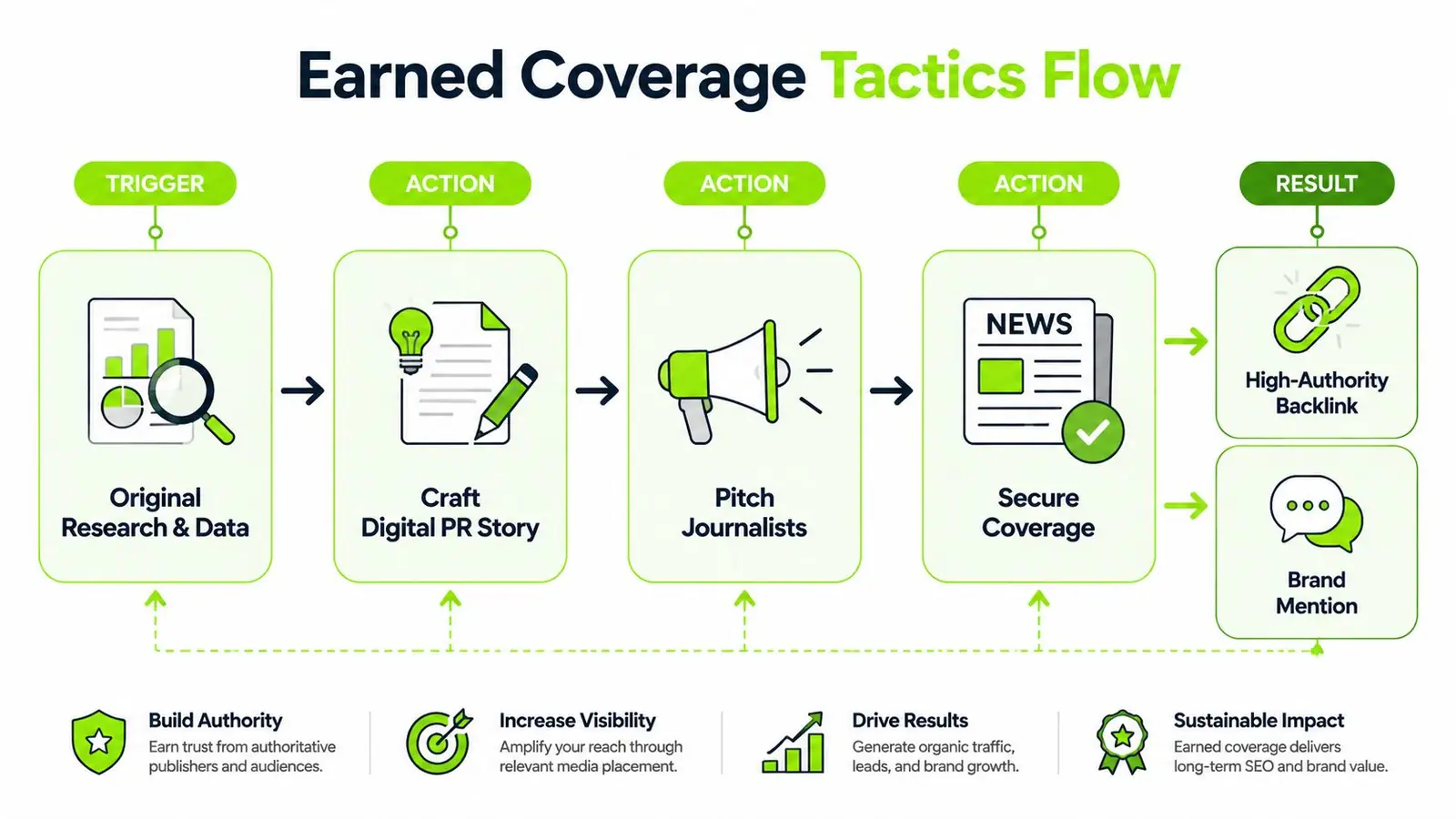
Partnerships create a different kind of value. Integrations, co-marketed resources, expert roundtables, and implementation guides can produce recurring references inside relevant tools and communities. They also expose the brand to audiences that already understand the problem.
A practical tactic brief should record:
- Target outcome: Specify whether the campaign seeks editorial links, mentions, reviews, partner references, or discovery.
- Target publications and communities: Separate trade media, local outlets, analyst circles, Reddit, forums, and private groups.
- Required inputs: List data, spokespeople, creative assets, customer permissions, and approval owners.
- Follow-up path: Define how the team will convert coverage into additional mentions, reviews, or partner distribution.
Reddit, niche forums, Slack groups, and Discord communities can support discovery when participation is useful and transparent. They shouldn't become dumping grounds for promotional links. The objective is to answer questions, share evidence, and earn attention that may later lead to stronger coverage.
What to retire: Reciprocal link schemes, low-quality directories, and private blog network footprints create volume without durable trust. They also consume outreach capacity that could support a real editorial relationship.
For teams exploring sponsored storytelling, AI advertorial examples can help distinguish promotional formats from earned editorial work. Keep the distinction clear in reporting. Paid placement, partner distribution, and independent coverage shouldn't sit in one undifferentiated “links earned” bucket.
Watch the video for a visual walkthrough of earned coverage planning.
When evaluating placement quality, this guide to the best backlinks for SEO is useful as a team discussion prompt. Ask whether the page is relevant, editorially justified, and likely to be read by the audience you want, not just whether a tool assigns it a high authority score.
Metrics That Reveal Whether Your Work Is Working
Off-page reporting fails when the team presents one backlink number as the entire result. A healthy dashboard connects authority, reputation, local trust, engagement, and AI visibility so leadership can see whether the program is compounding or stalling.
Read five layers together
Link authority includes referring domain growth, changes in domain rating, followed versus nofollowed links, anchor diversity, link placement, and lost links. Referring domains matter because one sitewide link pattern shouldn't be mistaken for broad independent recognition. Domain rating can help identify directional movement, but it shouldn't overrule relevance or editorial quality.
Brand reputation includes mention volume, share of voice, sentiment, and the topics associated with those mentions. A rise in mentions without new referring domains may indicate that the campaign is gaining attention before publishers convert references into links. That's a follow-up opportunity, not an automatic failure.
Local and entity trust includes citation coverage, NAP consistency, review velocity, review sentiment, and Google Business Profile activity. These measures matter most for local and multi-location programs, where identity accuracy and customer experience work together.
Social resonance includes engagement quality, saves, meaningful replies, reposts, and discussion depth. A large reaction count can be less useful than a smaller discussion where practitioners ask detailed questions and share the asset with relevant peers.
AI and LLM visibility requires repeatable prompt testing across ChatGPT, Perplexity, and Google AI Overviews. Record whether the brand appears, how it's described, which competitors appear instead, and which sources receive citations. Prompt sets should represent commercial, informational, comparison, local, and category queries.
| Metric Layer | Primary KPIs | What It Signals |
|---|---|---|
| Link authority | Referring domains, lost links, anchor diversity, authority trend | Breadth and quality of external endorsement |
| Brand reputation | Mentions, share of voice, sentiment, topic association | Whether the market recognizes the brand |
| Local and entity trust | Citation coverage, NAP consistency, review velocity | Entity clarity and customer confidence |
| Social resonance | Saves, replies, reposts, thread depth | Distribution and audience engagement |
| AI and LLM visibility | Brand appearances, competitor presence, citations, prompt coverage | Whether AI systems recognize and reference the brand |
Track visibility as a comparative measure, not a vanity score. Share of visibility measurement can help teams frame performance against competitors and query groups rather than relying on isolated rankings.
Measurement principle: A link spike can hide declining relevance. A steady link profile can still support growth when mentions, reviews, citations, and AI references are improving.
Normalize the layers into a single weekly view. Include the campaign activity, the external outputs, the target query set, and the movement in rankings or AI citations. This makes it easier to identify editorial fatigue, weak follow-up, or a local data problem before the quarterly review.
Building Off Page SEO Into Agency and In House Workflows
Off-page work becomes dependable when teams manage it like a production pipeline. Each opportunity needs an owner, a next action, a target signal, and a clear definition of success. Without those fields, outreach turns into a spreadsheet of hopeful contacts.
Set a cadence that keeps opportunities moving
Run a weekly outreach standup. The team should triage publisher targets, approve campaign angles, review replies, assign spokesperson availability, and remove approval blockers. Keep the meeting focused on decisions, not a tour of every active row.
A monthly strategy review should answer harder questions:
- Which tactic produced editorial links? Separate independent coverage from partner placements and paid distribution.
- Which tactic produced mentions without links? Decide whether follow-up is appropriate or whether awareness was the intended outcome.
- Which sources created qualified attention? Look at relevance, audience fit, and engagement, not authority scores alone.
- Which signal family is underdeveloped? A B2B brand may need more analyst mentions, while a local operator may need better reviews and citation consistency.
- What should stop? Remove channels that repeatedly create low-quality placements or unqualified traffic.
Assign ownership by capability. The strategist owns positioning, research questions, and linkable assets. The outreach lead manages publisher and partner relationships. The analyst maintains the dashboard, validates referring domains, and runs AI and LLM prompt monitoring. Local teams or account managers should own review requests and business profile updates when those tasks depend on customer contact.
A single weekly brief should connect activity to outcomes across all five signal families. Include new and lost links, notable mentions, review movement, citation issues, social conversations, AI appearances, and next actions.
Avoid tool sprawl by consolidating backlink monitoring, mention tracking, review aggregation, and AI visibility where practical. Surnex is one option for teams that want backlinks, referring domains, rankings, audits, content opportunities, and AI visibility in a shared SEO workflow. The platform also supports monitoring across Google AI Overviews and ChatGPT-driven discovery, with reporting and API capabilities for larger operations.
The operating principle is simple. Off-page SEO is infrastructure, not a one-off stunt. Cadence and ownership usually determine whether the trust layer compounds.
Your 90 Day Off Page SEO Plan and What to Track Next
A quarter is long enough to establish a defensible baseline, launch meaningful campaigns, and compare external movement against a starting point. It's not long enough to promise that every placement will change rankings immediately. Measure leading indicators and outcomes together.
Days 1 to 30 focus on audit and baseline
Start by crawling the current referring-domain profile. Classify links by relevance, placement, status, anchor pattern, and relationship type. Record existing brand mentions, competitor share of voice, review profiles, citation coverage, and local data inconsistencies.
Create a prompt set for ChatGPT, Perplexity, and Google AI Overviews. Test commercial, informational, comparison, category, and local queries. Save the exact prompts, responses, brand descriptions, competitor appearances, and cited sources so later tests remain comparable.
Days 31 to 60 focus on production and outreach
Choose one research or data asset with a clear audience and editorial angle. Build the supporting page, charts, spokesperson notes, media list, and outreach sequence before pitching. In parallel, activate relevant partnerships, integrations, expert contributions, and community participation.
Give each campaign a target signal. A research launch may prioritize editorial coverage and LLM citations. A partner campaign may prioritize recurring mentions. A local program may prioritize reviews and citation consistency. This prevents the team from judging every activity by the same backlink standard.
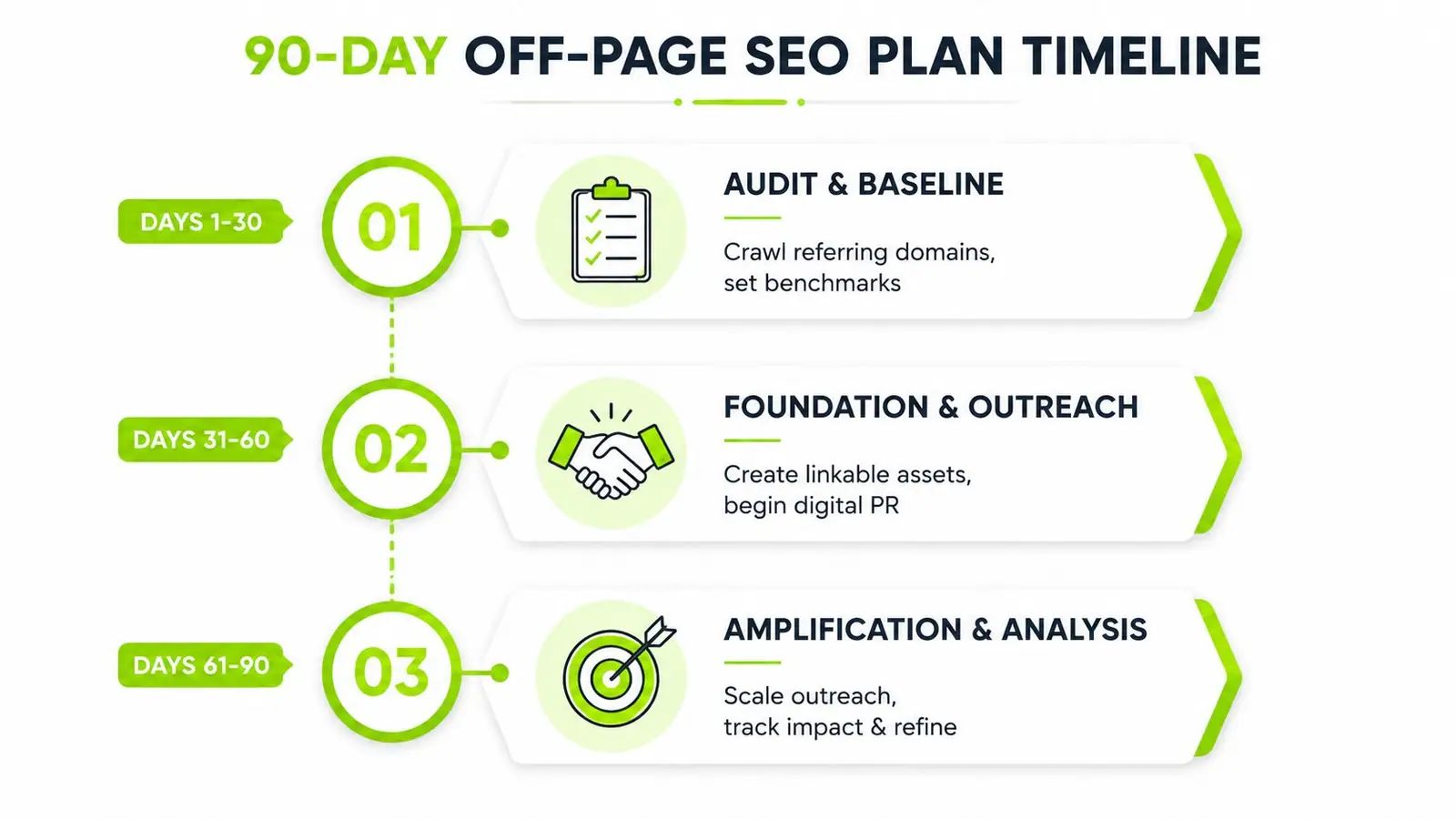
Days 61 to 90 focus on amplification and analysis
Follow up with publishers who mentioned the research without linking when that request adds genuine reader value. Repackage strong findings for LinkedIn, relevant communities, partner newsletters, and sales enablement. Refresh the prompt tests and compare AI references with the original baseline.
Use the final review to separate movement from noise:
- Referring domains: Record net new relevant domains and lost high-value links.
- Share of voice: Compare visibility across the same competitor and query set.
- Reviews: Track review velocity, sentiment, and unresolved response patterns.
- Citations: Check consistency across locations, directories, and aggregators.
- Brand mentions: Identify new associations with priority topics.
- AI visibility: Record brand appearances and citations inside AI answers.
Some results will lag. A campaign can generate discussion before links, and links can appear before rankings respond. The scorecard should therefore show activity, signal movement, and search outcomes as separate columns.
Run this process every quarter. Keep the baseline, preserve the prompt set, annotate campaign launches, and explain changes in plain language during client or leadership reviews. That creates a program you can defend because every action has a target signal and every signal has a measurement path.
Visit Surnex to explore a platform that brings backlink monitoring, SEO metrics, and AI visibility tracking into one workflow. Use it to establish your off-page baseline, monitor referring domains and citation gaps, and report how external trust is changing across traditional and LLM search.