Your traffic dashboard has dipped, the editorial team wants to publish another batch of posts, and nobody can confidently say which existing pages deserve attention first. The site may contain outdated advice, overlapping articles, broken internal links, weak conversion paths, and pages that search engines can find but AI-generated answers never cite. Publishing more content won't fix that foundation.
A web content audit turns the site into a decision system. It connects every URL to search visibility, user behavior, business value, technical accessibility, and emerging AI visibility. Done properly, it doesn't produce a spreadsheet that gets forgotten. It creates a repeatable operating rhythm for deciding what to preserve, improve, combine, or retire.
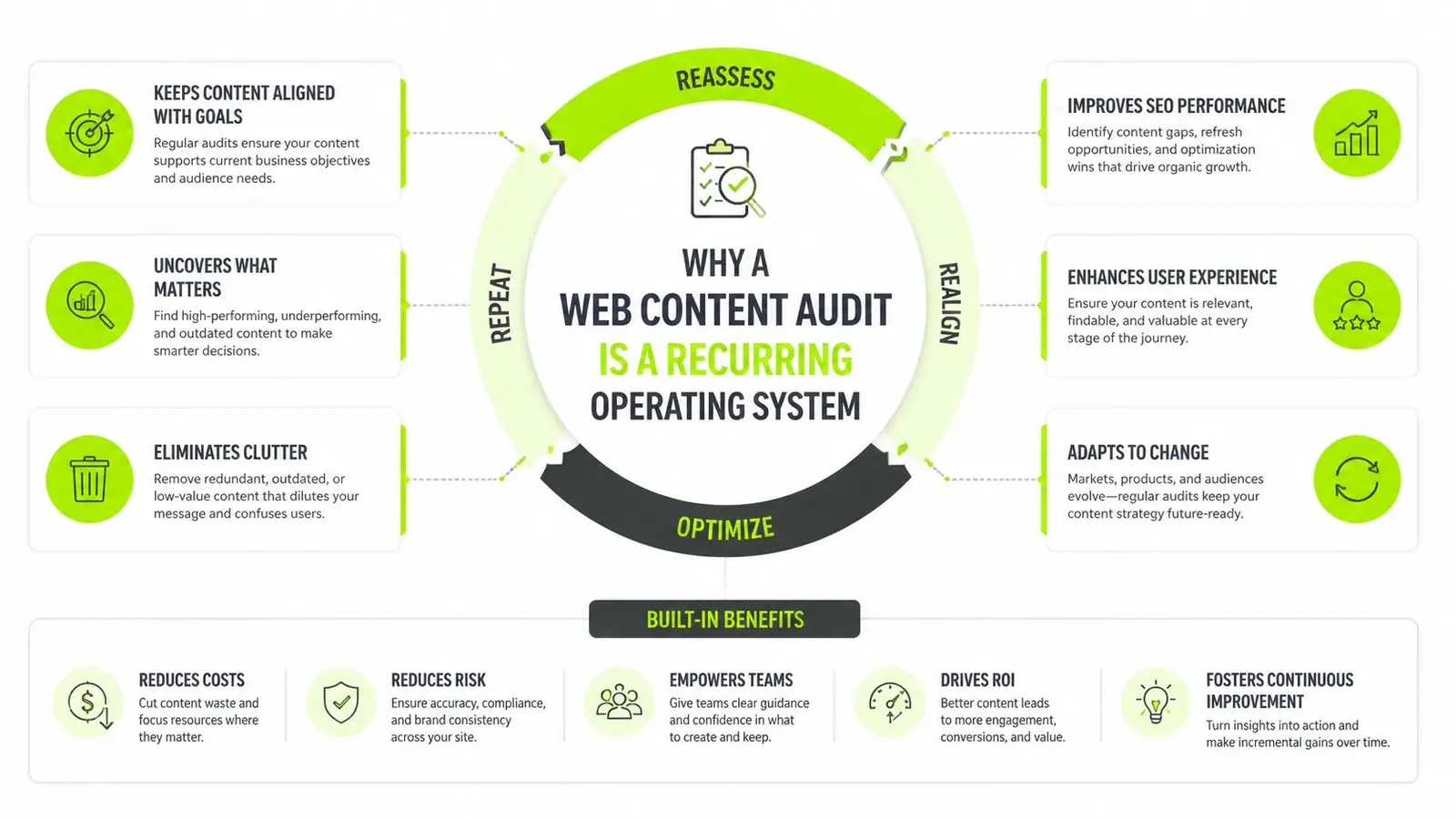
Why a Web Content Audit Is a Recurring Operating System
A content audit works best when it runs as part of normal marketing operations, not as an emergency response to a traffic decline. Moz's definition of a content audit describes a full inventory of indexable content, reviewed against performance metrics so teams can decide what to keep, improve, remove, or consolidate. The American Marketing Association guidance also supports revisiting audits quarterly or during major content reviews.
That cadence matters because pages change after publication. Links break, offers expire, CTAs stop working, competitors publish stronger explanations, and search results evolve. A page can retain rankings while its information becomes inaccurate, or keep attracting visitors while sending almost nobody toward a commercial action. AI-generated search experiences add another layer. A page might perform adequately in classic results but fail to provide clear, extractable answers that systems can summarize and cite.
What a useful audit produces
A strong audit leaves behind working assets, not just observations:
- A maintained inventory: Every URL has an owner, purpose, status, and review history.
- A decision backlog: Each page is assigned keep, update, consolidate, or remove, with a reason tied to evidence.
- A content brief pipeline: Gaps discovered during analysis become briefs writers can use in upcoming production cycles.
- A leadership view: Stakeholders can see which actions protect revenue, improve visibility, or reduce operational risk.
- A measurement baseline: The next review uses comparable data rather than memory or isolated screenshots.
The failure pattern is familiar. Someone exports URLs, adds comments, presents a large spreadsheet, and moves on. Months later, the file hasn't changed. Recommendations with vague rationales get ignored, while developers receive redirect requests without enough context to protect valuable links or user journeys.
Practical rule: If the audit doesn't change what gets updated, published, linked, redirected, or measured next, it was an inventory exercise, not an operating system.
Build the workflow around a shared process, similar to the operating principles outlined in workflow optimization guidance. Each cycle should feed the next one. Completed updates become new baselines, recurring problems reveal governance gaps, and internal-link improvements become easier to spot because the team now understands the content library as a connected system.
Defining Goals, Scope, and a Complete URL Inventory
Start with the business question, not the crawler. “Audit the blog” is a scope statement, but it isn't a useful objective. A better objective might be protecting organic demand for product education, resolving competing pages around a commercial topic, or improving the chance that priority pages appear in AI-generated answers.
Choose one primary outcome and a small set of supporting measures. If the primary concern is declining visibility, prioritize impressions, clicks, rankings, and CTR. If the concern is pipeline, make conversions and assisted conversions central. If the concern is AI discovery, record whether pages are accessible, structured, attributable, easy to summarize, and cited for relevant prompts.
Match the scope to the decision
A full-domain audit suits a redesign, migration, rebrand, or major technical change. A subdirectory audit is more efficient when a team owns a specific area, such as a resource center or product documentation. A blog-only review can work for a publishing reset, but it may miss product pages that compete for the same intent.
| Scope | URL Count | Best For | Caveat |
|---|---|---|---|
| Full site | Entire domain inventory | Redesigns, migrations, broad governance | Requires coordination across teams |
| Key subdirectory | Targeted content area | Topic clusters, resource hubs, product sections | Can miss competition from URLs elsewhere |
| Blog only | Editorial library | Publishing strategy and content pruning | May overlook commercial or support content |
| Priority URL set | Curated pages | Fast diagnosis of a known issue | Won't reveal wider structural problems |
Build the inventory from more than one source. Export published URLs from the CMS, pull page data from Google Search Console, and crawl the site with Screaming Frog or another crawler. A CMS export reveals ownership and publication details. Search Console reveals URLs that receive impressions even when internal navigation doesn't expose them. A crawler finds status codes, canonicals, indexability directives, internal links, and discoverable pages outside the CMS view.
For a practical process to get all pages of a website, normalize every URL before joining datasets. Standardize protocol, hostname, trailing slashes, case, and query parameters. Keep the original URL in a separate field so you can investigate discrepancies later.
Clean the dataset before analysis
Legacy migrations often leave duplicate slugs or several URL formats pointing to similar pages. Pagination, tag archives, category archives, faceted navigation, print versions, and parameterized URLs can inflate the list. Staging URLs may appear in exports or crawl paths, so confirm that every row belongs to the production scope.
Set crawl rules before starting. Decide whether analytics parameters, internal search URLs, filter combinations, and session identifiers should be excluded or stored separately. Use consistent user-agent settings and document blocked paths. A clean inventory isn't the largest possible list. It's a defensible representation of the pages that can influence search, users, and business outcomes.
Collecting the Metrics That Drive Decisions
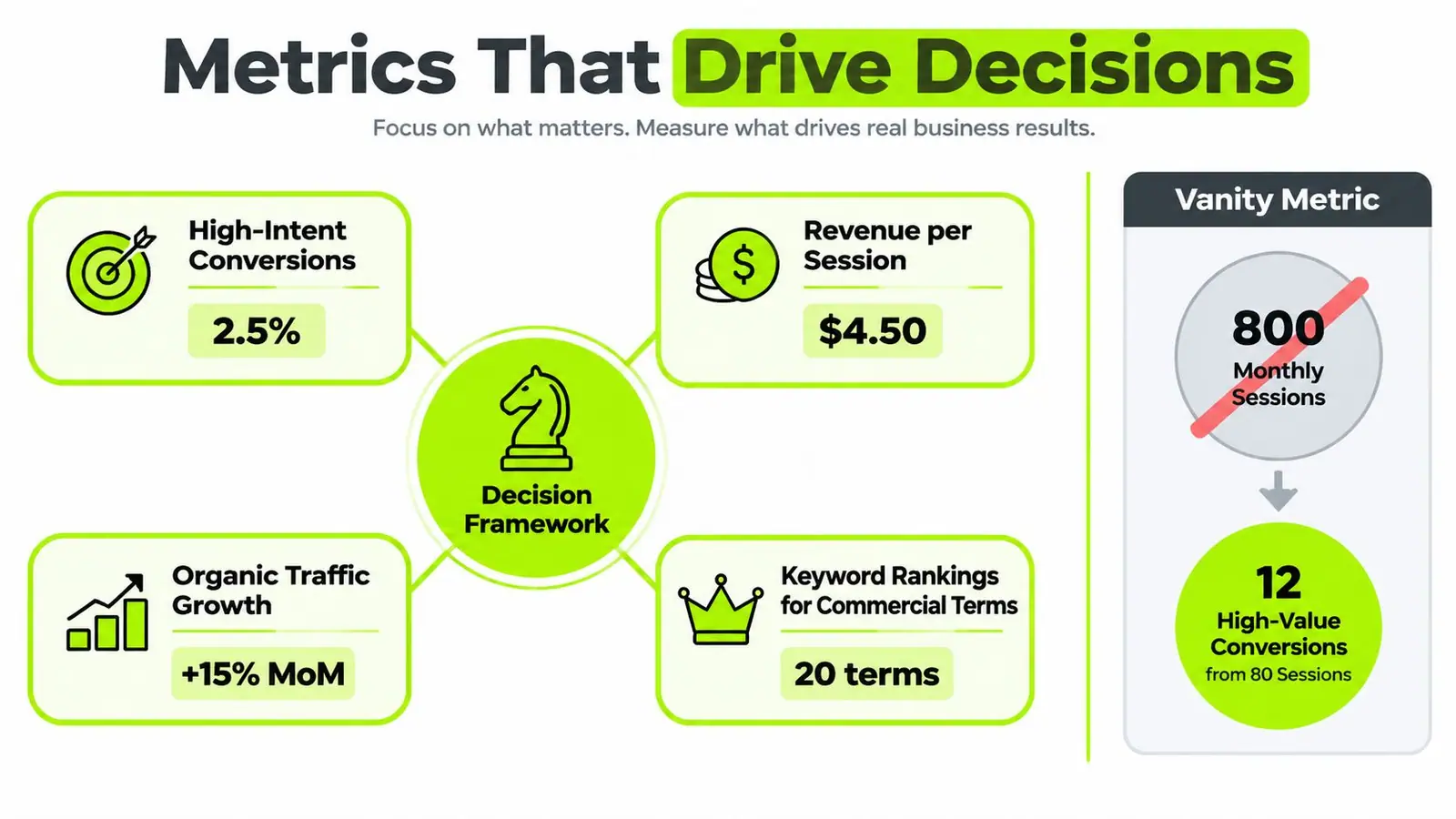
A page can attract substantial traffic and still contribute little to the business. Branded visitors may already know the company, while a smaller page may reach people with strong purchase intent and assist a conversion. Sessions show that someone arrived. They do not show whether the page earned relevant visibility, satisfied intent, supported the next step, or created business value.
Use a consistent measurement window
Huble's recommended audit structure combines a complete URL inventory, page-level metrics from the same timeframe, and a decision state for every page. Apply that structure even when separate teams manage analytics, search, content, and technical systems. Without a shared window, teams can mistake reporting differences for performance changes.
Pull clicks, impressions, CTR, and average position from Google Search Console. Add organic landing-page sessions and conversions from analytics, while keeping direct traffic, organic traffic, referrals, and assisted activity separate. Capture backlinks and referring domains from a backlink platform, then record internal-link counts from the crawl.
Add indexability status, canonical target, response status, title, main heading, last-updated date, content type, author, and owner. These fields often explain why a page with promising demand is not earning results, or why a page with reasonable visibility is not producing useful outcomes. Record whether the page is cited or represented accurately in AI Overview and other LLM answers, so AI visibility becomes part of the recurring audit rather than a separate exercise.
Read trends instead of isolated values
Compare each page across comparable periods. Falling impressions require a different response from impressions generated by irrelevant queries. Stable visibility with weak CTR may call for a sharper title and description. Clicks without meaningful engagement can indicate an intent mismatch or a weak next step.
Group URLs that receive impressions for the same or closely related queries to find cannibalization. Check whether several pages fluctuate around one topic, divide internal links, or leave no clear primary result. Similar slugs do not justify a merge by themselves. Verify the query set, purpose, depth, backlinks, conversions, and historical performance before consolidating anything.
Create one master sheet with one row per canonical URL. Join source exports through a normalized URL key, flag missing matches, and keep raw exports untouched in separate tabs. The audit then remains reproducible, and another reviewer can trace each recommendation back to its source data.
For teams collecting or normalizing large website datasets, Scrapeway vendor comparisons can help frame tool trade-offs before a data workflow is selected. The tool is only one decision. Consistent, page-level evidence carries the analysis.
A useful framework should combine search visibility, user behavior, links, conversions, freshness, technical status, and AI citation checks rather than rely on one dashboard number. Document definitions beside the audit, following the framework for content performance metrics, and retain the same fields for the next review cycle.
Evaluating Quality, Engagement, and AI-Readiness
A consistent scoring rubric keeps the review from following the strongest opinion in the room. Score every canonical URL across three dimensions, then use the result to focus human judgment. A page with modest traffic may support a valuable customer journey and deserve protection. A high-traffic page may require prompt attention if its information is inaccurate or difficult for readers and AI systems to interpret.
Use a five-point scale for each signal. Keep the definitions stable across audit cycles so changes in quality, engagement, and AI-readiness remain comparable. The audit works best as a recurring operating system, with the same checks repeated after major updates, template changes, and content refreshes.
| Dimension | What to Score (1–5) | Signal Source | Weight |
|---|---|---|---|
| Quality | Accuracy, originality, depth, intent match, author signals | Editorial review and SERP comparison | High |
| Engagement | Content consumption, scroll behavior, internal-link flow, conversions | Analytics and event data | Medium |
| AI-readiness | Extractable answers, headings, schema, attribution, crawler access | Crawl, source review, AI visibility checks | High |
Score the page people encounter
Quality review should establish whether the page solves the visitor's problem without making them assemble the answer themselves. Check the opening, heading sequence, examples, evidence, update history, author attribution, and internal links. Flag unsupported generalities, dated instructions, duplicated passages, and claims that no longer match the product or brand.
Interpret engagement by page type and intended journey. A reference page may satisfy a user quickly, while a buying guide should create a clear next step. Review scroll depth, engaged time, form interactions, downloads, assisted conversions, and movement into related pages. Low time on page can reflect efficient answers. High time can indicate confusion, weak structure, or missing information.
AI-readiness belongs in the same review cycle as editorial quality and user behavior. Check whether the page includes:
- Answer-shaped sections: Important questions receive direct responses near the relevant heading.
- Summarizable paragraphs: Each paragraph makes one clear point without hiding the conclusion behind throat-clearing.
- Entity and author clarity: The author, organization, subject, and review process are identifiable.
- Structured data: Applicable schema describes the page accurately and does not contradict visible content.
- Crawler access: Important content is available despite noindex directives, broken links, or rendering failures.
- Citation-worthy substance: The page contributes original explanation, firsthand detail, or a clearly maintained reference.
Run representative prompts through AI search experiences and LLMs, including queries tied to the page's target intent. Record whether the page appears in AI Overviews or receives a citation, which passage is used, and whether the generated summary preserves the page's meaning. Teams comparing manual checks with platform monitoring can review AI visibility audit services as an external reference.
A worked scoring example
Suppose two articles target the same broad question. Article A attracts more organic visits, has strong internal links, and names a recognizable author, yet buries its answer in long paragraphs and lacks meaningful schema or a concise summary. Article B receives less traffic but gives a direct answer under a question-aligned heading, identifies the reviewer, cites its evidence, and uses clean structured data.
Article A may score well for engagement and moderately for quality while scoring poorly for AI-readiness. Article B may score higher overall because its content is easier to retrieve, interpret, and cite. Preserve Article B's stronger evidence, improve Article A's extractability where the intent supports it, and verify through the next audit cycle whether both pages still deserve separate roles.
Turning Audit Findings Into a Prioritized Action Plan
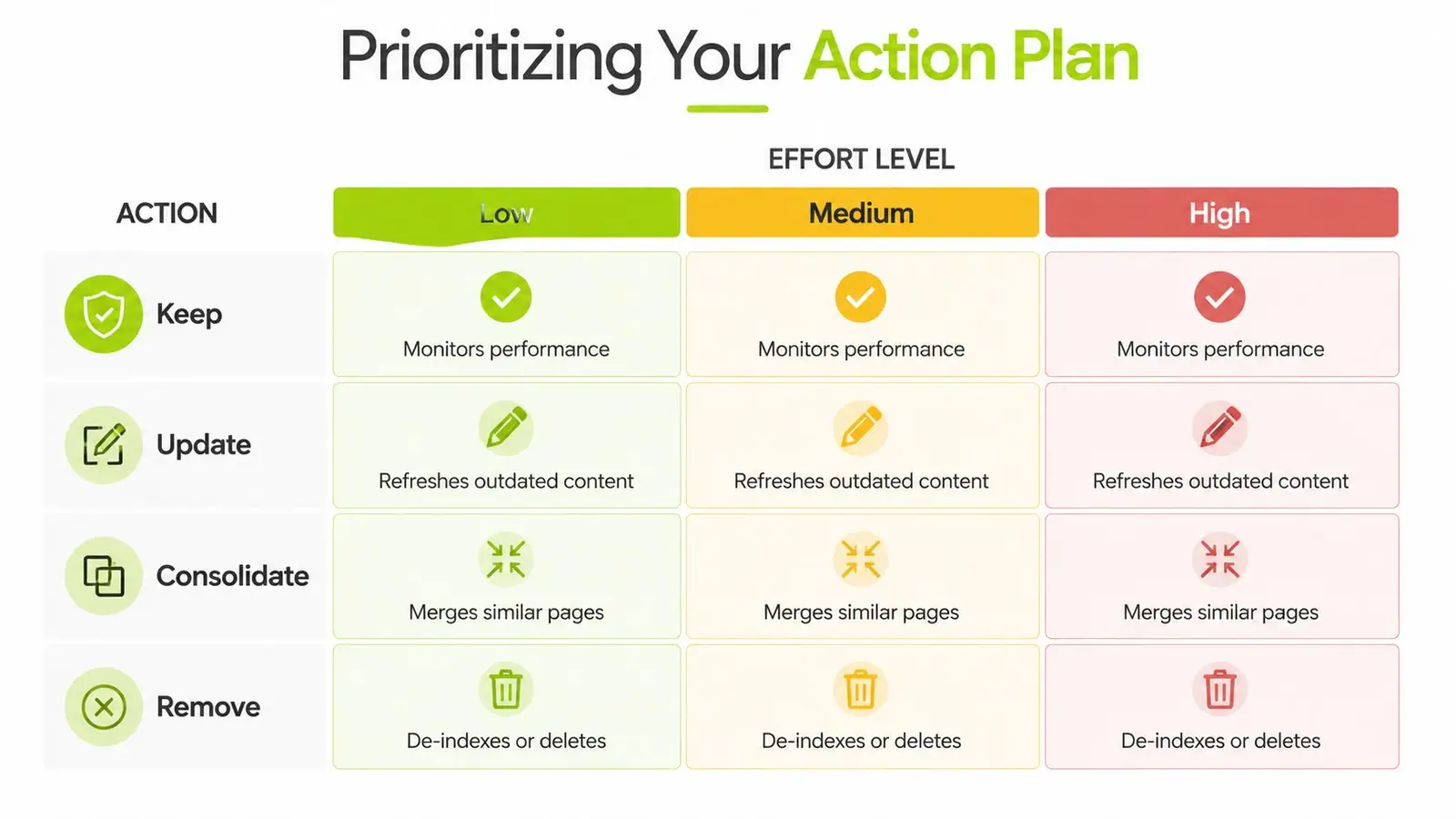
An audit becomes useful when every row turns into an assigned piece of work. Start with four decisions, keep, update, consolidate, or remove. Then add effort and impact. Without the second layer, teams often spend weeks polishing low-value pages while leaving structural problems untouched.
Make the backlog operational
A good action row includes the URL, decision, rationale, effort, owner, target date, dependency, and expected KPI movement. “Improve SEO” isn't a task. “Rewrite the comparison section, add reviewer attribution, repair internal links, and monitor CTR and qualified conversions” is a task someone can estimate and complete.
Use an impact-versus-effort matrix:
- High impact, low effort: Repair broken internal links on priority pages, replace inaccurate titles, restore missing author details, and fix accidental indexability problems.
- High impact, medium effort: Refresh pages with declining visibility, improve intent coverage, strengthen conversion paths, and add clear answer blocks.
- High impact, high effort: Consolidate overlapping clusters, migrate content, redesign templates, or rebuild technical delivery.
- Low impact, high effort: Rewriting pages with no strategic relevance or trying to outperform much stronger competitors without a defensible angle.
Consolidation needs more care than a delete-or-keep label. Preserve the strongest material, choose the surviving URL using performance and business evidence, map redirects, update internal links, check canonicals, and verify that old URLs don't create redirect chains. A 2026 benchmark reported valid canonicals on only 62.0% of desktop pages and 62.3% of mobile pages, so canonical validation belongs in the implementation checklist, not as an afterthought. The benchmark source also highlights why consolidation can create technical risk when teams remove pages without protecting signals.
Implementation check: Never approve a consolidation ticket without a survivor URL, redirect destination, backlink review, canonical check, internal-link update, and post-launch validation owner.
The broader benchmark context is sobering. A 2026 dataset covering 100,000+ audited sites reported a median audit score of 71 out of 100, with 6.8% receiving an A and 10.3% falling into F territory. It also reported that 71.2% failed performance checks and 54.6% failed AI/GEO readiness checks, showing that modern audits extend well beyond copy edits. These figures come from the SEO audit benchmarking dataset, and they reinforce the need to give technical delivery and AI-readiness the same operational status as editorial quality.
Reporting, Templates, and a Cadence That Sticks
Leadership needs decisions, not a raw export. A useful report explains what changed, why it matters, who owns the work, and how success will be judged. Keep the reporting stack layered so executives can act quickly while practitioners have enough detail to execute.
Use three reporting layers
The executive summary should fit on one page. Include:
- Business context: The audit's purpose and the areas reviewed.
- Key findings: The main visibility, conversion, quality, and technical patterns.
- Recommended investment: Work requiring editorial, development, analytics, or leadership support.
- Expected measurement: Metrics to review after implementation.
- Risks: Redirect, canonical, brand, compliance, or traffic-protection concerns.
The stakeholder report should group actions by owner, not discovery order. Give editorial a content queue, developers a technical queue, and marketing a conversion or messaging queue. Every recommendation needs a URL, action, rationale, priority, due date, dependency, and status.
Teams building briefs, review checklists, and project documentation can adapt these ready-to-use content templates. Replace generic fields with the criteria your team uses to approve, measure, and close work.
Set the review rhythm
Run the full review quarterly, or more often for sections that change frequently. Use a lighter monitoring pass between reviews for priority URLs, new products, major migrations, algorithm-related disruption, and noticeable changes in AI Overview behavior. A scheduled reporting workflow can keep owners accountable without requiring a manual presentation for every review.
Apply the same scorecard each cycle:
- Organic clicks, impressions, CTR, and rankings
- Qualified conversions and assisted conversions
- Backlinks and internal-link coverage
- Indexability, status codes, and canonical health
- Content quality and freshness status
- AI Overview appearances, AI citations, and citation gaps
- Completed actions, overdue tasks, and unresolved dependencies
Assign one owner to each action and record the next review date. Without that accountability, a polished report becomes another file in the project folder.
Surnex provides a site audit workflow that surfaces technical and on-page issues. Its broader platform combines AI visibility tracking with rankings, backlinks, audits, and content opportunities. Use it alongside existing crawl, analytics, and editorial systems when a shared view of classic search and AI visibility reduces tool switching.
Surnex can help teams connect web content audit findings with traditional SEO signals, AI Overview visibility, LLM presence, citations, and actionable site issues in one workflow. Visit Surnex to assess whether it can support consistent ownership, reporting, and follow-through across recurring audits.