Monday morning hits, the inbox is full, and the same report is still half-finished. Someone needs rankings, someone else wants a client-ready summary, and the data you need is split across dashboards, exports, and old slide decks. That scramble is exactly why scheduled reporting matters, because it turns reporting from a recurring fire drill into a dependable system.
The strongest reporting habits have always been about predictability. The United Nations handbook on official statistics recommends a 12-month release schedule and a specific release date at least four weeks in advance where practicable, and the U.S. Census Bureau's calendar shows that discipline in practice with releases like January 7, 2026 at 10:00 AM for Manufacturers' Shipments, Inventories and Orders, January 8, 2026 at 8:30 AM for U.S. International Trade in Goods and Services, and January 9, 2026 at 8:30 AM for New Residential Construction. That same logic applies to client reporting, stakeholder updates, and SEO performance reviews. If you need a practical reference for agencies, build trusted client reports is a useful place to compare expectations with delivery habits.
Moving Beyond Manual Reporting Chaos
The pain is familiar. A strategist pulls numbers from one platform, an account manager copies screenshots from another, and the final deck gets assembled under deadline pressure while everyone asks for “just one more chart.” By the time the report goes out, it already feels late, and nobody is confident the numbers match the latest export.
Scheduled reporting solves more than speed. It creates a repeatable rhythm that people can trust, which matters when clients, executives, or internal teams expect the same report every week or month. The point isn't just to save time, it's to remove the uncertainty that makes reporting feel fragile.
Practical rule: if a report needs manual rebuilding every cycle, the process is already too expensive.
That's why the best teams treat reporting like an operating system, not an afterthought. In public statistics, release schedules are formal commitments, and in business settings they should feel the same way. When expectations are fixed in advance, the conversation shifts from “where's the report?” to “what changed, and why?”
That discipline also improves retention because it shows consistency. A stakeholder who knows when to expect updates is easier to serve than one who gets sporadic email attachments at odd hours. For teams building that kind of process, the goal is not a prettier spreadsheet, it's a reliable communication channel that keeps search performance visible and understandable.
The Core Components of Scheduled Reporting
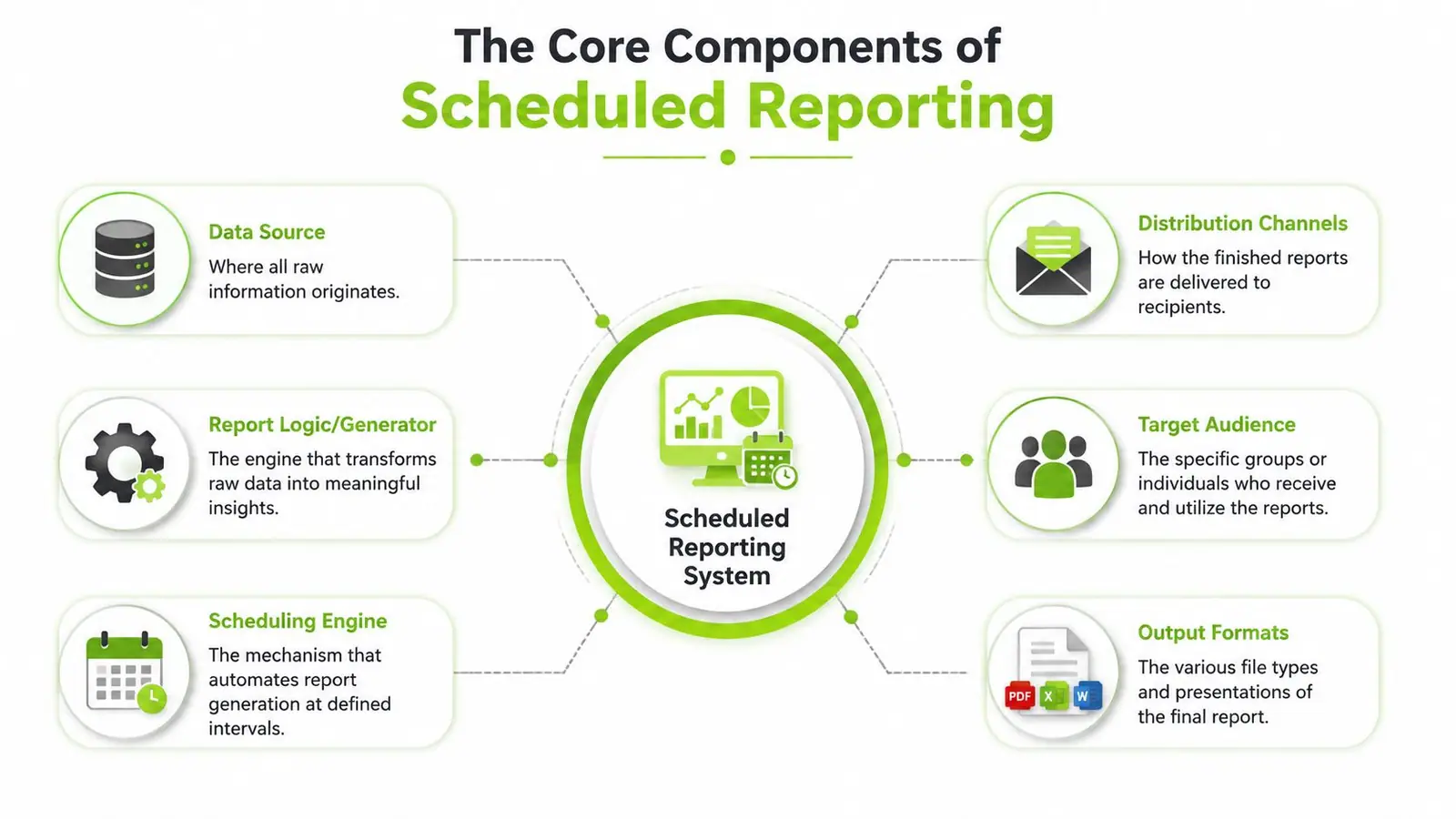
Think of scheduled reporting as a data subscription. The subscriber doesn't ask each week whether the issue will arrive, the system delivers it because the timing, format, and audience are already defined. IBM describes scheduled report definition as automation that generates reports at a specific time interval through a report scheduler, and F5's workflow shows that mature systems also require a start date, start time, end date, frequency, and retention policy.
Timing, delivery, and retention are separate decisions
The first decision is cadence. Daily, weekly, and monthly schedules are common because they map to different decision cycles, and some platforms narrow those options further by report type. Amazon Connect documents a 15-minute delay after the scheduled report time, which is a useful reminder that scheduling is not the same as immediate execution, especially when data consistency matters.
The second decision is delivery. Some reports exist for humans, others feed machines, and those goals don't always share the same format or destination. If the audience needs a readable summary, a polished PDF or HTML report can work well. If the output will be loaded into another system, structured formats are usually the better choice.
The third decision is retention. Reports that land in inboxes or storage buckets without a deletion policy become a compliance problem later. That's why a governed process needs rules for how long outputs are kept, who receives them, and what happens when a schedule fails.
A report that arrives on time but cannot be retained, traced, or deleted cleanly is not operationally complete.
For teams setting this up, a good internal reference is the agency client reporting workflow, because the mechanics of audience, timing, and delivery are where most reporting systems either scale or break.
What to Measure in the Age of AI Search
Legacy SEO reports still matter, but they no longer tell the whole story. Most scheduled-reporting guidance still centers on classic metrics, and AWS's documentation makes that gap obvious by focusing on periodic report delivery while leaving little guidance for AI Overviews, brand presence in LLM-driven discovery, or citation gaps over time. That's the wrong shape of reporting for teams trying to explain modern search visibility.
Choose metrics by decision level
A useful reporting system separates operational metrics from executive metrics. Practitioners need signals that help them act quickly, while leaders need summaries that show direction and risk. The cadence should follow that split, not the other way around.
| Cadence | Audience | Core KPIs to Include | Focus |
|---|---|---|---|
| Daily | SEO specialists, analysts | AI Overview appearance changes, citation presence, page-level visibility shifts | Fast detection of movement |
| Weekly | Channel managers, account leads | Brand mentions across search surfaces, recurring visibility patterns, content gaps | Prioritization and trend review |
| Monthly | Executives, clients, stakeholders | Search performance summary, AI visibility progress, strategic opportunities | Direction, risks, and decisions |
The key is not to stuff every report with every possible metric. That only creates noise. Instead, define one report that tracks the data needed to make tactical decisions, and another that shows whether the overall search program is becoming more visible in AI-driven experiences.
A lot of teams also benefit from separating vanity metrics from decision metrics. Rankings alone can still be useful, but they don't explain whether a brand is surfacing in AI-generated answers or whether its citations are holding over time. That's the conversation modern reporting needs to support.
For teams building their metric stack, data for SEO is a good companion topic because it reinforces a basic truth, good reporting starts with clean inputs and a clear purpose.
Build the report around the audience, not the tool
An analyst may want row-level detail, while a client just wants the takeaway. An executive may only care whether visibility is improving in the places that matter. The same underlying data can serve all three, but only if the report is shaped to the audience.
That's where AI-era reporting changes the job. Instead of asking only, “Where did we rank?” ask, “Where did we appear, where did we get cited, and where are we missing?” Those questions make scheduled reporting more useful because they connect traditional SEO work to the way people discover information now.
Best Practices for Reports People Actually Read
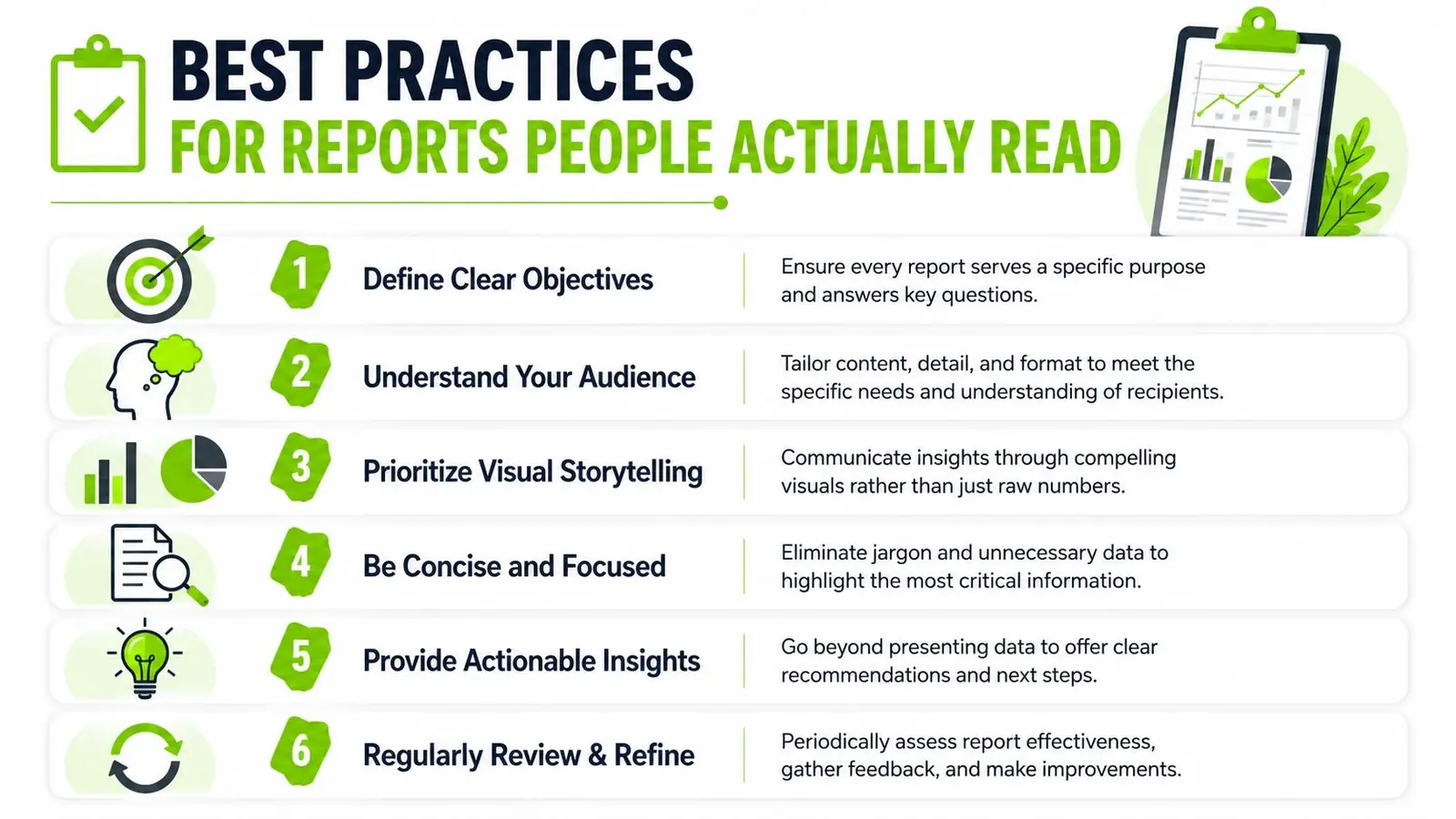
A report gets read when it answers a real question quickly. It gets ignored when it feels like a data dump. That difference usually comes down to structure, context, and whether the report respects the reader's time.
Give the report a point of view
A good report doesn't just display numbers, it explains what changed and what should happen next. That means each output needs a clear narrative, even if the format is short. If the report says visibility dropped, it should also show the likely cause, the affected pages, and the next action.
Visuals matter because they reduce effort. Charts help people see movement, but they need to be paired with concise analysis so the reader doesn't have to guess what matters. That's especially important in recurring reports, where repeated exposure to the same layout can either build trust or create boredom.
The governance side matters just as much. Gainsight's scheduled report documentation highlights practical issues like recipient limits, branded sender domains, attachment formats, and deletion policies, all of which affect whether reports are delivered reliably and safely at scale. These details are boring until they break a workflow.
Keep delivery clean and controlled
A report that reaches the wrong inbox is a problem, even if the numbers are right. A report that lands with broken attachments or inconsistent branding feels less credible, even if the data is solid. That's why governance belongs inside the reporting strategy, not in an afterthought checklist.
Reports fail in practice when delivery is treated as a side feature instead of a managed process.
For teams that want a cleaner presentation layer, SEO reporting dashboard design is a useful point of reference because it reinforces how layout choices change reader behavior. The principle is simple, a report should look like a decision tool, not a spreadsheet export.
How to Automate and Scale Your Reporting Workflows
The fastest path to automation is the one you already have. Most tools include some form of built-in scheduler, and that's enough for many teams to move from manual exports to dependable delivery. AWS's dashboard email delivery is a good example of how a recurring workflow can be turned into a scheduled report without rebuilding the entire process every time.
Built-in schedulers work well when the audience is fixed and the output is straightforward. They're less useful when teams need to combine multiple sources, push data into other systems, or route different formats to different stakeholders. That's usually the point where a workflow needs an API, not another email rule.
Choose the output format with the downstream use in mind
Akamai's documentation shows why format choice matters. HTML scheduled reports are limited to 25 table rows, while CSV can carry the full dataset, which is a real difference when the output feeds another process. If the report is for a client meeting, a visual format may be enough. If it's going into a warehouse, BI tool, or alerting workflow, CSV is usually the safer choice.
That distinction gets more important as reporting matures. A system that produces attractive but truncated output creates false confidence. A system that produces machine-readable output can support other automation, including alerts, data blending, and trend analysis.
For teams looking at more flexible workflow design, Built-in AI agent integrations is worth reviewing as a reference point for how connected automation can fit into broader operations. It's most useful as a reminder that reporting no longer has to be a manual endpoint.
Build toward a repeatable pipeline
Once the basics are stable, the next step is to standardize how reports are generated, named, delivered, and archived. That matters whether the workflow is simple or complex. A good pipeline reduces handoffs, keeps the same logic in place every cycle, and makes the output easier to trust.
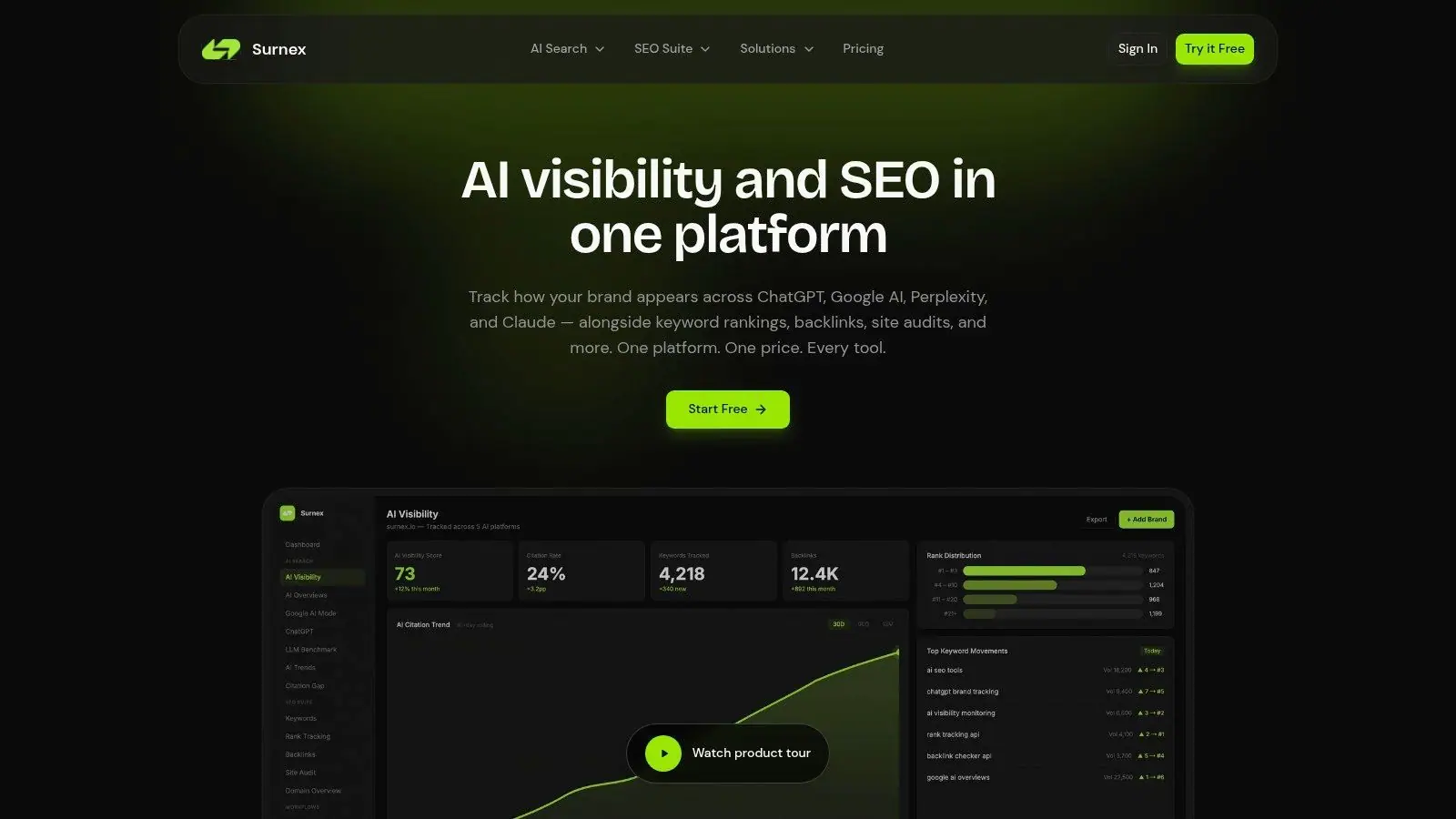
For teams that need a more connected setup, the internal automation guide at automate SEO reporting is a helpful companion because it frames reporting as a system rather than a one-off task. In practice, that's where tools like Surnex fit, as a platform that combines AI visibility tracking and SEO reporting in one place, alongside a flexible API for teams that need to move data into other workflows.
The Future of Automated Search Intelligence
The future of reporting isn't just faster delivery. It's better interpretation. As search keeps shifting toward AI-driven surfaces, teams need reports that show not only where they ranked, but where they surfaced, where they were cited, and where visibility is missing.
Scheduled reporting has always been about trust. Official statistics use release calendars to synchronize expectations, enterprise platforms use cadence and retention rules to keep outputs predictable, and modern search teams need the same discipline to communicate value clearly. The report that matters most is the one stakeholders can understand without extra explanation.
This is a major upgrade. Move from static dashboards to a system that produces consistent, audience-specific, AI-aware reporting on a schedule people can rely on. When that system is in place, SEO stops looking like a pile of disconnected metrics and starts looking like a managed intelligence function.
Surnex helps teams track AI visibility, traditional SEO signals, and citation gaps in one place, then turn that data into repeatable reporting for clients and stakeholders. If you're ready to replace manual SEO reporting with a system built for modern search, visit Surnex and see how it can support your workflow.