Most guides treat AI visibility as one score, then rank tools by the size of their feature lists. That approach misses the central problem. A platform that tracks citations in ChatGPT isn't measuring the same outcome as a Google AI Overviews tracker, a traditional rank tracker, or a technical crawler.
This comparison evaluates the best AI search visibility tools by the search surfaces and workflows they measure. The comparison considers AI engine coverage, citation and mention data, traditional SEO depth, reporting, integrations, pricing transparency, agency scale, and in-house implementation needs. Surnex is the featured option because it brings AI visibility, traditional SEO, agency reporting, and API access into one operating layer. The other tools are strong in different situations, especially when a team already has an established SEO stack or needs enterprise Google monitoring.
The need for better measurement is growing, but the market is uneven. One late-2024 study reported AI Overviews on 18.76% of U.S. SERPs, while a 2026 research summary reported roughly 48–50% of tracked U.S. queries showing them. Volume-weighted analysis indicated coverage above 54.61% because AI Overviews cluster around high-traffic informational searches, according to SE Ranking's AI Overviews research. That variation is why a useful tool must show where visibility occurs, not just attach a single number to it.
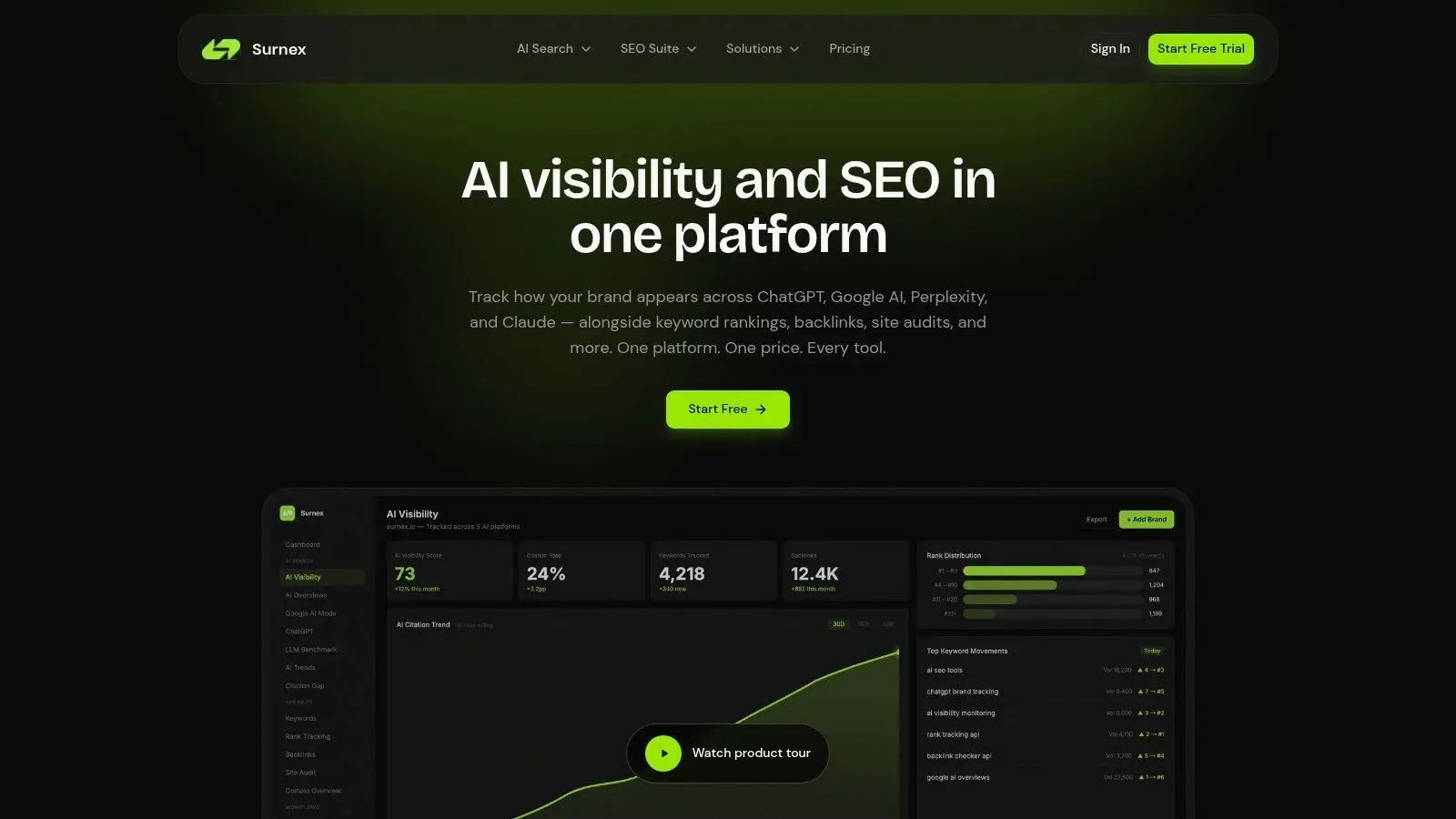
1. Surnex
Surnex is the strongest fit for teams that need one view of traditional search and AI-powered discovery. It tracks presence and citations across Google AI Overviews, Google AI Mode, ChatGPT, Perplexity, and Claude, while also providing keyword research, rank tracking, backlink analysis, site audits, Core Web Vitals, and domain snapshots.
That combination changes the operating model. An SEO manager can compare a ranking loss with a citation gap, an agency can connect client reporting to AI visibility trends, and a developer can access the same search intelligence through a REST API. Teams don't have to maintain separate dashboards for organic rankings, backlinks, technical readiness, and AI mentions.
Where Surnex creates an advantage
Surnex's most useful distinction is its focus on citation gaps and competitive explanation. A visibility score tells you that a competitor appears more often. Citation-gap analysis helps identify which competitors receive references, which pages earn those references, and where your content or authority signals may be insufficient.
The platform also benchmarks multiple LLMs side by side. That's important because Google AI Overviews, ChatGPT, Perplexity, and Claude can surface different sources for similar questions. A brand may be visible in one environment and absent in another, so a single-assistant report can create false confidence.
Practical rule: Treat AI visibility as a diagnostic workflow. The useful question isn't only whether your brand appeared, but which source earned the citation and what your team can improve.
Surnex is particularly suited to agencies, in-house SEO and growth teams, consultants, web developers, and product teams building search intelligence into another application. White-label reports support client delivery, while unlimited clients, projects, and users make the operating structure easier to scale. Its API-first design also allows teams to connect search signals to internal dashboards, assistants, or automated workflows.
Pricing and limitations
Surnex offers four monthly plans priced from $49 to $399 per month: Starter, Growth, Agency, and Scale. Every plan includes unlimited users and projects plus API and MCP access, and white-label reports start on the Agency plan. A 14-day free trial of the Growth plan requires no credit card, according to the Surnex pricing page.
The main limitation is that AI citation behavior changes as answer surfaces evolve. Teams should validate the signals against their own prompts and reporting needs rather than treating any vendor's metric as permanent truth. Surnex can replace several tools for many workflows, although teams that need very large legacy backlink datasets may still retain a specialist platform.
2. Ahrefs, Brand Radar and AI Overviews Tracker
Ahrefs Brand Radar is a strong choice for teams that already depend on Ahrefs for keyword, link, and content intelligence. It measures mentions, citations, impressions, and AI share of voice across Google AI Overviews, AI Mode, ChatGPT, Perplexity, Gemini, and Copilot.
The product's value comes from connecting AI visibility to the datasets SEO teams already use. A brand mention isn't isolated from content performance or authority research. Users can compare competitors, examine visibility over time, and relate cited sources to the broader search environment.
Best fit for established Ahrefs workflows
Custom prompt tracking supports Google AI Overviews, AI Mode, ChatGPT, Perplexity, and Copilot. Developer API endpoints for Brand Radar also make the platform suitable for teams building dashboards or ETL pipelines around existing Ahrefs data.
Ahrefs has also published a free AI Overviews Tracker for quick checks. That makes it useful for an initial investigation, while Brand Radar is better suited to recurring measurement and reporting.
The main tradeoff is workflow complexity. Teams unfamiliar with Ahrefs may need time to understand how its AI metrics relate to traditional SEO reports. Add-on and API availability can also depend on plan level or additional fees, so procurement teams should confirm the exact package before standardizing on it.
For a broader comparison of monitoring approaches, see this guide to tools for monitoring AI Overviews. It helps clarify why a Google-focused tracker and a cross-LLM citation platform shouldn't be treated as interchangeable.
Ahrefs is most compelling when AI visibility is another layer in an existing search intelligence system, not when a team wants a small standalone mention monitor.
3. Semrush, AI Visibility Toolkit
Semrush's Visibility Overview brings AI visibility into a broad SEO suite. Its reports can show mentions, citations, cited pages, distribution by LLM, and AI share of voice, while domain and top-page reports connect AI signals with established SEO data.
That makes Semrush practical for agencies and in-house teams that already use its keyword, competitor, content, and reporting workflows. They can add AI visibility without creating an entirely separate operating system for search measurement.
Reporting strength and practical limits
Semrush supports prompt tracking and provides a free AI Overviews Visibility Checker for quick brand scans. Its Visibility Overview is more useful for recurring reporting because it gives teams a place to compare platforms, cited pages, and competitor presence over time.
The platform also publishes ongoing AI Overviews research and market studies. Semrush's AI Visibility Index says it analyzed 126 million real U.S. AI search prompts across 22 industries and four AI platforms. That figure is relevant because prompt benchmarking needs broad sampling to avoid conclusions based on a handful of manually selected questions.
Some AI capabilities sit in higher tiers or enterprise modules. Methodology detail can also vary between features, so buyers should ask how each report is sampled, refreshed, and integrated with their existing dashboards.
For teams building a measurement program, this AI Overview tracker guide offers a useful distinction between monitoring the feature itself and measuring broader AI citations across assistants.
4. BrightEdge, Generative Parser and AI Overviews
BrightEdge is built for enterprise SEO teams that need deep Google AI Overviews monitoring. Its Generative Parser tracks AI Overview presence, share of voice, and citation patterns across large keyword sets, then places those signals inside enterprise reporting and research workflows.
The platform is most relevant when Google remains the primary discovery surface for the organization. BrightEdge publishes recurring research on AI Overviews activation, stabilization, and citations, which helps large brands interpret market movement rather than reviewing isolated prompt results.
A Google-centered enterprise layer
BrightEdge's strength is depth around Google search behavior. A large brand can compare its AI Overview share of voice with competitors, examine which sources appear in generated answers, and connect the findings to existing SEO governance.
That focus is also the key limitation. Documentation is less centered on non-Google assistants than tools designed around cross-LLM citation tracking. A team that needs ChatGPT, Perplexity, Claude, Gemini, and Google AI Mode in one comparable report may need another platform or additional workflow.
Pricing and procurement are enterprise-oriented, with the buying process requiring direct vendor engagement. That can make BrightEdge a poor fit for a small agency seeking transparent self-serve pricing, but a sensible choice for organizations where governance, scale, and executive reporting matter more than fast setup.
5. Similarweb, Rank Tracker and Rank Ranger lineage
Similarweb Rank Tracker adds AI Overview indicators to conventional rank tracking. It flags keywords that trigger Google AI Overviews, supports campaign-level filtering, and provides reporting, exports, and API options.
This is a useful design for teams that don't want AI visibility separated from keyword performance. Analysts can review rankings, SERP features, and AI Overview presence in the same campaign structure, then export results into established reporting pipelines.
Strong for Google SERP operations
The product's Rank Ranger lineage and search intelligence infrastructure support daily keyword tracking with AIO indicators. Enterprise-grade API and reporting integrations are valuable for agencies managing recurring client reports or internal data warehouses.
The measurement scope is narrower than a cross-LLM platform. Detecting a Google AI Overview doesn't reveal whether ChatGPT or Perplexity cites the brand, and an AI Overview indicator isn't equivalent to URL-level citation analysis across answer engines.
Pricing and packaging can be difficult to assess from public information. Buyers should request a precise quote based on keyword volume, API access, markets, users, and reporting requirements.
Teams comparing competitors should also consider competitive benchmarking workflows, especially when the goal is to explain why another domain appears in an AI result rather than just record that it does.
6. Advanced Web Ranking
Advanced Web Ranking is a mature rank tracker that has extended into AI Overviews, AI Mode, ChatGPT, and Perplexity. It fits agencies that manage large keyword programs and want AI indicators alongside classic rankings, search engine coverage, and client reporting.
AWR provides dedicated AI tracking documentation and metrics such as AIO Citation Rank. It also supports coverage across more than 170 countries, according to the product information supplied for this comparison. That global reach matters for agencies whose clients operate across multiple markets, although AI answer behavior still needs to be interpreted by country, device, and query intent.
Agency scale with a focused surface set
The platform's reporting and export capabilities are familiar to rank-tracking teams. Its API and MCP Server can connect AWR data to ChatGPT or Claude workflows, giving technical users a path to custom automation rather than forcing them to work only inside the standard interface.
AWR's coverage remains more focused on Google, ChatGPT, and Perplexity than on the full LLM ecosystem. That's not necessarily a weakness. It can be an advantage when an agency wants dependable rank operations and selected AI signals, without paying for a broad platform it won't use.
AI answers fluctuate, so the team should look for sustained patterns across a carefully maintained prompt set. A single changed answer shouldn't automatically trigger a content rewrite or client escalation.
7. AccuRanker
AccuRanker is designed for teams that prioritize fast rank updates and operational monitoring. Its AI layer, AccuLLM, adds emerging AI analytics to a familiar rank-tracking environment, while its AI Search Volume research helps teams investigate how search behavior is changing.
The practical appeal is continuity. A team can keep its established rank-tracking workflows, alerts, SERP analysis, and reporting integrations while adding an early view of AI-related signals.
Best for rapid operational feedback
AccuRanker's speed-focused positioning suits agencies and in-house teams that need frequent updates for active campaigns. Integrations, MCP, and API options support reporting pipelines and automation, so the tool can feed existing dashboards rather than creating another manual reporting task.
Its AI visibility capability is newer than its conventional rank-tracking foundation. Some AI features may be limited to higher tiers, and AccuRanker isn't positioned as a dedicated cross-LLM citation platform. Teams needing URL-level citation history across many assistants should compare it with a purpose-built AI visibility product.
That narrower scope can still be the right choice. If the main job is monitoring rank changes and adding AI indicators to a familiar workflow, a specialized citation dashboard may add complexity without improving execution.
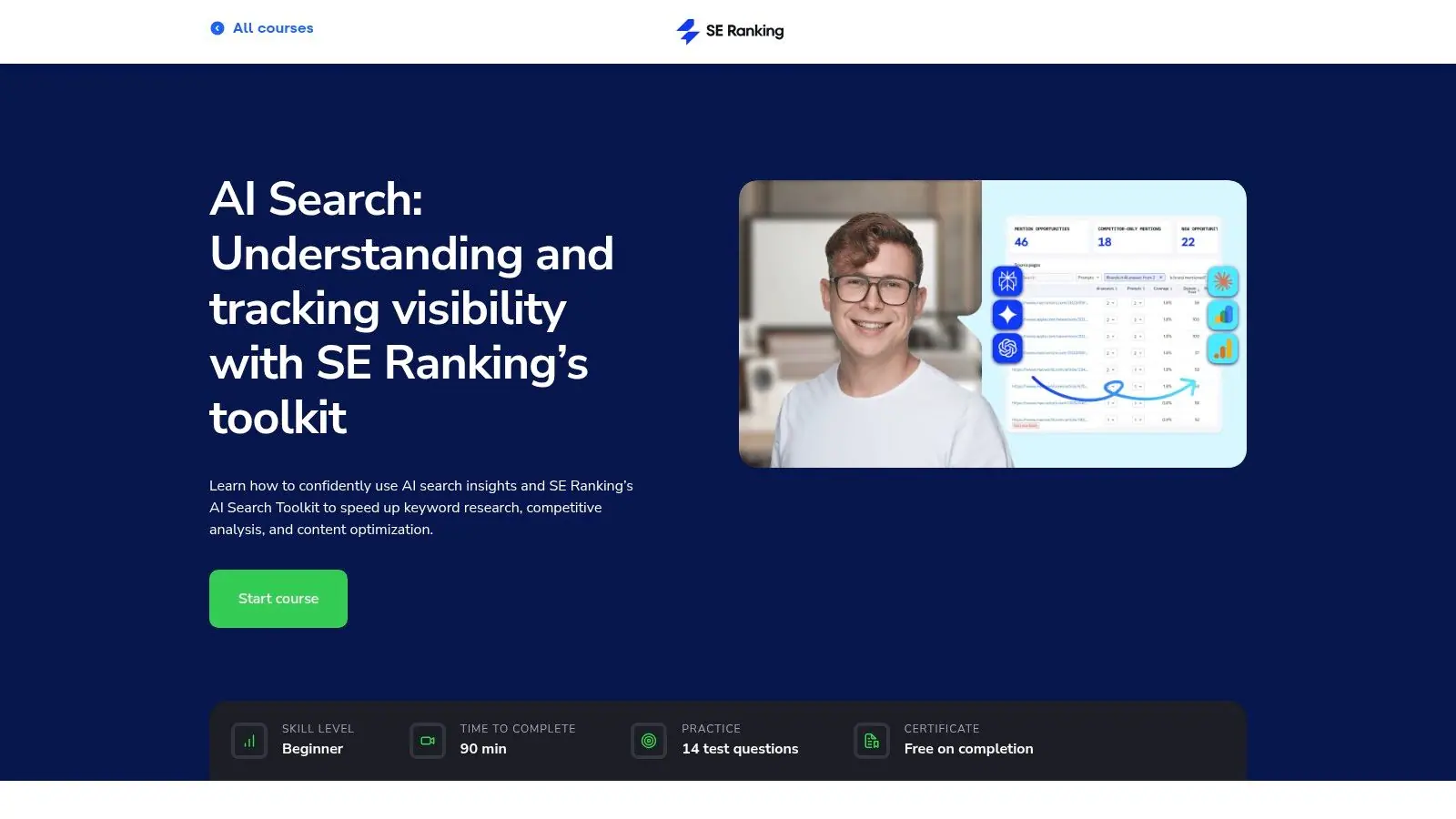
8. SE Ranking, AI Search Toolkit
SE Ranking's AI Search Toolkit combines classic rank tracking with AI Results Tracker, competitive AI visibility through SE Visible, and an AIO Tracker. It is aimed at small and mid-market agencies that want to add AI measurement without moving to an enterprise platform.
The workflow feels familiar to SEO practitioners. Teams can monitor traditional rankings, review presence in AI results, compare competitors, and bring the findings into client reporting. Educational resources and onboarding courses also help teams that are still defining what AI visibility should mean operationally.
Accessible entry, lighter depth
SE Ranking's advantage is adoption. It integrates AI into an established SEO product rather than asking a small agency to build a separate research process around a specialist tool. The optional AI Search add-on and API create a path to more advanced usage as reporting needs grow.
The tradeoff is breadth and sampling depth. Enterprise tools may provide more granular market analysis, while dedicated AI platforms may offer richer prompt and citation detail. Some AI features are add-ons, so the apparent base price won't necessarily represent the total cost for a full AI workflow.
Agencies should test the same client prompts in SE Ranking and in one dedicated citation platform. The question isn't which interface looks better. It's whether the data supports the explanations clients need, including cited URLs, competitor comparisons, and changes over time.
For developers connecting search data to internal systems, this overview of the SE Ranking API is relevant when evaluating automation requirements.
9. seoClarity
seoClarity is an enterprise SEO platform for organizations that need to connect AI search preparedness with technical SEO operations. Its capabilities include AI and AEO modules, schema and page optimization, internal link optimization, split testing, competitive tracking, and Bot Optimizer functionality intended to improve retrieval by search and AI bots.
This makes seoClarity different from a tool that only reports whether a brand was mentioned. It helps teams investigate technical conditions that may affect whether content can be crawled, understood, and retrieved.
Technical readiness before citation analysis
Large organizations often have a practical problem before they have a visibility problem. Important pages may be difficult to crawl, poorly structured, weakly connected internally, or missing the schema and page-level signals that support reliable interpretation. seoClarity's technical breadth gives teams a way to address those issues inside their SEO operation.
The limitation is measurement specificity. Documentation describes AI search broadly, while explicit AI Overview reporting details are less prominent than in platforms built primarily for AIO tracking. Buyers should ask for a product demonstration using their own domains, priority pages, and target AI surfaces.
Pricing is customized and the sales process is enterprise-oriented. That can be justified where technical governance and large-scale SEO coordination are central, but it may be excessive for a team that only needs prompt monitoring and citation exports.
10. Otterly.AI
Otterly.AI is a dedicated AI visibility platform for teams that care more about prompt and URL-citation monitoring than a complete traditional SEO suite. It tracks brand mentions and domain citations across ChatGPT, Google AI Overviews, Google AI Mode, Perplexity, Gemini, and Copilot.
The product reports daily prompt results, coverage, citation changes, and competitive winners and losers. Exportable raw responses are useful when an agency needs to show a client the actual answer behind a metric instead of presenting a summary score without context.
A focused citation layer
Otterly's citation trend views help teams see which URLs appear in AI answers and how those sources change over time. GEO audits add a practical readiness layer, although the platform isn't intended to replace a full backlink database, rank tracker, or deep technical SEO suite.
That narrow scope is a feature for some buyers. A content team can start monitoring priority prompts without migrating its entire SEO stack, and an agency can produce clear exports for stakeholders. A team that needs keyword research, site audits, backlink analysis, and AI visibility under one subscription will likely need an additional platform.
Otterly also focuses on major engines and intentionally excludes some long-tail tools. Prospective users should therefore map the assistant mix to their audience before buying. If the priority is direct citation evidence across the main AI surfaces, Otterly is easier to justify than if the team needs broad search operations.
Top 10 AI Search Visibility Tools, Feature Comparison
| Tool | Core features | Quality (★) | Value & Pricing (💰) | Target (👥) | Unique selling points (✨) |
|---|---|---|---|---|---|
| Surnex 🏆 | AI visibility across major LLMs + full SEO suite (rank, backlinks, audits) + REST API | ★★★★★ Modern UX & API‑first | 💰 Four plans $49–$399/mo; 14‑day trial | 👥 Agencies, in‑house SEO, developers, product teams | ✨ Cross‑LLM citation gap analysis, API + white‑label reporting |
| Ahrefs, Brand Radar | Brand/AI mentions, citations, impressions tied to Ahrefs keyword & link datasets; API | ★★★★☆ Strong research & methodology | 💰 Add‑on/API may require higher plans | 👥 Agencies, enterprise SEO teams | ✨ Broad engine coverage + integrated link/keyword data |
| Semrush, AI Visibility | AI signals in core reports (Visibility, Domain/Top Pages) + free AIO checker | ★★★★☆ Integrated reporting & docs | 💰 Tiered pricing; some AI features in higher plans | 👥 Agencies, exec reporting teams | ✨ AI visibility baked into existing SEO dashboards |
| BrightEdge, Generative Parser | Google AIO tracking, SOV, enterprise research & optimization guidance | ★★★★☆ Enterprise research cadence | 💰 Enterprise pricing & procurement | 👥 Large brands, enterprise SEO orgs | ✨ Deep Google‑centric AIO research and board‑level reports |
| Similarweb (Rank Tracker) | Rank tracking with AIO flags, exports and enterprise API (Rank Ranger lineage) | ★★★★ Reliable rank + AIO indicators | 💰 Enterprise packaging; can be opaque | 👥 Reporting teams, enterprises needing SERP + AIO | ✨ Places AIO detection alongside traditional ranking metrics |
| Advanced Web Ranking (AWR) | AIO tracking (AIO Citation Rank), global coverage, MCP Server & API | ★★★★ Scales for large keyword volumes | 💰 Flexible agency pricing; scalable | 👥 Agencies managing high keyword volumes | ✨ Dedicated AIO metrics and broad country/engine support |
| AccuRanker | Very fast rank updates, SERP analysis, emerging AI analytics (AccuLLM) | ★★★★ Fast refresh cadence | 💰 Fast data; AI in higher tiers | 👥 Ops teams needing frequent updates | ✨ High‑cadence rank updates + early AI search volume research |
| SE Ranking, AI Toolkit | AI Results Tracker, SE Visible, AIO Tracker; courses & onboarding | ★★★☆ Accessible UX for SMBs | 💰 Affordable entry; AI as add‑on | 👥 Small/mid‑market agencies | ✨ Cost‑effective AI + training resources |
| seoClarity | AI/AEO modules, Bot Optimizer, schema & technical optimization | ★★★★ Enterprise technical tooling | 💰 Enterprise sales & custom pricing | 👥 Enterprises focused on technical SEO readiness | ✨ Bot Optimizer + large‑scale AI search preparedness tools |
| Otterly.AI | Dedicated daily prompt & citation monitoring across major LLMs; raw response exports | ★★★☆ Focused, actionable citation views | 💰 Subscription; narrower scope than suites | 👥 Teams needing citation‑level monitoring | ✨ URL‑level citation trends, raw response exports for audits |
Choose the Measurement Layer You Need
The right tool depends less on the longest feature list than on the search surface your team must explain. Google AI Overviews research varies sharply by method and market. One study reported 19.23% prevalence in U.K. SERPs, while other markets were observed in the 30–40% range, according to SE Ranking's market research. That variation makes country, device, and intent settings important during evaluation.
Choose a unified platform such as Surnex when AI citations, traditional rankings, backlink and technical reviews, agency reporting, and API workflows need to operate together. This is the most practical route for agencies managing many clients, in-house teams coordinating content and technical work, and developers who need programmatic access to the same signals.
Choose a broad SEO suite such as Ahrefs or Semrush when the organization already relies on their datasets, dashboards, and reporting conventions. The benefit is workflow continuity. The limitation is that AI visibility may be an added layer inside a much larger product, so teams should verify whether the citation detail is deep enough for their decisions.
Choose a Google-focused tracker such as BrightEdge, Similarweb, Advanced Web Ranking, AccuRanker, or SE Ranking when Google AI Overviews and AI Mode are the primary concern. These tools are particularly useful when the team wants AI indicators beside conventional keyword rankings. They won't automatically answer how the brand performs across every standalone assistant.
Choose a dedicated AI visibility platform such as Otterly.AI when the core requirement is prompt monitoring, raw response review, and URL-level citation analysis. This approach keeps the measurement layer focused, but it leaves traditional keyword, backlink, and technical workflows elsewhere.
Enterprise tooling such as BrightEdge and seoClarity makes more sense when scale, governance, technical controls, procurement, and executive reporting outweigh pricing simplicity. Smaller teams should be cautious about buying enterprise depth they don't have the staff to interpret or act on.
The strongest adoption signal is still the gap between interest and systematic measurement. A 2026 practitioner survey reported that only 16% of brands systematically track AI search performance, while established platforms remained more commonly used than standalone products, according to Vectoron's AI visibility tools survey. That suggests many teams don't need another isolated dashboard. They need a measurement layer that fits the work they already do.
Before committing, run a trial with your own prompts, named competitors, markets, reporting cadence, and integration requirements. Check whether the tool exposes the cited URLs, preserves historical comparisons, separates Google AI visibility from cross-LLM results, and gives the team a clear next action. A platform that produces a complex score but can't support a content brief, technical ticket, client report, or API workflow won't solve the operational problem.
Surnex combines AI visibility tracking across Google AI Overviews, AI Mode, ChatGPT, Perplexity, and Claude with rankings, backlinks, audits, citation-gap analysis, benchmarking, white-label reporting, and a REST API. Visit Surnex to test the unified AI-plus-SEO workflow with your own prompts, competitors, and reporting needs.