More than 60% of news-related queries tested across eight AI search tools returned incorrect answers, according to the Columbia Journalism Review and Tow Center study. The problem wasn't limited to invented facts. Some systems returned broken or fabricated URLs, which means an answer can sound credible while failing the basic test of traceable evidence.
That changes how SEO teams should approach AI search problems. These aren't abstract model risks reserved for research labs. They're operational failures in retrieval, generation, citation, ranking, freshness, evaluation, and model behavior. If an agency can't identify which failure occurred, measure its impact, and assign someone to fix it, AI visibility reporting quickly becomes another unreliable spreadsheet.
What Counts as an AI Search Problem
An AI search problem is any defect inside an AI-driven search experience that produces an answer that's wrong, incomplete, misattributed, stale, or unstable. The surface might be Google AI Overviews, Google AI Mode, Perplexity, ChatGPT search, Microsoft Copilot, or Gemini. The practical trigger is simple: a human reviewer with relevant knowledge would flag the response or its supporting source.
That definition separates AI search quality from ordinary search volatility. A ranking shift in a traditional SERP may reflect competition, algorithm changes, or personalization. An AI answer can fail earlier in the chain. The system might retrieve the wrong document, summarize a valid document incorrectly, attach a citation that doesn't support the sentence, prefer a weak source, or use information that has since changed.
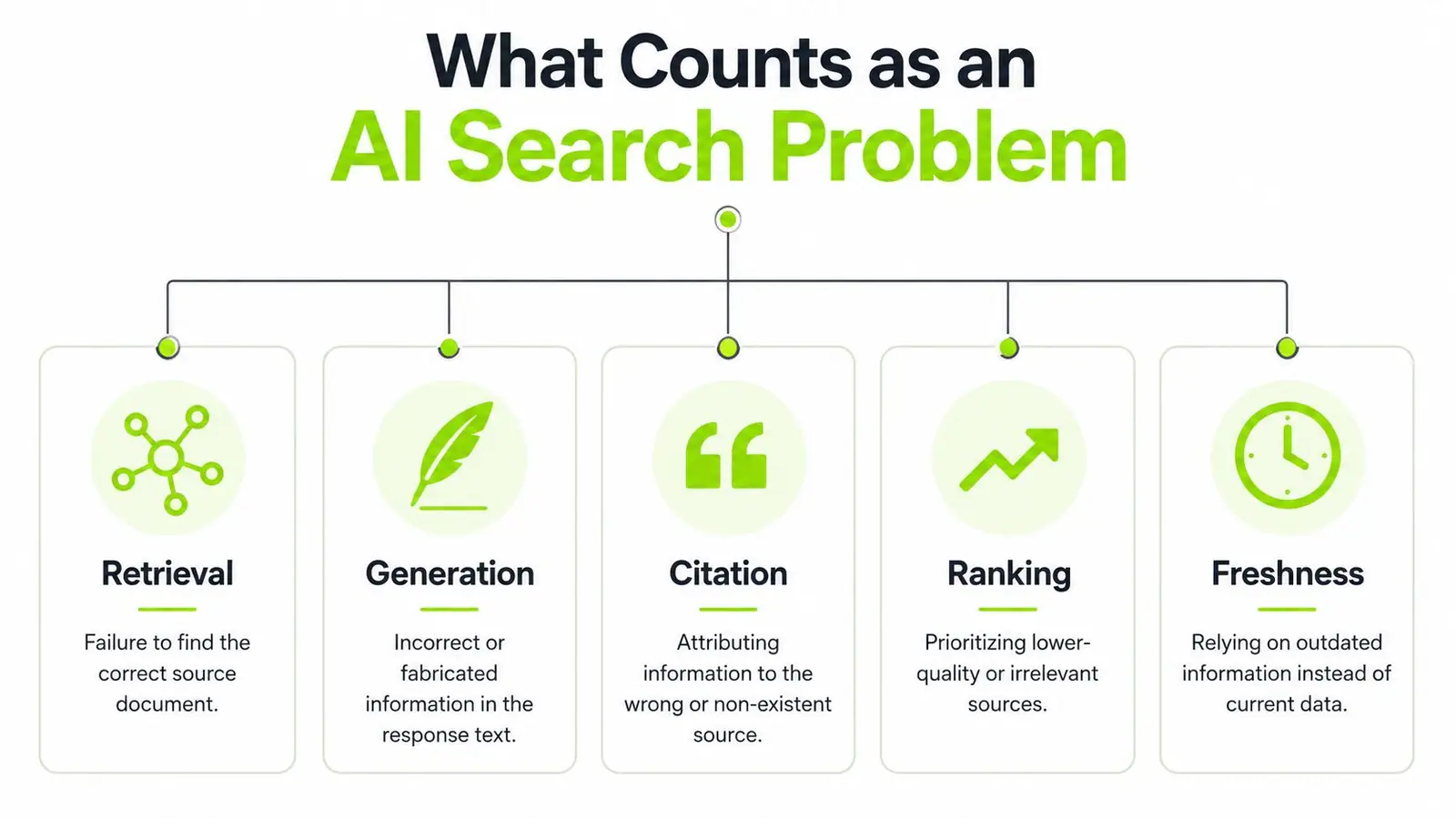
The operational test
Use a response-level review rather than a vague “AI visibility” score. For each answer, ask:
- Retrieval: Did the system find the correct source document?
- Generation: Does the response accurately represent the available evidence?
- Citation: Does each citation support the claim beside it?
- Ranking: Did the system prioritize relevant, credible sources?
- Freshness: Is the information current enough for the query?
Teams working on semantic retrieval can also review how semantic retrieval with embeddings changes document matching beyond exact keyword overlap. That distinction matters because a system may retrieve a semantically related page that still lacks the precise fact needed to answer the query. Clearer principles for natural-language search help teams assess whether the query was interpreted correctly before blaming the model.
The seven problem families in this article are hallucinations, citation gaps, source bias, rank instability, index freshness, evaluation gaps, and model drift. Treating them as product-quality defects gives an agency something useful to do: reproduce the failure, tag its location in the pipeline, measure its frequency, and route the correction to an owner.
The Seven Most Common AI Search Problems
AI search problems often appear similar to users, but they don't have the same cause. A fabricated product specification is a generation failure. A correct specification linked to the wrong page is a citation failure. A brand disappearing from answers can result from source bias, ranking changes, or an index that hasn't picked up a new page.
| Problem | User-Facing Symptom | Root Cause |
|---|---|---|
| Hallucination | The answer contains an invented fact, statistic, product, or feature | The generation layer fills an evidence gap with unsupported text |
| Citation gap | The claim may be correct, but the source is missing, broken, or unrelated | Citation extraction or attribution fails |
| Source bias | The answer repeatedly favors a narrow set of domains or viewpoints | Retrieval and ranking over-reward familiar or accessible sources |
| Rank instability | A brand appears for the same prompt, then vanishes | Candidate selection, ranking, context, or vendor behavior changes |
| Index freshness | The response uses old pricing, features, policies, or company information | Crawling, indexing, or retrieval lags behind the live site |
| Evaluation gap | Teams disagree about whether an answer is good | No shared rubric for relevance, factuality, support, and usefulness |
| Model drift | Answer quality changes after a vendor update | The provider changes models, prompts, retrieval, or ranking logic |
What each failure looks like in practice
Hallucinations are the most visible defect. The system invents a fact, attributes a feature to the wrong product, or combines details from unrelated pages. Users usually report this as “the AI got it wrong,” even when the underlying issue began with poor retrieval.
Citation gaps are quieter and often more damaging to reporting. A response can contain a defensible claim but provide no source, a dead URL, or a related page that doesn't support the specific sentence.
Source bias appears when the same publishers, forums, or reference sites dominate answers regardless of the query's needs. That can hide niche experts and make a brand effectively invisible even when its own material is more relevant.
Rank instability makes monitoring difficult because one manual check doesn't establish a baseline. Index freshness creates a different symptom, a confident answer based on information that was once accurate but no longer is.
Evaluation gaps prevent teams from separating a harmless wording variation from a material commercial error. Model drift then makes historical reports unreliable if the team doesn't record the model, surface, prompt, response, and citations together. AI Overview optimization should therefore be treated as a measurement discipline, not a one-time content task.
The key diagnosis is straightforward: hallucination is usually the symptom users notice, while retrieval and citation failures often sit underneath it.
Why Hallucinations and Citation Gaps Are Getting Worse
The Tow Center test used 200 quote-retrieval prompts for each of eight AI search engines, totaling 1,600 queries, and found that the systems failed to return the correct article information more than 60% of the time. The Nieman Lab summary of the study reports that Perplexity had the lowest incorrect-answer rate at 37%, while Grok-3 Search reached 94% incorrect answers.
The operational lesson isn't that every answer is fabricated. It's that the retrieval layer can fail before generation begins. If the system selects the wrong article, the model may produce fluent text from an unsuitable source, then attach a citation that looks plausible because it shares a topic, publisher, or title pattern.
Three forces compound the defect
First, AI search handles broader query types than conventional lookup. Users ask for comparisons, recommendations, explanations, current product details, and multi-step decisions. Those prompts create more opportunities for the system to combine sources that were never intended to support one conclusion.
Second, the interface often makes citation presence look like citation quality. A link beside a paragraph reassures the user, but the link may support only one detail, an adjacent claim, or none of the sentence at all. A separate verifiability audit found that only 51.5% of generated sentences were fully supported by their citations, while 74.5% of citations supported the statement attached to them. Citation extraction without sentence-level checking isn't enough.
Third, source diversity can decay as ranking systems repeatedly select familiar domains. A small group of sources then receives more visibility and more opportunities to be cited, while specialist pages become harder to discover. The research on AI search source diversity and visibility describes lower response variety and reduced exposure for long-tail sources compared with traditional search, alongside reported publisher traffic declines ranging from 15% to 64% depending on query type and context.
A practical review should record the claim, cited URL, exact supporting passage, publication or update date, and whether the source is first-party. The AI Overview tracker can support recurring observation, but no tracker removes the need for human verification on high-value claims.
The most useful question isn't “Did the model hallucinate?” Ask instead, “Which document did it use, and does that document support the sentence?”
The following short explainer shows why broken retrieval and source attribution can look convincing in the interface:
How These Problems Hit Your SEO and Product Metrics
AI search changes the measurement path between visibility and revenue. A citation can replace a conventional blue-link visit, a referral can disappear into direct traffic, and an incorrect generated answer can influence a buyer before that person reaches the product page.
Start with visibility. If an AI Overview cites a competitor or a third-party page instead of your domain, your brand may lose exposure even when your traditional ranking remains steady. Google said AI Overviews had more than 1.5 billion monthly users in the first quarter of 2025, while independent tracking found the feature on 13.14% of Google searches in March 2025 and 25.11% by early 2026. Another dataset measured coverage at 48% of queries by February 2026. These figures come from the AI Overviews coverage analysis, and they show why AI surfaces belong in an operational dashboard.
Follow the metric trail
Attribution breaks when an AI referral is classified as direct, unassigned, or another channel in analytics. Compare landing-page sessions with server logs, annotated referral data, and branded query behavior. Don't assume a flat organic line means demand is unchanged.
Conversion suffers when an answer misstates a product's specifications, compatibility, availability, or policy. Review assisted conversions and support tickets for pages that AI systems cite frequently. A bad answer can create qualified-looking traffic that arrives with the wrong expectation.
Trust declines when a client sees one story in Search Console and another in an AI surface review. That isn't a reason to discard either source. It means the reporting model needs separate fields for traditional impressions, AI mentions, cited domains, answer sentiment, and verified claim support. Guidance such as CodeDesign.ai's SEO guide can help with the underlying site foundation, but it won't substitute for monitoring how AI systems interpret the finished site.
| Problem | Primary Metric Affected | Where It Appears |
|---|---|---|
| Citation drift | Click-through rate and referral share | AI answer citations, analytics, landing pages |
| Misattribution | Channel accuracy | GA4, server logs, assisted-conversion reports |
| Product hallucination | Conversion rate and support demand | Product pages, sales calls, chat transcripts |
| Rank instability | Share of answer and brand presence | Prompt monitors and AI surface snapshots |
| Stale retrieval | Revenue protection and trust | Pricing, policy, feature, and comparison queries |
Use a broader content performance metrics framework to connect these observations to page-level outcomes. The four categories worth reporting separately are visibility, attribution, conversion, and trust.
Diagnosing AI Search Problems Step by Step
A useful diagnostic process doesn't start with a giant platform purchase. It starts with a controlled query set and a record of what each system returned.
Build a reproducible sample
Create a query log of 200 prompts across branded, category, competitor, and long-tail commercial intent. The number is a practical starting point for the workflow described here, not a universal benchmark. Store the exact wording, location where relevant, date, surface, model label if exposed, response, cited URLs, brand sentiment, and reviewer notes.
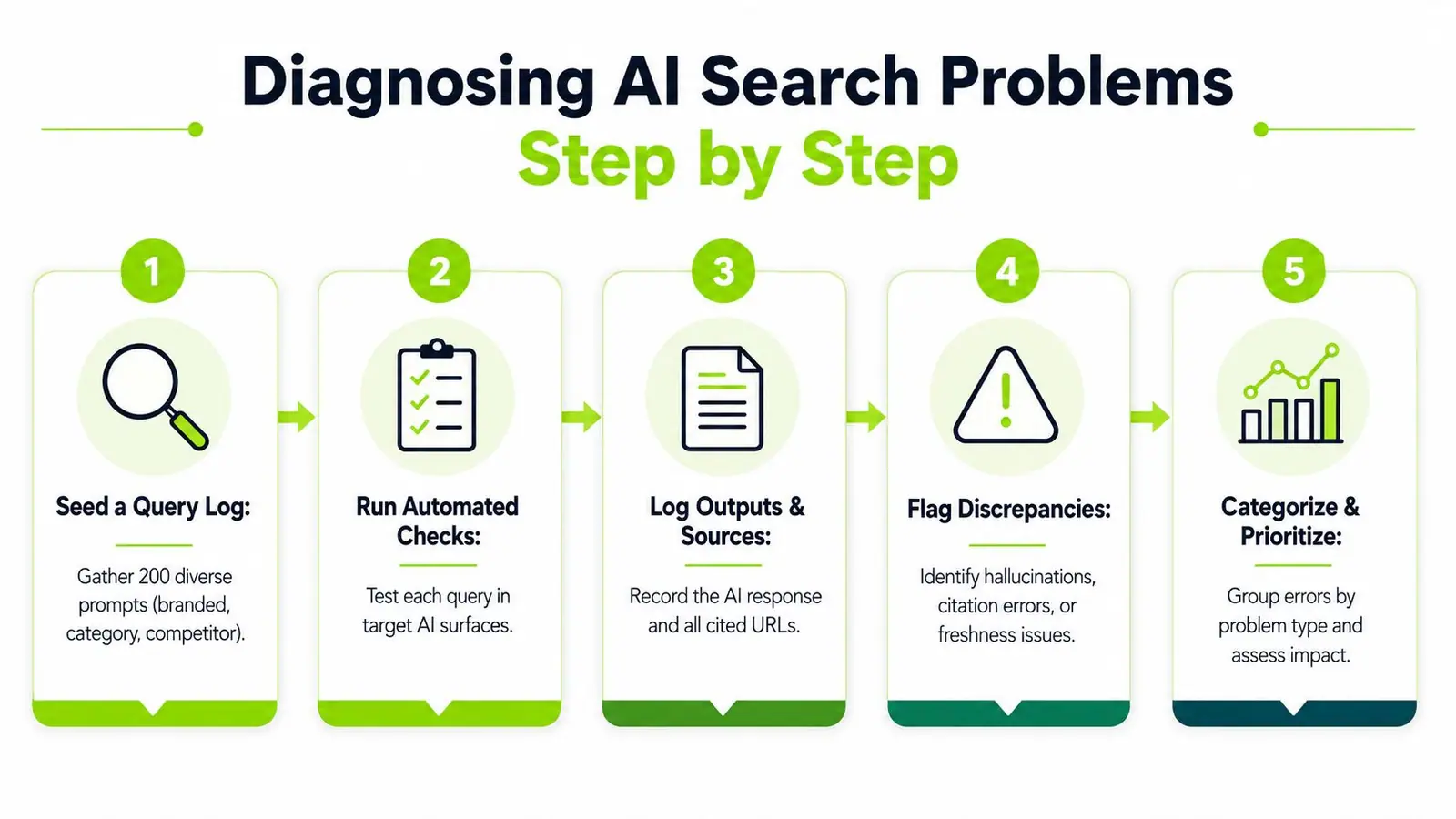
Run the same prompts across Google AI Overviews, Perplexity, ChatGPT search, and Copilot. Keep the surfaces separate. A combined score can hide the fact that one vendor is reliable for citations but weak for freshness, while another has the opposite profile.
Turn responses into testable records
Parse every answer into individual claims and citations. Then tag each issue:
- Hallucination: The claim has no credible support or conflicts with the source.
- Citation gap: The claim lacks a citation, or the URL doesn't support it.
- Bias: The source set is narrow, skewed, or repeatedly excludes relevant alternatives.
- Instability: The same prompt produces materially different brand visibility.
- Freshness: The answer relies on outdated information.
- Drift: The change follows a vendor or model update.
Compute precision-at-k for citations, claim-verification rate, and share of answer for your domain. Precision-at-k should mean that the cited sources in the first k positions support the claims they accompany. Claim-verification rate should use a documented reviewer decision, not a model's own confidence score.
Practical rule: Keep the raw response and the normalized score. A clean dashboard without the original evidence can't support a client dispute or a content correction.
Review priority prompts daily, especially those tied to revenue, reputation, or regulated information. Run the complete set weekly, compare trend lines, and assign one owner to each metric. A dashboard without named ownership will decay into an archive of interesting anomalies.
Fixation Strategies and Mitigation Playbook
Mitigation works best when each failure has an owner, a check, and a response time. Content teams shouldn't be asked to solve model drift, and developers shouldn't be asked to judge brand sentiment without a rubric.
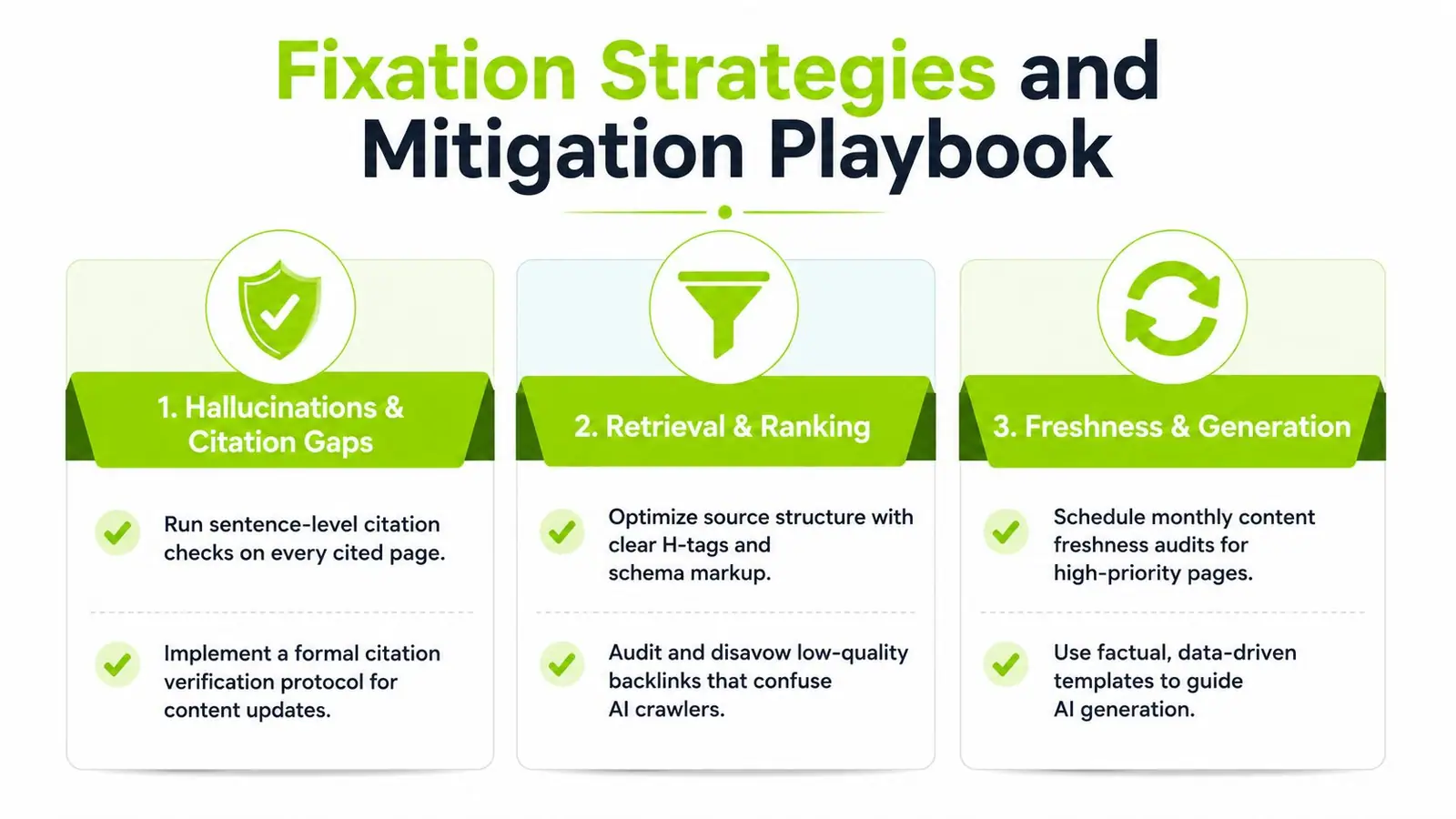
Match the fix to the failure
Hallucinations and citation gaps: Give SEO or editorial operations responsibility for sentence-level checks on cited pages. Maintain a corrections page, link it from the sitemap, and connect corrections to the affected source content. A formal citation verification protocol should be part of every high-priority content update, not a final optional review.
Source bias: The insights lead should maintain a balanced query sample across demographics, brands, use cases, and geographies. Run a monthly sentiment and source-diversity audit, then separate a true relevance issue from an accessibility or retrieval issue.
Rank instability: Track citation-source churn weekly and alert when more than 15% of citations change within a seven-day window, using the threshold specified in this operating plan. Investigate prompt formatting, source updates, vendor changes, and competitor publishing before changing the entire content strategy.
Index freshness: Content operations should publish an AI-readable changelog and an llms.txt file where appropriate, then ask engineering to verify crawler access through server logs. These measures don't guarantee inclusion, but they create clearer signals and an audit trail for freshness investigations.
Evaluation gaps: Product or SEO leadership should maintain a golden set of 500 prompts and grade it weekly against relevance, factual accuracy, citation support, freshness, and usefulness. Keep prompt wording versioned so a changed test doesn't masquerade as improved quality.
Model drift: Pin evaluation prompts and alert on regressions above 5%, as defined in this playbook. Record vendor, model, surface, date, and response so the team can identify whether the change came from your site or the provider.
Dev teams building AI-assisted workflows should also document permissions, logging, and validation controls. A practical companion is this AI coding security guide, especially when monitoring or content systems trigger automated actions.
Finish with a one-page RACI. Name the responsible operator, accountable decision-maker, consulted specialist, and informed stakeholder for every metric. Without that page, cadence and ownership remain open to interpretation.
Building an AI Search Quality Stack for Your Team
A workable stack has three layers. The first is query sampling. Pull prompts from Search Console, customer-support logs, sales questions, product reviews, and relevant Reddit discussions. Group them by intent and business risk, then preserve exact wording so future comparisons remain valid.
The second is evaluation. A weekly process should score hallucination, citation accuracy, source diversity, freshness, sentiment, and drift across the selected surfaces. Prompt monitors capture responses, citation auditors test support, SERP feature trackers preserve traditional context, and change-feed scrapers identify updates to important pages.
The third is content operations. Every failed claim needs a route to an owner. A factual error may go to editorial, a crawl or rendering issue to engineering, a missing comparison page to content strategy, and a source-diversity concern to the SEO lead. Set service-level expectations internally, even if the public-facing answer remains qualitative.
Agencies should avoid seven disconnected spreadsheets, one for each problem family. A unified evaluation dashboard makes it easier to compare client accounts, preserve raw evidence, annotate vendor changes, and distinguish a visibility loss from a citation-support failure. An AI search visibility platform such as Surnex can connect AI answer monitoring with rankings, backlinks, audits, content opportunities, citation gaps, and API-based workflows in one environment.
A practical adoption checklist is short:
- Define the account scope: Choose priority topics, surfaces, competitors, and risk-sensitive queries.
- Create the baseline: Store prompts, responses, citations, and review decisions before recommending changes.
- Assign ownership: Put one person behind each metric and escalation path.
- Report separately: Keep traditional SEO visibility distinct from AI answer presence and citation support.
- Review weekly: Compare evidence, not just scores, and record every material vendor change.
The solvable problems are operational. You can improve source structure, update stale pages, verify citations, refine sampling, and expose reporting gaps today. You can't force an external model to rank your page or remain stable after an update, so the quality stack must detect those changes rather than promise permanent control.
Surnex helps agencies and in-house teams monitor brand presence, cited sources, and visibility across AI search experiences while keeping traditional SEO metrics in the same workflow. Visit Surnex to evaluate your priority prompts, identify citation gaps, and replace fragmented AI search reporting with a repeatable operating process.