The shift is often felt before it can be named. A customer types a full question into site search, a marketer watches a “keyword” page miss obvious intent, and a developer sees a query engine return technically correct results that still feel wrong to the person asking. That gap is where natural language search matters, because the user isn't thinking in fields, operators, or exact phrases, they're thinking in plain English.
The change is bigger than a feature upgrade. Natural language search sits inside the broader NLP ecosystem, and one market estimate puts the NLP market at $42.47 billion in 2025, with a projection of $791.16 billion by 2034 and a 38.40% CAGR over that period, which is a strong signal that language understanding has moved into core infrastructure for search, chatbots, translation, and document processing (NLP market estimate). For teams comparing conversational search tools, a useful place to start is compare AI support platforms, because the buying decision often overlaps with how systems handle user intent, not just how they store content. For content teams still thinking in keyword blocks, the older framing still matters, especially where exact phrases are intentional, which is why a refresher on keywords in content can help bridge the old model and the new one.
The Shift from Keywords to Conversations
A decade ago, most search boxes behaved like strict librarians with no patience for ambiguity. If you typed the wrong term, used the wrong order, or asked the right question in the wrong shape, you got thin results or none at all. Today, people expect to type, speak, or even paste a messy request and still get something useful back.
That expectation didn't come out of nowhere. Natural language search reflects a broader move away from rigid keyword matching toward systems that accept full questions and everyday phrasing, and research and industry explainers describe that shift as a usability win for real workflows (natural language search overview). In complex environments, users don't want to learn the system's vocabulary first.
For marketers, the shift means search visibility is no longer only about matching a query string. For developers, it means the system has to infer intent, context, and meaning, not just scan for literal terms. That's also why conversations about conversational commerce, support bots, and assistant-style interfaces keep converging on the same core problem, understanding what the user meant.
One practical way to think about the change is this. Keyword search asks, “Do these words appear?” Natural language search asks, “What is this person trying to do?” That difference changes content design, ranking logic, analytics, and even the way teams define success.
Practical rule: if your users speak in problems, your search layer should respond in solutions, not just matches.
For teams evaluating conversational interfaces alongside broader AI tooling, the shift is less about novelty and more about reducing friction at the point of intent. That's why the old habit of optimizing only for exact terms is fading, even if it still has a place in structured lookup use cases.
What Is Natural Language Search
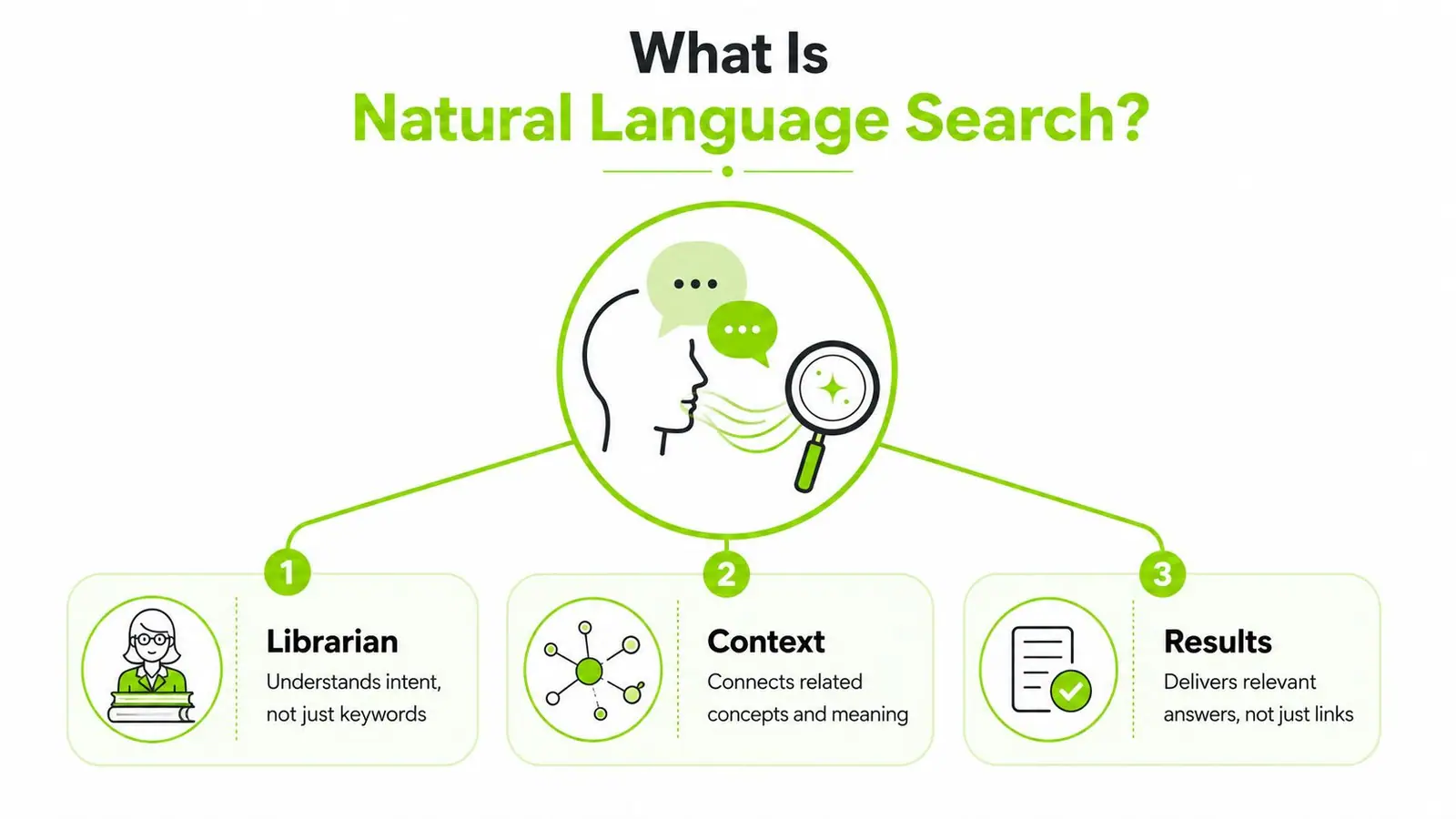
A natural language search system acts like a librarian who listens to the whole question before walking to the shelf. It does not stop at the individual words on the page. It tries to understand the request, the surrounding context, and the likely meaning behind the query.
That difference matters because people rarely search in clean, machine-ready phrases. They ask for “the policy for remote work,” “documents about onboarding,” or “what do we have on refund exceptions?” A natural language system does not require the user to know the official document title or the exact database field name. It can connect the request to the right topic even when the wording changes.
For marketers, that means search visibility depends on more than matching a query string. For developers, it means the system has to infer intent and context, not just scan for literal terms.
The user experience difference
The simplest way to see the value is to compare how each system behaves for the person searching. A strict keyword engine can feel fast and precise when the user already knows the exact term. Once the user is unsure, new to the product, or speaking in everyday language, the keyword model starts to feel brittle.
Coveo's overview notes that users preferred a web-style conversational search interface over a traditional search interface for finding variables in health data archives, because the conversational approach fit real human language and improved usability (natural language search and usability). The point is not that one interface always wins. The point is that the interface has to match how people ask for information.
Users trust search more when they can ask a question the way they would ask a teammate.
The mental model to keep in mind
A natural language search system usually does three things at once. It interprets the question, maps it to a meaning, then ranks content that best fits that meaning. If the query is vague, the system should still recover gracefully instead of treating the miss as a dead end.
That also affects site architecture. If content is written in the same language customers use, the system has a better chance of understanding the request. A useful companion view of search styles is types of search, because natural language search works best when you know where it fits alongside other search modes.
Understanding Core NLS Technologies
Natural language search feels simple on the surface, but the machinery underneath has three different jobs. One part reads language structure, one part represents meaning mathematically, and one part improves the system over time. If you're on a product or engineering team, separating those jobs helps you avoid treating every search issue as a model issue.
NLP handles the language itself
Natural Language Processing, or NLP, helps a system parse grammar, identify entities, and extract intent from a request. It's the layer that makes the difference between a bag of words and a meaningful input. Without it, the search engine can't reliably tell whether “apple” refers to the company, the fruit, or a typo.
That's why NLP sits at the heart of the broader market growth mentioned earlier, and why conversational interfaces keep spreading across search, chat, translation, and document workflows (NLP market estimate). The growth signal matters because it shows the language layer is no longer a sidecar feature, it's becoming part of the main stack.
Vector embeddings capture meaning
A vector embedding turns text into numbers so the system can compare meaning rather than just spelling. Similar ideas end up close together in semantic space, which helps the search engine retrieve content that says the same thing in different words. That's the technical reason a query like “cancel my subscription” can surface material that mentions “terminate account” or “end billing.”
Developer takeaway: embeddings don't replace content structure, they give the system a way to compare ideas at scale.
Machine learning keeps tuning relevance
Machine learning models help the system improve ranking, adapt to patterns in user behavior, and refine how it handles edge cases. In practice, that means the search experience can get better as the corpus grows and the system sees more real queries. The important part is not hype, it's feedback.
For teams choosing tooling, that often means deciding whether to use an API, build around open components, or lean on a managed platform. A useful implementation reference is best LLM optimization options for AI visibility tools, especially if your search strategy sits close to generative interfaces and visibility tracking.
Comparing Semantic and Lexical Search
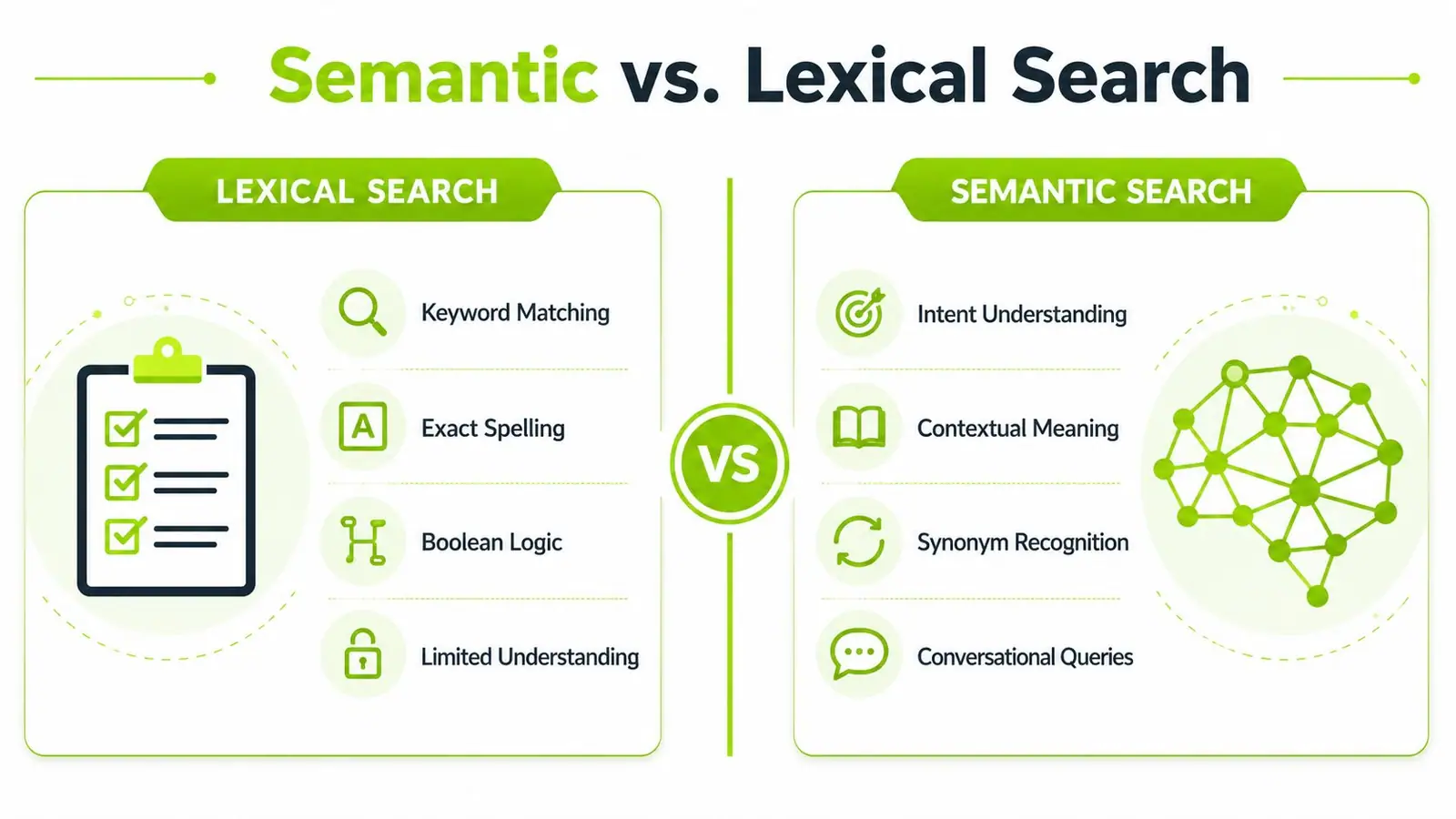
| Aspect | Lexical Search, Keyword-based | Semantic Search, Intent-based |
|---|---|---|
| Matching logic | Looks for exact terms | Looks for meaning and intent |
| Query style | Best with precise phrases | Handles conversational language |
| Synonyms | Often weak | Usually stronger |
| Failure mode | Misses relevant content that uses different wording | Can be too broad without filters |
| Best use case | Exact lookups, IDs, rigid terms | Questions, discovery, ambiguous requests |
A search box can accept the same words and still behave very differently depending on the engine behind it. Lexical search reads the query like a matching exercise, while semantic search tries to interpret what the user is trying to find.
That difference matters the moment a user stops typing in controlled keywords. A lexical engine is strongest when the query is exact and the content uses the same wording. A semantic engine is stronger when the user is phrasing a need in ordinary language, because it can relate the query to meaning rather than only spelling.
The practical effect shows up in relevance. NLP helps the system infer intent, handle synonyms, and use context so results are less likely to miss the target because the page uses different wording than the query, as explained in NLP search engine explanation. If a shopper does not know your product category label, semantic search can still guide them to the right answer.
A simple scenario makes the difference clearer. A query like “show me pictures of bears fishing” is asking for visual content about an idea, not a page that repeats those exact words. Lexical search can get stuck on the literal phrase. Semantic search treats the request as a concept and looks for content that matches that intent.
Why hybrid search matters
Pure semantic search can cast too wide a net for structured tasks. That is why many systems pair semantic retrieval with filters. Vector search surfaces candidates that are close in meaning, then metadata rules narrow the set by category, price, content type, or another field in the record, which is the hybrid semantic and filter pattern.
For developers, that pattern keeps search practical. Exact-match logic still handles fields that need precision, while semantic ranking handles conversational requests. For SEOs, the same setup changes how content is judged, because relevance depends on how well pages map to intent, not only how often they repeat a phrase. The bridge between those two views is explored further in latent semantic indexing SEO, which helps connect content relevance with search understanding.
How to Implement Natural Language Search
Choosing an implementation path depends on your timeline, data shape, and tolerance for complexity. Some teams want speed. Some want control. Some need both. The right answer is usually the one that matches your content structure and the amount of engineering support you have.
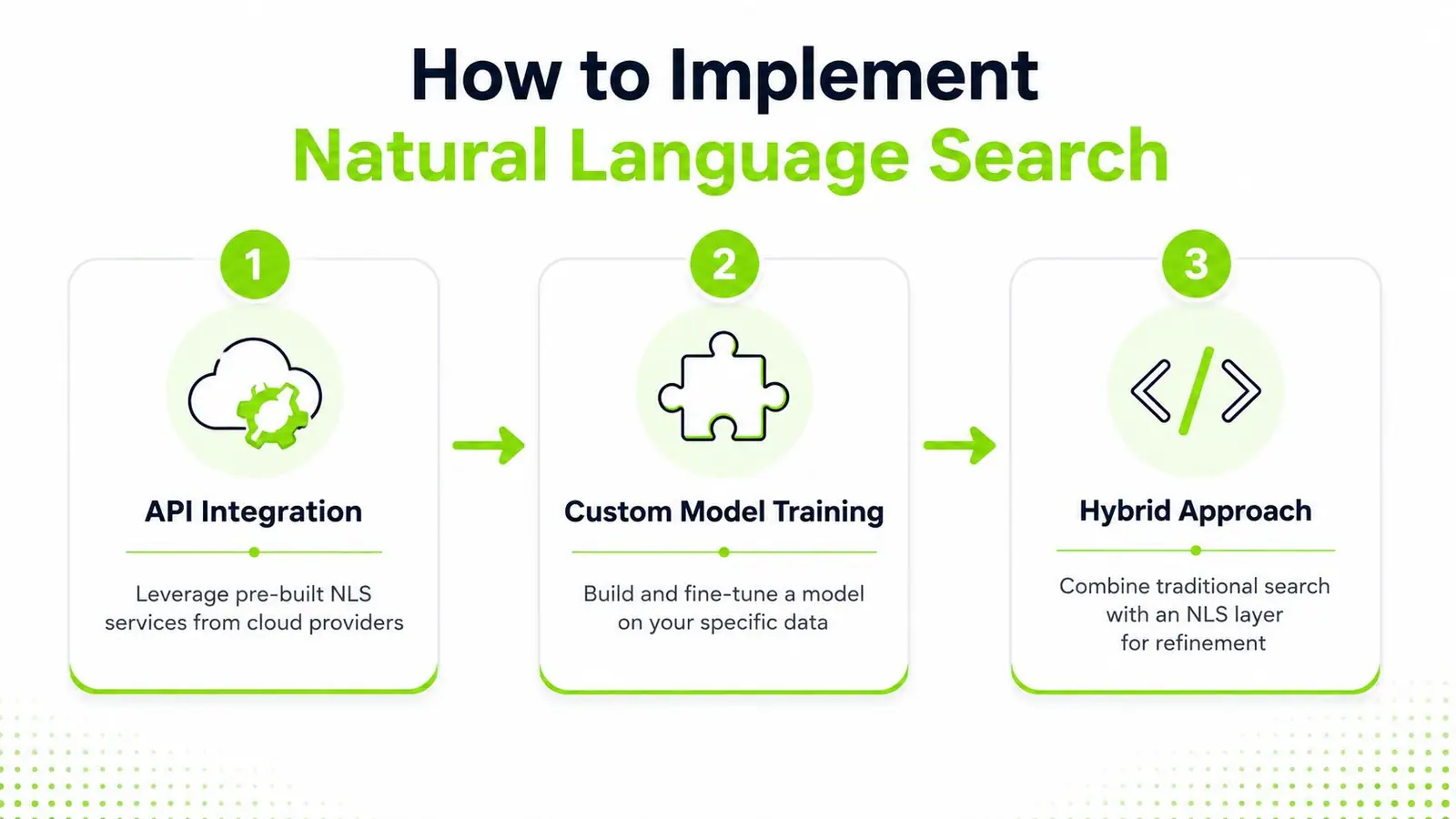
Three practical paths
API integration works well when a team wants a faster launch and fewer moving parts. Cloud-based search or AI APIs can handle much of the language understanding for you, which reduces the need to maintain your own model stack.
Custom model training makes sense when your domain language is specialized. Internal terminology, regulated vocabularies, or unique product catalogs often need tighter control than a generic tool can provide. This path demands more tuning, but it can fit edge cases better.
A hybrid approach blends traditional retrieval with a natural language layer. That lets you keep exact-match behavior for structured lookups while adding intent awareness for conversational queries.
The implementation pattern that usually holds up
A common pattern is to combine semantic retrieval with structured filters, because vector search alone can return broad matches while filters help preserve precision (structured filters with semantic retrieval). That is especially important in ecommerce, support, and knowledge bases, where a user may want something relevant and constrained at the same time.
Build for the query the user actually writes, then protect precision with metadata.
What teams should choose first
If your team is small, start with the simplest path that can support your real query mix. If your catalog is messy, fix the content and metadata before you chase model complexity. If your experience spans customer support, internal docs, and product discovery, a hybrid approach usually gives you the most room to grow.
One platform teams may evaluate in that mix is Surnex, which tracks brand presence across AI-generated answers and traditional search surfaces, useful when search and visibility strategy overlap. That matters because implementation choices don't just affect user experience, they affect what your team can measure later.
Adapting Your SEO for Conversational Queries
Search optimization changes when users stop typing fragments and start asking questions. A page built around a single head term can still rank, but it may not answer the broader set of phrases people use when they're unsure, comparing options, or trying to solve a problem. In conversational search, content has to sound like it belongs in the same conversation as the query.
The most important shift is from keyword targeting to topic coverage. Titles, headings, and body copy should reflect the language a real person would use, not just the internal phrase list your team prefers. That doesn't mean ignoring keywords, it means using them in a way that reads naturally and answers adjacent questions too.
Content structure matters more than many teams expect
One data point makes this especially clear. An ablation study of 255 open-data datasets and 765 natural-language queries found that the description field was the most critical metadata element for retrieval effectiveness, especially when those descriptions were generated by LLMs (metadata and retrieval effectiveness). The implication for SEOs is direct, because upstream content structure can matter as much as the search layer itself.
That means clean descriptions, clear labels, and meaningful section headers are not cosmetic. They are retrieval assets. If your page, product feed, or knowledge base buries the key idea in vague copy, the search system has less to work with.
Practical content moves that help
- Use natural phrasing in headings: write headings the way users speak, so the page can match a wider range of queries.
- Answer the obvious follow-up questions: if a person asks one thing, cover the next two things they usually ask.
- Keep metadata descriptive: titles, summaries, and content descriptions should say what the item is, not just what team owns it.
- Build for intent clusters: one page should serve a topic family, not only one exact phrase.
For marketers, the value is better coverage across question-based discovery. For developers, the value is cleaner source data that improves retrieval quality before ranking even starts. If you want a more operational lens on visibility across AI surfaces, the same content discipline applies to systems that monitor answer inclusion and citation patterns.
Monitoring and Measuring NLS Performance
The hardest part of natural language search is not launch, it's proof. Traditional rank tracking tells you where a page sits for a fixed keyword, but it doesn't tell you whether a conversational query got a useful answer or whether the system recovered from a messy prompt. That gap is where many teams misread performance.
Recent practitioner guidance emphasizes testing with real-world, imperfect queries and checking zero-result behavior, because polished demos hide the failures users hit in production (measurement guidance for natural language search). That is the right place to start. If the system cannot handle ambiguity, fallback behavior, or mobile-style phrasing, it is not ready for real use.
What to watch instead of only keyword rank
Look at how often the system returns a relevant answer for varied phrasing. Check what happens when users leave out one important attribute, and inspect whether filters prevent broad semantic drift. Those signals are more useful than a vanity ranking for a query no customer uses.
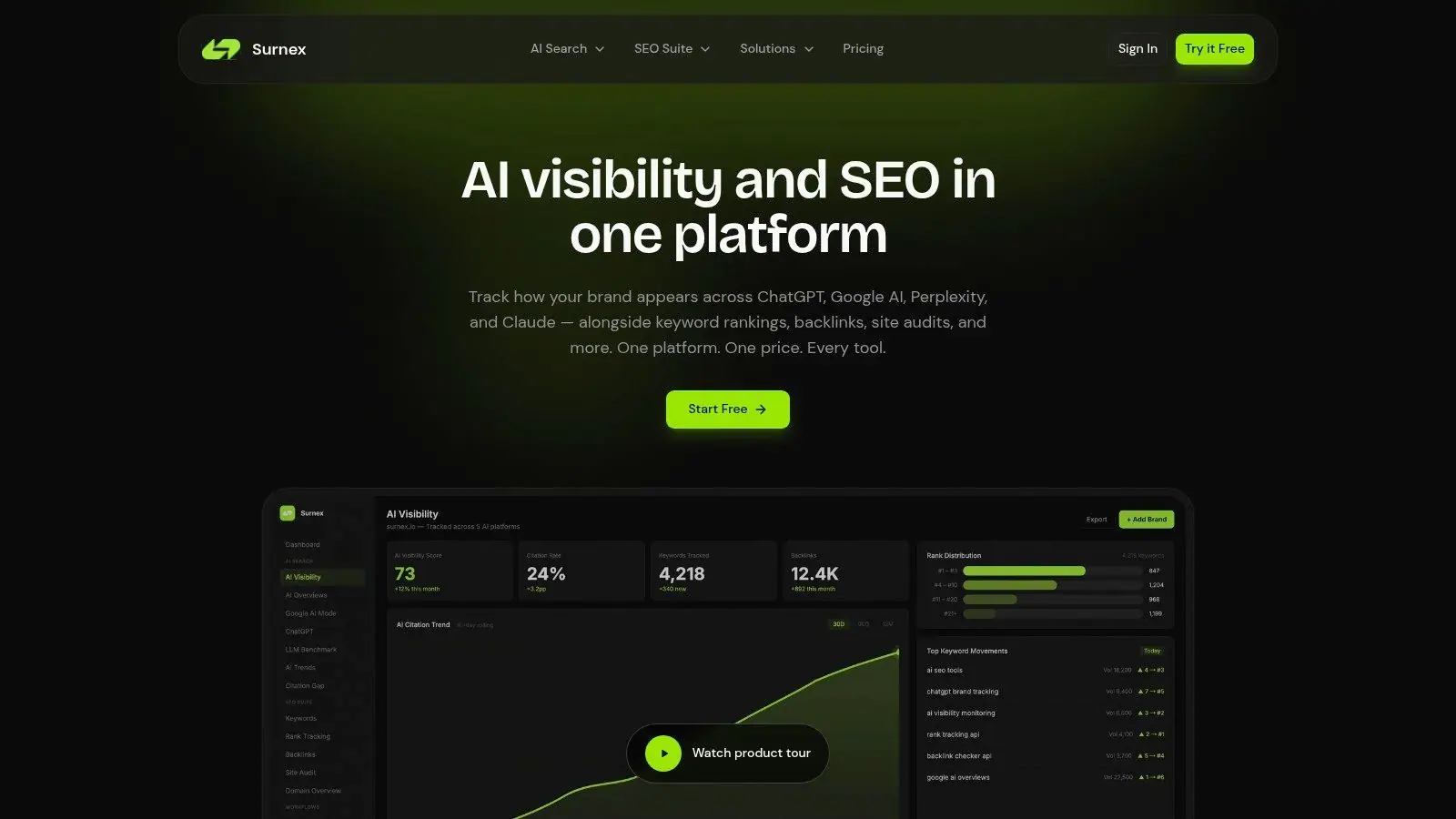
For teams dealing with both SEO and AI search visibility, a unified dashboard helps a lot. Surnex combines traditional SEO metrics with AI visibility tracking, so teams can see where brands appear across search results and AI-generated answers without jumping between separate tools. That kind of view is useful when the same content has to perform in both keyword and conversational environments.
Measure the query patterns your users actually write, not the clean examples your team likes to demo.
The practical takeaway is simple. If your measurement model still depends only on exact keyword rank, you're blind to the part of search that now matters most. Conversational search needs conversational testing, and it needs a reporting layer that can follow visibility across changing surfaces.
If you're building or auditing a search experience, start by mapping your top user questions, then check whether your content, filters, and metadata support them. For a clearer view of how your brand appears across both traditional search and AI-driven answers, visit Surnex and use it to track visibility, surface gaps, and connect search performance back to the queries people really ask.