Why does “search” still get treated like one box on one page, when the job is often choosing between a query that finds a fact, a query that opens a product, a search that listens to your voice, or an AI answer that may never send a click? In 2026, types of search is less about a tidy list and more about a layered system. The useful way to think about it is intent, modality, technology, and context, because each layer changes what users expect and what teams need to measure.
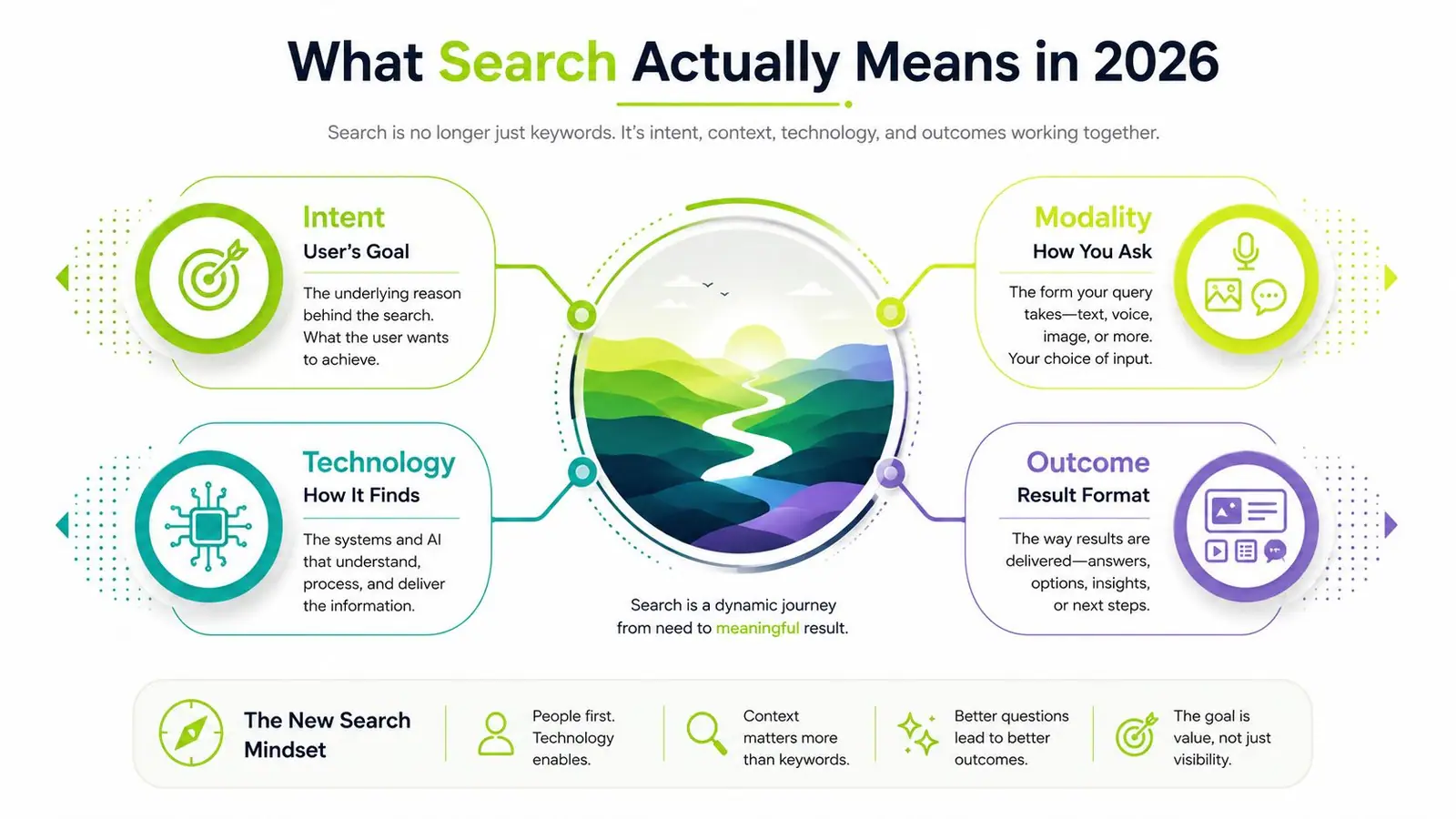
A simple analogy helps. Intent is the reason someone is searching, modality is how they ask, technology is how the engine finds, and context is the environment where the query runs. A single keyword can move through all four layers and behave differently at each step, which is why a neat category list often misses the core decision a team has to make.
For a broader view of how these layers fit into search intelligence, the overview at What Search Intelligence Means is a useful companion. Keep that framework in mind here, because the rest of the guide uses it to separate user behavior from retrieval mechanics and reporting needs.
What Search Actually Means in 2026
Search used to feel like a single action. You typed, the engine returned links, and you clicked one. That mental model breaks down fast once users search inside apps, speak into a phone, upload a photo, or read an AI summary instead of a classic results page.
Four layers make the landscape easier to read
The first layer is intent, the user's goal. The second is modality, the way they express it. The third is technology, the retrieval method behind the results. The fourth is context, the place where the search happens, such as web, site, enterprise, e-commerce, or an AI assistant.
That separation matters because teams often mix them up. A marketer might call a query “transactional” when the actual issue is that the product search engine can't handle synonyms. A developer might optimize a vector index and still miss the fact that the user never wanted a link, they wanted an answer inside a workflow.
Practical rule: if a search problem keeps getting vague in meetings, name the layer first. “Intent problem,” “modality problem,” “retrieval problem,” or “context problem” usually gets you to the right fix faster.
The types of search conversation becomes much more useful when it stops being a list of categories and starts becoming a decision tree. If the question is who owns the index, what input the user gave, and what result format they expect, the taxonomy gets clearer. If the question is how to track visibility in Google AI Overviews or LLM-driven answers, the same four layers still apply, but the outcome shifts from ranking alone to citation, synthesis, and presence.
Search Intent Categories and Why They Matter
Think about a restaurant. One person is browsing the menu, another is asking for directions, a third is ready to place an order, and a fourth is comparing nearby options before choosing where to go. Those are the classic intent categories in search, and they still hold up because they map cleanly to what the user wants next.
The four intent categories in plain language
Informational intent is the browser at the table. They want to learn, compare, or understand. In content terms, that usually fits guides, explainers, FAQs, and how-to pages. Navigational intent is the person looking for a specific place or brand, so the best match is a homepage, login page, store locator, or contact page.
Transactional intent is the customer who wants to act now. That often aligns with product pages, booking flows, checkout paths, or lead forms. Commercial intent sits between learning and buying, where comparison pages, reviews, and product roundups usually work best.
A spreadsheet tag for intent helps teams stay honest about what a keyword should do. If a phrase is informational, don't judge it by checkout conversion. If it's transactional, don't celebrate time on page when the user needed a fast path to buy.
A helpful test is simple. Ask, “What would a satisfied searcher do next?” If the answer is read, click, buy, or compare, you're already sorting intent correctly.
AI Overviews make this even trickier, because the user may get the answer without clicking at all. That means intent still matters, but the success metric changes. A keyword can satisfy a question in the overview, support a citation, or drive a visit, and each outcome deserves a different expectation.
For teams building content around keywords, keywords in content is worth reviewing alongside this framework, because intent tagging only works when the page matches the searcher's goal.
Search Modalities From Text to Voice and Video
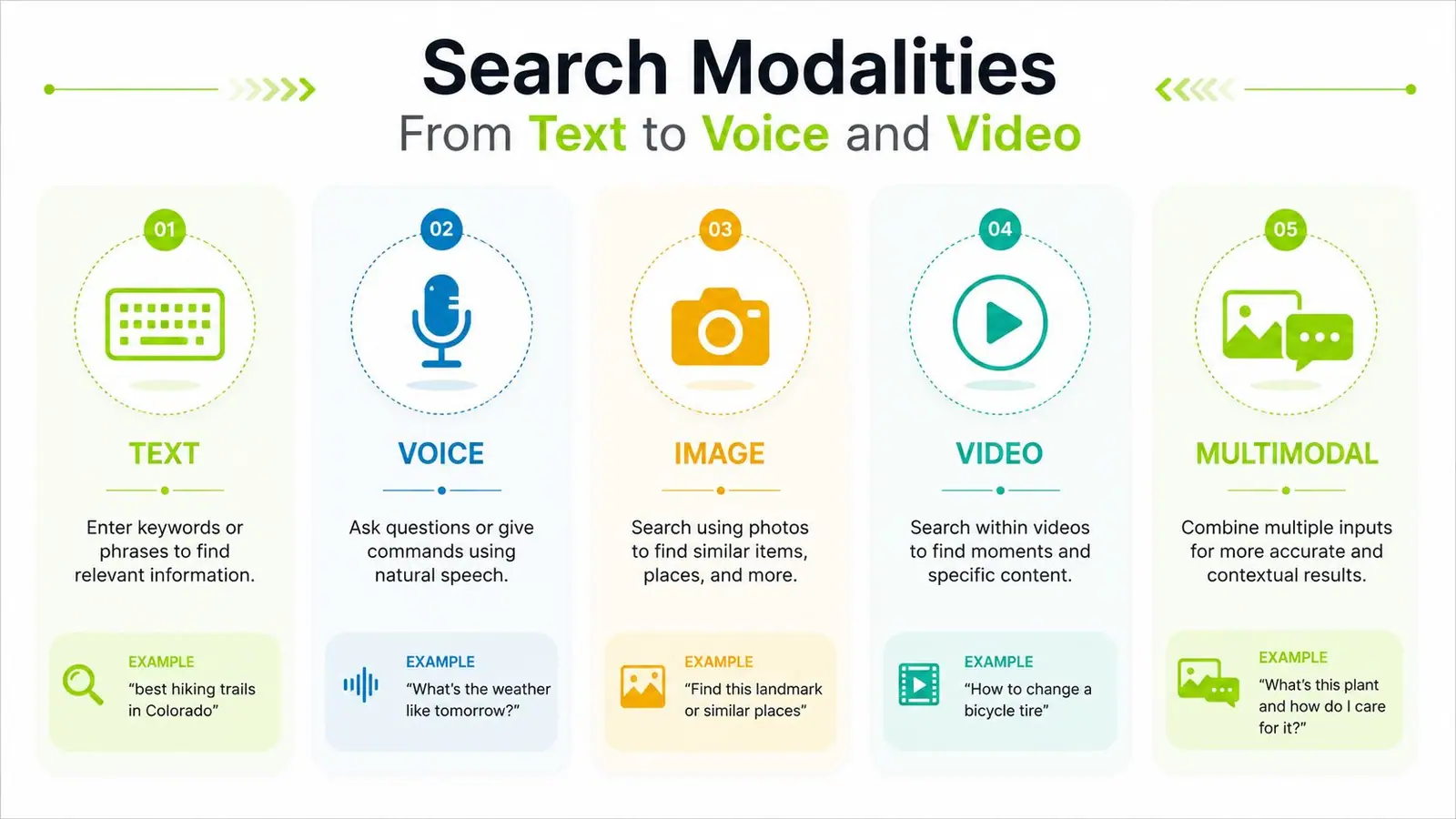
A query can arrive like a typed sentence, a spoken request, a photo, or a clip. That sounds obvious until you watch how much the engine has to adjust after each input. Text search asks for spelling and phrasing, voice search asks for conversational clarity, image search asks for visual similarity, and video search asks for transcript-level understanding.
Each modality changes what counts as a good query
Text search still carries most of the burden for precise work. Users can include brand names, model numbers, and comparison terms, so the ranking system can lean on exact wording. Voice search usually sounds more natural and shorter in practice, which is why concise answers tend to perform better there. Image search rewards visual signals, descriptive alt text, and surrounding context, while video search depends heavily on transcripts, timestamps, and chapter markers.
The best way to think about this is a relay race. The user hands off the baton at the moment they choose how to ask, and every downstream ranking system inherits that choice. A product photo can become the first clue, then a voice follow-up can narrow the result, and the search engine has to keep the thread intact.
If your team builds content assets, this affects format choices. A page with clear image alt text helps image discovery. A page with tight, spoken-style FAQs helps voice discovery. A video with chapters and transcripts makes it easier for search systems to read the structure, which is why video marketing SEO matters for more than just traffic.
For a practical comparison of ad behavior by input and targeting path, the discussion at search vs display ad targeting is a useful adjacent read, because modality often changes what “intent” even looks like in paid and organic discovery.
Search Technologies Behind the Results
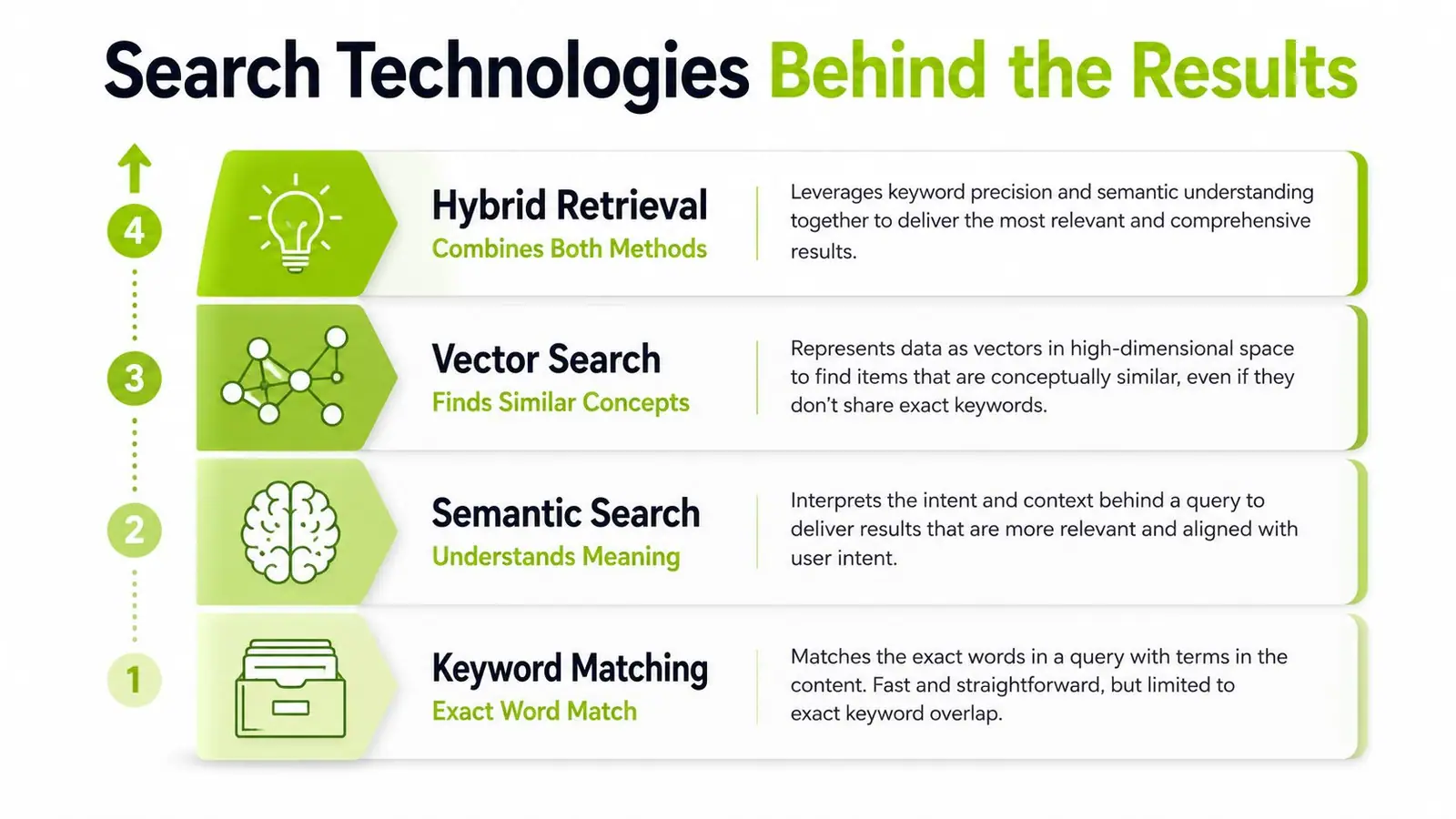
A library card catalog and a modern recommender system solve different problems. One finds the exact record you asked for, the other tries to understand what you meant and surface a better match. Search technology has moved along that same path, from keyword matching toward semantic, vector, and hybrid retrieval.
The retrieval stack in everyday terms
Keyword search is still the strongest option for exact product names, IDs, and precise phrases. It's direct, predictable, and easy to explain to a client. That fits the index-layer behavior of exact-value, prefix, and full-text search, where exact matching uses direct equality on stored fields, prefix matching supports partial-term lookup, and phrase or proximity search depends on tokenization and positional indexing. Phrase and proximity queries are usually more expensive than exact or prefix lookups, especially at scale, because the engine has to reason about term order and distance as described here.
Semantic search helps when the user's wording and the document's wording don't line up. It can connect synonyms, related concepts, and intent even when the exact terms differ. Vector search goes a step further by representing meaning in a space where similar items sit close together, which is why it shows up in natural language retrieval and visual similarity tasks. Hybrid retrieval combines the strengths of both, so exact filters and semantic ranking can work together.
Practical rule: use keyword retrieval when accuracy and exactness matter most, then add semantic or vector methods where the user's language is messy, incomplete, or visual.
Modern visibility platforms become useful for understanding whether a brand is being discovered, cited, or summarized across traditional results and AI-generated answers, not just for telling you whether a page ranks. That matters because AI Overviews and LLM-driven discovery can reorder the path from query to answer, even when classic ranking signals still matter in the background.
For developers, the cleanest mental model is simple. Choose the narrowest retrieval method that solves the problem, then layer in broader methods when the user journey demands it. For marketers, that means not treating every visibility report as a pure keyword report, because the engine may be matching meaning, not wording.
The deeper mechanics of this shift are closely related to search generative experience, especially where generated summaries start acting like a new result format rather than a traditional list.
Search Contexts That Shape the Rules
The same query behaves differently depending on who owns the index and what the user is trying to accomplish. Different airports illustrate this. The traveler may show up with the same passport, but one terminal has strict boarding rules, another has business lounges, and another has extra checks for special cargo.
Why context changes the rules of the game
Web search is public and broad. The engine crawls the open web and tries to answer nearly anything. Site search stays inside one domain or product experience, so it has to understand the site's own catalog, navigation, and terminology. That usually means stronger synonym handling, because users rarely type the exact label a site uses internally.
Enterprise search pulls from private systems such as cloud storage, messaging tools, databases, and project platforms. That changes the game because retrieval has to respect heterogeneous schemas, metadata, and access controls as outlined here. E-commerce search blends structured filters with semantic ranking, since shoppers often want a mix of brand, price, availability, and product meaning in the same query.
AI assistant search shifts the result format again. Instead of a list of ranked pages, the user may see a synthesized answer with citations or source references. That changes how teams think about visibility, because a brand can be present, absent, or mentioned indirectly inside the answer itself.
One useful distinction is this. Web search optimizes for public discoverability. Enterprise search optimizes for task completion inside a workflow. E-commerce search optimizes for conversion-friendly browsing. AI assistant search optimizes for citation and synthesis, which means ranking is no longer the only outcome that matters.
The difference between consumer search and workflow search is still underexplained in a lot of content. The consumer version focuses on finding information. The workflow version helps someone solve a task across fragmented systems, which is why long-tail queries, review gaps, support tickets, and behavioral signals often reveal demand that generic explainer content misses as noted in this research guidance.
An Agency Workflow Putting the Layers Together
A mid-sized agency onboarding a new retail client rarely starts with one clean search problem. The strategist looks at the client's keyword set and tags intent first, because the reporting has to separate educational queries from purchase-ready ones. The developer pulls query data from the search console API, then checks whether the site search log and product feed use the same product naming.
How each role uses the same taxonomy
The content lead then writes around the gaps. If voice search matters, they add FAQ blocks that sound natural when read aloud. If image discovery matters, they tighten alt text and captions around product visuals. If the client's audience uses comparison queries, they build pages that answer “which one should I choose?” before sending people deeper into the funnel.
The analyst has a different job. They watch for AI Overview appearances, citation patterns, and changes in visibility across LLM-driven discovery. In that setup, a keyword may show up in a classic SERP report, a product may be mentioned in an AI answer, and a support question may reveal a workflow search need that no existing page covers.
The clearest agency mistakes happen when teams optimize one layer and report on another. A developer can improve retrieval quality and still fail the brief if the client wanted more citations in AI answers, not more internal precision.
A platform like Surnex can sit in the stack as one option for teams that want traditional SEO metrics alongside AI visibility tracking. It's useful when the same client needs rankings, backlinks, audits, content opportunities, and visibility across AI Overviews or LLM-driven discovery in one place.
Workflow search is the quiet signal in the background. Searches across tools to finish a job reveal pain points, hidden demand, and content gaps that standard keyword reports often miss.
Monitoring and Optimization Tactics by Search Type
Search monitoring works best when it behaves like a weather dashboard. One pane shows intent movement, another shows modality coverage, another shows retrieval quality, and a final pane shows AI visibility. If you only watch one pane, you miss the storm until clients ask why the numbers changed.
A simple checklist for each layer
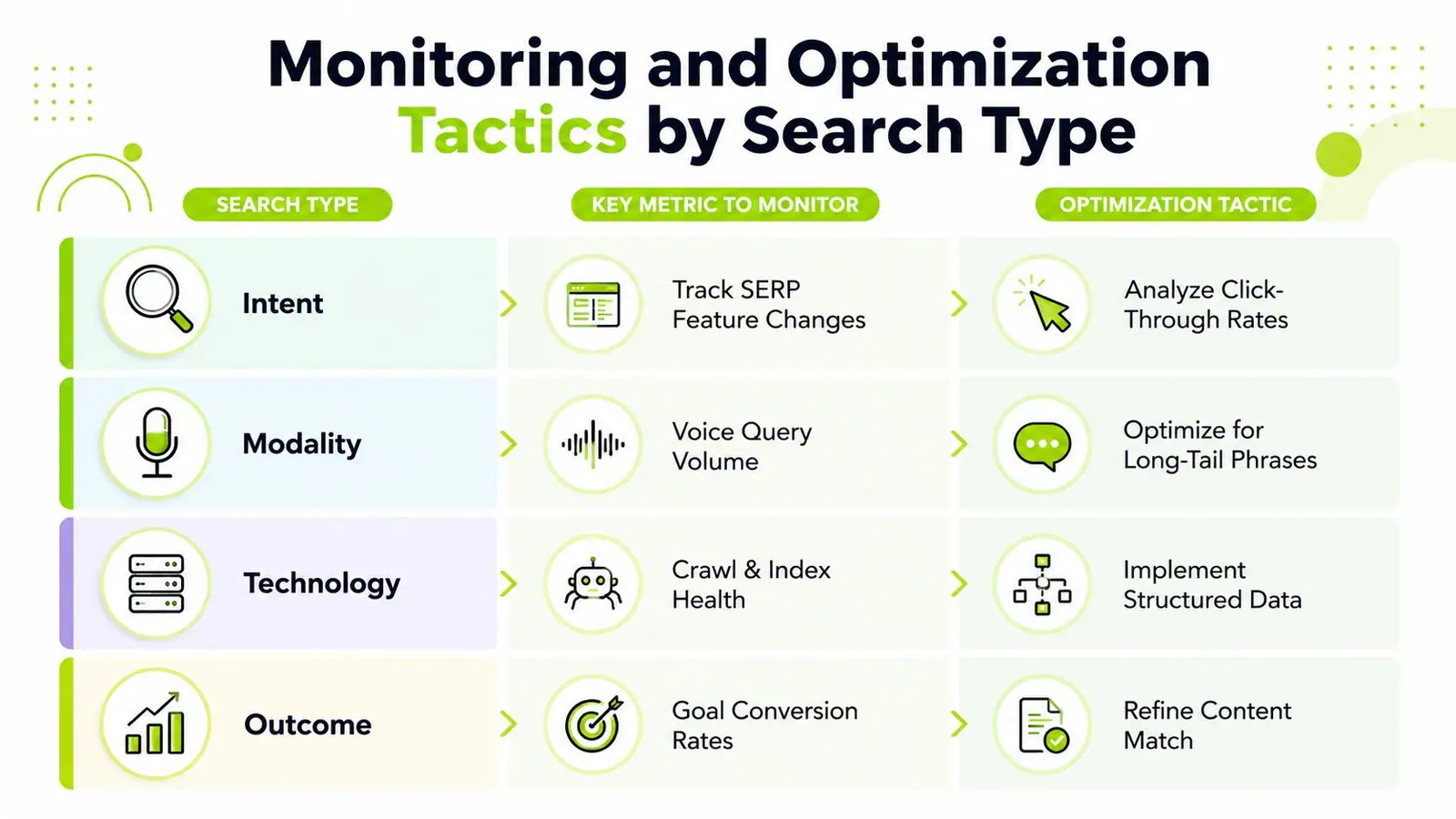
- Intent tracking: watch SERP feature changes, then compare them with click behavior and landing-page match. If a query flips from informational to commercial, the content should follow.
- Modality coverage: test voice-style questions, image-based discovery, and short text queries separately. A page can rank well for typed searches and still be weak for spoken or visual discovery.
- Technology checks: run retrieval quality tests against exact-match, semantic, vector, and hybrid paths. If the engine can't find the right item quickly, the problem is usually in the index, not the copy.
- Outcome review: look at goal completion, not just traffic. A result that gets seen but never helps the user complete the task is a weak result.
The optimization move should match the problem. If exact product searches miss, fix naming, fields, and filters. If vague queries fail, improve semantic coverage and supporting copy. If AI answers cite other sources, examine the content structure, entity clarity, and source-worthiness of the page.
For teams comparing tooling, find AI tools for SEO can help surface options when you're deciding how much of this workflow to automate. The key is to use tools for monitoring and triage, not to replace judgment about what the searcher needed.
Do: separate reporting by layer, then connect the layers in one review. Don't: treat a voice miss, a citation gap, and a ranking drop as the same problem.
A Unified Mental Model for Search Strategy
The easiest way to brief a team on types of search is to draw one rectangle and split it into four parts. Put intent at the top left, modality at the top right, technology at the bottom left, and context at the bottom right. That one sketch keeps people from collapsing every issue into “SEO,” which is too broad to act on.
The model that helps teams prioritize
If the audience wants answers, start with intent and context. If they ask in voice, image, or video, add modality. If the result quality is off, inspect technology. If the brand disappears inside AI summaries or citations, the visibility problem sits at the context layer, not just the keyword layer.
That separation is the actual shift. Search is no longer one channel, and visibility no longer means only a blue-link ranking. It can mean being cited, summarized, discovered in a product feed, or retrieved inside a private workflow. The biggest blind spot for many teams is still the AI assistant layer, because classic SEO reports weren't built to capture synthesis and citation behavior.
A practical next step is to audit your client or product mix against the four layers. Pick one under-tracked context, maybe enterprise search, site search, or AI assistant visibility, and monitor it for a month before expanding. Then choose one platform that unifies traditional SEO metrics with AI visibility tracking so the team isn't stitching together half a dozen dashboards by hand.
For teams comparing options, top-rated platforms for SEO specialists can help narrow the field before you commit to a workflow. The best choice is the one that lets strategists, developers, and analysts see the same search story without arguing over which layer they're looking at.
A CTA for Surnex if you want one dashboard for rankings, audits, backlinks, content opportunities, and AI visibility across modern search.