
A lot of teams are stuck in the same loop. They publish a video, the YouTube view count looks decent, and then the client asks the question that matters: what did this do for search, traffic, and pipeline?
That's usually where weak video programs break down. They were built like isolated creative projects, not like an SEO system. The video lives on YouTube, the page embed is an afterthought, metadata gets written five minutes before launch, and nobody has a reporting model that connects platform performance to organic visibility.
A proper video marketing SEO program works differently. It treats each video as a search asset, a page asset, a distribution asset, and a reporting asset. That's the difference between getting views and building a repeatable engine that supports Google rankings, YouTube discovery, link earning, and stronger engagement across the site.
Beyond Views Why a Video SEO System Is Crucial
Clients rarely object to video itself. They object to unclear outcomes. If the only result they can see is a platform view count, they'll treat video as a brand expense instead of an acquisition channel.
That view is outdated. Video is already standard marketing infrastructure. 93% of marketers consider video a key element of their strategy, blog posts with video attract 3x more inbound links, and 88% of videos ranking on Google also rank on YouTube, according to video marketing statistics compiled by Rev. Those numbers matter because they show where video yields impact: not in one channel, but across search, platform discovery, and authority building.
The operational problem is that teams often still run video in silos. Social owns clips. SEO owns pages. Brand owns messaging. Nobody owns the system.
Practical rule: If your team can't explain which page should rank, which query the video supports, and how the asset will be distributed after publish, you don't have video SEO. You have content production.
A scalable system starts with one shared goal. The hosted page should gain search value. The YouTube upload should widen discovery. The transcript, title, thumbnail, and embed placement should all support the same intent. That's how video stops being a vanity layer and starts improving broader organic performance.
This is also why agencies need better visibility reporting than rank tracking alone. A page can gain more search surface area through video integrations while standard keyword reporting misses the story. Tools that track broader search presence, such as a visibility score for SEO, help teams explain why video matters before the direct conversion data fully matures.
If YouTube is a major part of the plan, it also helps to study platform-specific packaging and promotion. This guide to strategies for YouTube growth is useful because it focuses on the mechanics that influence discovery after publication, not just on production tips.
Building Your Scalable Video Content Strategy
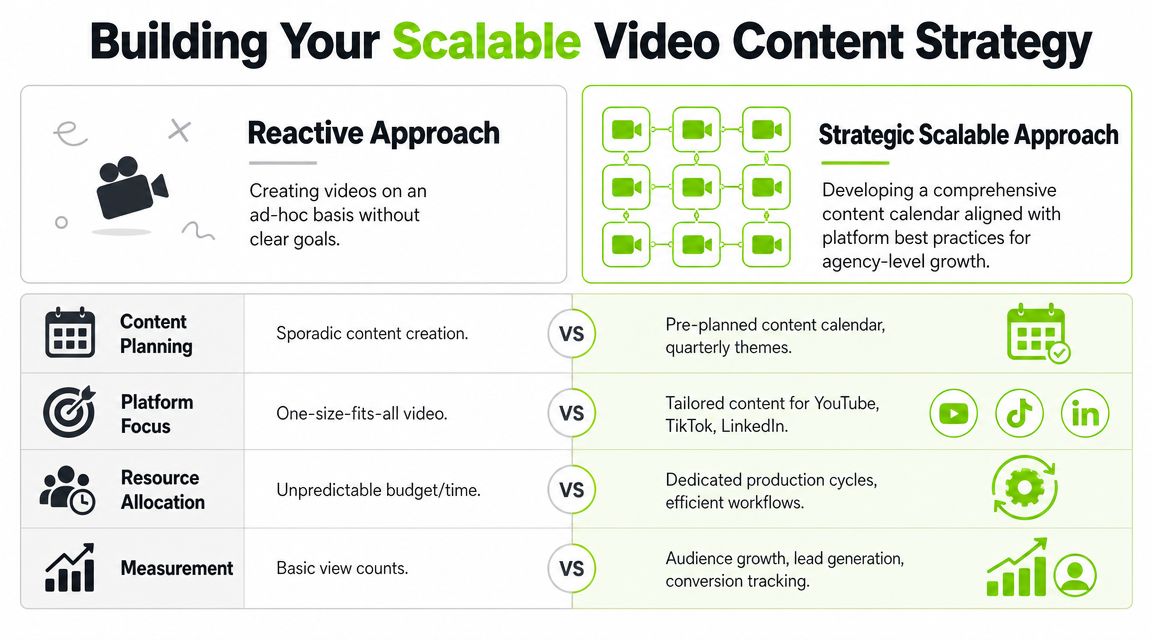
Most video programs fail before production starts. The problem isn't editing quality. It's topic selection. Teams choose ideas because they sound useful, then try to force the same asset into search, social, and sales without deciding what job it needs to do.
Build around intent, not format
The cleanest planning model is simple. Start with search intent, then choose the format that best serves that intent.
For agency and enterprise teams, I usually split video opportunities into three buckets:
- Direct-answer topics that map to existing keyword demand and fit product, service, or educational pages.
- Explainer topics that support category education and help move users from awareness to consideration.
- Distribution-first topics designed for platform reach, audience building, and repurposing into larger content hubs.
That distinction matters more now because short-form and long-form don't earn visibility the same way. As noted in this guide to short-form video SEO, many teams still optimize as if metadata alone controls discovery, even though platforms like YouTube Shorts rely heavily on viewer behavior such as watch time and engagement.
Decide where each topic should win
Not every topic should be a YouTube video embedded on a blog post. Not every topic should become a Short. Good planning asks a harder question: where is this topic most likely to win organic discovery first?
A practical framework looks like this:
- Use long-form video when the topic needs explanation, comparison, or a walkthrough that supports a high-intent page.
- Use short-form video when the topic can hook quickly, demonstrate a point fast, or seed demand before users search in Google later.
- Pair both formats when a larger topic can support a full search-oriented asset plus repurposed clips for platform distribution.
That's the system. One topic. Multiple assets. Different discovery environments.
Teams that publish one long video and call the job done usually leave most of the demand uncaptured.
Plan content in clusters
A scalable workflow needs a calendar, but not a random one. Build quarterly clusters around a service line, product area, or recurring customer problem. Each cluster should include a central page target and supporting video assets.
For example, a cluster might include:
- A primary long-form video tied to a commercial or educational page
- A supporting blog post that embeds the video and expands the written explanation
- Short clips for YouTube Shorts, LinkedIn, or other channels
- Sales enablement cuts that account teams can reuse in follow-up sequences
Keyword planning still matters, but the output should be organized by content role, not just query volume. If your team needs a cleaner process for building those themes, this walkthrough on how to build a keyword list is a useful starting point for turning raw terms into structured content groups.
You also need platform-aware production standards. A social clip often needs faster pacing, clearer framing, and stronger on-screen text than a video meant to support a search landing page. If your team handles both SEO and social distribution, these expert tips for social media video are worth reviewing before you finalize the content calendar.
Optimizing Video Assets for Platform and Search
A solid content plan still falls apart if the asset packaging is weak. Consequently, many teams lose the click before the video even has a chance to perform.
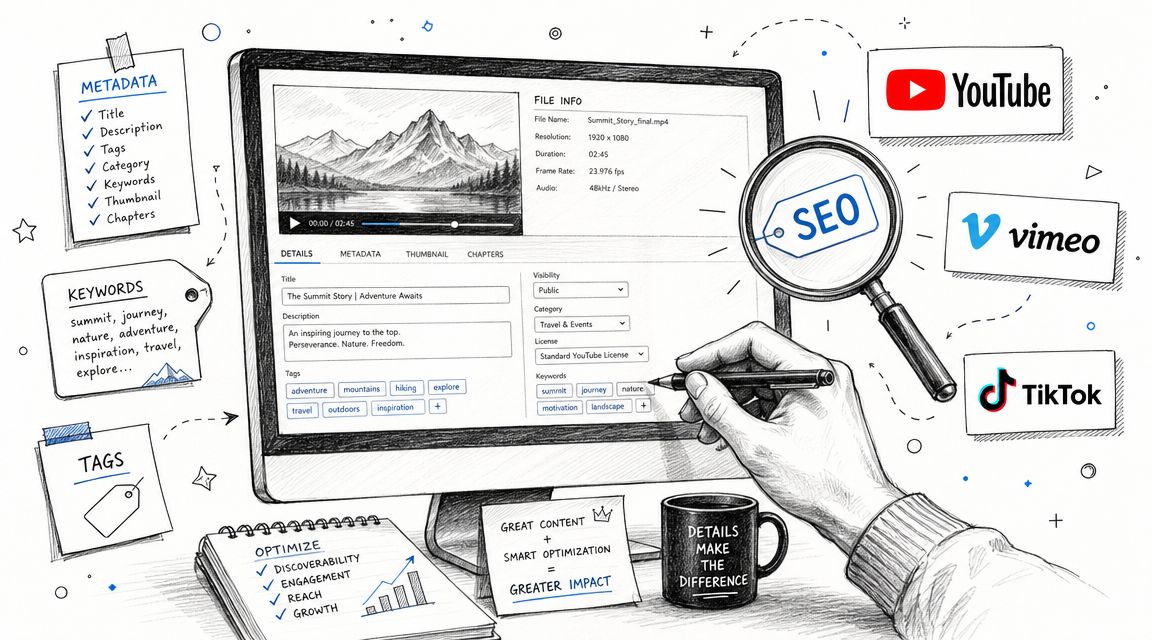
A practical workflow for video marketing SEO is straightforward: choose one search intent per video, keep the topic focused, place the embed above the fold, and publish a transcript. One industry source also notes that videos around 4–5 minutes can be a useful target for search-oriented content, while vague titles are a common failure point, as covered in this video SEO workflow guide.
Write titles for the click and the query
A lot of titles fail because they try to sound broad and impressive. Search-focused titles need to do the opposite. They should tell both Google and the viewer exactly what problem the video solves.
Bad titles are usually vague, branded, or overloaded with buzzwords. Strong titles are narrower and more literal.
A practical title checklist:
- Lead with the topic that the user searches for
- Clarify the outcome so the viewer knows what they'll get
- Avoid clever phrasing if it hides the core subject
- Keep promise and delivery aligned so the thumbnail and opening match the title
If your team struggles with naming and metadata consistency, it helps to document the required fields the same way you would for page SEO. This primer on metadata in SEO is useful for standardizing that workflow across content and video teams.
Treat thumbnails like SERP creative
On YouTube, the thumbnail often determines whether the metadata even gets tested. On a hosted page, the preview image still shapes perceived quality and engagement. I push teams to review thumbnails with the same seriousness they bring to title tags and ad creative.
Good thumbnails tend to share a few traits:
- Clear contrast so the visual stands out in crowded feeds
- One central idea instead of too many design elements
- Readable text only when it adds meaning quickly
- Consistency across a series so users recognize related content
A mismatch between title, thumbnail, and opening hook creates a retention problem fast. You may win the click, but you'll lose the viewer early.
Placement changes outcomes
This is the part teams skip most often. They build a good video, then bury it halfway down the page under a wall of copy. That wastes the asset.
If the video is meant to support search performance, put it where users can see it quickly and where the page clearly signals that the video is central content. That improves the chance that both users and search engines understand the asset's relevance to the page.
Here's a useful example of the kind of packaging and pacing choices that help a video compete:
The recurring client mistake isn't low production value. It's sloppy alignment. Wrong intent, weak title, buried embed, no transcript, and a thumbnail that belongs to a different video. Fix those first.
Implementing Technical SEO for Videos at Scale
Once the asset is live, technical structure determines whether search engines can reliably interpret it across a large site. At this stage, one-off optimization habits stop working. Enterprise teams need templates, governance, and QA.
The transcript discussion is a good example. A lot of advice says to add transcripts everywhere and stop there. The more useful question is when a transcript serves discovery, when it serves accessibility, and when it strengthens on-page relevance for a page where the video is the main content. That distinction is the actual trade-off, as explained in this video transcript and placement analysis.
Use schema to remove ambiguity
Search engines shouldn't have to guess what the video is, where it lives, or what page it belongs to. VideoObject schema helps reduce that ambiguity.
For agency programs, I recommend building schema requirements into page templates instead of relying on manual entry. The SEO team defines the fields. The CMS team exposes them. QA checks them before publish.
Here's the practical baseline.
| Schema Property | Purpose | Priority |
|---|---|---|
| name | Identifies the video title for search engines | High |
| description | Explains the video content and context | High |
| thumbnailUrl | Supplies the preview image associated with the video | High |
| uploadDate | Provides publication timing information | High |
| embedUrl | Shows where the video is embedded | High |
| contentUrl | Identifies the direct file location when applicable | Medium |
| duration | Helps define the video asset more clearly | Medium |
| transcript | Adds text context when supported in your implementation | Medium |
If your team is also trying to earn richer search presentations on page assets, this guide to rich snippets in SEO is useful background because it clarifies how structured data supports stronger SERP interpretation.
Decide transcript depth by page role
Not every transcript needs the same treatment. The right implementation depends on what the page is trying to do.
For example:
- Primary video pages usually benefit from a visible or expandable transcript because the text supports relevance and accessibility.
- Service pages with supporting video may only need a tighter summary plus selective transcript sections if the written page content already carries the main SEO load.
- Resource libraries often need transcript standardization because consistency helps scale indexing and internal search.
A transcript isn't valuable because it's a transcript. It's valuable when it helps the page communicate meaning more clearly.
Teams waste time. They fully transcribe low-value pages and under-support the pages where the video is doing the heavy lifting.
Build technical controls for large sites
On a small site, manual checks are annoying. On a large site, they're dangerous. Video SEO at scale needs operational controls:
- Template-level fields for title, description, thumbnail, transcript, and embed URL
- Schema validation checks inside launch QA
- Video sitemaps for sites with large video libraries or distributed content hubs
- Indexation monitoring for pages where video should be eligible for enhanced search visibility
For reporting and monitoring, teams often end up stitching together Search Console, YouTube Studio, crawler exports, and custom sheets. That works, but it gets messy fast. Platforms such as Surnex can centralize rank tracking, backlinks, audits, and AI search visibility in one workflow, which is useful when video pages are part of a broader enterprise SEO operation.
If YouTube remains a primary discovery channel, this resource on how to boost YouTube rankings is also worth reviewing alongside your technical checklist. It complements on-site SEO because platform packaging and site structure need to support the same content strategy.
Strategic Distribution to Amplify SEO Impact
A video that never leaves its publish URL is under-distributed. Consequently, many teams lose the SEO upside they expected from production.
The goal isn't just to circulate the asset. The goal is to route attention back to the page that should accumulate value. That means your distribution plan needs to support the hosted page, not compete with it.
Distribute to strengthen the page
A common mistake is sending all promotional effort toward the YouTube URL because it's easier to share. That can help platform growth, but it doesn't do much for the page you want ranking.
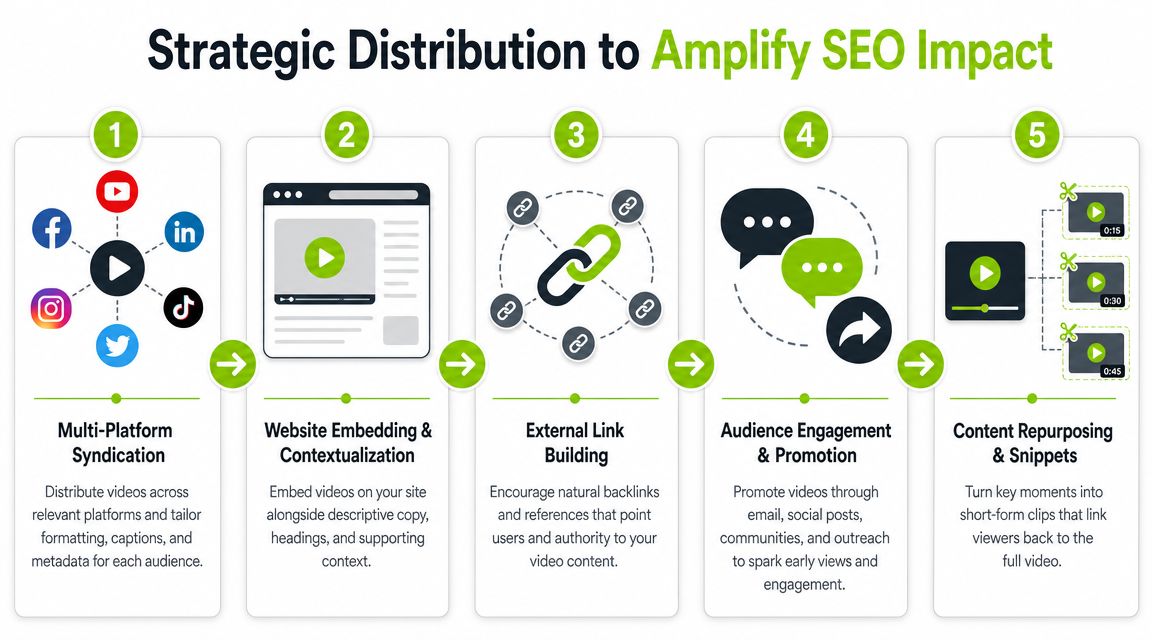
A stronger workflow looks like this:
- Embed the video on a relevant page where the surrounding copy matches the topic and intent
- Promote the hosted page in newsletters, outreach, and internal sharing when the SEO goal is page authority
- Use platform uploads as discovery layers that introduce users to the brand and point them toward deeper owned content
- Repurpose clips that support the same parent topic rather than spinning off disconnected messages
This is especially important for blog posts, service pages, comparison pages, and resource hubs. If the page is meant to rank, the page needs the promotional support.
Use video in link earning campaigns
Video can make a page easier to reference, cite, and share. That's why it works well inside digital PR and outreach, especially for explainers, demos, expert commentary, and visual walkthroughs.
I've seen this work best when the outreach angle is tied to the page's usefulness, not to the fact that it contains a video. The video supports the pitch. It doesn't replace it.
A distribution checklist for link-focused teams:
- Target pages that deserve links already. Video won't save a weak page.
- Pitch the page, not the platform upload. The hosted asset is what should earn authority.
- Create reusable snippets for sales, social, and outreach teams so they amplify the same page target.
- Refresh older high-potential pages with relevant video embeds when the page already has some authority.
If a video earns attention but your site doesn't capture the benefit, the distribution model is broken.
Connect platform reach to owned search assets
Short clips are useful here, especially when they act as feeders into a deeper page experience. A short-form teaser, a YouTube description link, a LinkedIn post, or a newsletter embed can all push users toward the main asset.
What matters is consistency. The same topic should show up in multiple formats, but each format should have a defined next step. Platform discovery creates awareness. The owned page captures organic value over time.
Measuring and Reporting on Video SEO Success
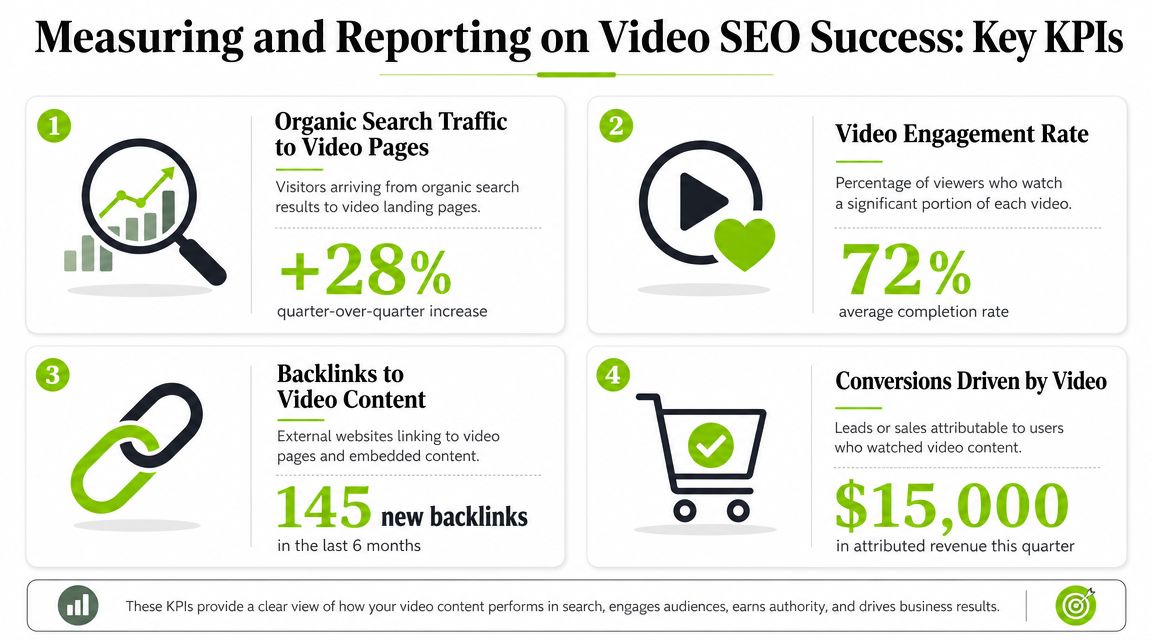
Views matter, but they don't answer the client's real question. The right reporting model shows whether video improved search visibility, engagement quality, and page performance.
Track the metrics that reveal problems
Benchmarking helps, but only if you use it diagnostically. According to video performance benchmarks from Swydo, 50–70% completion is a solid range for short videos under two minutes, while 40–50% is strong for longer videos over twenty minutes. On YouTube, 4–5% organic CTR is typical and 6–8% is considered excellent. The same source also notes that ignoring retention-curve drop-offs is a common execution failure.
Those numbers are useful because they point you to specific fixes:
- Low CTR usually means the title and thumbnail package is weak
- Early retention drop-offs often mean the opening hook doesn't match the promise
- Strong watch time but weak site impact can signal poor page placement or weak internal linking
- Good YouTube response but low Google visibility may point to page-level technical or content issues
Report at the page, video, and program level
I recommend three reporting layers.
First, page-level SEO reporting. Track impressions, clicks, rankings, and engagement on the hosted pages with embedded video. This information demonstrates whether video contributes to owned search performance.
Second, video-level platform reporting. Pull CTR, completion rate, retention curves, and top-performing topics from YouTube Analytics or the relevant platform dashboard.
Third, program-level reporting. Look at which content clusters, formats, and distribution paths repeatedly produce stronger outcomes. That's how you move from isolated wins to a reliable system.
Good reporting doesn't just show results. It shows where the production and SEO workflow needs adjustment.
While data is often abundant, the challenge lies in developing a measurement model that connects the various sources into a cohesive narrative. When this is achieved effectively, video marketing SEO becomes much easier to defend, prioritize, and scale.
If your team is trying to manage video SEO alongside rankings, backlinks, technical audits, and AI search visibility, Surnex is worth evaluating. It gives agencies and in-house teams one place to track modern search performance, which makes video reporting easier to tie back to the broader SEO program.