Most advice about keywords is stuck in an older version of Google.
It treats SEO like a placement exercise. Pick one phrase, repeat it often enough, tuck it into a few tags, and wait for rankings. That approach still shows up in audits, briefs, and client requests. It's also why many pages rank for the wrong terms, compete with each other, or bring in traffic that never turns into pipeline.
The job is different. If you want to know how to use keywords for search engine optimization today, think less about repetition and more about selection, mapping, implementation, and measurement. Keywords are not decorations you add after writing. They are the language layer that connects a searcher's intent to a page that deserves to exist.
That matters even more as search shifts toward AI-generated answers and blended result pages. A page can be technically optimized and still miss the language, structure, and intent patterns that drive visibility in classic SERPs and AI surfaces. Teams that adapt are already treating keyword work as content planning, site architecture, and business prioritization, not just on-page optimization. A practical starting point is understanding how SEO for AI search changes the way pages earn visibility.
Rethinking Your Approach to Keyword SEO
Keyword SEO no longer starts with placement. In agency work, it starts with page economics. If a target query will not bring the right visitor, support the right offer, or justify a dedicated URL, it does not belong in the plan, even if the search volume looks attractive.
That shift matters because Google now evaluates pages in context. It looks at intent match, topical coverage, site structure, supporting entities, and whether the result solves the job behind the query. AI-generated search features raise the bar further. Pages need clear language, strong information gain, and structure that can be cited or summarized. A modern workflow for SEO for AI search has to account for both classic rankings and visibility inside AI Overviews.
What actually works now
The strongest keyword strategies are built before anyone writes a draft. I use four checks.
-
Define the page job Every page needs a clear role. Generate demos, capture comparison intent, answer pre-sales questions, win branded demand, or support retention. If the page has two jobs, it usually performs neither well.
-
Use customer language, not internal language Sales calls, support tickets, CRM notes, and on-site search logs usually produce better keyword direction than a tool export. Teams often describe products in a cleaner way than buyers do. Buyers use problem language, workaround language, and competitor language.
-
Test whether the page deserves to exist A page with weak differentiation, thin substance, or no conversion path will struggle even with solid optimization. Keywords do not rescue low-value pages. They expose them.
-
Set the success metric before production Rankings are a diagnostic. The business metric matters more. Qualified leads, assisted conversions, revenue, pipeline influence, lower support volume, or better branded click share usually tell you whether the keyword target was worth pursuing.
One practical rule helps junior teams avoid wasted work. If changing the keyword does not change the page brief, the search intent, or the CTA, the term is probably too close to matter as a separate target.
Where agency teams usually go wrong
A lot of underperforming SEO programs fail for process reasons, not technical ones.
-
One URL is forced to target every nearby variation The result is a page that tries to educate, compare, and convert at the same time. Search engines get mixed signals. Users do too.
-
Keywords are added after the content is written Retrofitting creates awkward headings, weak internal linking, and pages that technically mention the term but never fully answer the query.
-
Opportunity is judged by volume alone High traffic terms can produce low-quality sessions, poor engagement, and no pipeline. For clients, that is not a win.
-
Keyword work is separated from site architecture A page rarely ranks because of copy alone. Internal links, neighboring content, template constraints, and crawl priority shape results.
I also pay attention to source quality during research. Trend data can be useful, but it should support judgment, not replace it. Teams experimenting with the trending Onlykeywordlab tool should still validate themes against real SERPs, Search Console patterns, and client revenue priorities.
The mature approach is less about inserting phrases and more about making deliberate decisions. Choose terms that map to business value. Assign them to the right page type. Build content that can win in standard results and AI-generated summaries. Then measure whether those choices improved visibility, conversions, and revenue.
Uncovering High-Intent Keywords That Drive Business
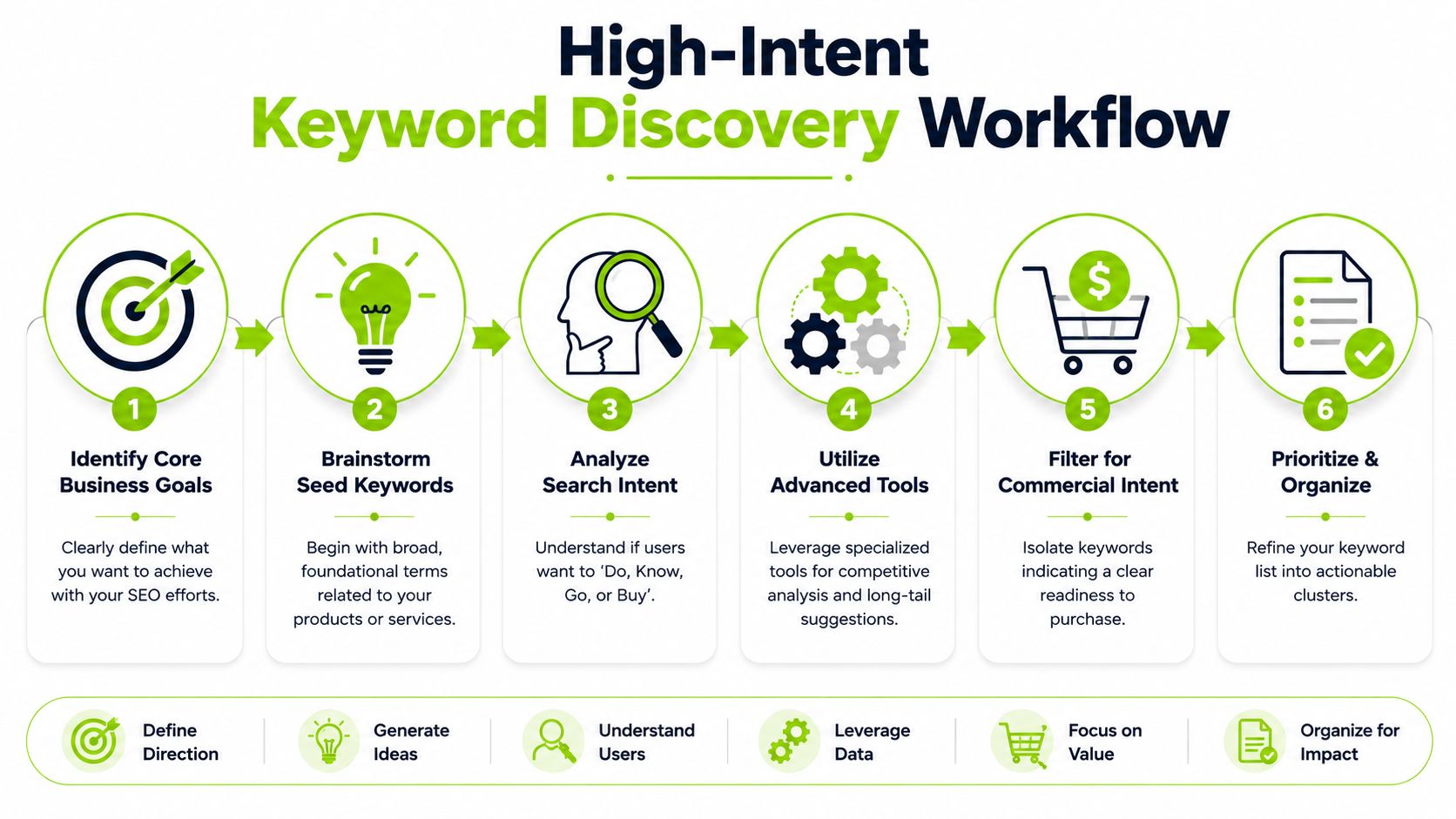
The best keyword lists usually don't come from exporting a giant tool report and sorting by volume. They come from finding the phrases that reflect real buying language, real problems, and real gaps in your site.
Ahrefs reports that 94.74% of keywords get 10 monthly searches or fewer, which is why strong SEO programs usually win through many specific queries rather than a few head terms, according to Ahrefs SEO statistics. That should change how you evaluate opportunities from the start.
Start with business intent, not keyword tools
Before touching Ahrefs, Semrush, Google Search Console, or anything else, define what the client needs from search. That usually falls into buckets like qualified leads, demo requests, ecommerce transactions, branded demand capture, or support deflection.
Then create seed themes around those outcomes. If the client sells software, “reporting dashboard” may matter more than a broad term like “analytics.” If the client runs a service business, problem-aware phrases often beat generic industry language.
A useful reference for expanding those themes into something workable is this guide to building a keyword list.
Pull language from first-party data
Third-party tools are helpful. First-party data is where the sharpest insights usually come from.
SE Ranking recommends mining Google Search Console and GA4 site search, then scoring terms by intent and feasibility. It also notes that grouped zero-search-volume keywords can still generate traffic when they collectively address a specific user need, as outlined in SE Ranking's advanced keyword research workflow.
Use your own data sources in this order:
-
Google Search Console Look for queries with impressions but weak click-through rate, or queries driving traffic to pages that aren't the best match.
-
GA4 site search Internal search terms often reveal exact wording customers use when they're close to taking action.
-
Sales and support language Pull phrasing from call notes, tickets, demos, and objection handling docs.
-
Question-based communities Forums, Reddit threads, and niche communities surface modifiers and pain points most tools flatten.
Review SERP competitors, not just direct competitors
A common junior mistake is benchmarking against only business rivals. In SEO, your real competitors are the pages already winning the search result.
Check who ranks for your target query set. Study:
-
Page format Is Google rewarding landing pages, product pages, guides, comparisons, or templates?
-
Angle Are results framed around speed, price, implementation, use cases, or alternatives?
-
Missing subtopics If every top page covers integrations and your page doesn't, that gap matters.
-
Conversion readiness Some keywords look informational but lead naturally into a commercial action.
If you want an external workflow to speed up pattern spotting, a tool like the trending Onlykeywordlab tool can help surface phrase variations and trend signals worth validating against first-party data.
High intent doesn't always look transactional on the surface. A searcher comparing methods, integrations, migration paths, or alternatives is often much closer to revenue than a broad educational visitor.
Prioritize by fit, not by size
Once you've collected candidates, score them manually. A simple agency scoring sheet should look at:
-
Intent fit Does the term match what the business sells?
-
Page fit Can one existing page satisfy it well, or do you need a new asset?
-
Feasibility Can your site credibly compete in that SERP?
-
Commercial value If this page wins visibility, does it move someone closer to a conversion?
That's how you build a keyword portfolio that drives business instead of vanity traffic.
Mapping Keywords Across the Customer Journey
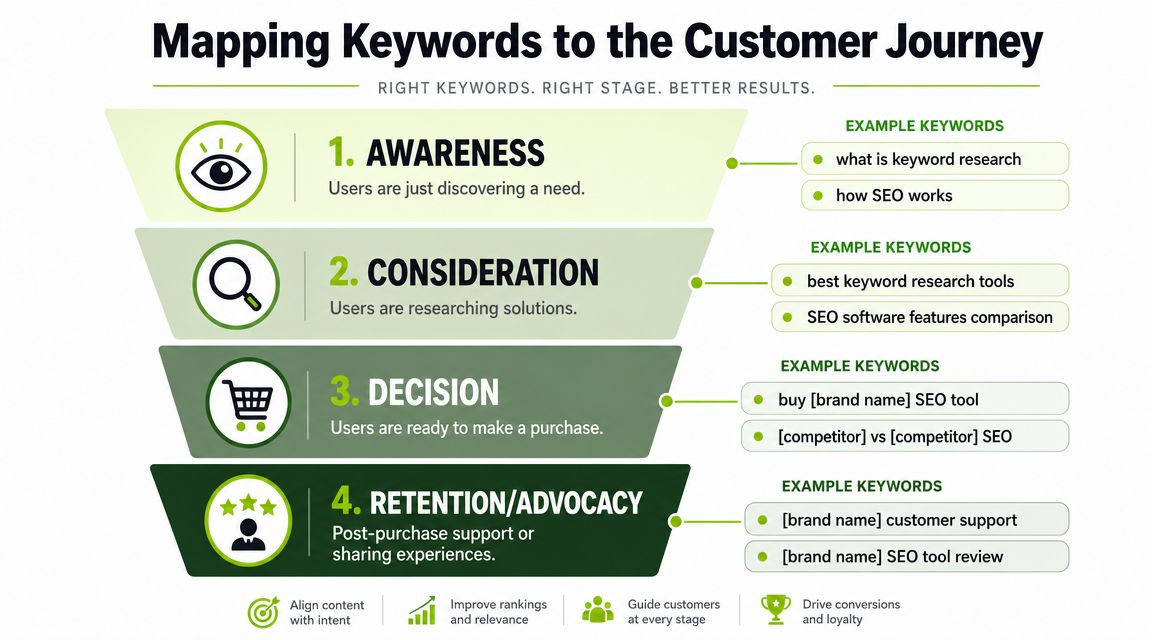
A keyword list by itself is not a strategy. It becomes a strategy when each cluster has a home, a job, and a place in the customer journey.
The cleanest model is to group terms by user sophistication and funnel stage, then assign each cluster to one primary page with contextual internal links. Search Engine Land recommends this approach because it reduces cannibalization and creates a better topical progression for the user in its guide to advanced SEO keyword strategy.
One cluster, one primary page
Agency accounts often get messy. Teams publish multiple pages that target slight variations of the same idea, then wonder why rankings bounce between URLs.
A better structure is simple:
| Content type | Keyword pattern | Primary goal |
|---|---|---|
| Educational article | Problem-aware and definition queries | Build relevance and qualify traffic |
| Comparison or solution page | Evaluation and alternative queries | Move users toward consideration |
| Service or product page | Transactional and high-intent queries | Convert demand |
| Support or post-sale page | Retention and brand-modified queries | Help customers and protect branded search |
If two pages target the same core intent, consolidate or reposition one of them. Don't let the CMS decide your architecture.
Use the funnel without oversimplifying it
The funnel still works if you use it as an organizational tool instead of a rigid rulebook.
Top of funnel queries
These are broad, problem-aware, educational searches. They often belong on blog articles, glossaries, learning hubs, and explainer pages.
Examples include:
- Definition searches People trying to understand a concept.
- Process searches People asking how something works.
- Early problem framing People recognizing a pain point but not choosing a solution yet.
These pages should earn trust and route users deeper through internal links.
Middle of funnel queries
Here, commercial value usually becomes more visible. Searchers are comparing approaches, tools, providers, or methods.
Good MoFu assets include:
- comparison pages
- use case pages
- feature breakdowns
- “best for” pages
- migration and implementation content
These pages should bridge education and decision. They need tighter copy, clearer proof, and stronger next-step calls to action.
If a page targets consideration-stage keywords, don't bury the conversion path under an educational essay. Help the reader decide.
Bottom of funnel queries
These are the pages closest to revenue. Users often search with service, product, platform, pricing, demo, near-me, alternative, or brand-modified language.
Bottom-funnel pages should do three things well:
- confirm relevance quickly
- remove obvious objections
- create a clear action path
That usually means sharper headings, stronger internal linking from upper-funnel pages, and fewer distractions.
Internal links should reflect progression
Internal linking is where the journey becomes visible to both users and search engines. Contextual links should move someone from broad understanding to practical evaluation to action.
A useful pattern looks like this:
- Educational article to comparison page “See which approach fits your team”
- Comparison page to service page “Review implementation options”
- Service page to proof or contact page “Talk to a specialist” or “See platform capabilities”
That kind of structure does more than pass authority. It turns keyword research into a navigable system.
Implementing Keywords for Maximum On-Page Impact
Keyword implementation is where a lot of SEO work goes off course. Teams spend hours picking terms, then weaken the page by forcing exact-match phrasing into every field. Strong on-page SEO is more controlled than that. The job is to make the page unmistakably relevant, easy to scan, and useful enough to earn the next click, the conversion, or a citation in AI-generated search results.
Get the core placements right
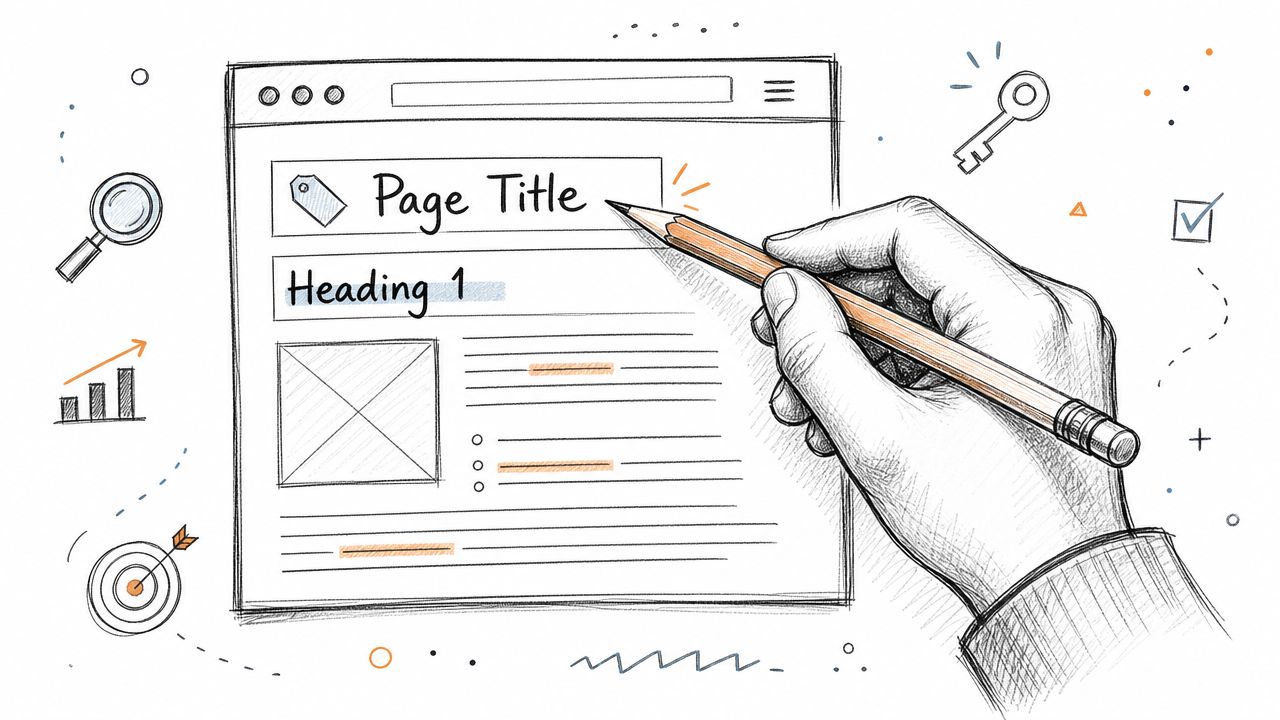
Start with the fields that shape topical clarity and click behavior. If the primary keyword belongs on the page, it usually belongs in these places:
-
Title tag Put the main term close to the front when possible, but write for the click. A relevant title that earns traffic beats a stiff one that only checks a box.
-
H1 Match the page topic directly. Headlines that hide the subject behind branding or clever copy often underperform.
-
Opening paragraph Confirm the topic early. Users should know they landed in the right place within a few seconds.
-
Meta description This helps qualify the click. Treat it as message match, not filler.
For a useful writing reference, this guide on SEO content strategy and structure does a good job showing how keyword placement should support readability rather than distort it.
Write for coverage, not repetition
A page rarely wins because the target phrase appears one more time than a competitor's. It wins because it answers the query clearly, covers the expected subtopics, and removes friction from the next action.
That matters even more now. Google's AI Overviews and other answer layers pull from pages that are well-structured, specific, and easy to extract from. If the copy is vague or bloated with repeated terms, it becomes harder for search engines to identify the useful takeaway.
A practical workflow for writing SEO content should treat the keyword as the page's organizing topic, not a quota.
Here's the rule set I give new team members:
-
Choose one primary keyword per page Keep the page centered on a clear intent. If two terms produce meaningfully different SERPs, they usually deserve separate pages.
-
Use close variants where they help clarity Supporting headings, body sections, FAQs, image alt text, and comparison tables are all reasonable places for related phrasing.
-
Match the language to the task A service page should help a buyer evaluate. A how-to page should help a reader complete something. Keyword usage should support that job.
-
Edit out anything that sounds engineered If a sentence reads like it was written for a crawler instead of a prospect, rewrite it.
Read the page aloud. Awkward repetition shows up fast.
Build semantic coverage into the page
Topical completeness carries more weight than old keyword formulas. Pages that perform well usually include the surrounding language users expect to see and the supporting details that prove the page deserves visibility.
That often includes:
-
Subtopics and modifiers Methods, pricing factors, use cases, integrations, limitations, timelines, or industry-specific concerns.
-
Related entities Tools, platforms, standards, teams, workflows, and concepts tied to the subject.
-
Evidence and proof Screenshots, process visuals, examples, mini case studies, or implementation notes that make the content more credible and easier to use.
-
Scannable extraction points Tight definitions, short lists, comparison tables, and FAQ-style answers that can surface in featured snippets and AI-generated summaries.
A short video can also help a page answer intent more completely when it supports the query:
A page-level implementation checklist
| Element | What to do |
|---|---|
| Title tag | Include the primary keyword naturally and make the page promise clear |
| H1 | Match the topic directly without stuffing variants |
| Intro | Confirm the topic and intent in plain language |
| H2s and H3s | Use supporting phrases where relevant |
| Body copy | Cover the topic fully with natural wording |
| Images | Add alt text only when it accurately describes the image |
| Internal links | Link to adjacent pages in the journey using descriptive anchor text |
| Structured answers | Add concise definitions, summaries, and FAQs where they genuinely help extractability |
On-page keyword work should make the page easier to understand, easier to rank, and easier to convert. That is the standard agencies should use now. Not whether the exact phrase appeared a set number of times.
Measuring Keyword Performance and Business Impact
If a page ranks but doesn't contribute to pipeline, revenue, signups, or qualified engagement, the keyword choice was probably weak, the page intent was misaligned, or the conversion path broke somewhere after the click.
That's why performance reporting has to move past ranking screenshots. Effective keyword strategy should be judged by business outcomes, not just search volume, and many guides still miss the connection between keywords and core KPIs, as discussed in American Eagle's guide to choosing keywords for SEO.
What to track instead of vanity metrics
Rankings still belong in reporting. They just shouldn't sit at the top by themselves.
A practical measurement stack includes:
-
Organic clicks to the target page This tells you whether the page is earning traffic from search visibility.
-
Click-through rate from search A page may rank decently and still lose clicks because the title and snippet don't match intent well.
-
Engaged sessions or equivalent quality signals If users bounce quickly, the keyword may be mismatched to the page.
-
Primary conversions Leads, purchases, demo requests, form fills, or signups.
-
Assisted conversions Many upper-funnel pages support revenue without being the final click.
Join Search Console to analytics data
Reports frequently fall apart. Search Console shows query and page demand. Analytics shows what happened after the click. You need both.
Use a shared page-based view:
| Page | Search signal | Business signal |
|---|---|---|
| Blog article | Queries, clicks, CTR | Assisted leads, newsletter signups |
| Comparison page | Commercial queries, CTR | Demo requests, contact clicks |
| Service page | High-intent queries, landing sessions | Form submissions, calls |
| Product page | Transactional queries | Purchases, revenue events |
When you review performance this way, keyword work becomes easier to defend. You can show that one page captures discovery demand while another closes it.
Report by page cluster, not isolated terms
Individual keywords move around. That's normal. Reporting only on exact-term position creates noise and usually leads to bad decisions.
A stronger reporting habit is to group performance by page or cluster:
- Primary page objective What was this page built to do?
- Target query set Which intent group is it supposed to capture?
- Traffic quality Are the right users landing there?
- Outcome Did the page contribute to a meaningful business action?
For agency teams, a structured visibility report helps a lot here. This framework for a keyword rankings and visibility report is a good model for connecting rankings to broader performance signals.
A ranking increase is a useful diagnostic. A qualified conversion is the result the client actually buys.
When a page underperforms, ask the harder question first. Was this the wrong keyword target, or was it the right keyword on the wrong page? That one distinction saves months of wasted revisions.
Advanced Keyword Strategy for the AI Search Era
Ranking for a target term is no longer the finish line. In many SERPs, the first interaction happens inside AI Overviews, product modules, forum results, or expanded snippets. Agencies that still treat keyword strategy as a placement exercise are measuring the wrong thing.
The job now is to build pages that can be retrieved, understood, cited, and clicked. Keywords still matter, but mostly as labels for intent. The primary work is aligning the page with the question, the entity set around that question, and the next action the visitor is likely to take. That shift matters even more for agency teams because clients do not buy rankings in isolation. They buy pipeline, revenue, and lower acquisition costs.
Think in topics, entities, and tasks
A page built around one exact-match phrase usually underperforms in modern search because it gives search engines too little context and gives AI systems too little confidence. Strong pages cover the topic well enough that the system can identify what the page is about, what supporting concepts it includes, and what problem it helps solve.
I coach teams to pressure-test every target keyword with three questions:
-
What is the core topic? Define the subject the page needs to cover, not just the phrase in the brief.
-
Which entities belong on the page? Include products, features, use cases, competitors, terminology, and related concepts that shape the searcher's decision.
-
What task should this page help complete? Clarify whether the user needs a definition, a comparison, a process, a shortlist, or a buying path.
That is also why low-volume terms still matter. Many of the best opportunities never look impressive in a keyword tool. They show up in Search Console, sales call notes, support tickets, on-site search, and competitor gap reviews. One low-volume query may not move a dashboard by itself. A cluster of tightly related queries often drives qualified visits because it reflects a real task the audience is trying to finish.
Build pages that are easy to cite
AI systems tend to pull from pages that are clear, specific, and structurally predictable. A page full of broad claims, vague headings, and generic copy is harder to interpret and harder to trust as a source. That is a content problem, not a keyword density problem.
Use a format that makes extraction easy:
-
State the answer early Put the primary definition, recommendation, or conclusion near the top of the page.
-
Break content into labeled sections Write headings that match subtopics a searcher would expect to see.
-
Keep supporting details close to the claim If a page mentions a feature, process, or recommendation, explain it immediately instead of forcing the user to hunt for context.
-
Refresh pages when the SERP changes If Google starts showing comparison results, discussion results, or AI summaries for a query set, the page usually needs a structural update, not just a title tag tweak.
AI visibility often goes to the page that explains a topic clearly and completely.
Add AI visibility to the reporting stack
Traditional rank tracking still belongs in the workflow. It just cannot be the only view anymore. Teams also need to monitor whether the brand appears in AI Overviews, which competitor domains are cited, and which page types are getting pulled into those experiences.
One option is Surnex, which tracks AI visibility alongside traditional SEO signals such as rankings, backlinks, audits, and content opportunities. That context helps when a client sees flat rankings but a drop in organic clicks, or when impressions rise because the brand is being surfaced in AI-driven results without a matching increase in sessions.
The practical trade-off is simple. Broader topic coverage can improve citation potential, but it can also blur page intent if the content team tries to answer every possible variation in one URL. Good agency strategy sets page boundaries on purpose. One page should solve one primary job well.
Use an agency-ready checklist
A simple operating sheet keeps research, content, QA, and reporting aligned. If the page strategy is weak, the handoff usually falls apart before publishing.
| Page URL | Primary Keyword | Secondary Keywords | Search Intent | Funnel Stage | Title Tag | H1 | Meta Desc |
|---|---|---|---|---|---|---|---|
| / | |||||||
| / | |||||||
| / | |||||||
| / |
Use this during kickoff, content production, and final QA. Then add two fields your team will find useful in the AI search era: entity coverage and citation readiness. Entity coverage checks whether the page includes the concepts the SERP expects. Citation readiness checks whether the page answers a narrow question clearly enough to be summarized.
The teams that adapt fastest will not be the ones cramming more phrases into a brief. They will be the ones running keyword strategy as an end-to-end operating system for search visibility, AI retrieval, and business outcomes.
If your team needs a clearer way to connect keyword strategy, AI visibility, rankings, and reporting across multiple clients, Surnex gives agencies and in-house teams one platform to track how pages surface in traditional search and emerging AI experiences.