You publish a piece that should work. The brief is solid, the writing is clean, the topic has demand, and still the page stalls somewhere no one clicks.
That usually isn't a writing problem. It's a workflow problem.
In 2026, knowing how to write seo content means building pages that can compete in two places at once. They need to rank in classic search results, and they need to be structured well enough that AI systems can extract, summarize, and cite them. If your process only optimizes for one of those outcomes, you're leaving visibility on the table.
The New Rules for Writing SEO Content
Often, SEO writing is still approached as a publishing task. Pick a keyword, write a post, add the keyword in the usual places, and hit publish. That approach breaks down because search behavior has changed faster than most editorial processes.
Search still matters at the highest level. Organic search results claim 94% of all clicks, with the top three positions securing 68.7%, and the #1 spot alone receiving a 27.6% click-through rate according to AIOSEO's SEO statistics roundup. That's why first-page placement still decides whether a page becomes an asset or dead weight.
What changed is what “visibility” now means. A reader might click a traditional result. They might also get a synthesized answer in Google's AI experiences, compare cited sources, and only then decide where to visit. That creates a different standard for content. It has to be useful to a human scanning fast, and it has to be machine-readable enough for retrieval systems to trust it.
Practical rule: If a paragraph doesn't help a reader understand the answer faster, it probably won't help a search engine or an AI model either.
That's why the old split between “good writing” and “SEO writing” no longer helps. Good SEO content now needs four things working together:
- Clear intent match so the page solves the exact problem behind the query
- Strong structure so crawlers and AI systems can map the content quickly
- Credible substance so the page earns links, trust, and citations
- Ongoing refinement so updates keep the page useful after publication
If you need a broader planning lens before you start drafting, this guide to content strategy for publishers and bloggers is useful because it frames content as a system, not a queue of isolated posts.
Find Your Angle Before You Find Your Keywords
The most common mistake new writers make is opening Semrush or Ahrefs too early.
Keyword data matters, but it shouldn't be the first move. First, decide why your page deserves to exist. If ten articles already answer the query the same way, an eleventh version with slightly better formatting usually won't win.

Read the SERP before you trust the keyword
When I review a topic, I look at the live search results before I decide anything about the brief. The SERP tells you what Google thinks the user wants. That matters more than what a keyword spreadsheet suggests.
Start by checking these signals:
- Format pattern. Are the ranking pages tutorials, landing pages, listicles, comparison posts, or product pages?
- Intent pattern. Does the SERP lean informational, commercial, or transactional?
- Depth pattern. Are top pages broad explainers or tight answers to one specific question?
- Freshness pattern. Are recent pieces replacing older ones, or do evergreen pages hold the positions?
If the query is “how to write seo content,” the SERP usually favors educational content. That means a sales-led article or a thin checklist won't align well, even if the keyword looks attractive.
Find the gap competitors ignored
Once intent is clear, look for sameness.
A lot of pages rank because they're competent, not because they're distinctive. That gives you room to win by bringing a stronger angle. You can find that angle by reading comments on LinkedIn posts, scanning Reddit threads, reviewing sales calls, talking to account managers, and pulling support questions from your own team.
That matters more than most guides admit. Google Trends data shows queries for “SEO content angles” have spiked 40% year over year, while fewer than 5% of top-ranking guides explain how to use social listening or newsletters to find those perspectives, as noted by Buffer's content research methods guide.
The keyword tells you what people type. The angle tells you why they'll choose your page over the other results.
A few examples of weak versus strong angles:
| Topic | Weak angle | Stronger angle |
|---|---|---|
| SEO content writing | Generic beginner tips | A real agency workflow from brief to refresh cycle |
| Topic clusters | Definitions only | When clusters help, when they create maintenance drag |
| AI search optimization | Abstract predictions | How to make a page citable by AI systems today |
Use keywords after the angle is clear
Once the angle exists, then you can research keywords with purpose. Now you're not hunting random terms. You're mapping search language to a point of view and a user need.
I usually separate the list into three buckets:
- Primary query that defines the page
- Secondary terms that cover subtopics and adjacent intent
- Language from real users pulled from forums, newsletters, reviews, and sales calls
For teams that want a faster way to organize that research, Surnex's keyword research workflow is a clean place to centralize themes and intent patterns without bouncing between disconnected tools. If you want a complementary look at narrowing broad terms into practical opportunities, this walkthrough on a profitable long-tail keyword strategy for 2025 is worth reading.
Build a Bulletproof Content Blueprint
A strong article usually isn't won in the draft. It's won in the brief.
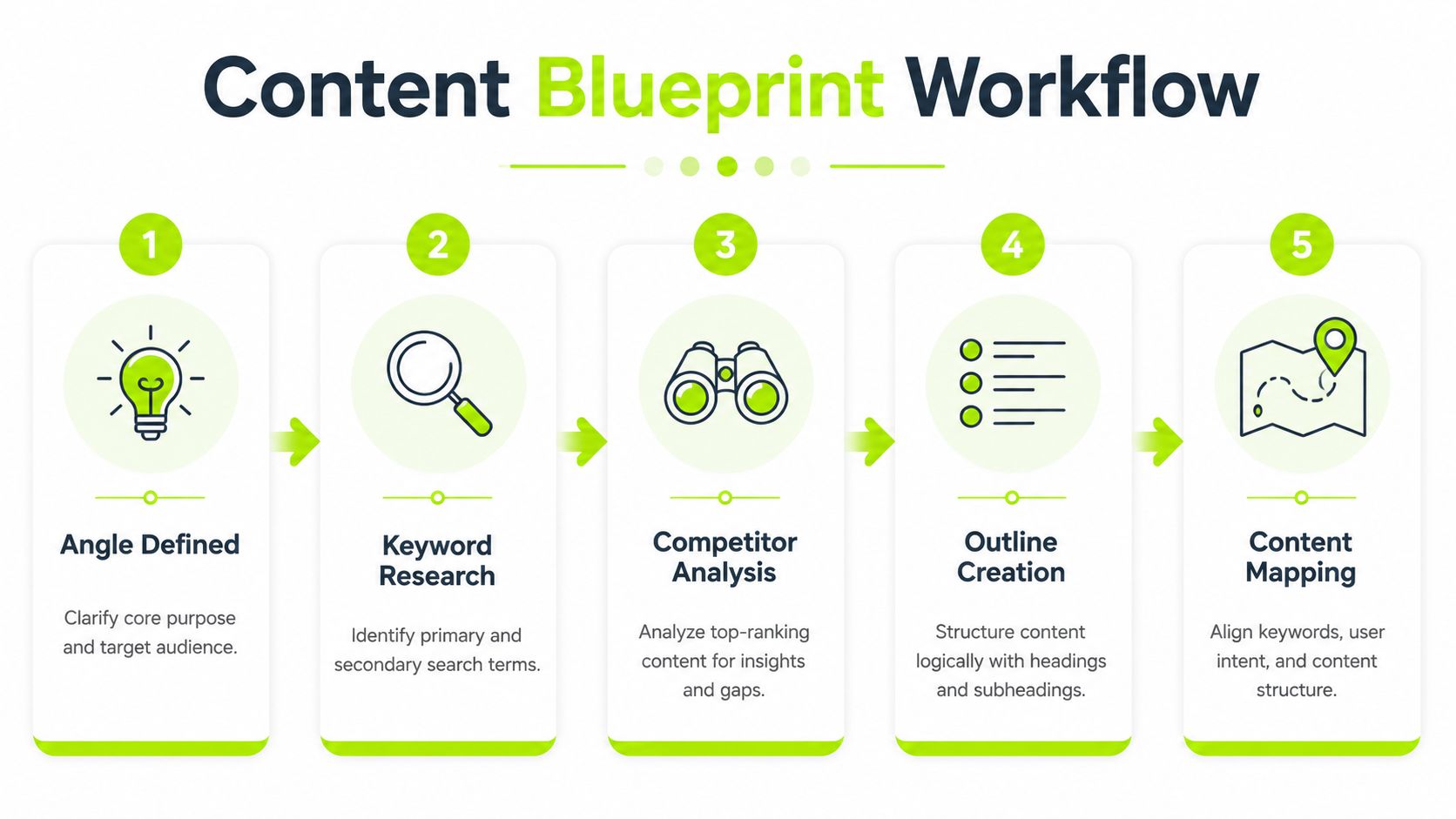
Writers move faster when the structure is already doing strategic work. That means the outline should reflect the SERP, the intent, the angle, and the evidence you need to include. If the brief is vague, the draft will wander. If the brief is precise, revision gets easier.
Benchmark the current winners
Before I assign a piece, I review the top results in detail. Not to copy them. To understand the minimum threshold for entry and where the opening sits for a better version.
A useful benchmark comes from Semrush's SEO writing methodology, which notes that ranking pages average 1,800 to 2,500 words with 4 to 7 H2 and H3 headings, and that pages following a structured, benchmarked outline rank 20% to 30% higher in Google's top 10 within 90 days versus non-optimized content.
What I record from those pages is straightforward:
- Coverage. Which subtopics appear on almost every ranking page?
- Blind spots. What questions are still answered poorly or buried too deep?
- Evidence quality. Are competitors using original examples, expert input, screenshots, or just recycled advice?
- Formatting choices. How often do they use lists, comparison tables, examples, and visual aids?
Turn research into a usable brief
Most bad briefs fail because they dump information instead of directing decisions. A writer doesn't need a pile of exports. They need a content blueprint.
My standard brief includes the elements below.
Core brief fields
- Primary keyword and intent so the writer knows the page's main job
- Working title that reflects the query and the promise
- Audience definition in plain language, not a persona document
- Angle statement explaining what makes this version different
- Required subtopics based on SERP coverage and user questions
- Evidence plan listing what examples, data, visuals, or expert inputs must appear
- Internal linking targets so the page fits the broader site structure
- Conversion goal so the draft supports the business outcome without hijacking the user experience
Here's the difference in practice:
| Weak brief | Strong brief |
|---|---|
| Write about SEO content | Teach agency teams how to write SEO content for both SERPs and AI retrieval |
| Mention keywords naturally | Use one primary query and support it with intent-matched subtopics |
| Add internal links | Link to pages that strengthen topical relationships and next-step actions |
| Make it comprehensive | Cover planning, briefing, drafting, on-page optimization, and post-publish iteration |
Build clusters, not isolated pages
A single article can rank. A connected set of pages builds authority.
That's why I map each new page into a topic cluster before writing starts. If a page doesn't support a pillar or connect to supporting content, it often ends up as an orphan with limited long-term value. Cluster planning also makes internal linking much easier because the relationships are intentional from the start.
For teams doing this at scale, citation visibility matters too. If AI systems keep citing competitors when discussing your topic area, you need to know where the content gap sits. That's where a workflow like citation gap analysis becomes useful, because it pushes the brief beyond “rank for keyword” into “become a source worth citing.”
A brief should remove uncertainty, not create more of it.
Drafting Content with Experience and Expertise
Writers often ask where optimization begins. My answer is simple. It begins after the draft has something worth optimizing.
If the content is generic, no amount of title tag tuning will fix it. Search engines can crawl a page. They can't rescue a weak point of view. The strongest SEO content feels written by someone who understands the work, the trade-offs, and the mistakes people make.
Write like someone who has done the job
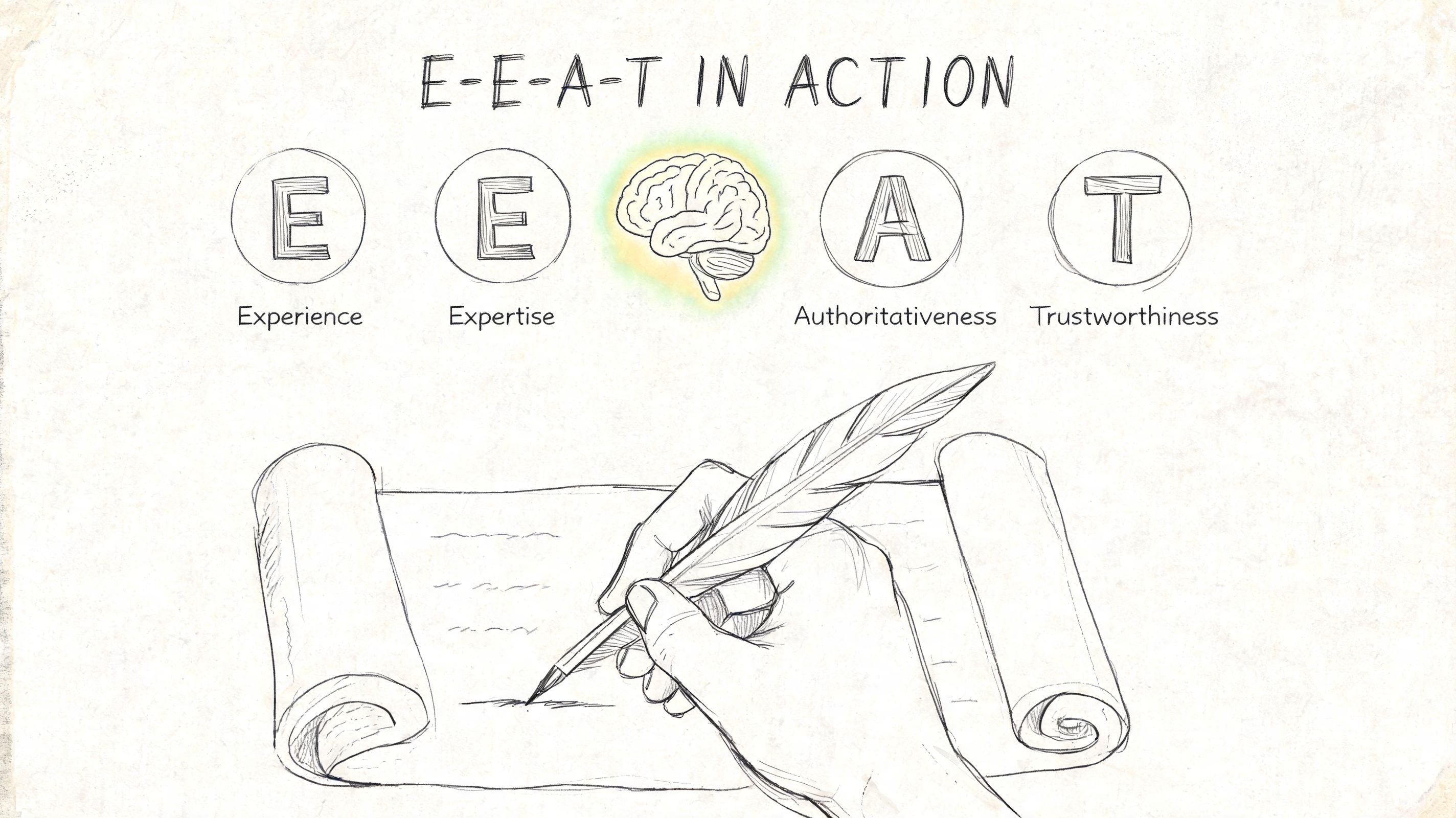
Google's E-E-A-T framework matters because it pushes content toward credibility. In practice, that means the page should show signs of lived experience, informed judgment, and transparent sourcing.
A weak paragraph says, “Use internal links to improve SEO.”
A stronger paragraph says, “Linking every mention of a phrase to the same page creates clutter. Use internal links where the next click helps the reader complete the task or understand the topic better.”
That difference is small on the surface. It's huge in effect. One sounds memorized. The other sounds practiced.
Ways to build that signal into a draft:
- Add operational detail that only appears when someone has done the work
- Name trade-offs instead of pretending every tactic is universally useful
- Use examples that show what good and bad execution look like
- State limitations when advice changes based on site type, competition, or resources
Depth still wins when the depth is earned
Long-form content isn't magic. Fluff wrapped in subheadings won't rank well for long.
But there is strong evidence that deeper coverage works when it helps the reader. In 2025, 55% of bloggers publishing posts over 2,000 words reported significantly better results, and those in-depth articles attracted an average of 77.2% more inbound links than shorter content, according to RyeSing's blog statistics and SEO roundup.
That doesn't mean every page should be long. It means the page should be complete. For a competitive educational topic, completeness usually requires more space because the user has more questions, and the page needs room to answer them well.
Good long-form content feels shorter than it is because every section earns its place.
Make the draft easy to scan
Thorough doesn't mean dense.
If a page is hard to scan, readers won't stay with it long enough to find the value. AI systems also benefit from clean structure because they can identify section boundaries, extract direct answers, and understand the hierarchy more reliably.
I coach writers to tighten drafts using this checklist:
- Short paragraphs so the page doesn't become a wall of text
- Direct openings that answer the subtopic before expanding
- Specific subheadings that tell the reader exactly what sits below
- Lists and tables when comparison beats prose
- Natural language instead of copy that sounds written for a crawler
Use evidence without sounding stitched together
Citing data helps, but dumping statistics into every section can make a page feel assembled rather than authored. The draft should still sound like one person with a clear argument.
A simple pattern works well:
- State the point plainly
- Add evidence where it sharpens the point
- Explain what that means in practice
- Give the reader the next decision
Here's what that looks like on the page:
| Weak writing move | Better writing move |
|---|---|
| Add a stat with no interpretation | Explain why the stat changes the tactic |
| Mention E-E-A-T abstractly | Show what credibility looks like in the copy |
| Repeat common SEO advice | Add context about when the advice fails |
Trust is built in the small details
Trustworthiness usually shows up in little things. Clean grammar. Honest wording. Clear authorship. No exaggerated claims. No vague “experts say” padding.
That's especially important now because AI-generated content has made generic confidence cheap. The pages that stand out are the ones that are specific, grounded, and careful. If you want to know how to write seo content that lasts, start there.
Applying Essential On-Page Optimizations
Once the draft is solid, on-page work becomes worth doing. This part isn't glamorous, but it often decides whether a strong article earns clicks, gets understood properly, and contributes to site-wide authority.
Get the page-level basics right
Title tags, meta descriptions, headings, URLs, image alt text, and internal links are basic because they work. Teams skip them when they're rushing, then wonder why a good article underperforms.
I use a simple pass before publication.
On-page pass
- Title tag. Put the primary topic near the front, make the promise clear, and avoid clever phrasing that hides the value.
- Meta description. Write for click intent, not keyword stuffing. Explain what the reader gets.
- H1 and subheadings. Keep the hierarchy clean. Each heading should reflect an actual section purpose.
- URL slug. Short, descriptive, and stable.
- Images. Use descriptive filenames and alt text that help accessibility and context.
- Internal links. Add links where the next page supports the reader's task.
A lot of heading issues are self-inflicted. Writers use vague subheads because they sound polished. Search systems usually respond better to headings that are explicit and useful.
Build topic clusters through internal linking
Internal linking is where single-page SEO turns into site architecture.
According to ContentWriters' guide to SEO content writing, implementing topic clusters, where a central pillar page links to 5 to 10 related content pieces, can increase organic traffic 2.3x within six months. The same source notes that 70% of top-ranking pages use keyword-rich H2 to H4 headers.
That matters because internal links do more than distribute authority. They tell crawlers which pages belong together, show users the next logical step, and reinforce topical depth over time.
A practical way to handle this is to think in page roles:
| Page role | Job |
|---|---|
| Pillar page | Covers the broad topic and links outward |
| Supporting guide | Answers a narrower question in depth |
| Comparison or use-case page | Helps readers evaluate options or scenarios |
| Conversion page | Captures action once intent shifts |
Technical issues can still drag down even a strong content system. Before publishing at scale, run the page through a proper site audit workflow so indexing, linking, and page health issues don't undercut the content.
Use schema and media where they help clarity
Schema markup isn't something I add because it feels “advanced.” I add it when it helps search engines interpret the content more accurately. Article schema is often a sensible baseline. FAQ schema can help when the page includes distinct question-and-answer content that adds value.
This short video is a useful refresher on practical SEO page optimization:
Media matters too, but only when it earns its place. Add screenshots when they clarify a step. Add diagrams when the concept is easier to understand visually. Don't scatter stock visuals through the page just to make it feel “content-rich.”
A polished page isn't the one with the most elements. It's the one where every element supports understanding.
Optimizing for AI Search and Measuring What Matters
AI search optimization isn't a separate layer you bolt on later. It's the result of disciplined SEO writing.
Pages that perform well in AI-driven discovery usually share familiar traits. They answer questions directly. They use clear subheadings. They define terms before expanding on them. They organize ideas into lists, comparisons, and short sections that are easy to extract.
Make the page easy to cite
If you want your content to surface in AI Overviews and other retrieval-driven experiences, write with citation in mind.
That usually means:
- Lead with the answer instead of making the reader work through a long intro
- Use question-led headings where that matches the query
- Keep definitions tight before adding nuance
- Format steps clearly so procedures are easy to follow
- Separate opinion from fact so claims stay trustworthy
This isn't a break from SEO. It's a stricter version of the same discipline. Clear structure has always helped rankings. Now it also helps models decide whether your page is safe and useful to reference.
Measure outcomes, not publishing activity
A published article isn't a result. It's an input.
The metrics that matter are the ones tied to visibility and business impact: target keyword movement, organic traffic quality, conversions from organic sessions, backlink growth, and whether the page is being cited or surfaced in AI-driven results. If a page ranks but doesn't attract the right audience, the job isn't done. If it gets traffic but never assists conversion, the topic or intent may be wrong.
That's why unified reporting matters. Teams need to see traditional rankings and AI visibility in one view, not in separate tools with separate stories. A dedicated AI visibility tracking workflow makes that much easier because it shows whether a page is merely indexed, discoverable, or becoming a cited source.
Update based on evidence
I refresh content when the page shows one of three signals: it's slipping, the SERP changed, or the article still gets impressions but underdelivers on clicks or conversions.
When you revisit a page, don't just rewrite sentences. Re-check intent. Re-open the SERP. Tighten the answer format. Add missing examples. Improve internal links. Treat the page like an asset that needs maintenance, not a one-time deliverable.
Final Quality Checklist and Common Questions
Before publishing, run a quick QA pass. It catches most avoidable mistakes.
Final checklist
- Angle is clear and different from what already ranks
- Primary intent matches the current SERP
- Outline is complete without obvious filler
- Headings are specific and easy to scan
- Claims are grounded in experience or credible evidence
- Title tag and meta description make a clear promise
- Internal links support the journey instead of being added mechanically
- Images, schema, and formatting improve clarity
- Direct answers appear early enough for both readers and AI retrieval
- Post-publish review plan exists so the page can be improved with real data
Common questions
How long does it take SEO content to rank
It depends on the site's authority, the query, and the competition. New pages can move quickly for low-competition topics, while harder terms may take longer and require updates, links, and stronger clustering support.
How important is word count
Word count matters only when it reflects complete coverage. A short page that answers the query cleanly can work. A longer page usually wins when the topic requires depth, examples, and subtopic coverage.
How often should content be updated
Update when the SERP changes, performance softens, or the page no longer reflects the best answer. Don't refresh on a fixed schedule just to stay busy.
Can AI-generated drafts be used
Yes, but only with strong editorial control. AI can speed up outlining and first drafts. It should not replace judgment, experience, fact checking, or the subject-matter detail that makes a page worth ranking and citing.
If your team needs one place to track rankings, backlinks, audits, and AI search visibility together, Surnex gives agencies, in-house teams, and developers a practical way to manage modern search performance without stitching together separate tools.