
You're probably in the same spot a lot of agencies hit. Clients keep asking for SEO, your sales team knows there's demand, but delivery starts to break as soon as you add a few more accounts. One strategist becomes a bottleneck, technical work slips, reporting gets inconsistent, and margins get squeezed by rushed hiring.
That's where white label seo becomes less of a shortcut and more of an operating model. The right partner lets an agency sell and manage SEO under its own brand without building every specialist function in-house. The wrong partner creates client risk, internal confusion, and a reporting mess you'll spend months cleaning up.
What's changed is that classic SEO delivery isn't enough on its own anymore. Agencies now need a way to handle rankings, audits, backlinks, and content while also explaining visibility in AI-driven search experiences. That's the core scaling challenge in 2026.
Why Agencies Struggle to Scale SEO Services
Most agencies don't fail at selling SEO. They fail at delivering it consistently at scale.
The first problem is staffing. Good SEO work needs multiple skill sets at once: technical audits, on-page optimization, content planning, content production, link acquisition, analytics, and client communication. Hiring one “SEO person” rarely solves that. It usually creates a generalist role with too much surface area and not enough depth.
The second problem is operational drag. One client needs a local SEO push, another needs technical cleanup, and a third wants content velocity with executive-level reporting. The work itself is manageable. What gets difficult is coordinating tasks, maintaining standards, and keeping client-facing communication clean while the actual execution happens behind the scenes.
White label seo works when the agency keeps control of strategy, positioning, and client relationships, while the fulfillment partner handles repeatable execution well.
That's why many agencies cap out earlier than expected. They can close more business, but they can't fulfill more business without adding payroll, management overhead, training time, and process debt. Instead of becoming more profitable, growth starts to feel heavier.
A lot of teams solve this by narrowing their offer. Others turn away SEO work entirely. A better option is to build a delivery layer that expands with demand. For agencies managing multiple accounts, a platform built for agency workflows, reporting, and modern search visibility can make that shift easier, especially when it supports marketing agency SEO operations.
What usually breaks first
- Delivery capacity becomes uneven. Strong months overload the team, and weak months leave expensive specialists underused.
- Technical SEO gets delayed because urgent content and client requests always win the queue.
- Reporting quality drops when account managers have to assemble updates from disconnected tools and vendors.
- Strategy gets crowded out by fulfillment management, revisions, and deadline chasing.
Agencies don't need more chaos wrapped in a new package. They need a model that protects margin and preserves client trust.
Understanding the White Label SEO Model
White label seo is simple once you strip away the jargon. It's similar to a restaurant with a strong brand that still sources specialty ingredients from expert suppliers. The guest experiences one brand. Behind the scenes, specialists handle parts of production that require dedicated skill and infrastructure.
In this model, your agency owns the client relationship. The white label provider handles agreed SEO work. Your client sees your brand, your communication, and your reporting.
Who does what
There are three players in a healthy setup.
- The agency handles sales, strategy ownership, account management, and the client relationship.
- The white label provider executes the work. That may include technical SEO, content briefs, on-page updates, local SEO, link outreach, and reporting inputs.
- The client receives the service under your agency brand and judges the quality based on outcomes, communication, and clarity.
The important distinction is that white label seo is not just generic outsourcing. In a real white label arrangement, the provider is built to support another company's delivery model, documentation needs, and branding requirements.
What services are usually included
A mature provider typically supports a mix of core SEO tasks:
- Technical work such as crawl issue reviews, indexation checks, internal linking analysis, structured data recommendations, and Core Web Vitals fixes
- On-page optimization including title tags, headings, page copy refinement, and keyword mapping
- Content support through topic planning, briefs, page outlines, and article production
- Off-page execution such as backlink acquisition and digital PR support
- Local SEO for businesses that depend on geographic visibility
- Reporting inputs that your team can repackage into client-ready updates
The cleanest white label relationships feel boring in the best way. Requests are clear, work is documented, and clients never feel the handoff behind the curtain.
What white label does not remove
Agencies often encounter problems. White label seo does not remove your responsibility to think.
You still need to define positioning, approve strategy, set expectations, translate deliverables into business outcomes, and make sure the work fits each client's market. If you hand all judgment to a provider, you're not scaling. You're renting a process and hoping it matches the client.
That's why the best agency owners treat white label partners as fulfillment infrastructure, not as a substitute for leadership.
The Business Case for White Label SEO
A familiar agency problem looks like this: sales closes three new SEO retainers in a month, then delivery stalls. The strategist starts writing briefs, the account manager is chasing updates, and margins shrink before the first report goes out.
That is the core business case for white label SEO. It gives an agency a way to sell SEO without rebuilding the fulfillment team every time revenue spikes.
Why the model works financially
The economics improve when you stop treating every new account like a hiring trigger.
Instead of adding a technical SEO, content lead, outreach specialist, and reporting analyst one by one, you buy access to an existing delivery function. Your internal team stays focused on the work clients associate with agency value: strategy, prioritization, communication, and expansion into related services.
That changes two things at once. It lowers fixed payroll pressure, and it shortens the time between closing a deal and starting work. Both matter if you want SEO to be a profitable service line rather than a capacity headache.
The strongest version of this model is not cheap outsourcing. It is controlled delegation.
Where the margin actually comes from
Agency owners sometimes frame white label SEO as a labor cost decision. The better lens is throughput.
If a partner can deliver audits, on-page updates, content support, and reporting inputs on a repeatable schedule, your team can manage more revenue per headcount. That is where margin improves. You are not just reducing cost. You are increasing delivery capacity without breaking client experience.
A few practical gains show up fast:
- Faster sales follow-through because fulfillment capacity already exists when the proposal is signed
- Better use of senior staff time because strategists stay out of production work that does not require their level of judgment
- More predictable gross margin because delivery costs are tied to client volume instead of speculative hiring
- Cleaner expansion paths into local SEO, technical projects, and content production without building each capability from scratch
Agencies that scale this well usually pair the provider with an internal system for audits, workflow visibility, and reporting consistency. A modern SEO tech stack for agency delivery helps keep fulfillment tied to what clients themselves see each month, especially as reporting expands beyond rankings and traffic into AI search visibility.
Why this matters more now
SEO reporting is getting harder, not easier.
Clients still ask about rankings, leads, and organic traffic. Now they also want to know whether their brand appears in AI Overviews, how often they are cited in answer-driven search results, and whether visibility is shifting away from traditional blue-link clicks. If your agency sells SEO in 2026, that reporting expectation lands on your desk whether your fulfillment model is ready or not.
White label SEO makes more financial sense when the partner can support that shift. Traditional execution still matters, but the agency keeps its edge by combining it with unified reporting that tracks both standard search performance and emerging AI surfaces. That is the difference between reselling yesterday's SEO package and building a service clients will still renew next year.
Where agencies still miscalculate
The common mistake is assuming any positive spread between what you charge and what the provider charges equals profit.
It does not.
Profit disappears when revisions drag on, recommendations arrive without context, reporting needs heavy cleanup, or the provider cannot adapt to how your agency presents strategy. Then account managers become translators, deadlines slip, and clients start questioning the value of the retainer.
The winning equation is capacity plus consistency. If the work is reliable, on brand, and easy for your team to present, white label SEO can increase margin and reduce operational strain. If those pieces are weak, the agency merely trades payroll problems for delivery problems.
Designing Your Operational Workflow
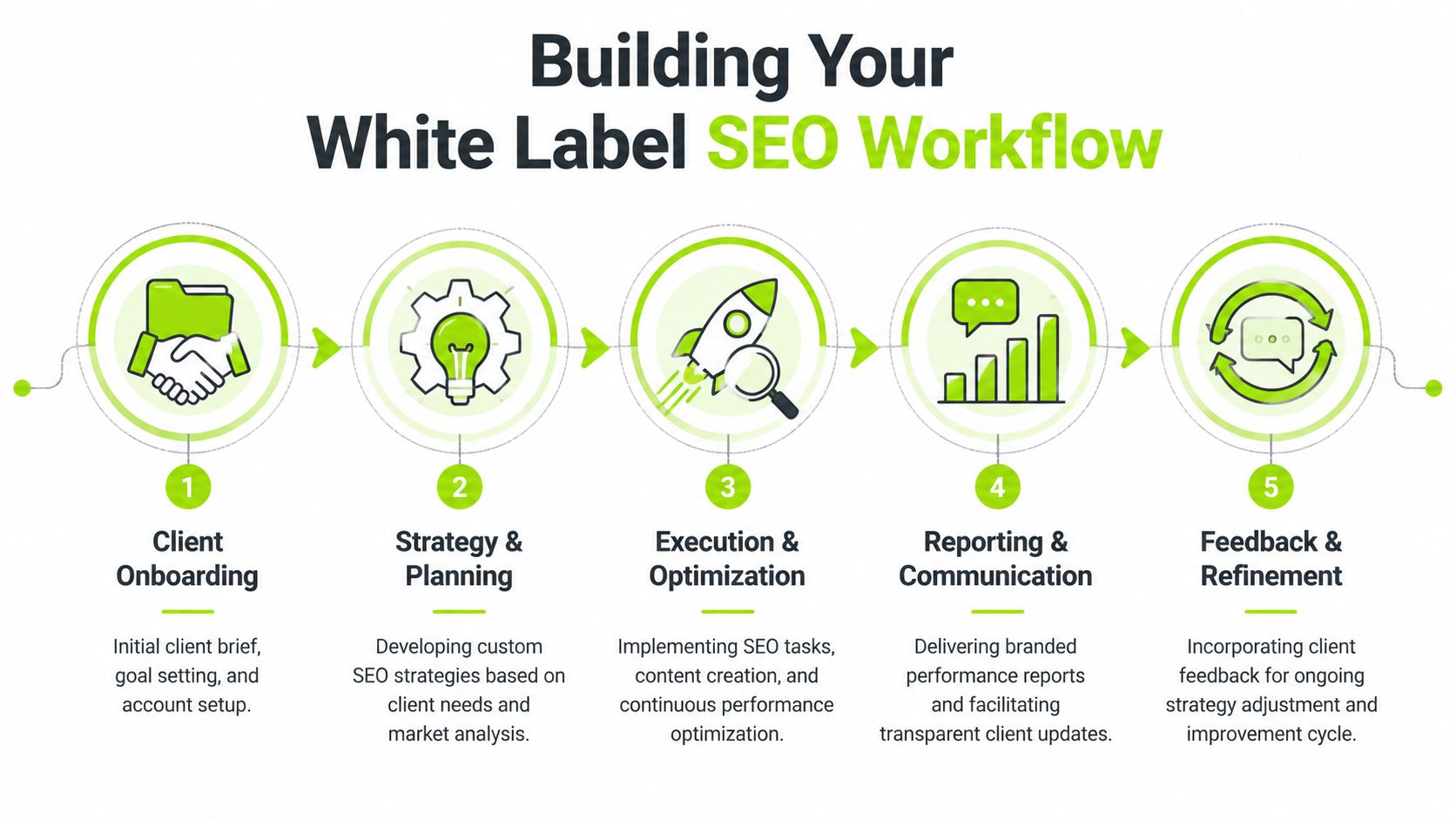
A white label seo partnership succeeds or fails in operations. Not in the proposal. Not in the kickoff call. In the day-to-day handoff between your team, your provider, and your client.
If that workflow is loose, small issues pile up fast. Scope gets fuzzy, deadlines move, revisions multiply, and account managers start translating between systems that were never designed to work together.
Start with a fixed handoff structure
Every client should enter the same operational path, even if the strategy is custom. The handoff needs a standard brief that covers business goals, target pages, priority services, brand constraints, approval paths, and reporting expectations.
The workflow should answer these questions before work begins:
- Who owns strategy approval?
- Who owns execution?
- Who communicates with the client?
- What gets reported monthly?
- What qualifies as out-of-scope?
Build around technical standards
A good provider shouldn't just say they do technical SEO. They should show the benchmark they're working toward.
In 2026 white label technical audits need to target Interaction to Next Paint under 200ms, and fixes such as code minification and structured data can support up to 30% richer snippet visibility and 10% to 20% traffic gains within 3 to 6 months, based on the benchmarks cited in ALM Corp's white label SEO guidance.
That matters because your workflow should be able to surface these details clearly:
- Core Web Vitals ownership so nobody guesses who is responsible for speed fixes
- Site audit cadence with recurring checks, not one-time cleanup
- Schema implementation tracked as an active task, not an optional extra
- Developer dependencies documented early, especially for CMS constraints and deployment timing
If your provider can't explain what they do with performance issues, crawlability problems, and structured data, they're not ready for serious accounts.
For agencies that want a repeatable audit layer, a defined technical site audit workflow helps keep benchmarks visible and client deliverables consistent.
Reporting cadence matters more than most agencies think
A lot of partnerships break because reports arrive late or don't match what the client was sold.
You need a cadence that separates internal operations from client-facing communication:
- Internal weekly updates for blockers, completed work, and next actions
- Monthly client reports with branded slides or dashboards
- Quarterly strategy reviews that connect SEO work to broader business direction
Practical rule: If an account manager has to manually rebuild the story every month, the workflow isn't finished.
The best reports don't dump metrics. They explain movement, decisions, and next actions in plain language.
Choose pricing that matches delivery reality
Pricing models need to fit the work, not just your sales preference.
| Pricing model | Works well when | Watch out for |
|---|---|---|
| Monthly retainer | SEO is ongoing and multi-channel | Scope creep if deliverables aren't fixed |
| Per-project | Audits, migrations, cleanup work | Clients may expect ongoing support anyway |
| Flat-fee package | You want standardization | Can break on unusual client complexity |
| Custom scope | Enterprise and mixed-service accounts | Harder to fulfill consistently without strong SOPs |
Put the SLA in writing
An SLA should define turnaround times, revision limits, communication channels, escalation paths, and what happens if deadlines slip. It should also clarify access requirements, approval windows, and reporting delivery dates.
Without that structure, agencies end up paying twice. Once for the provider, and again in internal time spent managing avoidable confusion.
Evaluating and Choosing a White Label SEO Provider
A bad provider usually looks fine in month one.
Problems show up later, after clients are asking questions, deliverables are tied to your retainers, and your team is spending extra hours translating weak work into something presentable. Provider selection affects margin, retention, and how hard your operation is to run.
Evaluate delivery maturity, not just service coverage
Service menus are easy to copy. Execution standards are not.
Two providers can both sell audits, content, links, local SEO, and reporting, yet produce very different outcomes because one has review layers, documented QA, clear ownership, and a process for handling setbacks. The other has a sales deck and a Slack channel.
Ask direct questions that expose how the work gets done:
- Who sets strategy, and who approves it before it reaches our team
- How do you review link quality and reject weak placements
- What happens when rankings drop after a migration, redesign, or CMS change
- How are revisions scoped, tracked, and capped
- What does the monthly reporting package include
- Can your team support branded dashboards and client-ready commentary
Reporting deserves more scrutiny than agencies usually give it. Margin gains from white label SEO can disappear if account managers have to rebuild the narrative every month or explain reporting gaps to clients. Agencies that plan to cover both classic SEO and emerging search experiences should also ask whether the provider can feed data into client-ready reporting workflows for agencies, including AI visibility metrics alongside rankings, traffic, and conversions.
Compare operating models before you compare prices
Cheap fulfillment often gets expensive once internal management time is included.
The better question is whether the provider model fits your sales motion, client mix, and tolerance for complexity.
Comparing White Label SEO Provider Models
| Provider Model | Best For | Typical Cost | Communication Style | Specialization |
|---|---|---|---|---|
| Freelancer network | Small agencies testing demand | Lower and variable | Informal, often direct with one point person | Narrow, depends on the individual |
| Boutique white label firm | Agencies that want flexibility and closer collaboration | Mid-range, usually scoped by service or retainer | Hands-on, consultative | Often stronger in content, local, or technical SEO |
| Larger fulfillment shop | Agencies managing many accounts and standardized packages | Structured package pricing | Process-driven, ticket-based or account-managed | Broad service coverage |
| Hybrid strategic partner | Agencies needing both execution and strategic input | Higher, tied to account complexity | More collaborative and layered | Stronger for complex or enterprise-style accounts |
Freelancer networks can work for testing demand, but they often depend too heavily on one person. Larger fulfillment teams usually handle volume better, though they can become rigid if your client base needs custom thinking. Hybrid partners cost more, but they tend to perform better when accounts involve technical SEO, multiple stakeholders, or a need to report beyond standard rank tracking.
If you are vetting the software layer around fulfillment, this roundup of top white label SEO tools for agencies is useful for comparing reporting, automation, and account management options.
Contracts reveal how the provider handles risk
A provider agreement should protect your agency before anything goes wrong, not after.
One useful benchmark comes from Umbrella US on white label SEO economics, churn risk, and contract safeguards, which notes margin gains from outsourcing SEO, higher churn risk when branded reporting is weak, and the value of clauses around penalty indemnification and business impact planning.
Review these terms closely:
- Penalty responsibility if the provider uses harmful tactics
- Data ownership for reports, dashboards, and deliverables
- Exit terms so accounts can be transferred cleanly
- Confidentiality language covering client information and internal process
- Turnaround commitments tied to actual fulfillment timelines
- Access and implementation responsibility so delays are not blamed on the wrong side
I also want to see how they define failure. If a deadline slips, is there an escalation path? If a deliverable misses the brief, who rewrites it? If AI Overview tracking or other newer visibility metrics become part of your client package, can that reporting be added without rebuilding the contract from scratch?
Strong providers reduce operational drag
Good partners are clear about limits.
They tell you when the site structure is the primary issue. They ask who owns implementation before promising timelines. They explain why a link target is weak, why a content brief needs revision, or why local SEO will stall without better review generation.
That kind of pushback protects your agency.
A provider that agrees to everything usually creates hidden work for your team later. The right one makes delivery more predictable now and gives you room to expand into newer reporting demands, including AI search visibility, without breaking your service model.
Future-Proofing SEO With AI and Unified Reporting
A lot of agencies still report SEO like it's only a ranking problem. Keyword positions, traffic trends, backlinks, and maybe a few conversions. That reporting still matters, but it no longer reflects the full search environment your clients care about.
Search visibility now extends into AI-generated discovery, AI Overviews, and LLM-influenced journeys that don't behave like a classic ten-blue-links SERP. If your white label seo program ignores that, your reports are already incomplete.
Traditional reporting has a blind spot
This is the gap most providers still haven't solved. According to Vulcan Point's review of white label SEO gaps and AI search monitoring, 68% of agencies already outsource SEO, yet most white label coverage still ignores how to integrate AI search monitoring. The same source states that 93% of search experiences now involve AI modes, which makes unified visibility tracking a practical need, not an experimental add-on.
That changes the agency brief.
Clients don't just want to know whether a page moved from one ranking position to another. They want to know whether their brand appears in AI-generated answers, how often they're cited, where competitors are surfacing first, and what content or entity signals improve discoverability.
What a modern reporting stack should include
A future-ready workflow should combine classic SEO data with AI visibility data in one place.
That means tracking:
- Rankings and backlinks for traditional SEO performance
- Technical health so underlying site issues don't get buried
- AI Overview presence where applicable
- LLM citation patterns and visibility gaps over time
- Client-ready branded reporting without forcing account managers into spreadsheet assembly
One way agencies are handling this is by using platforms that unify these signals. For example, client-ready reporting workflows can support classic SEO reporting alongside AI visibility tracking, which helps agencies explain why a brand may be visible in one search experience and absent in another. That's the kind of workflow Surnex is built to support.
If your team is reviewing vendors in this category, this guide on how to evaluate AI SEO platforms for teams is a practical place to compare what different products track and automate.
Here's a quick walkthrough of what unified reporting can look like in practice:
What agencies should change now
Don't wait for clients to ask about AI visibility. By then, you're reacting.
Start by updating your reporting language, your provider evaluation criteria, and your internal SOPs. Ask whether your white label partner can support AI search monitoring, whether your dashboards reduce tool sprawl, and whether your team can clearly explain search performance across both traditional and AI-driven surfaces.
The agencies that adapt early will be easier to retain because they'll sound more current, report more clearly, and spot emerging opportunities faster.
If your agency needs one system for rankings, audits, backlinks, and AI search visibility, Surnex gives teams a way to manage modern search reporting without stitching together separate tools.