Google AI Overviews reduced traditional-result clicks from 15% to 8% when the summary appeared, while links inside the Overview received only 1% of clicks, according to data cited in industry research (Omnibound's AI SEO statistics). That shift changes the SEO brief. Ranking well still matters, but it no longer tells you whether Google will cite your page, represent your claims accurately, or send meaningful visitors.
AI Overview optimization is therefore an engineering problem. You need to make content retrievable, extractable, attributable, and commercially useful. The teams gaining durable visibility aren't just adding FAQ schema or placing short answers beneath headings. They're building a system that connects technical eligibility, entity clarity, source quality, citation monitoring, and post-click measurement.
Why AI Overview Optimization Is a Different Game Now
AI Overviews don't add another standard result to the page. They synthesize information from multiple sources and redistribute attention before users reach the classic organic listings. In the historical data cited by Omnibound, traditional-result clicks fell from 15% without an AI summary to 8% with one, while links within the summary attracted 1% of clicks. Ahrefs also reported a 34.5% lower average CTR for the top-ranking page across 300,000 informational keywords when an AI Overview appeared, using the same source.
Exposure is moving quickly as well. Advanced Web Ranking found AI Overviews in 42.51% of search results in Q4, an increase of 8.83 percentage points from the previous quarter (Omnibound). These figures don't mean every query or market behaves identically. They do show why a page-one ranking can't serve as the sole proxy for search performance.
A useful way to understand the new workflow is to separate three layers:
- Retrieval eligibility: Can Google's systems crawl, index, understand, and retrieve the page for the query?
- Extraction quality: Can the system isolate a clear answer, supporting evidence, and relevant entities from the page?
- Claim fidelity: If Google cites or paraphrases the page, does the resulting statement accurately reflect the source?
Classic SEO usually measures rankings, snippets, and visits. AI Overview optimization adds different win conditions: citation, attribution accuracy, brand context, and correct representation. A page may rank below competitors and still be selected as a source. Conversely, a top result may be ignored if its content is difficult to extract or its claims lack clear support.
Practical rule: Treat ranking as an eligibility signal, not a citation guarantee.
The distinction matters because an Overview is composed, not merely ordered. Google can select passages, combine claims, omit caveats, and surface sources that don't match the conventional first-page set. Research summarized by SEO Francisco found that nearly 30% of cited domains didn't appear in the corresponding first-page results. That makes the old on-page checklist incomplete. Keywords, links, and headings remain useful, but they need to support an answer pipeline rather than only a ranking page.
The practical target is citation-worthiness across the full pipeline. Your page must be discoverable, easy to parse, specific enough to quote, and supported well enough that a generated answer can use it without distorting the meaning.
| Dimension | Classic SEO | AI Overview Optimization |
|---|---|---|
| Primary visibility signal | Organic ranking | Citation and brand inclusion |
| Content unit | Page and snippet | Claim, passage, entity, and source |
| Main user action | Click the result | Read the summary, inspect a citation, or continue searching |
| Quality concern | Relevance and ranking strength | Relevance, extractability, source support, and fidelity |
| Reporting focus | Impressions, rankings, clicks | Presence, cited URL, claim accuracy, framing, and downstream impact |
For background on how generative search changes the result page, see Surnex's guide to what Search Generative Experience means. The key point is simple: AI Overview optimization isn't classic SEO with a new label. It uses SEO foundations, then adds a source-selection and representation problem.
Prerequisites Before You Chase a Citation
Content teams often start with answer blocks before checking whether Google can reliably access the page. That reverses the order of operations. A citation campaign should begin with pass or fail tests for crawlability, structured data, experience, and entity identity.
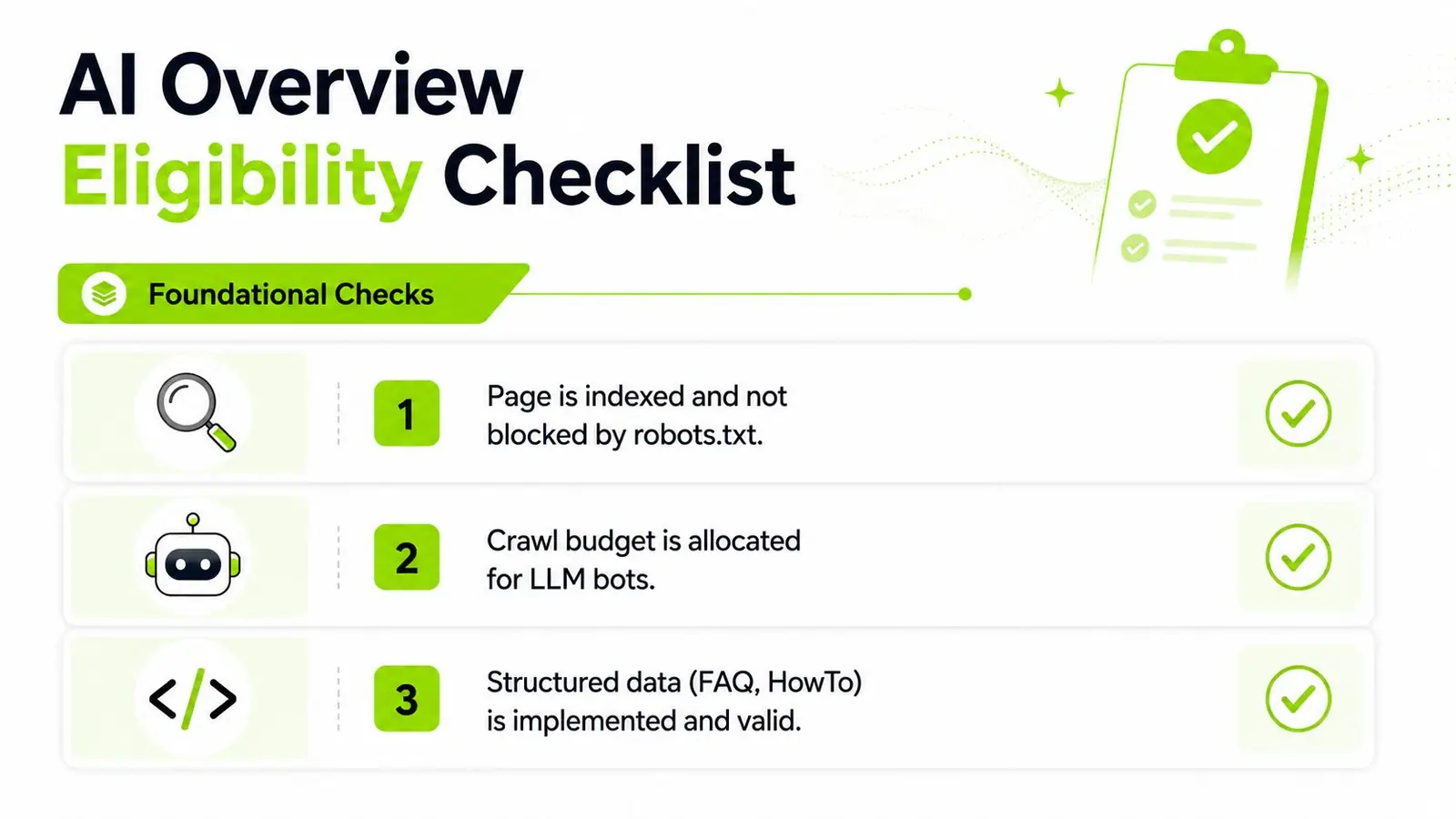
Check access and canonical signals
Pass: The target URL returns a successful response, is indexable, has no accidental noindex directive, isn't blocked by robots.txt, and appears as the preferred canonical version in your technical audit.
Fail: The page is blocked, redirected through an unnecessary chain, duplicated across variants, or canonicalized to a different document. A model can't cite content Google hasn't confidently retrieved and indexed.
Review XML sitemaps, internal links, rendering behavior, and orphan pages together. Don't assume a URL is eligible because it loads in a browser. Check the rendered HTML and search engine inspection data.
Establish a structured data baseline
Pass: The page uses valid, relevant markup, and its Organization, Article, Person, product, or other applicable entities agree with the visible content.
Fail: The schema describes an entity that isn't visible, uses incomplete author or publisher details, or contains conflicting properties. Structured data won't force a citation, but it can reduce ambiguity when it accurately describes the document and its relationships.
Every page should identify its author and publisher clearly. The author should have a meaningful bio, not a generic label, and the publisher should connect to a consistent organization entity.
Resolve the entity before publishing more content
Google needs to distinguish your company, products, experts, locations, and related organizations from similarly named entities. Use consistent names, authoritative profile links, and sameAs references where appropriate. Thin author bios, missing profile connections, and conflicting business, product, or contact information fragment that confidence.
Page experience also matters operationally. If important content appears only after unstable rendering, loads inside obstructive components, or becomes difficult to read on mobile, extraction and user evaluation both become harder.
Use a documented audit process rather than a one-off scan. Surnex's web content audit guide can sit alongside log analysis, Search Console inspection, schema validation, and manual rendering checks. Don't begin citation engineering until the page passes the basic access and identity tests.
Structuring Pages So the Model Can Extract You
A readable article isn't automatically extraction-friendly. The page needs a visible relationship between the query, the answer, the evidence, and the qualification. I prefer a structure that makes each important claim independently understandable.
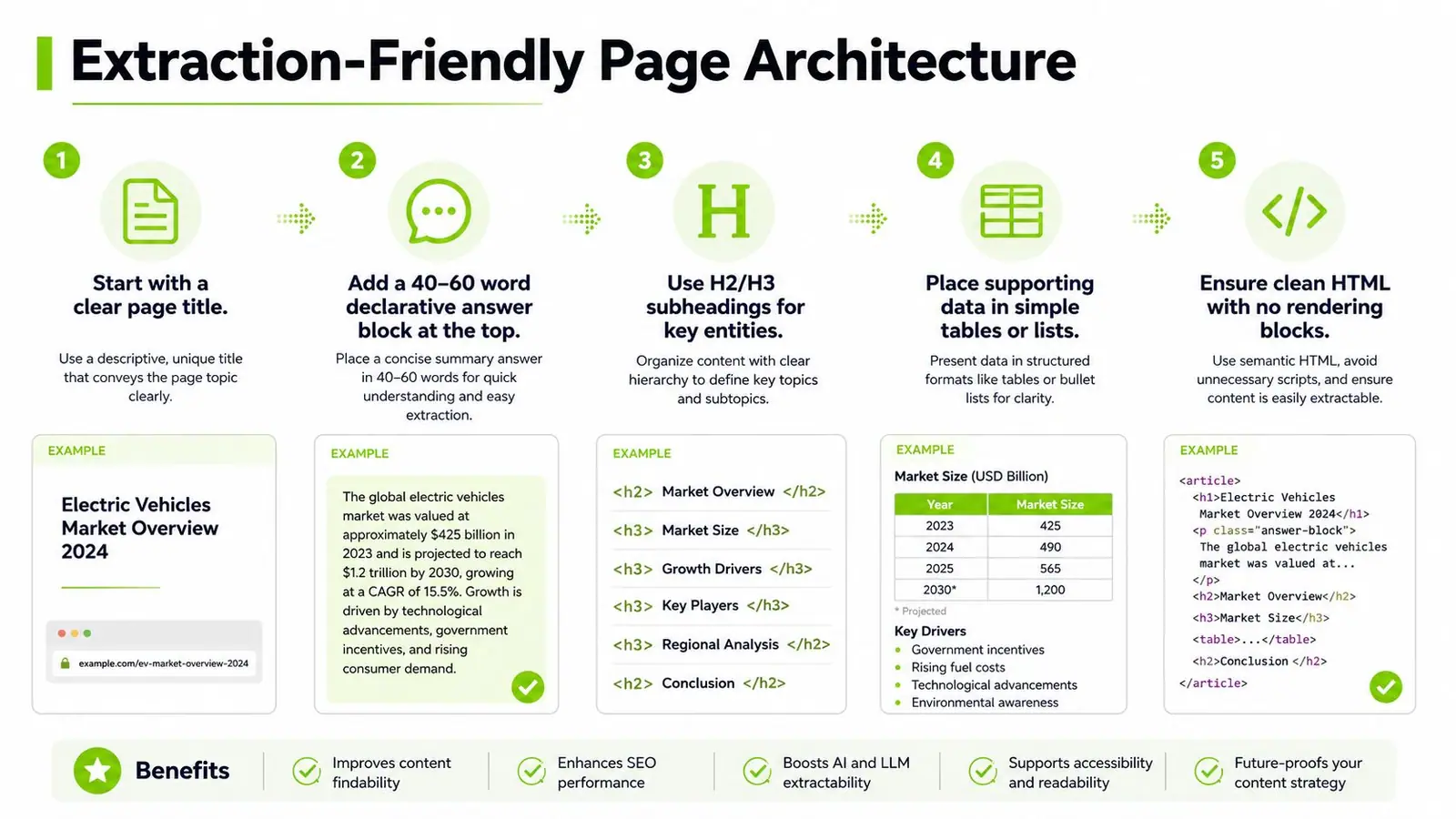
Build a predictable answer unit
Place a concise declarative answer directly under the relevant H2. Aim for roughly 40 to 60 words when the question demands a compact definition or process summary. Follow it with evidence, examples, limitations, or a counterpoint.
For example, a page answering “What is AI Overview optimization?” could open with this pattern:
AI Overview optimization is the process of making a page easy for Google to retrieve, extract, cite, and represent accurately in an AI-generated search summary. It combines technical SEO, clear entity signals, answer-focused page structure, visible source attribution, and monitoring that tests whether citations produce accurate and useful visibility.
That block answers the question. The paragraphs beneath it can define retrieval, explain citation selection, and distinguish visibility from traffic.
Give claims a visible shape
Use formats that map naturally to discrete facts:
- Definition lists: Put the term beside its direct meaning.
- Comparison tables: Use a consistent row structure for trade-offs, alternatives, and criteria.
- Numbered steps: Reserve each step for one action and one outcome.
- Summary boxes: State the operational conclusion before the supporting detail.
- Short paragraphs: Keep each paragraph focused on one claim or one qualification.
Don't hide key information inside long introductions, rhetorical transitions, or heavily nested components. Headings should mirror the language of the query where that sounds natural, and internal links should point to corroborating entity pages with descriptive anchor text.
Convert a conventional post into an extraction-ready asset
Suppose a top-of-funnel article begins with several paragraphs about search changes, then introduces AI Overviews halfway through the page. A stronger version would put the definition under an H2, add a comparison table for classic SEO and AI Overview optimization, explain the workflow in numbered steps, and link each major concept to a dedicated technical or measurement page.
The rewrite isn't automatically better because it is shorter. Depth can help when the page supports its claims and uses clean formatting. A citation-pattern analysis of 1,000 queries reported that pages longer than 2,500 words were cited 1.6 times more often than pages under 800 words, while also finding that schema-marked pages were cited 2.3 times more often than unstructured equivalents (Digital Applied). Treat those findings as directional, not as a reason to inflate every article. Useful depth beats word-count padding.
Before publishing, validate the markup and rendered output with a structured-data testing workflow such as Surnex's structured data testing resource. The model needs clean content, but users still need a page that answers the question without forcing them through an obstacle course.
Engineering Content to Earn the Citation
Citation-worthiness starts with a claim inventory. Pick one target page, list the statements you want Google to understand, and identify the entity, evidence, date, and qualification attached to each statement. This process replaces the vague instruction to “add more authority” with an editable production workflow.
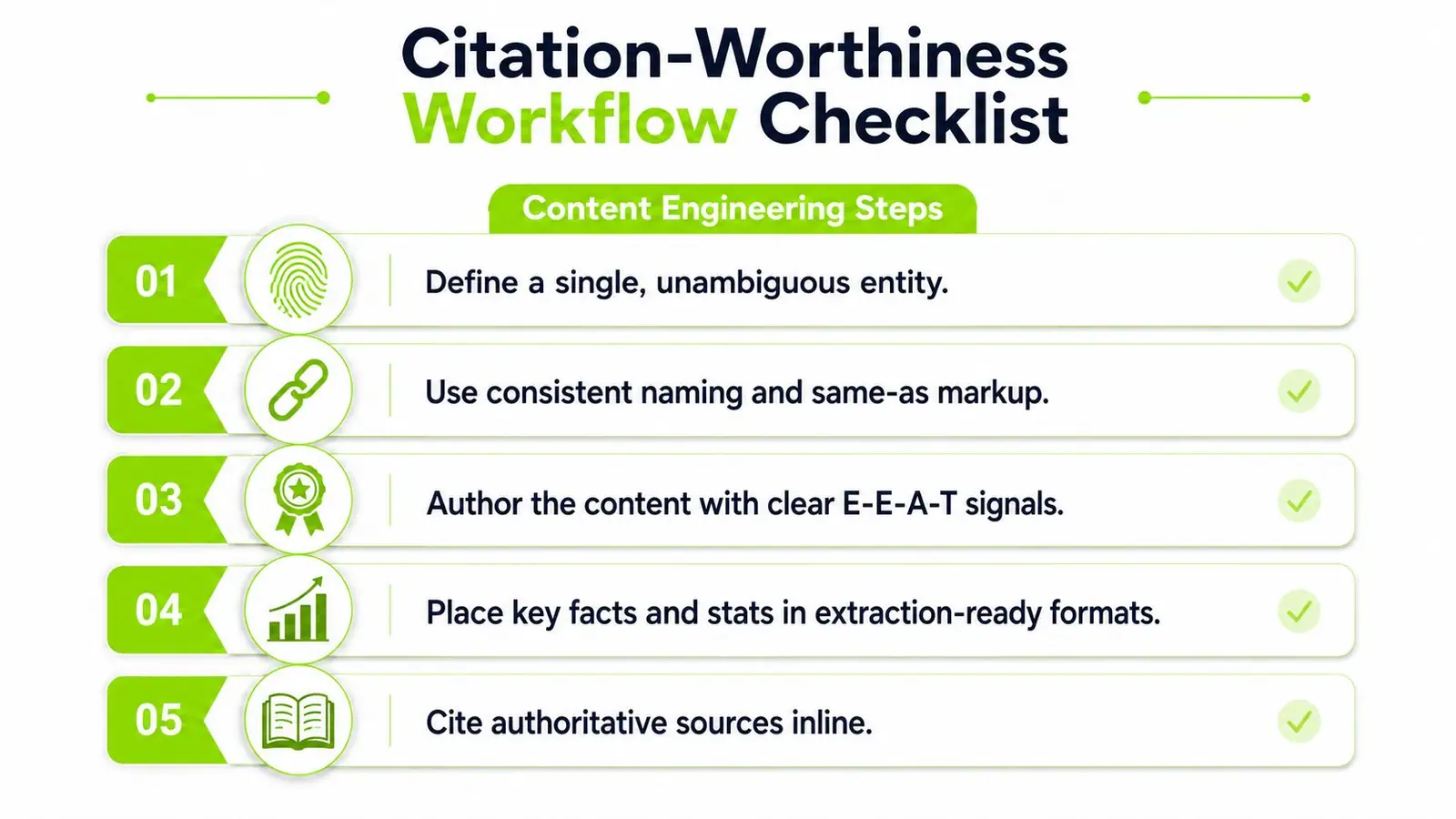
Make the subject unambiguous
Use one consistent name for the company, product, methodology, or person throughout the page. Connect the visible entity to the publisher, author, and relevant authoritative profiles. Avoid switching between a brand abbreviation, a legal name, and a product nickname unless the page explicitly defines the relationship.
A claim should also carry its own evidence. For quantitative or time-sensitive statements, use a pattern like:
Assertion, figure, attribution, date, source link.
For example, the verified research in Search Engine Land's coverage reports that Seer Interactive analyzed more than 3.1k queries from June 2024 to September 2025. The source, date range, and scope belong close to the statement, not in an unlinked reference list at the bottom.
Separate first-party evidence from outside evidence
First-party data can explain what your organization measured, built, or observed. It shouldn't be presented as independent validation. Third-party research can support a market claim, but the page should identify the study and its scope rather than turning an isolated result into a universal rule.
Freshness signals need substance. Update the visible date when the page has materially changed, explain what changed, replace outdated evidence, and preserve useful historical context. Changing a date without revising the claims creates a weak trust signal.
Use a supporting explainer when one page can't carry enough context. A definition page can link to a technical audit, an entity profile, and a measurement methodology. Those related pages help Google and users verify the claim without forcing one article to answer every adjacent question.
A citation-ready edit should pass this checklist:
- Entity clarity: The subject has one primary name and identifiable relationships.
- Claim boundaries: Each major statement has a clear scope and qualification.
- Evidence placement: Important figures link to visible, relevant sources.
- Freshness: Dates and updates reflect real editorial work.
- Extraction: Answers, tables, lists, and headings expose discrete claims.
- Fidelity: A reader can compare the generated statement with the cited passage.
The workflow isn't about making every sentence sound authoritative. It is about making the page easy to verify and difficult to misinterpret.
The Visibility Versus Traffic Trap
A citation is a visibility event, not a business outcome. That distinction matters because the Overview can mention a brand, cite a page, summarize a claim, and still send no meaningful visit. The click behavior described earlier makes that outcome normal rather than exceptional.
The deeper issue is fidelity. A 2026 arXiv study decomposed 98,020 atomic claims and found 11.0% were unsupported by the cited pages, with omission as the dominant failure mode (SEO Francisco). A brand can therefore win inclusion while losing control over what the summary says about it.
Audit every appearance with three questions:
- Is the claim accurate? Compare the Overview's wording with the exact passage on the cited page.
- Is the brand framed correctly? Check whether Google assigns the right category, capability, audience, or limitation.
- Is the link surfaced? Record whether the cited URL is visible and whether it points to the page that supports the statement.
A useful report separates presence from performance instead of placing both under a single “AI visibility” score.
| Metric | What It Tracks | What It Misses | Use Case |
|---|---|---|---|
| Overview presence | Whether the feature appears for a monitored query | Whether your brand or page appears | Measure search-surface exposure |
| Citation share | How often your domain or URL is cited | Whether the cited claim is complete | Compare source selection |
| Accuracy rate | Whether the summary matches the source | Commercial value and assisted behavior | Prioritize content corrections |
| Framing score | Whether the brand is described appropriately | Exact revenue contribution | Monitor reputation and positioning |
| Organic CTR | Visits from search results | Unlinked mentions and influence before a later visit | Evaluate traffic impact |
| Conversion or revenue | Downstream business action | Brand exposure that converts elsewhere | Connect search changes to outcomes |
The practical north star is fidelity-adjusted visibility. A citation with a distorted claim should not count as a full win. Likewise, a correct brand mention with no link may have awareness value, but it shouldn't be reported as equivalent to a qualified visit.
A larger citation count can conceal a worse representation of the brand.
This is why teams should resist optimizing for inclusion alone. Improve the page when the Overview omits a critical qualification, attributes a claim incorrectly, or cites an outdated version. The work is closer to content quality assurance than to rank chasing.
Monitoring Citations, Claims, and Real Impact
Monitoring needs two views: the search result and the source page. A rank tracker can tell you that a query has changed, but it won't reliably tell you which passage Google used or whether the generated statement remains faithful.
Start with a representative query set. Include definitional, how-to, comparative, commercial, branded, and high-value customer questions. The verified citation-pattern analysis found that definitional and how-to intents averaged 5.6 citations, while commercial intents averaged 3.1, and AI Overviews averaged 4.2 citations per response across its sample (Digital Applied). That difference supports intent-specific monitoring rather than one blended score.
Capture the result and the source
On a regular cadence, record:
- Query and market: Preserve the exact wording and search context.
- Overview presence: Mark whether the feature appeared.
- Cited URL: Store the page Google surfaced, not only the domain.
- Claim text: Copy the relevant generated statement for review.
- Accuracy status: Mark supported, partially supported, omitted, or unsupported.
- Framing notes: Record category, audience, product, and limitation errors.
- Link surface: Note whether the citation is visible and actionable.
- Post-click outcome: Connect visits and conversions where analytics can identify them.
Manual sampling remains valuable for high-priority queries because rendered layouts and citation displays can change. Lightweight scrapers or browser automation can expand coverage, but teams must handle consent, access rules, localization, and changes to page structure responsibly.

Run a weekly fidelity loop
Assign an owner to review new or changed citations each week. When a claim is unsupported, locate the closest source passage, decide whether the page needs clearer wording or stronger evidence, and log the correction. If the generated answer omits a material caveat, place that caveat beside the core claim instead of burying it later.
Your stakeholder report should have separate sections for visibility wins, traffic wins, and quality risks. Surnex can be used as one option for tracking Google AI Overviews, cited sources, and changes across monitored queries. Combine that view with Search Console, analytics, conversion data, and a human review queue.
For teams comparing platforms and workflows, Surnex's guide to tools for monitoring AI Overviews provides a useful starting point. The reporting standard should remain strict: don't call a citation successful until you know what Google said, what it cited, and what happened afterward.
Your 90-Day AI Overview Optimization Plan
A workable rollout should reduce uncertainty before expanding production. Assign engineering, content, and SEO ownership from the beginning, then use weekly checkpoints to decide whether the next phase is justified.
Days 1 to 30 focus on eligibility
Engineering should resolve crawl blocks, canonical errors, rendering problems, and analytics instrumentation. The technical team should also review robots rules, structured data, and the site's entity relationships, including organization, author, publisher, product, and profile connections.
The SEO lead owns the query inventory and baseline dashboard. Content teams document priority entities, existing claims, source gaps, and pages that already answer important questions. Treat the phase as complete only when priority pages are accessible, indexable, measurable, and associated with the correct entities.
Days 31 to 60 focus on citation engineering
Choose the top 20 query clusters for the first content cycle. For each cluster, restructure priority pages around direct answer blocks, clear H2s, evidence sections, comparison tables, numbered processes, and visible attribution.
Content owners rewrite and fact-check. SEO owns intent mapping, internal linking, and source review. Engineering supports templates, schema, rendering, and reusable page components. Don't scale this phase if the team can't explain which claim each page is designed to support.
Days 61 to 90 focus on QA and iteration
Capture Overview results, cited URLs, generated claims, framing notes, and downstream outcomes. Review the dashboard weekly and promote recurring errors into editorial rules. A page that gains citations but produces inaccurate summaries needs correction before more promotion.
Use a simple stakeholder update:
- Exposure: Where Overviews appeared and where the brand or URL was cited.
- Fidelity: Which claims were supported, incomplete, or misframed.
- Traffic: Organic visits, engagement, assisted behavior, and conversions.
- Actions: Pages changed, owners assigned, and tests planned.
- Decision: Continue, revise, or pause the next content batch.
FAQ
Should informational or transactional queries come first? Start with informational and definitional clusters when your objective is learning how citation selection behaves. Commercial and transactional queries still matter, but they need stricter framing and stronger conversion measurement.
Should we prioritize ranking position or citation frequency? Neither metric works alone. Ranking supports retrieval, while citation frequency measures inclusion. The better target is a cited page whose claim is accurate and whose visibility contributes to a measurable business outcome.
When should classic SEO take priority? Prioritize classic search when the query has strong navigational or transactional intent, the Overview is absent or unstable, or your site has unresolved technical and conversion problems. AI Overview optimization shouldn't replace fundamentals that already drive qualified demand.
Surnex helps agencies and in-house teams monitor Google AI Overviews, cited sources, AI visibility trends, and core SEO performance from one platform. Visit Surnex to see how its monitoring and reporting workflows can help you separate citation presence, claim fidelity, and real search impact.