Traditional rankings no longer tell the whole search story. A page can hold a strong organic position and still be absent from Google AI Overviews, AI Mode, ChatGPT, Perplexity, or Claude, while a less prominent page earns the citation that shapes the answer. One Ahrefs-based analysis found that only 38% of AI Overview citations came from top-10 organic results, leaving 62% from pages ranked beyond the first page or outside the top 100 (BrightEdge's analysis). Rank tracking alone can't explain that gap.
Google AI Overviews appeared on about 31% of tracked queries in February 2025 and around 48% by February 2026, according to independent reporting compiled by Otterly's AI Overview monitoring guide. By mid-2026, another report placed the feature at 2 billion monthly users across more than 200 countries and 40 languages, making AI visibility a major-market reporting concern rather than a niche experiment.
The best tools for monitoring AI Overviews should capture more than presence. Look for surface coverage, cited URLs, brand mentions, repeatable query tracking, location and language controls, historical snapshots, API or reporting access, predictable pricing, and connections to conventional SEO data. This roundup organizes the options around real monitoring jobs, from unified visibility and enterprise governance to SERP forensics, rank tracking, and agency reporting. Teams building a broader automated SEO opportunity scoring workflow should also prioritize exports and APIs, not just attractive dashboards.
1. Surnex
Surnex is the strongest fit for teams that want AI search visibility and traditional SEO in one operating layer. It monitors brand appearance in Google AI Overviews and AI Mode, ChatGPT, Perplexity, and Claude, then places those signals beside keyword rankings, backlinks, site audits, Core Web Vitals, content opportunities, and local SEO data. That combination matters because an AI citation is most useful when the team can connect it to the page, query, competitor, and authority signal behind it.
The platform is API-first, with a REST API exposing every feature for programmatic workflows and product integrations. Agencies can use white-label reporting and unlimited clients, projects, and users, while developers can feed visibility data into internal dashboards or agent workflows. Its citation-gap analysis is particularly practical. Instead of stopping at “your visibility changed,” it helps identify queries where competitors earn citations and your domain does not.
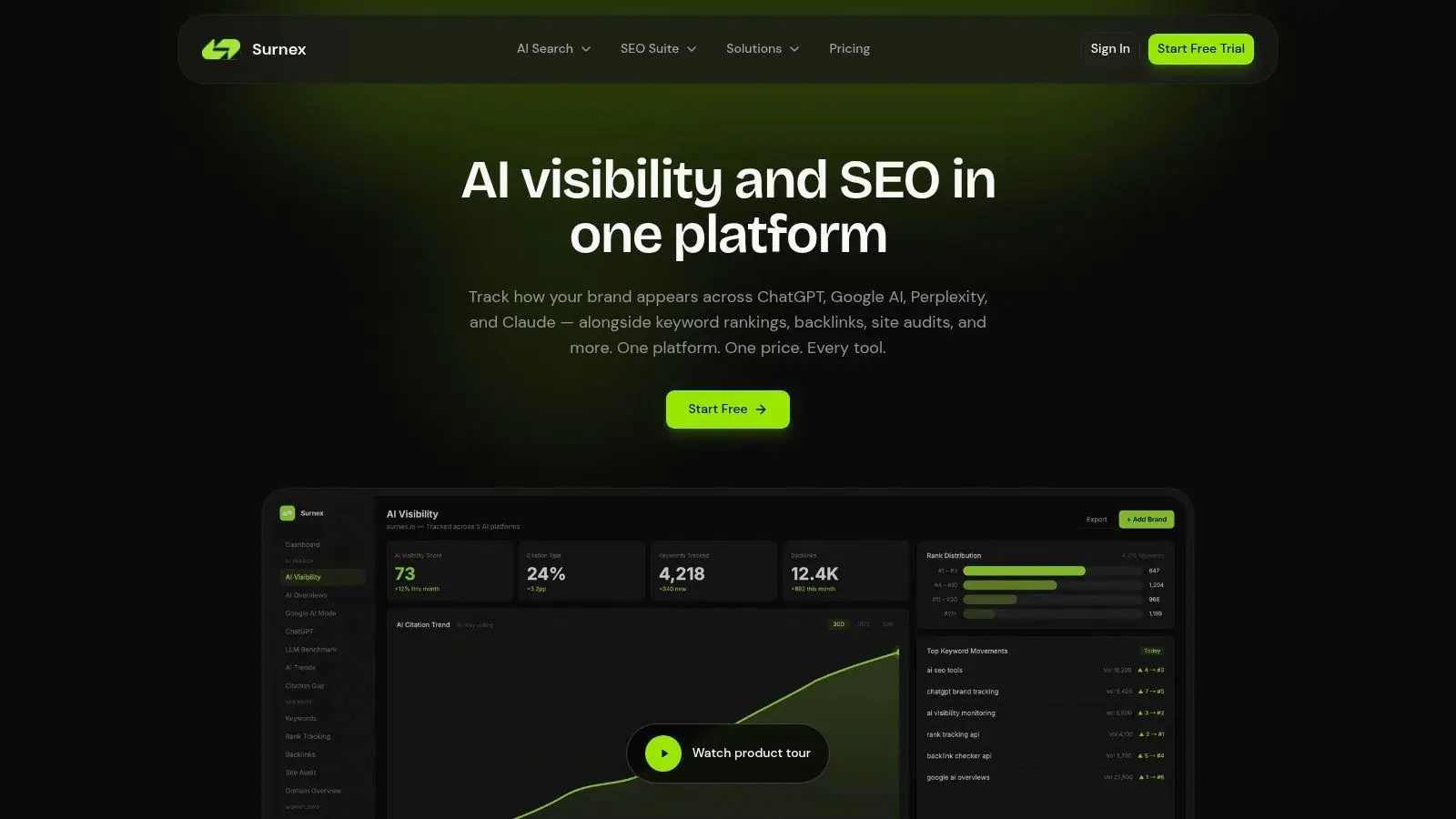
Best for unified visibility and automation
Surnex also supports LLM benchmarking, so teams can compare how several models answer the same prompt and which domains they cite. That is useful for content and digital PR decisions because a page that wins in Google may not be the page cited by ChatGPT or Perplexity.
Its pricing uses four monthly plans, from $49 to $399, with unlimited users and projects on every plan, as described on the Surnex pricing page. A 14-day free trial of the Growth plan requires no card, which gives a small team room to test query design and reporting before committing.
Practical rule: Use Surnex when the reporting question is “what should we change next?” rather than only “did we appear?”
The trade-off is usage planning. High-volume monitoring can require a larger plan, since AI prompts, tracked keywords, and research lookups are capped per plan, so usage needs a forecast. Coverage is also limited to the AI surfaces Surnex currently monitors. For agencies, in-house teams, and developers trying to reduce tool sprawl, that trade-off is often worthwhile because one subscription connects AI visibility with the SEO work needed to improve it.
2. Semrush
Semrush suits SEO teams that already depend on a broad search platform and want AI Overview signals inside familiar position-tracking workflows. Its Position Tracking and Sensor reporting can identify keywords that trigger AI Overviews, show whether a site is cited or mentioned, and place AI visibility alongside organic ranking data. GA4 and Google Search Console integrations add traffic and performance context, although standard Search Console reporting doesn't provide a dedicated AI Overview click filter, as noted by Morningscore's tracker guidance.
The practical advantage is continuity. An SEO manager can tag a keyword set, inspect conventional rankings, review AI Overview presence, and compare competitor movement without exporting everything into a separate system. That makes Semrush a sensible choice for teams that already have governance, users, and reporting processes built around the platform.
Where the toolkit earns its place
Semrush's AI Visibility Toolkit extends beyond Google's surface into other AI visibility workflows, including ChatGPT and Gemini or AI Mode reporting, depending on the selected product configuration. The useful question isn't whether the dashboard contains another score. It's whether the team can connect a lost citation to a target page, a content gap, or a competitor source that deserves review.
For implementation, start with business-critical queries rather than importing every tracked keyword. Segment them by product line, intent, country, and funnel stage. Review AI Overview presence beside organic position, then send citation gaps to the content owner with the exact query and competing source.
The main limitation is packaging. Some AI features are gated behind specific Semrush One or AI Visibility Toolkit tiers, so the apparent convenience of an all-in-one suite can add cost. Teams should confirm which AI surfaces, exports, integrations, and historical views are included in their plan before moving a reporting program.
For a focused explanation of how AI Overviews affect optimization decisions, see this Google AI Overviews SEO guide. Semrush is best when the organization values a mature SEO ecosystem and doesn't want a separate AI monitoring interface. It's less attractive when citation research and API-first automation are the primary requirements.
3. Similarweb
Similarweb's Rank Tracker is built for large rank-tracking programs, agencies, and data teams that need AI Overview detection inside an enterprise reporting stack. It flags AI Overviews for tracked keywords, supports daily rank data, and provides device and location segmentation. The Rank Tracking API is the deciding feature for teams that need to move query-level signals into business intelligence systems.
This is a rank-tracking-first product, not a lightweight AI visibility checker. That distinction is useful. If the main job is to monitor a large keyword portfolio, compare daily movement, and feed recurring reports into BI, Similarweb provides a mature foundation. If the main job is to study every cited URL and turn citation gaps into editorial briefs, the evaluation should focus on whether the selected package exposes enough source-level detail.
Best for enterprise reporting pipelines
A sensible setup starts with a controlled keyword taxonomy. Create groups for brand, category, competitor, product, and high-intent questions. Apply country, device, and location segmentation, then use the API to deliver daily fields into a warehouse or dashboard. Keep AI Overview presence separate from organic position so executives don't mistake a feature appearance for a conventional ranking change.
The pricing trade-off is significant. Pricing and broader SEO capabilities are sales-assisted and quote-based, and AI Overview detection is tied to customers with SEO capabilities across Starter, Business, and Enterprise options. That can work for an organization already buying Similarweb intelligence, but it creates more procurement friction for a smaller team seeking only AI Overview monitoring.
Similarweb's broader competitive data ecosystem can make the investment easier to justify for multinational programs. Still, request a sample export before signing. Confirm whether the API includes the citation fields, historical retention, segmentation, and refresh schedule your reporting team needs.
4. seoClarity
seoClarity is designed for organizations that treat AI Overview monitoring as part of enterprise SEO governance. It tracks which keywords trigger AI Overviews, identifies cited sources, and trends visibility over time. Because the platform also covers technical SEO and broader reporting workflows, it can place AI search findings inside the same operating process used for large websites and portfolios.
That context changes how the tool should be evaluated. A small content team may want a quick answer for a handful of prompts. An enterprise SEO group may instead need recurring monitoring across business units, markets, templates, and stakeholders, with consistent reporting definitions. seoClarity is oriented toward the second job.
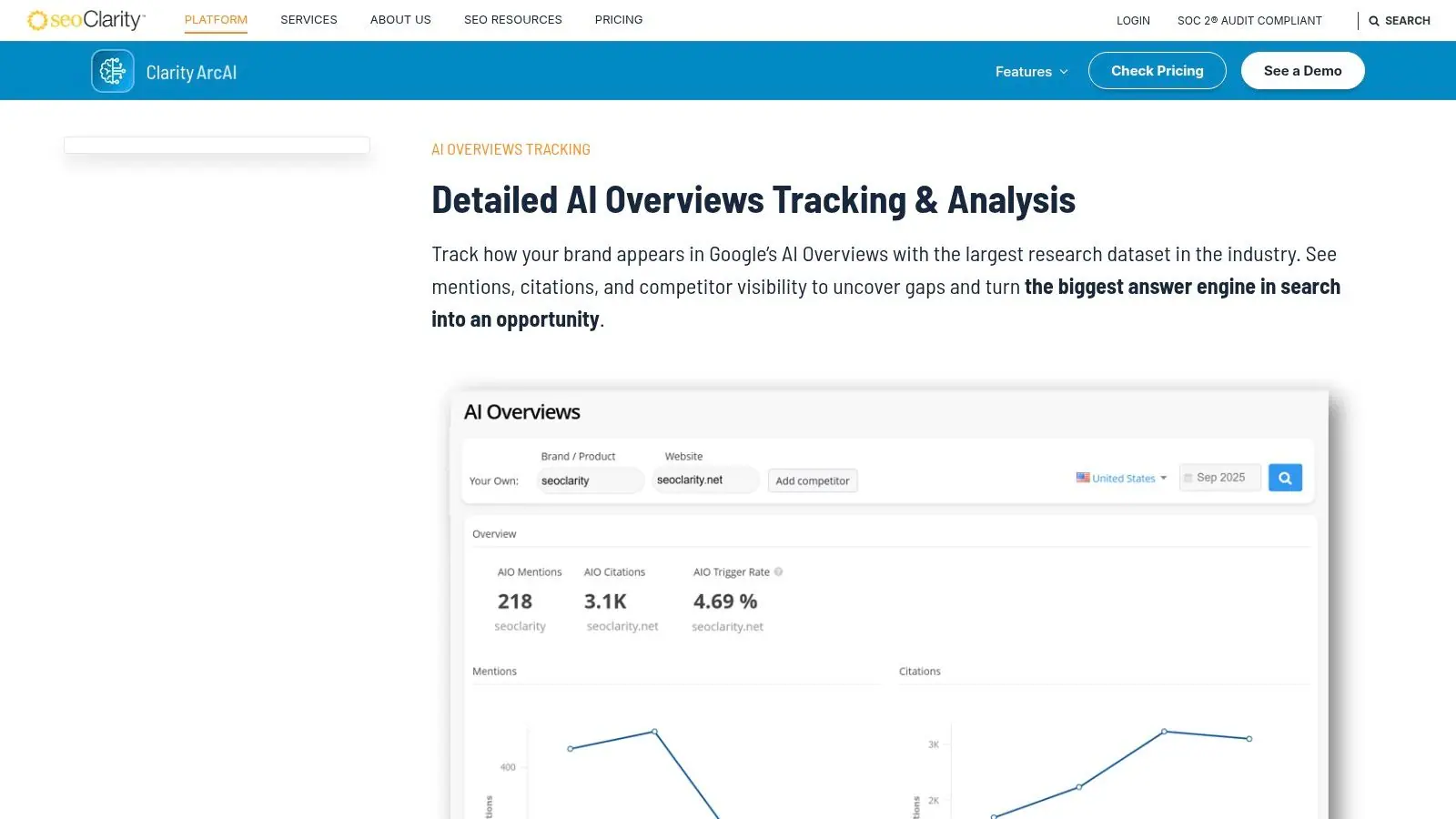
Best for governance and trend analysis
Build the implementation around ownership. Assign keyword groups to product or regional teams, define what counts as a meaningful citation, and schedule reviews that compare presence, cited URLs, competitors, and organic performance. When a cited source changes, the SEO team can inspect whether the shift reflects content freshness, a new competitor page, a technical issue, or normal SERP volatility.
The platform's enterprise orientation is its strength and its limitation. Pricing is quote-based and sales-led, and the breadth of the system can be excessive for teams with a simpler monitoring requirement. A buyer should ask for a working session using representative queries, including local and international variations, rather than judging the product from a generic feature tour.
For a narrower overview of the category, use this AI Overview tracker guide. seoClarity is a strong candidate when reporting consistency, scale, and integration with technical SEO matter more than a low-friction self-serve start.
5. SE Ranking
SE Ranking's AI Results Tracker gives mid-market teams a more approachable way to monitor Google AI Overviews and related AI results. It can show whether an Overview appears, the position of a brand within the AI snippet, and the overlap between classic organic rankings and AI results. That overlap view is valuable because citation visibility and organic position don't move together reliably.
The setup wizard helps teams configure prompts and queries across supported AI systems, including Google AI Overviews and AI Mode. For an SEO manager who wants a clear set of KPIs rather than a large enterprise command center, the module is easier to operationalize. Start with priority topics, label queries by intent, and establish a baseline for presence, citation, organic position, and competitor overlap.
Best for balanced cost and usability
SE Ranking works well when the team already uses the broader suite for rank tracking, audits, and competitor work. The AI module can become a natural extension of an existing weekly workflow. Review new Overview triggers, inspect queries where the site ranks organically but isn't represented in the AI result, and assign page updates based on the cited content format.
The platform is also useful for explaining the organic to AI overlap problem to non-specialists. A page may rank well but not appear in the answer, while a competitor page outside the conventional top results earns a citation. That is a stronger action signal than a single visibility score because it tells the team where conventional SEO assumptions fail.
The trade-offs are plan-related. It's a newer module, and the breadth and depth of non-Google AI coverage can vary by plan. Advanced capabilities may also be restricted to selected tiers. Confirm prompt limits, refresh frequency, citation detail, and export availability during the trial. SE Ranking is a good fit for mid-market teams that want dedicated AI Overview monitoring without immediately adopting an enterprise platform.
6. BrightEdge
BrightEdge is aimed at enterprise SEO and AEO programs that need deep analysis, recurring research, and executive-ready reporting. Its AI-focused modules track AI Overview presence trends and citation patterns, while broader BrightEdge workflows connect those signals with content, research, and performance reporting.
The platform's value is strongest when a large organization needs to explain market movement, not merely check whether a domain appeared for one query. BrightEdge's ongoing research can help teams interpret changes in AI Overview coverage and citation overlap, while the platform gives internal SEO leaders a place to connect those findings with content priorities and reporting narratives. Its published research has also highlighted that citation overlap with organic rankings can change over time, reinforcing the need for monitoring rather than one-time audits (BrightEdge research).
Best for executive analysis
A practical rollout should begin with a small set of strategic topics and a defined reporting audience. Create views for brand leadership, SEO operators, content teams, and regional stakeholders. For each group, show the underlying query and cited source, not only a blended score. That keeps recommendations auditable when visibility changes.
BrightEdge is enterprise-only and custom-priced, with access and commercial details requiring a sales conversation. The deployment can therefore be difficult to justify for a small agency or a brand that only needs lightweight keyword monitoring. Buyers should ask for details on daily capture, citation URL exports, historical retention, market segmentation, and how AI Overview data connects with existing reporting.
Choose BrightEdge when governance, research depth, and executive communication are central requirements. Don't choose it solely because the brand is familiar. The right enterprise platform is the one that gives analysts enough raw evidence to move from “visibility declined” to a defensible explanation and an assigned action.
7. Ahrefs
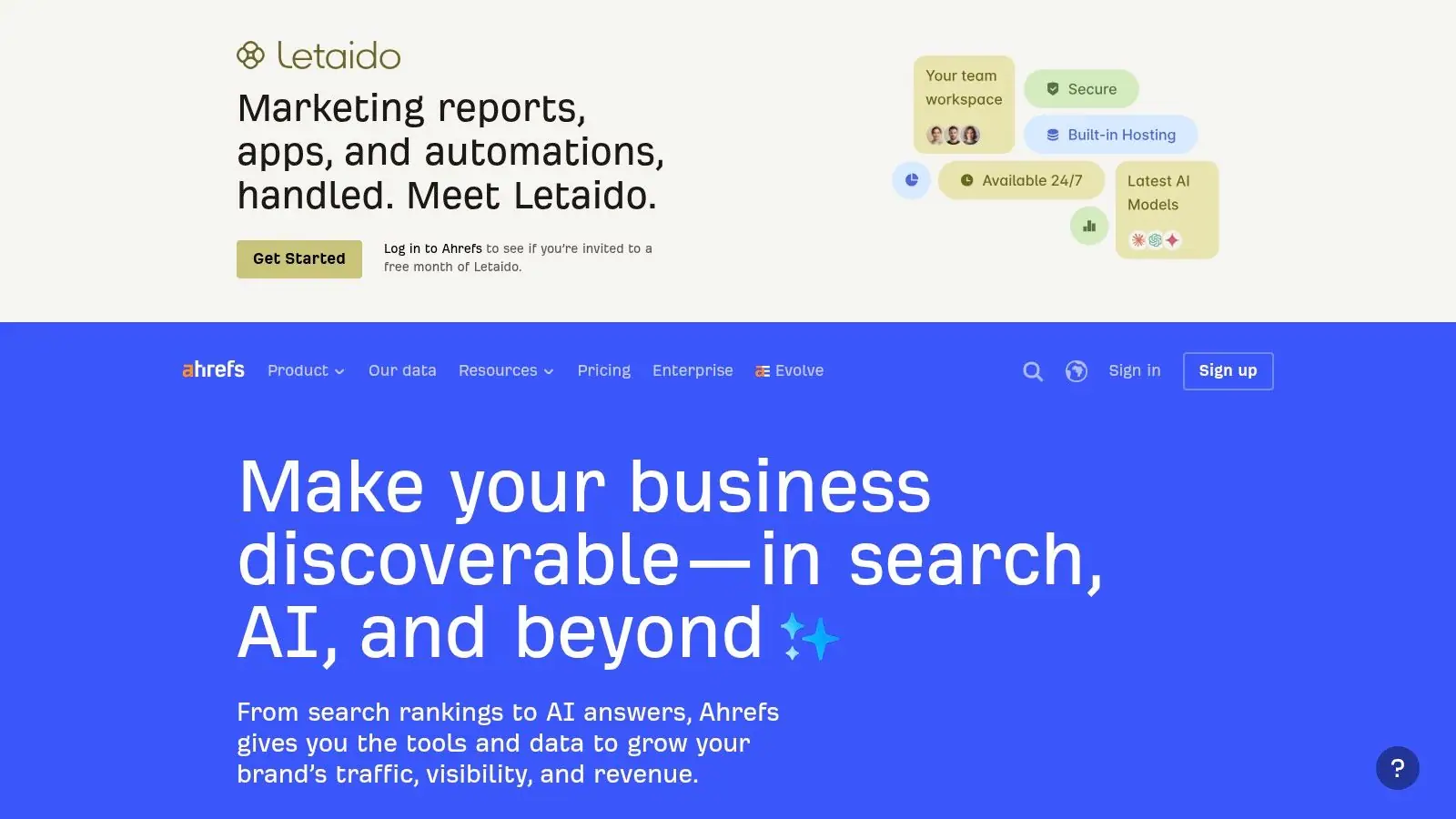
Ahrefs adds AI Overview monitoring to its established keyword, competitor, and link intelligence workflow. Its AI Overviews Tracker provides daily tracking and citation charts, while Brand Radar extends monitoring to brand mentions and citations across supported platforms. This combination suits SEO teams that need to connect AI visibility with the authority signals they already review.
Use Ahrefs for a citation-led investigation. Start with queries that trigger AI Overviews, inspect the cited domains and URLs, then compare those pages with your own content and link profile. If a competitor is cited for a page with a different format, broader topical coverage, or more external references, assign a content update or authority task rather than treating the observation as a standalone report.
Best for link-focused SEO teams
Ahrefs works best when the monitoring job is connecting citation capture with conventional SEO analysis. AI citations do not always follow organic rankings. Teams should therefore compare cited URLs with ranking, referring-domain, and competitor data, then record the specific page attributes that may explain the difference.
The main trade-off is access. Full AI visibility capabilities may require paid Ahrefs access, and available features vary by plan. Before purchasing, confirm that the subscription includes the tracker, Brand Radar, citation charts, competitor views, and the historical data required for recurring analysis.
For a wider comparison of platforms in this category, review these AI search visibility tools. Ahrefs fits an SEO department that already relies on its link and keyword datasets. It is less suitable for teams that need extensive automation, white-label agency reporting, or one cross-model API without adding another product layer.
8. AccuRanker
AccuRanker is a specialist rank tracker with AI Overview indicators and LLM metrics layered into a fast, keyword-centered workflow. It's a natural fit for agencies and in-house SEO teams that care about fresh rank data, clear segmentation, and straightforward reporting more than a large AI research suite.
The implementation is simple. Create keyword groups by client, product, market, or intent. Add the AI Overview and LLM indicators to recurring rank reports, then flag queries where conventional position remains stable but AI presence or citation status changes. This keeps the team from treating AI visibility as a separate project with its own disconnected keyword universe.
Best for fast keyword monitoring
AccuRanker's strengths are speed and data freshness, along with transparent keyword-based pricing and a 14-day refund policy, as described on the AccuRanker platform. Those characteristics make it attractive to agencies that need to manage recurring client reports and quickly investigate SERP changes.
The trade-off is depth. AI visibility features are not as extensive as those in enterprise AEO and AI Overview suites, and the product remains focused on rank tracking rather than broad AI research. Confirm whether the AI metrics expose the citation detail, source URLs, historical views, and API fields your team needs. A presence indicator may be enough for a weekly rank report, but it won't replace forensic source analysis.
For teams comparing rank trackers, this rank checker software guide provides useful context on the difference between conventional ranking data and modern AI search signals. AccuRanker works best as a high-speed monitoring layer. Pair it with a citation-focused platform if content teams need detailed explanations of why competitors appear in AI answers.
9. Nozzle
Nozzle is built for SERP forensics, making it a strong option when the question is not just whether an AI Overview appeared, but exactly what Google displayed around it. The platform detects and analyzes AI Overviews for tracked keywords, captures the full top-100 SERP, and supports flexible crawl cadence. That broader context helps analysts study the relationship between AI citations, organic results, features, competitors, and SERP layout.
A citation without context can lead to the wrong conclusion. A competitor may be cited from a page that ranks outside the traditional first page. Another source may appear in the Overview while occupying a different SERP feature. Nozzle's deeper capture model gives an analyst more evidence to inspect before recommending a rewrite or link campaign.
Best for deep SERP investigation
Use Nozzle when a major visibility change requires a defensible audit. Select a query set, specify the target locations and devices, capture the AI Overview alongside the top 100 results, and compare snapshots after content updates or algorithm changes. Analysts can then examine whether citation movement coincided with organic ranking changes, a new competitor result, or a changed answer format.
The commercial model requires planning. Pricing and packaging are tied to checks and frequency, so costs can vary with crawl cadence and monitoring scope. Full enterprise usage may also require a sales or plan discussion. That flexibility is useful for teams that want to allocate more checks to high-value query groups and fewer to stable ones, but it makes budgeting less plug-and-play.
Nozzle is not the easiest choice for a small team seeking a single dashboard and a quick score. It is a better fit for technical SEOs, competitive intelligence teams, and agencies that need to preserve evidence of what appeared in the SERP and explain the change to a client or executive.
10. Nightwatch
Nightwatch extends traditional rank tracking with AI and LLM visibility features that show brand mentions and citations across supported models, including Google AI Overviews and other AI search contexts. Its dashboards support cross-model analysis, while the core product continues to provide daily rank tracking, competitor reporting, and agency-oriented views.
That combination makes Nightwatch useful for agencies adding AI monitoring to an existing reporting service. A team can create prompt and keyword groups, monitor classic rankings and AI mentions, then package the findings into a client report without introducing a highly complex enterprise platform. API and reporting access also help agencies connect the data to internal dashboards or recurring deliverables.
Best for accessible agency workflows
Start with one client or one business unit. Track branded questions, category comparisons, product questions, and competitor prompts. Review citations on a fixed cadence, then classify each gap as a content issue, an authority issue, a market-specific issue, or a measurement limitation. This classification is more useful than sending a client a raw AI visibility chart.
Nightwatch's public positioning emphasizes a lower starting cost than many enterprise suites and public pricing tiers, but the exact plan limits still matter. Check prompt capacity, model coverage, API access, citation history, report branding, and competitor comparison before standardizing the tool across accounts.
The AI module is newer, so its historical depth and breadth may be lighter than those of long-running enterprise systems. That isn't necessarily a problem for an agency beginning its program. It becomes a concern when clients need long-term archives, complex governance, or detailed source-level forensic work. Nightwatch is best when ease of setup, rank tracking, and practical reporting matter more than maximum research depth.
Top 10 AI Overview Monitoring Tools, Comparison
| Product | Core features ✨ | Quality ★ | Target audience 👥 | Pricing / Value 💰 | Unique selling points 🏆 |
|---|---|---|---|---|---|
| Surnex 🏆 | ✨ AI visibility (Google AIO/Mode, ChatGPT, Perplexity, Claude) + rank tracking, backlinks, audits, REST API | ★★★★ | 👥 Agencies, in‑house SEO teams, developers | 💰 Four plans $49–$399/mo; 14‑day trial; unlimited projects/users | ✨ Citation‑gap, LLM benchmarking, API‑first + white‑label reporting 🏆 |
| Semrush, AI Visibility Toolkit | ✨ AI Overview detection in Position Tracking, GA4/GSC integrations | ★★★★ | 👥 Mid‑market to enterprise SEOs & agencies | 💰 Tiered (Semrush One / Toolkit); some AI features gated | ✨ Combines AI signals with rank & traffic context |
| Similarweb, Rank Tracker | ✨ Keyword‑level AI Overview detection, daily ranks, Rank Tracking API | ★★★★ | 👥 Large programs & enterprise agencies | 💰 Quote‑based / enterprise pricing | ✨ Enterprise-grade rank tracking + competitive data |
| seoClarity, AI Overviews | ✨ AIO detection, cited source insights, trend reporting | ★★★★ | 👥 Enterprise SEO teams & large sites | 💰 Sales‑led / quote pricing | ✨ Enterprise-scale monitoring + AIO research |
| SE Ranking, AI Results Tracker | ✨ AI Overview presence, organic–AI overlap, multi‑prompt setup | ★★★ | 👥 Mid‑market teams & growing agencies | 💰 Mid-market plans; some AI features tiered | ✨ Purpose‑built AI module with easy setup |
| BrightEdge, AI Search Insights | ✨ Daily AIO trends, citation tracking, market research | ★★★★ | 👥 Enterprise programs & exec reporting | 💰 Enterprise‑only / custom pricing | ✨ Deep AIO research and integration with content workflows |
| Ahrefs, AI Overviews & Brand Radar | ✨ AIO Tracker + Brand Radar, citation charts, CTR impact research | ★★★★ | 👥 SEOs, agencies, content teams | 💰 Paid plans; full AI features may require higher tiers | ✨ Strong keyword & link datasets for AIO analysis |
| AccuRanker, Rank + LLM Metrics | ✨ AI Overview flags in rank tracking, AI search volume research | ★★★★ | 👥 Agencies needing fast, fresh rank data | 💰 Transparent keyword‑based pricing; 14‑day refund policy | ✨ Speed & data freshness; agency favorite |
| Nozzle, SERP & AIO Analysis | ✨ AI Overview detection, top‑100 SERP captures, flexible cadence | ★★★★ | 👥 Teams needing deep SERP forensics & BI | 💰 Flexible checks/frequency pricing (tailored) | ✨ Granular SERP forensics and customizable refresh |
| Nightwatch, AI/LLM Visibility | ✨ Cross‑model AI visibility, daily rank tracking, API/reporting | ★★★ | 👥 Agencies & SMBs scaling AI monitoring | 💰 Lower starting cost; public pricing tiers | ✨ Affordable entry with easy setup and API access |
Turn AI Overview Monitoring Into an Operating Routine
There isn't one universal winner among the best tools for monitoring AI Overviews. The right choice depends on the monitoring job. A team that needs Google AI Overviews, AI Mode, ChatGPT, Perplexity, Claude, conventional SEO data, white-label reporting, and automation should favor a unified platform such as Surnex. An enterprise with governance requirements and executive reporting may prefer BrightEdge, seoClarity, Similarweb, or another large SEO suite.
Specialist rank trackers make sense when the core requirement is fresh keyword monitoring. AccuRanker and Nightwatch can extend existing rank workflows without forcing every analyst to learn a complex enterprise system. Nozzle is the better fit when analysts need SERP forensics, full result context, flexible capture schedules, and archived evidence. Ahrefs, Semrush, and SE Ranking are practical choices when the organization already uses their broader SEO ecosystems and wants AI signals in the same workspace.
The market is moving toward hybrid tooling. SE Ranking's own positioning maps AI Overview monitoring across organic rankings, position tracking, visibility, competitor research, prompt research, and volatility analysis, while its AI Overview tracker reflects that bundled direction. The reason is operational, not cosmetic. AI visibility has to connect with keyword demand, competitor share, content ownership, and SERP volatility if the reporting is going to change decisions.
A durable monitoring routine should follow a fixed sequence:
- Define priority queries: Group prompts by business value, intent, product, market, and language. Don't treat every keyword as equally important.
- Record a baseline: Capture organic position, AI Overview presence, cited URLs, competitor citations, device, location, and date.
- Review on a set cadence: Check high-priority queries frequently enough to identify meaningful movement, then use longer trend windows before declaring a strategic change.
- Inspect the citation gap: Find pages and domains competitors earn citations from while your site remains absent. A citation gap is an action queue, not just a score.
- Assign the right action: Update a page when the structure or coverage is weak, build authority when competitors have stronger external support, and investigate technical access when your content should be eligible but isn't being surfaced.
- Report limitations clearly: Explain that AI results can vary by query context, market, device, and time. Include the exact query and captured evidence so stakeholders understand what the metric represents.
Google Search Console remains useful for conventional performance context, but independent guidance notes that it doesn't split AI Overview clicks into a dedicated reporting view. That is why specialized tools emphasize query-level detection, citation analysis, historical archives, market segmentation, and competitor benchmarking (Morningscore's AI Overview tracker guidance).
Before committing, test the actual workflow. Ask each vendor to demonstrate citation capture for your priority queries, location controls for your key markets, refresh frequency, historical snapshots, CSV or API exports, competitor comparison, white-label reporting, and plan limits. A dashboard that looks impressive but hides the cited URL or makes exports difficult won't help a content team ship better work.
The best monitoring program closes the loop. It tells you where your brand appears, which sources Google and other models trust, how competitors occupy the answer, and what your team should improve next. Choose the platform that makes those decisions repeatable.
Surnex combines Google AI Overview and AI Mode tracking with visibility monitoring across ChatGPT, Perplexity, and Claude, plus rankings, backlinks, audits, citation-gap analysis, LLM benchmarking, white-label reports, and a REST API. To connect AI search signals with practical SEO actions in one workspace, visit Surnex and test the platform with its 14-day trial.