Most competitive benchmarking advice is stuck in an older version of search. It tells teams to compare rankings, backlinks, and traffic trends, then call the job done. That still matters, but it no longer describes the whole market.
Clients are now discovered through Google's AI Overviews, ChatGPT-style research flows, and answer engines that summarize brands before a user ever clicks a blue link. If your reports only track classic SEO, you're benchmarking a shrinking slice of visibility while missing where buyer attention is moving.
Why Your Old Benchmarking Reports Are Obsolete
The old assumption is simple. If you track keyword positions, backlink growth, and organic traffic, you understand your competitive position. That assumption breaks the moment search stops being only a list of links.
Most competitive benchmarking content still doesn't address AI Overviews or LLM-driven discovery, even though 68% of marketers report that AI search is reshaping their benchmarking metrics and they still lack a standard framework for share of AI voice, according to Fusepoint Insights on competitor benchmarking.
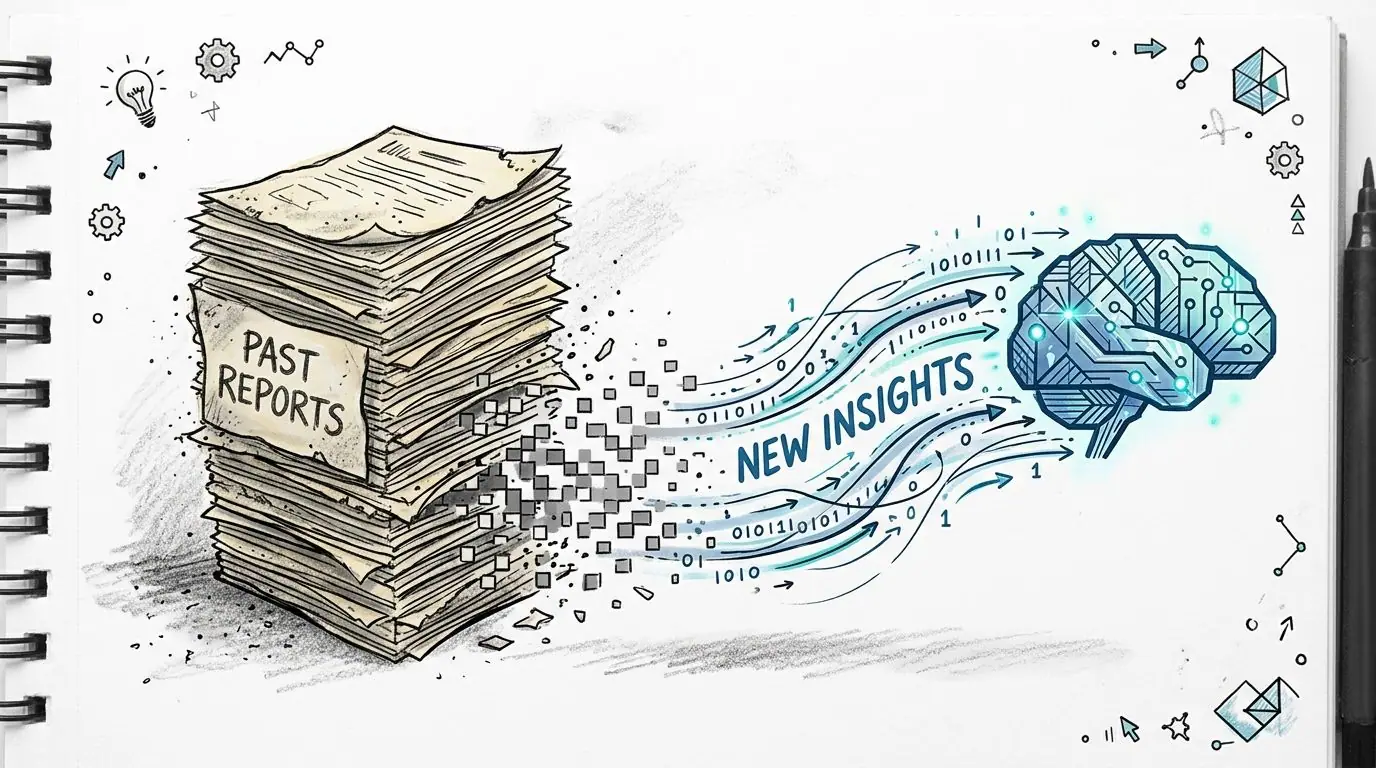
A ranking report can't tell you whether your brand is being cited in an AI answer. A backlink chart can't tell you whether a competitor is being named first in product comparisons. A traffic graph can't explain why branded search demand rises after users encounter your company inside an AI-generated summary.
What old reports still do well
Traditional SEO benchmarks are still useful for a few jobs:
- Tracking crawlable visibility: Rankings, indexation, and technical health still show whether search engines can process your site.
- Spotting authority gaps: Backlinks and referring domains still help explain why one site earns trust faster than another.
- Measuring page-level opportunity: Content gap analysis still identifies where you have no relevant page at all.
Those inputs matter. They just aren't enough on their own.
Where they fail in practice
Modern discovery is messy. A prospect might see an AI Overview, ask a follow-up in ChatGPT, then visit only one vendor site. If your team reports only on rank movements, you'll miss the brand that keeps getting cited during that journey.
Practical rule: If a reporting framework can't explain why a competitor appears in AI answers, it isn't a complete benchmarking framework anymore.
That's why newer search teams are adding AI visibility to competitive benchmarking. They want to know which domains get cited, which topics trigger mentions, and where their brand disappears entirely. If you're still treating AI surfaces as experimental, review how search generative experience changes discovery behavior and you'll see why last year's dashboard already feels incomplete.
Defining Your Battlefield and Strategic Goals
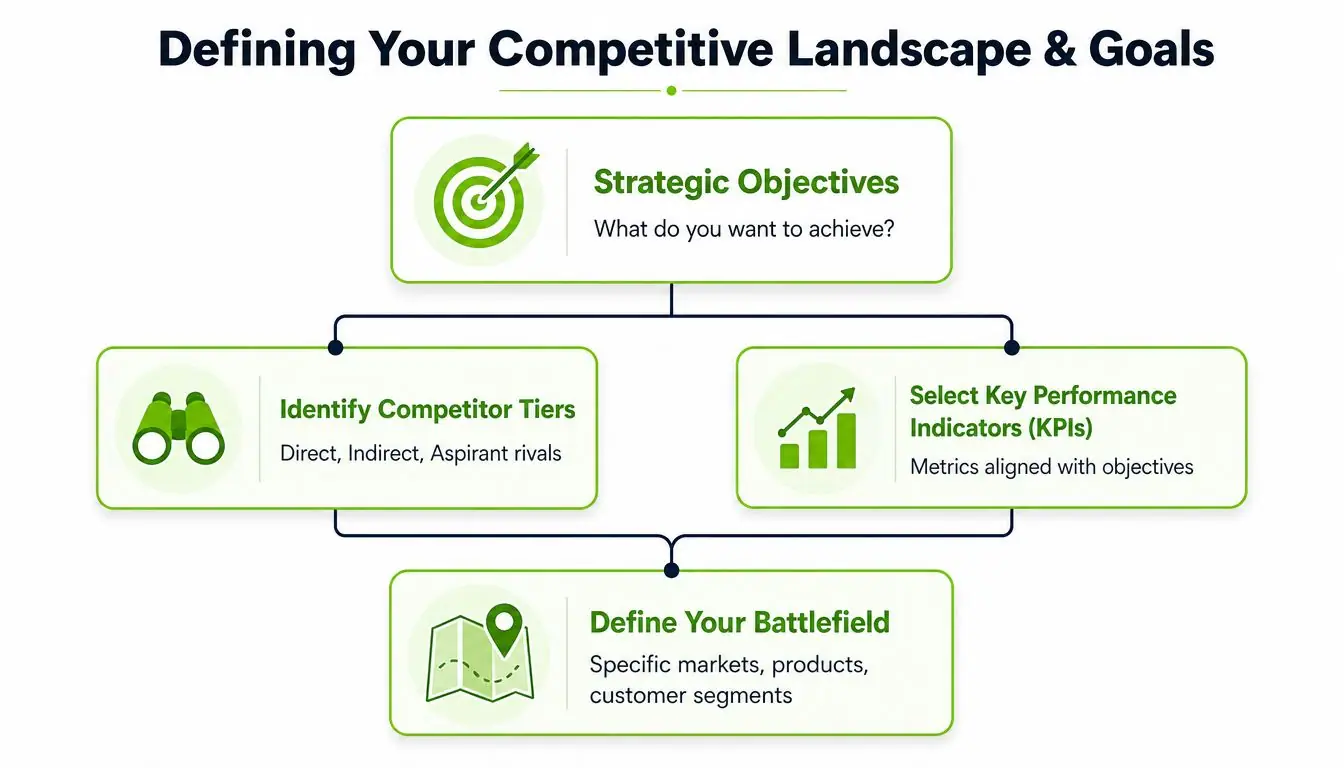
Bad benchmarking starts with a vague competitor list. Good benchmarking starts with a business question.
If a client sells enterprise software, the relevant battlefield isn't "everyone ranking for our keywords." It's the set of brands competing for the same budget, the same problem space, and the same AI citations around buying decisions. That list is usually smaller, and more useful.
Competitive intelligence practices, including competitive benchmarking, are used by 90% of Fortune 500 companies, according to Evalueserve's competitive intelligence statistics. Large organizations don't benchmark because it's fashionable. They benchmark because decisions get sharper when the comparison set is disciplined.
Start with the business objective
A benchmark should answer one of these questions:
- Where are we losing visibility before a click happens
- Which competitors own high-intent topic clusters
- Which search surfaces deserve budget first
- Where can content and technical fixes change the competitive picture fastest
If the objective is fuzzy, teams collect too much data and defend too little of it in client meetings.
Build competitor tiers, not one flat list
New hires often want a single spreadsheet of rivals. That creates noise. Use tiers instead.
- Direct competitors: These are the brands a client loses deals to right now. They overlap in service, audience, and commercial intent.
- Aspirational competitors: These may be larger publishers, category leaders, or brands with stronger content operations. You may not match them immediately, but they reveal what mature visibility looks like.
- AI-native disruptors: These are the fast movers that don't always dominate rankings yet appear frequently in AI summaries, review-style prompts, or educational queries.
A practical way to build that list is to combine sales input, SERP overlap, and prompt-level AI observations. If you need a cleaner discovery process, this guide on how to find competitors of a website is a useful starting framework.
Define success in operational terms
"Increase visibility" is not a benchmark goal. It doesn't guide action. Better goals are narrow and testable.
Use statements like these instead:
- Own the category narrative: Appear consistently for commercial and comparison topics where buyers evaluate vendors.
- Close the citation gap: Reduce the number of core prompts where competitors are referenced and your brand is absent.
- Improve breadth: Expand coverage across supporting topics that feed AI summaries, not only bottom-funnel pages.
- Protect branded understanding: Make sure AI systems describe your products, use cases, and differentiators accurately.
The strongest benchmarking plans don't start in SEO. They start in revenue, sales friction, and brand perception, then map those pressures to search surfaces.
This is also where cross-functional input matters. Product marketers know the claims that need reinforcement. Sales teams know the objections prospects raise. Content teams know which themes are underdeveloped. When all three align, benchmarking becomes a planning tool instead of a reporting ritual.
For teams thinking through operational support, the roundup of high-impact generative AI use cases is useful context because it shows how AI is changing research, content workflows, and analysis across marketing functions, not just search.
Selecting KPIs for Modern Search Visibility
A benchmarking dashboard only works if the KPIs reflect how discovery happens. If you choose old metrics alone, you'll optimize for old behavior.
The useful shift is this: keep the traditional SEO indicators that explain site strength, but add AI-era indicators that explain brand inclusion, citation patterns, and topical authority. Competitive benchmarking becomes much more valuable when it tracks both.
The baseline still matters
Competitive benchmarking relies on a set of universal metrics that 73% of enterprises prioritize, including cost, productivity, quality, awareness, perception, and likelihood to recommend, according to Drive Research on competitive benchmarking. That matters because it reminds teams not to turn benchmarking into a rankings-only exercise.
Awareness and perception belong in search benchmarking now more than ever. AI systems often compress a brand into a short answer. If your brand is absent, misrepresented, or consistently secondary, that's a visibility problem and a positioning problem at the same time.
Traditional vs Modern Search KPIs
| Metric Category | Traditional KPI | Modern AI-Era KPI |
|---|---|---|
| Organic visibility | Keyword ranking distribution | AI Overview presence by topic |
| Authority | Backlink profile and referring domains | Citation frequency across LLM prompts |
| Content coverage | Keyword gap and page gap | Topic coverage depth tied to AI citations |
| Brand visibility | Branded search and share of voice | Share of AI voice across recurring prompts |
| SERP performance | CTR and featured snippet presence | First-mentioned brand in AI summaries |
| Competitive comparison | Position overlap | Prompt-level competitor citation overlap |
| Content quality signals | Engagement proxies and on-page relevance | Consistency of brand facts in AI-generated answers |
What to keep, what to downgrade
Some metrics still deserve a permanent spot in the dashboard:
- Ranking distribution: It still shows whether your pages can compete in classic search.
- Backlink direction: You need this to understand authority gaps and off-page momentum.
- Content gaps: Missing pages still create obvious losses in both traditional and AI-driven discovery.
Some metrics should lose their old importance:
- Single keyword wins: A single rank jump doesn't matter much if AI answers bypass your page.
- Traffic in isolation: Traffic without citation visibility can hide competitive weakness.
- Generic share of search reporting: It often misses where AI systems repeatedly mention competitors.
Key takeaway: A modern KPI set should explain both eligibility and selection. Eligibility tells you whether your site can compete. Selection tells you whether AI systems and search interfaces actually choose to surface your brand.
How to define AI-era KPIs clearly
The mistake I see most often is vague naming. "AI visibility" sounds useful, but no one can act on it until you define it operationally.
Use working definitions like these:
- Share of AI voice: The proportion of tracked prompts where your brand is cited compared with your competitor set.
- Citation frequency: How often your domain, brand, or product is referenced across selected prompts and models.
- AI Overview presence: Whether your brand appears in overview-style summaries for target topics.
- Topic citation depth: The breadth of subtopics where your brand is cited, not just the head term.
These metrics are easier to defend internally when paired with a simple visibility framework such as a visibility score for SEO and AI search. Stakeholders usually need one roll-up metric for reporting and a smaller set of drill-down metrics for execution.
Executing Data Collection and Analysis at Scale
Benchmarking usually fails in execution, not in strategy. Teams define good goals, choose sensible KPIs, then ruin the process with inconsistent collection methods.
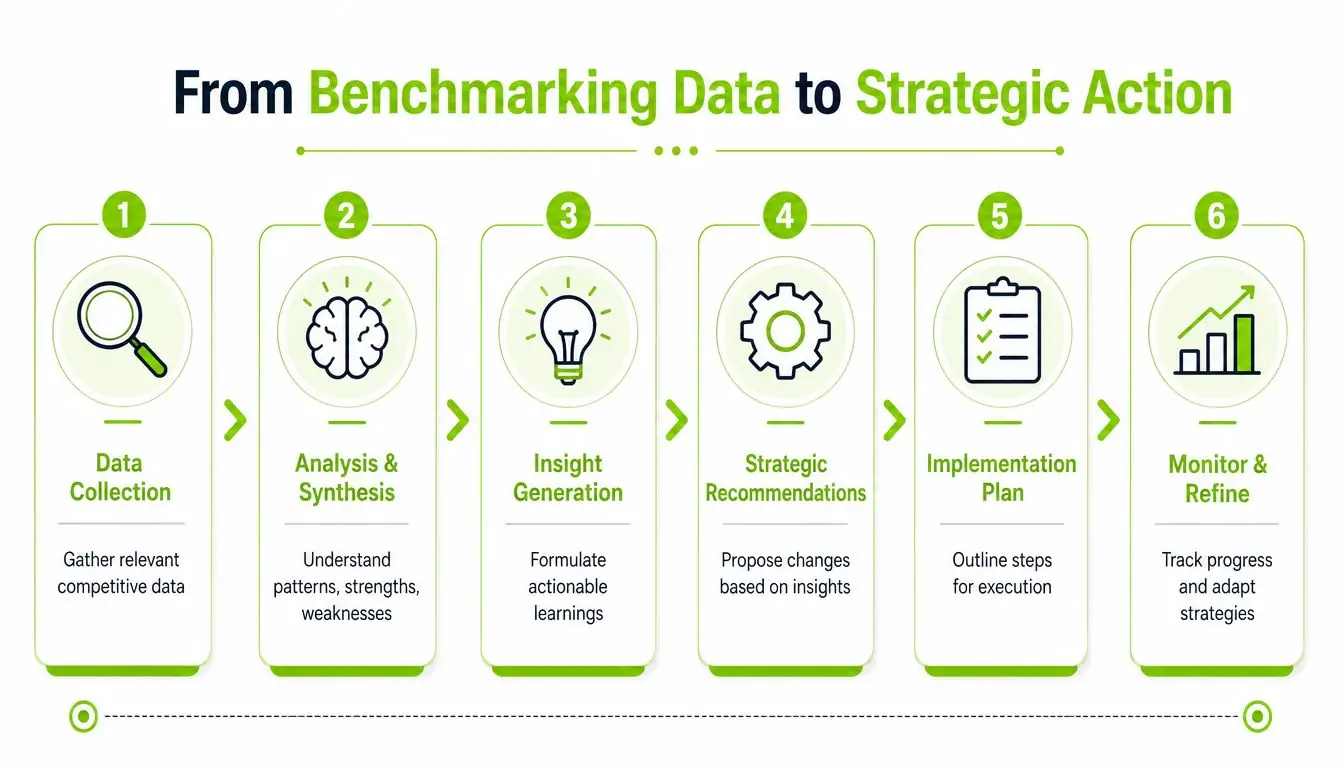
A rigorous methodology follows a six-step workflow of defining scope, selecting KPIs, collecting data, analyzing data, implementing improvements, and monitoring continuously, according to LinkedIn's overview of competitive benchmarking methods. The phrase that matters most in day-to-day work is consistent measurement. If you compare your internal data to competitor data gathered in a different way, the analysis drifts fast.
Manual collection versus automated collection
Manual collection has one advantage. It forces analysts to look closely at the overall situation. Early in an engagement, that can be useful.
After that, it becomes a bottleneck.
| Approach | What it helps with | Where it breaks |
|---|---|---|
| Manual checks | Early discovery, spot validation, prompt review | Slow updates, inconsistent sampling, analyst fatigue |
| Spreadsheet-heavy workflows | Lightweight pilot projects | Hard to scale across clients and topics |
| API-driven collection | Structured tracking, repeatability, dashboard feeds | Requires setup discipline and schema planning |
| Unified platforms | Centralized monitoring across classic SEO and AI surfaces | Still needs strong KPI definitions and QA |
What reliable collection looks like
A workable agency process usually includes these rules:
- Use one prompt set per topic cluster: If prompts change constantly, trend lines become unreliable.
- Normalize competitor sets: Compare the same brands across the same categories unless there's a specific reason to segment.
- Separate model observations: ChatGPT-style outputs, AI Overviews, and other answer engines shouldn't be blended into one undifferentiated metric.
- Time-box reviews: Weekly spotting and monthly analysis keeps the signal clear without turning the process into constant noise.
For teams building custom pipelines, it's worth reviewing tools that support extraction and structured monitoring. If you're evaluating collection infrastructure, this guide to discover AI scraping with Scrapfly gives a practical overview of scraping-oriented options and trade-offs.
Why single-source reporting matters
When an agency runs rankings in one tool, backlinks in another, prompt checks in a document, and client reporting in slides, nobody trusts the final picture. Analysts spend more time reconciling discrepancies than explaining performance.
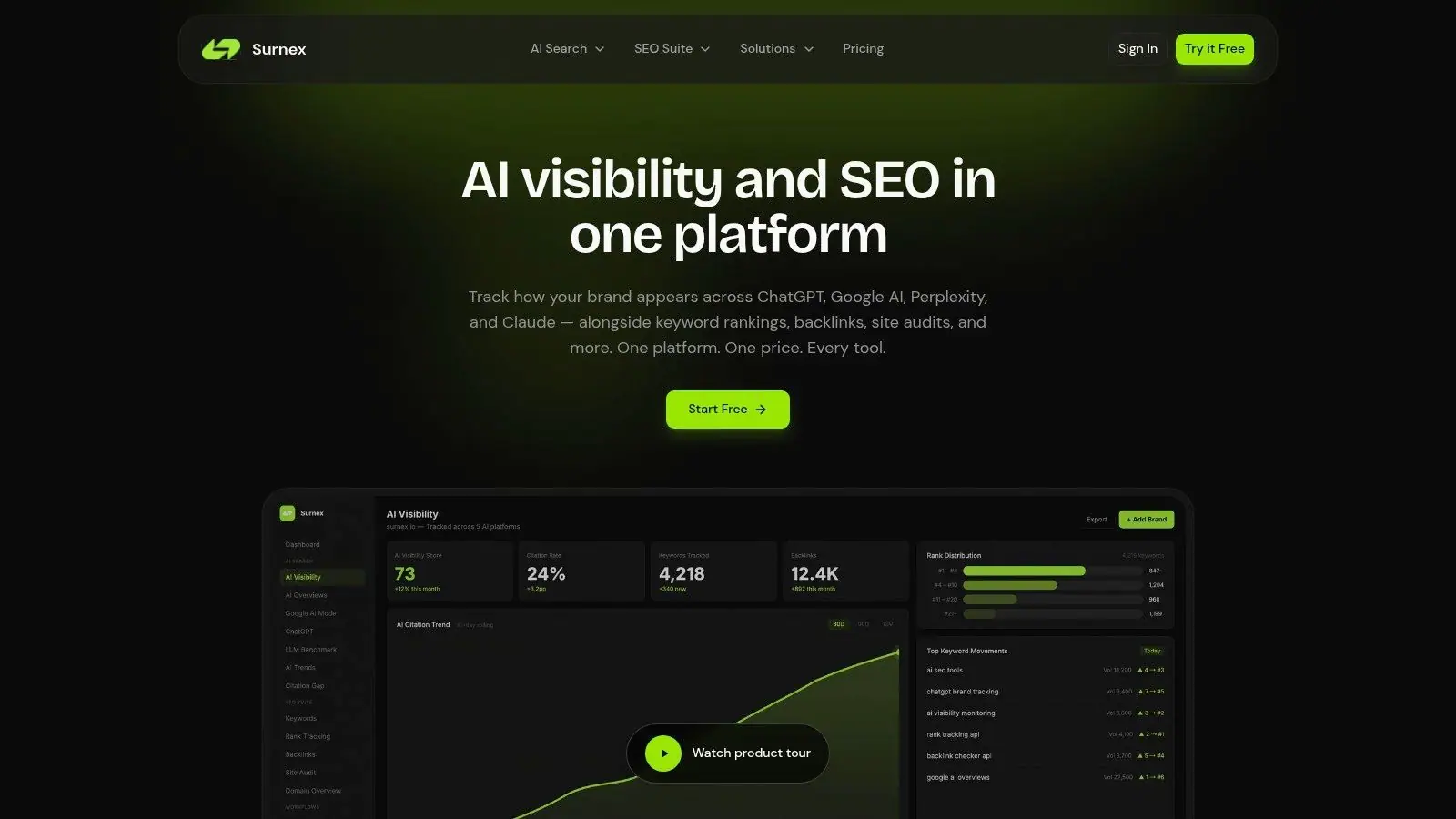
That is why teams are moving toward unified tracking. In practice, a platform like Surnex can combine rankings, backlinks, audits, content opportunities, AI Overview monitoring, and LLM citation tracking in one dashboard, which reduces tool sprawl and gives agencies one reporting layer. That doesn't replace analyst judgment. It removes repetitive collection work so analysts can focus on interpretation.
If your benchmarking process requires copy-pasting the same data into three systems, the process won't survive once client volume increases.
For teams trying to operationalize this, automated reporting matters more than flashy dashboards. A good setup should support recurring checks, anomaly detection, and exportable outputs that account managers can use without rebuilding every report by hand. That's where automated SEO monitoring workflows become part of benchmarking, not a separate function.
Turning Your Benchmarking Data into Action
A benchmark report that ends with observations is unfinished work. Clients don't pay for a catalog of gaps. They pay for a better competitive position.
The useful shift is to turn every finding into a decision. If a competitor dominates AI citations for comparison queries, the next step isn't "monitor closely." The next step is to identify which content assets, schema improvements, supporting pages, and factual reinforcement could change that pattern.
Prioritize by impact and effort
A simple decision grid works well in agency settings:
- High impact, low effort: Refresh weak pages that already rank and are close to earning AI visibility.
- High impact, high effort: Build missing topic clusters that shape category understanding.
- Low impact, low effort: Clean up supporting content, internal links, and outdated brand language.
- Low impact, high effort: Park these unless they support a larger strategic move.
This keeps the team from chasing every metric movement as if all changes deserve equal attention.
Build recommendations clients can act on
Stakeholders respond better when recommendations are concrete and owned.
- State the gap clearly: Name the competitor, the surface, and the topic area.
- Explain why it matters: Tie the visibility loss to buyer research, brand positioning, or lead quality.
- Assign a response: Content, technical SEO, digital PR, or product marketing should each have explicit ownership.
- Define the review window: Decide when you'll check whether the intervention changed the benchmark.
Here's a useful principle for presenting findings to clients.
Don't say, "You lag in AI visibility." Say, "Competitors are being cited in service-comparison prompts where buyers shortlist vendors, and your brand is absent."
That framing turns an abstract metric into a business issue.
A short walkthrough can help teams explain this transition from data to execution:
Frequently Asked Questions on AI Benchmarking
Teams usually accept that AI visibility matters. The friction starts when they try to report it consistently.
A 2025 industry survey found that 74% of in-house SEO teams struggle to define performance parity with competitors in AI modes because legacy metrics like share of search don't capture LLM citation dominance, according to Valona Intelligence's guide to competitor benchmarking. That tension shows up in almost every client conversation now.
Why can a lower-ranking competitor win in AI answers
Because AI systems don't mirror a simple ranking table. They synthesize sources, compare entities, and look for topical coverage that helps answer the prompt. A competitor with weaker traditional rankings can still earn repeated mentions if its content is clearer, more complete, and easier for AI systems to cite.
That changes content strategy. Instead of focusing only on rank position, teams need to improve factual clarity, topic completeness, and brand association across core themes.
How do you align stakeholders on new KPIs
Start with a dual-reporting model for a while. Keep classic SEO benchmarks visible, but add a smaller AI visibility layer with defined terms. Don't force executives to adopt unfamiliar language without context.
Use three plain questions:
- Are we present
- Where are competitors cited instead
- Which topics create the biggest commercial risk
Those questions usually land better than a dashboard full of novel labels.
How often should benchmarking run
Collection should be continuous where possible. Analysis should be scheduled. If teams analyze constantly, they overreact to noise. If they review only occasionally, they miss directional changes and lose client confidence.
A practical cadence is steady monitoring with structured review windows, ownership, and documented follow-up actions.
Can this be automated without losing nuance
Yes, if automation handles collection and trend tracking while analysts handle interpretation. That's the right division of labor. Automation is good at repeatability. Analysts are good at deciding whether a citation gap points to content debt, authority weakness, or positioning problems.
The failure mode is full automation with no prompt review, no QA, and no context from sales or content teams. That's not a modern operation. It's just faster confusion.
If your team needs one place to benchmark classic SEO and emerging AI visibility together, Surnex gives agencies, in-house teams, and developers a practical way to track rankings, backlinks, AI Overviews, and LLM citation trends without stitching the process together manually.