Organic search still drives 53.3% of all website traffic across major markets according to this 2025 SEO statistics roundup. That should make SEO data feel stable. It isn't.
The reporting layer has changed faster than many organizations' measurement stack. Searchers still discover brands through Google, but many now get answers without clicking, compare vendors inside AI summaries, and ask LLMs for recommendations before they ever reach a site. If your dashboard only tracks sessions, rankings, and conversions, you're not measuring search. You're measuring the part of search that still sends visits.
At an agency, the initial problems began to surface. Client reports showed rankings holding, technical health looking fine, and branded demand staying steady, but informational traffic softened. The old explanation was "content decay" or "intent shift." Sometimes that was true. Often it wasn't. The missing layer was visibility data from AI surfaces and answer-first search features.
That gap is why data for SEO needs a unified model now. Marketers need one place to see where a brand appears across traditional results and AI answers. Developers need a data structure they can automate, validate, and query without stitching together exports every week.
The New Reality of Search Data
Organic search still drives 53.3% of trackable website traffic, according to BrightEdge research cited by Search Engine Land. That headline still leads many teams to treat clicks as the main proof of SEO performance. The reporting model breaks down once users get the answer on the results page, compare brands inside AI summaries, or ask an LLM for options before they visit a site.
I see the same pattern in audits. Rankings look stable. Technical monitoring looks clean. Revenue may even hold for a quarter. Then non-brand traffic softens and the default explanation is content decay or shifting intent. Sometimes that is correct. In many cases, the missing layer is exposure data from AI Overviews, answer boxes, and other no-click surfaces that influenced the decision before analytics ever recorded a session.
The issue is operational, not theoretical.
Most dashboards were built for a search environment where visibility and visits were closely linked. They still track positions, sessions, conversions, and backlink metrics well enough. They rarely show whether your brand was cited in an AI-generated answer, whether competitors are being mentioned for commercial prompts, or whether a drop in clicks reflects weaker presence versus stronger zero-click behavior. A modern search marketing intelligence framework has to combine traditional SEO signals with AI visibility signals in one model, or reporting will keep producing half-answers.
That is especially obvious in verticals where users want a shortlist fast. Real estate is a good example because location, pricing, neighborhood context, and local recommendations are easy for AI systems to summarize. Teams focused on ranking real estate in AI search need more than blue-link rank tracking. They need to know which pages get cited, which entities get mentioned, and which prompt patterns lead to inclusion.
Here is what old reporting misses:
- Traffic-only views miss influence: A page can shape consideration without earning the click.
- Rank-only views miss AI presence: High positions help, but they do not guarantee citation or mention in AI outputs.
- Siloed channel reporting hides causality: Technical quality, content structure, authority signals, and AI inclusion now affect the same outcome.
A better question is not "How much traffic did this page drive?" It is "Where did this page show up, how was it represented, and did that visibility contribute to demand or conversion later?"
That shift changes the data model. Marketers need one source of truth for rankings, clicks, citations, mentions, and assisted outcomes. Developers need entities, prompt logs, URL mappings, and validation rules that make those signals queryable together. Data for SEO now has to measure search as a visibility system first, then connect that visibility to visits and revenue where clicks still happen.
The Two Worlds of Modern SEO Data
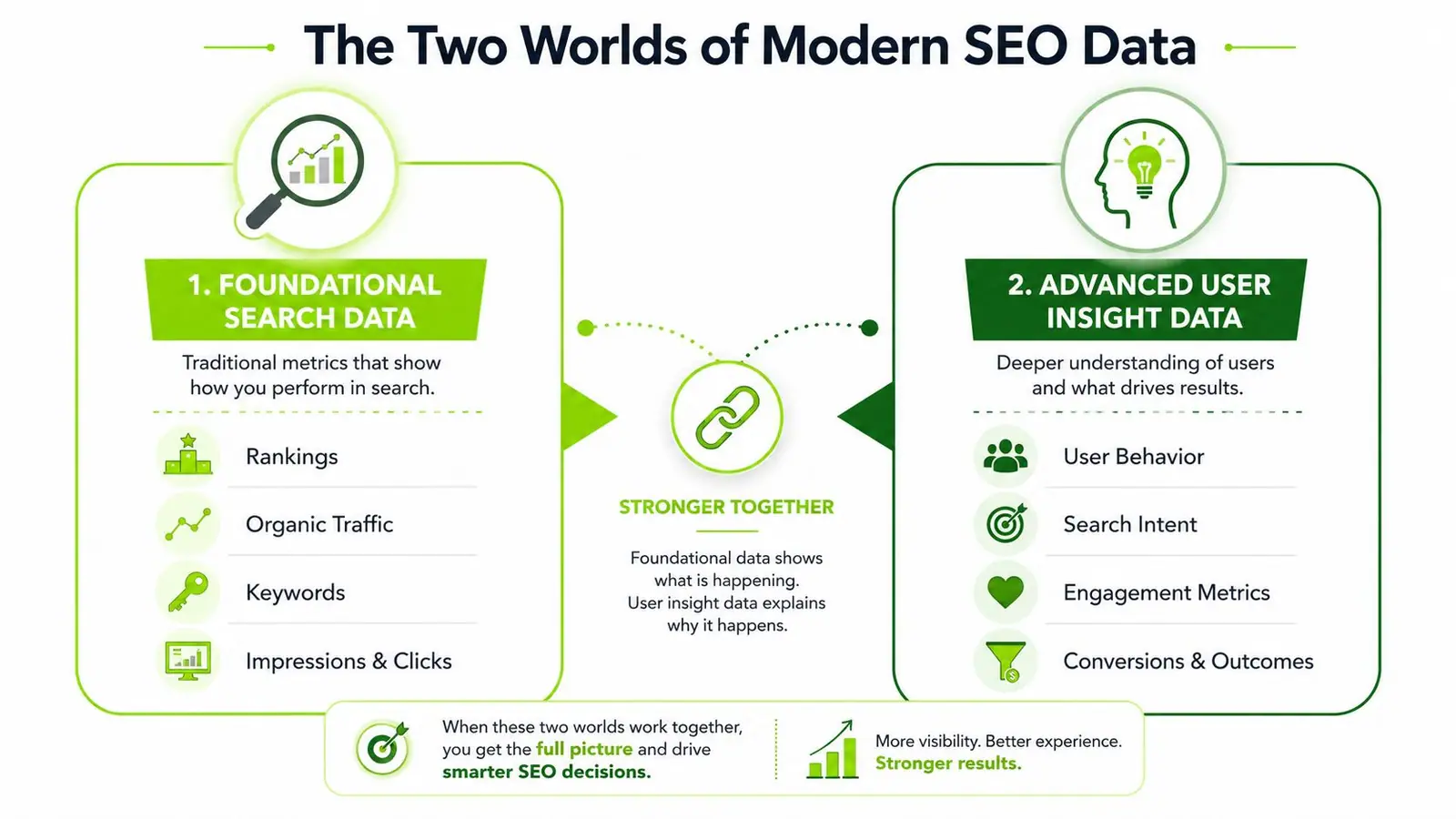
Search teams now work with two data systems at once. One measures whether a page can earn visibility in search. The other measures whether that page, brand, or entity is selected inside AI-generated answers. If those systems live in separate dashboards, reporting breaks fast. Marketing sees traffic and rankings. Product and brand teams ask why competitors keep showing up in AI Overviews and chat interfaces. No one is looking at the same source of truth.
Foundational search data
Foundational search data covers the signals SEO teams have used for years to explain eligibility, discoverability, and technical quality. It still matters because AI systems do not pull from weak pages by accident. In agency work, pages that fail basic SEO checks usually fail citation checks too.
This bucket usually includes:
- Rank tracking: Keyword positions by country, device, SERP feature, and target URL.
- Backlink data: Referring domains, link quality, topical relevance, and link velocity.
- Technical health: Crawlability, indexation status, canonicals, schema validity, Core Web Vitals, and internal linking.
- Content performance: Search Console impressions, clicks, CTR, query-to-page relationships, and conversion paths after the visit.
Organic search remains a high-return channel for many brands, but that return is uneven. A publisher with strong editorial authority, a SaaS company with long sales cycles, and a local service business will not see the same payoff from the same metrics. That is why I treat foundational data less like a scorecard and more like operating telemetry. It shows whether the site has earned the right to compete.
A useful framing comes from what search intelligence is. The job is not to replace rank tracking with a newer buzzword. The job is to connect search demand, technical state, authority, and SERP behavior into one model that people can act on.
AI visibility data
AI visibility data tracks selection, representation, and citation inside answer-first environments. This is the layer many teams are missing.
It usually includes:
- AI Overview inclusion: Whether your URL, brand, or entity appears in generated search answers.
- Citation source tracking: Which pages get cited, for which prompts, in which answer formats, and beside which competitors.
- LLM brand presence: Mentions across chat-based discovery, research assistants, and product recommendation flows.
- Prompt-level gap analysis: Repeated prompts where competitors appear and your content does not.
- Response capture metadata: Prompt text, timestamp, location, device context, model or interface, and rendered answer text.
This data is harder to collect cleanly. Interfaces change, answers are personalized, and the same prompt can produce different outputs by session, geography, or account state. Teams building internal collectors often rely on browser automation, controlled environments, and a sound proxy server API architecture so they can sample results without contaminating the dataset.
Why both worlds need one model
Foundational data and AI visibility data look different, but they explain the same business outcome. One tells you whether your pages are structurally ready. The other tells you whether the search layer is choosing to use them.
| Data world | Main question | Common failure if isolated |
|---|---|---|
| Foundational search data | Can this page be crawled, indexed, trusted, and ranked? | Teams keep improving pages that still lack authority or technical stability |
| AI visibility data | Is this page, brand, or entity being pulled into answer-first experiences? | Teams react to traffic swings without checking whether AI answers replaced the click |
The trade-off is practical. If you only track classic SEO metrics, you can miss brand exposure and assisted influence that happen before a visit. If you only track AI mentions, you can overvalue noisy appearances that never scale because the underlying pages are weak. The useful model ties them together at the URL, entity, prompt category, and query cluster level.
That is how modern data for SEO should work. One shared framework for rankings, links, technical state, citations, mentions, and downstream outcomes. Separate inputs. One decision system.
How to Collect and Validate Your Data
Collection isn't the hard part anymore. Validation is. Teams often can export from Google Search Console, pull numbers from Google Analytics 4, crawl a site, and buy rank tracking data. The mess starts when those sources disagree.

Start with a source hierarchy
Every SEO data stack needs a source-of-truth policy. Without one, analysts compare incompatible numbers and developers automate bad assumptions.
A practical hierarchy looks like this:
- Search Console for query and landing-page search data. Use it for impressions, clicks, CTR, and average position.
- GA4 for on-site behavior and conversion mapping. Use it to understand what happened after the visit.
- Crawler output for technical state. Use Screaming Frog, Sitebulb, or your own crawler for status codes, canonicals, metadata, and internal links.
- Rank tracking platform for stable position snapshots. Use this when Search Console averages are too noisy for daily operations.
- Prompt and AI citation collection for answer-layer visibility. Store the raw prompt, response, cited URLs, timestamp, and query category.
Don't merge these blindly. Keep the raw tables separate, then create modeled views that normalize URL formats, date grain, device labels, and country codes.
Collect technical metrics with fixed thresholds
Technical SEO data gets fuzzy when teams talk in generalities. Use concrete thresholds. To achieve good Core Web Vitals in 2026, teams must target LCP of ≤2.5s, INP of ≤200ms, and CLS of ≤0.1, according to this technical SEO guidance. Those aren't nice-to-have values. They're the thresholds your reports should check against automatically.
That means your collection process should capture:
- Page template grouping: Home, category, product, blog, docs, landing pages.
- Device segmentation: Mobile and desktop should not share one average.
- Trend state: Improving, stable, or deteriorating.
- Ownership field: Which team owns the fix, such as engineering, content, or design.
The best technical dashboards don't just show a problem. They identify the template, the owner, and whether the issue is spreading.
Add AI visibility without creating noise
Many stacks get brittle when prompt data is collected badly. If one analyst runs prompts manually and another uses a script with different wording, your trendline is garbage.
Use a repeatable prompt set. Group prompts by intent. Keep the wording stable. Store all outputs with timestamps, device or environment notes when relevant, and the cited URLs. If you're building collection pipelines at scale, the network layer matters too. This is one reason teams building large retrieval jobs spend time on proxy server API architecture, because stable request handling and routing directly affect data consistency.
For recurring operations, an automated SEO monitoring setup should flag missing rows, prompt failures, duplicate entries, and sudden schema drift before the data lands in reporting.
Validate before reporting
Validation is mostly comparison work. Check the same reality from more than one angle.
Use a simple review loop:
- Cross-check URLs: The ranking URL, canonical URL, and cited AI URL should match or map cleanly.
- Review date alignment: Search Console data lags. Rank tracking often doesn't. Don't compare them as if they are same-day facts.
- Inspect outliers manually: If one page suddenly disappears from AI citation logs, verify the prompt result before alerting the client.
- Version your prompt library: Small wording changes can create fake trend changes.
- Log nulls intentionally: Missing data should mean "not observed" or "not collected," never both.
A lot of bad SEO reporting comes from teams trying to make every dataset agree. They won't. The job is to define what each source is best at, then make the joins explicit. Clean collection gives you usable data. Clear validation gives you confidence to act on it.
Structuring Data for Analysis and Automation
Once collection is stable, the next bottleneck is storage. Most SEO teams start in spreadsheets because that's fast and familiar. The problem isn't that spreadsheets are bad. The problem is that they collapse under mixed-grain data.
Ranking data is usually tidy. AI responses are not. Crawl outputs are wide and technical. Search Console exports sit at a different aggregation level. If you put all of that into one sheet, you get a report that looks usable and breaks the minute someone asks a real question.
Choose a model that can handle different grains
The cleanest setup is a warehouse-style model, even if the stack is small. A SQL database or a warehouse like BigQuery makes it much easier to join page-level, query-level, and prompt-level data without rewriting everything every month.
A practical structure usually separates:
- Dimension tables: URLs, keywords, competitors, entities, page templates
- Fact tables: Daily ranks, backlink snapshots, crawl findings, Search Console metrics, AI citation events
- Lookup tables: Canonical mappings, country codes, device labels, content ownership, prompt libraries
The key design choice is not to force AI data into the same shape as ranking data. Keep AI observations event-based. A citation event should store the prompt, response date, target entity or URL, and citation source fields. Then you can roll it up later.
Example unified schema
Below is a minimal model that works for both analysts and developers.
| date | target_url | keyword | rank_position | search_volume | backlinks | is_in_ai_overview | ai_citation_source_url | llm_mention_count |
|---|
This table isn't enough by itself, but it's a strong analysis layer for dashboards and anomaly detection. The raw source data should still live elsewhere.
Structured data belongs in the warehouse too
On-page structured data often gets treated as a dev implementation detail. That's a mistake. It belongs in your analytical model because it affects discoverability.
According to this technical guide on manufacturing SEO and generative search, implementing precise JSON-LD structured data with specific entity attributes creates a direct causal link to appearing in AI Overviews. The same guidance notes that LLMs prioritize numerical density and definition lists for substantiating claims, and that validation through Google's Rich Results Test is essential.
That has direct implications for your schema design. Store whether a page contains:
- Entity markup: Product, organization, article, FAQ, or other relevant schema types
- Entity completeness: Key attributes present or missing
- Definition-list formatting: Whether the content includes structured explanatory blocks
- Validation state: Passed, warning, or failed in testing
Build note: If schema markup changes on-page and you don't capture that change in your warehouse, your reporting will miss one of the clearest explanations for visibility shifts.
A dashboard tied to an SEO analytics dashboard concept becomes much more useful when analysts can ask, "Show me pages with strong rank positions, valid schema, and no AI citation presence," or the reverse.
When spreadsheets still work
Spreadsheets are fine in two situations:
- You are proving the model. Early-stage teams can test prompt libraries, URL mapping, and field definitions there.
- The reporting question is narrow. For one campaign, one market, and one stakeholder, a sheet may be enough.
Move out of spreadsheets when any of these happen:
- Analysts duplicate tabs to support different clients
- Developers need reproducible joins
- Prompt sets are growing
- Multiple countries or devices are involved
- Stakeholders ask for trend views beyond a quick export
The goal isn't complexity. It's durability. Good data for SEO should survive team growth, tool changes, and the addition of AI search inputs without forcing a rebuild every quarter.
Actionable Workflows from Unified Data
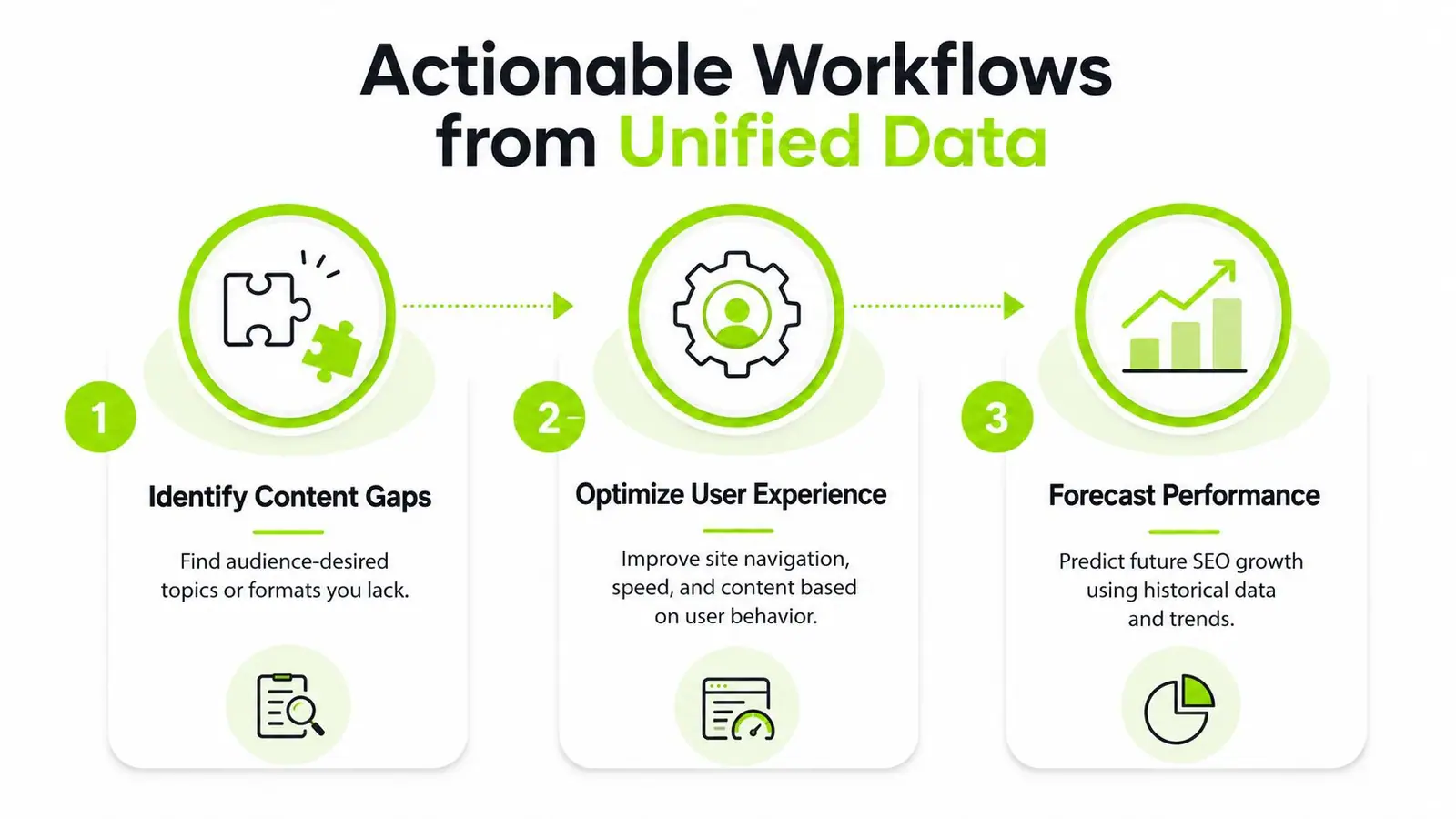
Unified data matters because it changes what teams do on Monday morning. The biggest gains usually come from three workflows: citation gap analysis, anomaly detection, and content ROI review. Each one gets stronger when AI visibility and foundational SEO data live together.
Citation gap analysis
The most useful AI-era workflow starts with prompts, not pages. Pull a defined set of category, comparison, and problem-solving prompts. Then compare which brands or URLs are cited across them.
As Andava notes in its discussion of content gap analysis, "citation frequency is the new currency of digital visibility," and the hard part is measuring the citation gap, meaning the share of prompts where a competitor is cited and your brand is absent.
A working process looks like this:
- Step one: Group prompts by intent so you're not mixing educational and transactional scenarios.
- Step two: Record every cited competitor URL and your own presence or absence.
- Step three: Join that view to ranking, page type, and backlink context.
- Step four: Identify pages that rank reasonably well but still fail to earn citations.
- Step five: Rewrite or expand those pages with clearer entities, stronger definitions, better factual structure, and tighter internal linking.
This analysis often reveals a painful truth. Some pages rank because they are relevant enough, but they aren't formatted or detailed enough to be used as source material in AI answers.
Automated anomaly detection
The second workflow is operational. You're looking for abrupt change, then routing it to the right owner.
A useful alerting system watches combinations such as:
| Signal combination | Likely next action |
|---|---|
| Rank drop plus crawl issue | Send to technical SEO or engineering |
| Stable rank plus lost AI citation presence | Review prompt set, page formatting, and competitor changes |
| Visibility stable plus traffic decline | Check SERP behavior and intent before rewriting content |
This approach saves teams time. Instead of arguing over whether "SEO is down," they can isolate which layer moved.
Don't trigger alerts on one metric alone. Use a paired signal so the alert already includes context.
Content ROI review
The third workflow helps agencies defend investment decisions. A page can justify its cost in more than one way. It may drive visits. It may support AI citation presence. It may increase branded discovery or improve conversion assist behavior.
When content review is unified, teams stop cutting pages just because direct sessions softened. They inspect:
- Search demand coverage: Which query clusters the page addresses
- Traditional visibility: Rank and impression footprint
- AI visibility: Citation or mention presence
- Business relevance: Assisted conversions, sales enablement, or lead quality feedback
The strongest content planning conversations happen when editors, SEOs, and developers all look at the same evidence. The editor sees where the explanation is weak. The SEO sees where authority or structure is missing. The developer sees where schema, rendering, or page speed may be blocking visibility.
That's what unified data for SEO should do. It shouldn't just produce cleaner charts. It should shorten the gap between diagnosis and action.
Modern SEO Reporting That Tells a Clear Story
Most SEO reporting still tells a partial story because it's built around traffic. That made sense when a click was the main proof that a search result mattered. It makes less sense when a user can discover, compare, and narrow options before visiting the site.
A better report starts with visibility, not just sessions.
What a modern report should show
A strong executive report needs a short narrative and a compact set of metrics. It should answer four questions:
- Where are we visible?
- Where are competitors visible and we are not?
- What changed this period?
- What actions come next?
That means combining traditional and AI-era signals into one view. Not every stakeholder needs the raw prompt logs or crawl exports. They do need a clear reading of search presence across the surfaces that affect discovery.
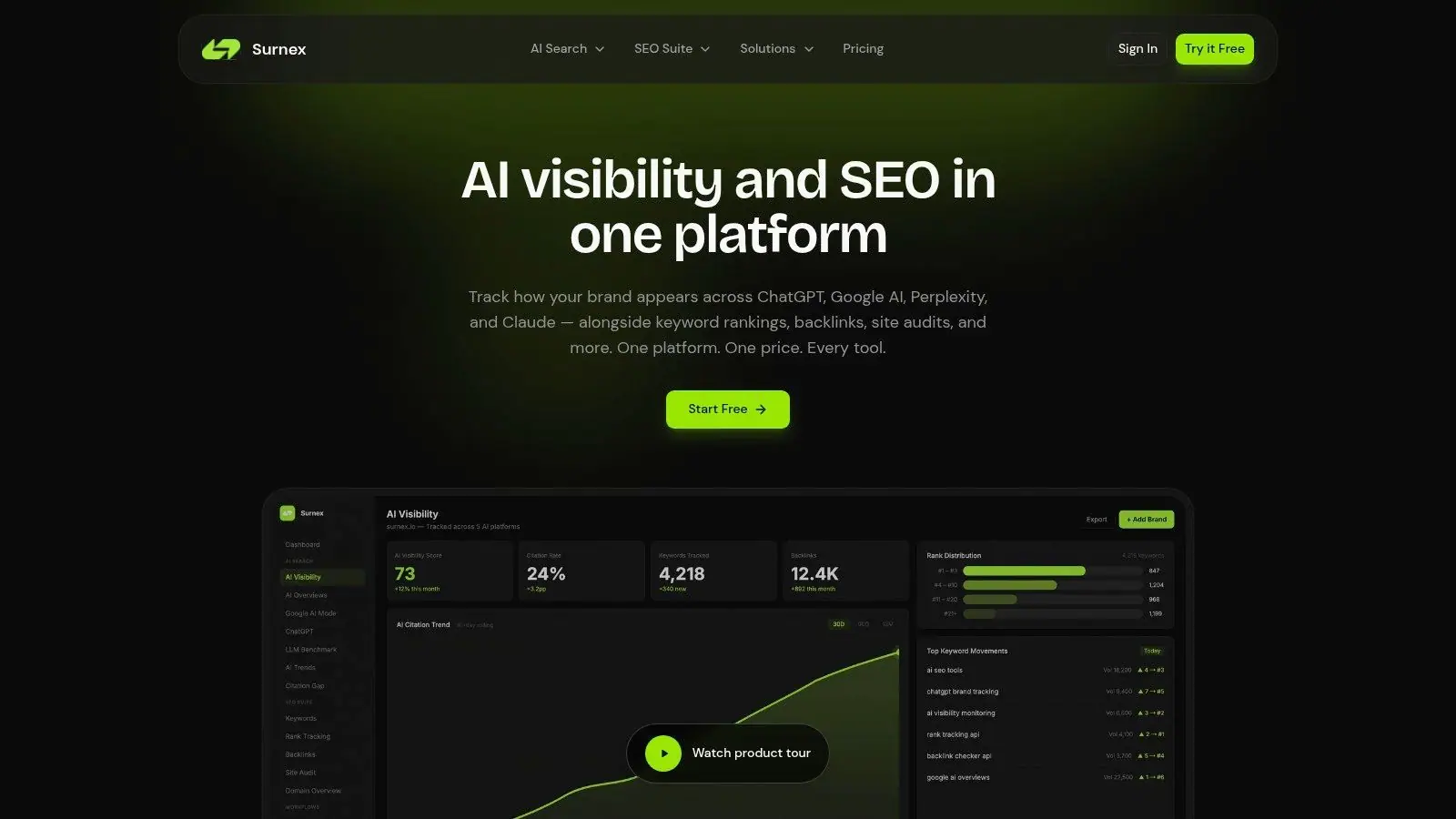
A useful dashboard usually includes:
- Keyword distribution: Movement across ranking bands
- Technical state: Template-level issues, not just a sitewide score
- Coverage by page type: Which content classes are gaining or losing visibility
- AI citation share: Presence across tracked prompt sets
- Competitive gaps: Priority topics where rival brands keep appearing
What to stop reporting as the headline
Traffic should stay in the report, but it shouldn't own the report. The old "sessions up, sessions down" opening often creates bad decisions. Teams panic over declines that came from changes in SERP behavior rather than a collapse in relevance.
A short stakeholder note is often enough:
Some informational queries now satisfy user intent directly on the results page. We track traffic, but we judge search performance by total visibility across rankings, citations, and brand presence.
That framing changes the conversation from blame to diagnosis.
Show the data in motion
A dashboard is useful. A walkthrough is often better for stakeholder alignment.
When teams present modern search reporting well, clients stop asking only, "Why are clicks down?" They start asking better questions, such as, "Which prompt categories are we missing?" or "Which content types are visible but underperforming in conversions?"
The reporting format that works best
For agencies and in-house teams alike, the clearest reporting flow is usually:
- Executive summary in plain language
- Search visibility snapshot across traditional and AI surfaces
- Key changes with probable causes
- Priority actions by team
- Appendix with raw evidence for analysts and developers
This structure keeps the report honest. It also gives each audience the level of detail they need. Executives see business impact. Marketers see opportunity. Developers get enough context to fix the underlying issue without decoding a slide deck full of vanity metrics.
Developer Guide to SEO Data APIs
Developers usually inherit SEO tooling after the manual process starts hurting. Exports pile up, analysts want fresh data, and stakeholders ask for alerts instead of spreadsheets. At that point, API design matters more than tool preference.
What to pull and how to think about it
For a practical SEO data pipeline, start with four families of endpoints:
- Search performance endpoints: Query, page, device, country, and date grain
- Crawl and audit endpoints: Status codes, canonical targets, schema state, and internal links
- Rank tracking endpoints: Daily keyword and URL positions
- AI visibility endpoints: Prompt results, cited URLs, brand mentions, and citation presence
Keep authentication and refresh logic separate from transformation logic. Don't hard-code metric assumptions inside the extraction job. Pull raw data first, normalize in a second layer, and publish alert-ready tables in a third layer.
A simple alerting pattern
A reliable daily job usually does five things:
- Fetch yesterday's ranking and AI visibility rows
- Compare them against recent baseline behavior
- Check whether the underlying page also had technical changes
- Classify the issue
- Send the alert to Slack or email with enough context to act
Pseudo-code can stay simple:
authenticate()
rank_data = fetch_rankings(date=yesterday)
ai_data = fetch_ai_citations(date=yesterday)
tech_data = fetch_technical_state(date=yesterday)

merged = join_on_url_and_keyword(rank_data, ai_data, tech_data)

for row in merged:
    if rank_drop_detected(row) and technical_issue_present(row):
        send_alert("Ranking drop tied to technical issue", row)
    elif ai_visibility_drop_detected(row) and rank_is_stable(row):
        send_alert("Lost AI visibility with stable rankings", row)
    elif traffic_drop_detected(row) and visibility_is_stable(row):
        send_alert("Traffic decline likely needs SERP behavior review", row)
What developers usually get wrong
The first mistake is flattening everything into one endpoint response and losing source context. The second is treating prompt-derived AI data as if it were as stable as daily ranking data. It isn't. Prompt libraries need versioning, response logs need storage, and your alerting logic needs tolerance for normal variation.
The third mistake is skipping URL normalization. Canonicals, trailing slash variants, parameters, and mobile alternates can wreck joins.
Build the pipeline so an analyst can trace every dashboard number back to a raw row. If they can't, trust drops fast.
A strong API-based SEO stack doesn't need to be fancy. It needs to be traceable, repeatable, and easy to extend when search adds another interface.
Search has outgrown single-purpose SEO reporting. Surnex gives agencies, in-house teams, and developers one place to track traditional SEO performance alongside AI visibility, citation gaps, rankings, backlinks, audits, and search intelligence workflows. If you're rebuilding your data for SEO around where search is heading, it's a practical platform to evaluate.