Brand monitoring is the continuous practice of tracking where and how a brand appears across search, social, news, reviews, forums, and AI-generated answers, then measuring sentiment, share of voice, and visibility trends. By 2033, the global brand monitoring tools market is projected to reach USD 591.6 million at a CAGR of 8.7%, which shows how this work has moved into mainstream analytics and risk management, not just PR ops.
If you're staring at a Slack thread full of mention screenshots, a half-finished alert setup, and a nagging question about how your brand shows up in AI search, you're already doing brand monitoring, just without a clean system. The hard part in 2026 isn't deciding whether to monitor. It's deciding what counts as a signal, where to look, and how to turn that signal into action before the noise wins.
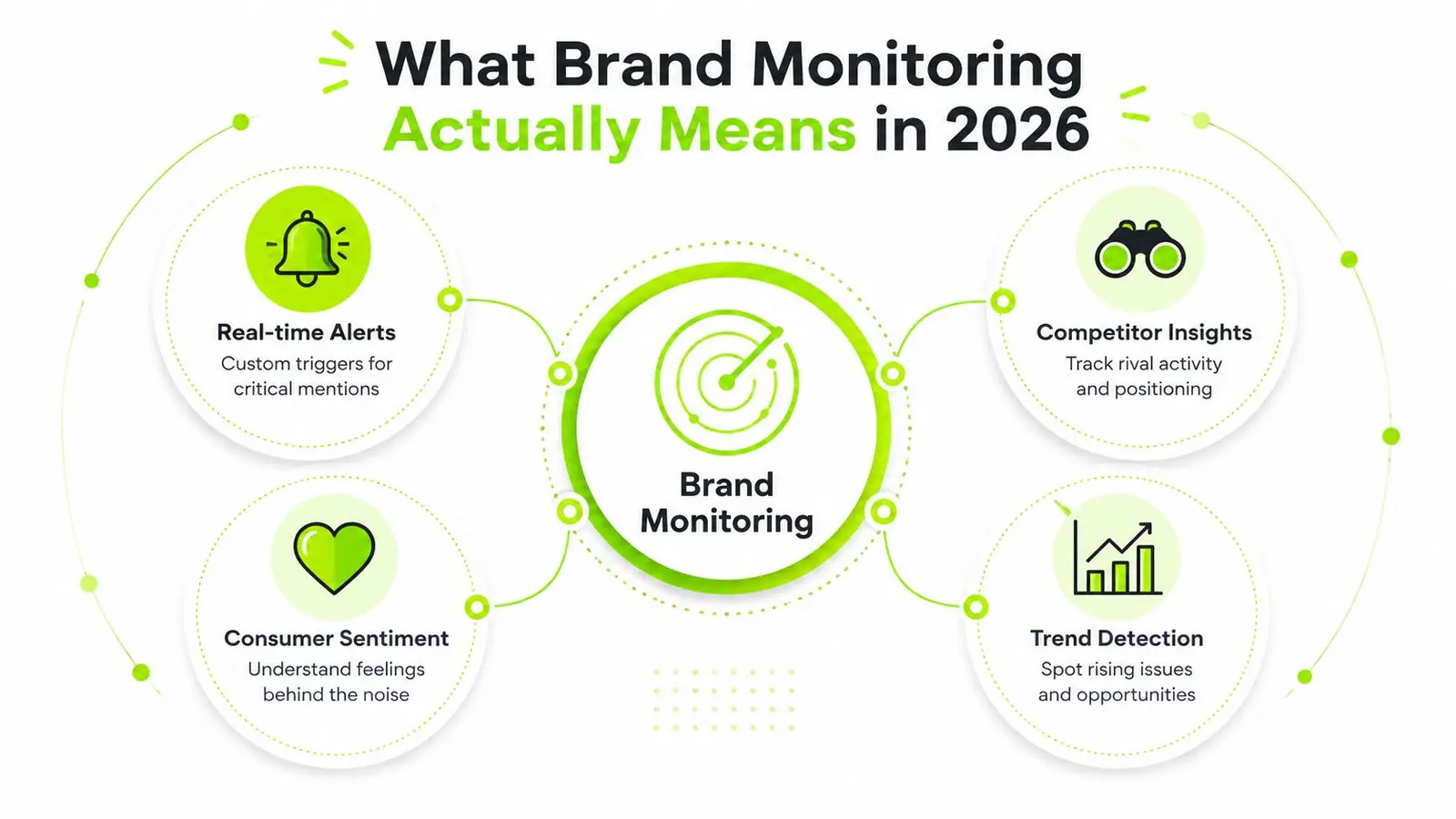
What Brand Monitoring Actually Means in 2026
Brand monitoring is the discipline of watching your brand's footprint across the places people discover, compare, and talk about companies. That includes search results, social platforms, news coverage, forums, review sites, podcasts, and now AI-generated answers. The job is not just to count mentions, but to understand whether the brand is being described accurately, favorably, and often enough to matter.
A useful working definition is simple. Brand monitoring tracks what is said, where it's said, how it feels, and how visible the brand is compared with competitors. In practical terms, that means you look at sentiment, share of voice, reach, and visibility trends, then decide whether those changes are random chatter or something worth acting on.
The confusion usually starts because people use brand monitoring, social listening, and media monitoring as if they mean the same thing. They don't. Social listening tends to center on social conversations. Media monitoring focuses more on news and earned coverage. Brand monitoring is broader, because the brand now lives across multiple surfaces, including review sites, search, forums, and AI answers.
A strong monitoring program also needs a wider query set than just the official brand name. Guidance from Sprout Social stresses adding product lines, misspellings, executive names, competitor terms, and category keywords so you reduce false negatives and calculate dynamic share of voice more reliably monitor brand mentions online. That matters because spelling variation and ambiguous terms can hide the mentions your team needs most.
For a junior team, the easiest test is this. If a stakeholder asks, “How are people finding us, talking about us, and comparing us to rivals right now?” and your answer can cover search, social, news, reviews, and AI outputs, you understand brand monitoring. If your answer only covers a Twitter feed, you're still doing a slice of it, not the full discipline.
Why Brand Monitoring Is a Business Function Now
The reason brand monitoring has moved out of the comms corner is scale. In 2025, the world's 100 most valuable brands were valued at a record USD 10.7 trillion, with Apple at USD 1.3 trillion, up 28% year over year, based on Kantar BrandZ research drawing on 4.5 million respondents and 22,000 brands across 538 categories. When brand value sits at that level, public perception is no longer soft noise, it's a financial asset that needs active management. Kantar BrandZ branding statistics
Protecting equity and catching risk early
A brand can lose trust long before sales data shows the damage. A product complaint that starts in a forum, a bad review pattern, or a misleading AI answer can change how people think about the company before the issue reaches leadership. Monitoring gives teams a chance to spot that shift while it's still small enough to fix.
Finding product and messaging gaps
Monitoring also shows where your own story is weak. If people repeatedly ask the same question, misunderstand a feature, or compare you to a competitor on the wrong criteria, the problem may be messaging, not demand. That's useful because the fix often lives in product pages, help docs, or sales enablement, not in another campaign.
Measuring marketing against the market
The clearest executive case is competitive context. A campaign may drive more conversation, but if a rival still owns the category language in search and AI answers, your team can't call that a win. Brand monitoring helps you separate internal activity from actual market presence.
Practical rule: If a mention doesn't change perception, visibility, or response priority, it's probably a reporting metric, not a business metric.
For teams formalizing the operating model, an internal planning resource like marketing and outreach helps connect monitoring inputs to the people who need to act on them. That handoff is what turns listening into business work.
Core Signals and Metrics That Drive Decisions
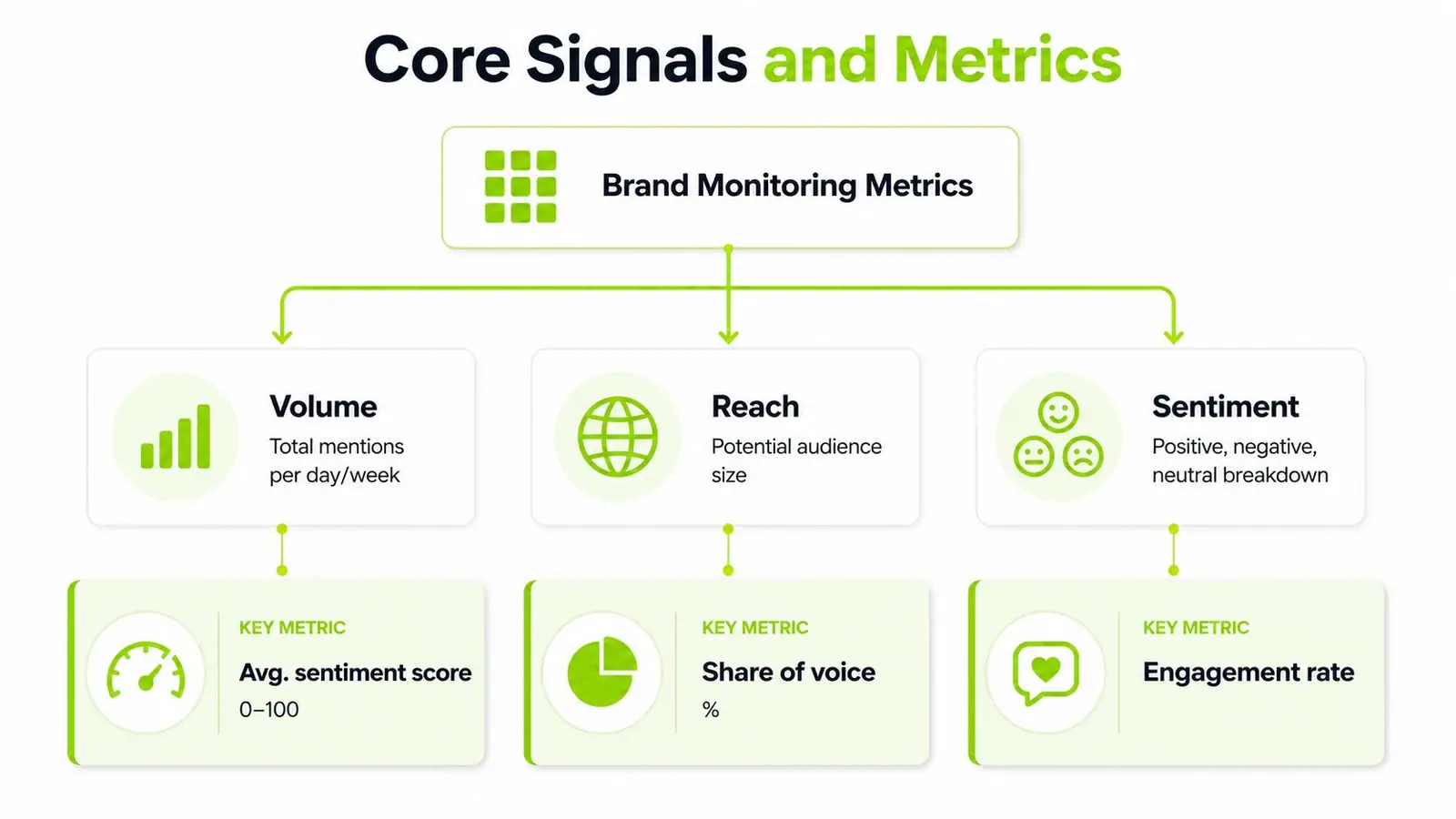
The easiest way to misuse brand monitoring is to stare at one number and treat it like truth. Mention volume tells you how much your brand is being talked about, but it doesn't tell you whether the conversation is useful, damaging, or even about the right entity. A spike can mean news coverage, a customer issue, or a spam wave.
The signals that matter
Sentiment shows the tone of the conversation, usually grouped into positive, negative, and neutral. It's useful, but it can mislead when the sample is tiny or when sarcasm, slang, or industry language gets misread.
Share of voice compares how often you show up versus competitors in a defined category or topic set. It's the metric that helps you understand whether your brand is winning attention in context, not just generating noise.
Reach estimates how many people could see the conversation. That matters because a few highly visible posts can outweigh a much larger but low-impact stream of mentions.
Visibility is the broadest signal here. It asks whether the brand appears at all across surfaces like search, reviews, and AI answers, and whether that presence is stable over time.
A simple dashboard usually works best when it combines one fast signal and one slower signal. Sentiment can tell you something changed today. Share of voice can tell you whether that change is part of a broader pattern. Together, they help a team avoid false alarms.
A weekly dashboard should be boring on purpose. If every chart is important, none of them are.
What to review weekly and what to review later
For weekly review, only a few items are needed.
- Sentiment trend: Watch for abrupt changes that need a human read.
- Share of voice: Check whether competitors are pulling ahead in the same topics.
- High-visibility mentions: Look at the sources most likely to influence buyers or stakeholders.
Monthly or quarterly review is where deeper analysis belongs. That's where you compare topic clusters, source quality, and how visibility shifts align with launches, support issues, or content updates.
Designing a Query Set That Captures Real Coverage
Most monitoring programs fail because the query list is too narrow. If you only track the company name, you miss misspellings, product names, founder mentions, and category language that real customers use. The result is a dashboard that looks clean and is missing the things that matter.
Start with the entity itself. Add the legal brand name, abbreviations, product lines, executive names, and common misspellings. Then add branded hashtags, competitor names, and category terms so you can measure context and share of voice. If you're in a crowded category, this step is what separates a useful system from a glorified alert feed.
Negative keywords matter too. They cut out job listings, unrelated industries, spam, and duplicate noise that would otherwise bury the mentions. Entity disambiguation is the other half of the job, especially when a brand name is also a common word or a person's name. Without that, you spend time reading irrelevant mentions and undercounting the conversations that matter.
| Query Type | Example | Purpose |
|---|---|---|
| Brand name | “Acme” | Capture direct brand mentions |
| Product line | “Acme Cloud” | Track product-specific discussion |
| Misspelling | “Acmme” | Catch typo-driven misses |
| Executive name | “Jordan Lee” | Monitor leadership visibility |
| Competitor name | “Northstar” | Measure share of voice |
| Category term | “project management platform” | Catch unbranded discovery conversations |
A good query set isn't static. Teams should review it when product names change, campaigns launch, or a new competitor enters the market. That's especially true for AI-search coverage, where prompt wording changes the answer set, which is why many teams pair brand queries with an AI tracking workflow like how to track brand mentions in AI search.
Typical Workflows, Tools, and Automation
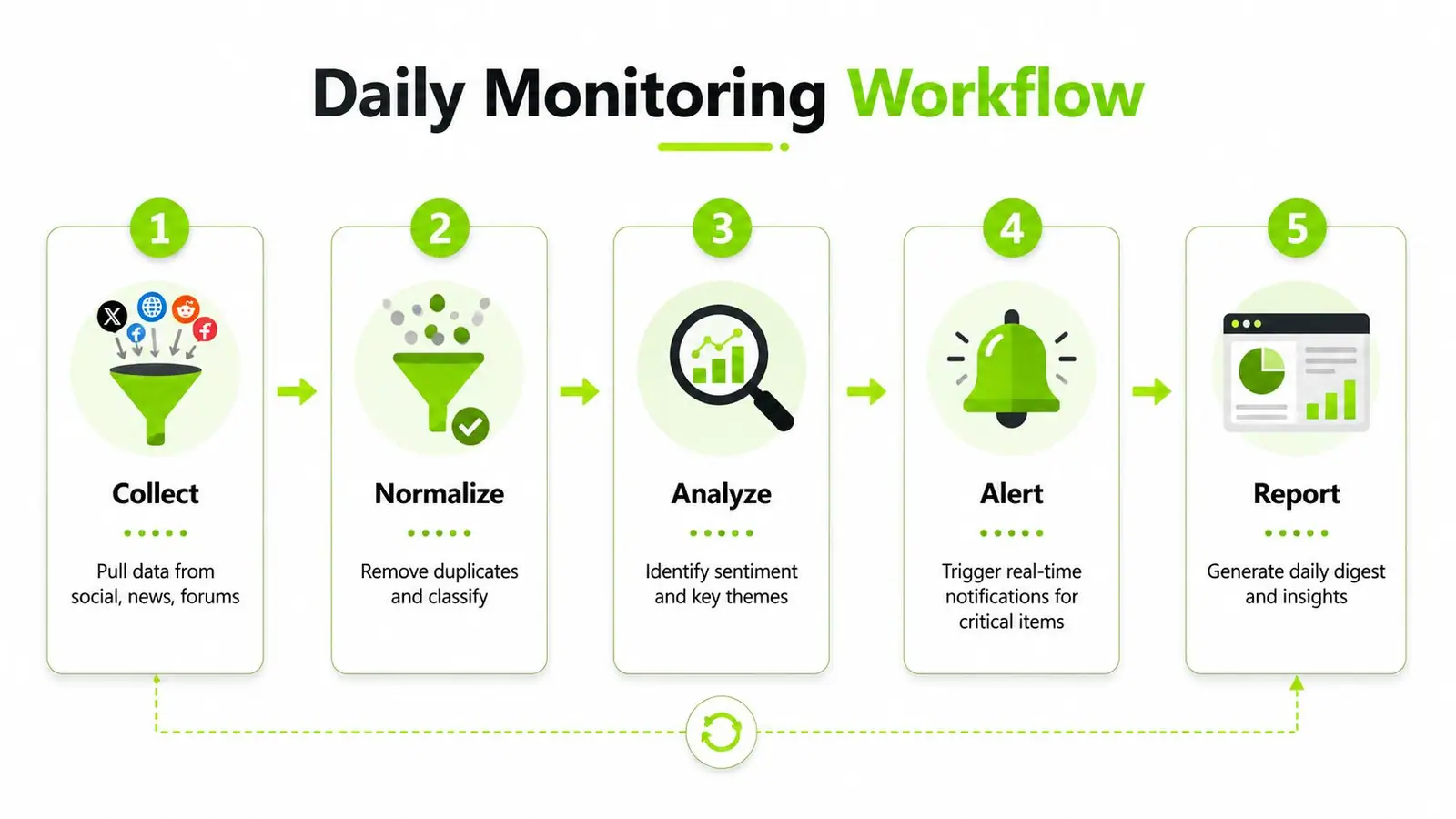
The day-to-day workflow is more mechanical than expected. Data comes in from sources, the system removes duplicates, tags entities, scores sentiment, and then routes the result into dashboards or alerts. That pipeline sounds basic, but every weak step creates bad reporting later.
How the workflow usually runs
Collection comes first. Brands pull from social channels, news, forums, review sites, and search surfaces. Then normalization cleans up repeated items and makes source formats consistent.
After that, enrichment adds context. That's where sentiment labels, topic tags, and entity tags make the raw feed readable. Once the data is usable, alerts and dashboards turn it into something the team can act on.
Where tools and APIs fit
Some teams use dedicated brand monitoring platforms. Others stitch together social listening tools, search monitoring tools, and custom APIs. For agencies and larger in-house teams, the deciding factor is usually less about features and more about whether the stack can route the right item to the right person without manual copy-paste.
Automation is what makes the workflow scalable. Scheduled digests reduce inbox clutter. Webhook alerts can push critical mentions into Slack or a ticketing system. CRM integrations help account teams turn a public mention into a customer follow-up instead of a screenshot buried in chat.
The practical benchmark from XBurst's key metrics for social media monitoring is useful here, because it reinforces that metrics only matter when they connect to response. The same logic applies across brand monitoring. If no one owns the next action, the metric just becomes decoration.
Some platforms now unify SEO and AI visibility signals in one view, which matters because teams often treat search, social, and AI discovery as separate jobs. Surnex is one option in that category, since it tracks brand presence in AI-generated answers alongside core SEO metrics, but the takeaway is the workflow, not the brand name. The strongest setups turn raw mentions into a named owner, a due date, and a visible decision.
How AI Overviews and LLMs Change the Game
AI answers changed brand monitoring because they sit between search demand and public perception. A user can ask a question in Google's AI Overviews, an AI mode, or a chatbot, get a synthesized response, and leave with a brand impression without ever clicking a result. That means visibility is no longer just a ranking problem, it's an answer-shaping problem.
Traditional monitoring definitions mostly stop at social, news, forums, and reviews. That misses the fact that an AI system can mention your brand, omit it, or replace it with a competitor based on the sources it has absorbed. The practical issue isn't only whether the brand appears, but whether the answer is accurate, cited, and competitive in context.
What to measure on AI surfaces
The first metric is simple presence. Does the brand show up in the answer for relevant prompts? If not, that's a visibility gap.
The second is attribution quality. Which sources are cited, and do those citations point to your own content, third-party coverage, or a competitor's footprint? If the answer consistently points elsewhere, that becomes an SEO and content problem, not just a monitoring issue.
The third is competitor substitution. When an LLM swaps your brand for another one in a recommendation or comparison, that's a share-of-voice shift on a new surface. It matters because the user is often at the decision stage already.
Useful frame: An AI answer is a mention, a citation, and a recommendation surface all at once.
Prompt-based monitoring helps here. Teams can track a fixed set of queries over time, then compare how answers change after a model update, a content refresh, or a major news event. That's also why many teams now include AI discovery in their monthly visibility review rather than treating it as a side project.
For teams building a process around this, AI Overview tracker is a relevant operational reference, especially when you need to connect prompt changes to citation gaps. The larger lesson is that brand monitoring in 2026 has to follow the user journey, not just the mention stream.
Common Pitfalls and How Mature Teams Avoid Them
The failures are predictable. Ambiguous brand names create false positives, noisy thresholds create alert fatigue, and raw mention counts get mistaken for progress. A lot of teams also lean too hard on one source, usually social, and then act surprised when review sites or AI answers tell a different story.
The fix usually starts with governance. Someone has to own the query rules, someone has to decide what counts as a crisis, and someone has to answer when a public response is needed. Without that, monitoring turns into a reporting ritual that nobody trusts.
Mature teams also tune alerts on a schedule instead of leaving them frozen. If an alert never led to action, it's noise. If the same issue keeps recurring, the threshold is probably wrong or the escalation path is unclear.
For review-heavy businesses, handle fake Google reviews effectively becomes relevant, because reputation work often breaks first at the review layer. Many teams also overlook unlinked mentions, which is why unlinked brand mentions deserve a place in the workflow when SEO and PR overlap.
Building Your First Brand Monitoring Program This Quarter
Start with goals, not tools. Decide whether you're protecting reputation, tracking visibility, or benchmarking competitors, then pick the first three metrics that match that goal. After that, build the query set, list the source types, and define who owns triage.
By week six, your team should have a working dashboard and clear escalation rules. By week twelve, review which alerts led to action, which sources mattered, and which queries need tightening. The best programs stay small at first, then expand only after the team trusts the data.
AI discovery will keep changing what gets measured, so the job isn't to freeze the system. It's to keep it adaptable enough that your brand doesn't disappear when the surface changes.
If you want a cleaner way to track how brands surface across search and AI answers, visit Surnex and see how its visibility tracking, citation gap analysis, and SEO metrics work together in one place. It's built for teams that need monitoring data they can act on, not just another dashboard to check.