Unlinked brand mentions are no longer a side quest for link builders. In 2026, industry analysis says branded web mentions are up to 3 times more influential than backlinks for citations in large language models, while another analysis found a Spearman correlation of 0.664 between branded web mentions and AI Overview visibility, compared with 0.218 for backlinks (LLM Pulse's glossary on unlinked brand mentions). That changes the job. A mention that used to be “nice to have” can now shape both classic search performance and the way AI systems decide what to cite.
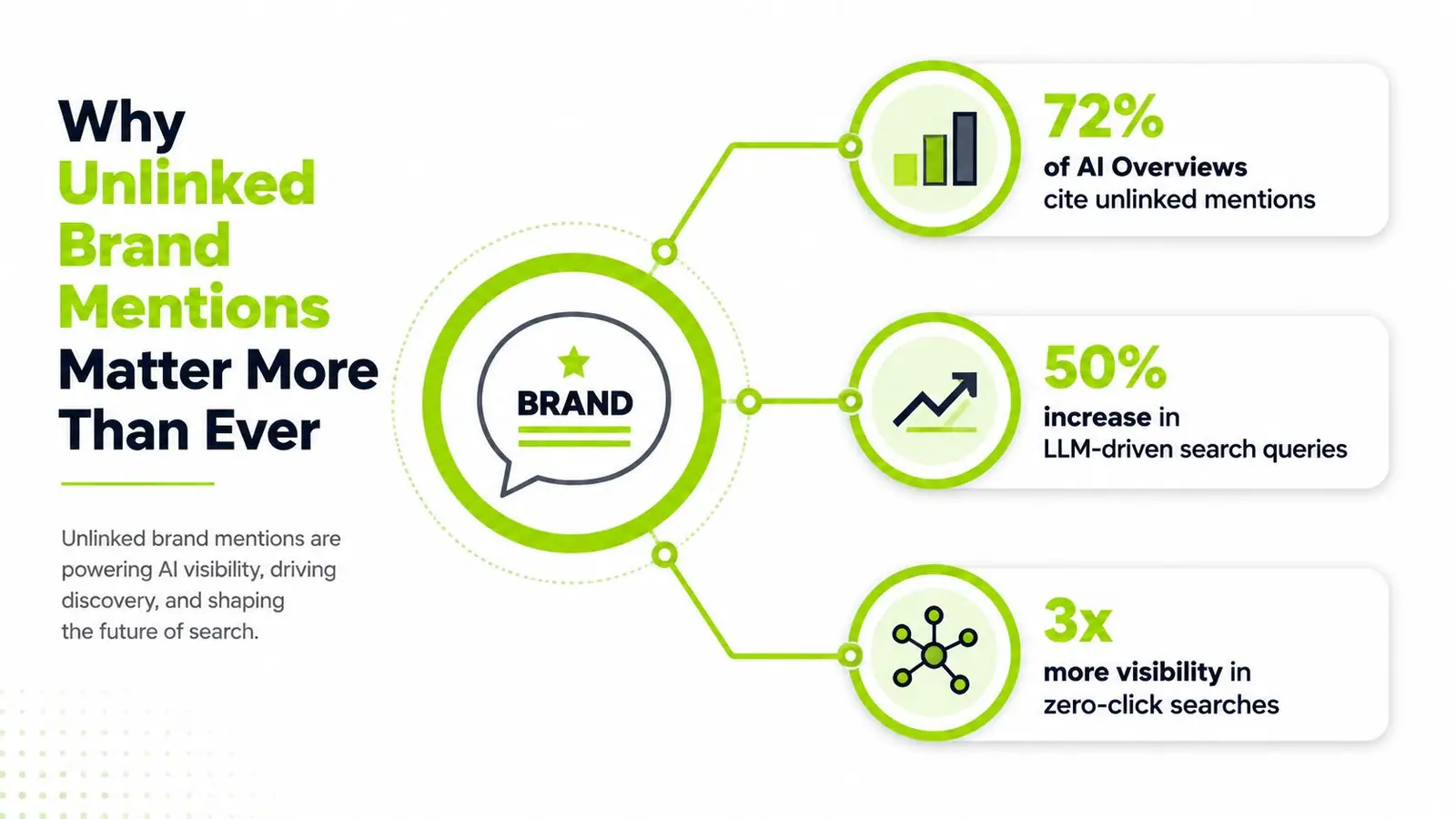
The practical implication is simple. Earned mentions now matter more because they're external signals, and a 2026 analysis says 85% of brand mentions in AI search came from sites the brand doesn't own or control (LLM Pulse). Owned properties still matter, but they don't create the same external proof that a brand exists in the wider web conversation. When teams treat every unlinked mention as a link request, they miss the bigger opportunity, which is to turn real-world brand visibility into both backlinks and AI citations.
For teams already thinking about AI search, that means unlinked brand mentions sit at the intersection of digital PR, SEO, and entity visibility. Google says AI Overviews and AI Mode reach billions of users monthly, which makes the gap between “mentioned” and “cited” more important than it was in the classic ten-blue-links era (Search Engine Land guide to unlinked mentions). The brands that benefit most are the ones that can find the right mentions fast, verify them carefully, and decide which ones deserve outreach.
If you're also tracking how mentions surface inside AI experiences, the operational side gets even more important. Surnex has a guide to tracking brand mentions in AI search, including how to separate mentions, citations, and competitor co-mentions, which is useful when you're trying to understand where your brand is visible but still not linked Surnex's AI search tracking guide.
Why Unlinked Brand Mentions Matter More Than Ever
The old framing was too narrow. Unlinked brand mentions were treated as a recycling bin for missed backlinks, useful when convenient but not worth a dedicated program. That view breaks down once you look at how AI search systems surface brands, sources, and entity relationships. If branded web mentions now influence LLM citations and answer visibility, the mention itself belongs in your visibility strategy, not just your link reclamation queue.
Owned versus earned signals
Owned mentions are the ones you control, your blog, your newsroom, your resource pages, and your docs. Earned mentions live elsewhere, on editorial sites, community posts, podcasts, listicles, and industry roundups. The distinction matters because AI systems and search engines have to trust the web beyond your own domain, and the strongest trust signals often come from third-party language around your brand.
A lot of teams still treat every mention as a broken handoff that should become a link. That misses what is happening. If a reputable site mentions your brand in context, it is already contributing to how the market and search systems understand you. Converting that mention into a link is often worth doing, but the mention itself may already be helping with AI visibility and entity recognition.
Practical rule: if a mention appears on a site that AI tools already treat as authoritative in your niche, the visibility value may justify outreach even when the SEO link equity looks modest.
Why the business case changed
The business case is stronger because the surface area changed. Google's AI Overviews and AI Mode now reach billions of users monthly, so the payoff from being represented accurately in third-party content is no longer limited to a single ranking slot (Search Engine Land). Teams that only measure backlinks will miss the part where brand language shapes citations, summaries, and answer engines.
The biggest shift is that most visibility signals are earned externally. That makes a systematic process worth the effort. If 85% of AI search brand mentions come from sites you do not control, you need a repeatable way to find, sort, and prioritize those mentions before they age out or get buried (LLM Pulse). Unlinked mention campaigns stop being opportunistic at that point and start becoming operational.
For teams that want to track how mentions surface inside AI experiences, the measurement workflow matters as much as the outreach list. See the AI search tracking workflow for a practical way to separate mentions, citations, and competitor co-mentions. The goal is not to replace backlinks, but to treat mentions as a parallel visibility asset that can influence both traditional rankings and AI citations.
Finding Unlinked Mentions at Scale
A mention is only useful if you can find it quickly and confirm it still exists. Start with branded queries in a content discovery tool, then look for exact-match mentions that do not already point to your site. Ahrefs Content Explorer makes that process practical, search your brand terms in quotes, review the results, and export the list for manual qualification. Content discovery workflows matter here because they give you a repeatable way to surface third-party pages before they drift into the background.
Build the discovery stack
Ahrefs is useful, but it should sit inside a wider monitoring stack. Google Alerts can catch fresh mentions, news tools can surface coverage that SEO platforms miss, and social listening can pick up posts that never show up in standard crawlers. The goal is not to chase every alert, it is to keep a steady intake of new mentions so outreach happens while the page is still current.
Use a weekly scan as the operating rhythm, then sort the results by quality before anyone sends an email. A first-pass filter based on domain authority, page traffic, and editorial fit cuts the noise fast. Low-authority pages are not worthless, they just should not crowd out pages that have real audience and context.
- Search branded terms in quotes: This catches exact mentions where your name appears in the body text, not only in metadata.
- Apply the unlinked filter carefully: It helps narrow the list, but it is not perfect, so false positives will still appear.
- Export to CSV: This makes review easier, especially when several people need to work from the same list.
- Verify before outreach: Check whether the page already links out, whether the mention is real, and whether the page can still be edited.
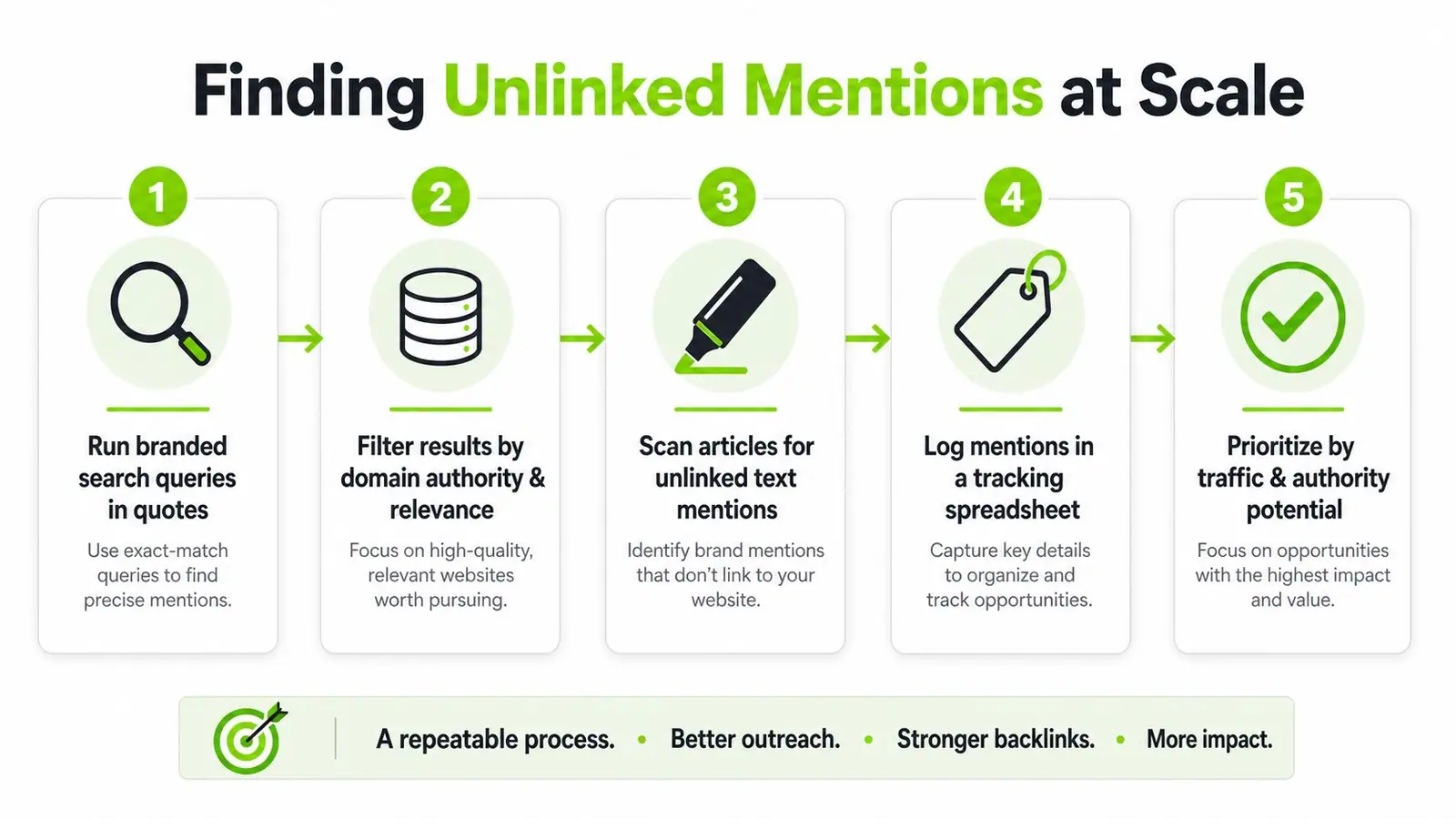
The teams that convert this work into links and citations do not trust a single filter. They collect candidates with automation, then use human review to separate real opportunities from dead ends.
Why human review still matters
Automation surfaces volume. It does not tell you whether the mention sits on a page worth targeting, whether the tone is favorable, or whether the publisher can make an edit. A forum post, a syndicated article behind a locked template, or a brand list with no outbound editorial links can all look promising and still produce no link.
Manual qualification keeps the queue honest. The objective is a short list of pages where a link request feels natural, useful, and worth the exchange. If the page cannot realistically change, move on and protect the relationship for a better target.
That is also where automated SEO monitoring helps. It turns discovery into a recurring process instead of a one-off cleanup, so you can act while the mention is still fresh enough to matter for rankings and AI citations.
Prioritizing Which Mentions Deserve Outreach
A mention only becomes a target when the page, the publisher, and the context all support a real edit. Teams that do this well treat prioritization as a filter for both link equity and AI visibility, since the mentions most likely to be cited by people are often the ones most likely to be surfaced by LLMs later. The work gets better fast when you stop treating every mention as equal.
Mention Prioritization Matrix
| Criteria | High Priority | Medium Priority | Skip |
|---|---|---|---|
| Domain strength | Strong authority and a real editorial footprint | Decent authority, but mixed quality | Thin, noisy, or obviously low value |
| Page traffic | The page gets visible attention or sits on a useful URL path | Traffic is unclear but the site is credible | No meaningful audience signal |
| Context | The mention is positive, specific, and easy to improve with a link | The mention is neutral and may need a light pitch | The surrounding content makes outreach feel forced |
| Link behavior | The site has linked to brands before | The site occasionally links out | The site rarely or never links externally |
| Contactability | Easy to identify an editor or author | Contact is possible, but slower | No realistic path to the right person |
What converts and what stalls
A practical starting point is to look for pages on stronger domains, then check whether the page itself has enough relevance to justify the ask. A cited mention on a page that already covers your topic usually converts better than a stronger domain with weak context. For a quick refresher on how different placements behave, this overview of backlink types is useful because it shows why some mentions are easier to turn into links than others.
Page-level fit matters more than vanity authority. A page with lower domain strength can still be a good target if it has real readership, a clean editorial structure, and a clear reason to point readers to a source. That is especially true for mentions that already sit near product comparisons, expert roundups, or category explainers.
A strong target gives the editor a clear reason to help the reader. A weak one gives you a chore to sell. If the mention is buried in a generic roundup or a loosely related list, response rates usually fall because the link request feels like extra work without much reader value.
Decision rule: if the page would not clearly help readers by adding a source, skip it.
Sentiment and opportunity cost
Tone changes the odds. A positive mention makes the request easier because the author has already signaled trust. A neutral mention can still be worth pursuing if the page has real visibility, but a strained or off-topic mention usually costs more time than it returns.
Opportunity cost is the part many teams ignore. A spreadsheet full of possible targets can look productive while the actual reply rate stays weak. I would rather work twenty clean prospects than one hundred mixed ones, because the outreach stays sharper and the team avoids wasting energy on pages that were never likely to move.
The metric that often helps here is not raw authority, it is the chance that the page can earn a real click, a real citation, or a real mention in an AI summary. That is why a mention with clear context, some editorial care, and an easy contact path often beats a bigger site that rarely links out.
A useful way to judge priority is to ask a simple question. Would this page make sense as a source if a reader wanted to verify the claim? If the answer is yes, the outreach is usually worth testing. If the answer is no, leave it alone and spend the time on stronger candidates.
Outreach Templates and Follow-Up Cadences That Convert
The email should be short, specific, and respectful. The best versions reference the exact mention, explain why a link would help readers, and suggest a relevant destination URL instead of dumping everyone onto the homepage. Generic outreach gets ignored because it looks like a mass blast, and busy editors can spot that instantly.
Timing beats cleverness
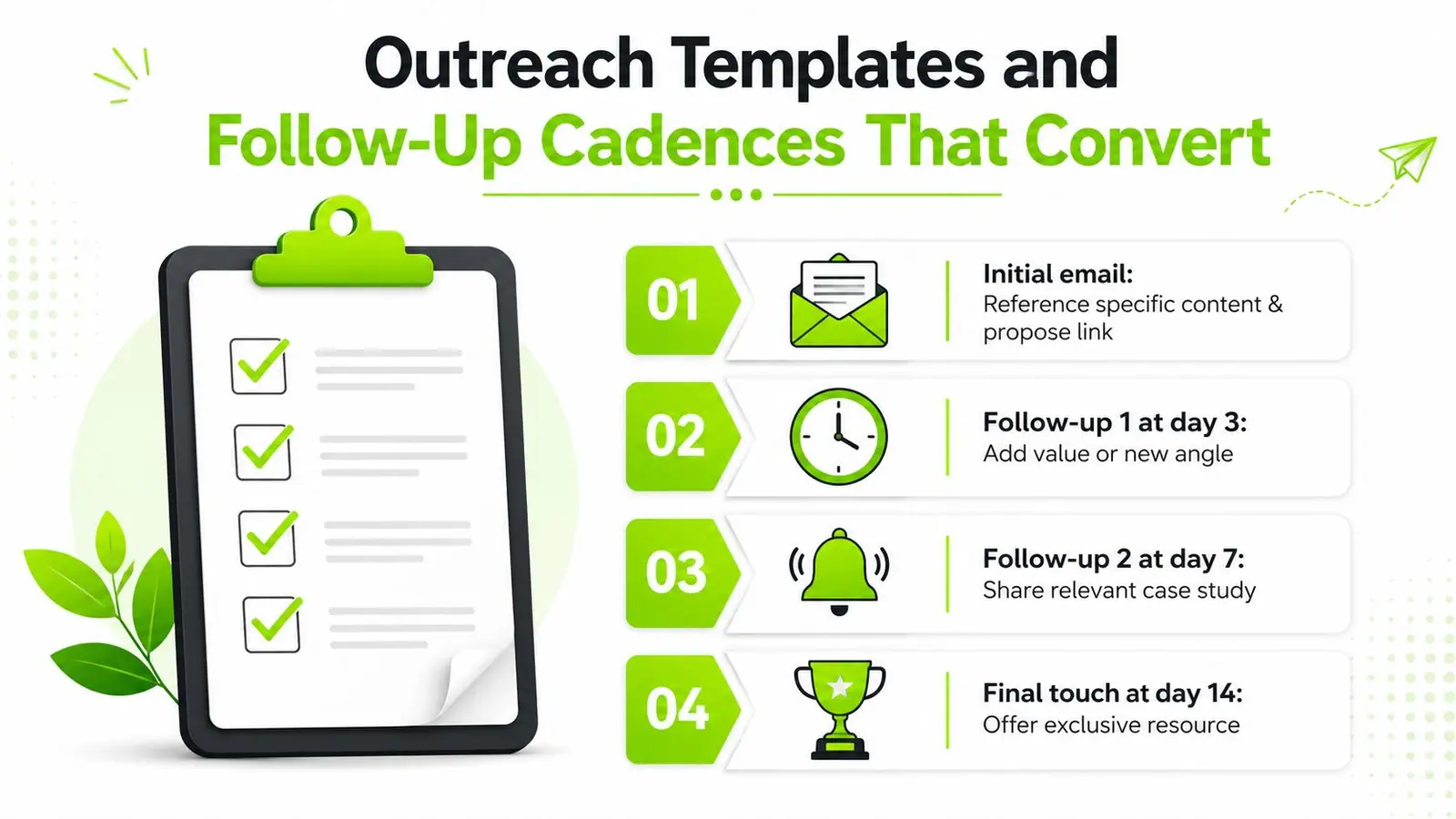
BuzzStream recommends reaching out within 24–48 hours of discovering a mention, because the closer the email lands to the original publication, the better the odds of a response (BuzzStream). That timing window matters because authors are still thinking about the piece, the page is still fresh, and the request feels tied to something they just published.
A short follow-up is fine. HubSpot's advice is to send only one follow-up after 7–10 days if there's no reply, and keep the email under five sentences (BuzzStream). More than that starts to feel like pressure, and pressure is where goodwill disappears.
A simple structure works well:
- Acknowledge the mention. Thank them for including your brand and name the page.
- State the request directly. Ask whether they'd add a web address for context.
- Point to a relevant URL. Don't force the homepage if a product page or guide fits better.
- Keep the tone easy. The writer should be able to say yes without re-reading the message three times.
A cleaner template
Hi [First Name],
Thanks for mentioning [Brand] in your [Page Title] piece. Would you be open to adding our page here, [preferred URL], so readers can find the source directly?
Thanks again for the coverage.
That's enough in many cases. Long explanations usually weaken the ask, especially when the value is already obvious from the mention itself. If the page is strong and the mention is clear, the email should feel like housekeeping, not negotiation.
For a useful look at why campaigns get ignored, the Mailwarm piece on why emails get no replies is worth reading before you blame the target. A lot of failures come from vague asks, bad timing, or using the wrong destination URL.
What burns bridges
The common failure mode is over-contacting weak targets or asking for a homepage link on a page where a deeper URL makes more sense. Another mistake is trying to sound clever in the subject line. Clean beats cute here.
Practical rule: if the writer can fix the mention in one quick edit, your email is probably short enough.
Log every attempt. Track the mention source, contact date, reply date, result, and destination URL used. Once you do that across a few campaigns, patterns start showing up, and your team can see which kinds of mentions convert.
Automating Discovery and Tracking with Tools and APIs
Manual workflows work when you're handling a few mentions a week. They break down fast when you're juggling multiple brands, multiple markets, or a client roster that never stops changing. That's where automation becomes the difference between a useful process and a spreadsheet nobody opens.
A smart setup starts with alerts feeding into one queue, not five disconnected tools. Content explorer exports, Google Alerts, CRM notes, and outreach statuses should all land in a system that makes review easy. If the team has to retype data every time a mention appears, the process will decay.
Build the pipeline
A practical version looks like this. Monitoring catches a new mention, the mention gets routed into a qualification list, and approved items move into outreach. The important part is that each step has a clear owner, because automation alone won't decide whether a page is worth contacting.
This is also where API connections become useful. Surnex documents a searchable approach to its SEO tool API, and that kind of integration pattern is what turns mention tracking into a repeatable system instead of a manual task. You can push alerts into a CRM, sync approved prospects into outreach software, and keep status changes visible across the team.
What to automate first
- Alert ingestion: Pull new mentions into one shared queue instead of checking tools individually.
- CSV handoff: Export qualified pages into outreach tooling so the team doesn't rebuild lists by hand.
- Status sync: Mark a mention as approved, contacted, replied, or won in one place.
- Reporting layers: Show which mentions led to links, which stalled, and which never deserved outreach.
There's a broader reputation angle too. For teams handling public-facing brands, ORM tools guidance for PR teams is useful because the same monitoring discipline that catches reputational issues also catches valuable mentions before they go cold.
Why AI visibility belongs in the same dashboard
Mention tracking shouldn't stop at links won. If a brand appears in AI-driven discovery or answer experiences, that's part of the same visibility story. A platform that unifies AI visibility tracking with backlinks and audits gives stakeholders one place to look, which makes the campaign easier to defend and easier to scale.
That matters for agencies especially. When clients ask what changed, the answer can't just be “we got more mentions.” It needs to show where the mentions appeared, which ones turned into links, and how the brand's presence shifted across both traditional search and AI surfaces.
Measuring SEO and Business Impact
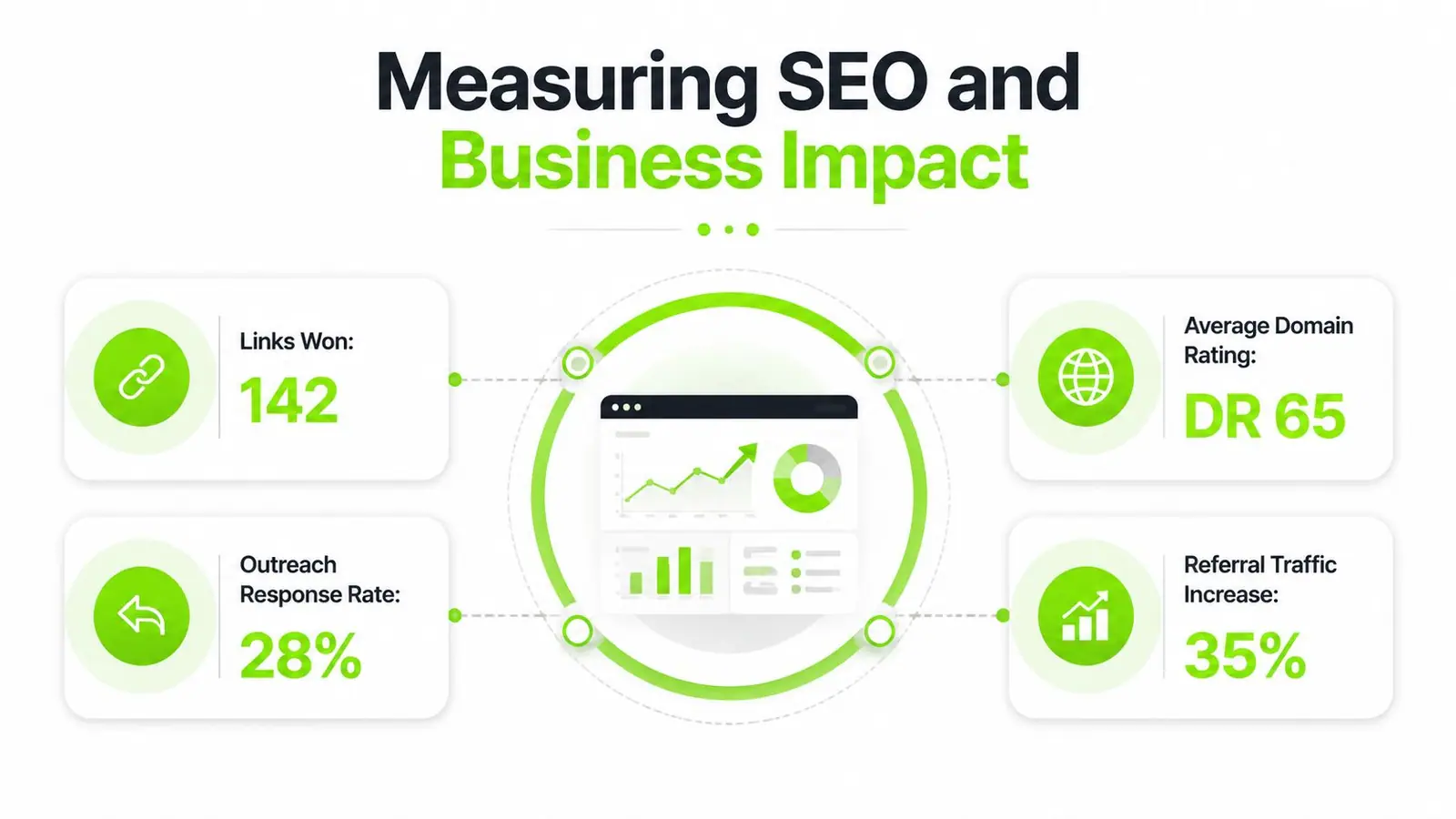
The cleanest read on unlinked brand mentions starts with the closest signals to revenue and search performance. Track links won, response rate, the authority level of the acquired links, referral traffic from converted mentions, and changes in AI Overview visibility for branded queries. Those metrics show whether the work is improving visibility across search and AI surfaces, or just creating activity in the outreach queue.
Close the loop
Attribution works best when you connect the source URL of the mention to the final linked page. If the mention became a link, record the destination URL, the contact date, and the reply time. If it did not convert, log the reason instead of leaving the outcome blank. That level of discipline is what lets you compare campaigns over time without relying on memory or anecdote.
For stakeholder reporting, keep the story simple. Show how many opportunities were qualified, how many were contacted, and how many became links. Then pair that with the AI visibility side, because brands now need to understand both link equity and citation presence. Google's AI Overviews and AI Mode reaching billions of users monthly means visibility cannot be measured only by classic ranking reports, as noted in Search Engine Land.
Read the signals together
A strong campaign does more than win links. It changes how the brand appears in the wider search ecosystem. If a mention converts on a relevant page, it can support referral traffic and stronger topical association. If the same brand also appears more consistently in AI-driven results, the campaign is doing work on both sides.
Use one reporting view for decision-making and one for storytelling. Leadership wants to know whether the work is worth repeating. Practitioners want to know which kinds of mentions convert, which authors reply, and which site types waste time.
Lead Printer's blog is a useful reference point if you need adjacent ideas on outreach and acquisition workflows, but the core discipline stays the same. The teams that win here are the ones that measure the full path from mention discovery to citation, not just the final link.