A lot of South Carolina businesses are doing good work offline and getting buried online. The Charleston hotel with strong repeat bookings. The Greenville industrial supplier with a solid sales team. The Columbia law firm that wins referrals. The Myrtle Beach home services company that stays busy in season. They all have the same problem when search underperforms: the market assumes they're less visible because they're less relevant.
That usually isn't the core issue.
The issue is that generic SEO advice doesn't match how South Carolina demand operates. Search behavior shifts by city, by industry, by season, and now by interface. A local service business isn't competing the same way as a tourism brand, and neither one should plan visibility as if Google's ten blue links are the whole game anymore.
Why Generic SEO Fails in South Carolina
South Carolina SEO fails when teams treat the state like one uniform market. It isn't. Charleston and Myrtle Beach have heavy visitor intent. Greenville and Spartanburg often revolve around industrial, B2B, and multi-location demand. Columbia has government, education, healthcare, and professional services in the mix. A statewide strategy that uses one service page template, one content calendar, and one reporting view usually spreads effort too thin.
The other reason generic playbooks fail is competition. South Carolina's SEO market is established, not early-stage. DesignRush's South Carolina directory listed 121 SEO companies as of April 18, 2026, which tells you two things at once. First, businesses in the state already understand SEO as a mainstream marketing channel. Second, average work won't stand out for long.
If you're looking for a South Carolina-specific perspective from another operator, this local SEO playbook for SC is useful because it keeps the discussion grounded in local business realities instead of abstract ranking theory.
One state, different search economies
A Charleston restaurant group needs search coverage for branded queries, map visibility, menus, reviews, and nearby discovery. A Greenville manufacturer may need product pages, spec-driven content, distributor visibility, and location signals for multiple service areas. A coastal vacation brand has to think about seasonal swings and non-local searchers planning a trip before they ever arrive.
Those are not small variations. They change page structure, conversion paths, content formats, and even what “local intent” means.
Practical rule: If your strategy looks like it could be copied from any U.S. city page, it probably won't win in South Carolina.
The old SEO model is too narrow
Many teams still define SEO as rankings for a keyword set plus some blog content. That misses how discovery now works. Google Business Profile, reviews, local landing pages, structured data, and AI-generated answers all shape whether a South Carolina business gets seen.
That's why I'd strongly recommend adding generative search into your thinking early, not after your traditional campaign is already built. A good primer is this explanation of what generative engine optimization means in practice. It helps frame why authority, citation clarity, and answer-ready content now matter beyond classic SERP positions.
Generic SEO doesn't fail because the advice is always wrong. It fails because it ignores context. South Carolina rewards businesses that align their search strategy with the state's real buying patterns, local geography, and changing discovery behavior.
Mastering Your Local Presence on Google and Beyond
For most South Carolina businesses, local visibility starts before a visitor reaches your website. Your Google Business Profile, your directory listings, and your reviews often create the first impression. Think of them as your digital storefront, your business cards distributed around the web, and your public reputation.
That matters because local search behavior is frequent and action-oriented. One industry compilation reports that 84% of consumers search online for local businesses daily, 45% default to Google for location-specific searches, and 89% expect business owners to respond to reviews (local search behavior data). If your local presence is incomplete, inconsistent, or ignored, you're leaking demand before SEO on the site can even help.
Here's the local framework I use most often.
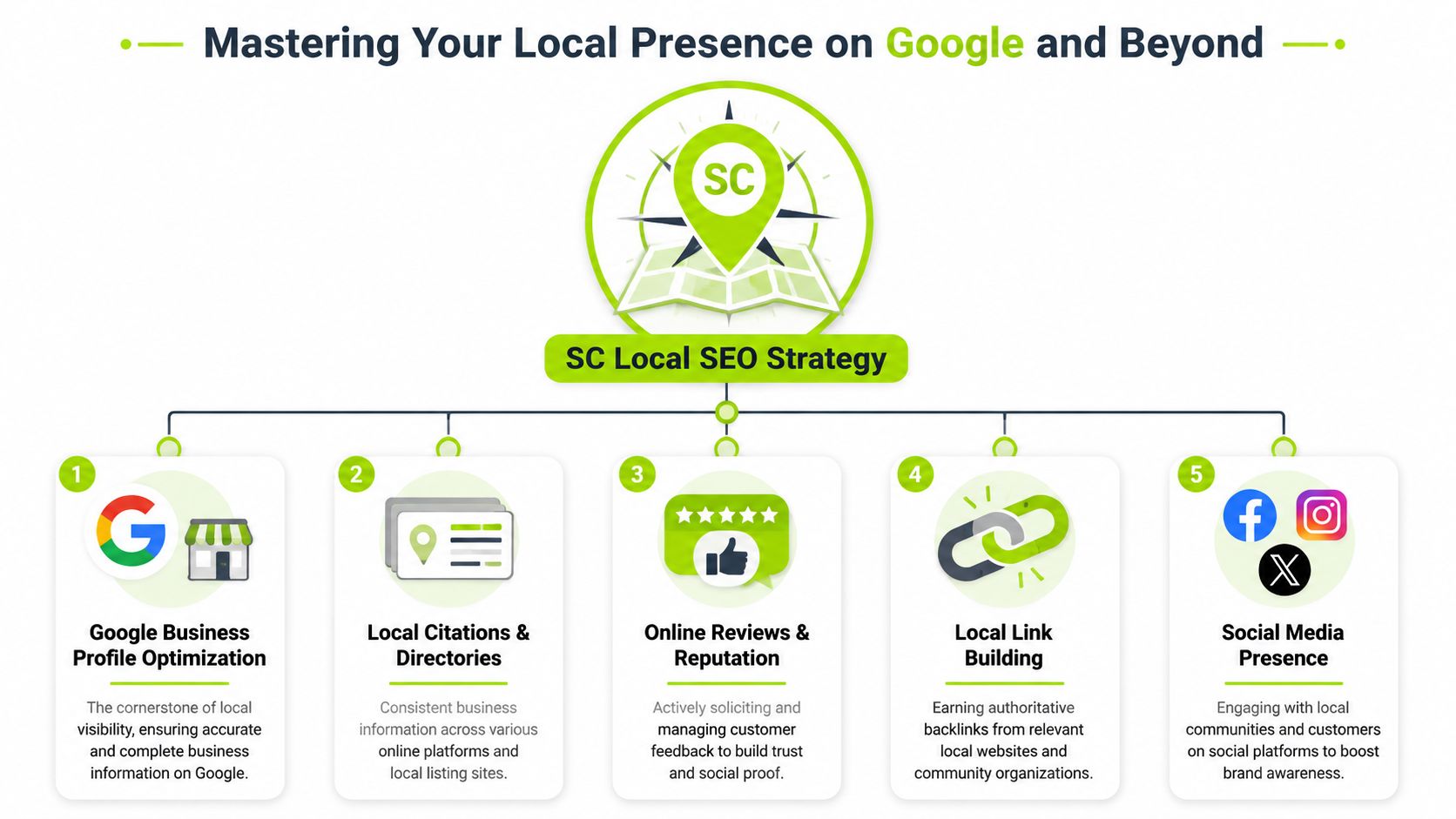
Build the Google Business Profile correctly
Claiming a profile isn't optimization. Plenty of South Carolina companies stop at the basics and wonder why nearby competitors outrank them in the map pack.
Your profile should be complete, current, and aligned with how customers search. Focus on these areas:
- Primary category choice: Pick the core service, not the broadest possible label.
- Service descriptions: Write them for humans first, but include location-relevant phrasing naturally.
- Hours and exceptions: Keep holiday and seasonal changes accurate, especially in tourism-heavy markets.
- Photos: Use real location imagery, team shots, storefront images, and work examples.
- Service areas: Define them carefully if you travel to clients instead of serving from a storefront.
If your team needs a simple walkthrough for setup and verification basics, this guide on effective Google Maps setup for local brands is a useful companion.
A strong profile doesn't just help maps. It helps Google connect your business to local intent across branded and non-branded searches.
Clean up citations before you chase links
Citations are mentions of your business name, address, phone number, and other key details across directories and listing platforms. In South Carolina, this gets messy fast for franchises, healthcare groups, law firms, contractors with old addresses, and companies that changed phone systems.
Use one canonical business format and push it everywhere. Don't let one directory say “Suite 200” while another omits it. Don't use tracking numbers in one place and a main line in another unless your attribution setup is deliberate and documented.
A messy citation profile tells search engines your business details might be unreliable. That weakens local confidence even when your website looks polished.
For teams that want a broader service framework around listings, reviews, and nearby rankings, this overview of best local SEO services is worth reviewing.
Treat reviews like part of operations
Reviews are not a side task for the intern or something to revisit once a month. In local SEO, review management is part customer service, part conversion optimization, and part visibility work.
A practical review process looks like this:
- Ask at the right moment. Right after a job is completed, a guest checks out, or a client issue is resolved.
- Make it easy. Use direct links and simple instructions.
- Respond consistently. Thank positive reviewers and address complaints clearly.
- Look for patterns. Repeated complaints about wait times, scheduling, or communication often signal operational friction that also hurts conversion.
Later in the buying journey, your website takes over. But for local discovery in Columbia, Charleston, Greenville, and similar markets, these off-site signals are the entry point.
A short walkthrough can help if your team wants the local basics explained visually.
Optimizing Your Website for South Carolina Searchers
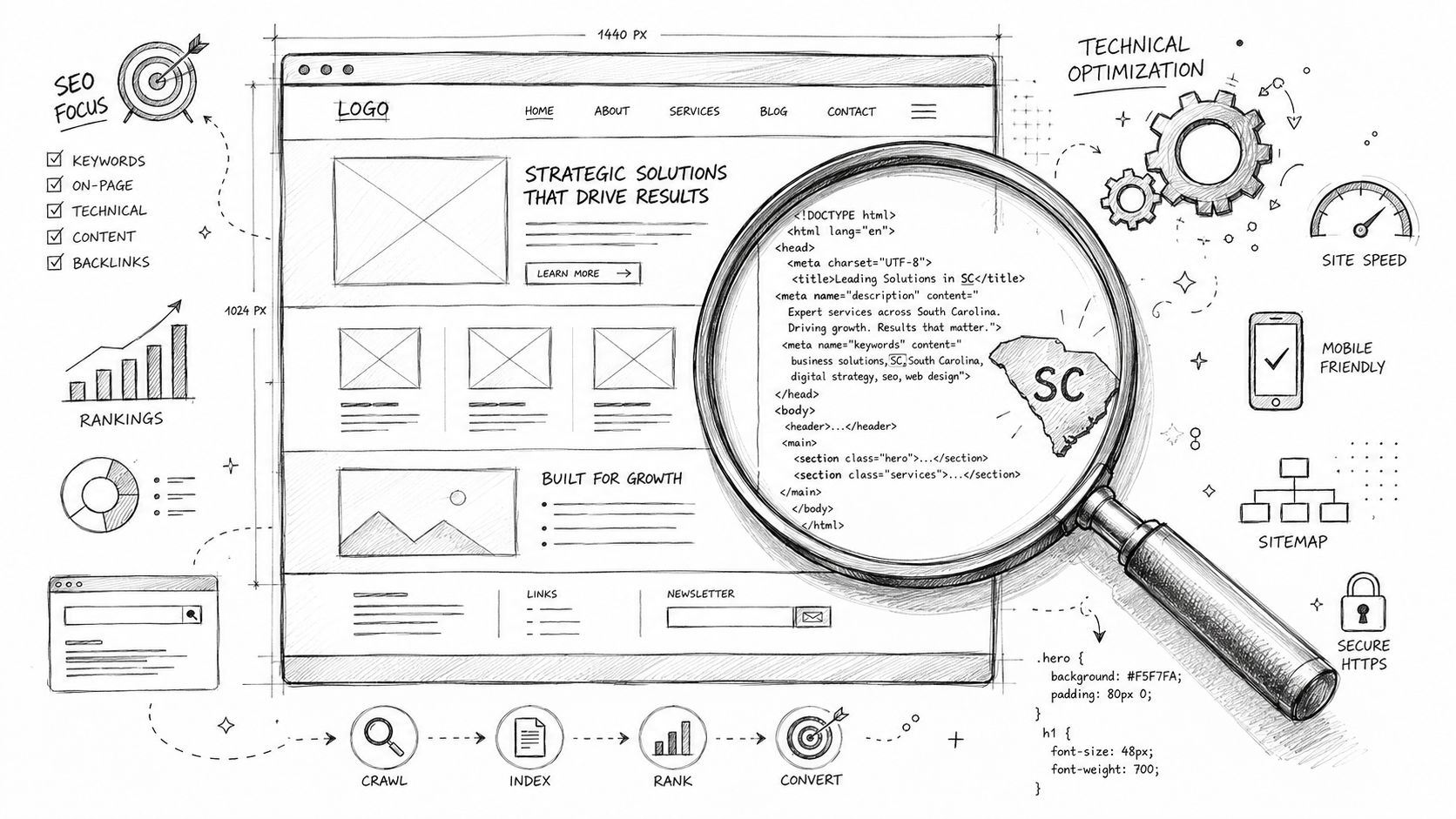
Your website is where local relevance gets confirmed. Google can see a solid profile and strong external signals, but if the site is thin, slow, vague about service areas, or hard to crawl, rankings stall.
South Carolina SEO on-site work needs to solve two jobs at once. It must help search engines understand where you operate and what you do, and it must help a real visitor decide whether you're the right fit in that location.
Build real location pages, not swapped-city duplicates
One of the most common mistakes in South Carolina SEO is cloning the same service page across cities and changing only the place name. Search engines have seen that pattern for years. Users recognize it even faster.
Good location pages do four things:
- Match the local offer: An HVAC company in Myrtle Beach may need content that speaks to coastal conditions and seasonal volume, while a Spartanburg page may need different service emphasis.
- Show proof of local presence: Include office details, service area specifics, staff references, project examples, or locally relevant FAQs where appropriate.
- Clarify intent: Separate “we serve this city” from “we have an office here” if that distinction matters.
- Support the conversion path: Calls, forms, directions, quote requests, and trust signals should reflect the location context.
A statewide company should usually build a hub-and-spoke structure. Core service pages explain the offer. City or regional pages localize demand. Supporting blog and resource content answers market-specific questions.
Use structured data and clean architecture
Technical SEO matters more in local search than many businesses realize. Regional providers in South Carolina explicitly tie local visibility to Google Business Profile optimization, structured data, and consistency across listings, along with broader technical work such as performance and crawlability (regional South Carolina technical SEO framing).
In practical terms, that means your site should make these signals easy to interpret:
- Business identity: Name, address, phone, business type, hours, service area
- Page purpose: What the page is about, who it serves, and where
- Internal pathways: Clear navigation from services to locations to supporting content
- Indexing clarity: No orphan pages, accidental noindex issues, or duplicate versions fighting each other
If your site has grown over time and feels hard to manage, start with a full review process instead of random fixes. This guide on how to do a website audit is a practical place to reset your priorities.
Performance affects local conversion too
A slow website doesn't only hurt rankings. It lowers trust. That's especially costly for mobile users checking hours, looking for directions, comparing nearby providers, or booking during travel.
Watch for these friction points:
- Heavy image pages on restaurants, hotels, and real estate sites
- Bloated templates on multi-location service websites
- Weak mobile layouts that bury contact actions
- Thin page hierarchy that makes it hard to move from a city page to a relevant service page
Your website shouldn't force a Charleston tourist, a Columbia homeowner, and a Greenville procurement manager through the same journey. The same domain can serve all three, but the page paths have to respect intent.
The best local websites aren't just optimized. They're organized. They tell search engines what matters and help visitors act without confusion.
Developing Content and Backlinks That Win SC Markets
Content and links work best in South Carolina when they reflect actual market behavior, not generic publishing habits. A business that keeps posting “top SEO tips” or broad industry summaries usually ends up with low-value traffic and no meaningful local authority. The better approach is to publish like a regional expert and earn links from places that already matter inside your market.
That's especially important outside the major metro areas. South Carolina still reported 28,724 broadband serviceable locations as unserved or underserved according to the state's update on the digital divide (South Carolina broadband access update). That changes how smaller-market SEO should be planned. Rural businesses often face thinner search demand, weaker directory coverage, and fewer obvious local publishers to earn links from.
Think like a local publisher
Good South Carolina content begins with the questions buyers pose in each market. For tourism-heavy businesses, that may be planning content, seasonal logistics, local comparisons, and location-specific service pages. For Upstate B2B brands, it may be process pages, certifications, buyer education, FAQs for procurement teams, and regional capability content.
Here's a simple way to map priorities:
| Market | Primary Audience | Key SEO Focus | Example Tactic |
|---|---|---|---|
| Charleston | Visitors, residents, service buyers | Local intent plus reputation | Create neighborhood-specific service pages and review-focused landing pages |
| Myrtle Beach | Tourists, seasonal customers, local homeowners | Seasonal discovery and maps | Publish booking and planning content tied to service availability |
| Greenville | Manufacturers, professional services, local consumers | Technical service relevance and authority | Build detailed solution pages with industry-specific FAQs |
| Columbia | Government-adjacent, education, healthcare, local services | Trust, clarity, and conversion paths | Create service pages that answer policy, process, and appointment questions |
| Rural and small-town SC | Local residents, regional buyers | Coverage, clarity, and niche relevance | Build county or service-area pages supported by community-based links |
Link building works when the asset deserves the link
South Carolina businesses often chase backlinks backward. They ask where to place links before they create something worth referencing.
A stronger sequence is this:
- Publish a useful local asset. Examples include relocation guides, permit explainers, local buyer checklists, event-driven pages, supplier resources, or city-specific service explainers.
- Match the asset to a likely linker. Chambers, tourism sites, local bloggers, schools, trade groups, neighborhood associations, or regional publications.
- Do targeted outreach. Show why the resource helps their audience.
- Support it internally. Link the asset from service and location pages so authority flows into conversion pages.
For example, a Charleston hospitality brand might publish a detailed guide answering common visitor planning questions. A Greenville industrial company might create a resource around local manufacturing capabilities, logistics considerations, or service-region support. A rural real estate office may need community profile pages that answer hyperlocal questions no national portal covers well.
The best South Carolina backlinks usually come from relevance and usefulness, not from volume.
Rural markets need a different playbook
Smaller towns and underserved areas can't rely on the same assumptions as Charleston or Greenville. Search demand may be lower. Google Business Profile categories may be less competitive but also less active. Local press coverage may be limited. That changes the content model.
What tends to work better in rural South Carolina:
- Broader service-area pages: County and corridor coverage can outperform tiny town pages with no demand.
- Plain-language content: Simpler pages often match real queries better than polished but abstract copy.
- Community anchors: Sponsorship pages, school partnerships, chamber listings, and local organization mentions matter more.
- Low-friction mobile experiences: In weaker connectivity conditions, lightweight pages matter.
The content and links that win South Carolina markets are rarely flashy. They are specific, local, and built around what the audience needs to know before they call, visit, request, or buy.
Measuring SEO Success in Traditional and AI Search
A strong South Carolina SEO program needs measurement that reflects how people discover businesses now. Rankings still matter. Organic traffic still matters. Conversions matter most. But if your dashboard stops there, you're missing part of the picture.
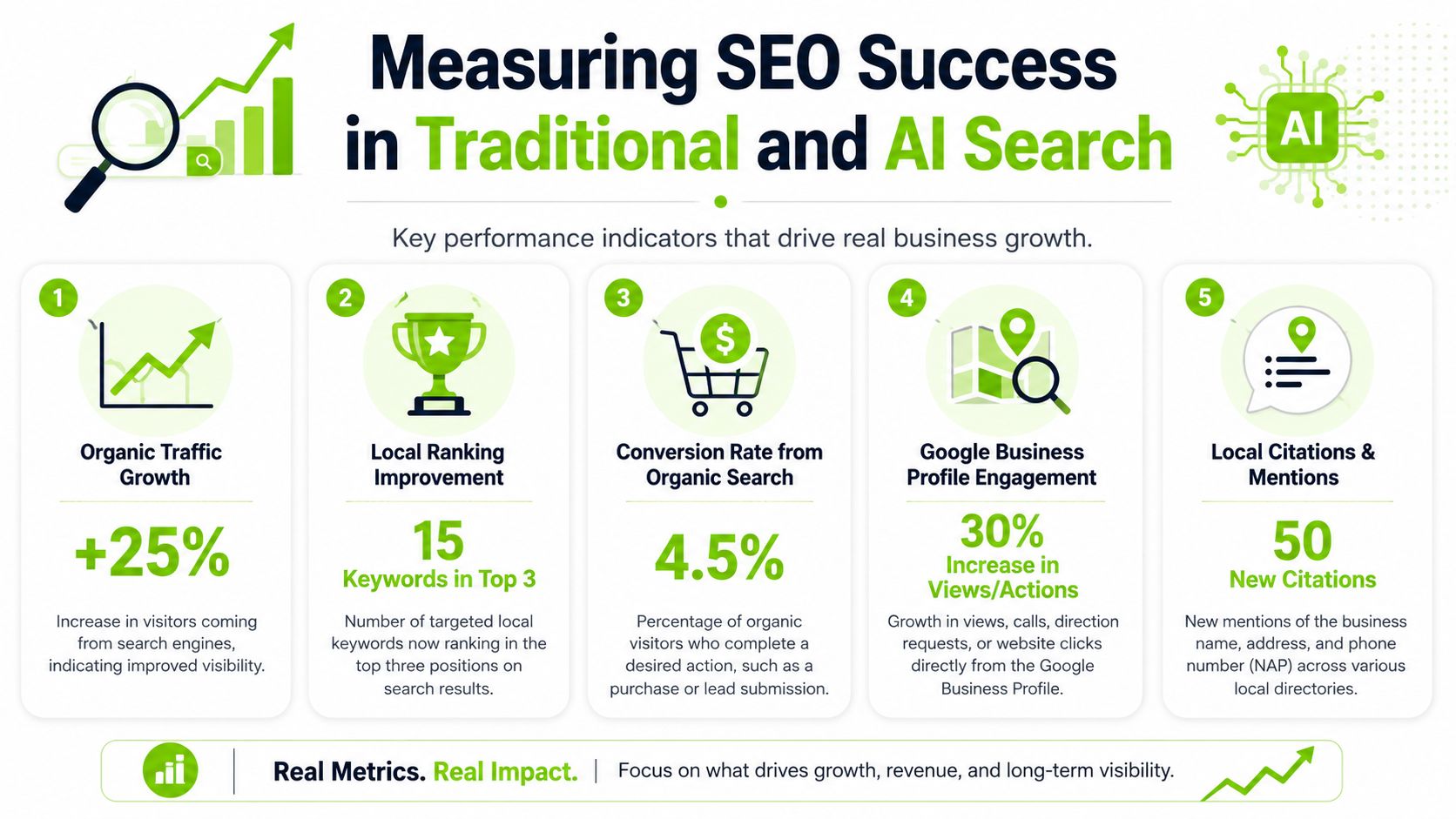
Agencies commonly build SEO programs around organic traffic, keyword rankings, click-through rate, and conversions, and some providers describe audits that examine 50+ technical and on-page factors (practical South Carolina SEO benchmarks). That's a good baseline. It's not the whole system anymore.
What to track in classic search
Traditional SEO reporting should answer two questions. Are you more visible for valuable searches, and is that visibility turning into business outcomes?
A practical dashboard usually includes:
- Organic traffic quality: Look at landing pages, not just sitewide sessions.
- Local keyword coverage: Track service-plus-location phrases that map to revenue.
- Click-through rate: A good ranking with weak CTR often points to a snippet, title, or intent mismatch.
- Conversions: Calls, form fills, bookings, quote requests, and other lead actions from organic traffic.
- Google Business Profile actions: Calls, direction requests, website clicks, and engagement trends.
For example, a Charleston restaurant shouldn't judge SEO only by website visits. Reservation intent, menu views, branded local discovery, and map interactions may matter more than a broad traffic increase. A Greenville B2B company should care less about vanity keywords and more about qualified visits to solution pages and contact requests from the right region.
What to track in AI-driven discovery
AI search introduces a second visibility layer. A brand can rank well in traditional search and still be absent from AI-generated answers. It can also appear in AI summaries for category questions before it earns a strong classic ranking for the same topic.
That changes reporting.
I'd track these AI-facing signals qualitatively and consistently:
- Presence in AI-generated answers for core commercial and informational prompts
- Brand mentions versus competitor mentions across key buying queries
- Citation patterns showing which pages or sources get referenced
- Page inclusion trends by topic cluster, not just homepage visibility
- Prompt coverage gaps where the brand is strong in SEO but weak in AI surfaces
The important mindset shift is this: traditional rankings show where your page stands in a list. AI visibility shows whether your brand gets included in the answer at all.
A page can rank. A brand can still be ignored.
That's why measurement needs both views. If you only report classic SEO, clients may think visibility is improving while discovery is fragmenting into channels they're not tracking.
For teams trying to bring those views into one reporting model, a metric framework like visibility score SEO is useful because it helps connect rankings, presence, and trend movement into something easier to interpret across accounts.
Don't confuse activity with progress
A lot of SEO reporting still overweights output. Blog posts published. pages updated. links acquired. audits completed. Those are work logs, not outcomes.
Real progress in South Carolina looks more like this:
- Better local page engagement in the markets you care about
- More calls and leads from high-intent geographic queries
- Stronger map visibility where competitors used to dominate
- More inclusion in AI answers for your highest-value topics
If the dashboard can't show that, it's not helping you make decisions.
Structuring Your Team and Tools for SC SEO
South Carolina SEO breaks down when ownership is scattered. One person manages Google Business Profile. Another writes blogs. A developer fixes technical issues when they can. Sales asks for more leads. Leadership wants reports. Nobody owns the whole search system.
The fix isn't more meetings. It's a tighter operating model.
Give each function a clear job
A workable team structure usually has four lanes, even if one person covers more than one lane:
- Local presence owner: Manages listings, review workflows, and location accuracy.
- Website and technical owner: Handles audits, templates, performance, indexing, and schema implementation.
- Content owner: Builds service pages, location pages, FAQs, and linkable assets.
- Reporting owner: Connects search visibility to leads, revenue signals, and market-level performance.
That structure works for agencies and in-house teams because it reduces overlap. It also makes it easier to diagnose where performance is slipping. If local visibility is weak but site engagement is strong, the issue likely isn't content production. If rankings improve and conversions don't, the conversion path may be the problem.
Reduce tool sprawl before it slows execution
The challenge isn't a lack of data. Instead, the issue arises because the data is split across too many systems. One tool for rankings. Another for audits. Another for listings. Another for backlinks. Another spreadsheet for AI checks. Reporting becomes manual, and strategy gets reactive.
A better stack supports a repeatable workflow:
- Audit the site and listings
- Prioritize fixes by business impact
- Publish or improve local and market pages
- Track traditional search performance
- Monitor AI visibility and citation gaps
- Report in one language the client or leadership team can understand
If you want an outside perspective on foundational planning, these search engine optimization strategies are a helpful reference point for thinking through the mix of technical work, content, and authority building.
The strongest South Carolina SEO teams don't just “do SEO.” They run a local discovery system that covers search results, maps, reviews, websites, and AI answers together.
That's the operational shift many businesses still haven't made. The teams that do make it tend to move faster, explain results more clearly, and spot visibility gaps before competitors do.
If your team wants one place to track both traditional SEO and AI-driven discovery, Surnex is built for that job. It gives agencies, in-house teams, and developers a clearer view of rankings, audits, backlinks, and emerging AI visibility without juggling a stack of disconnected tools.