You're likely in one of two situations right now. Either you've outgrown a basic citation tool and need a partner that can move rankings, calls, and store visits, or you're paying an agency already and wondering whether the work is deep enough to justify the retainer. That's the point where most “best local seo services” lists stop being useful, because they lump together software, agencies, enterprise platforms, and reputation tools as if they solve the same problem.
They don't.
Some teams need strategic operators who can diagnose a broken Google Business Profile setup, untangle location-page architecture, and manage local link acquisition. Others need a platform that helps them automate listings, review workflows, and reporting across many locations. More teams now need both, because local visibility isn't limited to blue links and the map pack anymore. If you're also trying to understand how to approach optimizing your trade business for Google, the partner you pick matters even more.
The short version is this. Good local SEO partners help you win nearby searches that lead to real actions. Great ones help you explain, measure, and expand that visibility as search behavior shifts. Here are the services worth serious consideration in 2026.
1. Surnex
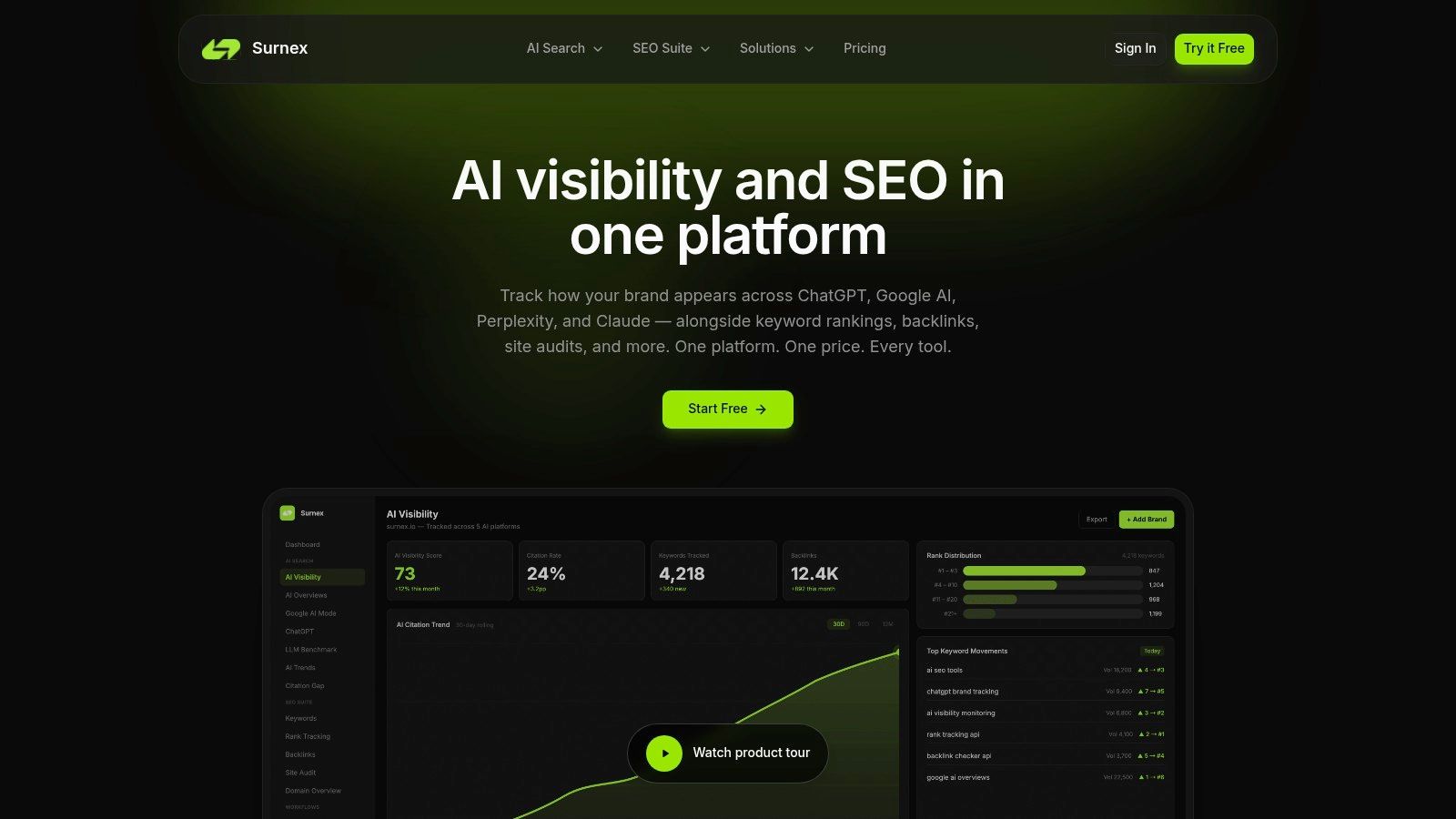
A common local SEO reporting problem shows up right after a client asks a simple question. They can see rankings improving and map pack visibility holding steady, but they also want to know why a competitor keeps appearing in AI answers. Traditional local SEO tools rarely answer both sides well. Surnex is built for that gap.
Its differentiator is the combination of standard SEO operations with AI visibility tracking in one system. The platform monitors presence across Google AI Overviews, Google AI Mode, ChatGPT, Perplexity, and Claude, while still covering keyword research, rank tracking, backlink analysis, site audits, Core Web Vitals, domain-level research, and local monitoring. That matters for agencies and in-house teams that are tired of stitching together screenshots from separate tools just to explain performance.
That positioning also lines up with a broader shift in the market. Analysts at First Page Sage noted that many local SEO providers still do not offer unified AI and SEO reporting, which helps explain why platforms like Surnex are getting attention.
Where Surnex fits best
Surnex makes the most sense for teams that need both execution data and executive-ready reporting. I would put it on the shortlist for agencies managing multiple local clients, growth teams that need competitive visibility data, and technical marketers who want API access for custom dashboards or internal tools.
This is also where the agency-versus-platform trade-off becomes clear. A full-service agency can diagnose messy location page structures, review workflows, and GBP problems for you. A managed platform like Surnex gives your team more direct control, faster access to data, and more flexibility in reporting, but it also assumes someone on your side can act on what the platform surfaces.
Practical rule: Choose Surnex if your team already knows how to execute local SEO and needs better visibility across both classic search and AI discovery. Choose a service-heavy agency if strategy and implementation are still the bottleneck.
What works and what to watch
The strongest part of the product is consolidation. Citation gap analysis, LLM visibility tracking, and core SEO diagnostics sit in the same workflow, which reduces tool sprawl and cuts reporting time. That is useful in real client environments where the work is not just finding issues, but explaining them quickly and turning them into priorities.
There are trade-offs. Pricing is not published publicly, so procurement takes an extra step. Teams evaluating the platform should also confirm coverage against their target markets and reporting needs, especially if AI visibility is a board-level question and not just a nice-to-have metric.
- Best for agencies and in-house operators: One platform covers AI visibility tracking and day-to-day SEO work.
- Best for technical teams: API access supports custom reporting and product integrations.
- Watch for fit: The value is highest when your team can interpret the data and execute on it internally.
2. Sterling Sky
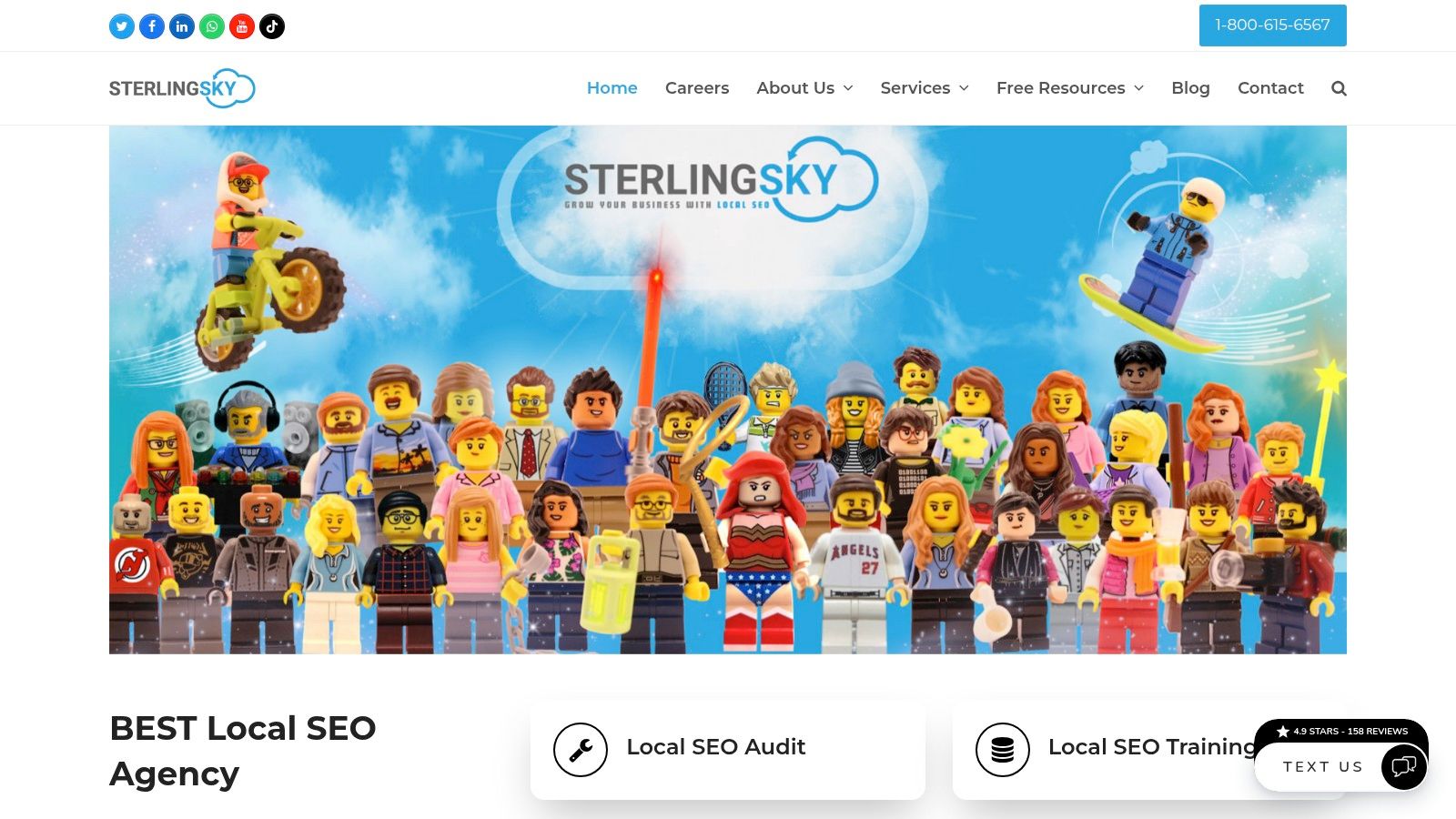
Sterling Sky is the kind of agency I'd shortlist when the problem isn't “we need software,” but “we need experienced people to fix local visibility issues correctly.” That usually means GBP category decisions, service-area setup, review strategy, suspension recovery, local page tuning, and the kind of audit work that requires judgment instead of templates.
This is a boutique operator, and that's the appeal. You're not buying a broad digital package with local SEO folded in. You're buying local search expertise.
Why teams hire them
Sterling Sky makes sense for SMBs and multi-location brands that want senior-level guidance and hands-on implementation. Their public reputation in the local SEO space also helps with trust. If a team wants a partner that publishes research, teaches, and handles edge cases like reinstatements, they're usually a serious contender.
What I like most about this model is the focus. Some agencies claim to offer everything, then assign local work to generalists. Sterling Sky feels better suited for businesses where map visibility and Google Business Profile quality are central to lead flow.
If your main local problem involves Google Business Profile quality, reviews, categories, or service-area confusion, specialist agencies usually outperform broad marketing shops.
Trade-offs
The trade-off is that boutique specialists tend to be premium buys. That's not necessarily bad, but it means you should hire them for problems that justify expert attention. If you mainly need repeatable listings maintenance at scale, platform-driven options may be more efficient.
They're also not the place I'd look first if you want broad creative production, paid media expansion, or a single vendor for every marketing channel. For local SEO expertise, though, they remain a strong option through Sterling Sky.
- Strong fit: GBP management, local audits, on-site optimization, Local Services Ads support.
- Less ideal: Teams seeking one vendor for SEO, design, dev, and paid media together.
- Practical upside: Published starting prices help with qualification before a sales call.
3. Local SEO Guide (LSG)
LSG sits in a different category from most firms on this list. I would look to this agency when a brand has a real multi-location footprint, messy location architecture, complex internal stakeholders, and enough data to benefit from business-intelligence-driven prioritization.
A small business with three locations could hire them, but it might be more horsepower than they need. A franchise system or enterprise brand with location and service-page sprawl is where they make more sense.
Where LSG earns its keep
Their value is in scale and complexity. Large-scale location-page builds, technical consulting, market sizing, and flexible engagement structures are useful when local SEO touches engineering, content operations, analytics, and regional business units all at once.
That matters because local search isn't a niche channel anymore. It accounts for a large share of how people find nearby businesses, and nearby searches often lead to visits and purchases soon after the search happens (projected local SEO market and nearby search behavior). For enterprise brands, local SEO often deserves the same planning rigor as national search.
The practical caution
LSG is likely overkill if you only need citation cleanup, review generation, and a few location page edits. Their enterprise orientation is a strength, but it can also introduce more process than smaller teams want.
If your local SEO program needs technical governance, page templates, and scalable rollout planning, that process is useful. If you want a leaner managed service, it may feel heavy. You can evaluate their approach through Local SEO Guide.
- Best for enterprise and franchise brands: Strong with large sites and many locations.
- Useful flexibility: Engagements can range from audits to deep implementation support.
- Main concern: Smaller companies may pay for sophistication they won't fully use.
4. Whitespark
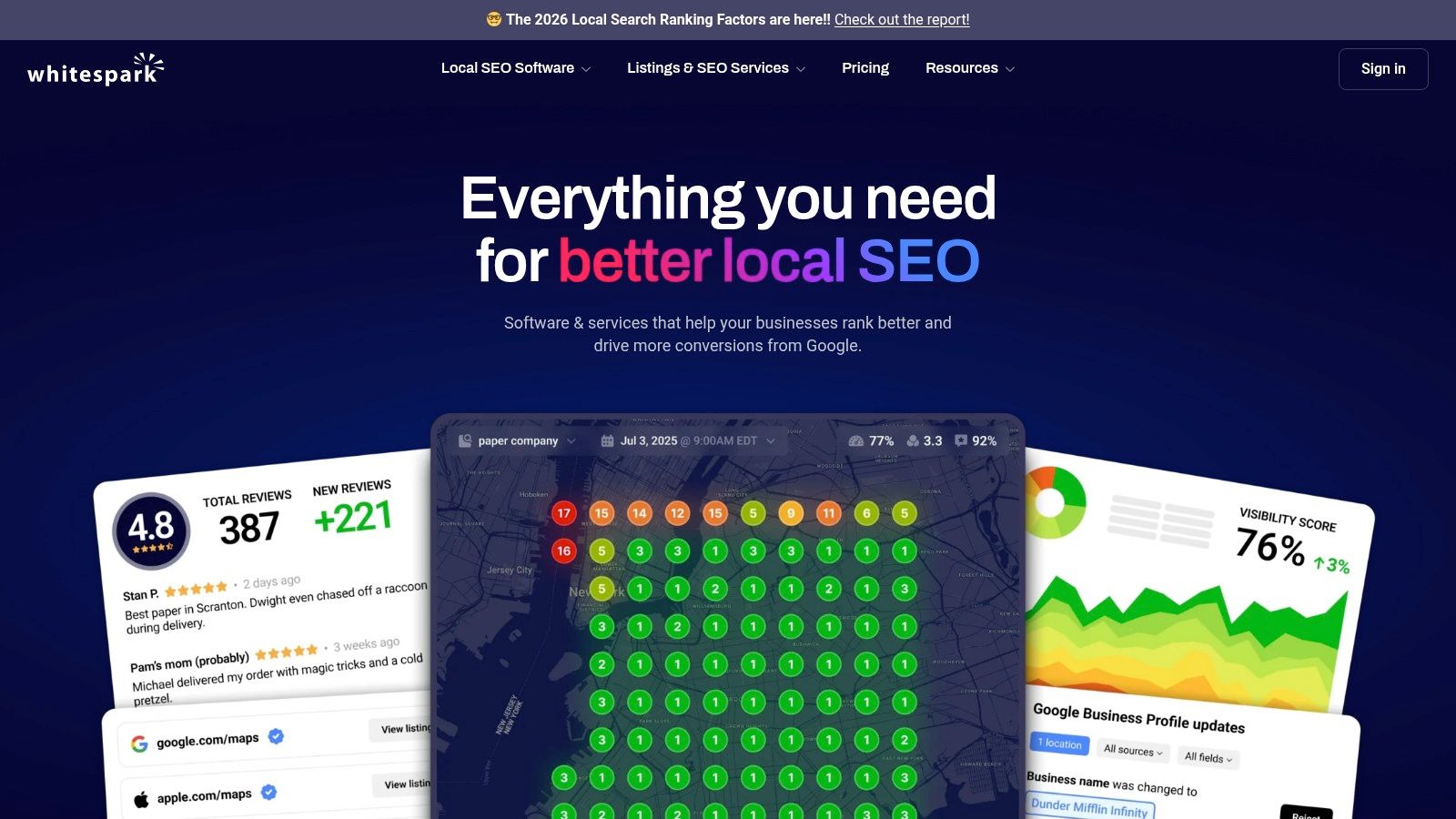
Whitespark is a practical middle ground. It's not trying to be a giant all-in-one enterprise layer, and it's not just a lightweight rank tracker either. For many SMBs and agencies, that balance is exactly the point.
I usually think of Whitespark as a strong choice when citation work, local rank tracking, GBP support, and reputation workflows need to be reliable and easy to buy. Their transparent pricing also helps. That sounds simple, but in local SEO it's a genuine advantage.
What they do well
Whitespark's service mix works for teams that want clear, modular support. Managed citation building and cleanup, rank tracking, geo-grid reporting, and GBP-related tools fit common local SEO needs without forcing a custom enterprise sales cycle.
Their long-standing industry presence helps too. Local SEO buyers often struggle to separate durable providers from short-lived vendors. Whitespark has been around long enough that the offering feels established rather than experimental.
Field note: When you're vetting best local seo services, transparent scope beats flashy promises. If you can't tell what's included, you can't judge the value.
Where it can fall short
Whitespark isn't the first name I'd choose for a full-funnel local growth program that also demands technical SEO depth, advanced content strategy, or broad paid media integration. It's better as a focused local operations partner than as a complete marketing department.
That's not a flaw. It just means you should pair the service model to the problem. If your bottlenecks are listings accuracy, local tracking, and GBP management, Whitespark is a sensible option.
- Good for pilot projects: Published pricing makes it easy to test without a long buying cycle.
- Good for agencies: À la carte services support internal delivery teams well.
- Potential limitation: Bigger growth programs may need another strategic partner alongside it.
5. Searchbloom
Searchbloom is a good fit for companies that don't want local SEO in a silo. Some businesses need local rankings to improve, but they also want paid search support, conversion rate work, and content or outreach under one roof. Searchbloom is built more like that kind of partner.
Their local SEO methodology combines technical fixes, citations, localized content, and link outreach. That's a useful mix for SMB and mid-market brands that need authority building, not just profile maintenance.
Why this model appeals
A local campaign often stalls when one vendor owns rankings, another owns PPC, and no one owns conversion performance. Searchbloom's broader service stack can reduce that fragmentation.
That matters because local traffic is often more valuable than general organic traffic. Verified industry summaries note that local traffic converts at a meaningfully higher rate than non-local organic traffic, which is why businesses often want local SEO tied directly to broader performance work rather than reported in isolation (local conversion context for nearby traffic).
The trade-off with broader agencies
The upside is consolidation. The downside is cost and focus. Once you add PPC or CRO, the monthly spend can climb quickly, and custom programs may stretch beyond what a smaller business expects from a “local SEO” engagement.
Still, if you want a partner that can start with local and expand into surrounding channels without replacing vendors, Searchbloom deserves a look.
- Best fit: SMBs and mid-market brands that need local SEO plus PPC or CRO.
- Operational benefit: In-house outreach and technical work reduce handoff problems.
- Watch for budget creep: Broader scope is useful, but it raises the floor on spend.
6. SOCi
A brand with 200 locations does not have a local SEO tactic problem. It has an operating model problem. One team updates listings, another handles reviews, regional managers want local control, and small inconsistencies spread across every market.
That is the case for SOCi.
SOCi is a managed platform built for large multi-location organizations that need central control with local execution. It covers listings, reviews, local pages, social publishing, ads, chat, and locator management in one system. That matters for franchisors, restaurant groups, retail chains, and enterprise service brands where process discipline matters as much as keyword targeting.
This is also where the agency versus platform distinction becomes clear. A specialist agency can diagnose issues, prioritize fixes, and drive strategy. A platform like SOCi helps a central team standardize those fixes across a large footprint, monitor compliance, and reduce the manual work that usually slows enterprise local programs down.
The upside is scale and governance. If one location has weak data, poor review handling, or an outdated page template, the same issue often appears in dozens more. SOCi is designed to reduce that repetition by giving teams one place to manage location data and workflows.
The trade-off is complexity.
Smaller businesses usually will not get enough value from this setup. SOCi involves implementation, stakeholder alignment, training, and a sales-led buying process. If you have five or fifteen locations, a hands-on agency or a lighter managed platform is often the better buy because you can get faster execution without adding enterprise software overhead.
But if your local search program is breaking under the weight of scale, SOCi fits the problem well.
- Best for enterprise footprints: Built for distributed brands with many locations and centralized oversight.
- Why teams buy it: One platform can manage listings, reviews, local pages, and related workflows across the network.
- What to watch: Setup time, custom pricing, and internal adoption can slow time to value.
7. Rio SEO
Rio SEO is another enterprise-grade choice, but it feels more execution-friendly for brands that want both platform infrastructure and managed support. That's the distinction I'd keep in mind. Some enterprise systems give you the controls and assume your team will run everything. Rio SEO adds optional service help around the platform.
For distributed brands, that can be a better operating model than hiring a pure agency or pure software vendor.
Why Rio SEO makes the list
The platform covers listings distribution, local pages, store and dealer locators, reviews and ratings, reporting, and optional managed services like review response, hyperlocal copywriting, and audits. If you run a multi-country or highly distributed brand, that blend is practical.
A lot of local search discovery still starts online before it becomes a visit, and businesses that keep their local presence complete and coordinated are better positioned to capture that demand. Rio SEO is built for the governance side of that work more than for one-off tactical consulting.
The real-world decision
If you're an SMB, skip it. Rio SEO's structure is aimed at larger organizations with centralized marketing and local execution needs. Smaller teams will likely move faster with a specialist agency or a lighter managed platform.
If your brand needs enterprise local pages, locator performance, and managed support layered onto the software, Rio SEO is one of the more sensible options.
- Strong fit: Large brands, franchises, dealer networks, multi-country operations.
- Useful differentiator: Optional managed services reduce internal workload.
- Primary downside: Enterprise pricing and demo-led procurement narrow the audience.
Top 7 Local SEO Services Comparison
| Product | Implementation complexity 🔄 | Resource requirements ⚡ | Expected outcomes 📊 | Ideal use cases 💡 | Key advantages ⭐ |
|---|---|---|---|---|---|
| Surnex | Medium, API-first setup; some dev work 🔄 | Moderate, SaaS subscription + developer time ⚡ | High, unified AI+SEO visibility; faster reporting 📊 | Agencies, growth teams, product integrations 💡 | ⭐ Unified AI+SEO + LLM benchmarking; API automation |
| Sterling Sky | Low, agency-managed, hands-on setup 🔄 | Moderate, retainer-based engagement ⚡ | Medium, improved GBP and prioritized local fixes 📊 | SMBs, home services, healthcare, legal, local brands 💡 | ⭐ Expert GBP work with published starting prices |
| Local SEO Guide (LSG) | High, enterprise technical programs & buildouts 🔄 | High, significant budget and coordination ⚡ | High, large-scale location programs and BI-driven roadmaps 📊 | Enterprises, franchises, multi-location deployments 💡 | ⭐ Deep technical capability and flexible engagements |
| Whitespark | Low, tool + managed services, easy to pilot 🔄 | Low–Moderate, transparent à‑la‑carte pricing ⚡ | Medium, improved listings, reputation, local tracking 📊 | SMBs, agencies, multi-location brands needing listings 💡 | ⭐ Published pricing, proven listings & reputation tools |
| Searchbloom | Medium, agency methodology with integrations 🔄 | Moderate, monthly retainers (often $2k–$5k) ⚡ | Medium–High, local SEO with PPC/CRO lift 📊 | SMBs to mid-market wanting integrated SEO+PPC 💡 | ⭐ Clear price guidance and in-house PPC/CRO |
| SOCi | High, enterprise platform, demo-led onboarding 🔄 | High, custom enterprise contracts and implementation ⚡ | High, automated location-level optimizations at scale 📊 | Franchisors, large retail/restaurant/financial networks 💡 | ⭐ Single orchestration layer for thousands of locations |
| Rio SEO | High, enterprise LX platform with managed services 🔄 | High, custom pricing; centralized governance ⚡ | High, centralized governance + location execution/reporting 📊 | Large distributed brands, multi-country franchises 💡 | ⭐ Platform + agency-style execution for multi-location scale |
How to Choose Your Local SEO Partner A Checklist
A local business signs with the wrong provider, gets polished reports for three months, and still has the same underlying problem. The rankings may move a little. The calls do not. In practice, the failure usually starts earlier, at the buying decision, when the company picks the wrong service model for its size, complexity, and internal resources.
That is the main split in this list. Some options are agency-led. You hire them for judgment, execution, and problem solving. Others are managed platforms. You use the software, workflows, and automation to keep many locations under control. A single-location contractor usually needs sharper execution, not enterprise software. A brand with hundreds of profiles usually needs systems, permissions, approvals, and reporting discipline, not just a smart consultant.
Start with the bottleneck. If the business needs category strategy, local page improvements, review operations, spam fighting, or GBP troubleshooting, an agency often delivers more value. If the business is struggling with listing consistency, location-level publishing, approval workflows, and reporting across many markets, a managed platform is often the better fit.
Reporting is where weak engagements get exposed. Basic reporting shows rankings, reviews, listing health, and traffic. Strong reporting connects local work to calls, leads, booked jobs, store actions, or location-level demand. If a provider cannot show how local SEO affects business outcomes, the engagement will be hard to defend internally.
Here's the vetting list I use:
- Ask how they handle GBP work. Look for a clear process around categories, attributes, images, posts, Q&A, reviews, and suspensions.
- Ask how the model changes across multiple locations. They should be able to explain templates, governance rules, exceptions, and who owns approvals.
- Ask what reporting a non-SEO stakeholder will see. A good partner makes progress easy for operations, leadership, or franchise teams to understand.
- Ask how they measure visibility beyond classic local rankings. AI search exposure is still evolving, but your provider should already have a practical way to track it.
- Ask what they do not do. Clear boundaries usually mean better delivery. Vague promises usually mean the opposite.
Buyer test: If a provider cannot explain their process in plain language, they probably will not explain your results clearly either.
The services on this list solve different problems. Sterling Sky and LSG are strong choices when expert-led strategy and execution matter most. Whitespark is easier to pilot if you want modular help with listings, reviews, and tracking. Searchbloom makes sense for teams that want local SEO tied closely to paid search and conversion work. SOCi and Rio SEO fit organizations that need control across large location sets. Surnex, as noted earlier, stands out for teams that want local SEO monitoring alongside AI visibility tracking in one system.
If you're comparing vendors in a specific geography and want another point of reference, it can also help to review examples of local SEO experts in Newark and contrast how they position strategy, reporting, and service scope.
If your shortlist includes both agencies and software vendors, use one final filter. Ask whether you need a partner to do the work, a platform to organize the work, or a hybrid that gives you both. That answer will narrow the field faster than any feature checklist.