
You know the moment. A VP asks how the brand is doing against competitors, and the room expects a fast answer. Rankings help, but they don't tell the full story anymore, especially when discovery now happens across classic search, AI Overviews, and chat-driven answers.
That's why industry benchmarking matters more than a quarterly check-in. The strongest programs treat it as a recurring management process, not a one-time research task, and they start with a precise peer set rather than a vague category comparison, because meaningful benchmarking depends on comparing like with like, not broad market averages. understanding SEO competition is useful here because it frames competitor analysis as a structured exercise, not a guess.
Many teams still benchmark in the old way, with historical rankings, traffic snapshots, and a slide deck that goes stale before leadership finishes reading it. That works poorly in an AI-shaped search environment, where visibility can shift faster than a traditional reporting cycle. If you want a broader operating model for search intelligence, the internal guide on search marketing intelligence is a helpful companion.
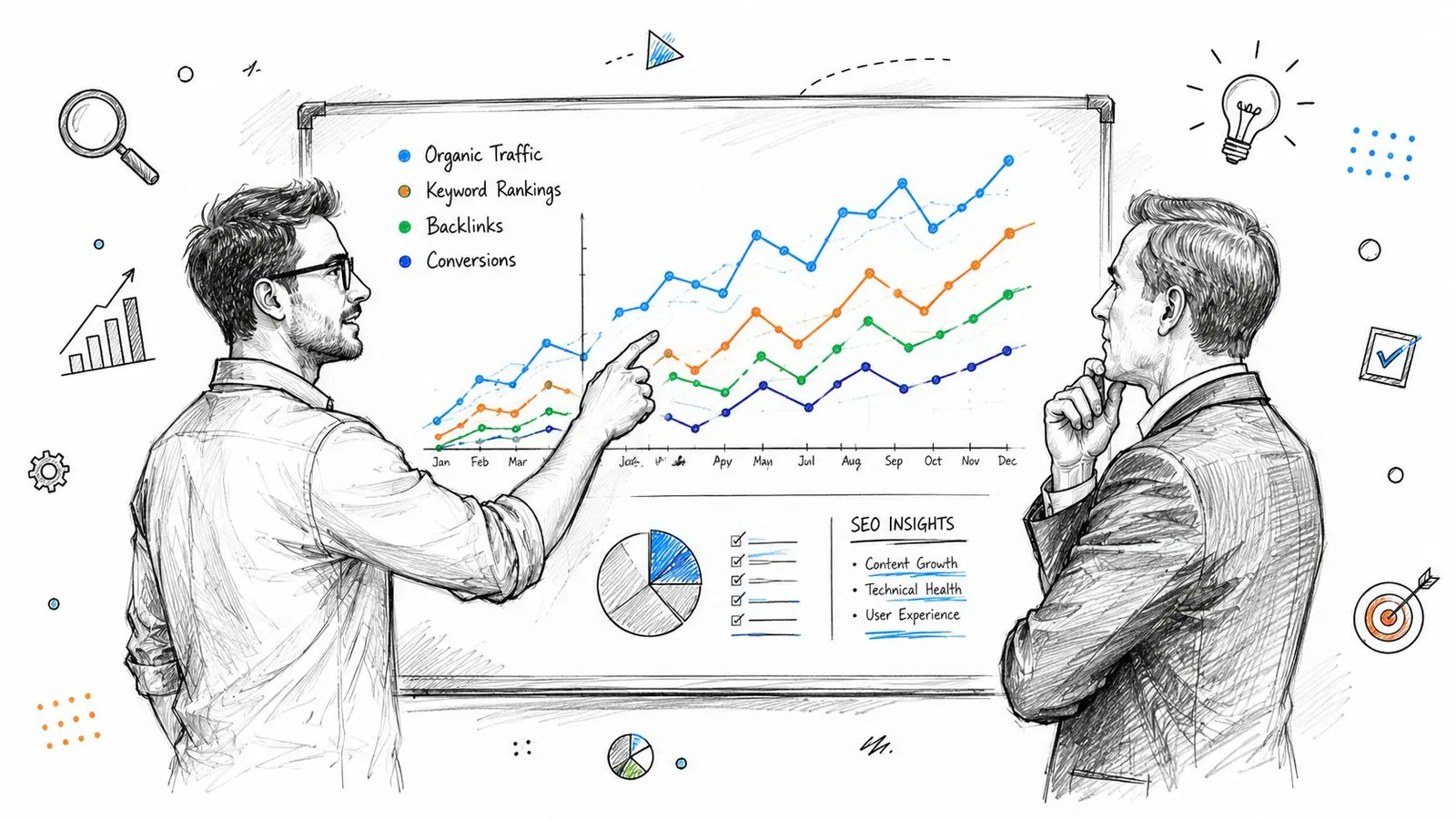
Why Industry Benchmarking Matters More Than Ever
The easiest way to lose confidence with leadership is to answer a competitor question with a screenshot of your own rankings. That tells part of the story, but it misses whether your visibility is improving faster than peers, whether your content is getting cited in AI surfaces, and whether the market is moving under your feet. In practice, industry benchmarking gives you the language to talk about relative performance, not just internal progress.
For SEO teams, the shift is obvious. Search is no longer a single results page, and discovery now spans traditional blue links, AI summaries, and answer engines that reuse source material in different ways. A brand can win classic organic visibility and still lose share of attention when AI-generated answers surface competitors more often.
The reason benchmarking has become a recurring process is simple. The most useful comparisons are defined against a precise peer set, and the metrics need to be normalized before anyone draws conclusions. Standardized government datasets such as the Census Bureau's Statistics of U.S. Businesses are part of that foundation, alongside Census, BLS, and SEC EDGAR for repeatable comparisons across firms and sectors. That logic is the same whether you're benchmarking financial ratios or search visibility, define the right peer group, then compare the right measures.
Practical rule: If you can't explain why a competitor belongs in the peer set, don't benchmark against them.
AI-driven discovery changes how stakeholders interpret performance. An executive who used to care only about rank position now needs to know whether your brand shows up consistently when buyers ask questions in new interfaces. That's also why structured benchmarking supports better budget decisions, the team can spot visibility gaps early, defend resource allocation, and show progress with evidence instead of optimism.
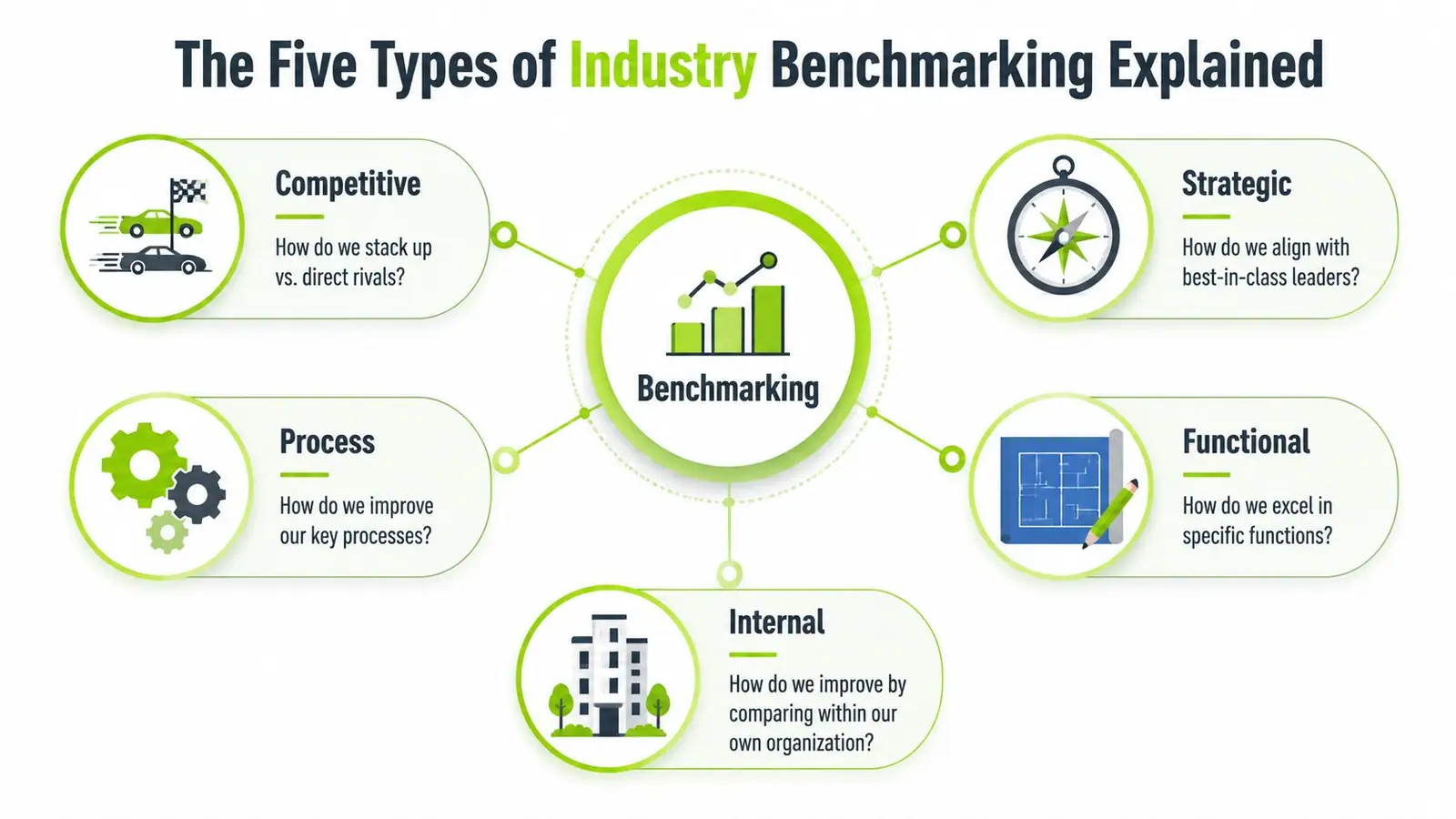
The Five Types of Industry Benchmarking Explained
Industry benchmarking isn't one method. It's a family of methods, and each one answers a different management question. When teams mix them up, they get tidy charts and wrong conclusions. The fix is to match the benchmark type to the decision you're trying to make.
Competitive benchmarking
Competitive benchmarking asks, how do we stack up against direct rivals? For SEO and AI visibility, that means comparing your share of organic demand, topic ownership, citation presence, or backlink profile against the brands that win the same searches. It's the right lens when leadership wants a market position view.
Strategic benchmarking
Strategic benchmarking is broader. It looks at how high-performing firms structure priorities, channels, and operating models, then asks what ideas are transferable. In search, that might mean comparing how different brands allocate effort between educational content, product pages, and AI-optimized assets.
Process benchmarking
Process benchmarking is where most SEO teams find real operational friction. It focuses on how work moves through the system, from brief creation to publishing to refresh cycles, and it's the best fit when your content pipeline feels slower than peers. If rankings lag because content goes live too late, this is the benchmark type that exposes the bottleneck.
Performance benchmarking
Performance benchmarking measures outcomes against standards or peer averages. Ratios work well here because they're scale-independent, which is why financial guidance often recommends metrics like current ratio, debt-to-equity, and return on equity when comparing operating efficiency. For search teams, the equivalent is comparing normalized visibility, not raw totals.
Internal benchmarking
Internal benchmarking compares teams, regions, product lines, or sites inside the same organization. It's especially useful when the market is too messy to isolate external causes, because you can still spot which business unit publishes faster, earns more citations, or responds better to AI-driven demand. A related way to think about this is functional benchmarking, which looks at a single capability across contexts, even if the industry differs.
Choose the type based on the question. Don't force one benchmark to answer all five.
The main failure mode is using performance data to answer a strategic question. That's how teams end up optimizing a KPI while missing the actual issue, which might be structure, process, or channel mix.
Key Metrics and Data Sources for Search Benchmarking
The right search benchmark starts with the right metric, but the wrong metric can still look convincing if it isn't normalized. Raw totals mislead when company size, reporting windows, or market mix differ, so convert figures into ratios, percentages, or per-unit measures before comparing them. That same “apples-to-apples” logic is the backbone of industry benchmarking outside SEO too.
A useful search benchmark usually blends a few layers of measurement. Organic visibility shows market share in search, keyword overlap shows whether competitors are winning the same intent space, backlink ratios help compare authority at a scale that raw link counts can't capture, and content velocity shows how fast a team can turn opportunities into live pages. For AI visibility, teams are increasingly tracking brand mentions in LLM responses, citation rates in AI Overviews, and sentiment in generated answers, but those numbers only help if the query set and source window stay consistent.
The data sources matter just as much as the metrics. Government datasets such as the Census Bureau's SUSB program are useful for industry context and peer definition, while SEO platforms, crawl data, and AI monitoring tools supply the channel-specific signals. If you want to go deeper on how page-level and source-level evidence gets surfaced in audits, advanced SEO audit techniques are a practical reference point for thinking about structured data collection. For teams building out their measurement stack, the internal guide on data for SEO is a useful next step.
| Metric | Purpose | Data Source |
|---|---|---|
| Organic traffic share | Compare visibility across peers | SEO platforms, analytics, search console data |
| Keyword overlap | Show intent-space competition | Rank tracking tools, keyword research databases |
| Backlink authority ratios | Compare authority at a normalized level | Link index tools, crawl data |
| Content velocity | Measure publishing cadence against competitors | CMS data, content inventories, crawl snapshots |
| Brand mentions in LLM responses | Track presence in AI answers | AI monitoring tools, prompt testing workflows |
| Citation rates in AI Overviews | Measure source inclusion in AI surfaces | AI visibility platforms, manual query testing |
| Sentiment in AI-generated answers | Understand how the brand is framed | AI analysis tools, prompt logs |
| Peer-group context | Define the comparison set | Census, BLS, SEC EDGAR, industry datasets |
The key move is to cross-reference sources instead of trusting one provider blindly. When the same signal appears in multiple datasets, confidence goes up. When they disagree, the gap itself is a signal that the benchmark needs cleaning before it goes into a board deck.
A Repeatable Benchmarking Framework You Can Use Today
A benchmark only becomes useful when the process is repeatable. One-off comparisons are easy to defend in a meeting and hard to trust the next month, which is why the best programs define scope, collect data on a fixed cadence, and assign ownership for follow-up. Without that discipline, the numbers look official while the underlying comparison keeps shifting.
Define the scope tightly
Start with a precise peer set. In business benchmarking, that often means using a four-digit NAICS code instead of a broad sector so the comparison is statistically meaningful, and the same logic applies in search when you group competitors by business model, geography, and intent mix. If your peer set is too broad, the benchmark stops describing your market reality.
Collect data in the same window
Get comparable external data from the same time period, or the variance analysis gets noisy fast. Calendar differences, seasonal cycles, and stale exports create false gaps that look strategic but are really timing issues. If the source data isn't aligned, fix the timeline before you fix the strategy.
Normalize before you compare
Raw totals can fool smart teams. Convert counts into ratios, percentages, or per-unit measures, then adjust for cycles and seasonality so the comparison stays fair. Consequently, much internal reporting fails because the slide shows a bigger number but not a better one.
Analyze variance, then assign a reason
Once the numbers are normalized, compare the gap and name the likely cause. Is the gap driven by content coverage, crawlability, authority, speed, or channel mix? If you can't tie the variance to a management lever, the benchmark is still descriptive, not operational.
Turn the gap into action
A benchmark should end with a plan, not a discussion. Assign an owner, set a timeline, and tie the work to a KPI that will prove the gap is narrowing. That's the point where benchmarking stops being research and becomes management.
Benchmarks only matter when someone owns the next move.
Recurring cadence matters here too. If the team only checks benchmarks during a quarterly review, the market will outrun the report. If it checks them consistently, the data becomes a live management tool instead of a historical artifact.
What to Do When Benchmark Data Is Scarce or Inconsistent
Most benchmark playbooks often prove inadequate. In clean categories with abundant data, the comparison is straightforward. In real markets, though, the peer set is messy, the numbers are incomplete, and different tools disagree for reasons that aren't obvious at first glance.
The first mistake is assuming one source is authoritative. It's better to cross-check multiple sources, compare the same metric across the same time window, and inspect outliers before trusting a number. That's consistent with current benchmarking guidance that emphasizes verifying data quality, keeping benchmarks current, and cross-checking sources before acting on them, because benchmark values can be unstable rather than universal.
When the data is noisy, precision theater doesn't help. A single clean-looking point estimate can hide a weak measurement process, so use a range of values, a confidence mindset, or at least a directional conclusion when the underlying data is uneven. The goal isn't false certainty, it's usable confidence.
Three practical workarounds help in hard cases:
- Tighten the peer set: If competitors span different business models or geographies, split them into smaller comparison groups instead of forcing one blended average.
- Use proxy measures carefully: When direct metrics are missing, substitute a related ratio or directional indicator, but label it clearly so nobody confuses it with the original signal.
- Separate signal from noise: If a metric swings wildly across tools, treat the disagreement as a data-quality issue first, not a performance story.
A useful mental model is that benchmark disagreement is often a product problem, not just an analytics problem. Different crawling coverage, index freshness, query selection, or API latency can all change the number you see. The practitioner's job is to ask which part of the measurement chain is unstable before deciding what the market is telling you.
If the benchmark can't survive a source check, it doesn't belong in decision-making.
That caution matters even more in search and AI visibility, where the system itself changes quickly and the output can vary by query wording, user context, or model behavior. When comparability is weak, the most honest answer is often to benchmark the process and trend direction, not the absolute number.
Operationalizing Benchmarking with Platforms and APIs
Strategy becomes useful when the team can run it every week without rebuilding the workflow. That's where platforms and APIs matter, because they turn a benchmarking framework into something the organization can maintain. A dashboard can unify AI visibility, rankings, backlinks, audits, and content opportunities in one place, which reduces tool switching and makes relative performance easier to read.
APIs change the economics of monitoring. Instead of manually exporting data for each client or business unit, teams can schedule pulls, feed BI systems, and keep benchmark views current enough to reflect changing search conditions. That matters in SEO, but it matters even more in AI visibility, where the surface itself can shift before a monthly report is useful.
For agencies, the value is in explanation. Clients don't just need a chart that says visibility changed, they need the comparison framework that shows why one competitor is getting cited more often, which topic clusters are saturated, and which search surfaces deserve budget first. The internal guide on SEO tool API is relevant for teams that want to understand how that pipeline gets automated.
Surnex is one option in this category. It combines AI visibility tracking with core SEO metrics, and its agent-ready API is designed for teams that need reporting to fit into existing workflows rather than sit in a separate tool. That kind of setup is especially useful when multiple stakeholders need the same benchmark data in different formats.
What changes the needle is not the dashboard itself, but the cadence it enables. If the platform lets a team see the same benchmark week after week, then variance becomes easier to explain, and action becomes easier to assign. That's a much stronger operating model than exporting screenshots into slides once a month.
The Future of Benchmarking in an AI-Driven Search Landscape
Static benchmark reports age badly in AI search. Models update, citation behavior shifts, and answer formats evolve, which means a benchmark built around last quarter's assumptions can mislead a team that's trying to make decisions this week. The answer is not more reporting for its own sake, it's benchmarking that updates with the market.
The most useful future state is near-real-time intelligence tied to changing business conditions. Search teams need to know when brand mentions rise or fall inside AI experiences, when competitor citations move, and when query patterns suggest the content mix is out of sync with discovery behavior. That's why emerging analysis workflows increasingly depend on understanding AI analysis platforms that can keep up with fast-moving outputs instead of treating the channel like a static SEO report.
The same logic applies to internal operating rhythms. If a team benchmarks only annually, it's describing a market that may no longer exist by the time the deck is reviewed. If it benchmarks continuously, the data becomes a living intelligence system that can support roadmaps, client conversations, and budget shifts with current evidence.
The internal guide on AI Overview tracker fits neatly into that thinking, because AI visibility is now one of the benchmarks that can't wait for a yearly refresh. The teams that win won't be the ones with the prettiest retrospective. They'll be the ones that treat industry benchmarking as an always-on operating layer for search discovery.
If you want to turn benchmarking into a working system instead of a quarterly slide, take a look at Surnex. It brings AI visibility tracking, SEO metrics, and API-driven reporting into one workflow so teams can compare performance against the right peers without stitching together half a dozen tools.