Most SEO advice still treats a landing page like a keyword container. Add the phrase to the title, repeat it in the copy, attach FAQ schema, and wait for rankings. That approach misses the primary job of an SEO landing page: it must satisfy a specific search need, make the next action obvious, load smoothly on a phone, and present information clearly enough for both Google and AI answer systems to understand.
The strongest pages unite these requirements instead of creating separate versions for traditional search and AI discovery. They answer the query directly, support the answer with useful evidence, reduce hesitation, and guide the visitor toward one meaningful conversion. Rankings matter, but a page that attracts the wrong audience or buries its value proposition won't produce useful business results.
Aligning Your Page with Search Intent
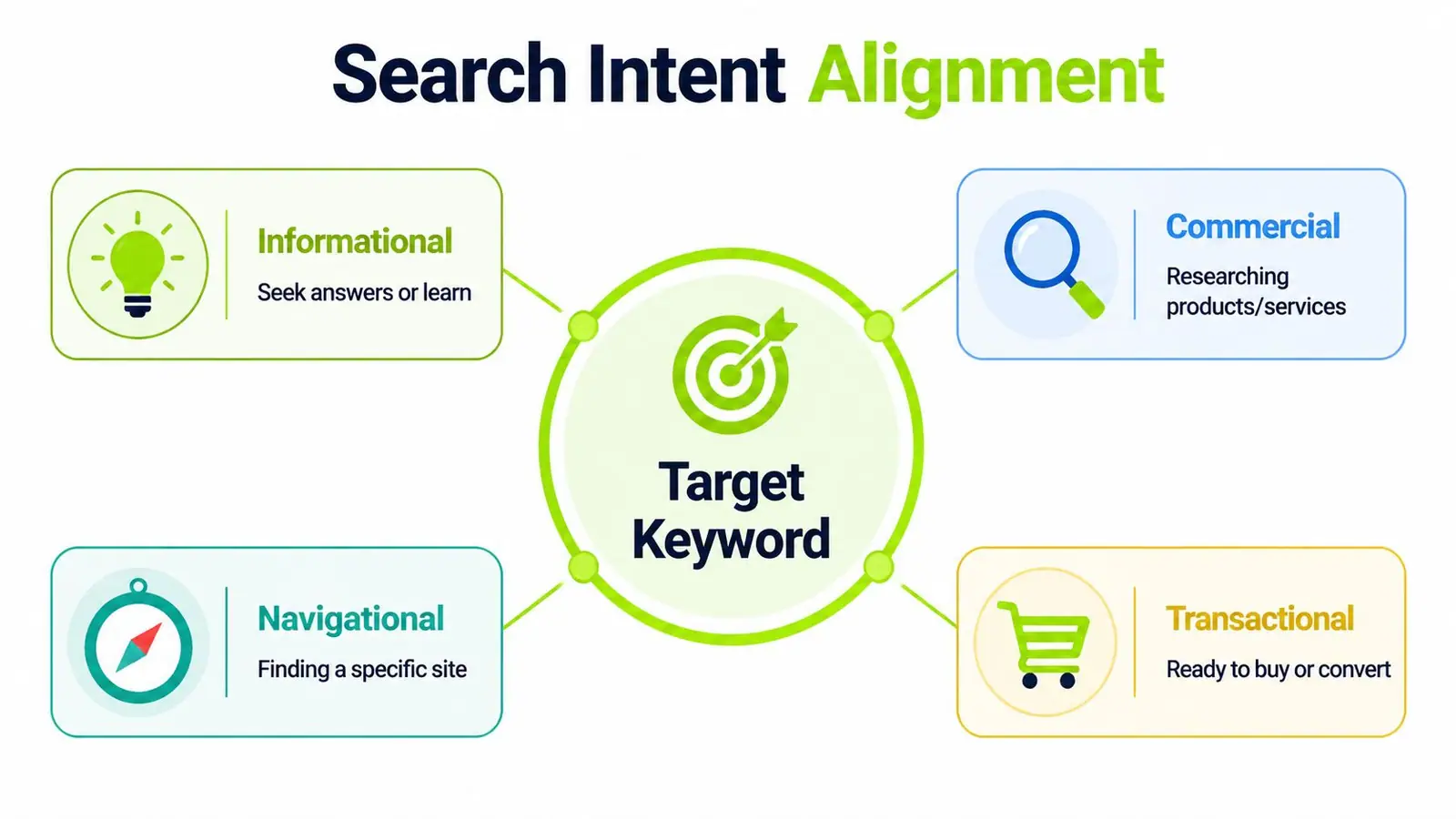
Keyword targeting tells you what people type. Search intent tells you why they type it. That distinction determines whether your page should teach, compare, help someone find a brand, or enable an immediate conversion.
Informational searches seek explanations, definitions, or instructions. Commercial searches indicate research, often around products, services, or alternatives. Navigational searches point toward a specific website or brand. Transactional searches signal readiness to buy, book, subscribe, or submit a form.
Start with the SERP, not the draft
Before writing, search the target phrase and inspect the results manually. Don't begin with keyword density or a page template. Begin by recording what Google appears to believe users want.
Look for these signals:
- Result formats: Are the leading pages guides, product pages, comparison pages, category pages, or local service pages?
- Headline language: Do results promise an answer, a shortlist, a quote, a demo, or a purchase?
- Depth and proof: Do ranking pages rely on definitions, screenshots, reviews, pricing information, specifications, or testimonials?
- Conversion behavior: Are visitors encouraged to read, compare, contact a provider, or start a transaction?
- Related questions: These often expose objections and subtopics that belong on the page.
The dominant format isn't an instruction to copy competitors. It's evidence about the expectation your page must meet. A transactional query usually won't be satisfied by a broad educational article, while an informational query can feel pressured by a sales-first page.
Map one page to one primary job
Build a keyword cluster around a single intent, then assign the page one primary outcome. Supporting phrases can expand the subject, but they shouldn't turn the page into a homepage with several unrelated destinations.
For a commercial service query, the page might explain the service, show how it works, establish credibility, answer buying questions, and invite a consultation. For an informational query, the primary action could be reading a related guide or joining an email list. The CTA should reflect the visitor's readiness rather than forcing a sales action too early.
Surnex's guide to types of search intent can help teams distinguish the underlying purpose behind related queries before grouping them into one landing-page brief.
Practical rule: If the page can't state its visitor, intent, promise, and primary action in one sentence each, the brief isn't ready.
Unbounce's benchmark reports a 6.6% median conversion rate across landing pages, but performance depends heavily on intent and friction. Pages below roughly 3% can indicate a mismatch between traffic and offer or unnecessary obstacles, while focused lead-generation pages in the 7% to 12% range are generally strong, according to Unbounce's landing page conversion analysis. Treat these figures as directional benchmarks, not guarantees. A page attracting research-stage visitors shouldn't be judged against a page targeting people ready to convert.
Structuring Content for Users and Crawlers
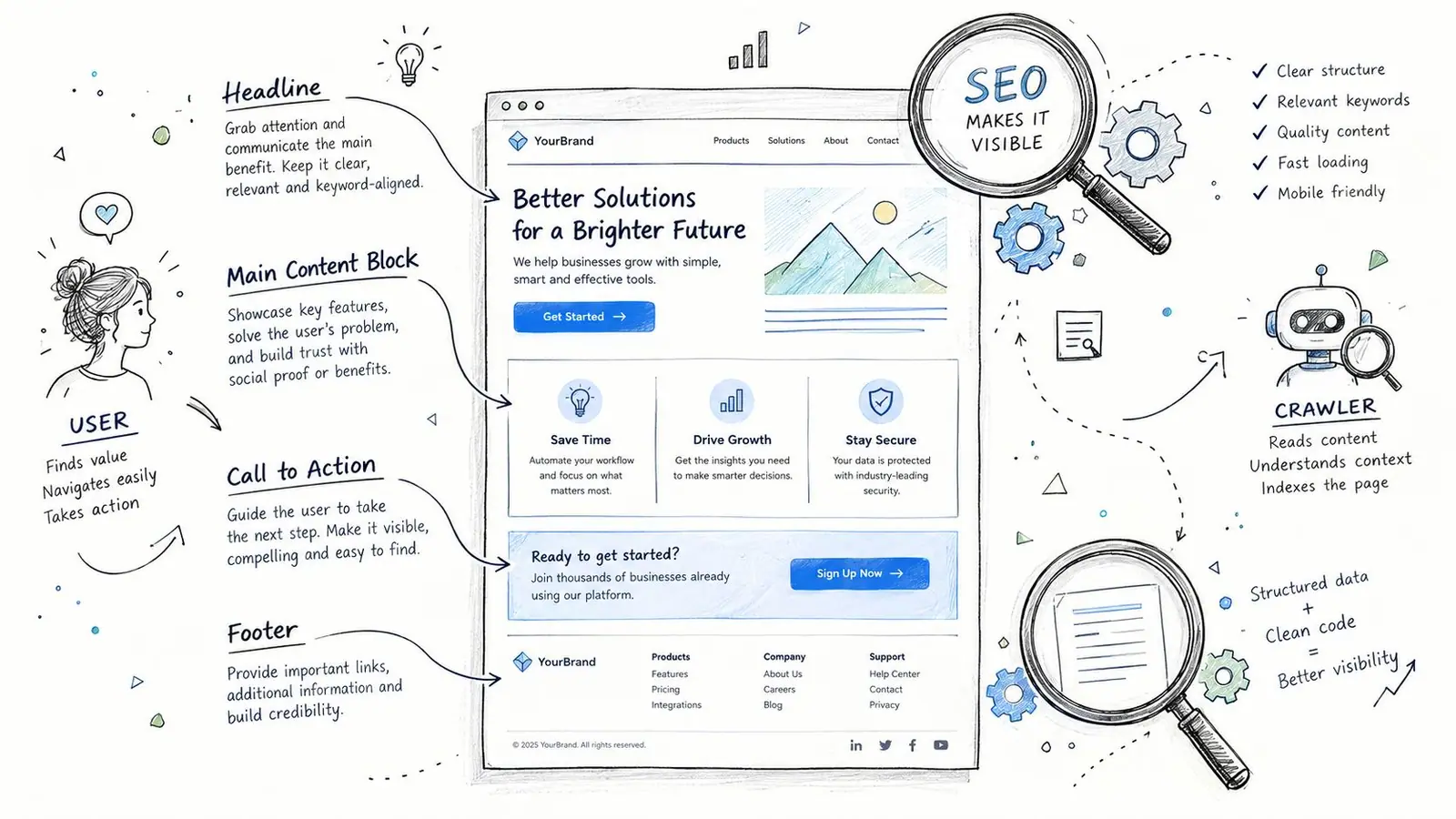
A useful landing page has a visible hierarchy. Search engines need clear topical signals, while visitors need to understand the offer without decoding a wall of copy. The page should make the same promise in the search result, the H1, the opening copy, and the CTA.
Build the page from the top down
Start with a title tag that describes the offer and matches the query's intent. Write an H1 that says the same thing in natural language, but make it persuasive for the visitor. Avoid clever headlines that hide the subject. A searcher who expects “enterprise SEO audits” shouldn't land on a vague headline about “enabling digital growth.”
A practical structure for a SaaS landing page targeting an evaluation-stage query might look like this:
- Hero section: State who the product serves, the problem it solves, and the next step.
- Proof section: Add relevant customer evidence, credentials, or transparent product detail.
- Benefits section: Translate features into outcomes the target audience values.
- Process section: Explain what happens after the click, so the CTA feels safe.
- Objection section: Address pricing, implementation, integrations, eligibility, or support.
- Primary conversion point: Repeat the same core action without introducing competing goals.
The page can be long when the decision requires detail, but every section should support the same decision. Navigation, social links, unrelated offers, and secondary CTAs may be appropriate in some contexts, yet they can also pull attention away from the intended action.
Write for scanning and comprehension
Use descriptive H2 and H3 headings, short paragraphs, bullets, captions, and visible labels. Put the most important qualification or benefit near the top instead of making visitors hunt for it. Internal links should be selective, with anchor text that explains the destination and supports the user's next question. Surnex's guidance on web page architecture offers a useful way to connect page structure with topical discovery.
Simple copy isn't simplistic copy. Research from the landing-page benchmark found that 82.9% of landing-page traffic comes from mobile devices, while desktop visitors convert slightly better on average. Pages written at a fifth-to-seventh grade reading level reached an 11.1% median conversion rate, compared with 5.3% for college-level copy, as reported by MarketingProfs' landing-page benchmark summary.
That doesn't mean every brand should flatten its language. It means the reader shouldn't need to reread a sentence to understand the offer. Use technical terms when the audience uses them, then define them plainly. On mobile, make the headline, supporting value proposition, and CTA visible without forcing an immediate search through the page.
Keep the CTA consistent
A primary CTA should describe the next step, not a vague outcome. “Request an SEO audit,” “Book a technical review,” or “See the platform” gives visitors a clearer expectation than “Learn more.” If the page serves multiple readiness levels, add a softer text link only when it supports the same journey. Don't present a demo, newsletter, download, consultation, and product tour as equal priorities.
Mastering Technical SEO for Landing Pages
A landing page can't convert visitors who can't use it, and it can't rank reliably if search engines can't crawl or interpret it. Technical work comes before decorative design and before an extended copy rewrite.
Run the pre-flight checks
First, confirm that the URL is reachable, indexable, and included in the site's information architecture. Check the robots directives, canonical setup, status response, sitemap inclusion, and internal links. A page that exists only behind scripts or an isolated campaign workflow may be difficult for crawlers to discover and difficult for users to revisit.
Next, inspect the page on a real mobile device or a reliable mobile testing workflow. Look for layout shifts, oversized hero media, intrusive pop-ups, small tap targets, clipped text, and forms that are difficult to complete. A desktop review won't reveal every problem created by a narrow viewport.
Page speed requires restraint. Compress images, choose an appropriate format, reserve space for media, defer nonessential scripts, and remove tracking or animation that doesn't support measurement or understanding. The aim isn't to strip the page of personality. It's to ensure that the first useful content and primary action appear before heavy assets compete for attention.
Independent SEO guidance identifies poor user experience, slow load times, weak mobile optimization, and missing title tags among the most common landing-page problems. The recommended audit order is technical soundness and mobile stability first, followed by content, links, and refinement, as outlined in Landingi's SEO mistakes guide.
Protect clarity in the URL and markup
Use a short, readable URL that reflects the page topic. Avoid unnecessary parameters for the indexable version, duplicate paths, and campaign naming that obscures the page's purpose. The title tag, H1, meta description, and visible opening should agree about what the page offers.
Use structured data only when it accurately describes visible content and follows search-engine guidance. Schema won't repair an unclear offer, a slow page, or a mismatched intent. It can help systems interpret entities and page relationships, but the foundation remains accessible HTML and coherent content.
Create contextual internal links
Link to the landing page from relevant, already-discovered pages. Use natural anchor text that explains the destination, and link out from the landing page when another resource genuinely helps the visitor decide. Internal linking should pass context, not create a network of forced references.
A technical review should end with a manual conversion test. Submit the form, complete the booking flow, check confirmation behavior, inspect analytics events, and verify that the thank-you experience works on mobile. A page can be crawlable and still fail commercially because the form, calendar, or CTA breaks at the moment of action.
Future-Proofing for AI-Driven Discovery
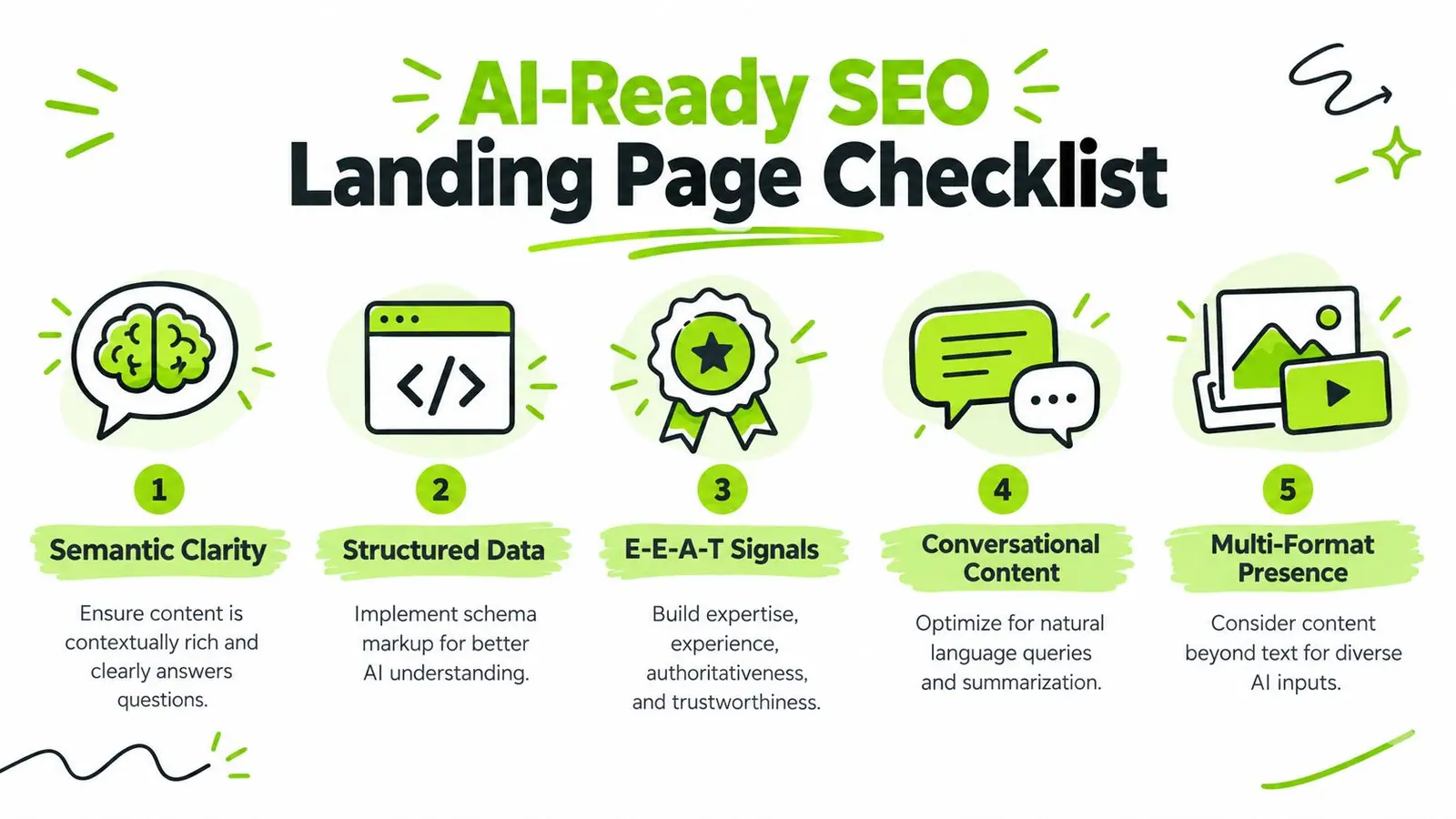
An SEO landing page now has to communicate with more than a traditional results page. Google features AI-generated answers, and people increasingly use conversational systems to compare providers, clarify concepts, and shortlist solutions. The page needs to remain useful when a system extracts one paragraph instead of displaying the whole document.
That changes the role of FAQs. With Google phasing out expandable FAQ rich snippets in organic listings as of May 2026, FAQ content matters less as a SERP decoration and more as material that an AI system can reuse in an answer, according to Shortlist's analysis of FAQ SEO and AI search.
Write citable answer blocks
A citable answer block is a compact passage that answers one question directly, defines its terms, and provides enough context to stand alone. It isn't a keyword-stuffed paragraph or a generic FAQ generated from a template.
Use this pattern:
- Lead with the conclusion: Answer the question in the first sentence.
- Add the condition: Explain who the answer applies to or where the trade-off appears.
- Support the point: Include a relevant source, product detail, process explanation, or named benchmark.
- Offer the next step: Point to the relevant section or conversion action.
For example, a landing page for an SEO audit could answer “What does the audit include?” with a direct summary, then list crawlability, indexability, mobile experience, metadata, performance, and internal linking. Each item should describe the actual service. Avoid promising outcomes the page can't substantiate.
Definitions deserve the same treatment. Define the service, audience, problem, and decision criteria in plain language. Named statistics can strengthen an answer when they clarify a choice, but unsupported superlatives weaken trust. AI systems can summarize clear evidence more reliably than ambiguous claims.
Make the page easy to interpret
Use meaningful headings, consistent terminology, descriptive tables, visible author or organization information, and structured data that matches the page. Keep each answer focused on one question. Put high-priority objections early enough that visitors and retrieval systems can find them without navigating an unnecessary maze.
FAQs should come from sales calls, support tickets, product documentation, and search logs. They shouldn't exist only because a competitor has an FAQ block. The strongest questions reveal genuine buyer friction, such as implementation effort, data access, integrations, reporting, eligibility, or what happens after submitting a form.
Teams evaluating this shift may also compare specialist resources such as a best AI SEO agency for SaaS when they need support with AI visibility, citation readiness, or search strategy for software products. The key is to apply the same standard to any partner: clear methodology, evidence, transparent deliverables, and alignment with the page's actual audience.
A page shouldn't become awkwardly conversational just to imitate a chatbot. Write for humans first, then make the logic explicit enough for machines to parse. Surnex's guidance on AI Overview optimization is relevant when teams want to connect answer design with broader visibility monitoring.
Measuring Performance and Iterative Testing
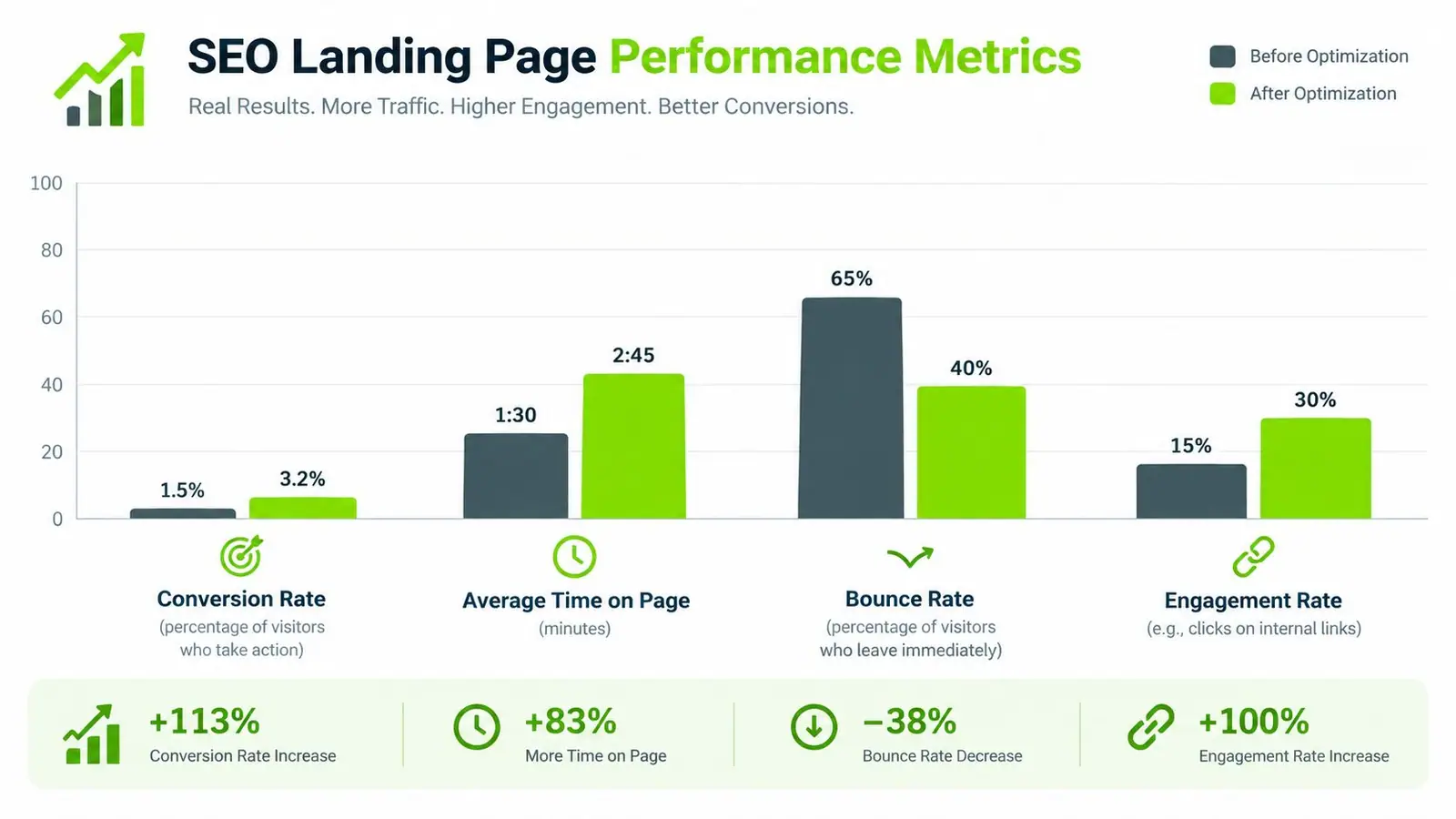
Traffic and rankings tell you whether the page is being discovered. They don't tell you whether the visitors are qualified, whether the offer is credible, or whether the form creates avoidable resistance. Measurement should connect the search query to the business action.
Set up a primary conversion event before launch. That might be a completed form, booked meeting, checkout, application, or qualified phone call. Add secondary events for meaningful engagement, such as viewing a pricing section, interacting with a product demonstration, opening an objection answer, or clicking a relevant internal link.
Segment before you diagnose
Report performance by intent class, landing page, device, location, brand versus non-brand query, and acquisition source. Organic traffic from a broad informational phrase should not be blended with branded or transactional traffic. A blended average can make a strong page look weak or hide a serious mismatch.
Track at least these dimensions:
- Visibility: Impressions, clicks, rankings, and search-result presentation.
- Engagement: Scroll behavior, meaningful interactions, return visits, and exits.
- Conversion: Completed primary actions, conversion rate, and assisted conversions.
- Quality: Lead qualification, sales acceptance, booked meetings, or revenue contribution.
- Technical health: Indexation, mobile usability, load experience, and broken journeys.
The 2024 benchmark analyzed 41,000 landing pages, 464 million visitors, and 57 million conversions, finding a 6.6% median conversion rate. The top 10% of pages converted above roughly 11.45%, according to Involve.me's landing-page statistics benchmark. Use that baseline to frame investigation. A result below the benchmark doesn't automatically mean the copy is poor, and a result above it doesn't prove the page is finished.
Test one meaningful variable
A/B testing works best when the hypothesis is specific. Test a headline that makes the audience clearer, a CTA that reduces uncertainty, a shorter form, a proof element near the hero, or a different order for objections and benefits. Don't change the headline, layout, form, imagery, and offer simultaneously, because you'll lose the ability to explain the result.
Testing should follow diagnosis. If mobile visitors abandon the form, reduce mobile friction before testing button color. If visitors engage with the page but don't convert, inspect offer clarity, trust, qualification requirements, and the post-click experience. Resources covering strategies for higher conversion rates can help teams develop stronger experimentation hypotheses.
For broader reporting, connect page-level conversion data with content performance metrics. The objective isn't to chase a universal number. It's to build a feedback loop where search behavior, page experience, lead quality, and test results guide the next revision.
A Cohesive Workflow for Modern Landing Pages
A reliable workflow keeps strategy, content, engineering, and measurement connected. Start with the query, not the design file. Confirm the dominant intent, identify the visitor's decision stage, and define the one action the page should earn.
Create a brief containing the target keyword cluster, SERP observations, audience, promise, objections, proof requirements, and conversion event. Then write the title, H1, opening answer, and CTA before expanding the page. If those elements disagree, the longer copy won't solve the problem.
Use this production sequence:
- Validate intent: Choose informational, commercial, navigational, or transactional alignment.
- Design the message: State the audience, problem, value, proof, and next step.
- Build the hierarchy: Organize the H1, benefits, evidence, process, objections, answer blocks, and CTA.
- Complete the technical review: Check crawlability, indexability, metadata, mobile stability, asset weight, forms, and internal links.
- Prepare for AI discovery: Make definitions and answers concise, self-contained, evidence-led, and easy to interpret.
- Launch measurement: Track the primary conversion, supporting interactions, traffic segments, and lead quality.
- Iterate deliberately: Use observed friction to choose one testable change at a time.
The finished page should feel like one coherent answer, not a collection of SEO tactics. Google can understand its topic, visitors can recognize its relevance, and AI systems can extract useful passages without losing the surrounding meaning.
Surnex helps agencies and in-house teams monitor traditional SEO performance alongside visibility in AI Overviews and conversational discovery, with rankings, audits, backlinks, content opportunities, and citation gaps in one workflow. Visit Surnex to see how your team can measure whether an SEO landing page is being found, understood, cited, and converted.